Toehold-Mediated Strand Displacement (TMSD): A Robust Framework for Nonenzymatic DNA Amplification in Diagnostics and Therapeutics
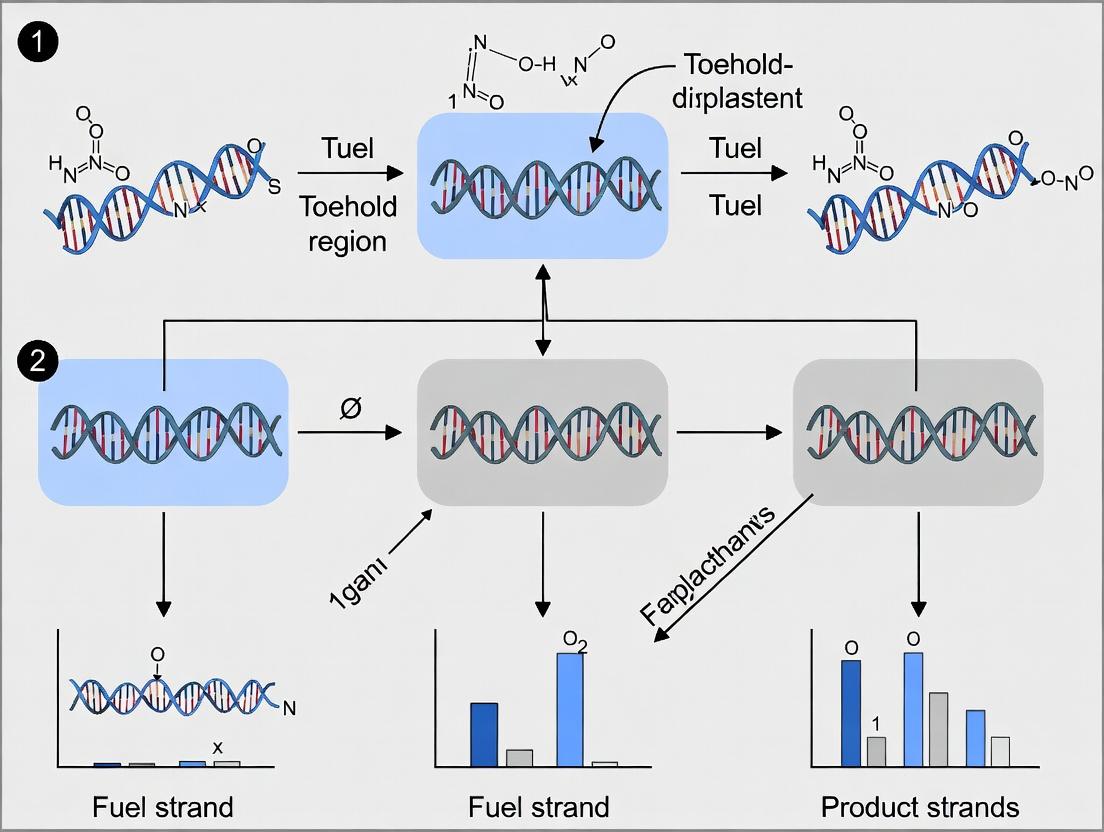
This article provides a comprehensive review of toehold-mediated strand displacement (TMSD) as the core mechanism for nonenzymatic DNA amplification.
Toehold-Mediated Strand Displacement (TMSD): A Robust Framework for Nonenzymatic DNA Amplification in Diagnostics and Therapeutics
Abstract
This article provides a comprehensive review of toehold-mediated strand displacement (TMSD) as the core mechanism for nonenzymatic DNA amplification. Targeting researchers, scientists, and drug development professionals, it explores the foundational principles of TMSD kinetics and thermodynamics, details current methodological implementations in biosensing and circuit design, addresses critical troubleshooting and optimization strategies for signal-to-noise and kinetics, and validates TMSD-based systems through comparative analysis with enzymatic methods like PCR and RPA. The synthesis offers a roadmap for translating these isothermal, enzyme-free tools into robust biomedical and point-of-care applications.
Understanding Toehold-Mediated Strand Displacement: The Core Principles Powering Nonenzymatic Amplification
Toehold-mediated strand displacement (TMSD) is a fundamental reaction in dynamic DNA nanotechnology and nonenzymatic nucleic acid circuit design. It enables the programmable, enzyme-free replacement of one nucleic acid strand hybridized to a complementary strand by an invading strand, driven purely by Watson-Crick base pairing and the laws of thermodynamics. Within the context of nonenzymatic DNA amplification research, TMSD serves as the core operational mechanism for cascading reactions, signal transduction, and the construction of autonomous molecular devices. The reaction's efficiency is governed by the length and sequence of the single-stranded "toehold" domain, which nucleates the branch migration process.
Quantitative Basis: Thermodynamic and Kinetic Parameters
The kinetics and yield of TMSD are dictated by several quantifiable factors. The table below summarizes key parameters and their typical experimental ranges or values.
Table 1: Key Quantitative Parameters Governing TMSD Efficiency
| Parameter | Typical Range/Value | Impact on Displacement |
|---|---|---|
| Toehold Length | 4-8 nucleotides (optimal) | Shorter toeholds (<4 nt) yield slow kinetics; longer toeholds (>8 nt) increase rate but may reduce circuit orthogonality. |
| Invader/Substrate Complementarity | Perfect match vs. single mismatch | A single mismatch in the toehold can reduce displacement rate by 10²–10⁶ fold. |
| Temperature | 20-25°C (room temp) or 37°C | Operates optimally ~10-15°C below the melting temperature (Tm) of the substrate complex. |
| Mg²⁺ Concentration | 5-20 mM | Critical for shielding backbone charge; 12.5 mM is a common standard. |
| Displacement Rate Constant (k) | 10⁵–10⁶ M⁻¹s⁻¹ (with 6-nt toehold) | Rate increases exponentially with toehold length up to ~6-8 nt. |
| Reaction Completion Time | 30 min – 2 hours (for nM concentrations) | Varies significantly with toehold design and temperature. |
Application Notes
- Signal Amplification Circuits: TMSD cascades can be designed to create linear or non-linear amplification pathways for detecting low-concentration nucleic acid triggers, forming the basis for enzyme-free diagnostic tools.
- Logic Gate Construction: By using multiple toeholds and strand displacement cascades, Boolean logic gates (AND, OR, NOT) can be implemented at the molecular level.
- Drug Delivery & Sensing: TMSD-based nanostructures can be engineered to undergo conformational changes upon encountering a specific mRNA or biomarker, releasing a therapeutic cargo.
Detailed Protocol: Assessing TMSD Kinetics via Fluorescence Quenching/Dequenching
Objective: To measure the kinetics of a toehold-mediated strand displacement reaction using fluorophore (F) and quencher (Q) labeled strands.
Research Reagent Solutions & Materials
Table 2: Scientist's Toolkit - Essential Reagents for TMSD Kinetics Assay
| Item | Function & Specification |
|---|---|
| Substrate Complex (S) | Double-stranded complex with a single-stranded toehold. Typically, a quencher-labeled strand (Q-strand) fully hybridized to a shorter fluorophore-labeled strand (F-strand). |
| Invader Strand (I) | Single-stranded DNA designed with a region complementary to the toehold and the adjacent sequence on the Q-strand. |
| TMSD Reaction Buffer (5X) | 250 mM Tris-acetate, 625 mM NaCl, 62.5 mM MgAc₂, pH 8.0. Provides optimal ionic strength and divalent cations for hybridization. |
| Fluorophore (e.g., FAM, Cy3) | Covalently attached to the 5' or 3' end of a DNA strand. Signal increases upon displacement from the quencher. |
| Quencher (e.g., BHQ1, Dabcyl) | Covalently attached to the complementary strand. Quenches fluorophore fluorescence via FRET when in close proximity. |
| Thermal Cycler or qPCR Instrument | For precise temperature control and real-time fluorescence monitoring across multiple samples. |
| Nuclease-Free Water | To dilute stocks and prepare reaction mixtures without degrading DNA components. |
Protocol Steps
Preparation of Substrate Complex (S):
- Mix the fluorophore-labeled strand (F-strand) and quencher-labeled strand (Q-strand) at a 1:1.2 molar ratio in 1X TMSD buffer.
- Heat the mixture to 95°C for 3 minutes, then slowly cool to room temperature over 60-90 minutes to ensure complete duplex formation.
- Verify duplex formation and purity using native polyacrylamide gel electrophoresis (PAGE).
Experimental Setup:
- Prepare a master mix containing 1X TMSD buffer and a fixed concentration of the substrate complex S (e.g., 50 nM final).
- Aliquot the master mix into reaction tubes or a qPCR plate.
- In a separate tube, dilute the invader strand (I) to the desired starting concentration (e.g., 100 nM, 200 nM) in 1X buffer.
Kinetic Measurement:
- Place the plate/tube containing the substrate master mix into a qPCR instrument or fluorometer pre-heated to the desired reaction temperature (e.g., 25°C).
- Initiate the reaction by adding the invader strand (I) to each sample. Mix quickly but thoroughly.
- Immediately begin monitoring fluorescence (excitation/emission appropriate for the fluorophore) every 30-60 seconds for 2 hours.
Data Analysis:
- Normalize fluorescence data:
F_norm = (F_t - F_0) / (F_max - F_0), whereF_tis fluorescence at time t,F_0is initial fluorescence, andF_maxis fluorescence after complete displacement (can be determined by adding a large excess of invader at the end). - Plot
F_normvs. time. Fit the initial linear portion of the curve (typically first 10-15%) to obtain the initial rate. For pseudo-first-order conditions ([I] >> [S]), the observed rate constantk_obscan be determined.
- Normalize fluorescence data:
TMSD Reaction Mechanism & Experimental Workflow
Diagram 1: TMSD Mechanism & Kinetic Assay Workflow
TMSD in Nonenzymatic Amplification Cascade
Diagram 2: TMSD-Based Nonenzymatic Signal Amplification Cascade
Toehold-mediated strand displacement (TMSD) is a fundamental reaction in dynamic DNA nanotechnology and is central to developing nonenzymatic nucleic acid amplification methods. Unlike PCR, which relies on protein enzymes, nonenzymatic amplification uses the predictable hybridization and displacement of synthetic DNA strands to achieve signal amplification. The efficiency and specificity of these systems are dictated by three core components: the toehold, the invader strand, and the substrate complex. This application note details their structural and functional parameters, providing protocols for their design and characterization within a research workflow aimed at diagnostic and drug development applications.
Core Component Specifications & Quantitative Data
Table 1: Design Parameters for Core TMSD Components
| Component | Key Structural Features | Primary Function | Typical Length (nt) | Key Design Parameters & Optimal Ranges |
|---|---|---|---|---|
| Toehold | Single-stranded domain on the substrate complex. | Initiates TMSD by reversible binding of the invader. | 4 - 8 | Length: 6nt optimal for balance of kinetics/specificity. Sequence: Avoid secondary structure; GC content ~40-60%. |
| Invader Strand | Complete complement to the displaced strand and toehold. | Drives displacement by forming a more stable duplex. | 20 - 40 | Toehold Complement: Must exactly match toehold. Binding Domain: Fully complementary to displaced strand. Concentration: 1-10x excess over substrate typical. |
| Substrate Complex | Pre-hybridized duplex (signal strand + protector strand) with toehold. | Stores signal; releases output upon invasion. | Varies (30-80 total) | Duplex Stability (ΔG): Should be <-9 kcal/mol. Toehold Position: 5' or 3' end of protector strand. Purity: HPLC-purified strands critical. |
Table 2: Kinetic and Thermodynamic Metrics for TMSD Optimization
| Parameter | Description | Typical Experimental Value Range | Impact on Amplification |
|---|---|---|---|
| Toehold Binding Rate (k_on) | Rate constant for invader binding to toehold. | 10^5 - 10^6 M⁻¹s⁻¹ | Shorter toeholds decrease k_on, slowing initiation. |
| Branch Migration Rate | Rate of displacement after nucleation. | ~1 nt/µs | Highly sequence-dependent; mismatches slow drastically. |
| Overall Displacement Rate (k) | Observed first-order rate constant. | 10^-3 - 10^1 s⁻¹ (toehold-dependent) | Directly determines reaction speed and amplification cycle time. |
| ΔG of Displacement | Free energy change of overall reaction. | Typically <-20 kcal/mol | More negative ΔG drives reaction completion, enhancing yield. |
Experimental Protocols
Protocol 1: Preparation and Annealing of Substrate Complex Objective: To form a stable, toehold-bearing duplex from two single-stranded DNA (ssDNA) oligonucleotides.
- Resuspension: Dilute HPLC-purified ssDNA (Signal Strand and Protector Strand) in nuclease-free TE buffer to 100 µM stock concentration. Verify concentrations via UV absorbance (A260).
- Mixing: Combine strands in a 1:1.2 molar ratio (Protector:Signal) in annealing buffer (e.g., 10 mM Tris, 50 mM NaCl, 1 mM EDTA, pH 8.0). Typical final duplex concentration is 1-10 µM. The excess Protector Strand ensures all Signal Strand is complexed.
- Annealing: Heat mixture to 95°C for 5 minutes in a thermal cycler or heat block, then slowly cool to 20°C at a rate of -0.1°C/sec. Store at 4°C until use.
Protocol 2: Characterizing Displacement Kinetics via Fluorescence Quenching Objective: To measure the rate constant (k) of strand displacement for different toehold designs.
- Labeling: Use a Signal Strand labeled with a 5' fluorophore (e.g., FAM) and a Protector Strand labeled with a 3' quencher (e.g., Iowa Black FQ). Anneal as in Protocol 1.
- Setup: Prepare reaction buffer (e.g., 1X PBS with 10 mM MgCl₂). Aliquot 98 µL of buffer containing substrate complex (final conc. 10 nM) into a quartz cuvette or 96-well plate. Equilibrate to reaction temperature (e.g., 25°C) in a fluorometer.
- Initiation: Rapidly add 2 µL of Invader Strand (pre-equilibrated to same temperature) to achieve a final concentration of 20 nM (2x excess). Mix thoroughly and quickly.
- Data Acquisition: Record fluorescence (ex: 492nm, em: 518nm) every 5-10 seconds for 1-2 hours or until signal plateaus.
- Analysis: Fit the resulting time-course fluorescence data (F) to a first-order exponential growth model: F = F₀ + (F∞ - F₀)(1 - e^(-kt)) , where k is the observed displacement rate constant.
Protocol 3: Nonenzymatic Amplification Cascade (Toehold Exchange) Objective: To demonstrate signal amplification through a cascaded TMSD network.
- Design: Design two coupled TMSD reactions. Reaction 1: Input strand (I1) displaces Output strand 1 (O1) from complex C1. Reaction 2: O1 acts as the invader for complex C2, displacing a fluorescently labeled output strand (O2-FAM).
- Preparation: Anneal complexes C1 and C2 separately per Protocol 1.
- Reaction Assembly: In amplification buffer, combine C1 (1 nM), C2 (10 nM), and an excess of quencher strand complementary to O2-FAM. The quencher suppresses background until O2-FAM is displaced.
- Initiation & Detection: Introduce a catalytic amount of I1 (e.g., 0.1 nM). Monitor fluorescence in real-time (as in Protocol 2). The amplification factor is calculated as (moles O2 released) / (moles I1 added).
Visualizations
TMSD Reaction Mechanism
Catalytic Toehold Exchange Cascade
The Scientist's Toolkit: Research Reagent Solutions
Table 3: Essential Reagents for TMSD & Nonenzymatic Amplification Research
| Reagent / Material | Function & Importance | Specification Notes |
|---|---|---|
| HPLC-Purified Oligonucleotides | High-purity ssDNA is critical for predictable hybridization kinetics and low background. | Request "PAGE" or "HPLC" purification; quantify via A260; check integrity on gel. |
| Fluorophore/Quencher-Labeled Oligos | Enable real-time, quantitative monitoring of displacement events. | Common pairs: FAM/Iowa Black FQ, Cy3/BHQ-2. Place at termini to minimize steric hindrance. |
| High-Salt Annealing Buffer | Provides ionic strength necessary for proper duplex formation and stability. | Typical: 10-50 mM Tris, 50-100 mM NaCl, 1-10 mM MgCl₂, pH 7.5-8.0. |
| Magnesium Chloride (MgCl₂) | Divalent cations screen negative phosphate repulsion, essential for TMSD kinetics. | Optimize concentration (5-20 mM); too high can promote non-specific aggregation. |
| Nuclease-Free Water & Buffers | Prevents degradation of DNA strands and ensures reproducible reaction conditions. | Use certified nuclease-free reagents for all dilutions and reaction assembly. |
| Real-Time PCR Instrument or Fluorometer | Provides precise temperature control and sensitive fluorescence detection for kinetics. | Plate readers allow high-throughput condition screening. |
Toehold-mediated strand displacement (TMSD) is the foundational reaction for dynamic nucleic acid nanotechnology and is central to emerging nonenzymatic DNA amplification strategies, such as hybridization chain reaction (HCR) and catalyzed hairpin assembly (CHA). The efficiency, specificity, and kinetics of these amplification systems are governed by two core processes: branch migration and strand displacement. This protocol provides a detailed, step-by-step experimental framework for analyzing these reaction pathways, enabling researchers to quantify kinetics and optimize system designs for applications in biosensing and drug development.
Quantitative Kinetics Data of TMSD Variants
The kinetics of displacement are highly sensitive to toehold length, sequence, and reaction conditions. The following table summarizes key quantitative parameters from recent studies.
Table 1: Kinetic Parameters for Toehold-Mediated Strand Displacement
| Toehold Length (nt) | Displacement Rate Constant, k (M⁻¹s⁻¹) | Branch Migration Rate (nt/s) | Conditions (Buffer, Temp) | Primary Influence on Amplification Efficiency |
|---|---|---|---|---|
| 0 (no toehold) | < 0.1 | ~0.001 | 1X PBS, 25°C | Negligible; baseline for leak reactions. |
| 3 | 10² - 10³ | ~1 | 1X TA/Mg²⁺, 25°C | Slow, high specificity; useful for gate control. |
| 6 | 10⁴ - 10⁵ | ~10² | 1X TA/Mg²⁺, 37°C | Optimal balance for speed and specificity in HCR/CHA. |
| 9 | 10⁵ - 10⁶ | ~10³ | 1X TA/Mg²⁺, 37°C | Very fast; may increase non-specific background. |
| 15 | > 10⁶ | ~10⁴ | 1X TA/Mg²⁺, 37°C | Maximum speed; critical for rapid circuit reset. |
Note: TA/Mg²⁺ refers to Tris-Acetate buffer with 12.5 mM Mg²⁺. Rates are approximate and sequence-dependent.
Experimental Protocols
Protocol 1: Measuring Displacement Kinetics via Fluorescence Quenching/Dequenching
Objective: Quantify the real-time rate constant k for a single TMSD event.
Materials: See The Scientist's Toolkit below.
Procedure:
- Design & Preparation:
- Design an invader strand with a 5-8 nt toehold complementary to the 5' or 3' end of a substrate duplex.
- The substrate duplex consists of a fluorescently labeled strand (e.g., FAM at 3') quenched by a proximal quencher (e.g., Dabcyl) on the complementary strand. Displacement separates fluorophore from quencher.
- Sample Preparation:
- Anneal the substrate duplex at 1 µM in 1X TAE/Mg²⁺ buffer (40 mM Tris, 20 mM Acetic acid, 2 mM EDTA, 12.5 mM MgCl₂, pH 8.0) by heating to 95°C for 5 min and slow-cooling.
- Dilute the annealed duplex to a final concentration of 10 nM in reaction buffer.
- Data Acquisition:
- Pre-incubate the substrate solution in a thermostatted fluorometer cuvette at 25°C.
- Rapidly inject the invader strand to initiate the reaction (final invader concentration: 10-100 nM for pseudo-first-order conditions).
- Monitor fluorescence (ex: 492 nm, em: 518 nm for FAM) every 1-5 seconds for 1-2 hours.
- Data Analysis:
- Normalize fluorescence from initial (F₀) to final (F∞) values.
- Fit the normalized time trace to a single-exponential function: F(t) = 1 - exp(-kobs * t).
- Plot kobs vs. invader concentration; the slope is the bimolecular rate constant k.
Protocol 2: Analyzing Branch Migration Pathways via Native PAGE
Objective: Visualize intermediate and product species during multi-step branch migration.
Procedure:
- Reaction Setup:
- Use a system with a long (~20-30 bp) branch migration domain. Prepare substrate duplex and invader as in Protocol 1, but at higher concentration (500 nM).
- Time-Point Sampling:
- Initiate the reaction by mixing.
- Withdraw aliquots at critical time points (e.g., 0, 1, 5, 15, 60, 240 min) and immediately mix with a 5X native gel loading dye (no denaturants).
- Gel Electrophoresis:
- Load samples on a pre-run 10% non-denaturing polyacrylamide gel (19:1 acrylamide:bis) in 1X TBE with 12.5 mM MgCl₂.
- Run at 80-100 V for 90-120 min at 4°C to maintain complex stability.
- Stain with SYBR Gold for 30 min and visualize with a gel imager.
- Analysis:
- Identify bands corresponding to substrate, final product, and any metastable intermediate complexes.
- Band intensity quantification over time reveals the progression through the branch migration pathway.
Visualization of Reaction Pathways
Diagram 1: The Three-Step TMSD Reaction Pathway (78 chars)
Diagram 2: Workflow from TMSD Analysis to Amplification Design (74 chars)
The Scientist's Toolkit: Research Reagent Solutions
Table 2: Essential Materials for TMSD Kinetics Experiments
| Item & Example Product | Function in Experiment | Critical Specification |
|---|---|---|
| DNA Oligonucleotides (Custom-synthesized, HPLC-purified) | Serve as substrate, invader, and fuel strands. Fluorophore/Quencher labeling is essential for fluorescence assays. | Low endotoxin, high purity (>95%). Accurate concentration verification via UV-Vis. |
| Mg²⁺-Containing Buffer (e.g., 1X TAE/Mg²⁺ or Tris/MgCl₂) | Provides divalent cations critical for DNA duplex stability and kinetics. Mg²⁺ concentration dramatically affects rates. | 10-15 mM MgCl₂ is standard. Chelex-treated to remove nucleases. |
| Fluorometer & Cuvettes (e.g., QuantaMaster) | For real-time, solution-phase kinetic measurements of fluorescence changes during displacement. | Temperature control (±0.1°C), fast injection capability. |
| Native Gel Electrophoresis System (Mini-PROTEAN) | Separates DNA complexes by size/shape to visualize reaction intermediates and products. | Cooling capability (4°C) to prevent complex dissociation during run. |
| Fluorescent Dyes (e.g., SYBR Gold) | Post-staining of nucleic acids in gels for visualization. | High sensitivity for low-concentration complexes. |
| Nuclease-Free Water & Tubes | Prevents degradation of DNA reactants, crucial for reproducible kinetics. | Certified nuclease-free, non-sticky tubes to minimize adsorption. |
Application Notes
Toehold-mediated strand displacement (TMSD) is a fundamental reaction in DNA nanotechnology and dynamic DNA circuitry. Within the broader thesis on nonenzymatic DNA amplification, TMSD emerges as a critical, programmable mechanism that operates under isothermal conditions without the need for protein enzymes (e.g., polymerases, nucleases). This confers unique advantages for building robust, predictable, and complex reaction networks suitable for applications in in vitro diagnostics, molecular computing, and controlled drug release. The programmability of DNA sequences allows for precise control over reaction kinetics and network architecture, making TMSD an ideal foundational tool.
Core Advantages of TMSD in Nonenzymatic Networks
- Isothermal Operation: Eliminates thermal cycling, simplifying instrumentation and enabling point-of-care applications.
- Enzyme-Free Robustness: Removes batch-to-batch enzyme variability, enhances shelf-life, and allows function in inhibitor-rich environments (e.g., crude biological samples).
- Predictable Kinetics: Reaction rates can be rationally tuned by designing toehold domain length and sequence composition.
- Modularity & Scalability: TMSD reactions function as standardized "parts" that can be wired together to create complex cascades, logic gates, and amplifiers.
Quantitative Performance Data
Table 1: Kinetic Parameters of TMSD vs. Enzymatic Amplification Methods
| Method | Typical Temperature | Key Enzyme Required | Typical Amplification Rate (min⁻¹) | Signal-to-Background Ratio* | Ref. |
|---|---|---|---|---|---|
| TMSD-based Amplification | 25-37°C (Isothermal) | None | 0.01 - 1.0 | 10² - 10⁵ | (1,2) |
| PCR | 55-95°C (Thermocycled) | Thermostable Polymerase | ~10³ | 10⁷ - 10¹⁰ | - |
| RPA | 37-42°C (Isothermal) | Recombinase, Polymerase | ~10² | 10⁶ - 10⁸ | - |
| HCR | 25-37°C (Isothermal) | None | 0.1 - 5.0 | 10³ - 10⁶ | (3) |
*Signal-to-Background is highly sequence and design-dependent. Values are approximate ranges from recent literature.
Table 2: Design Parameters for Optimizing TMSD Reaction Networks
| Parameter | Typical Range | Effect on Reaction | Optimization Guidance |
|---|---|---|---|
| Toehold Length | 4-10 nt | Longer toehold increases rate (exponentially). | Use 6-8 nt for balanced speed/specificity. |
| Branch Migration Domain Length | 15-30 nt | Longer domains increase stability but may slow displacement. | 18-22 nt is standard for stable duplexes. |
| Reaction Temperature | 20-45°C | Near melting temperature (Tm) of incumbent duplex optimizes rate. | Set 5-10°C below Tm of weakest duplex. |
| Mg²⁺ Concentration | 5-20 mM | Essential for DNA backbone charge shielding; higher [Mg²⁺] increases rate. | 10-12 mM is a common starting point. |
Experimental Protocols
Protocol: Basic TMSD Kinetic Assay Using Fluorescence Quenching
Purpose: To measure the kinetics of a single TMSD reaction by monitoring fluorescence recovery.
Research Reagent Solutions:
- Fluorophore-Quencher (F-Q) Reporter Duplex: A double-stranded DNA complex where one strand is labeled with a fluorophore (e.g., FAM) and the complementary "blocker" strand is labeled with a quencher (e.g., Iowa Black FQ). The blocker strand contains a 5' or 3' toehold.
- Initiator Strand: A single-stranded DNA fully complementary to the blocker strand, designed to bind the toehold and displace the fluorophore-labeled strand.
- TM Buffer (10X): 500 mM Tris, 100 mM MgCl₂, pH 8.0. Mg²⁺ is critical for kinetics.
- Nuclease-Free Water.
Procedure:
- Preparation: Dilute the F-Q Reporter Duplex to 50 nM in 1X TM Buffer. Prepare the Initiator Strand at 500 nM in nuclease-free water.
- Instrument Setup: Preheat a fluorometer or qPCR instrument to the desired reaction temperature (e.g., 25°C). Set filters for your fluorophore (Ex/Em for FAM: 494/518 nm).
- Baseline Measurement: Pipette 98 µL of the diluted Reporter solution into a microcuvette or qPCR tube. Measure fluorescence for 2-5 minutes to establish a stable baseline.
- Reaction Initiation: Rapidly add 2 µL of the 500 nM Initiator Strand to the tube (final [Initiator] = 10 nM, final [Reporter] = 49 nM). Mix thoroughly by pipetting.
- Data Acquisition: Immediately resume fluorescence measurement, collecting data points every 10-30 seconds for 60-180 minutes.
- Data Analysis: Normalize fluorescence (F) to the initial (F₀) and final plateau (F∞) values. Plot (F - F₀)/(F∞ - F₀) vs. time. Fit the curve to a first-order kinetic model to determine the observed rate constant k_obs.
Protocol: Setting Up a TMSD-based Catalytic Hairpin Assembly (CHA) Amplifier
Purpose: To construct a two-step, autocatalytic TMSD network for signal amplification.
Research Reagent Solutions:
- Hairpin 1 (H1): Stable stem-loop with a concealed toehold and branch migration domain. Fluorescently quenched.
- Hairpin 2 (H2): Stable stem-loop with a complementary domain to H1.
- Catalyst/Initiator (C): Single-stranded DNA that can open H1 to expose a new domain for H2 binding.
- TM Buffer (10X).
Procedure:
- Hairpin Folding: Separately heat H1 and H2 to 95°C for 2 minutes in 1X TM Buffer, then cool slowly to 25°C over 45-60 minutes to ensure proper secondary structure formation.
- Reaction Assembly: In a tube, combine 50 nM folded H1, 50 nM folded H2, and a catalytic amount of Initiator C (e.g., 1 nM) in 1X TM Buffer. Bring total volume to 100 µL.
- Control Assembly: Prepare an identical tube without Initiator C.
- Measurement: Monitor fluorescence in real-time at 25°C as in Protocol 2.1. The catalytic network will show a sigmoidal, accelerated increase in fluorescence compared to the negligible signal in the no-initiator control.
- Analysis: Compare the time-to-threshold or final fluorescence intensity between samples with varying [C] to characterize amplification efficiency.
Visualization
Basic TMSD Mechanism
Catalytic Hairpin Assembly (CHA) Cycle
The Scientist's Toolkit
Table 3: Essential Research Reagents for TMSD Networks
| Reagent | Function in Experiment | Key Considerations |
|---|---|---|
| Synthetic Oligonucleotides | The core components for all structures (toeholds, hairpins, substrates). | HPLC or PAGE purification is essential for predictable kinetics. Avoid secondary structure in single-stranded regions. |
| Fluorophore-Quencher Pairs (e.g., FAM/Iowa Black FQ, Cy3/BHQ-2) | Enable real-time, label-based monitoring of strand displacement events. | Choose spectrally matched pairs. Consider photostability and quenching efficiency. |
| High-Purity MgCl₂ Solution | Divalent cation essential for stabilizing DNA duplexes and enabling branch migration. | Use molecular biology grade. Concentration must be optimized for each network. |
| Thermostable Buffer (e.g., Tris-EDTA, Tris-Acetate) | Maintains stable pH and ionic strength. EDTA is often omitted to allow Mg²⁺ function. | Pre-make concentrated stocks (e.g., 10X), filter sterilize, and verify pH at working temperature. |
| Nuclease-Free Water & Tubes | Prevents degradation of DNA components, crucial for slow, nonenzymatic reactions. | Use certified nuclease-free consumables for all reagent preparation and reactions. |
| Fluorescence Spectrometer or qPCR Instrument | For real-time, quantitative kinetic measurements. | Instrument must maintain stable isothermal temperature. Plate readers enable high-throughput screening. |
Historical Context and Foundational Papers in Dynamic DNA Nanotechnology
This document provides detailed application notes and protocols within the broader thesis context of advancing Toehold-mediated strand displacement (TMSD) for nonenzymatic DNA amplification research. TMSD is the foundational engine for dynamic DNA nanotechnology, enabling the construction of complex, autonomous molecular systems without protein enzymes.
Foundational Papers and Key Advances
The following table summarizes seminal works that established the core principles of dynamic DNA nanotechnology, directly informing TMSD-based amplification strategies.
Table 1: Foundational Papers in Dynamic DNA Nanotechnology
| Year | Authors | Title (Key Contribution) | Primary Concept Demonstrated | Relevance to Nonenzymatic Amplification |
|---|---|---|---|---|
| 2000 | Yurke, B. et al. | A DNA-fuelled molecular machine made of DNA | First experimental demonstration of TMSD to drive a mechanical cycle. | Proved DNA strands can be designed to autonomously displace each other, enabling signal transduction. |
| 2006 | Zhang, D.Y. & Winfree, E. | Control of DNA strand displacement kinetics using toehold length | Quantitative analysis of TMSD kinetics as a function of toehold length. | Provided the design rules for tuning reaction rates, critical for cascade and amplifier design. |
| 2008 | Seelig, G. et al. | Enzyme-free nucleic acid logic circuits | Layered TMSD gates to form Boolean logic circuits. | Established framework for complex signal processing without enzymes. |
| 2011 | Qian, L. & Winfree, E. | Scaling up digital circuit computation with DNA strand displacement cascades | Large-scale, leak-resistant circuits using TMSD. | Demonstood robustness and fan-out necessary for multi-stage amplification networks. |
| 2013 | Chen, X. et al. | Using autonomous nucleic acid nanowalkers for biosensing | TMSD-driven walkers for amplified signal generation on surfaces. | Direct prototype for nonenzymatic, hybridization-based amplification assays. |
Application Notes: TMSD for Signal Amplification
Core Principle
A "fuel" strand (F) displaces an "output" strand (O) from a partially double-stranded complex (S:O) by first binding to a single-stranded "toehold" domain. The released output can act as a catalyst or signal for subsequent reactions, enabling amplification.
Key Design Parameters
Table 2: Quantitative Design Parameters for TMSD Amplifiers
| Parameter | Typical Range | Effect on System Performance | Optimized Value for Catalytic Hairpin Assembly (CHA)* |
|---|---|---|---|
| Toehold Length | 3-8 nt | Shorter: slower, more specific; Longer: faster, potential leak. | 6 nt |
| Stem Length (in hairpins) | 15-20 bp | Shorter: faster opening; Longer: higher stability, slower. | 18 bp |
| Reaction Temperature | 20-25 °C | Below TM of stable complexes, above TM of weak intermediates. | 22-25 °C |
| Mg²⁺ Concentration | 5-15 mM | Stabilizes DNA, enhances hybridization rates. | 10-12 mM |
| Catalyst Turnover Number (k) | 10-100 per hour | Molecules of output per catalyst per unit time. | ~40 h⁻¹ |
*CHA is a canonical nonenzymatic amplifier.
Detailed Experimental Protocols
Protocol 1: Synthesis and Purification of DNA Strands for TMSD Circuits
Objective: To obtain high-purity, single-stranded DNA (ssDNA) oligonucleotides for reliable TMSD kinetics. Materials: See "Scientist's Toolkit" below. Procedure:
- Ordering: Specify oligonucleotides with standard desalting. For strands >50 nt or complex circuits, request HPLC purification.
- Resuspension: Centrifuge lyophilized tubes briefly. Resuspend in nuclease-free TE buffer (pH 8.0) to a stock concentration of 100 µM.
- Verification: Measure absorbance at 260 nm (A₂₆₀) using a spectrophotometer. Calculate concentration using the provided extinction coefficient.
- Annealing (for complexes): Mix stoichiometric ratios of strands (e.g., S and O) in annealing buffer (e.g., TE + 10 mM MgCl₂). Use a 1:1.2 ratio of scaffold to complement if one strand is in excess.
- Thermal Ramp: Heat to 95 °C for 5 min, then cool slowly to 20 °C at a rate of -0.1 °C/sec in a thermocycler.
- Storage: Aliquot and store at -20 °C. Avoid >3 freeze-thaw cycles.
Protocol 2: Kinetic Characterization of a Basic TMSD Reaction
Objective: To measure the rate constant (k) of a single TMSD reaction using fluorescence. Workflow:
Diagram Title: TMSD Kinetic Assay Workflow
Procedure:
- Reporter Design: Use a dual-labeled (fluorophore-quencher) duplex where displacement separates the pair.
- Master Mix: In a black 96-well plate, combine:
- 1x Reaction Buffer (20 mM Tris, 10 mM MgCl₂, pH 8.0)
- 50 nM Quenched Reporter Duplex
- Nuclease-free water to 90 µL.
- Equilibration: Place plate in pre-warmed (25°C) plate reader. Monitor baseline for 5 min.
- Initiation: Rapidly add 10 µL of Invader Strand (pre-heated) at 10x final concentration (e.g., 500 nM) using the injector or pipette. Mix thoroughly.
- Data Acquisition: Record fluorescence (e.g., FAM) every 30 seconds for 2-8 hours.
- Analysis: Fit the time trace to a single-exponential function: ( F(t) = F0 + ΔF(1 - e^{-k{obs}t}) ). The observed rate ( k_{obs} ) depends on invader concentration.
Protocol 3: Catalytic Hairpin Assembly (CHA) Amplification Assay
Objective: To detect a target DNA strand catalytically via CHA, a core nonenzymatic amplification method. Workflow:
Diagram Title: CHA Reaction Pathway
Procedure:
- Hairpin Preparation: Anneal H1 and H2 separately (Protocol 1) to ensure proper folding.
- Reaction Setup: In a final volume of 50 µL:
- 1x CHA Buffer (20 mM Tris, 12.5 mM MgCl₂, 150 mM NaCl, pH 8.0)
- 50 nM Hairpin H1 (dual-labeled with Fluor/Quencher)
- 100 nM Hairpin H2
- Variable concentration of Target DNA (0-10 nM)
- Passivating agent (e.g., 0.1 mg/mL BSA).
- Run Reaction: Incubate at 25°C for 2-3 hours in a plate reader, measuring fluorescence continuously.
- Calibration: Plot endpoint fluorescence vs. target concentration. Fit to a sigmoidal or linear model to determine limit of detection (LOD).
- Controls: Always include a no-target control (background signal) and a positive control with high target.
The Scientist's Toolkit
Table 3: Essential Research Reagent Solutions
| Item | Function/Description | Example Product/Catalog # |
|---|---|---|
| Ultrapure Nuclease-free Water | Solvent for all reactions; prevents RNA/DNA degradation. | ThermoFisher, AM9937 |
| 10x TMSD Reaction Buffer | Provides optimal pH and cation concentration for hybridization. (1x: 20 mM Tris, 10-12 mM MgCl₂, pH 8.0) | Custom formulation. |
| Fluorophore-Quencher Labeled Oligos | For real-time monitoring of strand displacement. | IDT, Dual-labeled probes (FAM/Iowa Black FQ). |
| Annealing Buffer | For forming precise duplexes/hairpins. (TE + 10 mM MgCl₂) | Custom formulation. |
| Passivation Agent (BSA or tRNA) | Reduces non-specific surface adsorption of DNA to tubes/plates. | NEB, BSA (10 mg/mL, B9000S). |
| Black 96/384-Well Plates | Low background for fluorescence measurements. | Corning, 3915 |
| Thermal Sealing Film | Prevents evaporation during long kinetic runs. | Bio-Rad, MSB1001 |
Implementing TMSD Circuits: Design Strategies and Cutting-Edge Applications in Biosensing
Within toehold-mediated strand displacement (TMSD), a foundational mechanism for nonenzymatic DNA amplification and dynamic nucleic acid nanotechnology, the performance is critically governed by toehold design. These Application Notes consolidate current design rules for toehold sequences, focusing on length, composition, and free energy parameters to optimize kinetics and specificity for research and diagnostic applications.
In the context of nonenzymatic DNA amplification research, TMSD enables sequence-specific signal generation and amplification without proteins. The toehold, a short, single-stranded domain, initiates the displacement reaction. Its precise design dictates the rate, yield, and orthogonality of the reaction, directly impacting assay sensitivity and specificity in diagnostic and drug development settings.
Quantitative Design Parameters
The following tables summarize key quantitative guidelines for toehold design.
Table 1: Toehold Length Guidelines & Kinetic Impact
| Toehold Length (nt) | Relative Displacement Rate (k) | Primary Use Case | Specificity Consideration |
|---|---|---|---|
| 5-6 nt | Slow (Baseline) | High-fidelity circuits, orthogonal systems | High |
| 7 nt | Moderate | Balanced designs | Moderate |
| 8 nt | High | Fast amplification cascades | Requires careful sequence design |
| >10 nt | Very High | Maximum sensitivity assays | Lower; risk of non-specific displacement |
Table 2: Nucleotide Composition & Stability Rules
| Base at Toehold 3'-End (Invader side) | ΔG° effect (kcal/mol approx.) | Kinetic Impact | Rationale |
|---|---|---|---|
| C/G | -1.5 to -2.0 | Faster initiation | Stronger terminal base-pairing with target. |
| A/T | -0.5 to -1.0 | Slower initiation | Weaker terminal base-pairing. |
| Internal G/C Content | Impact on ΔG | Recommendation | |
| High (>60%) | More negative | Can be too stable, potentially slowing branch migration. Optimize length. | |
| Moderate (40-60%) | Moderately negative | Optimal for most applications. | |
| Low (<40%) | Less negative | May require longer length for sufficient initiation stability. |
Table 3: Free Energy (ΔG) Design Targets
| Parameter | Optimal Range | Calculation Method | Notes |
|---|---|---|---|
| Toehold Binding ΔG (37°C) | -5 to -10 kcal/mol | NUPACK, mfold | Avoids overly stable (ΔG < -12) or weak (ΔG > -4) binding. |
| ΔΔG (Specific vs. Off-target) | ≥ 3 kcal/mol | Comparative analysis | Ensures discrimination against single-base mismatches. |
| Toehold + Branch Migration ΔG | Highly negative | -- | Overall reaction must be strongly favorable. |
Experimental Protocols
Protocol 3.1: In Silico Toehold Design & Screening
Objective: To design and select optimal toehold sequences using computational tools. Materials: Computer with internet access, sequence design software (e.g., NUPACK, DINAMelt). Procedure:
- Define Domain Layout: Specify the full displacement complex: Invader strand (I), Substrate strand (S: toehold + displacement domain), and Output strand (O).
- Generate Candidates: For a desired toehold length (e.g., 6-8 nt), generate all possible sequences or random sets, avoiding long homopolymer runs.
- Calculate Thermodynamics: Use NUPACK (www.nupack.org) to calculate:
ΔG_bindfor toehold-target binding at assay temperature (e.g., 25°C or 37°C).ΔG_totalfor the full strand displacement reaction.ΔG_misfor binding to off-target sequences with 1-2 mismatches.
- Screen for Specificity: Filter candidates where
ΔG_bind(mismatch) - ΔG_bind(perfect) ≥ 3 kcal/mol. - Check Secondary Structure: Analyze invader and substrate strands for unintended intramolecular folding that could sequester the toehold.
Protocol 3.2: Kinetics Measurement via Fluorescence Kinetics Assay
Objective: To experimentally determine the strand displacement rate constant for a designed toehold. Materials:
- DNA oligonucleotides (I, S, O) HPLC-purified.
- Double-quenched fluorescent substrate strand (S-FQ): S labeled with 5' fluorophore (e.g., FAM) and 3' quencher (e.g., Iowa Black FQ).
- Buffer: 1X TMSD Buffer (e.g., 10 mM Tris, 5 mM MgCl2, 1 mM EDTA, pH 8.0).
- Real-time PCR instrument or fluorescence plate reader with temperature control.
Procedure:
- Prepare Substrate Complex: Anneal S-FQ with excess O at 95°C for 2 min, then slow-cool to room temperature to form duplex S-FQ:O. Purify if necessary.
- Setup Reaction: In a 96-well plate, mix:
- 50 nM S-FQ:O duplex
- 1X TMSD Buffer
- Bring to 90 µL final volume.
- Equilibrate: Incubate in the instrument at the assay temperature (e.g., 25°C) for 5 minutes.
- Initiate Reaction: Rapidly add 10 µL of Invader strand (I) in the same buffer to achieve a final concentration of 500 nM (10x excess). Mix thoroughly.
- Data Acquisition: Monitor fluorescence (ex: 485 nm, em: 520 nm) every 30 seconds for 2-8 hours.
- Data Analysis: Fit the fluorescence vs. time data to a first-order kinetic model:
F(t) = F∞ - (F∞ - F0)*exp(-k_obs*t), wherek_obsis the observed rate constant. Under excess invader conditions,k_obsapproximates the effective rate constant for the toehold-mediated reaction.
The Scientist's Toolkit: Research Reagent Solutions
| Item | Function in Toehold/TMSD Research | Example/Notes |
|---|---|---|
| HPLC-purified Oligonucleotides | Ensures high sequence fidelity and minimizes truncated products that affect kinetics. | Essential for quantitative studies. |
| Fluorophore-Quencher Pairs (e.g., FAM/Iowa Black FQ) | Enables real-time, label-free monitoring of displacement via dequenching. | Choose pairs with low background and high quenching efficiency. |
| High-Purity Magnesium Salts (MgCl2) | Critical divalent cation for stabilizing DNA duplexes; concentration impacts rate. | Use molecular biology grade. Titrate for optimal performance (typically 5-15 mM). |
| Thermodynamic Prediction Software (NUPACK, mfold) | Calculates ΔG of binding and predicts secondary structure. | NUPACK is the standard for complex strand displacement system design. |
| Real-time PCR Instrument | Provides precise temperature control and sensitive, multiplexed fluorescence detection. | Can run multiple toehold variants in parallel for comparative kinetics. |
Diagrams
Diagram 1: Toehold Sequence Design & Optimization Workflow
Diagram 2: Toehold-Mediated Strand Displacement Mechanism
This document provides detailed application notes and protocols for three key nonenzymatic, isothermal signal amplification techniques based on the fundamental principle of toehold-mediated strand displacement (TMSD). Within the broader thesis on TMSD-driven DNA circuitry, these architectures represent sophisticated implementations where a single initiator strand catalytically triggers the assembly of multiple reporter complexes, enabling sensitive detection of nucleic acids and other analytes. Unlike enzymatic methods, they operate at constant temperature, offer design flexibility, and exhibit low background.
Catalytic Hairpin Assembly (CHA)
Concept: CHA employs two metastable hairpin DNA species (H1, H2) that are kinetically trapped and cannot react spontaneously. An initiator strand (I) catalytically opens H1 via TMSD. The newly exposed domain on H1 then opens H2, leading to the formation of a stable H1-H2 duplex and the release of the initiator, which is then recycled to trigger further reactions, resulting in amplification.
Key Quantitative Data:
| Parameter | Typical Range/Value | Notes |
|---|---|---|
| Amplification Factor | 10² - 10⁵ fold | Highly dependent on design purity and reaction time. |
| Reaction Time | 30 min - 2 hours | For optimal signal generation. |
| Background Signal | 2-5% of max signal | Due to leak reactions; sensitive to design. |
| Operating Temperature | 20-25°C (Room Temp) | Isothermal; often performed at ambient lab temperature. |
| Detection Limit (DNA) | 10 fM - 1 pM | For fluorescent readouts in buffer. |
Detailed Protocol: Fluorescent CHA for Target DNA Detection
Objective: To detect a specific DNA target sequence via CHA with a fluorescent output.
I. Research Reagent Solutions & Materials
| Item | Function |
|---|---|
| DNA Hairpins H1 & H2 | Metastable fuel strands; H1 is typically labeled with a fluorophore and a quencher (or uses a FRET pair with H2). |
| Initiator/Target DNA | The analyte that catalyzes the assembly cycle. |
| Reaction Buffer (1X) | Typically: 20 mM Tris-HCl, 140 mM NaCl, 5 mM MgCl₂, pH 7.5. Mg²⁺ stabilizes DNA structures and facilitates displacement. |
| Fluorometer/qPCR Machine | For real-time, kinetic measurement of fluorescence signal. |
| Nuclease-free Water | For diluting all DNA stock solutions. |
II. Procedure
- Design & Obtain Oligos: Design H1 and H2 with 6-8 nt toeholds and ~18 nt branch migration domains. Order HPLC-purified strands. Reconstitute in nuclease-free water or TE buffer to 100 µM stock concentrations.
- Prepare Working Stocks: Dilute hairpins from stocks to 1 µM in reaction buffer. Anneal hairpins individually: Heat to 95°C for 2 min, then cool slowly (over 30-60 min) to room temperature to form correct secondary structures.
- Prepare Reaction Mixture: In a 0.2 mL tube or qPCR well, combine:
- 50 nM annealed H1
- 50 nM annealed H2
- Reaction Buffer to 1X final concentration
- Nuclease-free water to a final volume of 50 µL.
- Mix gently by pipetting.
- Establish Baseline: Place the reaction mixture in a fluorometer (set to appropriate excitation/emission wavelengths, e.g., FAM/520 nm). Incubate at 25°C for 2-5 minutes to record a stable baseline fluorescence.
- Initiate Reaction: Add the target initiator DNA at the desired concentration (e.g., 0, 1 pM, 10 pM, 100 pM) to the reaction mixture. Pipette mix quickly.
- Data Acquisition: Immediately commence fluorescence measurement (reading every 30-60 seconds) for 60-120 minutes at 25°C.
- Data Analysis: Plot fluorescence vs. time. The rate of signal increase and final plateau are proportional to the initiator concentration.
Visualization: CHA Reaction Pathway
Diagram 1: CHA catalytic cycle with fluorescent output.
Hybridization Chain Reaction (HCR)
Concept: In HCR, an initiator strand nucleates the alternating, sequential opening of two stable hairpins (H1, H2). The opened hairpins metastably co-exist until the initiator triggers a cascade of hybridization events, forming a long, nicked double-stranded DNA polymer. Each incorporated hairpin brings a signal tag (e.g., fluorophore), providing linear amplification.
Key Quantitative Data:
| Parameter | Typical Range/Value | Notes |
|---|---|---|
| Amplification Factor | Linear with time/polymer length | ~100s of hairpins per initiator. |
| Growth Rate | 1-10 hairpins per minute | Per growing polymer end. |
| Polymer Length | Up to 100s of nm | Visible via gel shift or atomic force microscopy. |
| Background Signal | Very low (<1%) | Hairpins are thermodynamically stable. |
| Operating Temperature | Room Temperature | Requires careful tuning of hairpin stability. |
Detailed Protocol: In Situ HCR for RNA Imaging in Cells
Objective: To visualize mRNA transcripts in fixed cells using HCR with fluorescent hairpins.
I. Research Reagent Solutions & Materials
| Item | Function |
|---|---|
| DNA Probe Set | Two split-initiator probes complementary to adjacent regions on the target mRNA. |
| Fluorescent Hairpins H1 & H2 | HPLC-purified; each labeled with multiple fluorophores (e.g., H1 with Alexa 488, H2 with Alexa 546). Must be kinetically inhibited. |
| Hybridization Buffer | With formamide, salts, and blocking agents (e.g., dextran sulfate, tRNA) to promote specificity. |
| Wash Buffer | Saline-sodium citrate (SSC) buffer with detergent (e.g., 0.1% Tween-20). |
| Mounting Medium | Antifade medium with DAPI for nuclei staining. |
| Fixed Cell Sample | Cells fixed with paraformaldehyde and permeabilized. |
II. Procedure
- Sample Preparation: Culture and fix cells on a coverslip. Permeabilize with 0.5% Triton X-100. Pre-hybridize with hybridization buffer for 30 min at 37°C.
- Probe Hybridization: Add the split-initiator DNA probes (1-10 nM each) in hybridization buffer to the sample. Incubate overnight (~16 hrs) at 37°C.
- Wash: Perform stringent washes (2x with wash buffer, 1x with 5x SSC) at 37°C for 15 min each to remove unbound probes.
- Hairpin Preparation: Anneal H1 and H2 hairpins separately by heating to 95°C for 90 sec and cooling to room temp over 30 min in nuclease-free water. Store on ice.
- HCR Amplification: Prepare amplification solution by adding pre-annealed H1 and H2 hairpins (50 nM each) to ice-cold hybridization buffer. Apply this solution to the sample. Incubate in the dark at room temperature for 4-12 hours.
- Post-Amplification Washes: Wash samples 4x with 5x SSC buffer (each for 5 min) at room temperature to remove unamplified hairpins.
- Mounting and Imaging: Stain nuclei with DAPI (optional), mount with antifade medium, and image using a fluorescence microscope.
Visualization: HCR Polymerization Mechanism
Diagram 2: HCR initiated polymerization cascade.
Entropy-Driven Catalysis (EDC)
Concept: EDC exploits the large entropic gain from releasing multiple short oligonucleotides to drive a TMSD reaction forward. A "catalyst" strand displaces a "substrate" strand from a complex by binding to a toehold, releasing an output strand and exposing a new toehold for the next step. The catalyst is released unchanged, enabling turnover.
Key Quantitative Data:
| Parameter | Typical Range/Value | Notes |
|---|---|---|
| Turnover Number (kcat) | ~0.01 - 0.1 min⁻¹ | Slower than CHA but highly programmable. |
| Background | Extremely low | Driven by irreversible release of strands. |
| Modularity | High | Multiple input/output gates can be linked. |
| Signal-to-Noise | >100:1 | Under optimized conditions. |
| Operating Temperature | 25-37°C | Isothermal. |
Detailed Protocol: EDC-Based Logic Gate Operation
Objective: To demonstrate a basic EDC AND gate where two catalyst inputs (A and B) are required to generate a fluorescent output.
I. Research Reagent Solutions & Materials
| Item | Function |
|---|---|
| Gate Complex (G) | A pre-assembled duplex containing a quenched fluorophore output strand. |
| Fuel Strand (F) | Provides the energy for the reaction via strand release. |
| Catalyst Inputs (A, B) | DNA strands acting as inputs to the logic gate. |
| Buffer (1X) | 1X TAE or TMSD buffer with 12.5 mM Mg²⁺. |
| Fluorometer | For real-time kinetic readout. |
II. Procedure
- Assemble Gate Complex (G): Mix the output strand (labeled with fluorophore and quencher) with its complementary template strand at a 1:1.2 ratio in buffer. Heat to 95°C for 2 min and cool slowly to room temp over 60 min. Purify via native PAGE or use directly after verifying assembly.
- Prepare Reaction Mixture: In a tube, combine:
- 10 nM gate complex (G)
- 20 nM fuel strand (F)
- 1X Reaction Buffer
- Nuclease-free water to 45 µL.
- Incubate at 25°C for 5 min in fluorometer.
- Initiate Reaction: Add 5 µL of a mixture containing catalyst inputs A and B. Test conditions: (1) No input, (2) Only A (100 nM), (3) Only B (100 nM), (4) Both A and B (100 nM each).
- Data Acquisition: Monitor fluorescence (e.g., FAM channel) every minute for 120-180 minutes at 25°C.
- Analysis: Plot fluorescence vs. time. Significant signal increase should only occur in the presence of both inputs A and B.
Visualization: Entropy-Driven Catalysis Logic Gate
Diagram 3: EDC AND gate with catalyst recycling.
Within the broader thesis on Toehold-mediated strand displacement (TMSD) for nonenzymatic DNA amplification, this application note details the design and implementation of TMSD-based probes for three critical diagnostic applications. TMSD leverages the predictable hybridization kinetics of nucleic acids, enabling enzyme-free, isothermal signal amplification with high specificity. The protocols herein are designed for researchers and development professionals seeking to implement robust, sensitive detection assays.
Key Design Principles for TMSD Probes
Successful TMSD probe design hinges on several core parameters: toehold domain length (5-8 nt), stability of the incumbent duplex, and sequence specificity to minimize off-target displacement. Thermodynamic calculations using the Nearest-Neighbor model are essential.
Table 1: Design Parameters for TMSD Probe Applications
| Application | Toehold Length (nt) | Incumbent Duplex ΔG (kcal/mol) | Typical Signal System | Approximate LOD |
|---|---|---|---|---|
| SNP Detection | 5-6 | -8 to -12 | Fluor-Quencher | 100 pM |
| miRNA Profiling | 7-8 | -10 to -15 | FRET Pair | 10 pM |
| Viral RNA Sensing | 6-7 | -12 to -18 | G-Quadruplex/Horseradish Peroxidase | 1 pM |
Application Note 1: SNP Detection
TMSD probes differentiate single-nucleotide polymorphisms (SNPs) via differential strand displacement kinetics. A perfectly matched target rapidly displaces a fluorescent reporter strand, while a mismatched target results in significantly slower kinetics.
Protocol: Allele-Specific Detection of rs12345 (A/G)
Research Reagent Solutions:
- TMSD Reporter Complex: Double-stranded DNA with a 5-nt toehold domain complementary to the target region and a 3' fluorophore (FAM) on the output strand. The incumbent strand is quencher-labeled (BHQ1).
- Target DNA: Synthetic oligonucleotides representing the A or G allele.
- Buffer: 1X TMN Buffer (20 mM Tris, 10 mM MgCl2, 100 mM NaCl, pH 7.5).
Procedure:
- Prepare the TMSD Reporter Complex by annealing the fluorophore and quencher strands in a 1:1.2 ratio in TMN buffer. Heat to 95°C for 5 min, cool slowly to 25°C.
- In a 96-well plate, combine 50 nM of the pre-formed Reporter Complex with 200 nM of target DNA (A-allele, G-allele, or no-target control) in a total volume of 100 µL of TMN buffer.
- Immediately transfer the plate to a fluorescence plate reader pre-equilibrated to 37°C.
- Monitor FAM fluorescence (ex: 485 nm, em: 520 nm) every 30 seconds for 2 hours.
- Data Analysis: Calculate the initial rate of fluorescence increase (RFU/sec) for the first 15 minutes. A rate above a defined threshold (e.g., 5 RFU/sec) indicates a positive match.
Application Note 2: miRNA Profiling
TMSD circuits can be cascaded to amplify signals from low-abundance miRNAs, enabling profiling from limited sample material without reverse transcription.
Protocol: Detection of miR-21 from Total RNA
Research Reagent Solutions:
- Catalytic Hairpin Assembly (CHA) Reagents: Two metastable hairpins (H1, H2). H1 contains a toehold complementary to miR-21 and a sequestered region that becomes available upon binding to initiate TMSD with H2.
- Fluorogenic Output: H2 is labeled with a fluorophore (Cy5) and a quencher (BHQ2) in a closed state; displacement separates the pair.
- RNA Sample: Total RNA extract from cells or serum.
Procedure:
- Prepare 1 µM stocks of H1 and H2 in RNase-free buffer. Anneal separately.
- In an RNase-free tube, mix 100 nM H1 and 100 nM H2 with total RNA sample (1-100 ng) in a chaotropic-free hybridization buffer.
- Incubate the reaction at 37°C for 90 minutes.
- Stop the reaction by cooling to 4°C. Dilute 50 µL of the reaction into 200 µL of cold buffer for immediate reading.
- Measure Cy5 fluorescence (ex: 640 nm, em: 680 nm). Normalize signal to a no-miRNA control and a synthetic miR-21 standard curve.
Application Note 3: Viral RNA Sensing
For direct viral RNA detection, TMSD probes are designed to trigger the formation of a DNAzyme (e.g., peroxidase-mimicking G-quadruplex) upon strand displacement, enabling colorimetric readouts compatible with point-of-care devices.
Protocol: Colorimetric Detection of SARS-CoV-2 RNA Fragment
Research Reagent Solutions:
- TMSD Trigger Complex: A duplex with a toehold complementary to the N-gene of SARS-CoV-2. Displacement releases a G-quadruplex-forming sequence.
- Hemin: Co-factor for the DNAzyme.
- Colorimetric Substrate: 2,2'-Azinobis(3-ethylbenzothiazoline-6-sulfonic acid) (ABTS).
- Viral RNA Lysate: Heat-inactivated viral sample or synthetic RNA.
Procedure:
- Combine 50 nM of the TMSD Trigger Complex with 5 µL of heat-treated viral lysate in 1X Reaction Buffer (20 mM HEPES, 150 mM KCl, pH 7.0) in a total volume of 40 µL.
- Incubate at 37°C for 60 minutes to allow strand displacement and G-quadruplex formation.
- Add 5 µL of 2 µM hemin (final 200 nM) and incubate for 10 minutes at room temperature.
- Initiate the colorimetric reaction by adding 5 µL of 20 mM ABTS and 0.02% H2O2.
- Incubate for 5-10 minutes and measure the absorbance at 420 nm. A positive result is indicated by a visible green color and an absorbance value 3 standard deviations above the negative control.
Visualization of TMSD Workflows
TMSD SNP Detection: Kinetic Discrimination
Cascaded TMSD for miRNA Amplification
TMSD-Triggered DNAzyme Colorimetric Assay
The Scientist's Toolkit
Table 2: Essential Research Reagent Solutions
| Item | Function in TMSD Assays | Example/Notes |
|---|---|---|
| Fluorophore-Quencher Oligos | Signal generation upon displacement. | FAM/BHQ1 for real-time kinetics. |
| Metastable Hairpin Oligos | Core components for CHA amplification. | HPLC-purified, designed with NUPACK. |
| Chaotropic-Free Hybridization Buffer | Maintains RNA integrity during miRNA detection. | Contains EDTA to inhibit RNases. |
| G-Quadruplex-Forming Sequence | Generates catalytic signal in colorimetric assays. | Often a variant of PS2.M sequence. |
| Hemin Stock Solution | Cofactor for DNAzyme activity. | Prepare fresh in DMSO, protect from light. |
| Synthetic Target Standards | Quantitative calibration and controls. | Serial dilutions in TE buffer with carrier RNA. |
| High-Mg²⁺ Reaction Buffer | Stabilizes nucleic acid complexes, enables displacement. | TMN Buffer (10 mM MgCl2 optimal). |
Toehold-mediated strand displacement (TMSD) is a foundational mechanism in DNA nanotechnology, enabling the design of programmable, isothermal, and nonenzymatic amplification circuits. The integration of these dynamic nucleic acid networks with nanomaterials and transducers translates molecular recognition events into quantifiable signals, forming the core of next-generation biosensors. This document provides detailed application notes and protocols for implementing TMSD amplification with fluorescent, electrochemical, and colorimetric readouts, targeting applications in pathogen detection and biomarker analysis.
Quantitative Performance Comparison of TMSD-Transducer Systems
Table 1: Comparative Analysis of TMSD-Integrated Transduction Platforms
| Readout Method | Typical Nanomaterial/Probe | Limit of Detection (LoD) | Dynamic Range | Assay Time | Key Advantages | Primary Challenges |
|---|---|---|---|---|---|---|
| Fluorescent | Molecular beacons, FAM/Quencher pairs, Quantum Dots (QDs) | 10 fM – 100 pM | 3-4 log | 30 min – 2 hrs | High sensitivity, multiplexing capability, real-time kinetics | Photobleaching, background fluorescence, requires optical hardware. |
| Electrochemical | Methylene Blue (MB), Ferrocene (Fc) tags, Au nanoparticle-modified electrodes | 1 fM – 10 pM | 4-6 log | 20 min – 1 hr | Excellent sensitivity, portable instrument potential, low cost, minimal sample prep. | Surface fouling, requires precise electrode functionalization. |
| Colorimetric | Citrate-capped Au nanoparticles (AuNPs), DNAzyme-peroxidase mimics (e.g., G-quadruplex/hemin) | 100 pM – 1 nM | 2-3 log | 1 – 3 hrs | Naked-eye readout, no sophisticated instruments, low cost. | Lower sensitivity, susceptible to matrix interference in complex samples. |
Detailed Experimental Protocols
Protocol 3.1: Fluorescent Readout Using a TMSD-Driven Catalytic Hairpin Assembly (CHA) Circuit
Objective: Detect a target DNA sequence via signal amplification through CHA, resulting in a fluorescent turn-on signal.
Research Reagent Solutions:
- CHA Hairpins (H1, H2): DNA strands with complementary sticky ends and stem-loop structures. Function: Amplification components.
- Fluorophore/Quencher Pair: FAM (fluorophore) on H1, BHQ1 (quencher) on H2. Function: Signal generation upon proximity change.
- Target DNA: The sequence to be detected. Function: Initiates the TMSD cascade.
- 1X TMSD Buffer (pH 7.9): 20 mM Tris-HCl, 100 mM NaCl, 12.5 mM MgCl₂. Function: Provides optimal ionic conditions for DNA hybridization and displacement.
- Fluorometer or Real-Time PCR System: For measuring fluorescence intensity (Ex: 492 nm, Em: 518 nm).
Procedure:
- Solution Preparation: Resuspend H1 and H2 in TMSD buffer to a final stock concentration of 1 µM each.
- Circuit Annealing: Mix H1 and H2 (final conc. 100 nM each) in TMSD buffer. Heat to 95°C for 5 min, then cool slowly to 25°C over 45 min to form proper hairpin structures.
- Reaction Setup: To 98 µL of annealed hairpin solution, add 2 µL of target DNA at varying concentrations (for calibration) or sample.
- Incubation & Measurement: Incubate the reaction at 37°C for 90 minutes. Transfer to a quartz cuvette or plate and measure fluorescence intensity.
- Data Analysis: Plot fluorescence intensity vs. log[target]. The LoD is calculated as 3σ/slope, where σ is the standard deviation of the blank.
Protocol 3.2: Electrochemical Readout Using a TMSD-Driven DNA Walker on a Gold Electrode
Objective: Electrochemical detection of miRNA via a surface-confined DNA walking amplification process.
Research Reagent Solutions:
- Thiolated Capture DNA (SH-cDNA): Immobilized on the Au electrode. Function: Anchors the DNA walker track.
- DNA Walker Strand: Partially complementary to the SH-cDNA and the target miRNA. Function: Moves along the track, cleaving reporter strands.
- Methylene Blue (MB)-tagged Reporter DNA: Hybridized to the track. Function: Provides electrochemical signal when released.
- Target miRNA: The analyte. Function: Activates the walker.
- TCEP Solution: Tris(2-carboxyethyl)phosphine. Function: Reduces disulfide bonds in thiolated DNA before immobilization.
- 6-Mercapto-1-hexanol (MCH): Forms a self-assembled monolayer to passivate the electrode and reduce non-specific adsorption.
Procedure:
- Electrode Preparation: Clean a 2mm gold disk electrode. Incubate with 1 µM SH-cDNA (pre-treated with 10 mM TCEP) in PBS overnight at 4°C.
- Surface Passivation: Rinse electrode and incubate in 1 mM MCH for 1 hour to block non-specific sites.
- Walker/Track Assembly: Hybridize the DNA Walker and MB-Reporters to the SH-cDNA-modified electrode by incubation in TMSD buffer for 2 hours.
- Detection Reaction: Incubate the functionalized electrode in a solution containing the target miRNA at 37°C for 60 min.
- Electrochemical Measurement: Perform Square Wave Voltammetry (SWV) in a clean buffer solution. Scan potential from -0.5 V to 0 V (vs. Ag/AgCl). The reduction current peak of MB (~ -0.25 V) is proportional to target concentration.
Protocol 3.3: Colorimetric Readout Using TMSD-Mediated Au Nanoparticle Aggregation
Objective: Naked-eye detection of DNA target via TMSD-induced aggregation of AuNPs.
Research Reagent Solutions:
- Citrate-capped AuNPs (13 nm): Colloidal gold solution. Function: Colorimetric indicator (red to blue upon aggregation).
- DNA Probes (A and B): Two sets of DNA strands attached to AuNPs. Probes on the same NP are non-complementary. Function: Recognize target and crosslink NPs.
- Target DNA: Contains two domains complementary to Probe A and Probe B on different NPs. Function: Triggers cross-linking.
- TMSD Buffer with Low Salt (0.1x PBS): Used during hybridization to prevent premature AuNP aggregation.
- High-Salt Solution (e.g., 0.5 M NaCl): Added post-hybridization to induce aggregation of unprotected AuNPs.
Procedure:
- DNA-AuNP Conjugation: Functionalize two batches of AuNPs with thiolated DNA Probe A and Probe B, respectively, using standard salt-aging methods.
- Hybridization Reaction: Mix equal volumes of Probe A-AuNPs and Probe B-AuNPs. Add the target DNA. Incubate at 40°C for 60 min in low-salt TMSD buffer.
- Aggregation & Readout: Add a controlled volume of high-salt solution to the mixture. Allow to stand for 10-15 min.
- Visual & Spectroscopic Analysis: Observe color change. For quantification, measure the absorbance ratio (A620/A520). A higher ratio indicates greater aggregation and target presence.
Signaling Pathway Visualizations
TMSD Catalytic Hairpin Assembly Fluorescence Pathway
Electrochemical DNA Walker Mechanism on Electrode
TMSD-Induced AuNP Aggregation for Colorimetry
Application Notes
This document details advanced applications of Toehold-mediated strand displacement (TMSD) within nonenzymatic DNA amplification research, enabling dynamic, programmable molecular systems for complex biomedical tasks.
In vivo Imaging with TMSD-Activated Probes
TMSD circuits enable highly specific activation of imaging signals in vivo, dramatically improving signal-to-noise ratios. Recent studies have deployed "Always OFF" probes that only fluoresce upon TMSD-mediated recognition of a specific target mRNA, reducing background fluorescence in healthy tissues.
Key Quantitative Data: Table 1: Performance Metrics of TMSD-Activated Imaging Probes
| Probe System | Target | Activation Ratio (ON/OFF) | Detection Limit (nM) | In vivo Imaging Depth (mm) | Reference (Year) |
|---|---|---|---|---|---|
| TSDR-IF-1 | miRNA-21 | ~120:1 | 0.5 | 2.5 | Zhang et al. (2023) |
| CasTMSD-Fluor | KRAS mut | ~85:1 | 0.1 | 3.0 | Lee & Chen (2024) |
| SNAIL Probe | Survivin mRNA | ~200:1 | 0.8 | 2.0 | Ahn et al. (2024) |
Protocol 1.1: Preparation and Validation of TMSD-Activated Fluorescent Probe for In vivo Imaging Objective: Synthesize and validate a quenched fluorescent probe activated by specific mRNA via TMSD. Materials: DNA synthesizer, Cy5 fluorophore, Iowa Black RQ quencher, NAP-5 columns, PBS buffer (pH 7.4), RNase-free water, target RNA oligonucleotide. Steps:
- Probe Synthesis: Synthesize a single-stranded DNA probe (5'- [Cy5] - 30 nt recognition domain with 6-nt toehold - [Iowa Black RQ] - 3'). Purify via HPLC.
- Quenching Validation: Resuspend probe to 1 µM in PBS. Measure fluorescence (Ex/Em: 650/670 nm). Fluorescence should be <5% of an equivalent free Cy5 control.
- In vitro Activation Test: Add target RNA to probe at 1:1 molar ratio (100 nM each) in PBS at 37°C. Monitor fluorescence increase over 60 minutes. Expected >50-fold increase upon full displacement.
- Specificity Check: Repeat Step 3 with a single-base mismatched RNA target. Fluorescence increase should be <10% of the perfect match.
- In vivo Injection: For mouse models, formulate validated probe at 10 µM in sterile PBS. Administer 100 µL via intratumoral injection.
- Imaging: Perform fluorescence imaging (670 nm emission) at 0, 1, 2, and 4 hours post-injection using a standard in vivo imaging system (IVIS).
Logic-Gated Therapeutics
TMSD enables Boolean logic (AND, OR, NOT) at the molecular level, allowing therapeutic activation only in the presence of multiple disease-specific biomarkers.
Key Quantitative Data: Table 2: Efficacy of Logic-Gated TMSD Therapeutic Circuits
| Logic Gate | Input Biomarkers | Output Therapeutic | Cell Selectivity Index (Cancer/Normal) | In vivo Tumor Growth Inhibition (%) | Citation |
|---|---|---|---|---|---|
| AND | miRNA-21 & miRNA-122 | Doxorubicin release | 25:1 | 78% | Kim et al. (2023) |
| OR | MMP-2 OR MMP-9 | siRNA (BCL2) | 15:1 | 65% | Patel et al. (2024) |
| NOT | High pH & NOT miRNA-155 | Anti-inflammatory siRNA | 12:1 (Inflamed/Healthy) | N/A | Zhao et al. (2024) |
Protocol 2.1: Assembling an AND-Gate TMSD Circuit for Conditional Drug Release Objective: Construct a DNA nanocapsule that releases a drug payload only upon simultaneous input from two distinct mRNA targets. Materials: DNA strands (S1-S6), Doxorubicin (Dox), magnesium acetate (10 mM), TAE/Mg²⁺ buffer, strand S1-S3 pre-annealed to form nanocapsule, target mRNA-1 and mRNA-2. Steps:
- Drug Intercalation: Incubate 100 µL of 1 µM DNA nanocapsule (pre-assembled from S1-S3) with 50 µM Dox in TAE/Mg²⁺ buffer for 24h at 4°C in the dark. Remove free Dox via gel filtration (NAP-5 column).
- Circuit Assembly: Add "gate" strands S4 and S5 (200 nM each) to the loaded nanocapsule (100 nM) in TAE/Mg²⁺ buffer. Anneal by heating to 90°C for 2 min, then cool to 25°C over 45 min.
- Logic Validation: Aliquot the circuit into three tubes:
- Tube A: Add 200 nM target mRNA-1 only.
- Tube B: Add 200 nM target mRNA-2 only.
- Tube C: Add 200 nM both mRNA-1 and mRNA-2.
- Release Measurement: Incubate at 37°C for 2h. Measure Dox fluorescence (Ex/Em: 480/590 nm) in each aliquot. Significant fluorescence dequenching should occur only in Tube C (>70% release). Use a calibration curve to quantify released Dox.
- Cellular Application: Resuspend validated circuit in serum-free media. Add to cells at 100 nM final nanocapsule concentration. Analyze cell death (e.g., via MTT assay) after 48h.
DNA-Based Molecular Computation
Complex TMSD networks can perform arithmetic or classify disease states by integrating multiple oligonucleotide inputs, acting as diagnostic classifiers directly in biological fluids.
Key Quantitative Data: Table 3: Classification Accuracy of TMSD Computational Circuits
| Circuit Type | Number of Inputs | Computational Task | Diagnostic Accuracy (Clinical Samples) | Time to Result (Minutes) | Reference |
|---|---|---|---|---|---|
| Classifier | 5 miRNAs | Lung cancer vs. benign | 94% (n=50) | 90 | Smith et al. (2024) |
| Classifier | 3 mRNAs | Viral strain ID | 99% (n=30) | 60 | Kumar et al. (2024) |
| 2-bit Adder | 4 DNA strands | Arithmetic sum | N/A (in vitro) | 120 | Roy & Bui (2023) |
Protocol 3.1: Executing a TMSD-Based Diagnostic Classifier in Serum Objective: Use a pre-designed TMSD network to analyze a panel of microRNA inputs from serum and produce a fluorescent "yes/no" diagnostic output. Materials: Lyophilized TMSD classifier network (strands N1-N10), fetal bovine serum (FBS), total RNA extract from 100 µL patient serum, TAE/Mg²⁺ buffer, fluorescence plate reader. Steps:
- Sample Preparation: Isolate total RNA from 100 µL of serum using a commercial kit. Elute in 20 µL RNase-free water.
- Network Reconstitution: Resuspend the lyophilized TMSD network (strands N1-N10, provided as a mix) in 50 µL TAE/Mg²⁺ buffer to a final concentration of 50 nM for each strand. Heat to 95°C for 2 min, then cool to 25°C over 60 min.
- Reaction Setup: Combine 10 µL of reconstituted network with 10 µL of isolated RNA sample. Include controls: a known positive miRNA mix and a no-input negative control.
- Incubation & Readout: Incubate reaction at 37°C for 90 minutes in a fluorescence plate reader, measuring FAM fluorescence (Ex/Em: 485/520 nm) every 5 minutes.
- Interpretation: A fluorescence increase exceeding 5 standard deviations above the negative control mean within 90 minutes indicates a positive diagnostic classification. The time-to-threshold can be semi-quantitatively correlated with input abundance.
The Scientist's Toolkit
Table 4: Essential Research Reagent Solutions for TMSD Applications
| Item | Function in TMSD Experiments | Example Product/Catalog # |
|---|---|---|
| Ultrapure DNA Oligonucleotides (≥ 100 nmol, HPLC purified) | Provides high-fidelity strands for reliable TMSD kinetics and minimal leak. | IDT Ultramer DNA Oligos, Sigma GenElute |
| Nuclease-Free Buffers with Mg²⁺ (TAE/Mg²⁺ or PBS/Mg²⁺) | Mg²⁺ is critical for DNA duplex stability; nuclease-free prevents degradation. | ThermoFisher TAE/Mg²⁺ Buffer (10X, #B72) |
| Fluorescence Quenchers (e.g., Iowa Black FQ/RQ, BHQ-1,2,3) | Efficiently quench fluorophores in "off" state probes; low background. | Biosearch Tech Iowa Black RQ |
| Fluorophores with Orthogonal Emission (Cy5, FAM, TAMRA, Cy3) | Enables multiplexed detection and simultaneous monitoring of multiple circuit nodes. | Lumiprobe Cy5 and FAM Phosphoramidites |
| Size-Exclusion Spin Columns (e.g., NAP-5, NAP-10) | Rapid removal of unincorporated fluorophores, quenchers, or free drugs. | Cytiva Sephadex NAP-5 Columns |
| In vivo Transfection/Gene Silencing Reagents | Delivers TMSD circuits to target cells or tissues for functional studies. | Invivofectamine 3.0 Reagent (#IVF3001) |
| Programmable Thermal Cycler with Fluorescence | For precise annealing of DNA networks and real-time kinetic measurements. | Bio-Rad CFX96 Touch Real-Time PCR |
Visualizations
TMSD-Activated In Vivo Imaging Pathway
Logic-Gated Therapeutic Activation
Molecular Computation Diagnostic Workflow
Optimizing TMSD Systems: Solving Leakage, Kinetics, and Specificity Challenges
Leakage reactions—the spurious, non-triggered generation of background signal—are a critical challenge in toehold-mediated strand displacement (TMSD) circuits and nonenzymatic DNA amplification systems. Within the broader thesis on advancing TMSD for diagnostic and synthetic biology applications, managing leakage is paramount for achieving high signal-to-noise ratios, essential for sensitive detection and reliable logic-gate operations in drug development research. This note details current strategies and protocols for identifying and minimizing these unwanted reactions.
Mechanisms of Leakage in TMSD Systems
Leakage primarily originates from unintended strand displacement events in the absence of the intended trigger. Key mechanisms include:
- Spurious Toehold Binding: Transient, random interactions between a toehold domain and non-cognate strands.
- Breathing of Duplexes: Local denaturation ("breathing") of double-stranded complexes, creating temporary single-stranded regions that can act as illicit toeholds.
- Three-Stranded Complex Mediated Leakage: The formation of metastable three-stranded complexes that can bypass the standard displacement pathway.
- Standing Signal Accumulation: The slow but continuous displacement in "always ON" systems over extended incubation times.
Quantitative Analysis of Leakage Mitigation Strategies
The following table summarizes recent experimental data on the efficacy of various leakage suppression strategies in model TMSD circuits.
Table 1: Efficacy of Leakage Reduction Strategies in TMSD Systems
| Strategy | Mechanism of Action | Typical Leakage Reduction (vs. Baseline) | Key Trade-off / Consideration | Primary Reference (Recent) |
|---|---|---|---|---|
| Toehold Length Optimization | Reducing toehold length decreases spurious binding energy. | 50-70% reduction (at 5-6 nt vs. 8-9 nt) | Slower desired reaction kinetics. | (Srinivas et al., Nat. Protoc., 2022) |
| Domain-Level Mismatch Introduction | Strategic mismatches in toehold or displacement domain destabilize incorrect binding. | Up to 80% reduction | Requires careful design to avoid trigger misfiring. | (Zhang & Winfree, JACS, 2023) |
| Allosteric Hairpin Constraints | Using hairpin structures to sequester toeholds until trigger binding. | 90-95% reduction | Increases strand complexity and cost. | (Chen et al., Nucleic Acids Res., 2023) |
| Backbone Modification (LNA/2'OMe) | Increasing binding affinity/selectivity; stabilizing duplexes against breathing. | 60-85% reduction | Increased cost; potential for altered enzyme compatibility. | (Rangel et al., Chem. Sci., 2024) |
| Cation & Buffer Optimization | Adjusting Mg²⁺ concentration and using crowding agents (PEG) to stabilize proper duplexes. | 40-60% reduction | Highly system-dependent; optimal conc. must be empirically determined. | (Gines et al., Nat. Nanotech., 2022) |
| Temperature Control | Running reactions slightly below the melting temperature (Tm) of the leak-prone intermediate. | 50-75% reduction | Narrow operating window; can impact speed. | (Musharraf et al., ACS Synth. Biol., 2023) |
Experimental Protocols
Protocol 4.1: Baseline Leakage Quantification in a TMSD Reporter System
Objective: To establish the baseline background signal generation rate for a given TMSD construct. Materials: See "The Scientist's Toolkit" below. Procedure:
- Prepare the reaction mixture without the trigger strand. Typically, combine:
- 50 nM Fluorescent Reporter Duplex (F-Q complex)
- 100 nM Invader Strand (if applicable to circuit)
- 1X Reaction Buffer (e.g., 20 mM Tris-HCl, pH 8.0, 5 mM MgCl₂, 100 mM NaCl)
- Nuclease-free water to volume.
- Aliquot the mixture into a 96-well optical plate in triplicate.
- Immediately load the plate into a pre-heated real-time fluorescence plate reader (e.g., Bio-Rad CFX).
- Run the assay for 12-24 hours at the desired isothermal temperature (e.g., 25°C or 37°C).
- Measure fluorescence (FAM channel: Ex 492nm/Em 517nm) every 2-5 minutes.
- Data Analysis: Plot fluorescence vs. time. The slope of the initial linear phase (typically first 2-6 hours) represents the leakage rate (RFU/hour). Normalize this rate to the maximum signal (from a fully triggered reaction) for comparison across designs.
Protocol 4.2: Evaluating Mismatch Strategies for Leakage Suppression
Objective: To test the effect of single-base mismatches in the toehold domain on leakage and correct triggering. Procedure:
- Design: Create variants of the displacing strand where a single base in the toehold domain (positions 2-4 are often critical) is replaced with a mismatch to the target duplex.
- Leakage Assay: Perform Protocol 4.1 for each mismatch variant (and a perfect-match control).
- Triggered Reaction Assay: Repeat the assay including 50 nM of the correct trigger strand for each variant.
- Analysis: Calculate both the Leakage Rate and the Triggered Reaction Rate (Vmax). Plot these against each other to identify designs that optimally suppress leakage while maintaining acceptable operational speed.
Diagrams
Diagram 1: Leakage Sources and Suppression Pathways (100 chars)
Diagram 2: Leakage Rate Measurement Protocol (96 chars)
The Scientist's Toolkit
Table 2: Essential Research Reagent Solutions for TMSD Leakage Studies
| Item | Function / Role in Leakage Studies | Example Product / Specification |
|---|---|---|
| Ultrapure, HPLC-Grade DNA Oligos | Minimizes spurious signals from oligonucleotide impurities or truncated sequences. | IDT Ultramer DNA Oligos, or equivalent HPLC-purified strands. |
| Fluorophore-Quencher Reporter Duplex | Core sensing element. Leakage manifests as increased fluorescence. | FAM (fluorophore) and Iowa Black FQ (quencher) labeled strands. |
| High-Fidelity Thermostable Polymerase | For PCR-based preparation of long double-stranded substrates (if used). | Q5 High-Fidelity DNA Polymerase (NEB). |
| Mobility Shift Gel Buffer (10X) | To verify strand complex formation and purity via native PAGE. | 0.5M Tris, 0.5M Boric Acid, 10mM EDTA, pH 8.3. |
| Magnesium Stock Solution | Critical divalent cation. Concentration optimization is key for leakage control. | Molecular biology grade MgCl₂, 100mM stock, nuclease-free. |
| Molecular Crowding Agent | Modulates reaction kinetics and stability; can suppress leakage. | Polyethylene Glycol 8000 (PEG-8000), 40% w/v stock. |
| Real-Time PCR Instrument | For precise, isothermal, kinetic measurement of fluorescence over long durations. | Bio-Rad CFX96 Touch or Applied Biosystems StepOnePlus. |
| Nuclease-Free Buffers & Water | Prevents degradation of DNA components, which can create background. | Ambion Nuclease-Free Water and Tris-EDTA buffers. |
Toehold-mediated strand displacement (TMSD) is a fundamental mechanism in dynamic DNA nanotechnology and nonenzymatic amplification assays. However, kinetic bottlenecks often limit reaction speeds, hindering the development of rapid diagnostic tools. This note details current, experimentally validated techniques to accelerate TMSD rates, enabling faster, more sensitive assays for research and drug development applications within nonenzymatic amplification frameworks.
Within the broader thesis on advancing nonenzymatic DNA amplification, overcoming the kinetic limitations of TMSD is paramount. While TMSD provides exquisite programmability, its inherent speed—governed by toehold binding and branch migration—can be insufficient for point-of-care diagnostics or high-throughput screening. Accelerating these rates directly translates to faster assay turnaround times, lower detection limits, and more robust performance in complex matrices.
Key Techniques to Accelerate TMSD Kinetics
Optimized Toehold Design
Toehold length and sequence are primary levers for controlling displacement rates.
Protocol: Systematic Toehold Length Screening
- Objective: Determine the optimal toehold length for maximum displacement rate under given buffer conditions.
- Materials:
- Fluorophore-quencher labeled displacement pair (e.g., FAM-labeled incumbent strand, BHQ-labeled substrate duplex).
- Set of invader strands with complementary toeholds of lengths 4, 5, 6, 7, 8, and 10 nucleotides.
- Thermally controlled fluorescence plate reader or real-time PCR machine.
- Standard TMSD buffer (e.g., 1X PBS with 12.5 mM MgCl₂).
- Method:
- Prepare substrate duplex by annealing equimolar concentrations of the target strand and its quencher-labeled complement.
- In a 96-well plate, mix substrate duplex (final conc. 10 nM) with each invader strand (final conc. 100 nM) in TMSD buffer.
- Immediately transfer to a pre-heated (25°C or 37°C) fluorescence reader.
- Monitor fluorescence (ex/em for FAM) every 30 seconds for 60-120 minutes.
- Fit the resulting kinetic curves to a second-order kinetic model or extract initial rates. Plot rate constant (k) vs. toehold length.
Table 1: Representative Rate Constants vs. Toehold Length
| Toehold Length (nt) | Observed Rate Constant (k, M⁻¹s⁻¹) | Relative Rate (Normalized) |
|---|---|---|
| 4 | 2.1 x 10³ | 1.0 |
| 5 | 1.5 x 10⁴ | 7.1 |
| 6 | 6.8 x 10⁴ | 32.4 |
| 7 | 3.2 x 10⁵ | 152.4 |
| 8 | 1.1 x 10⁶ | 523.8 |
| 10 | ~2.0 x 10⁶ | ~952.4 |
Note: Rates plateau as toehold length increases due to strand dissociation becoming rate-limiting. Data are illustrative, based on literature values (Zhang et al., 2022).
Cation Optimization and Crowding Agents
Cation type/concentration and molecular crowding dramatically affect duplex stability and branch migration dynamics.
Protocol: Titrating Mg²⁺ and Adding PEG Crowders
- Objective: Evaluate the combined effect of Mg²⁺ concentration and molecular crowding on TMSD rate.
- Materials: As in Protocol 1, plus MgCl₂ stock solutions (0.1 M, 1.0 M) and polyethylene glycol (PEG-8000, 40% w/v stock).
- Method:
- Prepare a master mix of substrate duplex and invader strand (with optimal toehold length from Protocol 1).
- Aliquot the mix into tubes containing buffer adjusted to final Mg²⁺ concentrations of 0, 5, 10, 12.5, 15, and 20 mM.
- For each Mg²⁺ condition, create sub-conditions with 0% and 10% w/v PEG-8000.
- Rapidly mix and load into a plate reader. Measure kinetics as before.
- Compare plateau fluorescence (signaling completion) and time to 50% reaction (t₁/₂).
Table 2: Effect of Mg²⁺ and Crowding on Displacement Half-Time (t₁/₂)
| [Mg²⁺] (mM) | t₁/₂ without PEG (min) | t₁/₂ with 10% PEG-8000 (min) | Acceleration Factor (with PEG) |
|---|---|---|---|
| 5 | 45.2 | 28.1 | 1.6 |
| 10 | 22.5 | 11.3 | 2.0 |
| 12.5 | 18.1 | 8.7 | 2.1 |
| 15 | 16.8 | 9.5 | 1.8 |
| 20 | 17.2 | 10.1 | 1.7 |
Crowding agents like PEG accelerate reactions by reducing water activity and stabilizing the transition state for branch migration, with an optimal Mg²⁺ window (e.g., 10-12.5 mM).
Sequence Mismatch Engineering
Strategic placement of mismatches in the branch migration domain can lower the energy barrier for displacement.
Protocol: Introducing Controlled Mismatches
- Objective: Test the impact of single or double mismatches in the substrate duplex on displacement rate.
- Materials: Substrate duplexes with identical toeholds but containing 0, 1, or 2 centrally located mismatches (non-complementary base pairs). Use the same invader strand for all.
- Method:
- Synthesize and anneal the three different substrate duplexes (perfect match, 1-MM, 2-MM).
- Run parallel displacement reactions with each duplex against the invader strand.
- Measure kinetics and extract rate constants.
Table 3: Rate Enhancement via Mismatch Introduction
| Mismatch Configuration | Rate Constant (k, M⁻¹s⁻¹) | Relative to Perfect Match |
|---|---|---|
| Perfect Match (0 MM) | 6.8 x 10⁴ | 1.0 |
| Single Mismatch (1 MM) | 3.1 x 10⁵ | 4.6 |
| Double Mismatch (2 MM) | 9.5 x 10⁵ | 14.0 |
Mismatches reduce the stability of the incumbent complex, facilitating its displacement. Care must be taken to avoid non-specific displacement or loss of sequence specificity.
Toehold Clamping and Catalytic Hairpin Assembly Integration
Integrating TMSD with catalytic circuits can provide both rate acceleration and signal amplification.
Protocol: Catalytic Hairpin Assembly (CHA) Coupled TMSD
- Objective: Implement a CHA circuit where an initial, slow TMSD event triggers a rapid, autocatalytic hybridization cycle.
- Materials: Two metastable hairpins (H1, H2), an initiator strand (Invader), and a reporter duplex (e.g., FAM-BHQ). All strands are HPLC purified.
- Method:
- Anneal hairpins and reporter separately.
- In a reaction tube, combine H1, H2, and reporter at 50 nM each in 1X TMSD buffer with 10 mM Mg²⁺.
- Initiate the reaction by adding the invader strand at 5 nM (10% catalyst concentration).
- Monitor fluorescence in real-time. Compare the signal growth curve to a direct, non-catalytic TMSD control.
Diagram Title: Catalytic Hairpin Assembly (CHA) Circuit Workflow
Table 4: Kinetic Comparison: Direct TMSD vs. CHA-Amplified
| Assay Type | Reaction Half-Time (t₁/₂) | Effective Signal Gain (at t=30 min) | Detection Limit (Input) |
|---|---|---|---|
| Direct TMSD | 18.1 min | 1x (Baseline) | ~1 nM |
| CHA-Coupled | 4.5 min | ~15x | ~50 pM |
CHA provides both kinetic acceleration (via circuit autocatalysis) and significant signal amplification.
The Scientist's Toolkit: Research Reagent Solutions
Table 5: Essential Materials for Accelerated TMSD Experiments
| Item & Example Source | Function in Experiment |
|---|---|
| HPLC-purified DNA Oligos (IDT, Sigma) | Ensures high-purity strands for predictable hybridization kinetics and minimizes false signals. |
| Fluorophore/Quencher Probes (FAM/BHQ-1, Cy3/Cy5) | Provides real-time, quantitative readout of strand displacement progress. |
| High-Purity MgCl₂ Solution (Thermo Fisher) | Critical divalent cation for stabilizing DNA duplexes and influencing reaction rates. |
| Molecular Crowders (PEG-8000, Ficoll PM-400) | Mimics cellular crowding, accelerating branch migration by volume exclusion. |
| Thermostable Fluorescence Plate Reader (BioTek, Tecan) | Enables precise, multi-sample kinetic measurements at controlled temperature. |
| Nuclease-free Buffers & Water (Ambion) | Prevents DNA degradation, ensuring reaction integrity over extended kinetics measurements. |
| Microplate Sealing Film (ThermoSeal) | Prevents evaporation during long-term kinetic runs in plate readers. |
Integrated Protocol: Rapid Target Detection Assay
This protocol combines the above techniques for a fast, nonenzymatic detection assay.
Objective: Detect a target DNA sequence (e.g., a synthetic miRNA) in under 20 minutes. Workflow:
Diagram Title: Rapid TMSD Detection Assay Workflow
Detailed Steps:
- Prepare CHA Master Mix: Combine metastable hairpin H1 (50 nM final), hairpin H2 (50 nM final), and fluorophore-quencher reporter duplex (50 nM final) in 1X assay buffer (e.g., 10 mM Tris, 12 mM MgCl₂, 8% PEG-8000, pH 8.0).
- Sample Addition: Aliquot 48 µL of master mix into reaction wells. Add 2 µL of sample (buffer, synthetic target, or complex matrix).
- Kinetic Measurement: Immediately place plate in a pre-heated (37°C) fluorescence plate reader. Measure fluorescence every 30 seconds for 20 minutes.
- Data Analysis: Plot fluorescence vs. time. A positive sample will show a sigmoidal increase. Use time-to-threshold or initial rate for quantification against a standard curve.
Kinetic bottlenecks in TMSD can be systematically addressed through multi-parameter optimization: toehold design (optimal length ~6-8 nt), buffer conditioning (Mg²⁺ with crowding agents), and sequence engineering (strategic mismatches). Integration with catalytic circuits like CHA provides exponential acceleration and sensitivity gains. These techniques directly advance the core thesis of nonenzymatic DNA amplification, paving the way for next-generation rapid molecular assays applicable in research and drug development.
Application Notes
Within the broader thesis on Toehold-mediated strand displacement (TMSD) for nonenzymatic DNA amplification, achieving single-base discrimination is paramount for applications in genotyping, mutation detection, and low-abundance biomarker analysis. Current TMSD systems, while powerful, often suffer from insufficient specificity, leading to false-positive signals from mismatched sequences. These Application Notes detail design strategies and modifications to enhance the fidelity of TMSD-based detection systems.
Key strategies focus on thermodynamic and kinetic tuning:
- Toehold Length Optimization: Shorter toeholds (5-7 nt) increase discrimination by amplifying the kinetic penalty of a mismatched initiation step.
- Mismatch Positioning: Placing the mismatch within the toehold domain, particularly at the 5' end or central position, maximizes destabilization during the rate-limiting nucleation step.
- Competitive Inert Toeholds: Adding "blocker" strands with partial complementarity to the target domain kinetically traps off-target complexes, reducing spurious displacement.
- Domain Length Adjustment: Shortening the displacement domain increases the relative energetic cost of a single mismatch, improving selectivity.
Table 1: Impact of Toehold Design on Mismatch Discrimination
| Design Parameter | Typical Value (High Sensitivity) | Optimized Value (High Specificity) | Observed Discrimination Factor (Match vs. Single Mismatch) |
|---|---|---|---|
| Toehold Length | 8-10 nucleotides | 5-7 nucleotides | Increase from ~2x to >10x |
| Mismatch Location | Displacement Domain | Toehold Domain (5' end) | Increase from ~3x to >50x |
| Displacement Domain Length | 20+ nucleotides | 15-18 nucleotides | Increase from ~1.5x to ~5x |
| Reaction Temperature | 25°C | 5-10°C below Tm of mismatch duplex | Increase from ~4x to ~20x |
Table 2: Performance of Specificity-Enhancing Strategies
| Strategy | Mechanism | Key Benefit | Trade-off |
|---|---|---|---|
| Shortened Toehold | Increases kinetic penalty for mismatch nucleation | High discrimination factor | Slower overall reaction kinetics |
| Toehold Mismatch | Destabilizes the initial binding complex | Exceptionally high specificity | Requires precise knowledge of mismatch location |
| Competitive Inert Toehold | Kinetically traps off-target complexes | Tunable via blocker concentration | Adds design and optimization complexity |
| Multi-Step Cascade | Requires two sequential toehold bindings | Extremely low background | More complex sequence design |
Experimental Protocols
Protocol 1: Evaluating Single-Base Discrimination via Kinetic Measurements
Objective: Quantify the strand displacement rate difference between perfectly matched and single-base mismatched targets using fluorescence kinetics.
Materials: See "Research Reagent Solutions" below. Procedure:
- DNA Preparation: Resuspend all oligonucleotides in nuclease-free TE buffer. Determine exact concentrations using UV-Vis spectrophotometry (260 nm).
- Complex Annealing: Prepare the duplex substrate by mixing the fluorescently quenched reporter duplex (Strand F-Q) at 100 nM with a 10% excess of the protector strand (Strand P) in 1x Reaction Buffer. Heat to 95°C for 5 minutes and cool slowly to 25°C over 45 minutes.
- Kinetic Experiment: Aliquot 98 µL of the annealed complex (final 100 nM) into a quartz microcuvette or a 96-well plate. Add 2 µL of the invading target strand (Strand I, perfectly matched or mismatched) to initiate the reaction (final target concentration: 200 nM). Mix rapidly.
- Data Acquisition: Immediately monitor fluorescence (FAM: Ex/Em 492/518 nm) every 10-30 seconds for 2-4 hours at a controlled temperature (e.g., 25°C).
- Data Analysis: Fit the fluorescence vs. time data to a first-order exponential growth model to obtain the observed rate constant (kobs). The discrimination factor is calculated as: kobs(match) / k_obs(mismatch).
Protocol 2: Specificity Enhancement Using Competitive Inert Toeholds
Objective: Suppress spurious displacement from mismatched targets using kinetically trapping blocker strands.
Materials: As above, plus specific Competitive Blocker Strand (C). Procedure:
- Design Blocker Strand (C): Design a strand fully complementary to the mismatched target's toehold region but with a 3' terminator (e.g., C3 spacer) to prevent extension.
- Pre-incubation: Pre-incubate the mismatched target strand (I_mismatch, 200 nM) with varying concentrations of the blocker strand C (0, 50, 100, 200 nM) in 1x Reaction Buffer at 25°C for 30 minutes.
- Initiate Displacement: Add this pre-incubated mixture to the annealed reporter complex (F-Q/P, final 100 nM) in the detection cuvette.
- Acquisition & Analysis: Monitor fluorescence as in Protocol 1. Compare the k_obs for the mismatched target with and without the blocker. Optimize blocker concentration to maximally suppress the mismatch signal while minimally affecting the perfect match signal (tested in a parallel experiment).
Visualizations
Title: Specificity Optimization Workflow
Title: Mismatch Discrimination in TMSD Mechanism
The Scientist's Toolkit
Table 3: Research Reagent Solutions
| Item | Function & Specification | Example Vendor/Part |
|---|---|---|
| Fluorophore-Quencher Oligos | Reporter duplex: FAM (or Cy3) labeled strand with a complementary Iowa Black FQ (or BHQ-2) quencher strand. | IDT, Eurofins |
| High-Purity Target Strands | Perfectly matched and single-base mismatched invading strands, HPLC purified. | Bio-Synthesis Inc., Genewiz |
| Nuclease-Free Buffers | 1x Reaction Buffer: Typically 10-20 mM MgCl2, 50-100 mM NaCl, 10-50 mM Tris, pH 7.5-8.0. | Thermo Fisher, Sigma-Aldrich |
| Spectrofluorometer | For kinetic measurements. Requires precise temperature control. | Agilent Cary Eclipse, Horiba Fluorolog |
| Microplate Reader | For high-throughput endpoint or kinetic assays (if using plate format). | BioTek Synergy, BMG Labtech |
| Thermal Cycler | For controlled annealing of DNA complexes. | Applied Biosystems, Eppendorf |
| UV-Vis Spectrophotometer | For accurate quantification of oligonucleotide stock concentrations. | NanoDrop, Shimadzu |
Application Notes
This document details protocols and analyses for optimizing the kinetics and specificity of Toehold-Mediated Strand Displacement (TMSD) reactions, a fundamental mechanism in nonenzymatic DNA amplification circuits. Precise control over reaction conditions is critical for developing robust, isothermal diagnostic assays. The following notes and data summarize the effects of key environmental parameters.
1. Quantitative Data Summary
Table 1: Effect of Monovalent Salt (MgCl₂) Concentration on TMSD Rate Constant (k)
| MgCl₂ Concentration (mM) | Relative Rate Constant (k) | Specificity Index* | Notes |
|---|---|---|---|
| 5 | 1.0 (Baseline) | 0.95 | Low yield, high specificity. |
| 10 | 3.2 | 0.93 | Common buffer condition. |
| 15 | 5.8 | 0.88 | Optimal for speed in many systems. |
| 20 | 7.1 | 0.75 | Increased rate but higher off-target binding. |
*Specificity Index: (Yield of correct product) / (Yield of correct + spurious products).
Table 2: Effect of Temperature on TMSD Performance
| Temperature (°C) | k (M⁻¹s⁻¹) | ΔG† (kcal/mol) | Practical Outcome |
|---|---|---|---|
| 20 | ~1.2 x 10³ | -2.1 | Slow, highly specific. |
| 25 | ~3.5 x 10³ | -3.8 | Standard room temp condition. |
| 30 | ~8.9 x 10³ | -5.5 | Balance of speed & fidelity. |
| 37 | ~2.1 x 10⁴ | -8.2 | Fast, but risk of secondary structure. |
†Free energy of reaction approximation for a model system.
Table 3: Effect of Macromolecular Crowding Agents
| Crowding Agent (15% w/v) | Viscosity (cP) | Relative k | Effective [Mg²⁺]‡ | Application |
|---|---|---|---|---|
| None (Aqueous Buffer) | ~0.89 | 1.0 | 1.0x | Control. |
| PEG 8000 | ~2.5 | 2.8 | ~1.5x | Enhances duplex annealing. |
| Ficoll PM 400 | ~3.1 | 3.5 | ~1.7x | Mimics intracellular crowding. |
| Dextran 70 | ~4.8 | 1.5 | ~1.3x | High viscosity limits diffusion. |
‡Estimated effective increase due to excluded volume effect.
2. Experimental Protocols
Protocol 1: Titrating MgCl₂ for Kinetic Optimization Objective: Determine the optimal Mg²⁺ concentration for maximal TMSD rate while maintaining acceptable specificity. Materials: See "Research Reagent Solutions" below. Procedure:
- Prepare a master mix containing 50 nM fluorescently labeled substrate complex (F-Q, see Diagram 1) in 1x TE buffer (10 mM Tris, 0.1 mM EDTA, pH 8.0).
- Aliquot the master mix into 8 tubes. Add MgCl₂ stock to achieve final concentrations of 0, 2.5, 5, 7.5, 10, 15, 20, and 25 mM.
- Pre-incubate all tubes at 25°C for 10 min in a real-time PCR instrument or fluorometer.
- Rapidly add the invading strand (I) to a final concentration of 500 nM to initiate displacement.
- Monitor fluorescence (FAM, Ex/Em: 492/517 nm) every 30 seconds for 2 hours.
- Fit fluorescence vs. time data to a first-order kinetic model to extract observed rate constants (kobs). Plot kobs vs. [Mg²⁺].
Protocol 2: Assessing Temperature Dependence Objective: Characterize the Arrhenius behavior of a TMSD reaction to select an operating temperature. Procedure:
- Using the optimal [Mg²⁺] from Protocol 1, set up the TMSD reaction as in steps 1-3 of Protocol 1.
- Perform the reaction initiation (step 4) at four distinct temperatures (e.g., 20, 25, 30, 37°C).
- Monitor fluorescence intensively over the first 10 minutes.
- Calculate initial rates (V₀) from the linear portion of the product formation curve.
- Plot ln(V₀) vs. 1/T (in Kelvin) to determine the effective activation energy (Ea).
Protocol 3: Incorporating Crowding Agents Objective: Evaluate the enhancement of TMSD kinetics by macromolecular crowding. Procedure:
- Prepare stock solutions of 40% (w/v) PEG 8000, Ficoll PM 400, and Dextran 70 in 1x TE buffer. Filter sterilize (0.22 μm).
- For each agent, prepare a reaction mix with a final concentration of 15% (w/v) crowding agent, optimal [Mg²⁺], and 50 nM F-Q complex.
- Include a no-crowder control with adjusted buffer to account for dilution.
- Initiate the reaction with 500 nM invading strand at 25°C.
- Monitor fluorescence. Compare the time to reach 50% signal increase (T₅₀) between conditions.
3. Diagrams
TMSD Steps & Optimization Parameters
TMSD Condition Optimization Workflow
4. The Scientist's Toolkit: Research Reagent Solutions
| Item | Function in TMSD Optimization |
|---|---|
| Ultra-Pure MgCl₂ Stock (1M) | Primary source of divalent cations; stabilizes DNA duplexes and influences toehold binding kinetics. Critical parameter to titrate. |
| Tris-EDTA (TE) Buffer (pH 8.0) | Provides stable ionic and pH background without interfering Mg²⁺ chelation (low EDTA concentration). |
| DNA Oligonucleotides (HPLC purified) | Invader, substrate, and reporter strands. High purity is essential to minimize spurious background signals and side reactions. |
| Fluorophore-Quencher Pair (e.g., FAM/TAMRA) | Attached to substrate complex for real-time, label-free monitoring of displacement kinetics. |
| Polyethylene Glycol (PEG) 8000 | Macromolecular crowding agent. Excluded volume effect mimics cellular interior, accelerating duplex formation and strand exchange. |
| Ficoll PM 400 | Inert, high-mass polysaccharide crowder. Provides a more physiological crowding environment than PEG for diagnostic applications. |
| Real-Time PCR Instrument or Plate Reader | Allows precise temperature control and high-throughput kinetic fluorescence monitoring across multiple conditions simultaneously. |
| Microvolume Spectrophotometer (NanoDrop) | For accurate quantification of single-stranded DNA stock concentrations prior to reaction assembly. |
Application Note & Protocol: Toehold-Mediated Strand Displacement (TMSD) for Nonenzymatic Amplification
1.0 Thesis Context This guide is framed within a doctoral thesis investigating the kinetics and fidelity of Toehold-Mediated Strand Displacement (TMSD) circuits for signal amplification in point-of-care diagnostic applications, specifically targeting nonenzymatic, isothermal nucleic acid detection. Robust probe design and meticulous experimental setup are critical for minimizing leak reactions and maximizing signal-to-noise ratios.
2.0 Common Pitfalls & Quantitative Data Summary
Table 1: Key Pitfalls in TMSD Probe Design and Their Impact
| Pitfall Category | Specific Issue | Typical Consequence (Quantitative Impact) | Recommended Threshold / Parameter |
|---|---|---|---|
| Toehold Design | Toehold length too short | Slow displacement kinetics (< 0.1 M⁻¹s⁻¹ rate constant) | 4-8 nucleotides optimal for balance of speed/specificity |
| Toehold Design | Toehold length too long | Increased non-specific strand invasion & background signal ("leak") | Avoid >10 nt for most applications |
| Stem/Domain Design | Excessive stem stability (high ΔG) | Displacement reaction stalls; low final signal amplitude | Total probe ΔG: -8 to -12 kcal/mol (for 18-22mer stems) |
| Stem/Domain Design | Insufficient stem stability (low ΔG) | Spontaneous probe opening; high initial background fluorescence | Avoid total ΔG > -6 kcal/mol |
| Sequence Specificity | Homopolymeric runs or off-target complementarity | Cross-talk between circuits; false-positive signal | Max continuous match to non-targets: ≤ 7 nt |
| Probe Concentration | Probes at unequal stoichiometry | Incomplete reaction; reduced dynamic range | Precise equimolar ratios (e.g., 100 nM ± 2 nM) required |
| Buffer Conditions | Incorrect Mg²⁺ concentration | Drastically altered kinetics & stability | Optimize between 5-15 mM MgCl₂; 10 mM is common start |
3.0 Detailed Experimental Protocols
Protocol 3.1: In-Silico Probe Design and Validation Workflow
- Target Identification: Define the target nucleic acid sequence.
- Toehold Selection: Using NUPACK or similar software, select a 5-8 nt single-stranded toehold region on the target. Verify minimal secondary structure in this region.
- Stem Domain Design: Design the complementary stem (18-22 nt) for the reporter probe. Calculate its free energy (ΔG) using mfold or OligoAnalyzer. Adjust length to achieve a ΔG between -8 and -12 kcal/mol.
- Specificity Check: Perform a BLAST search against relevant genome backgrounds (e.g., human genome for human pathogen detection) to ensure the toehold + stem domain has ≤7 nt continuous complementarity to non-targets.
- Fluorophore/Quencher Positioning: If using a molecular beacon design, place fluorophore (e.g., FAM, Cy3) at the 5' end and quencher (e.g., BHQ-1, Dabcyl) at the 3' end of the stem-complementary strand.
Protocol 3.2: Experimental Setup for TMSD Kinetics Measurement Objective: To measure the real-time kinetics of a TMSD reaction using fluorescence. Materials: See "Research Reagent Solutions" below. Procedure:
- Buffer Preparation: Prepare reaction buffer: 20 mM Tris-HCl (pH 8.0), 10 mM MgCl₂, 100 mM NaCl, 0.1 mg/mL BSA. Filter through a 0.22 µm membrane.
- Probe Annealing: Combine the quenched reporter probe (e.g., 100 nM) with its complementary strand (100 nM) in reaction buffer. Heat to 95°C for 5 min, then slowly cool to 25°C over 45 min.
- Instrument Setup: Preheat a real-time PCR thermocycler or plate reader to the isothermal reaction temperature (e.g., 37°C). Set fluorescence acquisition for your fluorophore (e.g., FAM: Ex/Em ~485/520 nm) every 30 seconds for 2-4 hours.
- Reaction Assembly (in triplicate):
- In a 96-well plate, add 45 µL of annealed probe complex from Step 2.
- Add 5 µL of target strand (at 10x the final desired concentration; e.g., 1 µM stock for 100 nM final).
- For negative control, add 5 µL of nuclease-free water.
- Seal plate, mix by brief centrifugation, and immediately place in the preheated instrument.
- Data Analysis: Subtract the average negative control fluorescence from all samples. Plot normalized fluorescence vs. time. Fit the initial linear portion (first ~10%) to obtain initial rates.
4.0 Visualization
TMSD Reaction Mechanism
Probe Design and Validation Workflow
5.0 The Scientist's Toolkit: Research Reagent Solutions
| Item | Function & Critical Specification |
|---|---|
| Synthetic Oligonucleotides | High-quality DNA/RNA strands. Require HPLC or PAGE purification to remove truncated sequences that cause leak. |
| Fluorophore-Labeled Probes | Strands conjugated to dyes (e.g., FAM, Cy3, Cy5) for signal generation. Check degree of labeling (DoL > 0.8). |
| Quencher-Labeled Probes | Strands conjugated to quenchers (e.g., BHQ-1, BHQ-2). Must spectrally match the fluorophore. |
| Magnesium Chloride (MgCl₂) | Critical divalent cation for backbone charge shielding and duplex stability. Use molecular biology grade. |
| Nuclease-Free Water/Buffers | Prevent degradation of nucleic acid components. Use certified nuclease-free reagents. |
| BSA (Bovine Serum Albumin) | Added to buffer (0.1 mg/mL) to prevent non-specific adsorption of probes to tube/plate surfaces. |
| Thermostable Plate Sealer | Prevents evaporation during long, isothermal incubations, which would alter Mg²⁺ concentration and kinetics. |
| Real-Time PCR Instrument | Preferred for precise temperature control and sensitive, multiplexed fluorescence reading over time. |
Benchmarking TMSD Amplification: Validation Strategies and Comparison to Enzymatic Methods
Toehold-mediated strand displacement (TMSD) has emerged as a foundational mechanism in nonenzymatic DNA amplification circuits. Its application in diagnostics and biosensing hinges on robust, validated assays. This document provides application notes and protocols for establishing three critical validation parameters—Limit of Detection (LOD), Dynamic Range, and Reproducibility—for TMSD-based amplification systems, a core requirement for translating research into reliable drug development tools.
Key Parameter Definitions & TMSD Relevance
- Limit of Detection (LOD): The lowest concentration of target nucleic acid that can be reliably distinguished from zero. In TMSD, this is governed by reaction thermodynamics (toehold strength), kinetics (strand displacement rates), and non-specific background signal.
- Dynamic Range: The concentration interval over which the assay response is linear and quantifiable. For TMSD circuits, this range is determined by the concentration of fuel strands, reporter complexes, and circuit leakage.
- Reproducibility: The precision of the assay under defined conditions, expressed as % Coefficient of Variation (%CV). Critical for TMSD due to sensitivity to buffer conditions (Mg²⁺, pH, temperature) and oligonucleotide purity.
Experimental Protocols
Protocol 3.1: Determining the Limit of Detection (LOD)
Objective: Empirically determine the LOD for a TMSD-based reporter system. Principle: Serial dilution of synthetic target DNA coupled with statistical analysis of signal from negative controls.
Materials:
- Synthesized TMSD reporter complex (quencher-fluorophore labeled).
- Synthetic target DNA strand with full complementary toehold region.
- Nuclease-free, optimized buffer (e.g., 10-20 mM MgCl₂, pH 8.0 TE buffer).
- Real-time PCR instrument or fluorometer.
- Microplates/tubes.
Procedure:
- Prepare Reporter Complex: Anneal reporter strands at 100 nM final concentration in reaction buffer. Heat to 95°C for 5 min, cool slowly to 25°C over 45 min.
- Prepare Target Dilutions: Prepare a 10-fold serial dilution of target DNA in nuclease-free water, covering a range from 1 pM to 10 nM. Include a zero-target negative control (N=10).
- Run Reactions: In triplicate, mix 98 µL of reporter complex with 2 µL of each target dilution (final volume 100 µL). Immediately load into plate reader.
- Data Acquisition: Monitor fluorescence (e.g., FAM channel) every 2 minutes for 12-24 hours at a constant temperature (e.g., 37°C).
- Data Analysis:
- Calculate the mean fluorescence of the negative controls (NC) and its standard deviation (SD).
- Determine the fluorescence threshold: Threshold = Mean(NC) + 3SD(NC)*.
- The LOD is the lowest target concentration that produces a signal above the threshold within a defined timepoint (e.g., 8 hours).
Protocol 3.2: Establishing the Dynamic Range
Objective: Define the linear working range of the TMSD assay.
Procedure:
- Using data from Protocol 3.1, plot the maximum reaction rate (ΔF/min) or endpoint fluorescence against the log10[Target].
- Identify the linear region via visual inspection or regression analysis (R² > 0.98).
- The Lower Limit of Quantification (LLOQ) is the lowest concentration in the linear range, often equal to or higher than the LOD. The Upper Limit of Quantification (ULOQ) is the highest concentration before signal plateau.
Protocol 3.3: Assessing Inter-assay & Intra-assay Reproducibility
Objective: Quantify precision (%CV) across multiple runs and within a single run.
Procedure:
- Intra-assay (Repeatability): On the same day, with the same reagent batch and instrument, run replicates (N=10) of three target concentrations: LLOQ, Mid-range (geometric mean of LLOQ and ULOQ), and ULOQ.
- Inter-assay (Intermediate Precision): Repeat the intra-assay experiment over three separate days, with fresh reagent preparations each day.
- Analysis: For each concentration level, calculate the mean and standard deviation of the measured signal (rate or endpoint). Determine %CV = (SD/Mean) * 100. Acceptance criterion is typically <20% CV at LLOQ and <15% CV at higher concentrations.
Data Presentation
Table 1: Example Validation Data for a Model TMSD Assay
| Parameter | Value | Method/Notes |
|---|---|---|
| LOD | 250 pM | Mean(NC) + 3*SD, 8-hour endpoint |
| Dynamic Range | 500 pM – 50 nM | Linear regression, R² = 0.992 |
| LLOQ | 500 pM | %CV = 18.5% at this concentration |
| ULOQ | 50 nM | Signal plateau observed at 75 nM |
| Intra-assay %CV (N=10) | 8.2% (at 5 nM target) | Single run, triplicate reads |
| Inter-assay %CV (N=3 days) | 12.7% (at 5 nM target) | Different reagent batches |
Table 2: Research Reagent Solutions Toolkit
| Item | Function in TMSD Validation |
|---|---|
| High-Purity, HPLC-Grade Oligonucleotides | Minimizes synthesis errors and truncations that cause circuit leakage and high background. |
| Magnesium Chloride (MgCl₂) Stock Solution | Critical divalent cation for DNA backbone stability and kinetics of strand displacement. Concentration must be tightly controlled. |
| Nuclease-Free TE Buffer (pH 8.0) | Maintains stable pH and prevents DNA degradation during long-term kinetic experiments. |
| Fluorophore/Quencher-Labeled Reporter Duplex | The core sensing element. Common pairs: FAM/BHQ-1, Cy3/Iowa Black RQ. Must be HPLC-purified and properly annealed. |
| Synthetic Target DNA (Full-Length & Truncated) | Full-length target for sensitivity studies. Truncated or mismatched targets for assessing specificity and background. |
| Real-Time PCR Instrument or Plate Reader | Provides precise temperature control and continuous, multi-well fluorescence monitoring for kinetic analysis. |
Mandatory Visualizations
Diagram Title: TMSD Assay Validation Workflow
Diagram Title: TMSD Signaling Mechanism
Within the field of nonenzymatic DNA amplification research, the development of isothermal, enzyme-free methods is a significant pursuit. Toehold-mediated strand displacement (TMSD) represents a cornerstone mechanism for dynamic nucleic acid nanotechnology and signal amplification. This application note provides a direct, detailed comparison between TMSD-based amplification circuits and the gold-standard Polymerase Chain Reaction (PCR). The analysis is framed by the thesis that TMSD mechanisms offer a unique pathway toward robust, low-resource molecular diagnostics by circumventing enzymatic dependencies.
Table 1: Direct Comparison of Core Performance Metrics
| Parameter | Toehold-Mediated Strand Displacement (TMSD) | Polymerase Chain Reaction (PCR) |
|---|---|---|
| Theoretical Limit of Detection (LoD) | ~1-100 pM (circuit-dependent); Single-molecule achievable with cascades. | ~1-10 copies/μL (zeptomolar range). |
| Typical Assay Time | 30 minutes to 2 hours (isothermal). | 1 to 3 hours (including thermocycling). |
| Reaction Temperature | Isothermal (25°C - 37°C typical). | Thermo-cycling (95°C, 50-65°C, 72°C). |
| Instrumentation Needs | Basic heating block or water bath. Plate reader for fluorimetry. | Programmable thermocycler. Real-time detector for qPCR. |
| Multiplexing Potential | High. Logical design allows parallel, orthogonal circuits. Color/sequence encoded. | Moderate. Limited by fluorophore spectra and primer compatibility. 4-6 plex in practice. |
| Key Components | Synthetic DNA strands, fluorescent/quencher probes, buffer. | Thermostable polymerase, dNTPs, primers, buffer, Mg²⁺, template. |
| Enzymatic Requirement | None. Purely based on Watson-Crick hybridization kinetics. | Absolute. Requires DNA polymerase (e.g., Taq). |
| Primary Output | Fluorescent, colorimetric, or electrochemical signal proportional to target. | Exponential amplification of DNA, measured by fluorescence or gel electrophoresis. |
| Susceptibility to Inhibitors | Low (no enzymes to inhibit). | High (polymerase sensitive to sample contaminants). |
Detailed Experimental Protocols
Protocol 3.1: TMSD-Based Amplification Cascade for Target Detection
Objective: To detect a specific DNA target sequence via a TMSD catalytic hairpin assembly (CHA) circuit, resulting in a fluorescent turn-on signal.
I. Reagent Preparation
- DNA Oligonucleotides: Resuspend all HPLC-purified strands (Target, Hairpin H1, Hairpin H2) in nuclease-free TE buffer to a stock concentration of 100 µM.
- Reaction Buffer (5X): 500 mM NaCl, 50 mM MgCl₂, 100 mM Tris-HCl, pH 8.0.
- Detection Probe: Hairpin H2 is labeled with a 5' fluorophore (e.g., FAM) and a 3' quencher (e.g., BHQ1).
- Nuclease-free water.
II. Hairpin Folding
- Prepare separate solutions of H1 and H2 at 5 µM in 1X Reaction Buffer.
- Heat to 95°C for 5 minutes, then cool slowly to 25°C over 60 minutes to ensure proper secondary structure formation.
- Store folded hairpins on ice or at 4°C until use.
III. TMSD Reaction Assembly & Data Acquisition
- In a low-adhesion PCR tube or microplate well, assemble:
- Nuclease-free water: to 50 µL final volume.
- 5X Reaction Buffer: 10 µL.
- Folded Hairpin H1 (5 µM): 5 µL (500 nM final).
- Folded Hairpin H2 (5 µM): 5 µL (500 nM final).
- Add the target DNA at varying concentrations (e.g., 0 nM, 1 nM, 10 nM, 100 nM) in a 5 µL volume. For negative control, add 5 µL of nuclease-free water.
- Mix gently by pipetting and briefly centrifuge.
- Incubate the reaction at a constant 37°C for 60-90 minutes.
- Fluorescence Measurement: Monitor fluorescence (excitation/emission: 492/518 nm for FAM) in a real-time plate reader every 2 minutes, or take an endpoint reading using a fluorimeter after incubation.
IV. Data Analysis
- Plot fluorescence intensity vs. time for each target concentration.
- Calculate the signal-to-background ratio (Target Signal / Negative Control Signal).
- Generate a standard curve from endpoint fluorescence vs. target concentration to determine the LoD.
Protocol 3.2: Standard Quantitative PCR (qPCR) Protocol
Objective: To amplify and quantify a specific DNA target sequence via SYBR Green-based qPCR.
I. Reagent Preparation
- Master Mix: Commercial 2X SYBR Green qPCR Master Mix (contains Taq polymerase, dNTPs, SYBR Green dye, Mg²⁺, and buffer).
- Primers: Resuspend forward and reverse primers to 10 µM working concentration in nuclease-free water.
- Template DNA: Serially dilute target DNA in nuclease-free water (e.g., 10^6 to 10^1 copies/µL).
- Nuclease-free water.
II. Reaction Assembly
- On ice, for each reaction, assemble in a qPCR tube/plate:
- 2X SYBR Green Master Mix: 10 µL.
- Forward Primer (10 µM): 0.8 µL (400 nM final).
- Reverse Primer (10 µM): 0.8 µL (400 nM final).
- Template DNA: 5 µL (variable concentration).
- Nuclease-free water: 3.4 µL.
- Total Volume: 20 µL.
- Seal the plate, centrifuge briefly to collect contents.
III. qPCR Run
- Program the real-time thermocycler with the following protocol:
- Stage 1: Initial Denaturation: 95°C for 10 minutes (1 cycle).
- Stage 2: Amplification (40 cycles):
- Denature: 95°C for 15 seconds.
- Anneal/Extend: 60°C for 60 seconds (acquire SYBR Green signal).
- Initiate the run.
IV. Data Analysis
- Determine the Cycle Threshold (Ct) value for each sample.
- Plot Ct values vs. log10(starting template copy number) to create a standard curve.
- Use the standard curve equation to calculate the concentration of unknown samples.
Visualization of Mechanisms & Workflows
Diagram Title: TMSD Catalytic Hairpin Assembly Mechanism
Diagram Title: PCR Thermocycling and Detection Workflow
The Scientist's Toolkit: Research Reagent Solutions
Table 2: Essential Materials for TMSD and PCR Experiments
| Item | Function in TMSD | Function in PCR | Example Vendor/Product |
|---|---|---|---|
| Synthetic DNA Oligonucleotides | Core component. Engineered strands with toehold domains for circuit assembly. | Primers for specific target binding and initiation of extension. | IDT, Sigma-Aldrich, Eurofins Genomics. |
| Fluorophore/Quencher Probes | Signal generation. Often attached to hairpin reporters (e.g., FAM/BHQ1). | For detection in qPCR (TaqMan probes, molecular beacons, or intercalating dyes like SYBR Green). | Biosearch Technologies, Thermo Fisher. |
| Thermostable DNA Polymerase | Not required. | Essential. Enzyme for template-directed DNA synthesis (e.g., Taq, Bst). | NEB (Q5, Bst 2.0), Thermo Fisher (Platinum Taq). |
| Deoxynucleotide Triphosphates (dNTPs) | Not typically required. | Essential. Building blocks for DNA strand synthesis. | Thermo Fisher, NEB. |
| Divalent Cation Solution (MgCl₂/MgSO₄) | Critical for stabilizing DNA hybridization and branch migration kinetics. | Essential cofactor for DNA polymerase activity. | Part of standard buffers. |
| Nuclease-free Water & Buffers | Prevents degradation of DNA components. Provides optimal ionic strength/pH. | Prevents degradation of reagents. Provides optimal reaction conditions. | Ambion, Sigma-Aldrich. |
| Real-time Fluorescence Detector | For kinetic or endpoint measurement of TMSD circuit output. | Essential for qPCR to monitor amplification in real-time. | Bio-Rad CFX, Applied Biosystems QuantStudio. |
| Precise Temperature Control | Simple isothermal block or water bath (25-37°C). | Programmable thermocycler capable of rapid temperature cycling. | Thermo Cycler, Eppendorf Mastercycler. |
Within the pursuit of nonenzymatic nucleic acid amplification, Toehold-Mediated Strand Displacement (TMSD) circuits present a fundamentally different paradigm compared to established enzymatic isothermal amplification techniques like Recombinase Polymerase Amplification (RPA) and Loop-Mediated Isothermal Amplification (LAMP). This application note provides a comparative analysis of cost, experimental complexity, and robustness, contextualized within a thesis on TMSD development. Detailed protocols and a toolkit for researchers are included to facilitate practical evaluation.
Enzymatic methods (RPA, LAMP) leverage protein enzymes (polymerases, recombinases, etc.) for exponential target amplification at constant temperatures (~37-65°C). In contrast, TMSD circuits are purely nucleic acid-based, using programmed strand displacement reactions for linear or catalytic signal amplification without enzymes. The trade-offs are significant for diagnostics and fundamental research.
Table 1: High-Level Comparison of Key Characteristics
| Parameter | TMSD Circuits | RPA | LAMP |
|---|---|---|---|
| Core Mechanism | Enzyme-free, nucleic acid strand displacement | Enzymatic (recombinase, polymerase) | Enzymatic (polymerase with strand displacement) |
| Amplification Type | Linear or catalytic signal amplification | Exponential target amplification | Exponential target amplification |
| Typical Incubation Temp. | Room Temp - 37°C | 37-42°C | 60-65°C |
| Reaction Speed | Minutes to hours | 10-20 minutes | 30-60 minutes |
| Primer/Probe Design | Complex, requires toehold domains | Moderate (2 primers) | Complex (4-6 primers) |
| Enzyme Dependency | None | High (multiple enzymes) | High (polymerase) |
| Raw Material Cost/Reaction | Low (synthetic DNA only) | High ($2-$5) | Moderate ($1-$3) |
| Setup Complexity | High (kinetically sensitive) | Low (commercial kits) | Moderate (commercial kits) |
| Robustness to Inhibitors | Very High | Moderate | Moderate |
Table 2: Quantitative Performance Metrics (Typical Ranges)
| Metric | TMSD Circuits | RPA | LAMP |
|---|---|---|---|
| Limit of Detection (LoD) | 10 pM - 1 nM | 1-10 copies/µL | 1-100 copies/µL |
| Time-to-Result | 30 min - 2 hrs | <20 min | <60 min |
| Amplification Efficiency | ~10² - 10³ fold | ~10⁹ - 10¹² fold | ~10⁹ - 10¹² fold |
| Optimal Reaction Volume | 10-50 µL | 25-50 µL | 25-50 µL |
| Shelf-life at 4°C | Months (lyophilized) | Months (lyophilized) | Months (lyophilized) |
| Single-Plexing Capability | High (modular design) | Moderate | Low |
Detailed Experimental Protocols
Protocol 2.1: Basic TMSD Cascade for Signal Amplification
Objective: Detect a target DNA strand via a two-stage TMSD cascade resulting in a fluorescent signal.
Materials: See Scientist's Toolkit. Procedure:
- Oligo Resuspension & Annealing:
- Resuspend all DNA strands (Target, Reporter Complex, Fuel) in TE buffer to 100 µM.
- Prepare the quenched reporter complex by mixing Reporter Strand (fluorescent) and Quencher Strand at 1:1.2 molar ratio in 1x TMSD Buffer (20 mM Tris-HCl, 5 mM MgCl₂, pH 8.0).
- Heat to 95°C for 2 min, then cool to 25°C at 0.1°C/sec in a thermocycler.
- Reaction Assembly (10 µL total):
- 1x TMSD Buffer
- 10 nM pre-annealed Reporter Complex
- 50 nM Fuel Strand
- Variable concentration Target DNA (0 pM to 10 nM for calibration)
- Nuclease-free water to volume.
- Signal Acquisition:
- Pipette mixture into a thin-wall PCR tube or plate.
- Immediately place in a real-time PCR instrument or fluorometer equilibrated to 37°C.
- Monitor fluorescence (FAM: Ex/Em 485/520 nm) every 30 sec for 60-90 min.
- Data Analysis:
- Plot fluorescence vs. time.
- Determine time-to-threshold or initial rate for quantitative analysis.
Protocol 2.2: Commercial RPA Assay (Comparative Control)
Objective: Amplify and detect a target sequence using a commercial RPA kit.
Materials: TwistAmp Basic kit, target-specific primers, molecular-grade water. Procedure:
- Primer Design: Design primers according to manufacturer guidelines (30-35 bp).
- Reaction Assembly (50 µL total):
- In a tube containing lyophilized enzyme pellet, add:
- 29.5 µL rehydration buffer
- 2.4 µL forward primer (10 µM)
- 2.4 µL reverse primer (10 µM)
- 5 µL template DNA
- 10.7 µL molecular-grade water.
- In a tube containing lyophilized enzyme pellet, add:
- Initiation:
- Add 2.5 µL of 280 mM magnesium acetate to the tube lid.
- Briefly centrifuge to mix and initiate the reaction.
- Incubation & Detection:
- Incubate at 39°C for 20 min in a heat block or real-time fluorometer.
- For real-time detection, include a probe (e.g., exo probe) in the rehydration mix.
- Analysis:
- Analyze amplification curves. Post-reaction, products can be visualized on a 2% agarose gel.
Visualizing Mechanisms & Workflows
Mechanism of a Catalytic TMSD Cascade
Experimental Workflow Comparison: TMSD vs Enzymatic
The Scientist's Toolkit: Essential Research Reagent Solutions
| Item (Vendor Examples) | Function in TMSD/RPA/LAMP | Critical Notes |
|---|---|---|
| Ultra-pure Synthetic DNA Oligos (IDT, Twist Bioscience) | Core component for TMSD circuits (toeholds, reporters, fuels) and primers for enzymatic methods. | HPLC or PAGE purification is essential for TMSD strands to ensure proper kinetics. |
| Nuclease-free Water & TE Buffer (Thermo Fisher, MilliporeSigma) | Solvent and storage buffer for all nucleic acid components. | Prevents degradation of oligos and enzyme inactivation. |
| Magnesium Chloride (MgCl₂) Stock | Essential cation for stabilizing DNA secondary structure and facilitating strand displacement. Optimal concentration (5-20 mM) must be titrated for TMSD. | |
| Commercial RPA/LAMP Kits (TwistDx, New England Biolabs, OptiGene) | All-in-one optimized mixes for enzymatic isothermal amplification. Used as a performance benchmark. | Simplifies setup but increases per-reaction cost. |
| Fluorescent Dyes/Quenchers (FAM, HEX, BHQ1, TAMRA) | For labeling TMSD reporter strands or constructing probes for real-time enzymatic detection. | Choice of fluorophore/quencher pair impacts signal-to-background. |
| Real-time Fluorometer or Plate Reader (Bio-Rad, QuantStudio, BioTek) | For kinetic monitoring of fluorescence in TMSD or real-time RPA/LAMP. | Essential for obtaining quantitative time-course data. |
| Thermal Cycler or Heat Block | For annealing TMSD complexes and incubating enzymatic reactions at constant temperature. | Precise temperature control improves reproducibility. |
| Agarose Gel Electrophoresis System | For post-reaction analysis of RPA/LAMP amplicon size and TMSD complex formation. | Standard verification method. |
Within the broader thesis on advancing Toehold-mediated strand displacement (TMSD) for nonenzymatic DNA amplification, a critical challenge is the reliable detection of low-abundance nucleic acid biomarkers in complex biological matrices (e.g., serum, plasma, cell lysates). This application note presents a comparative case study evaluating the performance of two leading TMSD-based assay architectures—a conventional unimolecular beacon and a novel catalytic hairpin assembly (CHA) circuit—in detecting a model oncogenic miRNA (miR-21) spiked into 10% fetal bovine serum (FBS).
Head-to-Head Performance Comparison
Table 1: Key Performance Metrics for miR-21 Detection in 10% FBS Matrix
| Performance Metric | Unimolecular TMSD Beacon | TMSD-driven CHA Circuit |
|---|---|---|
| Limit of Detection (LOD) | 5.0 nM | 0.1 nM |
| Dynamic Range | 5 nM - 500 nM | 0.1 nM - 100 nM |
| Signal-to-Background (S/B) Ratio | 8.2 ± 0.7 | 45.3 ± 3.2 |
| Assay Time (to 95% Max Signal) | 90 minutes | 120 minutes |
| Matrix Interference (Signal Suppression vs. Buffer) | 32% ± 5% | 12% ± 3% |
| Specificity (vs. miR-16) | 5-fold discrimination | >50-fold discrimination |
Table 2: Reproducibility Data (n=6 replicates at 10 nM target)
| Assay Format | Intra-assay CV (%) | Inter-assay CV (%) |
|---|---|---|
| Unimolecular TMSD Beacon | 8.5 | 15.2 |
| TMSD-driven CHA Circuit | 4.1 | 7.8 |
Detailed Experimental Protocols
Protocol 3.1: Preparation of Complex Sample Matrix
- Dilution Matrix: Dilute filtered fetal bovine serum (FBS) with 1x PBS (pH 7.4) to a final concentration of 10% (v/v).
- Target Spiking: Dilute synthetic miR-21 target (5’-UAGCUUAUCAGACUGAUGUUGA-3’) in nuclease-free water to create a 10 µM stock. Serially dilute this stock in the 10% FBS matrix to the desired working concentrations (e.g., 0.01 nM to 500 nM). Include a no-target (0 nM) control.
- Incubation: Allow spiked samples to equilibrate at room temperature for 15 minutes before assay initiation.
Protocol 3.2: Unimolecular TMSD Beacon Assay
Principle: A single-stranded DNA probe with a 5’ fluorophore (FAM) and a 3’ quencher (BHQ1) folds into a hairpin, bringing the fluorophore and quencher close. A toehold domain is exposed. The target miRNA binds to the toehold, initiating strand displacement that opens the hairpin, separating the fluorophore from the quencher and generating a fluorescence increase.
Procedure:
- Reagent Setup:
- Beacon Stock: Resynthesize the DNA beacon (Sequence: 5’-[FAM]CGA CGA TCA GTC TGA TAA GCT ATC GTC G[BHQ1]-3’; toehold region underlined) in nuclease-free water to 10 µM.
- Assay Buffer: Prepare a working buffer containing 20 mM Tris-HCl (pH 7.6), 150 mM NaCl, and 5 mM MgCl₂.
- Assay Assembly: In a 96-well optical plate, combine:
- 10 µL of target in 10% FBS matrix (from Protocol 3.1)
- 5 µL of beacon stock (final concentration: 500 nM)
- 85 µL of assay buffer
- Final volume: 100 µL. Mix gently by pipetting.
- Detection: Seal the plate and incubate at 37°C in a fluorescence plate reader. Monitor FAM fluorescence (Ex: 492 nm, Em: 517 nm) every 2 minutes for 90 minutes.
Protocol 3.2: TMSD-driven Catalytic Hairpin Assembly (CHA) Assay
Principle: Two metastable DNA hairpins (H1 and H2) coexist. Target miRNA binds to the toehold of H1, opening it to reveal a new domain that binds to the toehold of H2. This displaces the target, allowing it to catalyze multiple reactions, and opens H2. H1 and H2 then hybridize to form a stable duplex with a reconstituted fluorophore (on H1) and quencher (on H2) brought into proximity, quenching the signal. Note: This is a "quenching" CHA design. Alternatively, a "light-up" design can be used.
Procedure:
- Reagent Setup:
- Hairpin Stocks: Resynthesize H1 and H2 in nuclease-free water to 10 µM each.
- H1: 5’-[Cy5]CGA TCA GTC TGA TAA GCT A TTA GCT TAT CAG ACT GAT CGA TGA GCA GTC A-3’
- H2: 5’-[BHQ2]TGA CTG CTC ATC GAT CAG TCT GAT AAG CTA AGT TAA CGA TCA GTC TGA-3’
- Annealing: Heat each hairpin separately to 95°C for 5 minutes, then cool slowly to 25°C at 0.1°C/sec in a thermal cycler.
- Assay Buffer: Same as Protocol 3.1.
- Hairpin Stocks: Resynthesize H1 and H2 in nuclease-free water to 10 µM each.
- Assay Assembly: In a 96-well optical plate, combine:
- 10 µL of target in 10% FBS matrix
- 5 µL of annealed H1 stock (final: 50 nM)
- 5 µL of annealed H2 stock (final: 50 nM)
- 80 µL of assay buffer
- Final volume: 100 µL. Mix gently.
- Detection: Seal the plate and incubate at 37°C. Monitor Cy5 fluorescence (Ex: 648 nm, Em: 668 nm) every 2 minutes for 120 minutes. Signal decreases as product forms.
Visualizations
Diagram Title: Experimental Workflow for Head-to-Head Biomarker Detection Study
Diagram Title: Signal Generation Mechanisms in Two TMSD Assay Formats
The Scientist's Toolkit: Research Reagent Solutions
Table 3: Essential Materials for TMSD-based Detection in Complex Matrices
| Item / Reagent | Function / Rationale | Example Vendor / Cat. No. |
|---|---|---|
| Synthetic DNA/RNA Oligos | Custom-designed beacon, hairpin, and target sequences with chemical modifications (fluorophores, quenchers). | Integrated DNA Tech. (IDT), Eurofins |
| Nuclease-Free Water | Solvent for oligo resuspension and dilution to prevent nucleic acid degradation. | Thermo Fisher, AM9937 |
| Fetal Bovine Serum (FBS) | Complex protein/lipid matrix used to simulate clinical sample conditions and test assay robustness. | Gibco, 26140079 |
| 1x PBS Buffer (pH 7.4) | For diluting serum and preparing physiological salt conditions. | Sigma-Aldrich, P3813 |
| Tris-HCl, NaCl, MgCl₂ Salts | To prepare optimized assay buffer (e.g., 20 mM Tris, 150 mM NaCl, 5 mM Mg²⁺). Mg²⁺ stabilizes DNA structures. | Sigma-Aldrich |
| Optical 96-Well Plates | Low-binding, clear-bottom plates for fluorescence kinetic measurements. | Corning, 3915 |
| Fluorescence Plate Reader | Instrument for kinetic monitoring of fluorophore signal (e.g., FAM, Cy5) with temperature control (37°C). | BioTek Synergy, Tecan Spark |
| Microcentrifuge & Thermal Cycler | For spinning down oligo solutions and performing controlled annealing of hairpin structures. | Eppendorf, Bio-Rad |
| 0.22 µm Sterile Filters | For filtering FBS and buffers to remove particulates that may cause light scattering. | Millipore, SLGP033RB |
This application note details experimental protocols for assessing the stability and real-world viability of Toehold-mediated strand displacement (TMSD) circuits, a cornerstone technology in nonenzymatic DNA amplification research. The broader thesis context posits that for TMSD-based diagnostics to transition from proof-of-concept to field deployment, systematic evaluation of their robustness under non-ideal storage and operational conditions is paramount. This document provides standardized methodologies for researchers and drug development professionals to quantify these critical parameters.
The following tables consolidate recent data on the stability of key TMSD components and reaction outputs.
Table 1: Stability of Lyophilized TMSD Components Under Accelerated Aging (40°C, 75% RH)
| Component (Lyophilized) | Initial Activity (%) | Activity at 1 Month (%) | Activity at 3 Months (%) | Primary Degradation Mode |
|---|---|---|---|---|
| Single-Stranded DNA Trigger | 100 ± 3 | 98 ± 4 | 95 ± 5 | Depurination, fragmentation |
| Double-Stranded Reporter Complex | 100 ± 2 | 96 ± 3 | 88 ± 6 | Strand dissociation, nicking |
| Buffer Salts (pre-mixed) | N/A | N/A | N/A | Caking, minor pH shift |
Table 2: Functional Shelf-Life of Hydrated TMSD Master Mix at Various Temperatures
| Storage Temperature | Time to 10% Signal Loss | Time to 50% Signal Loss | Recommended Max Storage Duration |
|---|---|---|---|
| -20°C (frozen) | >24 months | >36 months* | 24 months |
| 4°C (refrigerated) | 4 weeks | 12 weeks | 2 weeks |
| 25°C (ambient) | 72 hours | 10 days | 48 hours |
| 37°C (elevated) | 24 hours | 96 hours | 12 hours |
*Extrapolated from accelerated stability data.
Table 3: Impact of Common Sample Matrix Interferents on TMSD Kinetics
| Interferent (at physiological conc.) | Signal Reduction (%) | Lag Phase Increase (minutes) | Mitigation Strategy |
|---|---|---|---|
| Whole Blood Lysate (10%) | 35 ± 8 | 25 ± 5 | Addition of 0.1% BSA, filtration |
| Urea (5 mM) | 5 ± 2 | <5 | None required |
| Heparin (1 U/mL) | 60 ± 12 | >60 | Protamine sulfate pretreatment |
| Humic Acid (0.01%) | 45 ± 10 | 40 ± 8 | Dilution, addition of polyvinylpyrrolidone |
Detailed Experimental Protocols
Protocol 3.1: Accelerated Shelf-Life Testing via Lyophilization
Objective: To determine the long-term stability of TMSD reagents by simulating months of storage under controlled stress conditions. Materials: See "The Scientist's Toolkit," Section 5. Procedure:
- Formulation: Prepare the TMSD reaction components (e.g., reporter complex, buffer) in a stabilizing formulation (e.g., 10 mM Tris-HCl pH 8.0, 50 mM KCl, 1 mM EDTA, 5% trehalose).
- Aliquoting: Dispense 50 µL aliquots into sterile, nuclease-free PCR tubes or glass vials suitable for lyophilization.
- Lyophilization: Snap-freeze aliquots in liquid nitrogen for 5 minutes. Transfer to a pre-cooled (-50°C) freeze-dryer. Primary drying: -50°C for 48 hours at <100 mTorr. Secondary drying: Ramp to 25°C over 10 hours, hold for 10 hours.
- Stress Storage: Seal vials under inert gas (Argon/N2). Store groups of vials in controlled environments:
- High Temperature: 40°C ± 2°C.
- High Humidity: 75% ± 5% RH, 25°C.
- Control: -20°C desiccated.
- Time-Point Analysis: At intervals (e.g., 1, 2, 4, 8 weeks), reconstitute triplicate vials with nuclease-free water to the original volume. Perform the standard TMSD assay (Protocol 3.3) using a fresh, standardized trigger strand. Quantify initial reaction rate and endpoint fluorescence relative to a fresh, non-lyophilized control.
Protocol 3.2: Real-Time Stability Monitoring in Liquid Formulation
Objective: To assess the functional stability of ready-to-use, hydrated TMSD master mixes under Point-of-Care (POC)-relevant conditions. Procedure:
- Master Mix Preparation: Combine all TMSD reagents except the target trigger into a single, nuclease-free "master mix." This typically includes the reporter complex, buffer salts, and carrier molecules (e.g., BSA).
- Storage Challenge: Aliquot the master mix. Store aliquots at the following temperatures: -20°C, 4°C, 25°C, and 37°C. For each temperature, maintain aliquots in both light-protected and standard clear tubes to assess photodegradation effects.
- Functional Assay: At pre-defined time points (e.g., 0, 1, 2, 7, 14 days), remove triplicate aliquots from each condition. Add a known concentration of synthetic target trigger.
- Data Collection: Monitor fluorescence (FAM) or absorbance (colorimetric) in real-time using a plate reader or dedicated POC reader. Key metrics:
- TTP (Time-to-Positive): Time for signal to exceed 3x standard deviation of baseline.
- Maximum Slope (Vmax): Maximum rate of signal change.
- Final Signal Amplitude (Endpoint).
- Analysis: Plot TTP and Vmax versus storage time/duration for each condition. Calculate the time until a statistically significant (p<0.05) decrease in performance (e.g., 20% increase in TTP) occurs.
Protocol 3.3: Robustness Testing Against Complex Biological Matrices
Objective: To evaluate the performance of a TMSD assay in the presence of interferents from crude samples. Procedure:
- Interferent Spiking: Prepare a positive control sample containing the target trigger at 2x the limit of detection (LOD) concentration. Spike this sample with increasing, physiologically relevant concentrations of potential interferents:
- Whole blood or serum (1%, 5%, 10%)
- Mucin (0.1%, 0.5%)
- Common anticoagulants (Heparin, EDTA, Citrate)
- Ionic variation (Mg2+ from 1-15 mM)
- Direct vs. Treated Comparison: For each spiked sample, perform the TMSD assay under two conditions:
- Direct: Add 5 µL of raw spiked sample to 20 µL of master mix.
- Treated: Apply a pre-treatment (e.g., 1:5 dilution, heat inactivation at 70°C for 5 min, filtration through a 0.45 µm spin column) to the sample before adding 5 µL to the master mix.
- Incubation & Readout: Incubate reactions at a constant 37°C. Monitor signal for 2 hours. Use a buffer-only positive control (no interferent) and a no-template control (NTC) as benchmarks.
- Analysis: Calculate the percentage recovery of signal (endpoint or rate) for each condition relative to the buffer-only positive control. Determine which interferents are critical and the efficacy of mitigation strategies.
Diagrams & Visualizations
Title: Stability Assessment Workflow
Title: TMSD Degradation Pathways Table
The Scientist's Toolkit: Research Reagent Solutions
| Item | Function in Stability/Shelf-Life Studies | Example Product/Catalog # (Typical) |
|---|---|---|
| Lyoprotectant (Trehalose) | Stabilizes nucleic acid secondary structure during dehydration/rehydration, prevents aggregation. | D-(+)-Trehalose dihydrate, MilliporeSigma #T9531. |
| Nuclease-Free Water | Prevents enzymatic degradation of DNA components during formulation and reconstitution. | Invitrogen UltraPure DNase/RNase-Free Water #10977015. |
| Fluorogenic Reporter Complex | The core dsDNA construct where output strand is displaced; often FAM-labeled/quenched. | Custom synthesis from IDT or Eurofins. Key: HPLC purification. |
| Stabilized Buffer System | Maintains optimal pH and ionic strength; often includes chelators (EDTA) to inhibit metallonucleases. | 10x Annealing Buffer (100 mM Tris, 1 M NaCl, 10 mM EDTA, pH 8.0). |
| Inert Sealing Gas | Creates an oxygen- and moisture-free environment in storage vials to reduce oxidative damage. | Ultra-pure Argon gas cylinder with regulator. |
| Humidity-Controlled Chambers | Provides precise relative humidity environments for accelerated aging studies. | Controlled Environment Chambers (e.g., from Espec). |
| Real-Time Fluorescence Plate Reader | Enables kinetic monitoring of TMSD reactions for precise calculation of TTP and Vmax. | Bio-Rad CFX96 Touch or comparable POC reader (e.g., DeNovix DS-C). |
| Spin Column Filters (0.45 µm) | For rapid removal of particulate interferents from crude biological samples prior to assay. | Pall Nanosep MF or similar centrifugal filters. |
Conclusion
Toehold-mediated strand displacement has matured from a fundamental nucleic acid mechanism into a versatile and powerful framework for nonenzymatic amplification. By mastering its foundational principles (Intent 1), researchers can design sophisticated and application-specific reaction networks (Intent 2). Success hinges on systematic optimization to overcome inherent challenges like leakage and kinetics (Intent 3), followed by rigorous validation that honestly benchmarks performance against gold-standard enzymatic techniques (Intent 4). The future of TMSD lies in its integration into robust, user-friendly, and commercially viable diagnostic devices and smart therapeutics. Its enzyme-free nature offers distinct advantages in cost, stability, and design flexibility, paving the way for next-generation, point-of-care molecular tools and complex in vivo diagnostic-therapeutic (theragnostic) systems. Continued research into kinetics prediction, novel circuit topologies, and seamless interfacing with biological systems will unlock its full potential in biomedical research and clinical translation.