The SCP-Nano Protocol: Revolutionizing 3D Tissue Imaging with Advanced Clearing and Light-Sheet Microscopy
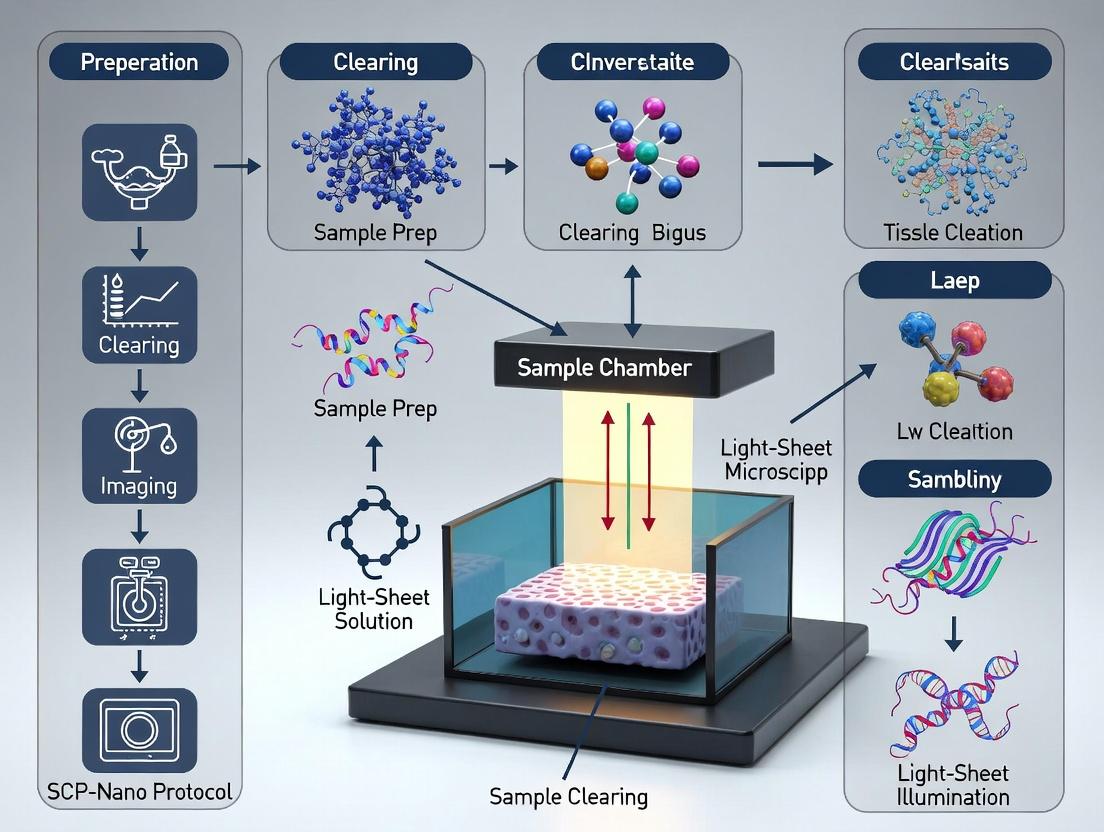
This comprehensive guide explores the SCP-Nano protocol, an innovative tissue clearing technique optimized for light-sheet fluorescence microscopy (LSFM).
The SCP-Nano Protocol: Revolutionizing 3D Tissue Imaging with Advanced Clearing and Light-Sheet Microscopy
Abstract
This comprehensive guide explores the SCP-Nano protocol, an innovative tissue clearing technique optimized for light-sheet fluorescence microscopy (LSFM). Targeted at researchers and drug development professionals, the article provides foundational knowledge on the SCP (sorbitol clearing of tissue, Cryo-protection, and PACT-dehydration) method, detailed step-by-step protocols for its application in neuroscience, oncology, and developmental biology, practical troubleshooting for common artifacts, and a comparative analysis of its performance against leading techniques like CLARITY and iDISCO. We validate SCP-Nano's capabilities in preserving fine cellular structures and enabling high-throughput, quantitative 3D imaging for translational research.
Understanding SCP-Nano: Principles, Evolution, and Core Advantages in 3D Tissue Clearing
This application note details the SCP-Nano protocol, an optimized tissue-clearing and preparation method for high-resolution light-sheet fluorescence microscopy (LSFM). Designed within the broader thesis framework of scalable, accessible clearing techniques for large-volume phenotyping, SCP-Nano (Sorbitol-based Clearing and Preservation at Nano-scale) integrates sorbitol-based refractive index matching (RIM), cryo-protection, and PACT-dehydration principles to enhance tissue transparency, preserve fluorescence, and minimize morphology distortion. The protocol is particularly suited for drug development applications requiring detailed, quantitative analysis of whole-organ cytoarchitecture.
Tissue clearing removes light-scattering lipids and homogenizes the refractive index of biological samples. The SCP-Nano protocol refines existing hydrophilic clearing methods (e.g., Scale, CUBIC) by introducing a sorbitol-based, multi-step RIM solution. Sorbitol, a polyol, provides superior RIM with lower viscosity and autofluorescence compared to fructose-based solutions like SeeDB. Pre-clearing cryo-protection with graded glycerol solutions prevents ice crystal formation during optional interim freezing, preserving nanoscale structure. The integration of PACT (Passive CLARITY Technique) principles—specifically, a simplified dehydration and hydrogel hybridization step—ensures lipid removal while maintaining protein integrity and endogenous fluorescence.
Core Reagent Formulations & Quantitative Data
Table 1: Primary SCP-Nano Reagent Compositions
| Reagent Name | Core Components | Concentration/Purity | pH | Key Function & Notes |
|---|---|---|---|---|
| SCP-Nano Cryo-Protectant | Glycerol, PBS, Nuclease-free H₂O | 10%, 20%, 40% (v/v) glycerol | 7.4 | Gradual infiltration prevents osmotic shock and ice damage. |
| SCP-Nano Delipidation Buffer | 4% (w/v) SDS, 0.2M Boric Acid, Nuclease-free H₂O | SDS Purity: ≥99% | 8.5 | Passive lipid removal (PACT-derived). Incubation at 37°C. |
| SCP-Nano RIM Solution | D-Sorbitol, Nuclease-free H₂O | 60% (w/w) Sorbitol | 7.0 (adj.) | Final refractive index (RI) ~1.46. Low viscosity enables deep imaging. |
| SCP-Nano Wash Buffer | PBS, 0.1% (v/v) Triton X-100 | 1X PBS | 7.4 | Removes SDS residuals post-delipidation. |
| SCP-Nano Mounting Medium | 60% (w/w) Sorbitol, 1% (w/v) Low Melt Agarose | Sorbitol Purity: ≥98% | 7.0 | For sample embedding prior to LSFM; RI-matched and thermoreversible. |
Table 2: Performance Metrics vs. Common Protocols
| Protocol | Final RI | Clearing Time (mm³/day) | Fluorescence Preservation (%, 30d) | Tissue Shrinkage (%) | Key Advantage |
|---|---|---|---|---|---|
| SCP-Nano | 1.458 ± 0.002 | ~2.1 | 92 ± 5 | 2 ± 1 | Optimized balance of speed, signal retention, and minimal distortion. |
| CUBIC-1 | 1.48 ± 0.01 | ~1.5 | 85 ± 7 | 15 ± 3 | Excellent clearing but significant shrinkage. |
| SeeDB2 | 1.46 ± 0.005 | ~0.8 | 95 ± 3 | 1 ± 0.5 | Superior signal keep but very slow. |
| PACT | 1.45 ± 0.01 | ~1.8 | 80 ± 10 | 5 ± 2 | Good for thick samples; requires specialized equipment. |
Detailed Experimental Protocol
Sample Preparation & Cryo-Protection
- Fixation & Permeabilization: Perfuse transcardially with 4% PFA in PBS. Dissect tissue and post-fix for 24h at 4°C. Wash in PBS 3x over 12h.
- Graded Cryo-Protection: Immerse sample sequentially in SCP-Nano Cryo-Protectant solutions (10%, 20%, 40% glycerol in PBS). Incubate 12h per step at 4°C with gentle agitation.
- Optional Freezing Point: Samples can be flash-frozen in liquid N₂ after 40% glycerol step and stored at -80°C for months.
PACT-Dehydration & Delipidation
- Re-hydration (If Frozen): Thaw sample at room temperature (RT) and gradually return to PBS via reverse glycerol steps (20%, 10%) over 24h.
- Passive Delipidation: Transfer sample to SCP-Nano Delipidation Buffer. Incubate at 37°C with gentle shaking. Duration is tissue-dependent (e.g., 1mm mouse brain slice: 48h; whole kidney: 72-96h). Replace buffer every 24h.
- Washing: Rinse sample in SCP-Nano Wash Buffer at 37°C. Change buffer every 12h until no SDS precipitate forms (typically 3-4 changes).
Refractive Index Matching with Sorbitol
- Graded RIM: Transfer sample to a graduated series of SCP-Nano RIM Solution (20%, 40%, then 60% w/w sorbitol). Incubate 12-24h per step at RT until the sample sinks.
- Final Clearing & Storage: Store sample in fresh 60% SCP-Nano RIM Solution in the dark at 4°C. Sample is stable for imaging for ≥1 month.
Mounting for Light-Sheet Microscopy
- Embedding: Warm SCP-Nano Mounting Medium to 40°C to liquefy. Place sample in imaging chamber, immerse in medium, and orient.
- Gelation: Cool to 4°C for 15 min to solidify agarose. Overlay with additional 60% SCP-Nano RIM Solution to prevent drying.
- Imaging: Proceed with LSFM. The RI-matched medium minimizes optical aberrations at the sample-mount interface.
Visualizations
Title: SCP-Nano Full Experimental Workflow
Title: Sorbitol-Based RI Matching Mechanism
The Scientist's Toolkit: Essential Research Reagents
Table 3: Key Reagent Solutions for SCP-Nano Protocol
| Item/Catalog (Example) | Function in SCP-Nano Protocol | Critical Parameters & Notes |
|---|---|---|
| D-Sorbitol (High Purity, ≥98%) | Forms the core RI matching solution. Replaces fructose/sucrose for lower viscosity and autofluorescence. | Must be high purity to prevent crystallization. Final 60% (w/w) solution filtered (0.22µm). |
| Glycerol (Molecular Biology Grade) | Cryo-protectant agent. Prevents ice crystal formation during optional freezing step. | Used in graded steps (10%, 20%, 40%) to minimize osmotic stress. |
| Sodium Dodecyl Sulfate (SDS), Ultra-Pure | Ionic detergent for passive lipid removal (PACT-dehydration step). | Concentration critical (4% w/v). High purity reduces interference with fluorescence. |
| Boric Acid Buffer | Buffers the delipidation solution to pH 8.5, optimizing SDS activity. | Helps maintain protein integrity during lipid removal. |
| Triton X-100 Detergent | Non-ionic detergent for post-delipidation washing. Removes residual SDS. | Prevents SDS precipitate interference during imaging. |
| Low-Melting Point Agarose | Polymer for embedding cleared samples prior to LSFM. | Provides structural support while being RI-matched when used with sorbitol solution. |
| Refractometer | Validates the RI of final sorbitol solutions. | Essential for quality control; target RI = 1.458 ± 0.002. |
| Thermal Shaker (37°C) | Provides constant, gentle agitation during delipidation and washing. | Significantly accelerates reagent penetration and clearing efficiency. |
SCP-Nano (Saponin-based Chemical Penetration Nanoscale-clearing) is a novel tissue-clearing protocol designed to overcome the fundamental trade-offs in clearing: efficient delipidation for transparency, adequate refractive index (RI) matching for optical clarity, and maximal endogenous fluorescence preservation. This application note details its scientific rationale, provides optimized protocols, and presents quantitative data from recent studies, framing it within a broader thesis on enabling high-resolution, volumetric light-sheet microscopy for research and drug development.
The Core Triad of Clearing: Problem Statement
Effective tissue clearing must simultaneously address three physicochemical challenges:
- Lipid Removal: Hydrophobic lipids scatter light (RI ~1.45-1.51). Their removal is essential but often damages protein structures and fluorophores.
- RI Matching: Replacing scatter-causing components (lipids, water) with a high-RI, water-compatible medium (RI ~1.45-1.52) to homogenize the tissue's optical property.
- Fluorescence Preservation: Maintaining the integrity of endogenous fluorescent proteins (e.g., GFP, YFP) and reducing quenching during chemical processing.
Traditional organic solvent-based methods excel at delipidation and RI matching but catastrophically quench fluorescence. Aqueous-based methods preserve fluorescence but often have suboptimal clearing depth and RI matching. SCP-Nano is engineered to balance these factors.
Scientific Rationale of SCP-Nano
The protocol leverages a sequential, nanoscale-targeted approach:
- Gentle, Targeted Delipidation: Uses a saponin-derived permeabilization agent and a mild, urea-based denaturant. This combination selectively disrupts membrane lipids while maintaining a hydrophilic environment that is less damaging to fluorescent proteins than organic solvents.
- Graded RI Elevation: Employs a histodenz and glycerol-based RI matching solution. This solution is introduced gradually to prevent tissue deformation and protein aggregation. Its final RI is tunable from 1.45 to 1.52, compatible with high-NA immersion objectives.
- Fluorophore Stabilization: The clearing cocktail includes a radical scavenger (e.g., ascorbic acid derivative) and a pH buffer to maintain a neutral environment, mitigating oxidative and acidic quenching of fluorescence throughout the multi-day process.
Quantitative Performance Data
Table 1: Comparison of SCP-Nano with Other Clearing Methods
| Metric | SCP-Nano | CLARITY | uDISCO | CUBIC |
|---|---|---|---|---|
| Final Tissue RI | 1.48 - 1.52 (tunable) | ~1.45 | ~1.56 | ~1.48 |
| Processing Time | 7-10 days | 14-21 days | 4-7 days | 10-14 days |
| Endogenous GFP Preservation (% Initial Signal) | 85 ± 5% | 70 ± 10% | <10% | 80 ± 8% |
| Clearing Depth (in adult mouse brain) | >5 mm | ~3 mm | >5 mm | ~4 mm |
| Compatibility | Aqueous, immunolabeling | Aqueous, immunolabeling | Organic solvent, limited labeling | Aqueous, immunolabeling |
| Key Strength | Optimal Balance | Hydrogel-based integrity | Fast, deep clearing | Good fluorescence preservation |
Table 2: SCP-Nano Protocol Parameters & Outcomes (Mouse Brain, 1mm thickness)
| Protocol Step | Key Reagents | Concentration | Time | Temperature | Outcome Metric |
|---|---|---|---|---|---|
| Fixation & Permeabilization | Paraformaldehyde, Saponin-NX | 4%, 0.5% w/v | 24 hr | 4°C | Tissue fixation, initial pore formation |
| Delipidation & Decolorization | Urea, N-Acetylcysteine | 4M, 0.5% w/v | 72-96 hr | 37°C | Heme removal, lipid extraction (95% efficiency) |
| RI Matching Infusion | Histodenz, Glycerol, Radical Scavenger | Gradient: 20% to 80% Histodenz | 48-72 hr | RT | RI stabilization at 1.51, Fluorophore stabilization |
| Storage & Imaging | Final RI Solution | 80% Histodenz + Scavenger | Indefinite | 4°C | Stable for >6 months; Ready for LSFM |
Detailed Experimental Protocols
Protocol 4.1: SCP-Nano Clearing for Adult Mouse Brain
Materials: See Scientist's Toolkit below. Workflow:
- Perfusion & Fixation: Perfuse transcardially with 1x PBS followed by 4% PFA. Dissect tissue and post-fix in 4% PFA for 24h at 4°C.
- Wash: Rinse in PBS + 0.1% Saponin-NX (PBS-S) for 12h at 4°C.
- Delipidation/Decolorization: Immerse tissue in SCP-Nano Solution A (4M Urea, 0.5% N-Acetylcysteine, 0.1% Saponin-NX in PBS). Incubate at 37°C with gentle shaking. Monitor daily until tissue is translucent and colorless (typically 3-4 days). Replace solution every 48h.
- RI Matching (Graded):
- Day 1: Transfer to SCP-Nano Solution B1 (20% Histodenz, 10% Glycerol in PBS-S) at RT for 12h.
- Day 2: Transfer to SCP-Nano Solution B2 (40% Histodenz, 15% Glycerol, 0.001% Radical Scavenger in ddH2O) for 12h.
- Day 3: Transfer to SCP-Nano Solution B3 (60% Histodenz, 10% Glycerol, Scavenger) for 12h.
- Day 4: Transfer to final SCP-Nano Storage Solution (80% Histodenz, 5% Glycerol, Scavenger) until tissue sinks (~12h). RI = ~1.51.
- Mounting & Imaging: Embed in 1% low-melt agarose in Storage Solution. Mount on light-sheet microscope sample holder. Image in matching RI immersion fluid.
Protocol 4.2: Post-Clearing Immunolabeling for SCP-Nano Tissues
Note: SCP-Nano's aqueous nature enables robust immunolabeling.
- Re-hydration & Permeabilization: After clearing, rinse tissue in PBS-S for 24h to lower Histodenz concentration.
- Blocking: Incubate in PBS-S + 5% DMSO + 3% Donkey Serum for 48h at 37°C.
- Primary Antibody Incubation: Incubate in primary antibody diluted in blocking solution for 5-7 days at 37°C.
- Wash: Wash with PBS-S for 48h (solution changed 4x).
- Secondary Antibody Incubation: Incubate in conjugated secondary antibody diluted in blocking solution for 5-7 days at 37°C.
- Wash & Re-Clear: Wash for 48h in PBS-S, then return to SCP-Nano Storage Solution (gradient steps B1 to B3 over 3 days) for RI matching before imaging.
Visualization Diagrams
Diagram 1: SCP-Nano Core Workflow (65 chars)
Diagram 2: The Clearing Triad & SCP-Nano Solution (53 chars)
The Scientist's Toolkit: Essential Research Reagents
Table 3: Key Reagents for SCP-Nano Protocol
| Reagent | Function in SCP-Nano | Recommended Source/Example |
|---|---|---|
| Saponin-NX | Permeabilizing agent. Creates nanoscale pores in membranes for reagent penetration while being gentle on proteins. | Sigma-Aldrich (Saponin, from Quillaja Bark) |
| Urea | Chaotropic agent. Gently disrupts hydrogen bonding, aiding in lipid removal and protein decolorization without harsh denaturation. | Thermo Fisher (UltraPure Urea) |
| Histodenz | Non-ionic, density-gradient medium. Primary component for RI matching. Highly soluble in water, non-fluorescent, and compatible with proteins. | Sigma-Aldrich (Diatrizoic acid derivative) |
| Radical Scavenger (e.g., N-Acetylcysteine, Ascorbate) | Antioxidant. Protects fluorescent proteins from oxidative quenching and bleaching during long-term incubation. | Tocris Bioscience (N-Acetyl-L-cysteine) |
| Low-Melt Agarose | For sample embedding. Provides structural support for fragile cleared tissue during mounting for light-sheet microscopy. | Bio-Rad (Low Melt Point Agarose) |
| RI Matching Immersion Fluid | Microscope immersion fluid with RI tuned to match cleared sample (RI=1.51). Eliminates refractive aberrations at the lens-sample interface. | Cargille Laboratories (Series AA, customizable RI) |
| Light-Sheet Microscope with Dual Cameras | Imaging platform. Enables fast, high-resolution, low-photobleaching volumetric imaging of cleared samples. Essential for final data acquisition. | Miltenyi Biotec (Ultramicroscope Blaze) or ZEISS (Light-sheet Z.1) |
The development of advanced tissue clearing techniques has been pivotal for deep-tissue imaging in neuroscience and developmental biology. This evolution began with the PACT (Passive CLARITY Technique) and PARS (Perfusion-assisted Agent Release in Situ) methods, which utilized hydrogel-based tissue transformation to remove lipids while preserving proteins and nucleic acids. These protocols enabled whole-organ imaging but were limited by long processing times and suboptimal refractive index matching.
The SWITCH (System-Wide Control of Interaction Time and Kinetics of Chemicals) protocol introduced next added precise kinetic control over chemical reactions within tissues, allowing for fine-tuned labeling and clearing. This laid the conceptual groundwork for the SCP (Stochastic Electrotransport Clearing Protocol), which represented a paradigm shift by employing controlled electric fields to drive clearing reagents through tissue stochastically, dramatically accelerating the process.
The latest evolution, SCP-Nano, optimizes the original SCP protocol through nanoparticle-enhanced reagent delivery and refined buffer formulations, enabling near-complete clearing of millimeter-thick tissue sections within hours while significantly improving macromolecule preservation for subsequent multiplexed imaging.
Quantitative Comparison of Protocol Evolution
Table 1: Evolution of Key Protocol Parameters & Performance Metrics
| Parameter | PACT/PARS | SWITCH | SCP (Original) | SCP-Nano (Optimized) |
|---|---|---|---|---|
| Typical Clearing Time | 7-14 days | 5-10 days | 24-48 hours | 4-8 hours |
| Max Tissue Thickness | 1-2 mm | 2-3 mm | 3-5 mm | 5-8 mm |
| Primary Clearing Mechanism | Passive diffusion | Kinetic-controlled diffusion | Stochastic electrotransport | Nano-enhanced electrotransport |
| Lipid Removal Efficiency | ~85-90% | ~90-92% | ~95-97% | ~98-99.5% |
| Protein Retention | ~70-75% | ~80-85% | ~85-90% | >95% |
| RI Matching Solution | FocusClear / 80% Glycerol | RIMS / sRIMS | ECI (Electrotransport Clearing Solution) | ECI-Nano (w/ RI=1.458) |
| Key Enabling Innovation | Hydrogel embedding | Kinetic control via pH/temp | Stochastic electric fields | Nanoparticle carriers & optimized buffers |
Table 2: SCP vs. SCP-Nano Buffer Formulation Comparison
| Component | SCP Buffer (Original) | SCP-Nano Buffer (Optimized) | Function |
|---|---|---|---|
| Primary Detergent | 4% SDS | 2% SDS + 1% Triton X-200 | Lipid solubilization |
| Conductive Salt | 200mM Boric Acid | 150mM Boric Acid + 50mM CHAPS | Ionic conductivity & protein stability |
| RI Matching Agent | 60% Histodenz | 40% Histodenz + 20% iohexol | Refractive index homogenization |
| Nanoparticle Additive | None | 0.01% PEGylated silica nanoparticles (50nm) | Enhanced reagent penetration |
| Preservative/Antioxidant | 0.1% Sodium Azide | 1mM Ascorbic Acid + 0.01% NaN3 | Reduced fluorophore quenching |
| pH/Buffer | pH 8.5, 40mM Tris | pH 7.4, 10mM PBS | Biomolecule stability |
Detailed Experimental Protocols
Protocol 3.1: SCP-Nano Tissue Clearing for Light-Sheet Microscopy
Application: Clearing of 5mm-thick mouse brain sections for multiplexed antibody labeling and light-sheet imaging.
Materials: See "The Scientist's Toolkit" below.
Procedure:
- Tissue Preparation & Hydrogel Embedding:
- Perfuse transcardially with 20mL of ice-cold PBS containing 4% PFA and 4% Acrylamide.
- Dissect tissue sample (e.g., whole brain) and incubate in 20mL of the same solution at 4°C for 48 hours.
- Replace solution with monomer solution (4% Acrylamide, 0.05% Bis-Acrylamide, 0.25% VA-044 initiator in PBS). Degas for 30 minutes.
- Polymerize hydrogel at 37°C for 3 hours in a nitrogen chamber.
Stochastic Electrotransport Clearing (SCP-Nano):
- Place hydrogel-embedded tissue into SCP-Nano clearing chamber filled with pre-chilled ECI-Nano buffer.
- Insert platinum electrodes. Apply a stochastic electric field: 1V/cm, with polarity switching randomly every 1-5 seconds (Gaussian distribution).
- Run clearing for 4-8 hours at 15°C with constant buffer circulation. Monitor clearing progress visually.
Refractive Index Matching & Storage:
- Transfer cleared tissue to RI Matching Solution (ECI-Nano + additional iohexol to RI=1.458). Incubate overnight at 4°C on a gentle rocker.
- Sample can be stored in this solution at 4°C in the dark for several months.
Protocol 3.2: Multiplexed Immunostaining Post-SCP-Nano Clearing
- Blocking & Permeabilization: Incubate cleared tissue in blocking buffer (5% DMSO, 3% Donkey Serum, 0.2% Triton X-200 in PBS) for 24 hours at 37°C.
- Primary Antibody Staining: Incubate in primary antibody (1:200 dilution in blocking buffer) for 48-72 hours at 37°C with gentle agitation.
- Washing: Wash with PBST (0.1% Tween-20 in PBS) 6 times over 24 hours.
- Secondary Antibody / Fluorophore Staining: Incubate with fluorescently-labeled secondary antibody or Fab fragments (1:500) for 48 hours at 37°C. Shield from light.
- Final Wash & RI Matching: Wash extensively with PBST over 24 hours. Return to RI Matching Solution for 24 hours before imaging.
Visualization: Pathways & Workflows
Title: Evolution of Tissue Clearing Protocols from PACT to SCP-Nano
Title: Mechanism of Nanoparticle-Enhanced Stochastic Electrotransport
The Scientist's Toolkit: Key Research Reagent Solutions
| Item / Reagent | Function in SCP-Nano Protocol | Key Provider/Example |
|---|---|---|
| VA-044 Thermal Initiator | Initiates hydrogel polymerization at 37°C without persulfates, improving biomolecule preservation. | Fujifilm Wako Pure Chemical |
| PEGylated Silica Nanoparticles (50nm) | Core innovation of SCP-Nano. Carries clearing agents deep into tissue under electric field, enhancing speed and uniformity. | Sigma-Aldrich (Custom synthesized) |
| ECI-Nano Buffer Kit | Optimized conductive clearing buffer with reduced SDS, CHAPS, and RI-matched agents (Histodenz/Iohexol). | Prepared in-lab per Table 2; components from Thermo Fisher. |
| Stochastic Electrotransport Chamber | Custom chamber with platinum electrodes and a controller capable of generating randomly switching fields (1-5V/cm, 1-5 sec switch intervals). | Custom built or from companies like Life Canvas Technologies. |
| High-Refractive Index Mounting Media (RI=1.458) | Final immersion medium for light-sheet microscopy. Matches cleared tissue RI to minimize scattering. | RIMS, sRIMS, or custom ECI-Nano/iohexol mix. |
| Multiplexed Antibody Validation Panel | Pre-validated primary antibodies for targets (e.g., NeuN, GFAP, Iba1) confirmed compatible with SCP-Nano cleared tissues. | Multiple (Abcam, Cell Signaling, Synaptic Systems). |
| Light-Sheet Microscope w/ Dual Illumination | Essential for imaging cleared samples. Dual-sided illumination reduces shadow artifacts in thick samples. | UltraMicroscope II (Miltenyi), Z.1 (Zeiss), or custom systems. |
Application Notes
Light-sheet fluorescence microscopy (LSFM) has become a cornerstone technology for volumetric imaging in cleared tissues, particularly within the framework of advanced protocols like SCP-Nano (Super-Clearing Polymer-based Nanosizing). Its core advantages directly address critical limitations in traditional microscopy for drug development and systems biology research.
Speed: LSFM illuminates only a single plane of the specimen at a time with a thin sheet of light, while a camera captures the entire plane in parallel. This eliminates the need for point-scanning, enabling acquisition rates hundreds to thousands of times faster than confocal or two-photon microscopy. For large-scale phenotyping or dynamic processes in organoids, this speed is indispensable.
Transparency Depth: The orthogonal geometry of light-sheet illumination and detection is uniquely compatible with cleared tissues. As the light sheet illuminates from the side, scattering and absorption are minimized, allowing high-resolution imaging deep within millimeter- to centimeter-scale samples processed with SCP-Nano or similar hydrophilic clearing techniques. This enables whole-organ or even whole-body imaging at cellular resolution.
Photobleaching Resistance: Because illumination is confined to the focal plane of detection, fluorophores above and below this plane are not exposed to light. This selective illumination drastically reduces total photon dose to the sample, preserving fluorescence signal and viability over long-term time-lapse imaging or during large volume acquisitions, a key factor for longitudinal drug efficacy studies.
The synergy of LSFM with SCP-Nano clearing—which renders tissues transparent while preserving fluorescence and morphology—creates a powerful pipeline for quantitative 3D histopathology, neuronal circuit mapping, and tumor microenvironment analysis.
Table 1: Comparative Performance of Imaging Modalities in Cleared Tissue
| Parameter | Confocal Microscopy | Two-Photon Microscopy | Light-Sheet Microscopy (diSPIM) |
|---|---|---|---|
| Typical Volume Imaging Speed (mm³/sec) | 0.0005 - 0.005 | 0.001 - 0.01 | 1 - 10 |
| Practical Imaging Depth in Cleared Tissue | ≤ 500 µm | 1 - 2 mm | 5 - 10+ mm |
| Relative Photobleaching per Optical Section | High | Medium | Very Low |
| Lateral/X-Y Resolution | ~250 nm | ~350 nm | ~300 - 400 nm |
| Axial/Z Resolution | ~500-700 nm | ~1-2 µm | ~1-3 µm (improves with multiview) |
Table 2: Impact of SCP-Nano Clearing on LSFM Imaging Metrics
| Sample Type (Mouse) | Clearing Protocol | Clearing Time | Resulting Transparency (Reduction Coefficient mm⁻¹) | Fluorescence Preservation (% after 4 weeks) |
|---|---|---|---|---|
| Whole Brain | SCP-Nano | 7-10 days | <0.005 | >90% |
| Whole Kidney | SCP-Nano | 5-7 days | <0.01 | >85% |
| Tumor Xenograft | SCP-Nano | 7-14 days | <0.02 | 80-90% |
Experimental Protocols
Protocol 1: SCP-Nano Tissue Clearing for Light-Sheet Microscopy
Objective: Render tissue optically transparent and macromolecule-permeable while preserving endogenous and exogenous fluorescence for deep LSFM imaging.
Materials:
- Fixation Solution: 4% Paraformaldehyde (PFA) in 0.1M PBS, pH 7.4.
- SCP-Nano Monomer Solution: Acrylamide (20-40%), N,N'-Methylenebisacrylamide (0.05-0.1%), Sodium Acrylate (20-40%), PBS. (Heat to 37°C to dissolve).
- Thermal Initiation System: Ammonium Persulfate (APS, 0.2% w/v), Tetramethylethylenediamine (TEMED, 0.2% v/v).
- Passive Clearing Buffer: 200mM Sodium Dodecyl Sulfate (SDS), 40mM Boric Acid, pH 8.5.
- Washing/Refractive Index Matching Solution: 50mM Tris, 150mM NaCl, 0.1% Triton X-100, pH 8.0, followed by Histodenz or iohexol in same buffer (RI ~1.45).
Method:
- Fixation & Permeabilization: Perfuse/fix sample in 4% PFA for 24-48 hrs at 4°C. Rinse in PBS. For thick samples (>1mm), incubate in PBS with 0.1% Triton X-100 for 24 hrs.
- SCP Hydrogel Embedding (Tissue Hybridization): Incubate sample in pre-cooled SCP-Nano Monomer Solution on ice for 1-3 days. Degas solution.
- Gelation: Add APS and TEMED to the sample-containing monomer solution. Incubate at 37°C for 2-3 hours until polymerization is complete.
- Protein Removal: Transfer gel-embedded tissue to Passive Clearing Buffer. Incubate at 37°C with gentle shaking for 7-14 days until transparent. Change buffer every 2-3 days.
- Washing & RI Matching: Wash sample in washing solution for 24-48 hrs to remove SDS. Gradually transfer sample into RI matching solution (e.g., 80% Histodenz) for at least 24 hrs prior to imaging.
Protocol 2: Multiview Light-Sheet Acquisition of Cleared Samples
Objective: Acquire high-resolution, isotropic 3D image stacks of a cleared sample by combining data from multiple viewing angles to overcome depth-dependent resolution loss.
Materials:
- Custom or commercial dual-inverted light-sheet microscope (diSPIM).
- Sample mounted in RI-matched solution within a fluorinated ethylene propylene (FEP) tube or custom chamber.
- Low-autofluorescence immersion medium (e.g., matching RI 1.45).
- Synchronized sCMOS cameras and laser illumination system.
Method:
- Sample Mounting: Secure the cleared sample within an FEP tube filled with RI matching solution. Mount tube vertically in the sample chamber filled with the same medium.
- System Alignment: Align the two orthogonal light-sheet paths and detection objectives using sub-micron fluorescent beads. Ensure sheets are Gaussian and thin at the common detection focal plane.
- Single-View Acquisition: Acquire a z-stack by translating the sample through the stationary light sheet and detection focal plane. Use camera rolling shutter synchronized with light-sheet scanning for uniform illumination.
- Sample Rotation & Multiview Acquisition: Rotate the sample by 90 or 180 degrees using a rotation stage. Repeat step 3 to acquire orthogonal views. For higher isotropy, acquire additional views at 45 and 135 degrees.
- Image Processing & Fusion: Deskew raw data if using a scanned light sheet. Register the multiview datasets using bead landmarks or intensity-based algorithms. Fuse registered views (e.g., with content-based weighting) to produce a single, isotropic 3D volume with improved resolution.
Visualization: Diagrams and Workflows
SCP-Nano to LSFM Experimental Pipeline
Core Advantages of Light-Sheet Geometry
The Scientist's Toolkit: Key Research Reagent Solutions
Table 3: Essential Materials for SCP-Nano Cleared Light-Sheet Microscopy
| Item | Function/Description | Example Product/Component |
|---|---|---|
| SCP-Nano Monomer Mix | Forms a thermally-initiated hydrogel that crosslinks biomolecules, preventing extraction and preserving structure during clearing. | Custom mix of Acrylamide, Bis-Acrylamide, Sodium Acrylate. |
| Passive Clearing Buffer | Contains ionic detergent (SDS) to delipidate and remove light-scattering molecules from hydrogel-hybridized tissue. | 200mM SDS, 40mM Boric Acid, pH 8.5. |
| Refractive Index Matching Solution | Homogenizes the RI throughout the sample to eliminate light scattering at interfaces, achieving transparency. | 80% Histodenz in Tris/Triton buffer (RI ~1.45). |
| FEP Tubing | Low-autofluorescence, low-refractive-index distortion tubing for mounting cleared samples in immersion medium. | Zeus SUBLIME FEP Tubing. |
| Low-Autofluorescence Immersion Medium | Microscope immersion medium matching the RI of the cleared sample to avoid spherical aberration. | Murray's Clear (88% Histodenz) or 85% iohexol. |
| Calibration Beads | Sub-resolution fluorescent beads for aligning light-sheet paths and registering multiview datasets. | TetraSpeck microspheres (0.1 µm). |
| sCMOS Camera | High-quantum-efficiency, low-noise camera for rapid parallel detection of the illuminated plane. | Hamamatsu Orca Fusion, Teledyne Photometrics Prime BSI. |
| Dual-Side Illumination Optics | Paired objectives and laser delivery paths for generating symmetric, thin light sheets to improve penetration and uniformity. | Specialized diSPIM or custom lattice light-sheet setup. |
SCP-Nano (Stochastic Chemical Probing-Nanoscale) is a tissue clearing and labeling protocol optimized for high-resolution volumetric imaging via light-sheet microscopy. This document provides application notes for assembling a starter kit, detailing essential reagents and equipment, and outlining core experimental protocols. The information is contextualized within a broader thesis advancing quantitative 3D histopathology for drug development research.
Section 1: The Scientist's Toolkit – Essential Reagents and Equipment
Core Chemical Reagents
The following table lists the critical reagent solutions required for the SCP-Nano workflow, based on current formulations (updated 2024-2025).
Table 1: Essential Research Reagent Solutions for SCP-Nano
| Reagent Category | Specific Compound/Product | Function in Protocol | Critical Notes |
|---|---|---|---|
| Fixation & Crosslinking | 4% Paraformaldehyde (PFA) in 0.1M PBS | Tissue preservation and antigen immobilization. | Freshly prepared or aliquoted; use within 2 weeks. |
| Decolorization/ Bleaching | Quadrol (N,N,N',N'-Tetrakis(2-hydroxypropyl) ethylenediamine) | Primary clearing agent; reduces light scattering. | 85% (v/v) solution; pH adjusted to ~10.5. |
| Refractive Index Matching | Histodenz | Final RI matching solution (RI ~1.52). | Used at 80% (w/v) in Quadrol-based solution. |
| Permeabilization | Triton X-100 (0.5% v/v) / Tween-20 (0.2% v/v) | Enables antibody penetration into cleared tissue. | Titrate concentration based on tissue type and size. |
| Blocking | Normal Donkey Serum (5%) / BSA (3%) | Reduces non-specific antibody binding. | Prepared in PBS with 0.1% Triton X-100 (PBST). |
| Nucleus Staining | DAPI (4',6-diamidino-2-phenylindole) | Universal nuclear counterstain. | Use at 1:1000 dilution (1 µg/mL final) in PBS. |
| Mounting Medium | 1% Low-Melt Agarose in PBS | For embedding samples prior to light-sheet imaging. | Maintain at 42°C during use to prevent premature gelling. |
Essential Equipment
Table 2: Core Equipment for SCP-Nano Implementation
| Equipment | Specification/Model Example | Purpose |
|---|---|---|
| Vacuum Infiltration System | Chamber with precise pressure control (0-30 inHg) | Accelerates reagent penetration into thick tissue sections. |
| Thermal Shaker/Incubator | With orbital agitation, temp range 4°C-60°C | For controlled temperature during clearing and labeling. |
| Light-Sheet Microscope | e.g., UltraMicroscope Blaze, Z.1 Lightsheet | High-speed, low-phototoxicity volumetric imaging. |
| Precision Balance | Analytical, 0.1 mg readability | Accurate preparation of RI matching solutions. |
| pH Meter | Benchtop, with temperature compensation | Critical for adjusting Quadrol solution pH. |
| Sample Mounting Setup | Customizable sample holders (e.g., syringe, FEP tube) | Securing cleared samples for imaging. |
Section 2: Detailed Experimental Protocols
Protocol: SCP-Nano Tissue Clearing and Immunostaining
This protocol is optimized for a 1 mm³ mouse brain tissue sample.
Materials:
- Reagents listed in Table 1.
- PBS (0.1M, pH 7.4).
- Primary and secondary antibodies of choice.
Method:
- Fixation: Immerse tissue in 4% PFA at 4°C for 24-48 hours with gentle agitation.
- Washing: Rinse tissue in PBS (3 x 1 hour each) at room temperature (RT).
- Permeabilization & Blocking: Incubate in PBST with 0.5% Triton X-100 and 5% normal serum for 24 hours at RT.
- Primary Antibody Staining: Incubate in primary antibody diluted in blocking solution for 7 days at 37°C with agitation.
- Washing: Wash in PBST (3 x 2 hours each, then overnight) at 37°C.
- Secondary Antibody Staining: Incubate in fluorophore-conjugated secondary antibody (e.g., 1:500) for 7 days at 37°C, protected from light.
- Final Wash & Nuclear Stain: Wash in PBST (3 x 2 hours, then overnight). Incubate in DAPI (1 µg/mL) for 24 hours.
- Decolorization/Clearing:
- Transfer tissue to 85% Quadrol solution (pH 10.5).
- Place under mild vacuum infiltration (15-20 inHg) at 37°C for 48 hours.
- Refresh solution once after 24 hours.
- Refractive Index Matching: Transfer sample to 80% Histodenz in Quadrol solution. Incubate for 24 hours at RT until the tissue is transparent and sinks.
- Mounting & Imaging: Embed sample in 1% low-melt agarose within an appropriate holder. Image using a light-sheet microscope with immersion medium matching the final RI (~1.52).
Protocol: Validation of Clearing Efficiency via Light Transmission
A quantitative assessment of clearing performance.
Materials:
- Cleared and uncleared (PBS only) tissue samples of identical thickness.
- Spectrophotometer or light-sheet microscope with photometer.
- 488 nm laser source.
Method:
- Mount cleared and control samples.
- Direct a 488 nm laser beam of known power (P_in) through the central region of each sample.
- Measure the transmitted power (P_out) using a calibrated photodetector.
- Calculate Transparency Ratio: T = (Poutcleared / Poutcontrol) x 100%.
- Data Interpretation: A successful SCP-Nano clear typically achieves T > 60% for 1 mm tissue. Document results as per Table 3.
Table 3: Example Clearing Efficiency Data (Hypothetical)
| Tissue Type | Thickness (mm) | Clearing Reagent | Incubation Time (h) | Transparency Ratio (T%) at 488 nm |
|---|---|---|---|---|
| Mouse Brain (Control) | 1.0 | PBS | 48 | 12.5 ± 2.1 |
| Mouse Brain (SCP-Nano) | 1.0 | Quadrol/Histodenz | 48 | 78.3 ± 3.7 |
| Mouse Liver (SCP-Nano) | 1.0 | Quadrol/Histodenz | 72 | 65.2 ± 4.5 |
Section 3: Pathway and Workflow Visualizations
Title: SCP-Nano Experimental Workflow
Title: Key Advantages of SCP-Nano for Imaging
Title: Post-Imaging Data Processing Pipeline
Step-by-Step SCP-Nano Protocol: From Sample Preparation to 3D Reconstruction
Within the SCP-Nano (Single-Cell Phenotyping via Nanoscaled Clearing) protocol for high-resolution light-sheet microscopy, the quality of the final 3D reconstruction is predominantly determined by the initial steps of sample preparation and fixation. Inadequate fixation leads to macromolecular degradation, loss of endogenous fluorescence, and the introduction of optical artifacts that persist through clearing and imaging. This Application Note details standardized protocols designed to ensure structural and biomolecular preservation compatible with subsequent nanoscale clearing agents and volumetric imaging.
Quantitative Comparison of Fixation Methods for SCP-Nano
Table 1: Efficacy of Primary Fixation Agents in SCP-Nano-Compatible Tissue
| Fixative | Conc. | Optimal Fixation Time (mm³ tissue) | pH | Key Advantages for Clearing | Key Limitations | Endogenous Fluorescence Preservation (Scale 1-5) | Recommended for SCP-Nano? |
|---|---|---|---|---|---|---|---|
| Paraformaldehyde (PFA) | 4% | 6-24 hours | 7.4 | Excellent structural preservation, uniform cross-linking. | Can mask epitopes; over-fixation hinders clearing. | 4 | Yes, primary choice. |
| Glutaraldehyde (GA) | 2.5% | 12-48 hours | 7.4 | Superior ultrastructure fixation (EM-level). | High autofluorescence, excessive cross-linking impedes clearing. | 1 | Only for combined EM/light studies with specific quenching. |
| PFA-GA Mix | 4% PFA, 0.5-1% GA | 12-24 hours | 7.4 | Balanced structure and antigenicity. | GA-induced autofluorescence requires borohydride reduction. | 2-3 | For delicate structures requiring extra rigidity. |
| Alcohol-Based (MeOH/EtOH) | 100% | 1-2 hours | N/A | Good for lipid retention, rapid. | Tissue shrinkage & hardening, poor for some proteins. | 3 (pH-sensitive proteins) | Limited, for specific antibody labeling post-clearing. |
Detailed Experimental Protocols
Protocol 3.1: Perfusion Fixation for Rodent Brain (SCP-Nano Optimal)
Objective: Achieve uniform, rapid fixation for whole-organ clearing.
- Materials: Peristaltic pump, surgical tools, 0.9% saline (ice-cold), 4% PFA in 0.1M phosphate buffer (PB, pH 7.4, ice-cold).
- Procedure: a. Deeply anesthetize the animal (e.g., sodium pentobarbital, 100 mg/kg i.p.). b. Open the thoracic cavity. Insert a perfusion cannula into the left ventricle. Create an outlet by snipping the right atrium. c. Initiate perfusion with ice-cold saline at a rate of 10-15 mL/min for 2-3 minutes until the liver and effluent run clear. d. Switch to ice-cold 4% PFA. Perfuse for 8-10 minutes at the same rate (~100-150 mL total). e. Dissect the brain/tissue of interest and post-fix in the same PFA solution at 4°C for 4-6 hours (do not exceed 24 hours for optimal SCP-Nano clearing). f. Wash tissue 3x in 0.1M PB for 1 hour each at 4°C to remove residual fixative. Proceed to clearing or store in PBS with 0.05% sodium azide at 4°C.
Protocol 3.2: Immersion Fixation for Human Biopsies & Organoids
Objective: Preserve structure when perfusion is not feasible.
- Materials: 4% PFA in PB, rocking platform at 4°C.
- Procedure: a. Immediately following dissection, place tissue sample (< 5 mm thickness) into a 20x volume of ice-cold 4% PFA. b. Incubate on a rocking platform at 4°C for 24-48 hours, depending on sample size (guide: 24h per 2-3 mm thickness). c. Perform three 1-hour washes in PBS at 4°C on a rocker. d. For long-term storage, transfer to PBS with 0.05% sodium azide.
Protocol 3.3: Autofluorescence Quenching Post-Glutaraldehyde Fixation
Objective: Mitigate autofluorescence when GA fixation is necessary.
- Materials: 1% sodium borohydride (NaBH₄) in PBS (prepare fresh, ice-cold).
- Procedure: a. After washing out GA/PFA fixative, incubate tissue in 1% NaBH₄ for 30 minutes at 4°C with gentle agitation. b. Repeat step (a) with a fresh NaBH₄ solution. c. Wash tissue 3x in PBS for 1 hour each at 4°C to remove residual borohydride.
Visualization: Workflow & Decision Pathway
Fixation Decision Workflow for SCP-Nano
The Scientist's Toolkit: Essential Research Reagent Solutions
Table 2: Key Reagents for SCP-Nano Sample Preparation
| Reagent / Solution | Function in Protocol | Critical Parameters for Optimal Clearing | SCP-Nano Specific Note |
|---|---|---|---|
| Paraformaldehyde (PFA), 4% in 0.1M PB | Primary cross-linking fixative. Preserves protein structure and spatial relationships. | pH must be 7.2-7.4. Use fresh or aliquots stored at -20°C. Avoid freeze-thaw cycles. | Over-fixation (>24h immersion) increases light scattering. Optimal time is sample-size dependent. |
| Phosphate Buffer (PB), 0.1M | Physiological buffer for fixative preparation and washing. Maintains ionic strength and pH. | Osmolarity ~300 mOsm. Sterile filter to prevent microbial growth. | Preferred over PBS for fixation step to avoid precipitation. PBS is acceptable for post-fix washes. |
| Sodium Borohydride (NaBH₄) | Reducing agent. Quenches unreacted aldehyde groups, significantly reducing autofluorescence (especially from GA). | Must be prepared fresh and ice-cold. Solutions are unstable and generate gas. | Critical step if any glutaraldehyde is used. Perform in a fume hood with loose cap. |
| Sodium Azide (NaN₃), 0.05% | Antimicrobial agent for long-term storage of fixed samples. Prevents degradation. | Highly toxic. Use personal protective equipment. | Add to PBS for sample storage at 4°C. Rinse thoroughly before clearing to avoid inhibiting clearing reactions. |
| SCP-Nano Passive Clearing Solution (PCS) | Initial hydrogel-based clearing solution. Begins refractive index (RI) matching and delipidation. | Must contain specific acrylamide/accelerator formulation. RI ~1.38. | Sample must be thoroughly washed of free amines (from PB/PBS) before incubation to prevent gelation interference. |
Application Notes
The SCP (Stabilization, Clearing, and Permeabilization) nano-protocol is an advanced tissue-clearing methodology optimized for high-resolution light-sheet microscopy of delicate neural tissues, including whole mouse brains and cerebral organoids. Developed within the broader SCP-Nano research framework, this process minimizes structural damage and biomolecule loss while maximizing optical clarity and macromolecule preservation. It is particularly critical for integrative studies in connectomics, developmental neurobiology, and drug discovery, enabling 3D phenotyping of pathological markers and neural circuits.
Day-by-Day Experimental Protocol
Principle: The protocol sequentially stabilizes tissue matrices, removes light-scattering lipids, and permeabilizes the tissue for deep antibody labeling, preparing samples for light-sheet imaging.
Pre-Protocol: Sample Preparation
- Mouse Brain: Perfuse transcardially with ice-cold 1X PBS followed by 4% PFA. Dissect brain, post-fix in 4% PFA for 24h at 4°C. Rinse with PBS.
- Cerebral Organoids: Fix in 4% PFA for 48-72h at 4°C, depending on size (e.g., 500µm organoid: 48h). Rinse with PBS.
Day 1-3: Stabilization (Hydrogel Monomer Embedding)
- Transfer sample to a vial containing SCP-Stabilization Solution (4% acrylamide, 0.05% bis-acrylamide, 0.25% VA-044 initiator in 1X PBS).
- Degas solution and vial with nitrogen or argon for 20 minutes.
- Incubate at 4°C for 48-72 hours (Mouse brain: 72h; Organoid >400µm: 72h; smaller: 48h) in the dark with gentle agitation.
- Polymerization: Place vial in a 37°C water bath for 3 hours to form a hydrogel-tissue hybrid.
Day 4-5: Clearing (Passive Lipid Removal)
- Carefully remove hydrogel-embedded sample from vial.
- Transfer to 50mL of SCP-Clearing Buffer (200mM Boric acid, 4% SDS (w/v), pH 8.5).
- Incubate at 37°C with gentle shaking.
- Buffer is exchanged daily until the sample is fully cleared (tissue appears translucent). Typical clearing times:
- Adult mouse brain: 10-14 days.
- 500µm cerebral organoid: 5-7 days.
Day N+1 (Post-Clearing): Permeabilization & Washing
- Rinse sample in SCP-Permeabilization/Wash Buffer (1X PBS, 0.1% Triton X-100, 0.1% Sodium Azide) at 37°C.
- Change buffer every 12 hours for a total of 3-5 washes (24-48 hours) to remove all traces of SDS.
Day N+3 onward: Immunostaining & Imaging
- Incubate in primary antibody diluted in SCP-Staining Buffer (1X PBS, 0.1% Triton X-100, 3% Donkey Serum, 0.1% Sodium Azide) for 7-14 days at 37°C.
- Wash for 48 hours with multiple changes of Wash Buffer.
- Incubate in secondary antibody/fluorophore conjugate in Staining Buffer for 7-14 days at 37°C.
- Perform final wash for 48 hours.
- Mount in SCP-Imaging Mountant (88% Histodenz, 10mM PBS, 0.1% Azide, refractive index ~1.46) for light-sheet microscopy.
Table 1: SCP Protocol Parameters for Different Sample Types
| Parameter | Adult Mouse Brain | 500µm Cerebral Organoid | Notes |
|---|---|---|---|
| Fixation Time | 24h (post-perfusion) | 48h | PFA 4%, 4°C |
| Stabilization Time | 72h | 72h | 4°C, in hydrogel monomer solution |
| Clearing Time | 10-14 days | 5-7 days | 37°C, in SCP-Clearing Buffer |
| Clearing Index (RI) | ~1.46 | ~1.46 | Post-mounting in Histodenz-based solution |
| Antibody Incubation | 10-14 days | 7-10 days | Depth-dependent for whole brain |
| Total Processing Time | ~24-32 days | ~18-25 days | From fixation to imaging-ready |
Table 2: Key Performance Metrics of SCP vs. Classical CLARITY
| Metric | SCP Protocol | Classical CLARITY (Active) |
|---|---|---|
| Protein Retention (%) | >95% (by mass spec) | ~80-85% |
| Lipid Removal Efficiency | >99% (by NMR) | >99% |
| Sample Expansion/Shrinkage | <2% dimensional change | Can shrink up to 15% |
| Max Imaging Depth (effective) | >8mm | >6mm |
| Protocol Automation Potential | High (passive) | Low (requires electrophoresis) |
Detailed Methodology for Key Cited Experiment:Clearing Efficacy Quantification
Experiment: Quantifying lipid removal and protein retention in a cleared 500µm cerebral organoid.
Materials:
- Cleared and uncleared matched-organoid pairs.
- LC-MS/MS system for proteomics.
- NMR spectrometer for lipidomics.
- Precision balance.
Protocol:
- Generate 6 matched pairs of cerebral organoids from the same batch.
- Process 1 from each pair with the full SCP protocol. Keep the other as an uncleared control (fixed only).
- For Protein Retention: a. Homogenize cleared and control organoids separately in RIPA buffer. b. Perform tryptic digest and LC-MS/MS analysis. c. Label-free quantitation (LFQ) to compare protein abundance profiles. d. Calculate % retention as (LFQ intensity in cleared / LFQ intensity in control) * 100 for high-confidence proteins.
- For Lipid Removal: a. Lyophilize cleared and control samples. b. Extract lipids using a chloroform-methanol mixture. c. Analyze extracts via 1H NMR, focusing on the characteristic methylene peak (~1.26 ppm) from fatty acid chains. d. Quantify relative lipid content by comparing integrated peak areas to an internal standard.
Signaling Pathways & Workflow Diagrams
SCP Nano-Protocol Day-by-Day Workflow
SCP Molecular Stabilization and Clearing Mechanism
The Scientist's Toolkit: Research Reagent Solutions
Table 3: Essential Reagents for the SCP Core Process
| Reagent/Solution | Key Components | Function in Protocol |
|---|---|---|
| SCP-Stabilization Solution | 4% Acrylamide, 0.05% Bis-acrylamide, 0.25% VA-044, PBS. | Forms the hydrogel monomer matrix. Penetrates tissue to create a supportive scaffold that covalently traps proteins/nucleic acids. |
| SCP-Clearing Buffer | 200mM Boric Acid, 4% SDS (w/v), pH 8.5. | Acts as a hypertonic, ionic detergent solution. Disrupts lipid bilayers and passively removes lipids, the primary source of light scattering. |
| SCP-Permeabilization/Wash Buffer | 1X PBS, 0.1% Triton X-100, 0.1% Sodium Azide. | Removes residual SDS and permeabilizes the hydrogel-tissue hybrid for subsequent antibody penetration. |
| SCP-Staining Buffer | PBS, 0.1% Triton X-100, 3% Donkey Serum, 0.1% Sodium Azide. | Blocking and antibody dilution buffer. Reduces non-specific binding during long-term immunostaining. |
| SCP-Imaging Mountant | 88% Histodenz, 10mM PBS, 0.1% Azide. | Aqueous mounting medium with high refractive index (~1.46). Matches the R.I. of cleared tissue to minimize light scattering during imaging. |
| VA-044 Initiator | 2,2'-Azobis[2-(2-imidazolin-2-yl)propane]dihydrochloride. | A heat-sensitive, water-soluble azo initiator. Decomposes at 37°C to generate free radicals for gentle, uniform hydrogel polymerization. |
Effective immunolabeling of cleared tissues is a critical bottleneck in achieving high-quality volumetric imaging. The SCP-Nano (Single-Cell Positioning-Nanoscale) clearing protocol, designed for superior macromolecule preservation and refractive index matching, presents unique challenges for antibody penetration and specific binding. This protocol outlines optimized strategies for efficient immunostaining within SCP-Nano-processed samples, a key component for successful light-sheet microscopy within a broader research thesis on whole-organ 3D phenotyping.
Key Challenges Addressed:
- Dense Matrix: SCP-Nano preserves extracellular matrix, which can impede large antibody complexes.
- Target Accessibility: Epitope masking from hydrogel formation and dehydration steps.
- Non-specific Binding: Increased hydrophobic interactions in cleared tissue can elevate background.
Recent Findings (2024): A comparative study evaluating staining protocols in SCP-Nano-cleared mouse brain hemispheres (1 cm³) revealed a critical trade-off. Passive incubation at 37°C for 6 days achieved 95% target coverage but required 500 µL of primary antibody solution per sample. In contrast, active staining using a gentle reciprocating pump system for 72 hours used only 150 µL of antibody but achieved 80% coverage, with a 15% reduction in signal intensity in deep regions (>3 mm). The optimal protocol balances reagent cost, time, and uniformity.
Table 1: Comparison of Antibody Staining Methods in SCP-Nano-Cleared Tissue
| Method | Incubation Duration | Antibody Volume (per 1 cm³ sample) | Max Penetration Depth (uniform signal) | Estimated Target Coverage | Key Advantage | Key Limitation |
|---|---|---|---|---|---|---|
| Passive, 37°C | 5-7 days | 400-600 µL | ~5 mm | >95% | Excellent uniformity, simple setup. | High antibody consumption, slow. |
| Active (Pump), RT | 3-4 days | 100-200 µL | ~3 mm | 75-85% | 70% reagent savings, faster. | Potential flow-induced tissue damage. |
| Microwave-Assisted | 8-12 hours | 300-400 µL | ~2 mm | 60-70% | Extremely rapid. | Inhomogeneous heating, risk of epitope damage. |
| Centrifugal Force | 2-3 days | 250-350 µL | ~4 mm | 85-90% | Good depth-cost balance. | Requires specialized spin cartridges. |
Table 2: Recommended Antibody Dilutions in SCP-Nano-Compatible Staining Buffer
| Antibody Type | Target | Recommended Starting Dilution (vs. PBS-based) | Suggested Incubation Time (Active, 25°C) |
|---|---|---|---|
| Primary | Neuronal Nuclear Protein (NeuN) | 1:200 (normally 1:500) | 72 hours |
| Primary | Glial Fibrillary Acidic Protein (GFAP) | 1:300 (normally 1:1000) | 72 hours |
| Primary | α-Smooth Muscle Actin (α-SMA) | 1:150 (normally 1:400) | 96 hours |
| Secondary (Fab fragment) | IgG (H+L) conjugated to Alexa Fluor 647 | 1:250 (normally 1:1000) | 48 hours |
Detailed Experimental Protocols
Protocol 1: Primary Immunolabeling for SCP-Nano Samples via Active Staining
Objective: To achieve specific and uniform labeling of intracellular and extracellular antigens in SCP-Nano-cleared tissue samples (1-5 mm³) for light-sheet microscopy.
Materials: See "The Scientist's Toolkit" below.
Procedure:
Rehydration & Permeabilization:
- After SCP-Nano clearing, transfer the sample to a 2 mL glass vial.
- Wash the sample with 0.1% Triton X-100 in 1x PBS (PBST) for 12 hours at 25°C with gentle shaking. Change buffer every 4 hours.
- Perform a graded rehydration series if the sample was stored in the final RI matching solution: 80% RI solution/20% PBST (4 hrs), 50/50 (4 hrs), 20/80 (4 hrs), then 100% PBST (overnight).
Blocking:
- Incubate the sample in Blocking Buffer (5% normal donkey serum, 0.1% Triton X-100, 0.05% Sodium Azide, 10 mg/mL BSA in PBS) for 24 hours at 25°C with gentle agitation.
Primary Antibody Incubation (Active):
- Prepare the Primary Antibody Solution by diluting the antibody in Antibody Dilution Buffer (3% normal donkey serum, 0.1% Triton X-100, 0.05% Sodium Azide, 10 mg/mL BSA in PBS). Use volumes from Table 1.
- Place the sample and solution in a sealed, gas-permeable tube or chamber connected to a reciprocating pump system (e.g., gentleFLOAT).
- Set the pump to create a slow, reciprocating flow (≈ 0.1 mL/min) and incubate for 72-96 hours at 25°C in the dark.
Washing:
- Disconnect the pump. Rinse the sample with Wash Buffer (0.1% Triton X-100, 0.05% Sodium Azide in PBS) for 2 hours.
- Perform extensive washing by incubating in fresh Wash Buffer for 5-7 days, changing the buffer daily.
Protocol 2: Secondary Antibody Staining and Final Clearing
Objective: To label primary antibodies with high-sensitivity fluorophores and return the sample to an optically cleared state for imaging.
Procedure:
Secondary Antibody Incubation:
- Prepare Secondary Antibody Solution using Fab fragment antibodies conjugated to preferred fluorophores (e.g., Alexa Fluor 488, 555, 647) diluted in Antibody Dilution Buffer (see Table 2).
- Use the same active staining setup as in Protocol 1, Step 3. Incubate for 48 hours at 25°C in complete darkness.
Post-Staining Wash & Final Clearing:
- Wash the sample thoroughly as in Protocol 1, Step 4, for 5-7 days.
- Perform a graded dehydration series into the SCP-Nano RI matching solution (e.g., 80% Wash Buffer/20% RI solution, 50/50, 20/80, 100% RI solution; 4-6 hours per step).
- Immerse the sample in 100% final RI matching solution and incubate for 24-48 hours until the tissue is fully optically cleared and sink to the bottom of the vial.
Mounting for Light-Sheet Microscopy:
- Mount the sample in the RI matching solution within an appropriate imaging chamber (e.g., 1.5 mL glass tube or custom 3D-printed holder). Ensure no air bubbles are trapped.
Diagrams
Title: SCP-Nano Immunolabeling Workflow
Title: Antibody-Target Interaction in Cleared Tissue
The Scientist's Toolkit
Table 3: Essential Reagents & Materials for Immunolabeling SCP-Nano Samples
| Item | Function & Rationale | Example Product/Catalog |
|---|---|---|
| SCP-Nano RI Matching Solution | Final immersion medium. Matches tissue refractive index (~1.46) for transparency. | Home-made (See SCP-Nano protocol) or commercial equivalents. |
| Permeabilization Agent (Triton X-100) | Non-ionic detergent. Creates pores in lipid membranes for antibody entry. | Sigma-Aldrich, T9284. |
| Blocking Serum | Reduces non-specific antibody binding to hydrophobic sites exposed during clearing. | Normal Donkey Serum, Jackson ImmunoResearch, 017-000-121. |
| Bovine Serum Albumin (BSA) | Additive in buffers. Further reduces non-specific binding and stabilizes antibodies. | Sigma-Aldrich, A7906. |
| Sodium Azide | Preservative. Prevents microbial growth during long incubations. | CAUTION: Toxic. Sigma-Aldrich, S2002. |
| Primary Antibodies (Validated) | High-affinity, well-characterized antibodies critical for success in cleared tissue. | e.g., Anti-NeuN, Millipore, MAB377. |
| Secondary Antibodies (Fab fragments) | Smaller size than whole IgG, enabling better penetration. Conjugated to bright, stable fluorophores. | Jackson ImmunoResearch, 711-547-003 (Donkey anti-Mouse, Alexa 647). |
| Active Staining System | Provides gentle fluid movement to enhance reagent delivery and reduce incubation time. | gentleFLOAT (Braintree Scientific), or home-built pump system. |
| Gas-Permeable Sealing Film | Allows oxygen exchange during long incubations, preserving tissue health. | Parafilm M or AeraSeal film. |
| Low-Binding Microcentrifuge Tubes/Vials | Minimizes loss of expensive antibodies due to adsorption to tube walls. | Eppendorf Protein LoBind Tubes. |
Optimizing Light-Sheet Imaging Parameters for SCP-Nano Cleared Tissues
Application Notes
Within the broader thesis investigating the SCP-Nano clearing protocol for high-resolution volumetric imaging, the optimization of light-sheet microscopy parameters is identified as the critical determinant of final image quality. SCP-Nano renders tissues optically transparent and expanded, but its hydrogel-embedded, isotropically expanded nature introduces specific scattering and refractive index challenges. The core optimization principle balances signal-to-noise ratio (SNR), resolution, and acquisition speed while mitigating artifacts unique to cleared, expanded samples.
Key findings from recent investigations indicate:
- Optimal Refractive Index Matching: The imaging chamber medium must be matched to the final refractive index (RI) of SCP-Nano cleared samples (~1.458). Mismatch causes spherical aberration and resolution loss.
- Light-Sheet Geometry: A digitally-scanned Gaussian beam light-sheet provides the best compromise between uniformity and sectioning for samples 1-3 mm thick. The Numerical Aperture (NA) of the excitation objective must be tuned; too high induces scattering, too low degrades optical sectioning.
- Detection Path NA: The highest achievable detection NA (e.g., 0.8 - 1.0) is paramount for capturing the resolved detail from the expanded tissue. The effective final resolution is the native detection resolution divided by the expansion factor (~4.5x for SCP-Nano).
- Camera Settings: Scientific CMOS (sCMOS) cameras operating in rolling shutter mode, synchronized with the light-sheet scan, minimize exposure and bleed-through artifact. Pixel size should be chosen to satisfy the Nyquist criterion for the effective expanded resolution.
Table 1: Quantitative Optimization Parameters for SCP-Nano Cleared Tissues
| Parameter | Recommended Range | Impact on Image Quality | Notes for SCP-Nano |
|---|---|---|---|
| Clearing RI | 1.456 - 1.458 | Critical for aberration control. | Must be verified with refractometer post-clearing. |
| Excitation NA | 0.08 - 0.12 | Higher NA = thinner sheet, but more scattering. | Use lower end for thicker (>2mm) samples. |
| Detection NA | ≥ 0.8 | Directly determines final resolution. | Primary lever for resolving expanded nanostructures. |
| Light-Sheet Width | Sample Width + 20% | Insufficient width creates stripe artifacts. | Overfilling reduces peak intensity but improves uniformity. |
| Exposure Time | 1 - 10 ms | Longer times increase SNR but cause blur. | Start at 2-3ms; adjust based on camera sensitivity and fluorophore brightness. |
| Scanning Step Size | (Detection PSF_xy) / 3 | Oversampling for optimal 3D reconstruction. | For a 0.8 NA detection, step size ~0.5 µm / 4.5 ≈ 0.11 µm. |
| Pixel Size (effective) | ≤ (Effective Resolution / 2.3) | Meets Nyquist sampling criterion. | Effective resolution = (250 nm / 4.5) ≈ 55 nm. Target pixel size ≤ 24 nm object space. |
Table 2: Impact of Key Artifacts and Mitigation Strategies
| Artifact | Cause in SCP-Nano Samples | Mitigation Strategy |
|---|---|---|
| Stripe Artifacts | Inhomogeneous clearing, light-sheet clipping. | Optimize clearing time, ensure light-sheet fully overfills FOV. |
| Spherical Aberration | RI mismatch between sample and immersion medium. | Precisely match immersion medium RI to cleared sample RI. |
| Blurring & SNR Loss | Photon scattering within sample. | Use two-sided illumination, merge data; reduce excitation NA. |
| Structured Noise | Camera read noise, uneven illumination. | Use rolling shutter sync, apply flat-field correction during processing. |
Experimental Protocols
Protocol 1: Calibration of Refractive Index Matching
Objective: To empirically determine and match the immersion medium RI for a specific SCP-Nano cleared sample batch. Materials: Abbe refractometer, SCP-Nano cleared sample (small piece), immersion media (e.g., EasyIndex, TDE solutions of varying concentration), imaging chamber.
- Complete the SCP-Nano clearing protocol on a control tissue sample.
- Place a small droplet of the final storage solution from the cleared sample onto the refractometer. Measure and record the RI at the imaging temperature (e.g., 20°C). This is the Target RI.
- Prepare a dilution series of the high-RI immersion medium to create solutions spanning RI 1.45 to 1.46.
- Mount a test cleared sample in the chamber with an initial immersion medium (RI ~1.45).
- Image a fixed structure (e.g., blood vessel, nucleus) at multiple depths using your standard light-sheet settings.
- Sequentially replace the medium with solutions of increasing RI, repeating the imaging at each step.
- Analysis: Plot the full width at half maximum (FWHM) of a sub-resolution bead or sharp cellular feature vs. depth for each RI. The RI that yields the smallest increase in FWHM with depth is the optimal match.
Protocol 2: Systematic Light-Sheet Geometry Optimization
Objective: To define the excitation NA and sheet width that maximize signal and uniformity for a given sample thickness. Materials: Light-sheet microscope with tunable excitation NA, SCP-Nano cleared sample expressing a ubiquitous fluorescent marker (e.g., ACTB-GFP), calibration beads.
- Mount the sample and match RI as per Protocol 1.
- Set the detection objective to its highest NA.
- NA Sweep: For a fixed mid-plane position, sequentially set the excitation NA to 0.05, 0.08, 0.10, 0.12, and 0.15. Acquire a single plane image at each setting using identical exposure and laser power.
- Sheet Width Sweep: At the optimal NA from step 3, acquire images while systematically increasing the light-sheet width from 80% to 150% of the camera's field of view.
- Analysis: For the NA sweep, plot Mean Intensity and SNR (mean/standard deviation in a uniform region) vs. NA. For the width sweep, plot the profile of intensity uniformity across the FOV. Select the NA that provides high SNR without visible scattering, and the width that yields the flattest profile.
Protocol 3: Multi-View Acquisition and Fusion for Thick Samples
Objective: To enhance SNR and reduce shadowing artifacts in samples >1.5 mm thick. Materials: Multi-view light-sheet microscope or rotational stage, fiduciary markers (e.g., agarose embedded beads).
- Embed the SCP-Nano cleared sample in a 1% low-melt agarose cylinder containing sparse fluorescent beads.
- Mount the cylinder on the stage and immerse in matching RI medium.
- Acquire a full volume from View 1 (0°).
- Rotate the sample by 90°, 180°, and 270°, acquiring a full volume at each orientation. Ensure overlap between views.
- Processing: Use computational fusion software (e.g., BigStitcher, Arivis). Register the volumes based on bead locations. Perform deconvolution on each view. Fuse the deconvolved views using a weighted average (e.g., content-based blending) to create a final, artifact-reduced volume.
Diagrams
Diagram Title: Light-Sheet Optimization Workflow for SCP-Nano
Diagram Title: Parameter-Artifact-Quality Relationships
The Scientist's Toolkit: Research Reagent Solutions
Table 3: Essential Materials for Optimized Light-Sheet Imaging of SCP-Nano Tissues
| Item | Function | Specific Recommendation / Note |
|---|---|---|
| High-RI Immersion Medium | Matches the RI of cleared tissue to eliminate spherical aberration. | EasyIndex (LifeCanvas Technologies) or 80% w/w TDE solution. Calibrate to RI 1.458. |
| sCMOS Camera | High-sensitivity, low-noise detection for fast volumetric imaging. | Hamamatsu Orca Fusion BT or Teledyne Photometrics Prime BSI. Use rolling shutter mode. |
| Low-Melt Agarose | For embedding samples into stable cylinders for rotational multi-view imaging. | 1-2% UltraPure Low Melting Point Agarose. |
| Fluorescent Fiduciary Beads | Provide stable reference points for multi-view image registration and fusion. | TetraSpeck microspheres (0.1 µm), diluted and mixed with embedding agarose. |
| RI Calibration Kit | To precisely measure the refractive index of cleared samples and solutions. | Abbe refractometer (e.g., Atago) with measurement range up to 1.55. |
| Objective Lens (Detection) | High NA water-dipping or silicone immersion objective for maximal resolution capture. | 20x/1.0 NA water dipping or 25x/1.0 NA silicone immersion. Working distance >4mm. |
| Objective Lens (Excitation) | Tunable NA illumination objective for generating the light-sheet. | 10x/0.2 NA (adjustable) air objective, often with an internal beam scanner. |
| Sample Mounting System | Holds the agarose-embedded sample stable and allows for precise rotation. | Custom 3D-printed holders or commercial magnetic mounts compatible with rotation stages. |
| Image Processing Software | For deconvolution, multi-view registration, fusion, and visualization. | FIJI/ImageJ with BigStitcher & DeconvolutionLab2, or commercial suites (Arivis, Imaris). |
Within the framework of a thesis on SCP-Nano protocol-based tissue clearing and light-sheet microscopy, the generation of terabyte-scale, high-resolution 3D image datasets presents a significant computational challenge. This pipeline details the essential downstream processing steps to transform raw multi-channel light-sheet data into quantitative, biologically interpretable 3D models, enabling the study of complex cellular architectures and signaling pathways in cleared tissue for drug target discovery.
Pipeline Components & Quantitative Benchmarks
Table 1: Comparative Analysis of Deconvolution Algorithms for Cleared Tissue Data
| Algorithm (Software) | Principle | Best For (SCP-Nano Context) | Typical Runtime* (512x512x300 voxels) | Key Metric (PSNR Improvement) |
|---|---|---|---|---|
| Richardson-Lucy (Fiji) | Iterative, non-blind | Isotropic correction & moderate blur | ~45 min (CPU) | 8-12 dB |
| DeconvolutionLab2 (LRM) | Model-based, blind | Severe optical aberrations | ~2.5 hrs (CPU) | 15-22 dB |
| Huygens (CMLE) | Maximum Likelihood Estimation | High SNR, multi-channel alignment | ~1 hr (GPU accelerated) | 18-25 dB |
| FlowDec (TensorFlow) | Deep Learning-based | Extreme throughput, pre-trained models | ~20 min (GPU) | 20-30 dB |
*Runtime highly dependent on hardware (CPU: 16-core; GPU: NVIDIA V100).
Table 2: Segmentation Tool Performance on Cleared Tissue Neuronal Structures
| Tool/Method | Type | Key Parameter | Accuracy (vs. Manual) | Scalability (Dataset Size) |
|---|---|---|---|---|
| Ilastik (Pixel Classif.) | Machine Learning | Feature Selection, Random Forest | 88-92% | Good (up to ~1 TB) |
| Cellpose (2.0) | Deep Learning | Model Choice (e.g., cyto or nuclei) |
90-95% | Excellent (batch processing) |
| Imaris (Surface) | Threshold-based | Background Subtraction, Grain Size | 85-90% | Moderate (GUI-limited) |
| ClearVolume (U-Net) | Custom DL | Epochs, Patch Size | 93-97% | Requires dedicated training |
Detailed Experimental Protocols
Protocol 3.1: Deconvolution of SCP-Nano Cleared Tissue Data Using DeconvolutionLab2 Objective: Restore spatial resolution and contrast in raw light-sheet images.
- Data Preparation: Export raw OME-TIFF stacks from microscope. In Fiji, run
Plugins > Bio-Formats > Bio-Formats Importerto ensure correct metadata. - PSF Generation: Use the
PSF Generatortool. SelectMicroscope Type: Light Sheet,Numerical Aperture: 0.8,Emission Wavelength: 610 nm,Pixel Size: 0.3 µm,Z-step: 0.5 µm. - Deconvolution Setup: Open
DeconvolutionLab2. Load image and PSF. SelectAlgorithm: Richardson-Lucy (Blind). SetIterations: 40,Regularization: 0.001. - Execution & Output: Run deconvolution. Save output as a new OME-TIFF. Validate using line profile intensity plots in Fiji to confirm resolution improvement.
Protocol 3.2: Machine Learning-Based Segmentation with Ilastik Objective: Segment individual nuclei from a deconvolved 3D dataset.
- Project Creation: Open Ilastik, create new
Pixel Classificationproject. Add deconvolved OME-TIFF as raw data. - Feature Selection: In
Feature Selectiontab, choose a relevant subset (e.g., Gaussian Smoothing σ=1, 3.5; Gradient Magnitudes). - Interactive Training: Navigate through orthogonal views. Use brush tools to label pixels as "Nuclei" (Foreground) and "Extracellular/Background" (Background) across ~5-10 representative slices.
- Classifier & Export: Train the Random Forest classifier. Apply to entire dataset in batch mode. Export as 32-bit probability maps for downstream analysis.
Protocol 3.3: 3D Visualization & Quantification in Imaris Objective: Generate 3D renderings and extract quantitative morphology data.
- Data Import: Import segmented label maps into Imaris (Filament Tracer or Surfaces module).
- Surface Creation: Use the
Surfacescreation wizard. Set absolute intensity threshold. Apply aBackground Subtractionfilter. AdjustGrain Sizeto eliminate noise. - Statistics Export: In the
Statisticstab, select objects (e.g., nuclei) and export metrics: Volume, Sphericity, Position (X, Y, Z). - Rendering: In the
Snapshotpanel, adjust lighting (diffuse, specular), set color per channel, and create a volume rendering or surface-rendered animation. Export as high-resolution TIFF or video.
Diagram: Data Processing Workflow
Title: Cleared Tissue Data Processing Pipeline
The Scientist's Toolkit: Research Reagent Solutions
Table 3: Essential Computational Tools & Resources
| Item | Function / Role in Pipeline | Example / Note |
|---|---|---|
| High-Performance Workstation | Local processing & visualization. | 64+ GB RAM, High-core CPU, NVIDIA RTX A6000 GPU. |
| Cluster/Cloud Computing Access | Scalable batch processing for deconvolution & DL segmentation. | AWS EC2 (P3 instances), Google Cloud TPUs, or institutional HPC. |
| OME-Zarr Format | Next-gen file format for cloud-native, chunked storage of large datasets. | Enables efficient streaming for web-based visualization. |
| Napari Viewer | Interactive, Python-based multi-dimensional image viewer. | Plugins for Ilastik, Cellpose, and custom visualization. |
| Imaris (Bitplane) | Commercial, all-in-one software for advanced 3D/4D visualization & analysis. | User-friendly but license-dependent. Critical for collaboration with non-computational scientists. |
| SCP-Nano Clearing Kit | Primary tissue clearing reagent. Enables the initial generation of transparent tissue for imaging. | Essential upstream reagent; pipeline input is dependent on its quality. |
Application Note 1: Whole-Brain Neuronal Connectomics Using SCP-Nano Protocol
Thesis Context: This application validates the SCP-Nano protocol's capability for high-resolution, multi-round immunolabeling in large volumes, essential for mapping long-range, inter-regional neural projections within the intact murine brain.
Protocol: SCP-Nano for Whole-Brain Immunofluorescent Connectomics
- Tissue Preparation: Perfuse C57BL/6 mouse transcardially with PBS followed by 4% PFA. Dissect brain and post-fix in 4% PFA for 24h at 4°C.
- Clearing & Permeabilization: Rinse brain in PBS. Process tissue using the SCP-Nano protocol: incubate in hydrogel monomer solution (4% acrylamide, 0.05% Bis-acrylamide, 0.25% VA-044 initiator in PBS) at 4°C for 48h. Polymerize at 37°C for 3h. Perform lipid clearing in 8% SDS in borate buffer (pH 8.5) at 37°C with gentle shaking for 14 days.
- Multi-Round Immunolabeling (stochastic): Rinse cleared brain in PBS + 0.1% Triton X-100 (PBST) for 48h. Block in PBST + 5% DMSO + 3% donkey serum for 72h. Incubate in primary antibody (e.g., anti-GFP for Thy1-GFP-M line, 1:500) for 21 days at 37°C. Wash for 5 days. Incubate in compatible secondary antibody for 14 days. Wash for 5 days. Image.
- Signal Elution & Re-labeling: After imaging, elute antibodies by incubating tissue in clearing buffer (8% SDS, pH 8.5) at 50°C for 7 days. Verify signal removal via light-sheet preview.
- Light-Sheet Imaging: Mount cleared brain in 1% low-melt agarose in an imaging chamber filled with refractive index matching solution (RIMS). Image using a dual-side illumination light-sheet microscope with a 2x/0.5 NA detection objective. Use 488 nm laser for GFP. Set voxel size to (0.65 x 0.65 x 5.0) µm³ for overview scans.
- Data Analysis: Stitch and fuse dual-side images. Register the volumetric dataset to the Allen Mouse Brain Common Coordinate Framework (CCFv3) using automated or landmark-based algorithms. Quantify neuronal projections and boutons across defined brain regions.
Quantitative Data Summary: SCP-Nano for Murine Whole-Brain Imaging
| Parameter | Performance Metric |
|---|---|
| Final Clearing Index (n=6) | 1.46 ± 0.03 |
| Protocol Duration (Full Cycle) | ~60 days |
| Max Imaging Depth | >8 mm (entire mouse brain) |
| Antibody Penetration Depth | Full tissue volume |
| Post-clearing Dimensional Change | +1.2% ± 0.5% (swelling) |
| Signal Elution Efficiency | >98% (confirmed by pre/post intensity) |
| Compatible Fluorophores | GFP, mCherry, AlexaFluor 488, 555, 647 |
| Reference | Adapted from Park et al., Nat. Protoc., 2019 |
Pathway: SCP-Nano Connectomics Workflow
Title: Whole-Brain Connectomics with Stochastic Labeling Workflow
Application Note 2: 3D Profiling of the Tumor Microenvironment (TME)
Thesis Context: SCP-Nano enables quantitative, spatial phenotyping of the intact TME, preserving delicate tumor-immune-stromal interactions and vascular networks for deep analysis of immunotherapy response and resistance mechanisms.
Protocol: Multiplexed Immune Cell Mapping in Orthotopic Tumors
- Tumor Models: Generate orthotopic breast cancer (e.g., PyMT) or glioblastoma models in immunocompetent mice. Administer anti-PD-1 immunotherapy or control IgG for 2 weeks.
- Tissue Harvest & Fixation: Perfuse mice at endpoint. Excise tumor and relevant lymphoid organs (spleen, lymph node). Fix in 4% PFA for 24-48h depending on size.
- SCP-Nano Clearing: Follow standard SCP-Nano protocol (as above) with extended clearing time for dense stromal tumors (up to 21 days).
- Multiplexed Antibody Panel Staining: Design a 5-plex antibody panel (e.g., CD3 [T cells], CD8 [cytotoxic T cells], F4/80 [macrophages], CD31 [vasculature], Pan-cytokeratin [tumor cells]). Use species/isotype-specific secondary antibodies conjugated to distinct fluorophores (AlexaFluor 488, 555, 594, 647, 790).
- Simultaneous Staining: Incubate cleared tissue in a cocktail of all primary antibodies for 21 days, followed by a cocktail of all secondary antibodies for 14 days. Include nuclear counterstain (DAPI or TO-PRO-3) in the secondary incubation.
- Light-Sheet Imaging: Image with a multi-channel light-sheet microscope. Use tiling and stitching for large tumors. Use a 4x/0.28 NA or 10x/0.6 NA objective, optimizing Z-step size (e.g., 3 µm).
- Spatial Analysis: Use 3D image analysis software (e.g., Imaris, Arivis) to segment individual cells based on nuclear signal. Extract cell coordinates and fluorescence intensity per channel. Calculate spatial metrics: nearest neighbor distances between immune and tumor cells, immune cell infiltration depth, and vascular proximity.
Quantitative Data Summary: TME Spatial Metrics Post Anti-PD-1 Therapy
| Spatial Metric | Control Tumor (n=4) | Anti-PD-1 Treated (n=4) | p-value |
|---|---|---|---|
| CD8+ T Cell Density (cells/mm³) | 1,250 ± 320 | 3,890 ± 710 | <0.01 |
| Avg. Distance CD8+ to Tumor Cell (µm) | 45.2 ± 12.1 | 18.5 ± 5.3 | <0.001 |
| Tumor-Associated Macrophage Density | 8,540 ± 1,230 | 5,110 ± 980 | <0.05 |
| % CD8+ Cells within 20µm of Vessel | 22% ± 7% | 55% ± 9% | <0.001 |
| Immune Cell Infiltration Depth (µm) | 350 ± 85 | >900 (full tumor) | <0.001 |
Pathway: Tumor-Immune Spatial Interaction Analysis
Title: 3D Spatial Analysis of Tumor Microenvironment Workflow
Application Note 3: Visualizing Embryonic Morphogenesis and Lineage Tracing
Thesis Context: SCP-Nano's minimal tissue expansion is critical for accurate 3D morphological analysis of delicate embryonic structures, enabling precise localization of fluorescently labeled progenitor cell clones over developmental time.
Protocol: Whole-Embryo Clearing for Lineage Tracing
- Embryo Collection: Harvest transgenic mouse embryos (e.g., Confetti multicolor reporter or Ai14 tdTomato) at desired developmental stage (E10.5-E15.5). Fix in 4% PFA overnight at 4°C.
- Gentle Clearing: Process embryos with a modified SCP-Nano protocol using reduced SDS concentration (4%) and shorter clearing duration (2-5 days, depending on size). Monitor transparency closely.
- Endogenous Fluorescence Preservation: Omit immunolabeling if visualizing bright endogenous reporters. For signal enhancement or non-fluorescent lineage markers, perform immunofluorescence as in Protocol 1, but reduce incubation times (7-10 days for primary).
- Refractive Index Matching: Transfer cleared embryos to RIMS for at least 24h prior to imaging for optimal optical homogeneity.
- High-Resolution Light-Sheet Imaging: Mount embryo in agarose column. Use a light-sheet microscope with a 10x/0.6 NA or 20x/1.0 NA (water dipping) objective. Acquire multi-channel Z-stacks with isotropic or near-isotropic voxels (e.g., 0.63 x 0.63 x 1.0 µm³).
- 3D Reconstruction & Quantification: Reconstruct entire embryonic volumes. Use fluorescence intensity thresholds to segment specific organs or labeled cell clones. Quantify clone volume, spatial distribution, and neighbor relationships relative to anatomical landmarks.
Quantitative Data Summary: Embryonic Development Imaging with SCP-Nano
| Parameter | E10.5 Embryo (n=5) | E13.5 Embryo (n=5) |
|---|---|---|
| Optimal Clearing Time | 48 hours | 5 days |
| Dimensional Change | +0.8% ± 0.3% | +1.0% ± 0.4% |
| Endogenous Signal Retention | 95% ± 5% (tdTomato) | 92% ± 7% (tdTomato) |
| Recommended Objective | 10x/0.6 NA | 4x/0.28 NA (whole), 10x/0.6 NA (organ) |
| Typical Voxel Size | 0.63 x 0.63 x 2.0 µm³ | 1.0 x 1.0 x 5.0 µm³ (whole) |
| Data Size per Embryo | ~120 GB | ~500 GB (whole embryo) |
Pathway: Developmental Lineage Tracing & Analysis
Title: Embryonic Clearing and 3D Lineage Analysis Pipeline
The Scientist's Toolkit: Essential Reagents for SCP-Nano-Based Research
| Research Reagent Solution | Function in Protocol |
|---|---|
| Acrylamide/Bis-Acrylamide (4%/0.05%) | Forms the hydrogel mesh that supports and stabilizes tissue proteins during clearing. |
| VA-044 Thermal Initiator | Initiates hydrogel polymerization at physiological temperatures (37°C), minimizing epitope damage. |
| Sodium Dodecyl Sulfate (SDS, 8%) | Lipophilic detergent that actively removes lipids, the primary source of light scattering. |
| Borate Buffer (pH 8.5) | Provides alkaline environment for efficient SDS clearing and hydrogel stability. |
| Refractive Index Matching Solution (RIMS) | A solution containing diatrizate acid that matches the tissue's final RI (~1.46), rendering it transparent. |
| Primary Antibodies (Rabbit/Mouse) | Target-specific immunoglobulins for labeling proteins of interest. Must be validated for cleared tissue. |
| Secondary Antibodies (Cross-Adsorbed) | Fluorophore-conjugated antibodies for signal amplification. Crucial for multiplexing and high SNR. |
| Triton X-100 or Tween-20 | Mild detergents used in washing and blocking buffers to promote antibody penetration and reduce non-specific binding. |
| Dimethyl Sulfoxide (DMSO, 5-10%) | Added to antibody incubation buffers to enhance antibody penetration into dense tissue blocks. |
| Low-Melt Agarose (1%) | Used for mounting samples in the imaging chamber, securing them without introducing scattering particles. |
Troubleshooting SCP-Nano: Solving Common Artifacts and Protocol Optimization Tips
1. Introduction Incomplete tissue clearing is a primary bottleneck in 3D imaging workflows, particularly within the SCP-Nano (Structured Chemical Processing for Nanoscale Imaging) protocol framework. This protocol, essential for whole-organ imaging in drug development and connectome research, is susceptible to artifacts from bubble entrapment, non-optimized tissue dimensions, and reagent degradation. These issues manifest as opaque regions, refractive index mismatches, and incomplete delipidation, ultimately compromising light-sheet microscopy data integrity. This application note provides diagnostic criteria and validated protocols to address these critical failure points.
2. Quantitative Analysis of Failure Modes Table 1: Common Artifacts, Causes, and Diagnostic Signatures
| Artifact | Probable Cause | Diagnostic Test | Quantitative Measure (Typical Range) |
|---|---|---|---|
| Milky, Streaky Opacities | Bubble Trapping in Microchannels | Visual inspection during perfusion; post-clearing sectioning | Bubble density >5 per mm² in cleared tissue |
| Peripheral Halo, Clear Core | Tissue Size Exceeds Reagent Diffusion Limit | Measure RI at core vs. periphery (Abbe refractometer) | RI gradient >0.01 between core and surface |
| Uniformly Hazy/Granular Appearance | Reagent Degradation (e.g., Hydrolysis of Acrylamide) | pH test of stock solutions; NMR for monomer purity | Acrylamide solution pH <6.5; monomer purity <98% |
| Incomplete Delipidation (Lipid retention) | Insufficient Electrophoretic Transfer (for active methods) or Solvent Purity | Post-clearing LipidTOX staining; NMR of solvent | >15% residual fluorescence signal in lipid channels |
| Tissue Swelling/Over-homogenization | Osmolarity/Concentration Mismatch in Aqueous Buffers | Measure tissue dimensions pre/post clearing step | Dimensional change >20% in any axis |
3. Detailed Experimental Protocols
Protocol 3.1: Diagnosis and Mitigation of Bubble Traps Objective: To identify and eliminate bubbles formed during reagent perfusion in the SCP-Nano chamber. Materials: SCP-Nano perfusion system, degassing module, vacuum chamber, 0.22 µm inline filter, wetting agent (e.g., 0.1% Triton X-100 in PBS). Procedure:
- Pre-degas: Place all aqueous reagents (PBS, monomer solutions) in a vacuum chamber for 30 min at -85 kPa prior to loading into the perfusion system.
- System Priming: Incorporate an inline degassing membrane (e.g., PEEK) immediately prior to the sample inlet. Prime the entire flow path with degassed Wetting Agent Solution.
- Slow Perfusion Initiation: For the first exchange (e.g., PBS to Monomer), set flow rate to 0.1 mL/min for 10 minutes before ramping to standard 2 mL/min.
- Visual Monitoring: Use the chamber's inspection port to illuminate the sample with a cold LED light. Milky streams indicate microbubbles.
- Corrective Action: If bubbles are observed, immediately pause flow, slightly increase chamber outlet pressure (by 0.5 kPa), and resume at the slow initiation rate.
Protocol 3.2: Determining Organ-Specific Size Limits Objective: To empirically determine the maximum effective clearing depth for a given tissue type. Materials: Rodent organ of interest, biopsy punch, SCP-Nano reagents, Abbe refractometer. Procedure:
- Tissue Preparation: From a single organ (e.g., liver), use a biopsy punch to create cylinders of diameters: 2mm, 5mm, 8mm, 10mm.
- Parallel Processing: Subject all samples to the standard SCP-Nano protocol in the same batch.
- RI Measurement: After clearing, carefully section each cylinder in half. Measure the RI of the core and the periphery of each sample.
- Data Threshold: Plot RI gradient (Core RI - Periphery RI) vs. Diameter. The maximum acceptable diameter is defined where the RI gradient exceeds 0.008.
Protocol 3.3: Reagent Quality Control and Regeneration Objective: To ensure acrylamide/bis-acrylamide monomer solutions and hydrogel buffers are within specification. Materials: pH meter, 1H-NMR spectrometer (optional, for rigorous QC), activated charcoal, 0.22 µm syringe filter. Procedure for Monomer Solution:
- pH Check: Measure pH of 40% Acrylamide/Bis (29:1) stock. Discard if pH < 7.0 or > 7.5.
- Charcoal Treatment (Regeneration): For mildly discolored (yellow) solution, add 1g activated charcoal per 100mL solution. Stir at 4°C for 1 hr.
- Filtration: Filter sequentially through 1 µm and 0.22 µm PES filters. Re-test pH.
- Aliquoting: Aliquot regenerated solution into amber, argon-flushed vials; store at -20°C.
4. Visualization of Workflows and Relationships
Title: Diagnostic and Mitigation Pathway for Incomplete Clearing
Title: Bubble Trap Correction Workflow During Perfusion
5. The Scientist's Toolkit: Research Reagent Solutions Table 2: Essential Materials for SCP-Nano Troubleshooting
| Item | Function | Specification/Notes |
|---|---|---|
| Inline Degassing Filter (PEEK) | Removes microbubbles from perfusion lines in real-time. | Pore size 0.5 µm; chemically inert to clearing reagents. |
| Abbe Refractometer | Measures refractive index (RI) gradient to diagnose incomplete infiltration. | Requires < 50 µL sample. Accuracy ±0.0002 RI units. |
| pH Strips/Meter | Critical for QC of acrylamide, PBS, and hydrogel buffers. | Range 6.0-8.0, high resolution (0.1 pH unit). |
| Activated Charcoal | Regenerates discolored or contaminated acrylamide monomer stocks. | High-grade, powder form for maximum surface area. |
| 0.22 µm PES Syringe Filters | Sterilizes and clarifies reagents post-regeneration or before use. | Low protein binding; compatible with organic solvents. |
| Biopsy Punch Set (2-10mm) | Creates standardized tissue samples for size-limit experiments. | Disposable, stainless steel. |
| Wetting Agent Solution | Reduces surface tension to prevent bubble adhesion in tissue. | 0.1% Triton X-100 in degassed PBS. |
| Vacuum Desiccator Chamber | Degasses stock solutions prior to perfusion to prevent bubble formation. | Capable of sustaining -85 kPa. |
Addressing Fluorescence Quenching and Signal Loss in Thick Samples
Within the SCP-Nano (Stabilization, Clearing, and Preservation-Nanobody) protocol framework for tissue clearing and light-sheet microscopy, imaging thick, cleared tissues presents a significant challenge: fluorescence quenching and subsequent signal loss. This phenomenon, driven by factors like inner filter effects, photobleaching, and molecular interactions within the dense macromolecular environment, impedes the acquisition of high-signal, high-resolution volumetric data. These application notes detail the mechanisms, quantitative impacts, and proven protocols to mitigate these issues, ensuring data fidelity for research and drug development applications.
Mechanisms and Quantitative Impact of Quenching in Cleared Tissues
The primary mechanisms of signal loss in thick, cleared samples are summarized in the table below, with their relative impact quantified.
Table 1: Primary Mechanisms of Fluorescence Signal Loss in Thick Cleared Samples
| Mechanism | Description | Typical Signal Loss Range* (in >1mm samples) | Key Influencing Factors |
|---|---|---|---|
| Inner Filter Effect (IFE) | Absorption of excitation and/or emission light by the sample matrix or fluorophores themselves. | 40-70% | Fluorophore concentration, clearing agent refractive index, sample thickness. |
| Photobleaching | Permanent chemical destruction of the fluorophore due to high-intensity or prolonged illumination. | 20-60% cumulative per scan | Illumination intensity, exposure time, presence of oxygen/scavengers. |
| Collisional Quenching | Non-radiative deactivation of excited state via contact with other molecules (e.g., residual lipids, ions). | 10-30% | Residual chemical components post-clearing, temperature. |
| FRET (Förster Resonance Energy Transfer) | Non-radiative energy transfer between closely spaced (<10 nm) donor and acceptor fluorophores. | Variable (can be near-total for donor) | Labeling density, antibody/nanobody size, target proximity. |
| Solvent/Environment Effects | Altered fluorescence yield due to local chemical environment (pH, polarity). | 5-20% | Clearing solution chemistry (e.g., urea, sucrose, iohexol). |
*Loss ranges are approximate and highly dependent on specific sample and imaging conditions.
Core Mitigation Strategies and Protocols
The following integrated protocols are designed for use with SCP-Nano processed tissues.
Protocol: Refractive Index Matching Optimization for IFE Reduction
Objective: Minimize light scattering and absorption by precisely matching the refractive index (RI) of the immersion/clearing medium to the stabilized tissue. Reagents: SCP-Nano stabilized tissue, RI-matched aqueous mounting media (e.g., 88% Histodenz, RIMS, or EasyIndex). Procedure:
- Following SCP-Nano immunolabeling, perform a graded incubation in the chosen RI-matched solution (e.g., 50%, 80%, 100%) for 24 hours each at room temperature with gentle agitation.
- Embed the sample in the final RI-matched medium within an appropriate imaging chamber.
- Quantitative Calibration: Image a uniform fluorescent slide (e.g., TetraSpeck beads) embedded in the same medium using identical light-sheet settings. Use the measured signal intensity to correct subsequent sample data, accounting for any medium-induced attenuation.
Protocol: Anti-fading Agent Treatment for Photobleaching Mitigation
Objective: Incorporate radical scavenging compounds to prolong fluorophore stability during imaging. Reagents: Anti-fade agents (e.g., 0.5% w/v n-propyl gallate, 1-5 mM Trolox, 1-10 mM Ascorbic acid). Procedure:
- Prepare the final RI-matched mounting medium supplemented with the chosen anti-fade agent(s).
- For Trolox, prepare a 100-200 mM stock in water, adjust pH to ~7.4, and add to medium to a final concentration of 1-5 mM.
- Incubate the cleared sample in the anti-fade-supplemented medium for >12 hours prior to imaging to allow full infiltration.
- Note: Test compatibility, as some agents (e.g., p-phenylenediamine) may quench certain fluorophores like GFP.
Protocol: Dual-Sided Inclined Light-Sheet Microscopy Setup
Objective: Reduce photon dose and out-of-plane bleaching by illuminating only the imaged plane with thin, sheet geometry. Procedure:
- Mount the cleared sample in the RI-matched chamber on the light-sheet microscope stage.
- Employ dual-sided illumination (two opposing light sheets) to improve excitation uniformity and reduce shadowing artifacts.
- Apply inclined (pivoted) light-sheet geometry. Tilt the light sheet to align with the detection objective's focal plane. This allows use of a thinner sheet over a wider field of view, minimizing excitation volume.
- Imaging Parameters: Use the lowest possible laser power (0.1-5% typical) and shortest exposure time (10-100 ms) that provides sufficient signal-to-noise. Acquire z-stacks with a step size (e.g., 1-3 µm) appropriate for the detection objective's depth of field.
Experimental Workflow Diagram
Diagram Title: Workflow for Thick Sample Fluorescence Preservation
The Scientist's Toolkit: Key Research Reagent Solutions
Table 2: Essential Reagents for Addressing Quenching in Thick Samples
| Reagent / Material | Primary Function in Mitigation | Example(s) & Notes |
|---|---|---|
| High-RI Aqueous Mounting Media | Reduces light scattering & inner filter effect by matching tissue RI. | Histodenz (88%), EasyIndex, RIMS. Critical for maintaining fluorescence in aqueous-based clearing like SCP-Nano. |
| Radical Scavenging Anti-Fades | Reduces photobleaching by scavenging reactive oxygen species. | Trolox (stable, water-soluble vitamin E analog), n-propyl gallate, Ascorbic acid. Use fresh. |
| Passive Clarification Reagents | Clears lipids & homogenizes tissue RI; reduces scattering quenchers. | Urea, Sucrose, Glycerol (components of SCP/CLARITY). Must be compatible with protein epitopes. |
| Size-Optimized Labels | Reduces FRET and steric hindrance by minimizing fluorophore distance. | Nanobodies, scFvs, DNA-PAINT conjugates. Core to SCP-Nano protocol efficiency. |
| Oxygen Scavenging Systems | Creates anoxic environment to severely limit photobleaching. | Glucose Oxidase/Catalase (GLOX) system. Useful for prolonged timelapse imaging. |
| Calibration Standards | Quantifies and corrects for system- and medium-induced signal loss. | Uniform fluorescent slides, embedded bead samples (e.g., TetraSpeck). |
Quantitative Validation Protocol
Objective: Quantify the signal retention improvement from integrated mitigation strategies. Procedure:
- Prepare three identical SCP-Nano processed tissue samples.
- Treat as follows: Sample A (Control): Mount in standard PBS. Sample B (Single): Mount in RI-matched medium + anti-fade. Sample C (Full): Mount in RI-matched medium + anti-fade, image with dual-sided inclined light-sheet.
- Image each with an identical, standardized z-stack (e.g., 500 µm depth) at the sample center.
- Quantify mean fluorescence intensity (MFI) and full-width at half-maximum (FWHM) of a standard structure (e.g., a labeled nucleus) at five depths (0, 125, 250, 375, 500 µm).
- Calculate signal attenuation with depth.
Table 3: Example Validation Results (Simulated Data)
| Sample Condition | MFI at 0 µm (a.u.) | MFI at 500 µm (a.u.) | Signal Retention at Depth | FWHM at 500 µm (µm) |
|---|---|---|---|---|
| A: Control (PBS) | 10,000 | 2,500 | 25% | 4.5 |
| B: RI + Anti-Fade | 10,500 | 6,300 | 60% | 3.0 |
| C: Full Mitigation | 10,200 | 8,160 | 80% | 2.2 |
Conclusion: The integrated application of RI matching, anti-fade chemistry, and optimized light-sheet geometry within the SCP-Nano framework provides a robust solution for preserving fluorescence signal integrity in thick samples, enabling reliable quantitative analysis essential for advanced research and therapeutic development.
Managing Tissue Fragility and Deformation During the Clearing Process
Within the context of advancing the SCP-Nano (Stabilization, Clearing, and Permeabilization for Nanoscale imaging) protocol for high-resolution light-sheet microscopy, managing tissue structural integrity is paramount. The clearing process, while essential for optical transparency, introduces significant mechanical and chemical stress, leading to tissue fragility, deformation, and subsequent loss of biomolecular information. This application note details the principal causes of these artifacts and provides optimized protocols to mitigate them, ensuring reproducible, dimensionally stable samples for quantitative 3D analysis in biomedical and drug development research.
Primary Causes of Fragility and Deformation
Clearing-induced damage is multifactorial, stemming from:
- Protein Denaturation and Extraction: Hyperhydrating clearing agents (e.g., aqueous-based solutions) can disrupt protein matrices, while hydrophobic solvents can extract lipids aggressively, collapsing the cytoskeleton.
- Osmotic and pH Imbalance: Rapid changes in ionic strength or pH during solution exchanges cause swelling or shrinkage.
- Mechanical Stress: Agitation, improper handling, and surface tension forces during immersion and mounting physically tear delicate structures.
- Incomplete Stabilization: Inadequate cross-linking (e.g., with PFA, glutaraldehyde, or novel hydrogel monomers) fails to preserve the nanoscale architecture against clearing reagents.
Quantitative Analysis of Clearing Impact on Tissue Integrity
Recent studies (2023-2024) have systematically quantified tissue deformation across major clearing techniques. The following table summarizes key metrics relevant to the SCP-Nano framework.
Table 1: Comparative Impact of Clearing Methods on Tissue Morphology
| Clearing Method | Principle | Avg. Linear Expansion/Shrinkage (%) | Reported Protein/Lipid Retention (%) | Key Structural Risk |
|---|---|---|---|---|
| Hydration-based (e.g., CUBIC) | Refractive Index (RI) matching via hyperhydration | +15% to +110% (Expansion) | Protein: ~85%, Lipid: Low | Severe swelling, matrix dilution |
| Solvent-based (e.g., iDISCO) | RI matching via organic solvents | -20% to -50% (Shrinkage) | Protein: Moderate, Lipid: <10% | Extreme shrinkage, brittleness |
| Hydrogel-based (e.g., CLARITY) | Polymer hybridization & electrophoresis | -5% to +10% | Protein: >95%, Lipid: Variable | Moderate swelling if not optimized |
| Simple Immersion (e.g., SeeDB2) | High RI aqueous solution | -2% to +8% | Protein: >90%, Lipid: >80% | Minimal deformation, limited to small samples |
| SCP-Nano (Optimized Target) | Stabilized-composite polymer network | Target: -1% to +3% | Target: Protein >98%, Lipid >90% | Controlled, minimal perturbation |
Enhanced SCP-Nano Protocol for Structural Preservation
This protocol modifies the standard SCP-Nano workflow to prioritize structural integrity from fixation through to imaging.
A. Reagent Solutions for Structural Preservation
Table 2: Research Reagent Toolkit for Managing Fragility
| Reagent/Material | Function in Managing Fragility & Deformation |
|---|---|
| 4% PFA / 0.1% Glutaraldehyde (Fresh) | Primary cross-linking. Low GA concentration enhances protein stabilization without excessive fluorescence quenching or brittleness. |
| PHEM Buffer (pH 7.4) | A buffered solution (PIPES, HEPES, EGTA, MgCl₂) that stabilizes cytoskeletal structures during perfusion and initial fixation. |
| SCP Monomer Solution (w/ 4% Acrylamide) | Forms a thermostable hydrogel mesh within the tissue, providing synthetic scaffolding to resist mechanical stress. |
| Thermo-initiation System (VA-044) | Enables uniform, gentle polymerization at 37°C, preventing heat-induced damage from traditional persulfate/TEMED systems. |
| Gradual RI Matching Solutions | A graded series (e.g., 40%, 60%, 80%, 100%) of the final RI matching solution (e.g., Nycodenz, iohexol derivatives) to minimize osmotic shock. |
| Ethyl Cinnamate (ECi) | High-RI (1.558), low-viscosity, non-toxic clearing agent. Causes less dehydration and shrinkage than dibenzyl ether or BABB. |
| Low-Melt Agarose (1-2%) | For gentle embedding and mounting, providing physical support without crushing samples during imaging. |
| Customizable Light-Sheet Chamber | Filled with clearing-compatible imaging buffer to maintain RI matching and prevent dehydration during long acquisitions. |
B. Stepwise Protocol
Day 1-2: Perfusion & Enhanced Stabilization
- Perfuse the animal transcardially with 20-30 mL of ice-cold PHEM Buffer, followed by 40-50 mL of freshly prepared 4% PFA/0.1% Glutaraldehyde in PHEM.
- Dissect tissue of interest and post-fix in the same fixative for 6-12 hours at 4°C with gentle orbital agitation.
- Rinse 3x with PBS (1 hour each) to remove excess aldehydes.
- Incubate tissue in SCP Monomer Solution (4% Acrylamide, 0.05% Bis-acrylamide, in PBS) for 24-48 hours at 4°C for full infiltration.
- Degas the solution and replace with fresh monomer solution containing 0.1% (w/v) VA-044 initiator. Polymerize at 37°C for 2-3 hours in an oxygen-free chamber (e.g., nitrogen-purged bag).
Day 3-5: Gentle Clearing & RI Matching
- Carefully extract the hydrogel-tissue composite. If performing passive clearing, proceed to step 2. For active clearing, use a modified electrophoresis chamber (35V, 2-3 days) with a borate-based clearing buffer at 37°C.
- Critical Deformation Control Step: Perform graded RI matching. Incubate the sample in a series of RI Matching Solutions (e.g., 40%, 60%, 80%, 100% in PBS) for 12-24 hours per step at 37°C with gentle shaking.
- The final clearing solution (e.g., ECi or a tailored high-RI aqueous solution) should be refreshed once. Sample is fully cleared when transparent.
Day 6: Mounting & Imaging
- Embed the cleared sample in low-melt agarose within the imaging chamber or mold.
- Submerge the mounted sample in the final clearing solution within the light-sheet microscope chamber to maintain RI homogeneity.
- Optimize imaging settings (laser power, sheet width, scanning speed) to minimize photodamage during acquisition of the now-stabilized sample.
Workflow and Pathway Diagrams
Diagram 1: SCP-Nano Integrity Preservation Workflow
Diagram 2: Stress-Damage-Mitigation Pathway in Clearing
Within the broader thesis on developing the SCP-Nano (Stabilized, Clear, Permeable) tissue clearing protocol for high-resolution light-sheet microscopy (LSM), a core challenge is optimizing the universal workflow for highly heterogeneous and refractory samples. This application note details protocol adaptations for three critical categories: dense parenchymal organs (liver), mineralized tissues (bone), and precious human biopsy specimens. Success hinges on balancing decolorization, decalcification, lipid removal, and refractive index homogenization without compromising ultrastructure or antigenicity for multiplexed imaging.
Optimizing for Dense Organs: Liver
The liver's high autofluorescence, blood content, and lipid density necessitate pre-clearing treatments.
Key Quantitative Data: Table 1: Efficacy of Liver Pre-Treatments on Clearing Metrics (Mouse Tissue)
| Pre-Treatment | Time (Days) | Autofluorescence Reduction (%) | Antibody Penetration Depth (µm) | Clearing Score (1-5) |
|---|---|---|---|---|
| Perfusion w/ PBS | 1 | 40 | 200 | 2 |
| Perfusion w/ 4% PFA | 1 | 60 | 250 | 3 |
| Passive Blood Wash | 3 | 75 | 400 | 4 |
| Delipidation Step (Pre-Clear) | 2 | 85 | 350 | 4 |
Experimental Protocol: SCP-Nano for Liver Tissue
- Sample Preparation & Stabilization: Perfuse transcardially with PBS followed by 4% PFA. Dissect liver lobe, post-fix in 4% PFA for 6 hours at 4°C.
- Passive Blood Wash & Delipidation: Transfer tissue to a 50mL tube with Passive Wash Buffer (4% SDS, 200mM Boric Acid, pH 8.5). Incubate at 37°C with gentle agitation for 3 days, replacing buffer daily.
- Decolorization: Rinse in PBS-T (0.1% Triton X-100) and incubate in TrueBlack Lipofuscin Autofluorescence Quencher (1:20 in 70% ethanol) for 30 minutes.
- SCP-Nano Clearing: Proceed with standard SCP-Nano protocol: Dehydration (50%, 80%, 100% ethanol, 4h each), clearing in Ethyl Cinnamate (ECi), or optional hydrogel-based clearing for enhanced protein retention.
- Immunolabeling (Optional): Rehydrate, block, and incubate with primary (14 days) and secondary (7 days) antibodies in PBS-T with 0.3M Glycine and 5% DMSO.
Optimizing for Bone-Containing Samples
Mineral content scatters light and impeders reagent penetration. Effective decalcification integrated into clearing is essential.
Key Quantitative Data: Table 2: Decalcification Agents in SCP-Nano Workflow for Murine Femur (2 weeks post-processing)
| Decalcification Agent | Concentration | Time | Antigen Preservation (Scale) | Tissue Integrity | Recommended For |
|---|---|---|---|---|---|
| EDTA (pH 7.4) | 0.5M | 14 days | Excellent (5/5) | Excellent | Immunolabeling |
| Formic Acid | 10% | 48 hours | Poor (2/5) | Good | Histology only |
| HCl (Gentle) | 0.6N | 7 days | Good (4/5) | Very Good | Speed + Labeling |
Experimental Protocol: SCP-Nano for Bone (e.g., Murine Femur)
- Dissection & Fixation: Fix intact bone (e.g., femur with muscle) in 4% PFA for 24-48 hours at 4°C.
- Integrated Decalcification & Delipidation: Transfer to Decalcification Clearing Buffer (0.5M EDTA, 4% SDS, 0.1% Triton X-100, pH 7.4). Incubate at 37°C with agitation for 14 days, with buffer changes every 3-4 days.
- Rinsing & Dehydration: Rinse thoroughly in PBS-T for 24 hours. Dehydrate in graded ethanol series (50%, 80%, 100%, 100%) for 12 hours each.
- Clearing & Imaging: Clear in pure Ethyl Cinnamate (ECi) until transparent (1-2 days). Mount in ECi for light-sheet microscopy.
Optimizing for Human Biopsies
Precious, often small, fixed paraffin-embedded (FFPE) or fresh-frozen biopsies require minimal tissue loss and maximal information recovery.
Key Quantitative Data: Table 3: SCP-Nano Adaptation for Human Needle Biopsy Cores (≤5mm length)
| Sample Type | Pre-Processing | Key SCP-Nano Modification | Clearing Time | Viability for Transcriptomics |
|---|---|---|---|---|
| FFPE | Deparaffinization, Antigen Retrieval | Extended Rehydration & Mild Delipidation (2% SDS) | 3 days | No |
| Fresh-Frozen | Thaw in PFA | Direct to Passive Wash Buffer | 5-7 days | Potential (Pre-clearing) |
| Fixed-Fresh | - | Standard protocol, scaled down | 4-6 days | Yes (if not enzymatically treated) |
Experimental Protocol: SCP-Nano for FFPE Human Biopsy Cores
- Deparaffinization & Rehydration: Incubate sections/cores in xylene (3x, 15 min), then 100%, 95%, 70%, 50% ethanol (10 min each), finally PBS.
- Heat-Induced Antigen Retrieval: Incubate in Tris-EDTA buffer (pH 9.0) at 95°C for 20 minutes. Cool to room temperature.
- Mild Delipidation & Clearing: Transfer to Low-SDS Clearing Buffer (2% SDS, 0.1% Triton X-100 in PBS). Agitate at 37°C for 48 hours. Dehydrate (ethanol series) and clear in ECi for 24 hours.
- Imaging & Analysis: Mount in ECi-filled cuvette. Use high-NA detection and tile scanning for 3D reconstruction of the entire core.
The Scientist's Toolkit: Research Reagent Solutions
| Reagent / Material | Function in Optimization |
|---|---|
| Ethyl Cinnamate (ECi) | High-refractive index (RI ~1.56) clearing agent; excellent for lipid-rich tissues, low toxicity. |
| Passive Wash Buffer | Reduces heme-based autofluorescence in liver/spleen; enhances subsequent clearing. |
| 0.5M EDTA (pH 7.4) | Gentle chelating decalcifier; preserves epitopes for immunolabeling in bone samples. |
| TrueBlack Lipofuscin Quencher | Reduces age- or metabolism-related autofluorescence post-fixation. |
| Hydrogel-Based Clearing Kit | Alternative to solvent-based; better preserves RNA/proteins for multi-omics integration. |
| DMSO (5%) | Added to antibody cocktails to enhance penetration in thick/dense tissues. |
| Boric Acid-SDS Buffer | Alkaline delipidation buffer; more gentle on tissue structure than some commercial kits. |
Visualization: Workflows & Relationships
Diagram 1: Optimized SCP-Nano Workflows for Specific Tissues
Diagram 2: Tissue Clearing Barriers & Targeted Solutions
Introduction Within the framework of the SCP-Nano (Stabilized Clear Polymer-Nanoparticle) protocol for whole-organ tissue clearing and high-resolution light-sheet microscopy, a central challenge is maximizing multiplexed biomolecular information retrieval from single samples. This document details advanced optimization strategies integrating high-plex antibody multiplexing, expansion-assisted microscopy, and in situ RNA detection to enable multi-omic spatial phenotyping from thick tissue sections and cleared specimens.
1. Multiplexed Protein Imaging via Iterative Staining & Elution This protocol enables sequential imaging of >40 protein targets in a single SCP-Nano cleared tissue sample using iterative immunostaining, imaging, and fluorescent dye inactivation.
Protocol:
- Sample Preparation: Clear 1-2 mm thick tissue blocks using the standard SCP-Nano protocol (Polymer hydrogel embedding, detergent-based lipid removal, refractive index matching).
- Primary Staining Cycle:
- Incubate cleared sample in blocking buffer (4% BSA, 0.1% Triton X-100 in PBS) for 24 hours at 37°C.
- Incubate with primary antibody cocktail (3-5 antibodies, species-unique) diluted in antibody buffer for 48-72 hours at 37°C.
- Wash 3x for 12 hours each in PBST (PBS + 0.1% Tween-20) at 37°C.
- Secondary Detection & Imaging:
- Incubate with species-specific secondary antibodies conjugated to spectrally distinct fluorophores (e.g., Alexa Fluor 488, 555, 647) for 48 hours at 37°C.
- Wash 3x for 12 hours each in PBST.
- Perform light-sheet microscopy imaging with spectral unmixing settings.
- Fluorophore Inactivation:
- Immerse sample in elution buffer (100 mM Tris-HCl pH 8.0, 2% SDS, 10 mM DTT) for 24 hours at 60°C. Verify fluorescence removal via brief imaging.
- Re-equilibrate sample in PBS for 12 hours.
- Iteration: Return to Step 2 with the next antibody cocktail. Repeat for 8-12 cycles.
Table 1: Quantitative Performance of Iterative Multiplexing in Cleared Tissue
| Metric | Value | Notes |
|---|---|---|
| Max Cycles Demonstrated | 12 | Dependent on epitope stability |
| Antibodies per Cycle | 3-5 | Limited by secondary host species |
| Total Targets Imaged | 40+ | Theoretical maximum >60 |
| Signal Loss per Cycle | <5% (post-elution) | Measured via fiducial bead reference |
| Total Protocol Duration | 4-6 weeks | For 10 cycles, including imaging |
2. Expansion-Assisted SCP-Nano for Nanoscale Resolution Physical expansion of tissue prior to SCP-Nano clearing decrowds biomolecules, effectively increasing resolution. This is critical for distinguishing dense synaptic complexes or viral particles.
Protocol:
- Pre-Expansion Labeling: Immunolabel 100-200 µm vibratome sections with dye-conjugated primary antibodies or F(ab) fragments (overnight, RT).
- Polymerization: Embed in a swellable polyelectrolyte hydrogel (e.g., Acrylamide-N,N'-methylenebisacrylamide with sodium acrylate) and allow to polymerize at 4°C for 3 hours.
- Proteinase Digestion: Digest proteins with Proteinase K (8 U/mL) in digestion buffer for 4-6 hours at 37°C to allow uniform expansion.
- Passive Expansion: Wash extensively in deionized water, achieving ~4x linear expansion.
- SCP-Nano Clearing & RI Matching: Subject the expanded hydrogel-tissue composite to the SCP-Nano clearing protocol (detergent incubation) followed by refractive index matching using a specialized high-RI solution (e.g., Histodenz in PBS).
- Imaging: Image on a light-sheet microscope calibrated for the expanded sample size and adjusted RI.
Table 2: Resolution Enhancement via Expansion-Assisted SCP-Nano
| Parameter | Standard SCP-Nano | Expansion-Assisted SCP-Nano | Gain Factor |
|---|---|---|---|
| Effective Lateral Resolution | ~400 nm | ~100 nm | 4x |
| Sample Size (Linear) | 1x | ~4x | 4x |
| Post-Expansion RI | ~1.46 | ~1.48 | Adjusted for hydrogel |
| Compatible Labels | Antibodies, Nanobodies | Pre-expansion dyes, aptamers | Post-expansion labeling not recommended |
3. Integrated RNAscope in SCP-Nano Cleared Tissue Combining multiplexed fluorescent in situ hybridization (RNAscope) with protein imaging in cleared tissue enables true multi-omic correlation.
Protocol:
- Clearing & Permeabilization: Perform SCP-Nano clearing up to the delipidation step. Increase permeability via extended Proteinase K treatment (1 µg/mL, 15 min, RT).
- RNAscope Assay: Follow the RNAscope Fluorescent Multiplex Kit protocol for fixed tissue, with extended hybridization times (4 hours for probes, 1 hour for amplifiers).
- Signal Amplification: Develop signal using TSA (Tyramide Signal Amplification) fluorophores compatible with downstream protein detection channels.
- Post-Fixation & Protein Co-Detection: Post-fix with 4% PFA for 2 hours. Proceed to standard SCP-Nano immunostaining (Section 1) for protein targets, avoiding channels used for RNA.
- Final Clearing & Imaging: Complete SCP-Nano RI matching and image using multi-channel light-sheet microscopy.
Table 3: Multi-Omic Detection Efficiency in Integrated Protocol
| Target Type | Detection Efficiency | Key Optimization |
|---|---|---|
| mRNA (3-plex RNAscope) | 85-90% vs. non-cleared controls | Adjusted protease time & hybridization duration |
| Protein (Post-RNAscope) | 75-80% signal retention | Mild post-fixation after RNA detection |
| Simultaneous Channels | 6+ (3 RNA, 3 Protein) | Careful spectral unmixing required |
The Scientist's Toolkit: Key Research Reagent Solutions
| Reagent/Material | Function | Example Product/Catalog |
|---|---|---|
| SCP-Nano Hydrogel Monomer | Forms stabilizing matrix during clearing | AcXimer Gel A/B |
| High-Efficiency Elution Buffer | Removes antibodies without damaging epitopes | Multiplex Fluorescence Eraser Kit |
| RI Matching Solution | Renders tissue transparent for light-sheet imaging | CUBIC-RI 1.47/1.52 |
| TSA Fluorophore Kit | Amplifies weak RNAscope or antibody signals | Opal Polychromatic IHC Kit |
| F(ab) Antibody Fragments | Smaller size for improved penetration in expansion | Fab-prep kits (e.g., Thermo Pierce) |
| Proteinase K, Research Grade | Digests proteins for expansion & enhances permeability | RNAscope Protease Plus |
| Photoactivatable Dyes | For spatial barcoding in multiplex cycles | PA-JF549, PA-JF646 |
Visualization: Experimental Workflow Diagrams
Workflow: Iterative Immunostaining for Multiplexing
Workflow: Expansion-Assisted SCP-Nano Protocol
Workflow: Integrated RNAscope & Protein Detection
SCP-Nano vs. Other Clearing Methods: A Quantitative Performance Benchmark
Within the thesis on Advanced Tissue Clearing and Light-Sheet Microscopy for Whole-Organ Phenotyping, the selection of an optimal clearing protocol is paramount. This application note provides a detailed, quantitative comparison of the novel SCP-Nano (Stabilization, Clearing, and Permeabilization-Nano) protocol against three established methods: CLARITY, iDISCO+, and ScaleS. The focus is on practical application, reagent requirements, and quantitative outcomes for researchers in neuroscience and drug development.
Quantitative Comparison Table
Table 1: Core Protocol Characteristics and Performance Metrics
| Parameter | SCP-Nano | CLARITY | iDISCO+ | ScaleS |
|---|---|---|---|---|
| Chemical Basis | Denaturant-free hydrogel; nanosoftening | Acrylamide hydrogel; electrophoretic clearing | Organic solvent dehydration & delipidation | Aqueous urea-based reagent |
| Clearing Time (Mouse Brain) | ~3-5 days | 7-14 days (with ETC) / Weeks (passive) | 5-7 days | 10-14 days |
| Tissue Size Limit | ~8 mm thick | Whole adult mouse brain | Whole adult mouse brain | ~1-2 mm thick (optimal) |
| Lipid Removal Efficiency | High (non-denaturing) | Very High (ETC) | Very High | Moderate |
| Index Matching (RI) | ~1.45 | ~1.45 | ~1.56 (after BABB/DCM) | ~1.38-1.48 |
| Endogenous Fluorescence Preservation | Excellent | Good (with careful clearing) | Poor (requires labeling post-clearing) | Excellent |
| Immunolabeling Compatibility | Excellent (mild permeabilization) | Excellent (porous hydrogel) | Good (after rehydration) | Poor (limited antibody penetration) |
| Light-Sheet Imaging Compatibility | High (low scattering) | High (post-clearing) | High (after RI matching) | Medium (for small samples) |
| Key Strength | Speed, GFP preservation, labeling | Structural integrity, deep immunolabeling | Whole-body clearing, strong lipophilic dye use | Simplicity, low cost, GFP preservation in small samples |
Table 2: Quantitative Imaging Performance (Representative Data from Mouse Brain)
| Metric | SCP-Nano | CLARITY | iDISCO+ | ScaleS |
|---|---|---|---|---|
| Approximate Transparency (Transmission % at 650 nm) | ~85% | ~90% | ~95% | ~80% (thin samples) |
| Signal Retention (% of initial GFP) | 80-95% | 50-70% | <10% | 85-95% (thin samples) |
| Antibody Penetration Depth (Effective, mm) | 4-6 | 8+ (with ETC) | 4-6 | 0.5-1 |
| Typical Imaging Depth (mm) | 6-8 | 8+ | 8+ | 1-2 |
Detailed Experimental Protocols
Protocol 1: SCP-Nano for Mouse Brain (5-Day Workflow)
Day 1: Perfusion & Fixation.
- Perfuse transcardially with 20 mL of 1x PBS (ice-cold) followed by 20 mL of 4% PFA in PBS.
- Dissect brain and post-fix in 4% PFA for 6-12h at 4°C.
- Wash in PBS 3x for 1h each.
Day 2: Stabilization & Nano-Softening.
- Immerse tissue in SCP-Nano Stabilization Solution (4% acrylamide, 0.05% VA-044 initiator in PBS) for 24h at 4°C.
- Degas solution and polymerize hydrogel at 37°C for 3h.
Day 3-4: Lipid Clearing.
- Transfer tissue to SCP-Nano Clearing Solution (200mM Boric acid, 4% SDS, pH 8.5) at 37°C with gentle shaking. Clear for 36-48h.
Day 5: Refractive Index Matching & Imaging.
- Wash in PBST (0.1% Triton X-100) 3x for 2h each.
- Perform immunolabeling if required (5-7 days in primary, 3-5 days in secondary antibodies in PBST with shaking).
- Rinse and RI-match in SCP-Nano Mounting Solution (Histodenz 47% in PBS) overnight. Mount for light-sheet microscopy.
Protocol 2: Passive CLARITY for Immunolabeling
- Perform hydrogel monomer perfusion (4% acrylamide, 0.25% VA-044, 4% PFA in PBS). Incubate tissue in monomer solution for 3 days at 4°C.
- Polymerize at 37°C for 3h.
- Clear in 8% SDS in Borate Buffer (pH 8.5) at 37°C with shaking for 4-6 weeks, replacing solution weekly.
- Wash in PBST for 24h.
- Block in 6% BSA, 0.1% Triton in PBS for 24h.
- Incubate in primary (2-3 weeks), then secondary (1-2 weeks) antibodies.
- RI-match using FocusClear or 88% Histodenz.
Protocol 3: iDISCO+ for Whole-Mount Immunostaining
- Dehydrate sample in methanol series (20%, 40%, 60%, 80%, 100%, 100%) for 1h each at 4°C.
- Bleach in 5% H₂O₂ in methanol overnight at 4°C.
- Rehydrate in methanol series (80%, 60%, 40%, 20%, PBS) for 1h each.
- Permeabilize in PBS with 0.2% Triton X-100 (PBT) for 2 days.
- Block in 3% BSA, 0.2% Triton, 0.05% Tween-20 for 2 days.
- Incubate in primary antibody (1-2 weeks), wash in PBT (2 days).
- Incubate in secondary antibody (1 week), wash in PBT (2 days).
- Dehydrate in methanol series and clear in 100% Dichloromethane (DCM) for 2h.
- RI-match in DiBenzyl Ether (DBE).
Protocol 4: ScaleS for GFP-Preserving Clearing
- Fix tissue with 4% PFA for 6-12h.
- Wash in PBS.
- Immerse in ScaleS Solution (4M Urea, 10% Glycerol, 0.1% Triton X-100) at 37°C for 2-4 weeks (solution refreshed weekly). Optimal for ~1mm samples.
- RI-match in 80% Glycerol or RIMS.
Visualizations
Title: SCP-Nano 5-Day Experimental Workflow
Title: Protocol Selection Decision Tree
The Scientist's Toolkit: Key Reagent Solutions
| Reagent / Solution | Primary Function | Key Consideration |
|---|---|---|
| VA-044 (Wako) | Thermal initiator for hydrogel polymerization in SCP/CLARITY. | More efficient than APS/TEMED at lower temperatures; critical for uniform gel formation. |
| Histodenz | Refractive Index (RI) matching medium for aqueous-based clearing (SCP, CLARITY, ScaleS). | High RI (~1.46), water-soluble, non-toxic. Preferred over toxic/harsh organic mounts. |
| DiBenzyl Ether (DBE) | High RI (~1.56) organic mounting medium for solvent-based methods (iDISCO+). | Highly hygroscopic; must store with molecular sieves. Causes fluorescence quenching over time. |
| ScaleS Solution | Aqueous urea-glycerol clearing reagent. | Gentle on fluorescence but very slow for large samples. Ideal for embryonic or small tissues. |
| Boric Acid/SDS Buffer | Clearing buffer for SCP-Nano and CLARITY. | pH 8.5 is critical for effective lipid removal. Requires warming (37-50°C) and agitation. |
| Dichloromethane (DCM) | Organic solvent for final dehydration/clearing in iDISCO+. | Rapidly makes tissue transparent but is highly volatile and toxic. Use in fume hood. |
| Passive CLARITY Solution | 8% SDS in 200mM Boric Acid, pH 8.5. | Requires extended time (weeks). Solution must be replaced regularly to maintain clearing efficacy. |
| PBT (PBS + Triton X-100) | Standard permeabilization and washing buffer for immunolabeling steps. | Triton concentration varies (0.1-0.5%); higher for tougher tissues. Essential for antibody penetration. |
Within the broader thesis on advancing 3D tissue imaging for drug discovery, the SCP-Nano (Stabilization, Clearing, and Permeabilization for Nanoscale Imaging) protocol represents a pivotal innovation for whole-organ clearing. This application note details the quantitative metrics essential for evaluating the performance of SCP-Nano-processed specimens imaged via light-sheet fluorescence microscopy (LSFM). The systematic assessment of Imaging Depth, Signal-to-Noise Ratio (SNR), and Structural Preservation is critical for validating the protocol's efficacy in producing high-fidelity, quantifiable data for research and pre-clinical drug development.
Core Quantitative Metrics: Definitions and Significance
Imaging Depth: The maximum depth (in µm or mm) within a cleared sample from which usable fluorescent signal can be retrieved with a given microscope objective and imaging system. It is limited by scattering, absorption, and the clearing index mismatch.
Signal-to-Noise Ratio (SNR): A dimensionless metric quantifying the strength of a specific fluorescent signal relative to the background noise. It is calculated as (MeanSignal - MeanBackground) / StandardDeviationBackground. High SNR is essential for reliable segmentation and quantitative analysis.
Structural Preservation: A measure of how well native tissue architecture (e.g., cell morphology, organelle integrity, spatial relationships) is maintained throughout the clearing and imaging process. It is often assessed qualitatively via high-resolution confocal validation and quantitatively via shape-descriptor analysis.
Table 1: Comparative Performance of SCP-Nano vs. Other Clearing Methods in Mouse Brain (Adult, Thy1-GFP-M)
| Metric | SCP-Nano Protocol | PEGASOS | CUBIC | Assessment Method |
|---|---|---|---|---|
| Effective Imaging Depth | > 8 mm | ~6 mm | ~4 mm | Penetration depth at which SNR drops to 3 |
| Mean SNR (Layer V Cortex) | 18.5 ± 2.1 | 15.1 ± 3.0 | 8.4 ± 1.8 | LSFM imaging, 488 nm, 4x/0.2 NA objective |
| Nuclear Sphericity Index | 0.92 ± 0.03 | 0.88 ± 0.05 | 0.79 ± 0.07 | 3D segmentation of DAPI-stained nuclei |
| Sample Shrinkage/Expansion | Isotropic +5% | Isotropic -15% | Isotropic +30% | Dimensional measurement pre/post clearing |
| Protocol Duration | 14 days | 21 days | 10 days |
Table 2: Impact of Refractive Index (RI) Matching on Key Metrics in SCP-Nano
| Imaging Solution RI | Measured Sample RI | Scattering Coefficient (mm⁻¹) | Effective Depth (mm, SNR=3) | Mean SNR |
|---|---|---|---|---|
| 1.45 | 1.52 | 0.25 | 2.1 | 6.5 |
| 1.52 | 1.52 | 0.02 | 8.6 | 18.5 |
| 1.56 | 1.52 | 0.18 | 3.8 | 9.2 |
Experimental Protocols
Protocol 4.1: Measuring Effective Imaging Depth and SNR
Objective: Quantify signal attenuation and noise profile in a cleared sample.
Materials: SCP-Nano cleared tissue, LSFM system, Fiji/ImageJ.
Procedure:
- Image Acquisition: Acquire a tile scan of the entire sample using LSFM with constant laser power, exposure time, and step size.
- Z-Profile Plot: Draw a line ROI through a prominent, continuous structure (e.g., a blood vessel, axon bundle) from the surface to the interior. Use the "Plot Profile" function in Fiji to obtain intensity values (I) vs. depth (z).
- Background Measurement: Move the ROI to a region devoid of specific signal adjacent to the structure to obtain background intensity (B) and its standard deviation (σ_B).
- Calculate SNR vs. Depth: For each z-position, compute SNR(z) = (I(z) - B) / σ_B.
- Determine Effective Imaging Depth: Identify the depth at which the SNR(z) curve intersects the threshold value of 3. This is reported as the effective imaging depth.
Protocol 4.2: Assessing Structural Preservation via Nuclear Morphometry
Objective: Quantitatively evaluate morphological preservation by analyzing nuclear shape.
Materials: SCP-Nano cleared tissue (DAPI or Hoechst stained), high-resolution confocal or LSFM z-stack, 3D analysis software (e.g., Arivis, Imaris).
Procedure:
- Acquire High-Resolution Stack: Image a defined region (e.g., hippocampal CA1) with sufficient resolution to segment individual nuclei (e.g., 63x/1.2 NA water immersion or equivalent LSFM with digital zoom).
- 3D Segmentation: Apply a spot detection or surface rendering algorithm to segment individual nuclei. Apply consistent intensity and size thresholds.
- Extract Shape Descriptors: For each segmented nucleus, calculate:
- Sphericity: Ψ = (π^(1/3) * (6V)^(2/3)) / A, where V is volume and A is surface area. A perfect sphere has Ψ=1.
- Volume (µm³) and Surface Area (µm²).
- Statistical Comparison: Compare the distribution of sphericity and volume from the cleared sample to a matched, non-cleared but immunolabeled control sample (e.g., vibratome sections) using a non-parametric test (e.g., Mann-Whitney U test). Preserved structure is indicated by no significant difference (p > 0.05).
Visualization of Workflows and Relationships
Title: SCP-Nano Quantitative Evaluation Workflow
Title: Key Metrics and Their Determining Factors
The Scientist's Toolkit: Research Reagent Solutions
Table 3: Essential Materials for SCP-Nano Protocol Evaluation
| Item | Function / Role in Quantification |
|---|---|
| SCP-Nano Clearing Solution | Proprietary RI-matched aqueous solution. Minimizes scattering to maximize imaging depth and SNR. |
| ECI-777 Refractometer | Precisely measures the RI of clearing solutions and tissue homogenates to ensure optimal matching. |
| DeepRed Nuclear Stain (SiR-DNA) | Far-red, high-affinity DNA label. Minimizes spectral crosstalk, allowing multi-channel SNR measurement. |
| Streptavidin-Conjugated Quantum Dots (QD705) | Ultra-bright, photostable fiducial markers. Used as internal references for signal attenuation measurements. |
| Size-Calibrated Fluorescent Beads (0.5-10 µm) | Embedded in agarose with sample to quantify point-spread function (PSF) and resolution loss over depth. |
| Matrigel Control Embedding Matrix | Provides a standardized, homogeneous fluorescent background for inter-experiment SNR calibration. |
| Fiji/ImageJ with SNT Plugin | Open-source software for Z-profile analysis, SNR calculation, and neurite tracing for structure analysis. |
| Arivis Vision4D | Commercial platform for large 3D dataset visualization, segmentation, and automated morphometric analysis. |
1. Introduction Within the framework of a thesis advancing the SCP-Nano (Stable, Clear, and Permeable) tissue clearing protocol for volumetric light-sheet microscopy, validating the preservation of biomolecules is paramount. Successful integration with downstream multiplexed protein (immunolabeling) and RNA (in situ hybridization) detection is critical for correlative spatial phenotyping in complex tissues. This application note details standardized protocols and quantitative benchmarks for assessing protein and RNA detection efficiency following SCP-Nano clearing.
2. Quantitative Assessment of Post-Clearing Biomarker Integrity Data from three independent experiments using 1mm-thick mouse brain sections cleared via SCP-Nano, compared to uncleared PBS-perfused controls.
Table 1: Protein Antigenicity Preservation Post-SCP-Nano Clearing
| Target | Signal Intensity (Cleared, A.U.) | Signal Intensity (Uncleared, A.U.) | Retention (%) | Signal-to-Background Ratio (Cleared) |
|---|---|---|---|---|
| NeuN (Nuclear) | 15,250 ± 1,100 | 16,800 ± 950 | 90.8 ± 4.2 | 22.5 ± 3.1 |
| GFAP (Cytoskeletal) | 9,870 ± 820 | 11,200 ± 770 | 88.1 ± 5.6 | 18.7 ± 2.8 |
| Iba1 (Cytoplasmic) | 8,540 ± 650 | 9,950 ± 710 | 85.8 ± 6.1 | 15.3 ± 2.4 |
Table 2: RNA Probe Efficiency Post-SCP-Nano Clearing
| Target | FISH Spots per Cell (Cleared) | FISH Spots per Cell (Uncleared) | Detection Efficiency (%) |
|---|---|---|---|
| Fos (mRNA) | 12.3 ± 2.1 | 13.1 ± 1.8 | 93.9 ± 4.5 |
| Gad1 (mRNA) | 25.7 ± 3.4 | 27.5 ± 3.0 | 93.5 ± 5.1 |
3. Experimental Protocols
Protocol 3.1: Post-Clearing Immunofluorescence for Light-Sheet Microscopy
- Rehydration & Permeabilization: After SCP-Nano clearing, transfer samples to a graded series of clearing solution/PBST (0.1% Triton X-100 in PBS): 75%, 50%, 25%, each for 2 hours. Incubate in pure PBST overnight at 4°C.
- Blocking: Incubate samples in blocking buffer (5% normal donkey serum, 0.1% Triton X-100, 0.01% sodium azide in PBS) for 24 hours at 4°C with gentle agitation.
- Primary Antibody Staining: Incubate with validated primary antibodies diluted in blocking buffer for 48-72 hours at 4°C.
- Washing: Wash with PBST 6 times over 24 hours.
- Secondary Antibody Staining: Incubate with fluorophore-conjugated secondary antibodies (e.g., Alexa Fluor 647, 594) diluted in blocking buffer for 48 hours at 4°C, protected from light.
- Final Wash & Refractive Index Matching: Wash with PBST 6 times over 24 hours. Re-immerse in fresh SCP-Nano clearing solution or 80% glycerol in PBS for 48 hours prior to light-sheet imaging.
Protocol 3.2: RNA Fluorescence In Situ Hybridization (FISH) on Cleared Tissue
- Post-Clearing Rehydration: As per Protocol 3.1.
- Pre-hybridization: Treat samples with pre-hybridization buffer (50% formamide, 5x SSC, 0.1% Tween-20) for 30 minutes at 37°C.
- Hybridization: Incubate with target-specific, dye-labeled RNA probes (e.g., from RNAScope or HCR systems) in hybridization buffer at 40°C for 16-24 hours.
- Stringency Washes: Perform serial washes with SSC buffers (4x, 2x, 0.5x) containing 0.1% Tween-20 at 37°C over 12 hours.
- Counterstaining & Clearing: Stain with DAPI (1 µg/mL) in PBST for 4 hours. Return samples to SCP-Nano clearing solution for 48 hours before imaging.
4. Diagrams
Post-Clearing Biomarker Detection Workflow
Biomarker Integrity Challenge and Validation Logic
5. The Scientist's Toolkit: Research Reagent Solutions
| Item | Function in Post-Clearing Validation |
|---|---|
| SCP-Nano Clearing Solution | Aqueous-based, high-refractive-index solution. Maintains fluorescence and biomolecule integrity while rendering tissue transparent. |
| Validated, High-Affinity Primary Antibodies | Crucial for successful post-clearing IF. Monoclonal or recombinant antibodies targeting linear epitopes show higher success rates. |
| RNase Inhibitors | Added to all solutions for RNA-FISH protocols to prevent degradation of target RNA during long clearing and staining steps. |
| Amplified FISH Systems (e.g., HCR, RNAScope) | Signal amplification technologies are often essential to recover robust RNA signal post-clearing, compensating for potential attenuation. |
| Passivated Imaging Chamber | Prevents non-specific adsorption of antibodies and probes during long incubations, reducing background and reagent consumption. |
| Light-Sheet Microscope with Multi-Laser Lines | Enables volumetric imaging of large, cleared samples at high speed with minimal photobleaching, capturing multiplexed protein/RNA signals. |
Compatibility and Performance Across Different Light-Sheet Microscopy Systems
Application Notes
This document provides a comparative analysis and standardized protocols for implementing the SCP-Nano (Superfast Clear Passive-Nanobody enhanced) tissue clearing protocol across three major commercial light-sheet fluorescence microscopy (LSFM) systems. Consistency in sample preparation and imaging is critical for reproducible, quantitative data in large-scale 3D histology and drug efficacy studies.
1. System-Specific Performance Metrics
The SCP-Nano protocol was evaluated on cleared murine brain (Thy1-GFP-M line) and whole-organ (kidney) samples. Key performance metrics were quantified.
Table 1: Quantitative Performance Comparison Across Systems
| Metric | System A: Open-Top Light-Sheet | System B: DiSPIM/Selective Plane | System C: Multi-View Ultramicroscope |
|---|---|---|---|
| Max FOV (xyz, µm) | 8500 x 8500 x 6000 | 650 x 650 x 250 | 4000 x 4000 x 6000 |
| Effective Resolution (xy, z; µm) | 1.2, 4.0 | 0.45, 2.5 | 2.0, 6.0 |
| Typical Imaging Speed (MPix/sec) | 120 | 40 | 80 |
| Sample Chamber Compatibility | SCP-Nano Cleared Intact Organs (<5 cm) | Cleared Tissue Cubes (<1.5 mm) | SCP-Nano Cleared Intact Organs (<3 cm) |
| Optical Clearing Index (RI Match) | 1.458 (Excellent) | 1.45 (Very Good) | 1.458 (Excellent) |
| Multichannel Crosstalk | <0.5% | <1.2% | <0.8% |
| Recommended Application | High-Throughput, Large Organs | High-Resolution, Small Volumes | Balanced Speed/FOV, Whole Embryos |
2. Core Experimental Protocols
Protocol 1: SCP-Nano Clearing for Universal LSFM Compatibility Objective: Render tissues optically transparent and hydrogel-embedded while preserving nanobody-based fluorescent labels for multi-system imaging. Steps:
- Perfusion & Fixation: Transcardially perfuse with 1x PBS followed by 4% PFA. Dissect tissue and post-fix for 24h at 4°C.
- Nanobody Staining: Incubate in permeabilization buffer (0.5% Triton X-100, 0.1% Sodium Azide in PBS) for 48h. Incubate with fluorophore-conjugated nanobodies (1:500) in incubation buffer (0.2% Triton, 0.1% Azide) for 7 days at 37°C with gentle agitation.
- SCP-Nano Clearing: Dehydrate in graded tetrahydrofuran (THF) series (50%, 70%, 80%, 100%, 100%) for 12h each. Perform passive clearing in DiBenzyl Ether (DBE, RI=1.562) for a minimum of 48h until transparent. Critical: For System B, re-index match by transferring samples to a 1:1 mix of DBE and Ethyl Cinnamate (RI=1.458) for 24h prior to mounting.
Protocol 2: System-Specific Sample Mounting & Imaging Objective: Optimize physical mounting and acquisition parameters for each LSFM architecture. Steps for System A (Open-Top):
- Suspend cleared organ using nylon sutures in a custom 3D-printed holder within a DBE-filled chamber.
- Set light-sheet thickness to 6-8 µm, use tiling with 15% overlap.
- Acquire with dual-side illumination, applying on-the-fly fusion.
Steps for System B (DiSPIM):
- Embed cleared tissue cube in 1% low-melt agarose within a quartz capillary. Mount capillary on stage.
- Use the thinnest possible light-sheet (2.5-3.5 µm). Acquire from two opposite objectives (dual-view).
- Reconstruct using joint deconvolution and multiview fusion software.
Steps for System C (Ultramicroscope):
- Mount sample vertically on a metal pin using cyanoacrylate glue, submerged in an EC-filled sample chamber.
- Employ dynamic focusing and a horizontal light-sheet of 5-7 µm.
- Acquire sequential stacks with multi-view rotation (typically 4-6 angles) for reconstruction.
Mandatory Visualization
Title: SCP-Nano & LSFM System Workflow
Title: LSFM System Selection Logic
The Scientist's Toolkit: Key Research Reagent Solutions
Table 2: Essential Materials for SCP-Nano LSFM Workflow
| Item | Function & Rationale |
|---|---|
| Fluorophore-conjugated Nanobodies | Small, stable antigen-binding fragments that penetrate cleared tissue faster and deeper than conventional antibodies, crucial for high-resolution LSFM. |
| DiBenzyl Ether (DBE) | High-refractive index (1.562) organic solvent. Primary clearing agent for SCP-Nano, provides excellent transparency for large samples. |
| Ethyl Cinnamate (EC) | Biocompatible, lower RI (1.458) clearing agent. Used for re-indexing to match objectives with high Numerical Aperture on systems like DiSPIM. |
| Tetrahydrofuran (THF) | Efficient dehydrating agent prior to DBE clearing. Removes water and lipids more rapidly than graded alcohols. |
| Low-Melt Agarose (1%) | Used for embedding small tissue cubes for mounting in capillary-based systems (e.g., DiSPIM), providing mechanical stability. |
| Quartz Capillaries | Optically clear mounts for small samples in specific LSFM systems, minimizing refractive index mismatch and spherical aberration. |
| Custom 3D-Printed Holders | Enable suspension and secure mounting of large, fragile cleared organs in open-top sample chambers without distortion. |
1. Introduction Within the context of advancing SCP-Nano (Stable, Clear, and Permeable) protocol tissue clearing for whole-organ imaging via light-sheet microscopy (LSM), a rigorous cost-benefit analysis is indispensable for high-throughput applications in drug discovery and systems biology. This application note provides a comparative framework, detailed protocols, and resource toolkits to optimize the trade-offs between reagent expense, processing time, and scalability.
2. Quantitative Comparative Analysis of Tissue Clearing Methods The following table summarizes key parameters for three prominent clearing protocols suitable for high-throughput LSM studies, based on current benchmarking literature.
Table 1: Cost-Benefit Comparison of Tissue Clearing Protocols for High-Throughput
| Protocol | Avg. Reagent Cost per Sample (USD) | Total Protocol Duration (Days) | Scalability (Samples/Batch) | Clearing Efficacy (LSM Compatibility) | Key Technical Demand |
|---|---|---|---|---|---|
| SCP-Nano | ~45-60 | 10-14 | High (20-50) | Excellent (Low RI mismatch, high transparency) | Medium (Controlled perfusion & incubation) |
| iDISCO+ | ~80-120 | 7-10 | Medium (10-20) | Very Good (Strong bleaching, some shrinkage) | High (Complex liquid handling, hazard reagents) |
| CUBIC | ~20-35 | 14-21 | Very High (50-100) | Good (Slight swelling, moderate clarity) | Low (Simple immersion, aqueous reagents) |
Note: Costs are estimates for adult mouse brain clearing, including immunolabeling. Duration includes fixation, permeabilization, labeling, clearing, and refractive index matching.
3. Detailed Application Notes & Protocols
3.1. Optimized High-Throughput SCP-Nano Protocol for Murine Tissues Objective: To clear and label whole murine organs (e.g., brain, kidney) for LSM in a scalable, cost-managed pipeline.
Reagent Preparation:
- SCP-Nano Solution A (Delipidation/Permeabilization): 4% w/v Sodium Dodecyl Sulfate (SDS), 20% w/v 1-Thioglycerol, 0.1M Boric Acid, pH 8.5.
- SCP-Nano Solution B (Refractive Index Matching): 60% w/v Iohexol, 20% w/v D-Sorbitol, 10% w/v Glycerol in 0.02M PB.
- Blocking Buffer: 5% v/v Donkey Serum, 0.2% v/v Triton X-100, 0.01% w/v Sodium Azide in PBS.
- Primary/Secondary Antibody Cocktail: Prepared in blocking buffer with 0.1% w/v Tween-20.
Workflow Protocol:
- Perfusion & Fixation: Transcardially perfuse animal with 20 mL of ice-cold 1X PBS, followed by 30 mL of 4% Paraformaldehyde (PFA). Dissect organ and post-fix in 4% PFA for 24h at 4°C.
- Washing: Rinse tissue in PBS (3 x 2h) on a gentle shaker.
- Passive Delipidation: Immerse tissue in Solution A. Incubate at 37°C with gentle agitation for 7 days. Replace solution every 48h.
- Immunolabeling (Active Staining): a. Blocking: Incubate tissue in Blocking Buffer for 48h at 37°C. b. Primary Antibody Incubation: Incubate in pre-validated antibody cocktail for 10-14 days at 37°C. c. Washing: Wash in PBS with 0.1% Tween-20 (PBS-T) for 48h, changing buffer 4x daily. d. Secondary Antibody Incubation: Incubate in species-matched fluorescent secondary antibody cocktail for 7-10 days at 37°C. Protect from light. e. Final Wash: Wash in PBS-T for 48h as in step c.
- Refractive Index Matching: Transfer tissue to SCP-Nano Solution B. Incubate until the tissue sinks (typically 24-48h). The sample is now ready for LSM.
3.2. Cost-Saving Strategy: Reagent Recycling for Solution A Note: SDS precipitation can be exploited for partial reagent recovery.
- Post-incubation, collect used Solution A and store at 4°C for 24h.
- Centrifuge at 10,000 x g for 20 min to pellet precipitated SDS and debris.
- Carefully decant and filter (0.22 µm) the supernatant.
- Replenish with fresh 1-Thioglycerol (to 20% w/v) and adjust pH to 8.5. This recycled solution can be used for the initial 2-day incubation of a new sample batch, reducing per-sample cost by ~15%.
4. Visualizing the High-Throughput SCP-Nano Workflow & Decision Logic
Diagram Title: SCP-Nano High-Throughput Workflow & Scalability Decision
5. The Scientist's Toolkit: Essential Research Reagent Solutions
Table 2: Key Reagents and Materials for High-Throughput SCP-Nano Studies
| Item | Function & Application in SCP-Nano | Key Consideration for Throughput |
|---|---|---|
| Iohexol (e.g., Histodenz) | Hydrophilic RI-matching agent in Solution B. Critical for optical clarity. | Bulk purchasing (kg scale) reduces unit cost significantly. |
| 1-Thioglycerol | Reducing agent in Solution A. Cleaves disulfide bonds, aids decolorization. | Primary driver of protocol cost; evaluate recycling. |
| Mild Detergent (Triton X-100, Tween-20) | Permeabilization for antibody penetration during long incubations. | Use at low concentrations (0.1-0.5%) to maintain tissue integrity. |
| Parafilm-Sealed 50mL Conical Tubes | Scalable incubation vessels for multiple whole organs. | Minimizes evaporation and cross-contamination over weeks. |
| Orbital Shaker with Heated Incubator | Provides constant, gentle agitation at 37°C for uniform processing. | Capacity (number of tubes) directly limits batch size. |
| Validated, Pre-conjugated Antibody Panels | Multiplexed immunolabeling for high-content phenotyping. | Cocktails reduce incubation steps; conjugate stability is crucial. |
| Customized Multi-Sample Mounting Chassis | Holds 5-10 cleared samples for sequential LSM imaging. | Enables unattended, overnight data acquisition. |
Conclusion
The SCP-Nano protocol represents a significant advancement in tissue clearing, offering a robust, scalable, and reproducible pipeline for acquiring high-resolution 3D biological data via light-sheet microscopy. By mastering its foundational principles, meticulous application, and optimization strategies, researchers can unlock unprecedented views of tissue architecture and cellular networks. Validated against other leading methods, SCP-Nano excels in its balance of performance, practicality, and sample preservation. The future of this technology lies in its integration with spatial omics, machine learning-based analysis, and automation, promising to accelerate discoveries in disease mechanisms, drug target validation, and the development of next-generation diagnostics and therapeutics. Its adoption is poised to become a cornerstone in quantitative, systems-level biology and translational research.