The Critical Role of Surface Chemistry in Nanoparticle Stability: Mechanisms, Challenges, and Solutions for Biomedical Applications
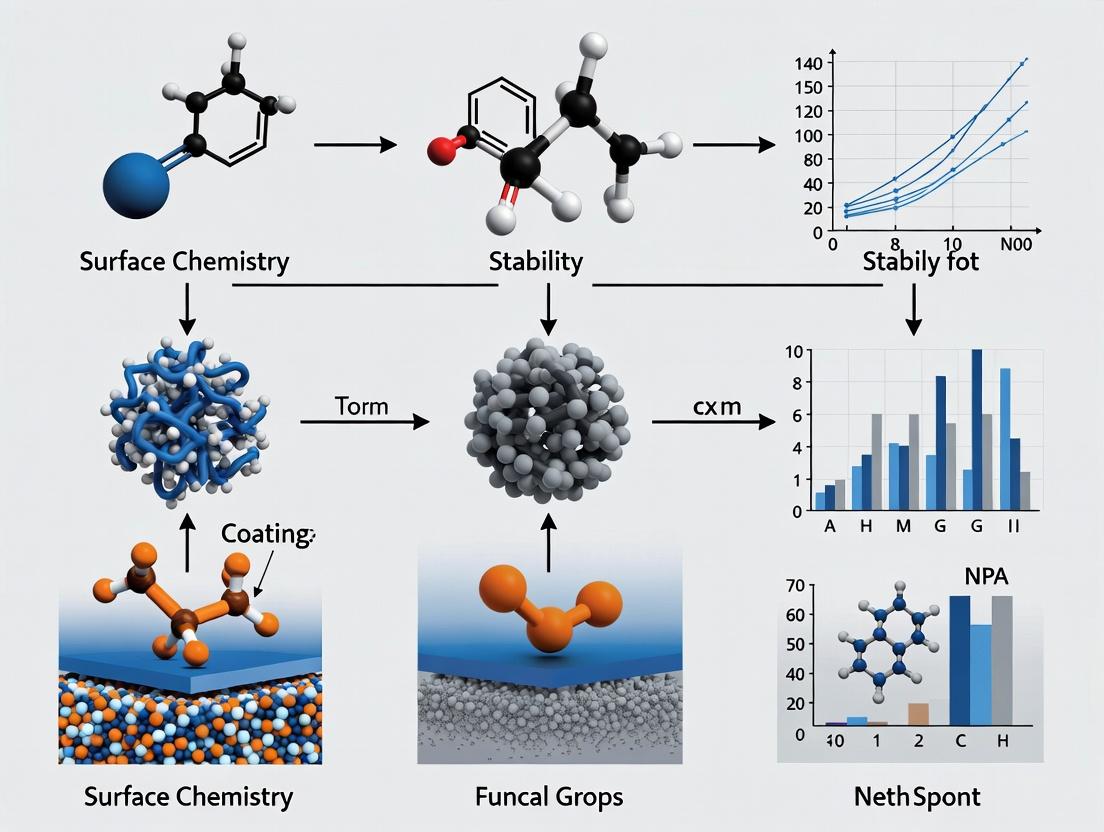
This article provides a comprehensive analysis of how surface chemistry governs nanoparticle stability, a pivotal factor for biomedical and drug delivery applications.
The Critical Role of Surface Chemistry in Nanoparticle Stability: Mechanisms, Challenges, and Solutions for Biomedical Applications
Abstract
This article provides a comprehensive analysis of how surface chemistry governs nanoparticle stability, a pivotal factor for biomedical and drug delivery applications. Targeting researchers and drug development professionals, it explores the foundational principles of colloidal stability and aggregation mechanisms. Methodologically, it details surface modification techniques, including ligand conjugation and stealth coatings, to engineer stable nanoparticles. The troubleshooting section addresses common instability challenges, offering optimization strategies. Finally, it compares analytical validation techniques and benchmarks performance across nanoparticle types. The synthesis provides actionable insights for designing stable, effective nanomedicines.
Understanding the Basics: How Surface Chemistry Dictates Nanoparticle Fate and Stability
This technical guide examines nanoparticle stability through three critical, interdependent lenses. The analysis is framed within the thesis that surface chemistry is the principal determinant of stability across all domains, dictating interactions that define nanoparticle fate and function.
Colloidal Stability
Colloidal stability refers to the resistance to aggregation and sedimentation, governed by interparticle forces. The Derjaguin-Landau-Verwey-Overbeek (DLVO) theory is foundational, describing the balance between van der Waals attraction and electrostatic repulsion. Steric stabilization using polymers (e.g., PEG) is a key surface chemistry strategy.
Experimental Protocol: Time-Dependent Aggregation Kinetics via Dynamic Light Scattering (DLS)
- Nanoparticle Preparation: Dilute the nanoparticle suspension (e.g., AuNPs, liposomes) in relevant media (deionized water, PBS, cell culture medium) to a standard concentration (~50 μg/mL).
- Instrument Calibration: Calibrate the DLS instrument using a standard latex nanosphere.
- Data Acquisition: Place sample in a cuvette. Measure the hydrodynamic diameter (Z-average) and polydispersity index (PDI) at time zero (t0).
- Incubation & Monitoring: Incubate the sample under relevant conditions (e.g., 37°C). Measure diameter and PDI at predefined intervals (e.g., 1, 4, 24, 48 hours).
- Data Analysis: Plot hydrodynamic diameter vs. time. A stable formulation will show minimal change. Calculate the aggregation rate constant from initial slopes if following second-order kinetics.
Quantitative Data on Colloidal Stability
| Nanoparticle Core | Surface Coating | Medium | Initial Z-avg (nm) | Z-avg after 24h (nm) | PDI Change (Δ) | Key Finding |
|---|---|---|---|---|---|---|
| Gold (15 nm) | Citrate | DI Water | 16.2 ± 0.5 | 16.5 ± 0.6 | +0.01 | Stable in low ionic strength |
| Gold (15 nm) | Citrate | PBS (1x) | 16.5 ± 0.7 | 2450 ± 350 | +0.45 | Rapid aggregation in high salt |
| PLGA (200 nm) | PEG(2k)-PLGA | PBS + 10% FBS | 212 ± 8 | 225 ± 12 | +0.03 | PEG confers steric & protein resistance |
Chemical Stability
Chemical stability involves the resistance to compositional change, including dissolution, oxidation, reduction, and surface ligand degradation. Surface coatings can act as protective barriers or be sites of reactive transformation.
Experimental Protocol: Monitoring Dissolution via Inductively Coupled Plasma Mass Spectrometry (ICP-MS)
- Sample Preparation: Prepare nanoparticle suspensions at a known concentration in biological buffers (e.g., acetate buffer for acidic pH mimicking lysosomes).
- Incubation: Aliquot samples and incubate at 37°C with agitation. At each time point (e.g., 0, 6, 24, 72 hours), centrifuge an aliquot using a 10 kDa centrifugal filter.
- Filtration: The filter will retain intact nanoparticles while allowing dissolved ions to pass through.
- Digestion & Analysis: Acid-digest both the filtrate (dissolved ions) and the retentate (nanoparticles). Analyze using ICP-MS to quantify the elemental composition in each fraction.
- Calculation: Determine the percentage of total material that has dissolved over time.
Quantitative Data on Chemical Stability
| Nanoparticle | Surface Coating | Environment (pH) | % Core Dissolved (24h) | % Ligand Degradation (24h) | Analytical Method |
|---|---|---|---|---|---|
| Silver (40 nm) | PVP | PBS (7.4) | 5.2 ± 0.8% | <2% | ICP-MS, HPLC |
| Silver (40 nm) | Silica Shell (5 nm) | PBS (7.4) | 0.8 ± 0.2% | N/A | ICP-MS |
| Quantum Dot (CdSe/ZnS) | PEG-COOH | Simulated Lysosomal Fluid (pH 4.5) | 12.3% Cd/Se release | Significant thiol ligand oxidation | ICP-MS, NMR |
Biological Stability
Biological stability encompasses the preservation of function and integrity in complex biological fluids, primarily focusing on resistance to opsonization, cellular uptake, and clearance by the mononuclear phagocyte system (MPS).
Experimental Protocol: Protein Corona Analysis using LC-MS/MS
- Corona Formation: Incubate nanoparticles (100 μg/mL) with 100% human plasma or serum at 37°C for 1 hour.
- Hard Corona Isolation: Separate nanoparticle-protein complexes via ultracentrifugation (e.g., 100,000 g for 1 hour) or size-exclusion chromatography.
- Wash: Gently wash the pellet 3x with PBS to remove loosely associated proteins (soft corona).
- Protein Elution & Digestion: Dissociate proteins from the nanoparticle surface using a denaturing and reducing buffer (e.g., SDS, DTT). Digest proteins using trypsin.
- LC-MS/MS Analysis: Analyze peptides via Liquid Chromatography with Tandem Mass Spectrometry.
- Bioinformatics: Identify proteins and quantify relative abundance. Perform pathway analysis for opsonins (e.g., immunoglobulins, complement) and dysopsonins (e.g., apolipoproteins).
Quantitative Data on Biological Stability
| Nanoparticle Type | Surface Chemistry | Hydrodynamic Diam. in Plasma (nm) | Key Corona Proteins Identified | Cellular Uptake in Macrophages (% Control) |
|---|---|---|---|---|
| Polystyrene | Carboxylate (-COOH) | +35 nm | Albumin, Fibrinogen, IgG, C3 | 100% (Baseline) |
| Polystyrene | Amine (-NH2) | +50 nm | IgG, C3, Apolipoprotein E | 185 ± 22% |
| Lipid Nanoparticle | PEG(2k)-Lipid | +10 nm | Apolipoproteins (A-I, E), Albumin | 35 ± 8% |
The Scientist's Toolkit: Key Research Reagent Solutions
| Item | Function in Stability Research |
|---|---|
| PEGylated Lipids (e.g., DSPE-PEG2000) | Provides steric stabilization, reduces protein opsonization, and prolongs blood circulation time. |
| Carbodiimide Crosslinkers (e.g., EDC, NHS) | Used for covalent conjugation of targeting ligands or stabilizers (e.g., polymers) to nanoparticle surface carboxyl groups. |
| Density Gradient Media (e.g., Sucrose, Iodixanol) | Enables isolation of nanoparticle-protein complexes from plasma for clean corona analysis. |
| Size-Exclusion Chromatography (SEC) Columns | Purifies nanoparticles from unbound ligands or aggregates; can separate corona-coated particles. |
| Fluorescent Probes (e.g., DID, FITC) | Incorporates into nanoparticles for tracking colloidal and biological fate via fluorescence assays. |
| Complement-Depleted Serum | Used to specifically investigate the role of the complement system in nanoparticle clearance. |
Diagrams
Within the broader thesis on "How does surface chemistry impact nanoparticle stability research?", understanding the fundamental forces governing colloidal interactions is paramount. Surface chemistry directly dictates the interfacial properties of nanoparticles, which in turn control their stability against aggregation—a critical factor in applications ranging from targeted drug delivery to diagnostic imaging. This whitepaper elucidates the core principles of the classical DLVO theory and its modern extensions, providing the theoretical and experimental framework essential for analyzing and engineering nanoparticle stability.
The DLVO Theory: A Foundational Framework
The Derjaguin-Landau-Verwey-Overbeek (DLVO) theory describes the stability of colloidal dispersions by balancing two primary long-range forces between particles as a function of their separation distance.
Attractive van der Waals (vdW) Interactions
These universal, non-specific attractive forces arise from induced dipole-dipole interactions. For two identical spherical particles of radius R, the approximate Hamaker expression for the vdW interaction energy (V_A) is: [ VA = -\frac{A{H}R}{12H} ] where (A_H) is the Hamaker constant (material-dependent, ~10^-19 - 10^-20 J) and H is the surface-to-surface separation.
Repulsive Electrostatic Double Layer (EDL) Interactions
When particles bear surface charge in a dispersing medium, a diffuse layer of counterions forms, creating an electrical double layer. The overlap of these layers upon particle approach generates a repulsive force. For two spheres with low surface potential ((\Psi0)) and thin double layers relative to particle size (( \kappa R >> 1 )), the repulsive energy (*VR*) is: [ VR = 2\pi R \epsilonr \epsilon0 \Psi0^2 \ln[1 + \exp(-\kappa H)] ] where (\epsilonr \epsilon0) is the permittivity of the medium, and (\kappa^{-1}) is the Debye screening length, inversely proportional to ionic strength.
The Total Interaction Energy Profile
The net DLVO interaction energy is the sum: ( V{Total} = VR + V_A ). This profile typically exhibits:
- A primary minimum at very short separations (strong attraction, irreversible aggregation).
- A repulsive energy barrier preventing close contact.
- A secondary minimum at larger separations (weak attraction, potentially reversible flocculation).
Table 1: Key Parameters Governing Classical DLVO Interactions
| Parameter | Symbol | Typical Range/Values | Impact on Stability |
|---|---|---|---|
| Hamaker Constant | (A_H) | 0.3 - 10 x 10^-20 J | Higher value increases attractive force, reducing stability. |
| Surface Potential | (\Psi_0) | ±10 to ±100 mV | Higher absolute value increases repulsive barrier, enhancing stability. |
| Ionic Strength | I | 1 mM - 1 M | Increase compresses EDL (( \kappa^{-1} ) decreases), lowering barrier, reducing stability. |
| Particle Radius | R | 1 - 1000 nm | Larger R scales up both V_A and V_R, but barrier height increases linearly. |
| Debye Length | (\kappa^{-1}) | 0.3 - 30 nm in water | Longer length increases the range of repulsion, enhancing stability. |
Beyond DLVO: The Role of Surface Chemistry
Surface chemistry introduces non-DLVO forces that are often decisive in nanoparticle stability, especially in complex biological or engineered environments.
Steric Repulsion
Grafted or adsorbed polymer chains (e.g., PEG, PVA) on the nanoparticle surface prevent aggregation via physical overlap and osmotic pressure. This is the primary stabilization mechanism for many drug delivery nanoparticles (e.g., liposomes, polymeric NPs).
Hydration and Hydrophobic Forces
- Hydration Force: Strong short-range repulsion between hydrophilic, often charged, surfaces due to energetically unfavorable displacement of bound water molecules.
- Hydrophobic Attraction: Strong, long-range attraction between hydrophobic surfaces in water, often overpowering DLVO repulsion and driving aggregation.
Ligand and Receptor-Mediated Interactions
In biological environments, specific interactions (e.g., antibody-antigen, ligand-receptor) can either stabilize nanoparticles by providing targeted binding or destabilize them via bridging flocculation.
Diagram Title: Forces Governing Nanoparticle Interaction and Stability
Experimental Protocols for Assessing Stability
Protocol: Measuring Zeta Potential to Assess Electrostatic Stability
Objective: Determine the effective surface charge (zeta potential, ζ) of nanoparticles to predict electrostatic repulsion per DLVO.
- Sample Preparation: Dilute nanoparticle suspension in appropriate buffer (typically 1 mM KCl or relevant medium) to ~0.1 mg/mL. Ensure conductivity is <5 mS/cm.
- Instrumentation: Use a Phase Analysis Light Scattering (PALS) based Zetasizer.
- Measurement: Load sample into folded capillary cell. Set temperature (e.g., 25°C). Perform at least 3 runs of 10-15 measurements each.
- Data Analysis: Report mean ζ ± standard deviation (SD). Per empirical rule: |ζ| > 30 mV indicates good electrostatic stability; |ζ| < 20 mV indicates susceptibility to aggregation.
- Variation: Measure ζ as a function of pH or ionic strength to identify isoelectric point and critical coagulation concentration (CCC).
Protocol: Dynamic Light Scattering (DLS) for Hydrodynamic Size & Aggregation Kinetics
Objective: Monitor the hydrodynamic diameter (D_H) and its distribution (PDI) over time or under stress.
- Sample Prep: Filter all buffers (0.1 μm) and dilute samples to avoid multiple scattering.
- Measurement: Use a backscatter detector (e.g., 173°). Perform triplicate measurements at constant temperature.
- Stability Assessment:
- Time-Course: Measure D_H and PDI at t=0, 1h, 4h, 24h, 1 week.
- Stress Test: Perform measurements after incubation at elevated temperature (e.g., 40°C) or after freeze-thaw cycles.
- Analysis: A significant increase in D_H and/or PDI indicates aggregation. The rate of change informs kinetic stability.
Protocol: Critical Coagulation Concentration (CCC) Determination
Objective: Experimentally find the ionic strength at which the DLVO barrier vanishes, leading to rapid aggregation.
- Prepare a series of nanoparticle suspensions in electrolytes (e.g., NaCl, CaCl₂) of varying molarity (e.g., 0.01 M to 2 M).
- Immediately after mixing, measure the initial rate of change in hydrodynamic radius (dR_H/dt) using DLS for each sample.
- Plot log(aggregation rate) vs. log(ionic strength). The CCC is identified at the transition from slow to fast aggregation regimes.
- The CCC validates DLVO predictions and quantifies stability against salt-induced aggregation.
The Scientist's Toolkit: Research Reagent Solutions
Table 2: Essential Materials for Nanoparticle Stability Research
| Item | Function & Relevance |
|---|---|
| Standard Ionic Salts (NaCl, KCl, CaCl₂) | To modulate ionic strength and screen electrostatic repulsion; used in CCC experiments. |
| pH Buffers (Citrate, Phosphate, Tris, HEPES) | To control surface charge (ζ-potential) by protonating/deprotonating surface groups. |
| Polymer Stabilizers (PEG, PVA, Poloxamers) | To provide steric stabilization; grafted or adsorbed to prevent particle approach. |
| Functionalized Ligands (Thiol-PEG-COOH, Silanes) | To engineer surface chemistry, introduce specific functional groups, and enable conjugation. |
| Fluorescent Dyes (Nile Red, Coumarin) | For labeling nanoparticles to enable tracking in complex media or in fluorescence-based aggregation assays. |
| Dialysis Membranes / Size Exclusion Columns | For purifying nanoparticles after synthesis or surface modification to remove unreacted species. |
| Model Aggregating Agents (Polylysine, Oppositely Charged Particles) | To induce controlled, specific aggregation (bridging flocculation) for mechanistic studies. |
| Serum/Plasma (Fetal Bovine Serum) | To test nanoparticle stability and protein corona formation in biologically relevant media. |
Diagram Title: Workflow for Nanoparticle Stability Assessment
Integrating DLVO and Beyond: A Modern Stability Analysis Framework
A complete stability analysis must integrate classical DLVO predictions with surface-chemical effects.
Table 3: Integrated Stability Analysis Matrix
| System Characteristic | DLVO Prediction | Surface Chemistry Influence | Experimental Verification Technique |
|---|---|---|---|
| High Salt Medium | Low barrier, aggregation likely. | Steric layer can maintain stability. Hydrophobic attraction may accelerate it. | CCC determination; DLS in serum. |
| Near Isoelectric Point | No electrostatic repulsion. | Hydration force may prevent aggregation if surface is hydrophilic. | Zeta potential vs. pH; measure aggregation at pH=pI. |
| Presence of Polymers | Not accounted for. | Steric repulsion dominates; can synergize with/override EDL. | Measure size in PEG-rich vs. salt-rich media. |
| Biological Fluid (e.g., plasma) | High ionic strength reduces barrier. | Protein corona formation radically alters surface chemistry and interaction potential. | DLS/Zeta before & after incubation; SDS-PAGE of corona. |
For the thesis investigating the impact of surface chemistry on nanoparticle stability, DLVO theory provides the indispensable, quantitative foundation for modeling electrostatic and van der Waals forces. However, it is the forces beyond DLVO—steric hindrance, solvation effects, and specific chemical interactions—dictated by engineered or acquired surface chemistry that frequently govern stability in practical applications. Successful nanoparticle design for drug delivery or diagnostics therefore requires a dual approach: leveraging DLVO to optimize core parameters like zeta potential, and deliberately engineering surface chemistry to harness stabilizing non-DLVO forces while mitigating destabilizing ones. This integrated framework is critical for transforming nanoparticle stability from an empirical observation into a predictable, designable property.
Within nanoparticle (NP) stability research, surface chemistry is the principal determinant of colloidal, chemical, and biological fate. This whitepaper examines three pivotal surface properties: Zeta Potential (surface charge), Hydrophilicity (wettability), and Ligand Density (conjugation efficiency). Their interplay governs stability against aggregation, protein corona formation, and target engagement—critical for therapeutic efficacy and safety in drug development.
Core Property Analysis
Zeta Potential (Surface Charge)
Zeta potential (ζ) measures the effective electric potential at the slipping plane of a nanoparticle in suspension, indicating its colloidal stability. High magnitude (typically > |±30| mV) promotes electrostatic repulsion, preventing aggregation.
Measurement: Laser Doppler Velocimetry via Dynamic Light Scattering (DLS) instruments. Key Factors: pH, ionic strength, and adsorbing species.
Hydrophilicity/Hydrophobicity
This property describes the affinity for water, influencing solubility, protein adsorption, and cellular uptake. Hydrophilic surfaces (e.g., PEGylated) resist non-specific protein fouling (opsonization), extending circulation time. Measurement: Water Contact Angle (for films), or indirectly via protein adsorption assays and two-phase partitioning.
Ligand Density
The number of functional molecules (e.g., antibodies, peptides, targeting moieties) per unit nanoparticle surface area. Optimal density balances target binding affinity with minimized steric hindrance and preserved colloidal stability. Quantification: Techniques include fluorescent labeling, NMR, radioassays, or spectrophotometric methods (e.g., BCA for proteins).
Table 1: Impact of Surface Properties on Nanoparticle Stability & Behavior
| Property | Typical Measurement Range | High Stability Indicator | Primary Influence on Stability |
|---|---|---|---|
| Zeta Potential | -60 mV to +60 mV | > |±30| mV | Electrostatic repulsion; aggregation resistance in low-ionic media. |
| Hydrophilicity | Contact Angle: 0° (hydrophilic) to >90° (hydrophobic) | Low Contact Angle (Hydrophilic) | Steric repulsion (via hydrated polymers like PEG); reduces protein corona formation, enhancing in vivo circulation half-life. |
| Ligand Density | 0.1 - 5 molecules / nm² (varies widely with ligand & core) | Optimal, system-dependent density | Balances targeting efficacy with stealth properties; excessive density can cause aggregation or hinder receptor engagement. |
Table 2: Characterization Techniques for Surface Properties
| Property | Primary Technique(s) | Sample Requirement | Key Output |
|---|---|---|---|
| Zeta Potential | Electrophoretic Light Scattering (ELS) | Dilute colloidal suspension | Zeta potential (mV), electrophoretic mobility. |
| Hydrophilicity | Water Contact Angle Goniometry; Isothermal Titration Calorimetry (ITC) | Flat substrate or NP suspension | Contact angle (degrees); enthalpy of hydration. |
| Ligand Density | Fluorescence Spectroscopy; Elemental Analysis (e.g., ICP-MS); UV-Vis | Purified functionalized NPs | Molecules/NP, ligands/nm². |
Experimental Protocols
Protocol: Measuring Zeta Potential of Nanoparticles
Principle: Measure particle velocity in applied electric field (electrophoresis). Materials: Purified NP suspension, appropriate buffer (low ionic strength, e.g., 1 mM KCl), zeta cell, DLS/ELS instrument. Steps:
- Dilution: Dilute NP sample in 1 mM KCl or 10 mM NaCl to achieve slight translucency. Ensure conductivity < 1 mS/cm.
- Loading: Inject sample into clean, dry folded capillary zeta cell, avoiding bubbles.
- Equilibration: Insert cell into instrument, allow temperature equilibration to 25°C.
- Measurement: Set parameters: dispersant dielectric constant (water: 78.5), viscosity (0.887 cP). Run 3-15 measurements.
- Analysis: Use Smoluchowski model for aqueous, high-ionic strength; Hückel model for non-aqueous. Report mean ζ ± SD.
Protocol: Determining Ligand Density via UV-Vis Spectroscopy
Principle: Quantify ligand concentration spectrophotometrically using its specific absorbance. Materials: Functionalized NPs, unmodified NPs (control), ligand standard, UV-Vis spectrometer, centrifugal filters (e.g., 100 kDa MWCO). Steps:
- Calibration: Prepare a series of ligand standards in buffer. Measure absorbance at λ_max (e.g., 280 nm for proteins). Create standard curve (A vs. concentration).
- NP Purification: Purify functionalized NPs via centrifugation/ultrafiltration (3x) to remove unbound ligand. Retain all wash supernatants.
- Indirect Measurement: Measure total ligand in wash supernatants. Subtract from initial ligand amount to calculate bound ligand.
- Direct Measurement (if possible): Lyse a known volume/concentration of purified NPs (e.g., with 1% SDS) to release bound ligand. Measure A of lysate.
- Calculation:
- Bound ligand concentration from standard curve.
- Number of NPs/mL = (Total NP mass/mL) / (Density * Volume per NP).
- Ligands/NP = (Bound ligand moles/mL) / (Number of NPs/mL) / Avogadro's number.
- Ligand density = Ligands/NP / (4πr²), where r is NP hydrodynamic radius.
Diagrams
Diagram 1: Surface Chemistry Dictates Nanoparticle Fate
Diagram 2: Zeta Potential Measurement Workflow
The Scientist's Toolkit
Table 3: Essential Research Reagents & Materials
| Item Category | Specific Example(s) | Function in Surface Property Analysis |
|---|---|---|
| Buffer Systems | 1 mM KCl, 10 mM PBS, HEPES, Citrate buffers | Control pH and ionic strength for accurate zeta potential and aggregation studies. |
| Purification Tools | Amicon centrifugal filters (various MWCO), Dialysis membranes | Remove excess/unbound ligands and byproducts to purify functionalized NPs for accurate density measurement. |
| Characterization Standards | Latex/NIST traceable zeta potential standards, Bovine Serum Albumin (BSA) | Calibrate instruments (DLS/ELS) and serve as model protein for hydrophilicity/protein adsorption assays. |
| Functionalization Reagents | Methoxy-PEG-Thiol (mPEG-SH), NHS-Ester modified ligands, EDC/Sulfo-NHS coupling kits | Introduce hydrophilic polymers or conjugate targeting ligands to NP surfaces. |
| Detection Reagents | Fluorescent dyes (e.g., FITC, Cy5), BCA/ Bradford protein assay kits | Label and quantify bound ligands for density calculations. |
| Reference Materials | Hydrophobic/Hydrophilic model nanoparticles (e.g., polystyrene with different coatings) | Positive/Negative controls for hydrophilicity and protein binding experiments. |
Within the context of a broader thesis on How does surface chemistry impact nanoparticle stability research, understanding the primary physical instability mechanisms is paramount. For colloidal nanosuspensions in pharmaceuticals, diagnostics, and material science, stability is not inherent. Three dominant pathways lead to the loss of nanoscale properties: aggregation, Ostwald ripening, and sedimentation. Each mechanism is fundamentally governed by the interplay of particle surface chemistry with the surrounding medium. This guide provides a technical dissection of these mechanisms, relevant experimental protocols, and the tools for their study.
Aggregation (Flocculation and Coagulation)
Aggregation involves particles sticking together to form larger clusters, driven by the net balance of attractive van der Waals forces and repulsive forces, typically electrostatic or steric.
Surface Chemistry Impact: The surface ligand density, charge (zeta potential), and hydrophilicity dictate the energy barrier to aggregation. A high zeta potential (> |±30| mV) promotes electrostatic stability, while polymeric coatings (e.g., PEG) provide steric hindrance.
Experimental Protocol for Assessing Aggregation Kinetics:
- Objective: Determine the rate of aggregation as a function of ionic strength or pH.
- Materials: Nanoparticle dispersion, salt solutions (e.g., NaCl), pH buffers, dynamic light scattering (DLS) instrument, zeta potential analyzer.
- Procedure:
- Characterize the initial hydrodynamic diameter (Z-average) and zeta potential of the nanoparticle stock.
- Prepare a series of vials with fixed nanoparticle concentration and varying concentrations of NaCl (0.1 mM to 1 M).
- Incubate at a constant temperature (e.g., 25°C).
- Measure the hydrodynamic diameter via DLS at regular time intervals (e.g., 0, 1, 2, 4, 24 hours).
- Plot diameter vs. time. A rapid increase indicates fast aggregation near the critical coagulation concentration (CCC).
Ostwald Ripening
Ostwald ripening is the growth of larger nanoparticles at the expense of smaller ones due to the difference in solubility as described by the Kelvin equation. Molecules dissolve from smaller, higher-curvature particles and redeposit onto larger ones.
Surface Chemistry Impact: Surface energy, which is a direct function of surface chemistry and curvature, drives this process. Surface coatings that reduce interfacial energy or form diffusion barriers can mitigate ripening.
Experimental Protocol for Monitoring Ostwald Ripening:
- Objective: Track the evolution of particle size distribution over time in a saturated medium.
- Materials: Nanoparticle dispersion, saturated solution of the nanoparticle core material, centrifugation equipment, Transmission Electron Microscopy (TEM) or asymmetric flow field-flow fractionation (AF4).
- Procedure:
- Suspend nanoparticles in a saturated solution to prevent net dissolution.
- Store the suspension at constant temperature.
- At defined time points (e.g., days 1, 7, 30), sample the suspension.
- Analyze particle size distribution using TEM (measuring primary particle diameters) or AF4 coupled with DLS. An increase in mean size and a broadening of the distribution over time indicates ripening.
Sedimentation
Sedimentation is the settling of particles under gravity, described by Stokes' law. It becomes significant when aggregation or ripening increases the effective particle size.
Surface Chemistry Impact: Surface charge and steric coatings influence the degree of aggregation and the effective density of the particle "corona," thereby indirectly controlling the sedimentation rate. A stable, well-dispersed colloid will sediment very slowly.
Experimental Protocol for Sedimentation Velocity Study:
- Objective: Quantify the sedimentation profile of a nanoformulation over time.
- Materials: Nanoparticle dispersion, optical analyzer for turbidity (or simple visual inspection), centrifuge tubes, analytical balance.
- Procedure (Visual Stability Index):
- Disperse nanoparticles uniformly by gentle agitation.
- Fill identical cylindrical vials to a marked height.
- Store undisturbed at constant temperature.
- At regular intervals, measure the height of the clarified supernatant layer (Hs) and the total height (Ht).
- Calculate the sedimentation ratio: Sedimentation (%) = (Hs / Ht) * 100.
- Plot sedimentation % vs. time. Faster settling indicates poorer colloidal stability.
Table 1: Characteristic Signatures and Driving Forces of Instability Mechanisms
| Mechanism | Primary Driving Force | Key Measurable Indicator | Typical Timescale | Surface Chemistry Lever for Mitigation |
|---|---|---|---|---|
| Aggregation | Net attractive interparticle forces | Rapid increase in hydrodynamic diameter (DLS); change in zeta potential | Minutes to hours | High surface charge (zeta potential); dense steric coatings (e.g., PEG) |
| Ostwald Ripening | Solubility gradient due to curvature | Shift in core size distribution (TEM); increase in polydispersity index | Days to months | Low interfacial energy coatings; cross-linked or solid shells |
| Sedimentation | Gravitational force & particle size | Clarification of supernatant; sediment layer formation | Hours to days | Maintain small primary size via anti-aggregation coatings; density matching |
Table 2: Common Analytical Techniques for Instability Analysis
| Technique | Measures | Applicable Mechanism(s) | Key Output Parameter |
|---|---|---|---|
| Dynamic Light Scattering (DLS) | Hydrodynamic diameter | Aggregation, Sedimentation | Z-average, PDI |
| Zeta Potential Analysis | Surface charge | Aggregation | Zeta Potential (mV) |
| Transmission Electron Microscopy (TEM) | Primary particle size, morphology | Ostwald Ripening, Aggregation | Core diameter distribution |
| Ultracentrifugation | Sedimentation rate | Sedimentation, Aggregation | Sedimentation coefficient |
| Turbidity/UV-Vis Spectroscopy | Light scattering/absorption | Aggregation, Sedimentation | Absorbance at λ_max |
Visualization of Mechanisms and Workflows
Diagram 1: Interplay of Primary Instability Mechanisms (75 chars)
Diagram 2: Workflow for Nanoparticle Stability Assessment (78 chars)
The Scientist's Toolkit: Key Research Reagent Solutions
| Item / Reagent | Primary Function in Stability Research |
|---|---|
| Polyethylene Glycol (PEG) Thiols/Alkovysilanes | Forms steric stabilization layer on nanoparticle surface (Au, SiO2, etc.) to prevent aggregation. |
| Citrate or Carboxylic Acid Capping Agents | Provides electrostatic stabilization via negative surface charge; common for gold and silver NPs. |
| Polyvinylpyrrolidone (PVP) | Steric stabilizer and reducing agent for various metal nanoparticles; controls growth and aggregation. |
| Phosphate Buffered Saline (PBS) | Common physiological medium for stability testing; ionic strength can induce aggregation. |
| Dithiothreitol (DTT) or TCEP | Reducing agents used to test ligand exchange kinetics and shell stability on noble metal NPs. |
| Sucrose or Glycerol | Viscosity modifiers and density adjustment agents to slow sedimentation and study ripening in quenched media. |
| Pluronic F-127 or Poloxamers | Non-ionic triblock copolymer surfactants used for steric stabilization and preventing protein fouling. |
| Custom Functionalized Ligands | (e.g., peptides, antibodies, targeted polymers) Used to study how complex surface chemistry impacts colloidal stability in biological milieu. |
The surface chemistry of nanoparticles (NPs) is the principal determinant of their stability, fate, and function within biological environments. A core challenge in nanomedicine is the rapid, dynamic interaction of NPs with biological fluids, leading to the formation of a "protein corona." This adsorbed protein layer critically alters the NP's synthetic identity, dictating its hydrodynamic size, surface charge, aggregation state, and interfacial properties. A key biological consequence of corona formation is opsonization—the adsorption of proteins (e.g., immunoglobulins, complement factors) that tag the NP for recognition and clearance by the mononuclear phagocyte system (MPS). Therefore, understanding corona formation and opsonization is fundamental to a thesis on how surface chemistry impacts nanoparticle stability research, bridging initial colloidal stability to biological stability and therapeutic efficacy.
Protein Corona: Composition, Dynamics, and Driving Forces
Upon entering a biological fluid (e.g., plasma, interstitial fluid), NPs are immediately coated with proteins. This corona exists in two layers:
- Hard Corona: A tightly bound, long-lived layer of proteins with high affinity, which defines the biological identity.
- Soft Corona: A loosely associated, rapidly exchanging outer layer.
The composition and configuration of the corona are governed by NP surface chemistry (hydrophobicity, charge, functional groups), size, shape, and curvature, as well as environmental factors (protein concentration, pH, temperature, flow dynamics).
Table 1: Key Opsonins and Their Impact on Nanoparticle Fate
| Opsonin | Molecular Weight (kDa) | Concentration in Human Plasma (mg/mL) | Primary Recognition Receptor on Phagocytes | Consequence for NP |
|---|---|---|---|---|
| Immunoglobulin G (IgG) | ~150 | 10-12 | Fcγ Receptors (FcγR) | Enhanced phagocytosis, MPS clearance. |
| Complement C3b/iC3b | ~185 (C3b) | 1.2-1.5 | Complement Receptor 1 (CR1), CR3 | Opsonization, activation of inflammatory response. |
| Fibrinogen | ~340 | 2-4 | Integrins (e.g., αMβ2) | Promotes inflammatory response, platelet adhesion. |
| Apolipoproteins (e.g., ApoE) | ~34-44 | Varies | LDL Receptor family | Can influence brain targeting or hepatic clearance. |
Experimental Protocols for Corona and Opsonization Analysis
Protocol: In Vitro Protein Corona Formation and Isolation
Objective: To isolate and analyze the hard protein corona formed on NPs after incubation in human plasma. Materials:
- Purified NPs (e.g., PEGylated liposomes, PLGA NPs).
- Human platelet-poor plasma (or relevant biological fluid).
- Phosphate-buffered saline (PBS), pH 7.4.
- Ultracentrifuge with swinging-bucket rotor.
- Density gradient media (e.g., sucrose cushions).
- SDS-PAGE and Western Blot apparatus, or LC-MS/MS for proteomics.
Procedure:
- Incubation: Incubate NP dispersion (1 mg/mL) with 50% (v/v) human plasma in PBS at 37°C with gentle rotation for 1 hour.
- Separation: Layer the NP-plasma mixture onto a dense sucrose cushion (e.g., 60% w/v sucrose in PBS) in an ultracentrifuge tube.
- Ultracentrifugation: Centrifuge at 100,000 x g for 3 hours at 4°C. The NPs with hard corona will pellet, while unbound proteins remain in the supernatant/cushion interface.
- Washing: Carefully aspirate the supernatant and cushion. Gently wash the pellet with cold PBS and repeat centrifugation (100,000 x g, 1 hour).
- Corona Elution & Analysis: Resuspend the pellet in 1X Laemmli buffer. Heat at 95°C for 10 minutes to elute proteins. Analyze by:
- SDS-PAGE: For protein pattern visualization.
- Western Blot: For specific opsonin detection (e.g., Anti-IgG, Anti-C3b).
- LC-MS/MS: For comprehensive proteomic profiling of corona composition.
Protocol: Quantitative Assessment of Phagocytosis via Flow Cytometry
Objective: To measure the uptake of opsonized NPs by macrophages, linking surface chemistry to biological outcome. Materials:
- RAW 264.7 or THP-1 derived macrophages.
- Fluorescently labeled NPs (e.g., FITC, Cy5).
- Human plasma for opsonization.
- Flow cytometer with appropriate lasers.
- Trypan blue (0.4%) as a fluorescence quencher for surface-bound NPs.
Procedure:
- NP Opsonization: Incubate fluorescent NPs with 50% human plasma (opsonized) or PBS (non-opsonized control) for 1 hour at 37°C. Purify via centrifugation (as in 3.1).
- Cell Incubation: Seed macrophages in 24-well plates. Add opsonized or control NPs to cells at a standard particle-to-cell ratio. Incubate at 37°C, 5% CO₂ for 2-4 hours.
- Quenching & Harvesting: Wash cells with cold PBS. Treat with trypan blue (0.4% in PBS) for 10 minutes to quench extracellular fluorescence. Wash thoroughly.
- Analysis: Detach cells, resuspend in PBS, and analyze by flow cytometry. Measure the geometric mean fluorescence intensity (MFI) of the cell population, which is proportional to NP uptake.
Visualization of Key Concepts and Pathways
Title: Nanoparticle Opsonization and Clearance Pathway
Title: Experimental Workflow for Hard Corona Isolation
The Scientist's Toolkit: Essential Research Reagents and Materials
Table 2: Key Research Reagent Solutions for Corona/Opsonization Studies
| Item | Function & Rationale |
|---|---|
| Human Platelet-Poor Plasma (PPP) | The gold-standard biological fluid for in vitro corona studies. Contains the full complement of proteins, lipids, and ions. Must be handled carefully to prevent complement activation. |
| Density Gradient Media (Sucrose/Nycodenz) | Used in ultracentrifugation to create a density barrier for clean separation of corona-coated NPs from unbound proteins, minimizing contamination. |
| Protease Inhibitor Cocktail | Added to biological fluids and wash buffers to prevent proteolytic degradation of corona proteins during isolation and analysis. |
| Anti-Human IgG (Fc specific) Antibody | A primary antibody for Western Blot or ELISA to specifically detect and quantify IgG opsonin within the hard corona. |
| Fluorescent Nanoparticle Standards (e.g., PEGylated QDs) | Well-characterized NPs with known surface chemistry, used as controls or reference materials in comparative uptake studies. |
| Differentiated THP-1 Monocytes | A consistent human-derived cell line that can be differentiated into macrophage-like cells, providing a standardized model for phagocytosis assays. |
| Trypan Blue (0.4%) | A vital dye used to quench extracellular fluorescence from NPs bound to but not internalized by cells, ensuring flow cytometry data reflects true uptake. |
| LC-MS/MS Grade Solvents (Acetonitrile, Formic Acid) | Essential for high-performance liquid chromatography and mass spectrometry analysis of corona proteome, ensuring minimal background interference. |
Engineering Stability: Surface Modification Techniques and Functionalization Strategies
Within nanoparticle (NP) stability research, surface chemistry is the principal determinant of colloidal stability, pharmacokinetic fate, and therapeutic efficacy. This guide provides a technical analysis of four core coating material classes—Polyethylene Glycol (PEG), synthetic polymers, lipids, and polysaccharides—detailing their mechanisms, quantitative performance, and experimental protocols for evaluating their impact on NP stability in biological environments.
Material Classes & Stability Mechanisms
Polyethylene Glycol (PEG)
- Mechanism: Forms a dense, hydrophilic, and sterically repulsive layer via surface conjugation ("PEGylation"). It reduces interfacial free energy, minimizes opsonin adsorption, and increases hydration.
- Key Parameters: Grafting density, molecular weight (MW), and chain conformation (mushroom vs. brush regime). High-density brush regimes (≥ 0.5 chains/nm² for 2kDa PEG) confer optimal stealth.
Synthetic Polymers
- Types & Examples: Poly(lactic-co-glycolic acid) (PLGA), Poly(vinylpyrrolidone) (PVP), Poly(ethylene imine) (PEI), and Poly(2-oxazoline)s.
- Mechanism: Provides steric stabilization. Charge can be introduced (e.g., cationic PEI for complexation). Biodegradable polymers (e.g., PLGA) offer controlled release and clearance.
Lipids
- Types & Examples: Phosphatidylcholine (PC), polyethylene glycolylated lipids (PEG-lipids, e.g., DSPE-PEG2000), and cholesterol.
- Mechanism: Form lamellar bilayers or monolayers on NP cores (e.g., lipid nanoparticles, liposomes). PEG-lipids impart stealth. Lipid fluidity and phase transition temperature (Tm) dictate membrane integrity and stability.
Polysaccharides
- Types & Examples: Hyaluronic acid (HA), chitosan, dextran, and heparin.
- Mechanism: Offer steric stabilization and biological targeting (e.g., HA for CD44 receptors). Chitosan's cationic nature enables mucoadhesion. Their biodegradability and low immunogenicity are advantageous.
Quantitative Stability Data Comparison
Table 1: Comparative Impact of Coating Materials on Nanoparticle Stability
| Coating Material | Typical Hydrodynamic Size (nm) | Zeta Potential (mV) | Key Stability Metric (e.g., Aggregation Onset) | Serum Protein Reduction vs. Uncoated (%) |
|---|---|---|---|---|
| Uncoated AuNP | 20 | -30 to -40 | Aggregates in >100 mM NaCl | Baseline (0%) |
| PEG (5kDa) | 35 | -5 to +5 | Stable in 1 M NaCl | 85-95% |
| PLGA | 150-200 | -20 to -30 | Stable in PBS for >14 days | 60-75% |
| DSPE-PEG2000 | 100 (LNPs) | -1 to +1 | Stable in serum for >48h | 80-90% |
| Chitosan | 220 | +30 to +40 | Stable at pH <6, aggregates at neutral pH | 40-60% |
| Hyaluronic Acid | 110 | -25 to -35 | Stable in physiological buffers | 70-85% |
Data compiled from recent literature (2022-2024). Values are representative and vary with synthesis.
Table 2: Critical Experimental Assays for Stability Assessment
| Assay | Measured Parameter | Coating-Specific Relevance |
|---|---|---|
| DLS / NTA | Hydrodynamic diameter (Dh), PDI | Detects aggregation; brush thickness for PEG. |
| Zeta Potential | Surface charge (ζ) | Indicates coating success & colloidal stability. |
| UV-Vis / SPR | Plasmon shift (metallic NPs), aggregation | Real-time aggregation monitoring. |
| ITC / DSC | Binding enthalpy, Phase transition (Tm) | Lipid bilayer integrity, polymer-drug interactions. |
| SDS-PAGE / LC-MS | Corona protein composition | Quantifies "stealth" effect of PEG/polysaccharides. |
| SEC / FFF | Size distribution in complex media | Detects stability breakdown in serum. |
Detailed Experimental Protocols
Protocol: Assessing Colloidal Stability via Salt Challenge
Objective: Quantify the aggregation resistance of coated NPs. Materials: Coated NP dispersion, NaCl solutions (0-1 M), PBS, DLS instrument. Procedure:
- Dialyze NP sample against deionized water.
- Prepare 1 mL aliquots of NP dispersion in increasing NaCl concentrations (0, 50, 100, 250, 500, 1000 mM). Final NP concentration constant.
- Incubate at 25°C for 1 hour.
- Measure hydrodynamic diameter (Dh) and PDI via DLS for each sample.
- Data Analysis: Plot Dh vs. [NaCl]. The critical coagulation concentration (CCC) is defined as the [NaCl] at which Dh increases by 20% from baseline.
Protocol: Analyzing Protein Corona Formation
Objective: Determine the protein adsorption profile of coated NPs in serum. Materials: Coated NPs, fetal bovine serum (FBS), ultracentrifuge, SDS-PAGE kit, LC-MS access. Procedure:
- Incubate 1 mg/mL of NPs with 50% FBS in PBS at 37°C for 1 hour.
- Centrifuge at 100,000 x g for 1 hour to pellet NP-protein complexes.
- Carefully remove supernatant and wash pellet gently with PBS. Repeat centrifugation.
- Resuspend the hard corona pellet in SDS-PAGE loading buffer. Heat at 95°C for 5 min.
- Analyze via SDS-PAGE (Coomassie staining) and/or perform in-gel tryptic digestion for LC-MS/MS identification.
- Data Analysis: Compare banding patterns/intensities or identified protein lists between different coatings.
Visualizing Coating-Mediated Stability Pathways
Title: Surface Coating Dictates Nanoparticle Fate in Biological Milieu
Title: Core Experimental Workflow for Coating Evaluation
The Scientist's Toolkit: Essential Research Reagents
Table 3: Key Reagent Solutions for Surface Coating & Stability Studies
| Reagent / Material | Function / Application | Key Consideration |
|---|---|---|
| mPEG-Thiol (e.g., mPEG-SH, 2k-10kDa) | Conjugates to gold, quantum dots via Au-S bond. Provides stealth layer. | Purify to remove disulfide dimers. Use fresh. |
| DSPE-PEG (2000) NH₂ / COOH | Amphiphilic lipid-PEG for post-insertion or co-formulation into lipidic NPs. | Critical micelle concentration (CMC) affects stability. |
| PLGA (50:50, acid-terminated) | Biodegradable polymer core for encapsulation. Surface charge allows further modification. | Viscosity & MW affect NP size & drug loading. |
| Chitosan (Low/Medium MW) | Cationic polysaccharide for mucosal adhesion or nucleic acid complexation. | Degree of deacetylation dictates solubility & charge. |
| Fetal Bovine Serum (FBS) | Standard medium for in vitro protein corona formation studies. | Batch variability affects corona composition. |
| Size Exclusion Chromatography (SEC) Columns | Purify coated NPs from unconjugated ligands or aggregates. | Select pore size appropriate for NP hydrodynamic radius. |
| Zeta Potential Reference Standard (e.g., -50mV) | Verifies instrument performance before measuring sensitive NP samples. | Essential for reproducible inter-study comparisons. |
The stability of nanoparticles (NPs) in complex biological and colloidal environments is a cornerstone of their successful application in diagnostics and therapeutics. Within the broader thesis investigating How does surface chemistry impact nanoparticle stability research, the choice between covalent and non-covalent functionalization emerges as a primary determinant. This guide provides a technical dissection of both strategies, analyzing their impact on NP stability—defined as colloidal integrity, resistance to opsonization, and retention of targeting/ therapeutic ligands under physiological stress.
Core Principles and Stability Implications
Covalent Functionalization involves forming irreversible chemical bonds (e.g., amide, thioether, disulfide) between the NP surface and functional ligands (PEG, antibodies, peptides). This method directly alters the surface chemistry at the molecular level.
Non-covalent Functionalization relies on reversible interactions: electrostatic adsorption, hydrophobic interactions, π-π stacking, or affinity binding (e.g., biotin-streptavidin). The surface chemistry is modified through physical association, which is more dynamic.
The selection dictates the nanoparticle's interfacial energy, surface charge (zeta potential), hydration, and ultimately, its thermodynamic and kinetic stability in vitro and in vivo.
Comparative Analysis: Pros and Cons
Table 1: Comparative overview of covalent vs. non-covalent functionalization.
| Aspect | Covalent Functionalization | Non-covalent Functionalization |
|---|---|---|
| Bond Strength & Stability | Strong, irreversible bonds. High kinetic stability under dilution, salinity, and shear. | Weak, reversible interactions. Prone to dissociation and ligand exchange. |
| Surface Coverage & Control | Precise, reproducible control over ligand density and orientation. | Less precise; coverage depends on interaction kinetics and equilibrium conditions. |
| Complexity & Reproducibility | Multi-step synthesis. Requires specific reactive groups. High batch-to-batch reproducibility. | Simpler, often one-step. Reproducibility can be sensitive to environmental conditions (pH, ionic strength). |
| Impact on Bioactivity | Risk of modifying active sites of biomolecules during conjugation. | Preserves native structure and activity of biomolecules. |
| Stability in Biological Fluids | Excellent resistance to opsonization and dilution, especially with dense PEG layers. | Can be unstable; ligands may desorb or be displaced by serum proteins. |
| Typical Applications | Long-circulating therapeutic NPs, in vivo diagnostics, stable biosensors. | Short-term assays, facile composite materials, modular pre-targeting strategies. |
Table 2: Quantitative comparison of key stability metrics for gold nanoparticles (AuNPs).
| Functionalization Type | Example Ligand | Average Hydrodynamic Size Increase (nm) | Zeta Potential Shift (mV) | Colloidal Stability in 1x PBS (Time) | Fibrinogen Adsorption (% Reduction vs. Bare NP) |
|---|---|---|---|---|---|
| Covalent | PEG-Thiol (5 kDa) | +8.2 ± 1.1 | -40 to -10 | > 30 days | 85-95% |
| Covalent | Anti-EGFR Antibody | +15.5 ± 2.3 | -35 to -25 | > 14 days | 70-80% |
| Non-covalent | Chitosan | +5.0 ± 2.5 | +25 to +40 | < 7 days | 40-60% |
| Non-covalent | Polystyrene Sulfonate | +3.1 ± 0.8 | -50 to -60 | < 48 hours | 20-40% |
Detailed Experimental Protocols
Protocol 1: Covalent Functionalization of AuNPs with PEG and Targeting Ligands via EDC/Sulfo-NHS Chemistry
This protocol creates stable, targeted NPs for in vivo applications.
Materials: Citrate-coated AuNPs (20 nm), mPEG-SH (5 kDa), Carboxyl-PEG-SH (3.4 kDa), targeting peptide (e.g., RGD, with terminal amine), EDC (1-ethyl-3-(3-dimethylaminopropyl)carbodiimide), Sulfo-NHS (N-hydroxysulfosuccinimide), MES buffer (0.1 M, pH 5.5), PBS (pH 7.4).
Procedure:
- Ligand Thiolation/Purification: If the targeting ligand lacks a thiol, react with Traut's reagent (2-iminothiolane) following manufacturer protocol. Purify via desalting column.
- Initial PEGylation: Incubate 1 nM AuNPs with a 10,000:1 molar ratio of mPEG-SH in PBS for 12 hours at RT. This creates a stabilizing monolayer.
- Activation: To the same solution, add carboxyl-PEG-SH (500:1 molar ratio to AuNP). Incubate 1 hour. Exchange buffer to MES using a 100 kDa centrifugal filter.
- Coupling Reaction: Add EDC (5 mM final) and Sulfo-NHS (10 mM final) to the AuNP solution. React for 15 min at RT to activate carboxyl groups.
- Targeting Ligand Conjugation: Add the thiolated/aminated targeting ligand (100:1 molar ratio to AuNP). React for 2 hours at RT.
- Quenching & Purification: Quench the reaction with 100 mM glycine for 15 min. Purify functionalized AuNPs via centrifugation (14,000 x g, 30 min) or tangential flow filtration. Resuspend in sterile PBS. Characterize by DLS, UV-Vis, and FTIR.
Protocol 2: Non-covalent Functionalization of Lipid NPs (LNPs) with Antibodies via Post-Insertion
This protocol modularly attaches antibodies to pre-formed LNPs for targeted drug delivery.
Materials: Pre-formed mRNA or drug-loaded LNPs, Maleimide-PEG-DSPE (MW 3400), targeting antibody, Tris buffer (pH 7.0), EDTA (2 mM), Sepharose CL-4B column.
Procedure:
- Linker Micelle Formation: Dissolve Maleimide-PEG-DSPE in chloroform, dry under nitrogen, and hydrate in Tris/EDTA buffer to form micelles (final lipid conc. ~1 mM). Sonicate if necessary.
- Antibody Reduction: Incubate the antibody (1 mg/mL) with a 20:1 molar excess of 2-mercaptoethylamine (Traut's reagent can be used alternatively) in Tris/EDTA for 90 min at 37°C to generate free thiols. Purify immediately using a desalting column equilibrated with degassed Tris/EDTA.
- Post-Insertion: Incubate the pre-formed LNPs (at ~1 mM total lipid) with Maleimide-PEG-DSPE micelles (at 1-5 mol% of total LNP lipid) for 1 hour at 60°C with gentle stirring. Cool to RT.
- Antibody Conjugation: Add the thiolated antibody (molar ratio 50:1, antibody:PEG-lipid) to the LNPs. React for 12 hours at 4°C under an inert atmosphere.
- Purification: Separate conjugated LNPs from unreacted antibody and micelles using size-exclusion chromatography (Sepharose CL-4B). Characterize by DLS for size/polydispersity and ELISA for retained antibody activity.
Visualizing Functionalization Strategies and Impact on Stability
Diagram Title: Functionalization pathways and stability assessment.
Diagram Title: Stability outcomes of surface chemistry in biological environments.
The Scientist's Toolkit: Research Reagent Solutions
Table 3: Essential materials for nanoparticle functionalization and stability analysis.
| Reagent/Material | Function in Research | Example Supplier/Catalog |
|---|---|---|
| EDC (1-Ethyl-3-(3-dimethylaminopropyl)carbodiimide) | Zero-length crosslinker; activates carboxyl groups for coupling to primary amines. Crucial for covalent conjugation. | Thermo Fisher, 22980 |
| Sulfo-NHS (N-hydroxysulfosuccinimide) | Stabilizes EDC-formed O-acylisourea intermediate, improving reaction efficiency and yield in aqueous buffers. | Thermo Fisher, 24510 |
| Maleimide-PEG-DSPE | Heterobifunctional linker for post-insertion. DSPE anchors in lipid bilayers, PEG spacers reduce steric hindrance. | Nanocs, PG2-MLNS-5k |
| Traut's Reagent (2-Iminothiolane) | Introduces sulfhydryl (-SH) groups onto primary amines, enabling thiol-based conjugation (e.g., to maleimides). | Thermo Fisher, 26101 |
| HPLC-purified Functional PEGs (e.g., mPEG-SH, COOH-PEG-NHS) | Provide defined-length spacers and specific terminal chemistry for controlled surface modification. | JenKem Technology, Laysan Bio |
| Zeta Potential Reference Standard | Calibrates electrophoretic mobility instruments (zeta potential analyzers) for accurate surface charge measurement. | Malvern Panalytical, ZTS3000 |
| Size Exclusion Chromatography Columns (e.g., Sepharose CL-4B, Sephacryl S-400) | Purifies functionalized NPs from unreacted small molecules, ligands, or micelles based on hydrodynamic size. | Cytiva, 17-0150-01 |
| Dynamic Light Scattering (DLS) & Nanoparticle Tracking Analysis (NTA) Systems | Measures hydrodynamic diameter, size distribution (PDI), and concentration of NPs pre- and post-functionalization. | Malvern Zetasizer, NanoSight NS300 |
Within the broader thesis on How does surface chemistry impact nanoparticle stability research, this guide addresses a critical, application-oriented dimension. Nanoparticle stability is not merely a function of colloidal dispersion but is defined by its dynamic interaction with a biological milieu. The primary destabilizing event in vivo is opsonization, leading to rapid recognition and uptake by the Mononuclear Phagocyte System (MPS). This review provides an in-depth technical guide on designing surface chemistries to confer "stealth" properties, thereby minimizing MPS uptake and enhancing systemic circulation time—a direct measure of nanoparticle stability under physiological conditions.
Core Principles of Stealth Nanoparticle Design
The stealth effect is primarily achieved by creating a hydrophilic, neutrally charged, and non-adhesive surface that minimizes protein adsorption (opsonization). The dominant strategy is the conjugation of poly(ethylene glycol) (PEG) or the development of PEG-alternatives.
Table 1: Common Stealth Coating Materials and Their Properties
| Material/Coating | Key Mechanism | Typical Circulation Half-life (in mice, ~30 nm particle) | Primary Limitations |
|---|---|---|---|
| PEG (low density) | Steric repulsion, hydration layer | 1-3 hours | Potential for anti-PEG antibodies, accelerated blood clearance (ABC) phenomenon |
| PEG (high density, "brush" regime) | Enhanced steric barrier, reduced protein adhesion | 8-15 hours | Complex synthesis, possible immunogenicity after repeated dosing |
| Polyphosphoesters | Biomimetic, hydrolyzable backbone | 6-12 hours | Batch-to-batch variability, characterization complexity |
| Polysaccharides (e.g., Hyaluronic Acid) | Natural biocompatibility, CD44 targeting | 4-10 hours | Potential interaction with physiological receptors |
| Zwitterionic Polymers (e.g., PCB, PSB) | Super-hydrophilicity via electrostatically induced hydration | 10-20+ hours | Synthetic complexity, long-term biodistribution data needed |
Quantitative Data on Key Design Parameters
Table 2: Impact of PEGylation Parameters on MPS Uptake and Circulation
| Design Parameter | Optimal Range | Effect on Plasma Half-life (t1/2) | Effect on Liver/Spleen Uptake (%ID/g) | ||
|---|---|---|---|---|---|
| PEG Molecular Weight (Da) | 2,000 - 5,000 | Increases with MW up to a plateau | Decreases significantly with higher MW | ||
| PEG Grafting Density (chains/nm²) | >0.5 (Brush regime) | Maximized in high-density brush regime | Minimized in high-density brush regime | ||
| Nanoparticle Core Hydrophobicity | Low (Hydrophilic core) | Extended t1/2 for hydrophilic cores | Increased uptake for highly hydrophobic cores | ||
| Surface Charge (Zeta Potential) | -10 mV to +10 mV | Neutral surfaces yield longest t1/2 | Highly charged surfaces (> | 20 | mV) increase uptake |
Detailed Experimental Protocols
Protocol: Synthesis of PEGylated Liposomes via Post-Insertion Technique
Objective: To create stealth liposomes with a defined PEG density on the surface.
Materials:
- DSPC, Cholesterol, PEG2000-DSPE (Avanti Polar Lipids)
- Chloroform, Methanol (HPLC grade)
- Rotary evaporator
- Extruder with 100 nm and 50 nm polycarbonate membranes
- HEPES Buffered Saline (HBS, pH 7.4)
- Pre-formed "bare" liposomes (100 nm, DSPC:Chol 55:45 mol%)
Procedure:
- Dissolve PEG2000-DSPE in chloroform/methanol in a glass vial to a known concentration.
- Dry the lipid film under a stream of nitrogen, followed by vacuum desiccation for >4 hours.
- Hydrate the dried PEG-lipid film with a small volume (e.g., 1 mL) of pre-formed, warm (60°C) bare liposome suspension.
- Incubate the mixture at 60°C for 60 minutes with gentle agitation every 15 minutes.
- Allow the suspension to cool to room temperature.
- Characterization: Determine final PEG density using a colorimetric assay for PEG (e.g., iodine complex method) or by tracking a fluorescently labeled PEG-lipid. Measure particle size and zeta potential via Dynamic Light Scattering (DLS).
Protocol:In VivoQuantification of MPS Uptake
Objective: To compare the biodistribution and liver/spleen uptake of stealth vs. non-stealth nanoparticles.
Materials:
- Stealth (PEGylated) and non-stealth (bare) nanoparticles, labeled with a near-infrared fluorophore (e.g., DiR dye) or a radiotracer (e.g., ^111In).
- Animal model (e.g., BALB/c mice).
- In vivo imaging system (IVIS) or gamma counter.
- Perfusion setup (saline, 4% PFA).
Procedure:
- Inject mice intravenously with a known dose (e.g., 100 µL, 1 mg/mL lipid) of labeled nanoparticles via the tail vein (n=5 per group).
- At predetermined time points (e.g., 1, 4, 24 hours) post-injection, anesthetize the animals.
- For terminal time points, perform transcardial perfusion with saline to clear blood from organs.
- Harvest major organs (liver, spleen, kidneys, lungs, heart, and a blood sample).
- Image organs ex vivo using IVIS or measure radioactivity with a gamma counter.
- Quantify fluorescence or radioactivity in each organ. Express data as percentage of injected dose per gram of tissue (%ID/g). A significant reduction in %ID/g in the liver and spleen for stealth nanoparticles confirms reduced MPS uptake.
Visualization of Key Concepts
Diagram 1: PEG Stealth Mechanism & In Vivo Fate Pathway
The Scientist's Toolkit: Essential Research Reagent Solutions
Table 3: Key Reagents for Stealth Nanoparticle Research
| Reagent/Material | Vendor Examples | Function in Research |
|---|---|---|
| Functionalized PEG-Lipids | Avanti Polar Lipids, NOF America | Provides reactive termini (COOH, NH2, Maleimide) for post-conjugation of targeting ligands to stealth particles. |
| Zwitterionic Lipids | Merck, Sigma-Aldrich | Used to create biomimetic, charge-neutral surfaces that resist protein adsorption (e.g., DMPC, DOPC). |
| Hyaluronic Acid (various MW) | Lifecore Biomedical, Bloomage | A natural polysaccharide alternative to PEG for stealth coatings and CD44-targeted delivery. |
| DSPE-PEG(2000)-Biotin | Nanocs, Creative PEGWorks | Enables quantification of surface density and in vitro cell binding studies via streptavidin assays. |
| Near-IR Lipophilic Tracers (DiR, DiD) | Thermo Fisher, Biotium | Fluorescent dyes for non-radiative, quantitative tracking of nanoparticle biodistribution in vivo. |
| Size Exclusion Chromatography Columns | Cytiva (Sepharose CL-4B), | Critical for purifying nanoparticles from unencapsulated drugs, free polymers, or unconjugated ligands. |
| Polycarbonate Membrane Extruders | Avanti Polar Lipids, Northern Lipids | Standardizes nanoparticle size (e.g., 50-200 nm), a critical parameter affecting MPS filtration and circulation. |
The central thesis of this research holds that surface chemistry is the primary determinant of nanoparticle (NP) colloidal stability, pharmacokinetics, and biological identity. Targeted drug delivery seeks to modify this critical interface by attaching targeting ligands (e.g., antibodies, peptides, aptamers) to direct nanoparticles to diseased cells. The fundamental challenge lies in executing this surface functionalization without inducing aggregation, altering the stabilizing corona, or triggering premature clearance. This guide details the core strategies and methodologies to achieve targeted delivery while preserving the stability engineered through precise surface chemistry.
Key Strategies for Stable Ligand Conjugation
Stable conjugation requires a strategic choice of chemistry that is efficient, specific, and minimally disruptive to the nanoparticle's steric or electrostatic stabilization layer.
| Strategy | Core Chemistry | Key Advantage | Primary Stability Risk |
|---|---|---|---|
| PEG Spacer Arm | Ligand attached to terminal end of surface-grafted PEG | Maintains hydrophilic shell; reduces steric hindrance | Multistep synthesis can increase polydispersity. |
| "Click" Chemistry | Copper-free azide-alkyne cycloaddition (e.g., SPAAC) | High specificity, fast kinetics, works in aqueous buffers. | Potential for residual catalyst if copper-catalyzed variant used. |
| Maleimide-Thiol | Reaction between maleimide and cysteine thiol | High efficiency for antibody/peptide conjugation. | Maleimide hydrolysis or thiol oxidation can reduce yield. |
| Streptavidin-Biotin | Non-covalent, high-affinity interaction | Simple, versatile, amplifies signal. | Avidin can be immunogenic; linkage may be less stable in vivo. |
| EDC/NHS Carbodiimide | Activates carboxylates for amine coupling | Direct conjugation to carboxylated NP surfaces. | Can cause intra- and inter-particle crosslinking (aggregation). |
The following table summarizes recent experimental findings correlating ligand density with key stability and efficacy parameters.
| Nanoparticle Core | Ligand Type | Conjugation Method | Optimal Density (molecules/NP) | Impact on Hydrodynamic Size (Δ nm) | Zeta Potential Change (Δ mV) | Ref. | ||
|---|---|---|---|---|---|---|---|---|
| PLGA-PEG | Anti-EGFR mAb | Maleimide-Thiol | ~50 | +8.2 ± 1.5 | -3.1 ± 0.8 | [1] | ||
| Lipid NP | cRGDfK Peptide | Maleimide-Thiol | ~200 | +5.0 ± 0.9 | +1.5 ± 0.5 | [2] | ||
| Gold Nanorod | HER2 Aptamer | Thiol-Au Chemisorption | ~80 | +3.5 ± 0.7 | -10.2 ± 1.2 | [3] | ||
| Silica NP | Folic Acid | EDC/NHS | ~300 | +12.5 ± 3.0 (Aggregation >400) | -15.0 ± 2.1 | [4] | ||
| Stability Threshold | --- | --- | --- | Δ > +15 nm often indicates aggregation | Δ | > 10 mV can destabilize electrostatically stabilized NPs | --- |
Experimental Protocols for Stable Conjugation & Stability Assessment
Protocol 4.1: Maleimide-Thiol Conjugation to PEGylated Liposomes
Objective: Attach a thiolated targeting peptide to maleimide-functionalized PEG-lipids without disrupting liposome integrity.
- NP Preparation: Prepare liposomes via thin-film hydration/extrusion containing 1-5 mol% of Maleimide-PEG-DSPE.
- Ligand Preparation: Reduce disulfide bonds in the peptide (e.g., cRGD) using Tris(2-carboxyethyl)phosphine (TCEP, 10x molar excess) for 1h, then purify via desalting column.
- Conjugation: Incubate reduced peptide with liposomes at a 2:1 (peptide:maleimide) molar ratio in degassed PBS (pH 6.5-7.0) for 2-4h at 4°C under gentle agitation. Low temperature slows maleimide hydrolysis.
- Quenching & Purification: Add 10x molar excess of L-cysteine (vs. maleimide) to quench unreacted sites for 15 min. Purify conjugated liposomes via size-exclusion chromatography (SEC, e.g., Sepharose CL-4B) to remove unbound peptide and quenching agents.
- Verification: Use Ellman's assay to confirm maleimide consumption or HPLC to quantify unbound peptide.
Protocol 4.2: Assessing Colloidal Stability Post-Conjugation
Objective: Quantify stability changes after ligand attachment.
- Hydrodynamic Size & PDI: Measure by Dynamic Light Scattering (DLS) in relevant buffers (PBS, cell culture media + serum) at time 0, 24h, and 48h at 37°C. A >10% increase in size or PDI >0.25 indicates instability.
- Zeta Potential: Measure via Phase Analysis Light Scattering (PALS). A large shift may indicate altered surface charge and aggregation propensity.
- Visual Analytics: Use Nanoparticle Tracking Analysis (NTA) to obtain concentration and size distribution profiles. Confirm absence of large aggregates.
- Long-Term Stability: Store conjugated NPs at 4°C and monitor size weekly for one month.
Visualization of Conjugation Strategies and Workflows
Diagram Title: Ligand Conjugation Pathways and Outcomes
Diagram Title: Stable Ligand Conjugation and Characterization Workflow
The Scientist's Toolkit: Key Reagent Solutions
| Item / Reagent | Function / Role in Stable Conjugation |
|---|---|
| Heterobifunctional PEG Linkers (e.g., Mal-PEG-NHS, DBCO-PEG-NHS) | Provides spacer arm and specific terminal chemistry for controlled, oriented ligand attachment, preserving colloidal stability. |
| Tris(2-carboxyethyl)phosphine (TCEP) | A stable, water-soluble reducing agent for cleaving disulfide bonds in antibodies/peptides without interfering with maleimide groups. |
| Size Exclusion Chromatography (SEC) Columns (e.g., Sephadex G-25, Sepharose CL-4B, PD-10 Desalting) | Critical for purifying conjugated NPs from unreacted ligands, quenching agents, and catalysts to prevent aggregation. |
| Degassed, Chelated Buffers (e.g., PBS-EDTA, pH 6.5-7.0) | Prevents oxidation of thiols and hydrolysis of maleimide groups during conjugation, improving yield and reproducibility. |
| Dynamic Light Scattering (DLS) / Zeta Potential Analyzer | Essential instrument suite for baseline and post-conjugation stability assessment (size, PDI, surface charge). |
| Nanoparticle Tracking Analysis (NTA) | Provides visualization and concentration-based sizing to identify sub-populations of aggregates not easily seen by DLS. |
Successfully attaching targeting ligands without compromising stability is an exercise in precision surface engineering. It requires selecting a conjugation chemistry compatible with the existing stabilizing coating, meticulously controlling reaction conditions (pH, temperature, molar ratios), and implementing rigorous purification and validation protocols. The data unequivocally demonstrates that ligand density must be optimized—not maximized—to balance targeting efficacy against the risk of destabilization. This process is a critical validation of the overarching thesis: that the functionalization of nanoparticle surface chemistry must be governed by the imperative of maintaining colloidal and biological stability to translate targeted nanomedicines from bench to bedside.
Within the broader thesis on How does surface chemistry impact nanoparticle stability research, surface engineering is established as the critical determinant of colloidal, chemical, and biological stability. This whitepaper presents three case studies examining stable formulations in mRNA-Lipid Nanoparticles (LNPs), metallic nanoparticles (NPs), and polymeric micelles, highlighting how specific surface chemical strategies address distinct stability challenges.
Case Study 1: mRNA-Lipid Nanoparticles (LNPs)
Stability Challenge & Surface Chemistry Solution
mRNA-LNPs require stability during storage, shipping, and in vivo administration. Key instability factors include mRNA degradation, particle aggregation, and lipid oxidation. Surface chemistry solutions focus on PEGylated lipids and ionizable cationic lipids.
Surface Chemistry Impact:
- PEG-lipids: Located on the surface, they provide a steric barrier, reducing aggregation and opsonization. The PEG chain length (e.g., DMG-PEG2000) and molar percentage (typically 1.5-3%) are crucial for balancing stability with cellular uptake.
- Ionizable cationic lipids (e.g., DLin-MC3-DMA, SM-102): Their pKa (~6-7) ensures a neutral surface at physiological pH (reducing nonspecific interactions) but a positive charge in endosomes for endosomal escape.
| Stability Parameter | Low PEG-Lipid (0.5%) | Optimal PEG-Lipid (2.0%) | High PEG-Lipid (5.0%) | Measurement Technique |
|---|---|---|---|---|
| Size (PDI) | >120 nm (PDI >0.3) | ~80 nm (PDI <0.2) | ~85 nm (PDI <0.15) | Dynamic Light Scattering |
| ζ-Potential | ~ -5 mV | ~ -2 mV | ~ -1 mV | Electrophoretic Light Scattering |
| Aggregation after 30 days (4°C) | Severe aggregation | <10% size increase | <5% size increase | DLS & NTA |
| mRNA Integrity (RNAse challenge) | <50% intact mRNA | >90% intact mRNA | >95% intact mRNA | Gel Electrophoresis (RiboGreen) |
| In Vivo Expression | High (low stability) | Optimal | Reduced (low uptake) | Bioluminescence Imaging |
Experimental Protocol: Assessing mRNA-LNP Stability
Objective: Determine colloidal and payload stability under stressed conditions.
- Formulation: Prepare LNPs via microfluidic mixing. Fix ionizable lipid:phospholipid:cholesterol:PEG-lipid molar ratio at 50:10:38.5:1.5. Vary PEG-lipid as per study.
- Size/PDI/Zeta: Measure hydrodynamic diameter, PDI, and zeta potential in 1mM KCl at 25°C using DLS.
- Stressed Storage: Incubate samples at 4°C, 25°C, and 40°C. Aliquot at t=0, 7, 14, 30 days for analysis.
- mRNA Integrity Assay: Lyse LNPs with 1% Triton X-100. Assess mRNA integrity via capillary electrophoresis (e.g., Fragment Analyzer) or agarose gel.
- Encapsulation Efficiency: Quantify using a Ribogreen assay. Compare fluorescence with/without Triton X-100 disruption.
mRNA-LNP Endosomal Escape Pathway
Diagram Title: mRNA-LNP Endosomal Escape Mechanism
Case Study 2: Metallic Nanoparticles (Gold NPs)
Stability Challenge & Surface Chemistry Solution
Gold NPs (AuNPs) are prone to aggregation due to high surface energy and van der Waals forces. Stability is achieved by introducing electrostatic or steric repulsion via surface ligands.
Surface Chemistry Impact:
- Citrate Capping: Provides electrostatic stabilization via negative charge (ζ-potential ~ -35 mV). Sensitive to pH and ionic strength.
- PEG-thiol (e.g., mPEG-SH): Forms a dense, covalent monolayer providing steric stabilization ("brush" or "mushroom" regime). Critical for in vivo stability.
- Functional Thiols (e.g., carboxylated): Allow further bioconjugation while maintaining colloid stability.
| Surface Coating | ζ-Potential (pH 7) | Hydrodynamic Diameter | Stability in 150mM NaCl | Stability in 10% FBS (24h) | Primary Stabilization Mechanism |
|---|---|---|---|---|---|
| Citrate | -38 mV | 21 nm | Aggregates | Aggregates | Electrostatic |
| mPEG-SH (2 kDa) | -5 mV | 28 nm | Stable (>6 months) | Stable (>1 week) | Steric |
| 11-Mercaptoundecanoic acid (MUA) | -45 mV | 23 nm | Aggregates | Partial Aggregation | Electrostatic |
| Mixed Layer (PEG + MUA) | -25 mV | 26 nm | Stable | Stable | Electrosteric |
Experimental Protocol: Salt Stability Assay for AuNPs
Objective: Evaluate colloidal stability against ionic strength.
- Functionalization: Synthesize 20nm AuNPs via citrate reduction. Functionalize by ligand exchange: add excess mPEG-SH or MUA to stirred AuNP solution for 24h. Purify by centrifugation.
- Baseline Characterization: Measure UV-Vis spectrum (SPR peak ~520 nm), DLS size, and zeta potential.
- Stress Test: Prepare a series of NaCl solutions (0, 50, 100, 150, 200 mM). Add equal volume to AuNP samples.
- Monitoring: Record UV-Vis spectra immediately and after 1h, 4h, 24h. A red-shift/broadening of SPR indicates aggregation.
- Quantification: Calculate the ratio of absorbance at 600 nm (aggregation) vs. 520 nm (monodisperse). Plot ratio vs. [NaCl].
AuNP Surface Functionalization Workflow
Diagram Title: AuNP Surface Ligand Exchange Pathways
Case Study 3: Polymeric Micelles
Stability Challenge & Surface Chemistry Solution
Polymeric micelles, self-assembled from amphiphilic block copolymers, suffer from thermodynamic instability upon dilution (critical micelle concentration, CMC) and in complex biological media. Surface chemistry focuses on core-crosslinking and shell-stealth modification.
Surface Chemistry Impact:
- PEG Shell: The hydrophilic block (e.g., PEG) forms a hydrated corona, providing steric stabilization and reducing protein adsorption.
- Core-Crosslinking: Introducing crosslinkable groups (e.g., methacrylate) in the hydrophobic core creates kinetically "locked" micelles, preventing dissociation below CMC.
- Functional Termini: Targeting ligands (e.g., folate) at the PEG terminus must be conjugated without destabilizing the micelle.
| Polymer Composition | CMC (mg/L) | Hydrodynamic Size (nm) | Stability in PBS (7 days) | Drug Retention (50% Serum, 24h) | Key Feature |
|---|---|---|---|---|---|
| PEG5k-PCL15k | 2.5 | 65 | Dissociates | <30% | Baseline, low stability |
| PEG5k-P(CL-co-MCCL) | N/A (Crosslinked) | 70 | Stable (>95%) | >85% | Core-crosslinked |
| Fol-PEG5k-PCL15k | 3.0 | 68 | Dissociates | <30% | Targeted, low stability |
| Fol-PEG5k-P(CL-co-MCCL) | N/A (Crosslinked) | 72 | Stable (>95%) | >80% | Targeted & Crosslinked |
Experimental Protocol: Determining CMC and Dilution Stability
Objective: Measure the critical micelle concentration and stability upon dilution.
- Micelle Preparation: Dissolve polymer in organic solvent, dialyze against water to form micelles.
- CMC via Pyrene Assay: Prepare polymer solutions across a concentration range (e.g., 0.001 to 1 mg/mL). Add pyrene probe.
- Fluorescence Measurement: Record emission spectra (λ_ex = 339 nm). Plot the intensity ratio (I₃₉₃ / I₃₇₃) of pyrene vibronic bands vs. log(polymer concentration). The inflection point is the CMC.
- Dilution Stability Test: Dilute a micelle solution (10x above CMC) to 0.1x CMC with PBS. Monitor size (DLS) and count rate over 48h. A drop in count rate indicates dissociation.
Polymeric Micelle Self-Assembly & Stabilization
Diagram Title: Micelle Stability Against Dissociation Pathways
The Scientist's Toolkit: Essential Research Reagents & Materials
| Item Name | Function/Application | Key Consideration for Stability |
|---|---|---|
| Ionizable Cationic Lipid (e.g., SM-102) | LNP core structure, mRNA encapsulation, endosomal escape. | pKa dictates surface charge & stability profile. |
| PEG-Lipid (e.g., DMG-PEG2000) | Provides steric stabilization, controls size, reduces opsonization. | Molar % and chain length are critical optimization parameters. |
| Cholesterol | LNP structural component, enhances membrane integrity and stability. | Hemisuccinate forms can enable responsive release. |
| Functional Thiols (e.g., mPEG-SH) | Covalent stabilization of AuNPs, prevents aggregation. | Thiol-gold bond strength; PEG density determines "brush" regime. |
| Citrate Tribasic | Reducing agent & temporary capping agent for AuNP synthesis. | Easily displaced; requires immediate further functionalization for stability. |
| Amphiphilic Block Copolymer (e.g., PEG-PCL) | Forms the core-shell structure of polymeric micelles. | Hydrophobe block length and PEG MW determine CMC and size. |
| Crosslinker (e.g., DTT for redox, UV initiator) | Stabilizes micelle core or shell kinetically. | Must be triggered after assembly without damaging payload. |
| Ribogreen/Quant-it Assay Kit | Quantifies free vs. encapsulated mRNA in LNPs. | Essential for measuring encapsulation efficiency over time. |
| Dynamic Light Scattering (DLS) Instrument | Measures hydrodynamic diameter, PDI, and zeta potential. | Primary tool for monitoring colloidal stability. |
These case studies demonstrate that surface chemistry is not a one-size-fits-all parameter but a precision toolset. For mRNA-LNPs, surface PEGylation and ionizable lipids balance storage stability with biofunctional efficacy. For metallic NPs, covalent thiol-based steric layers confer robust stability against harsh physiological conditions. For polymeric micelles, core-crosslinking combined with a PEG shell overcomes inherent thermodynamic instability. Each solution directly addresses the specific destabilizing forces at play, underscoring the central thesis that rational surface design is paramount to achieving stable, effective nanomedicines.
Solving Instability: Common Challenges and Advanced Optimization Protocols
Framing within the Thesis: How does surface chemistry impact nanoparticle stability research?
The stability of nanoparticle (NP) suspensions is a critical determinant of their efficacy and safety in applications ranging from drug delivery to diagnostic imaging. Instability primarily manifests as aggregation and surface degradation, phenomena intrinsically governed by the NP's surface chemistry. This guide details the diagnostic signs and analytical methods for identifying these failure modes, anchoring the discussion within the broader research thesis that deliberate surface chemical design—through ligand choice, conjugation density, and coating integrity—is the principal lever for achieving colloidal and functional stability. Understanding these signs is the first step in formulating corrective surface engineering strategies.
Quantitative Signs of Instability: Key Metrics and Data
The following table summarizes core quantitative parameters used to diagnose NP aggregation and surface degradation, their indicative thresholds, and the primary analytical techniques employed.
Table 1: Quantitative Metrics for Diagnosing Nanoparticle Instability
| Parameter | Stable System Indicator | Sign of Aggregation | Sign of Surface Degradation | Primary Technique(s) | ||
|---|---|---|---|---|---|---|
| Hydrodynamic Diameter (Dh) | Constant over time & conditions. | Increase > 10-20% of initial Dh, or multimodal distribution. | May increase (if degradation leads to cross-linking) or decrease (if coating shears off). | Dynamic Light Scattering (DLS). | ||
| Polydispersity Index (PDI) | PDI < 0.1 (monodisperse), <0.2 (acceptable). | Increase > 0.1 units, indicating broader size distribution. | Increase, suggesting heterogeneity in coating loss. | Dynamic Light Scattering (DLS). | ||
| Zeta Potential (ζ) | ζ | > 20-30 mV (electrostatic stability). | Drift towards zero, indicating loss of electrostatic repulsion. | Change in magnitude or sign, indicating ligand desorption or chemical change. | Electrophoretic Light Scattering. | |
| Core Size & Morphology | Consistent crystal structure & size. | Observable clusters or fused particles. | Erosion, pitting, or morphological change. | Transmission Electron Microscopy (TEM). | ||
| Surface Plasmon Resonance (SPR) Band | Constant peak wavelength & shape. | Red-shift & broadening. | Blue-shift or damping (for metals); change for others. | UV-Vis-NIR Spectroscopy. | ||
| Functional Group Density | Consistent with synthesis specification. | N/A (indirect effect). | Measurable decrease over time. | Spectroscopic assays (e.g., NMR, FTIR, colorimetric). |
Experimental Protocols for Key Diagnostic Assays
Protocol 2.1: Time-Dependent Dynamic Light Scattering (DLS) for Aggregation Kinetics
Objective: To monitor changes in hydrodynamic size and size distribution over time under simulated storage or physiological conditions. Materials: NP suspension, appropriate buffer (e.g., PBS, cell culture media), DLS instrument, controlled-temperature sample holder. Procedure:
- Filter all buffers and samples using a 0.1 or 0.22 μm syringe filter.
- Dilute the NP stock to an appropriate scattering intensity (typically 100-500 μg/mL).
- Load sample into a clean, low-volume cuvette.
- Equilibrate at the desired temperature (e.g., 4°C, 25°C, 37°C) for 300 s.
- Perform DLS measurement (minimum 3 runs, 10-15 sub-runs each).
- Record the Z-average hydrodynamic diameter (Dh) and Polydispersity Index (PDI).
- Return sample to storage condition (e.g., 37°C incubator). Repeat measurements at predefined timepoints (e.g., 0, 1, 2, 4, 8, 24, 48, 168 hours).
- Plot Dh and PDI vs. time. An upward trend in either indicates aggregation.
Protocol 2.2: Differential Centrifugal Sedimentation (DCS) for High-Resolution Size Distribution
Objective: To obtain high-resolution, mass-based size distributions to detect small populations of aggregates not resolved by DLS. Materials: DCS instrument, density gradient medium (e.g., sucrose, iodixanol), NP suspension, optical disk centrifuge tubes. Procedure:
- Create a density gradient (e.g., 8-24% w/v sucrose in water) inside the spinning hollow disk of the centrifuge using the instrument's gradient pump.
- Calibrate the instrument using a standard of known size (e.g., 100 nm polystyrene latex).
- Inject a small volume (typically 100 μL) of dilute NP sample into the center of the spinning gradient.
- Particles sediment based on their mass (size). The time of arrival at the detector is converted to a spherical equivalent size.
- Compare the size distribution profile with that from a fresh sample. The appearance of a tail or peak at larger sizes confirms aggregation.
Protocol 2.3: Quantification of Surface Ligand Density via Fluorescent Tagging
Objective: To directly measure the loss of surface-bound functional ligands (e.g., PEG, targeting peptides) as a sign of degradation. Materials: NPs with a conjugated fluorescent ligand (e.g., FITC-PEG-thiol), centrifugation filters (e.g., 100 kDa MWCO), plate reader, appropriate buffer. Procedure:
- Prepare a standard curve of free fluorescent ligand in buffer.
- Incubate a known concentration of fluorescently labeled NPs under test conditions (e.g., in serum at 37°C).
- At each timepoint, isolate the NPs from the supernatant using high-speed centrifugation or centrifugal filtration.
- Measure the fluorescence intensity of the supernatant (released ligand) using the plate reader.
- Calculate the amount of ligand released using the standard curve.
- Express remaining ligand density as a percentage of the time-zero value. A decreasing trend indicates surface degradation/desorption.
Visualization of Diagnostic Workflows and Relationships
Title: Diagnostic Pathways for NP Instability
Title: Stability Study Experimental Workflow
The Scientist's Toolkit: Key Research Reagent Solutions
Table 2: Essential Materials for Nanoparticle Stability Research
| Item / Reagent | Function / Purpose | Example & Notes |
|---|---|---|
| Sterile Syringe Filters (0.1 / 0.22 μm) | To remove environmental dust and large aggregates from buffers and samples prior to analysis, ensuring measurement accuracy. | PES or PVDF membrane, low protein binding. |
| Zeta Potential Reference Standard | To validate the performance and calibration of electrophoretic light scattering instruments. | -50 mV ± 5 mV polystyrene dispersion. |
| Size Standard Nanoparticles | To calibrate and verify the accuracy of DLS, DCS, and NTA instruments. | Monodisperse, certified polystyrene or silica beads (e.g., 50 nm, 100 nm). |
| Controlled-Temperature Sample Holder | To maintain samples at precise temperatures (4°C to 70°C) during measurements, simulating storage or physiological conditions. | Coupled to DLS or zeta potential instruments. |
| Density Gradient Media | To create the continuous gradient required for high-resolution size separation in Differential Centrifugal Sedimentation (DCS). | Sucrose (aqueous) or iodixanol (biocompatible, low osmolarity). |
| Centrifugal Filtration Units (MWCO) | To separate nanoparticles from soluble degradation products or released ligands for downstream quantification. | Choose MWCO significantly smaller than NP size (e.g., 100 kDa for 20 nm particles). |
| Fluorescent Dye / Tagging Kits | To label surface ligands or core materials for sensitive tracking of degradation and desorption. | NHS-ester or maleimide-activated dyes (e.g., FITC, Cy5) for covalent conjugation. |
| Simulated Biological Fluids | To test stability under physiologically relevant conditions that challenge surface chemistry. | Phosphate Buffered Saline (PBS), simulated interstitial fluid, cell culture media (with/without serum). |
Optimizing Ligand Conjugation Density and Surface Charge for Steric & Electrostatic Stability
Nanoparticle (NP) stability in complex biological matrices is a cornerstone of effective nanomedicine. This guide addresses a critical subset of the broader thesis: How does surface chemistry impact nanoparticle stability research? Specifically, we focus on the deliberate engineering of ligand conjugation density and net surface charge to achieve synergistic steric and electrostatic stabilization—a dual-shield strategy crucial for long-circulating, target-specific therapeutics.
Core Principles: Steric vs. Electrostatic Stabilization
- Steric Stabilization: Achieved by grafting polymers (e.g., PEG, polysaccharides) onto the NP surface. At sufficient density, these chains create a hydrated, entropic barrier that prevents van der Waals-driven aggregation.
- Electrostatic Stabilization: Results from surface charges (positive or negative) that generate repulsive Coulombic forces between particles, described by the DLVO theory.
- Combined Steric-Electrostatic (Electrosteric) Stability: Optimizing both mechanisms concurrently provides robust stability across a wider range of ionic strengths and pH values, overcoming the limitations of either approach alone.
Quantitative Design Parameters and Their Impact
The optimization landscape is defined by key interlinked parameters. The following table summarizes target ranges and their primary effects on stability.
Table 1: Key Parameters for Optimizing Ligand Density and Surface Charge
| Parameter | Measurement Technique | Optimal Range for In Vivo Stability | Impact on Stability | ||||
|---|---|---|---|---|---|---|---|
| Ligand Conjugation Density | Fluorescence assay, NMR, HPLC-MS | 0.2 - 0.5 chains/nm² for PEG (Mw: 2-5 kDa) | Too Low: Incomplete steric coverage, opsonization.Too High: Reduced binding efficiency, "mushroom" to "brush" transition critical. | ||||
| Net Surface Charge (Zeta Potential, ζ) | Dynamic Light Scattering (DLS) | ±10 to ±30 mV (moderate magnitude) | ζ | < 10 mV:* Risk of aggregation.* | ζ | > 30 mV: May increase non-specific cellular uptake. | |
| Hydrodynamic Diameter (Dh) | DLS | Minimal increase post-conjugation (< 10 nm) | A sharp, monomodal peak indicates uniform conjugation and lack of aggregation. | ||||
| Polydispersity Index (PDI) | DLS | < 0.2 | Indicates homogeneity; lower PDI correlates with more predictable behavior. |
Experimental Protocols for Optimization and Characterization
Protocol: Tuning PEGylation Density on Gold Nanoparticles (AuNPs)
Objective: To systematically vary PEG-thiol density on 20nm AuNPs and assess stability. Materials: Citrate-stabilized AuNPs (20 nm), mPEG-SH (5 kDa), Phosphate Buffered Saline (PBS), UV-Vis Spectrophotometer. Procedure:
- Prepare a series of mPEG-SH solutions in PBS at concentrations from 0.1 to 100 µM.
- Add 1 mL of each PEG solution to 1 mL of AuNPs under gentle vortexing.
- React for 12 hours at room temperature in the dark.
- Purify via centrifugation (14,000 rpm, 20 min) and resuspend in PBS.
- Characterization:
- UV-Vis: Monitor λmax of surface plasmon resonance (SPR). A red shift > 5 nm suggests aggregation.
- DLS: Measure Dh and PDI. The lowest PDI indicates optimal density.
- ζ-Potential: Measure shift from initial -35 mV (citrate) toward neutral (saturated PEG layer).
Protocol: Assessing Colloidal Stability via Salt Challenge
Objective: To evaluate the electrosteric stability of functionalized NPs under physiological ionic strength. Materials: Functionalized NP samples, 2M NaCl solution, DLS instrument. Procedure:
- Prepare a 1 mL aliquot of each NP formulation (0.1 mg/mL in deionized water).
- Add NaCl solution to achieve a final concentration of 150 mM (physiological saline).
- Incubate at 25°C for 1 hour.
- Measure Dh and PDI immediately via DLS.
- Interpretation: A formulation that maintains its original Dh (± 10%) and PDI (< 0.2) post-challenge is considered stable. Aggregation is marked by a significant size increase and peak broadening.
Visualizing the Optimization Workflow and Stabilization Mechanism
Diagram 1: NP Surface Optimization Workflow
Diagram 2: Steric-Electrostatic vs. Electrostatic Stabilization
The Scientist's Toolkit: Essential Research Reagents & Materials
Table 2: Key Reagent Solutions for Surface Optimization Studies
| Item | Function & Rationale |
|---|---|
| Functionalized Ligands (e.g., mPEG-NHS, mPEG-SH, Charged Peptides) | Provide the building blocks for surface modification. Chemical end-group (NHS, maleimide, thiol) determines conjugation chemistry to NP surface groups (amine, thiol). |
| Crosslinker Suite (Homobifunctional & Heterobifunctional) | Enable controlled, covalent attachment of ligands. Heterobifunctional linkers (e.g., SMCC: NHS-ester + maleimide) allow sequential, orthogonal conjugation. |
| Size-Exclusion Chromatography (SEC) Columns | Critical for purifying conjugated NPs from excess, unreacted ligands and byproducts, ensuring accurate characterization. |
| Dynamic Light Scattering (DLS) & Zeta Potential Analyzer | The primary tool for measuring hydrodynamic diameter, PDI, and surface charge (ζ-potential) in solution. |
| Nucleic Acid/Protein Assay Kits (e.g., BCA, Fluorescence-based) | Quantify ligand density by measuring supernatant depletion or using a labeled ligand (e.g., fluorescent PEG). |
| Stability Challenge Buffers (High Salt, Serum-containing Media) | Mimic physiological or stress conditions to assess the robustness of the engineered nanoparticle surface. |
The long-term stability of nanoparticle (NP) formulations, particularly for therapeutic applications, is fundamentally governed by their surface chemistry. Interactions at the nanoparticle-solvent interface dictate colloidal stability, susceptibility to aggregation, and chemical degradation. This guide details the rational selection of buffers, cryoprotectants, and stabilizers to preserve nanoparticle integrity during storage, a critical component of a thesis investigating how surface chemistry impacts nanoparticle stability research.
The Role of Surface Chemistry in Stabilization Needs
A nanoparticle's surface composition (e.g., PEGylation, charge, hydrophobic patches) determines its dominant destabilization pathways. Positively charged particles may be stabilized electrostatically, while hydrophobic surfaces require steric stabilization. Understanding these interactions is essential for selecting excipients that adsorb to or interact favorably with the surface, preventing aggregation and degradation during freezing, thawing, and long-term shelving.
Cryoprotectants: Mechanisms and Selection
Cryoprotectants prevent damage during freezing and lyophilization. They function by two primary mechanisms: colligative action (depressing the freezing point, reducing ice crystal formation) and vitrification (forming an amorphous glassy state that immobilizes NPs).
| Cryoprotectant Class | Example Compounds | Typical Conc. Range (w/v %) | Primary Mechanism | Key Considerations for Surface Chemistry |
|---|---|---|---|---|
| Sugars | Sucrose, Trehalose | 2-10% | Vitrification | Form hydrogen bonds with surface, replace water shell. Ideal for hydrophilic surfaces. |
| Polyols | Mannitol, Sorbitol | 2-5% | Colligative, Bulking Agent | Can crystallize; often combined with amorphous protectors. May not interact strongly with hydrophobic surfaces. |
| Polymers | PEG, PVP, Dextran | 0.1-2% | Steric Stabilization, Vitrification | Provide steric barrier against aggregation. PEG can directly conjugate to surface (PEGylation). |
| Amino Acids | Glycine, Histidine | 1-5% | Buffer, Vitrification | Can provide ionic and/or hydrophobic interactions depending on side chain. |
Stabilizers for Long-Term Liquid Storage
These excipients prevent aggregation, Ostwald ripening, and chemical degradation (hydrolysis, oxidation) in solution.
| Stabilizer Type | Example Compounds | Typical Conc. Range | Stabilization Mechanism | Surface Chemistry Fit |
|---|---|---|---|---|
| Surfactants | Polysorbate 20/80, SDS | 0.001-0.1% | Electrostatic/Steric Barrier | Adsorb to hydrophobic surfaces, providing charge or steric shield. Critical for lipid NPs. |
| Polymeric Steric Stabilizers | Poloxamer 188, PVA | 0.1-2% | Steric Repulsion | Adsorb onto surfaces, creating a hydrophilic, repulsive polymer layer. |
| Antioxidants | Ascorbic acid, α-Tocopherol | 0.01-0.1% | Free radical scavenging | Protects susceptible surface ligands (e.g., thiols, unsaturated lipids) from oxidation. |
| Chelating Agents | EDTA, Citric Acid | 0.01-0.1% | Bind metal ions | Prevents metal-catalyzed degradation of surface components. |
Buffer Selection: Beyond pH Control
The buffer system maintains pH and can directly interact with the nanoparticle surface.
| Buffer System | Effective pH Range | Potential Interaction with NPs | Storage Consideration |
|---|---|---|---|
| Citrate | 3.0-6.2 | Chelating agent, may bind to metal oxide NP surfaces. | Bacteriostatic. |
| Phosphate (PBS) | 5.8-8.0 | Can cause precipitation with cationic surfaces. | May promote hydrolysis. |
| Histidine | 5.5-7.0 | Mild surfactant properties, can interact with hydrophobic patches. | Good for freeze-thaw. |
| Tris | 7.0-9.0 | Inert for most surfaces. | Temperature-sensitive; can react with aldehydes. |
| Succinate | 4.0-6.0 | Minimal interaction. | Good for liquid storage at low pH. |
Experimental Protocols for Formulation Screening
Protocol 1: High-Throughput Cryoprotectant Screening via Freeze-Thaw Cycling Objective: Identify optimal cryoprotectants to prevent aggregation after freezing. Materials: Nanoparticle dispersion, 96-well plate, candidate cryoprotectant solutions, microplate reader. Method:
- Dispense 100 µL of NP formulation into wells of a 96-well plate.
- Add an equal volume of 2x concentration cryoprotectant solutions (e.g., 20% sucrose, 10% trehalose, 4% PEG) to respective wells. Include a buffer-only control.
- Seal plate and subject to 5 freeze-thaw cycles (-80°C for 2 hours / 25°C water bath for 30 min).
- After the final thaw, measure hydrodynamic diameter (DH) and polydispersity index (PDI) via dynamic light scattering (DLS) in-plate or after transfer.
- The optimal candidate minimizes ΔDH and PDI change vs. pre-freeze values.
Protocol 2: Long-Term Stability Study with Stabilizers Objective: Assess the effect of stabilizers on colloidal stability over time at 4°C and 25°C. Materials: NP stock, stabilizer stocks (surfactants, polymers), sterile vials, DLS, HPLC (for chemical assay). Method:
- Prepare 1 mL aliquots of NP formulation containing different stabilizers at target concentrations.
- Store samples in triplicate at 4°C and 25°C.
- At predetermined timepoints (e.g., 0, 1, 3, 6 months), analyze samples for:
- Physical Stability: DH, PDI, zeta potential.
- Chemical Stability: HPLC analysis of active ingredient/conjugate integrity.
- Plot size and concentration over time; degradation kinetics can be modeled.
Visualizing the Formulation Development Workflow
Formulation Development Decision Flow
Visualizing Excipient Stabilization Mechanisms
Excipient Stabilization Mechanisms
The Scientist's Toolkit: Essential Research Reagent Solutions
| Reagent / Material | Function in Stability Research | Key Considerations |
|---|---|---|
| Trehalose (Dihydrate) | Gold-standard cryoprotectant. Forms stable glass, protects via water replacement. | High purity (≥99%), endotoxin-free for in vivo studies. |
| Polysorbate 80 (Tween 80) | Non-ionic surfactant for steric stabilization in liquid and frozen states. | Monitor peroxides; use fresh solutions. Critical for lipid nanoparticle (LNP) stability. |
| Histidine-HCl Buffer | Effective buffer for many biologic NPs (mAbs, viral vectors). Low ionic strength, good freeze-thaw properties. | Adjust molarity to control ionic strength; impacts colloidal stability. |
| DMSO (Cell Culture Grade) | Penetrating cryoprotectant for cell-based NP systems or sensitive liposomes. | Cytotoxic at high conc.; require careful removal. |
| Sucrose (Ultra-Pure) | Common bulking agent and cryoprotectant for lyophilization. | Amorphous form is critical; may crystallize with certain salts. |
| EDTA (Disodium Salt) | Chelating agent to prevent metal-catalyzed oxidation of surface ligands. | Use at low concentrations (e.g., 0.05 mM) to avoid destabilizing metal-dependent structures. |
| Size Exclusion Chromatography (SEC) Columns | For buffer exchange into final formulation buffer post-synthesis and purification. | Select resin with appropriate pore size for your NP (e.g., Sepharose, Sephacryl). |
| Zetasizer Nano System (or equivalent) | Essential for measuring hydrodynamic diameter (DH), PDI, and zeta potential. | Must use appropriate dispersant refractive index and viscosity for accurate sizing. |
Within the broader thesis investigating How does surface chemistry impact nanoparticle stability research, the phenomenon of the protein corona presents a critical, real-world validation of surface interactions. Upon introduction to biological fluids, nanoparticles (NPs) are rapidly coated by a dynamic layer of proteins, forming the "protein corona." This corona directly determines the nanoparticle's biological identity, dictating its stability, biodistribution, cellular uptake, and efficacy. Consequently, mitigating or engineering the corona is not merely a supplementary goal but a foundational challenge in translating surface chemistry research into stable, functional nanomedicines.
The Protein Corona: Formation and Impact
The corona comprises a "hard corona" of tightly associated proteins and a "soft corona" of loosely bound, rapidly exchanging proteins. Formation is governed by Vroman's effect, where protein affinity and abundance drive competitive adsorption. Key impacts include:
- Altered Cellular Recognition: Opsonins in the corona promote macrophage clearance via receptor-mediated endocytosis.
- Masking of Targeting Ligands: Corona proteins can sterically block conjugated antibodies or peptides.
- Induced Aggregation: Protein bridging can destabilize colloidal suspensions.
- Changed Pharmacokinetics: The corona defines the hydrodynamic size, surface charge, and composition that biological systems "see."
Recent Mitigation Strategies and Engineered Coatings
Modern strategies focus on pre-emptively designing surface chemistry to resist uncontrolled protein adsorption or to form a predictable, beneficial corona.
Stealth Coatings (Passive Shielding)
These coatings minimize non-specific protein adsorption via hydrophilic, neutral surfaces that generate a hydration layer.
- Poly(ethylene glycol) (PEG) and Alternatives: PEG's conformational entropy and hydration create a steric barrier. Due to PEG immunogenicity concerns, alternatives are now prominent.
- Zwitterionic Polymers: Materials like poly(carboxybetaine) (PCB) or poly(sulfobetaine) (PSB) bind water molecules more tightly than PEG via electrostatically induced hydration, demonstrating superior anti-fouling properties.
- Biomimetic Polymers: Polyglycerols, poly(2-oxazoline)s (e.g., PEtOx), and peptide-based polymers offer high hydrophilicity and customizability.
Active Corona Engineering
Instead of complete prevention, this approach designs surfaces to recruit specific, beneficial proteins.
- "Don't-Eat-Me" Signal Display: Direct conjugation of CD47 mimetic peptides or incorporation of "self" markers like CD47 extracellular domain to signal "self" to macrophages.
- Pre-Formed Corona (Protein Pre-Coating): Incubating NPs with selected proteins (e.g., albumin, transferrin) to form a controlled, reproducible corona before in vivo administration.
Dynamic & Responsive Coatings
Coatings that change properties in response to specific disease microenvironment triggers (e.g., low pH, enzymes).
- pH-Sheddable PEG: Uses acid-labile linkers (e.g., hydrazone, acetal) to deshield PEG in the acidic tumor microenvironment, revealing targeting ligands.
- Enzyme-Cleavable Peptide Linkers: Coatings designed to be cleaved by matrix metalloproteinases (MMPs) or cathepsins overexpressed in tumors.
Biomimetic Membrane Coatings
Using natural cell membranes (e.g., from red blood cells, leukocytes, cancer cells) to cloak NPs. This provides a naturally evolved, biocompatible surface that retains source cell functionalities, such as immune evasion or homologous targeting.
Table 1: Quantitative Comparison of Coating Efficacy in Mitigating Protein Corona
| Coating Strategy | Common Materials | Avg. Reduction in Protein Adsorption (%) (vs. bare NP) | Key Measured Outcome | Primary Limitation |
|---|---|---|---|---|
| PEGylation | mPEG-SH, PEG-PLGA | 70-85% | Prolonged blood circulation half-life | Potential anti-PEG antibodies; "Accelerated Blood Clearance" |
| Zwitterionic | PCBMA, PSBMA | 90-95% | Ultra-low fouling in complex media | Synthesis complexity; long-term in vivo stability data |
| Biomimetic Polymer | Poly(2-ethyl-2-oxazoline) | 80-90% | High stability, low immunogenicity | Cost and characterization challenges |
| Red Blood Cell Membrane | Extracted RBC lipids/proteins | 60-75% | Inherited immune evasion functions | Batch-to-batch variability; precise ligand engineering is difficult |
| Pre-Formed Human Albumin Corona | Human Serum Albumin (HSA) | (Not for reduction) | Predictable corona composition; can exploit albumin pathways | May not prevent exchange with other proteins over time |
Experimental Protocols for Key Analyses
Protocol 4.1: In Vitro Protein Corona Formation and Analysis via SDS-PAGE & LC-MS/MS
Objective: To isolate, visualize, and identify proteins comprising the hard corona.
- Incubation: Incubate purified NPs (1 mg/mL) in 100% human plasma or serum (1:1 v/v) at 37°C for 1 hour.
- Hard Corona Isolation: Centrifuge the NP-protein complex at high speed (e.g., 21,000 x g, 30 min, 4°C). Carefully discard supernatant.
- Washing: Resuspend pellet in cold 1x PBS (pH 7.4). Repeat centrifugation/wash cycle 3 times to remove loosely bound (soft corona) proteins.
- Protein Elution: Resuspend final pellet in 2X Laemmli SDS-PAGE sample buffer. Heat at 95°C for 10 min to denature and elute proteins from NP surface.
- Analysis:
- SDS-PAGE: Load eluate onto a 4-20% gradient gel. Stain with Coomassie Blue or silver stain to visualize protein bands.
- LC-MS/MS Identification: Excise gel bands, digest with trypsin, and analyze peptides via Liquid Chromatography with Tandem Mass Spectrometry. Use databases (e.g., Swiss-Prot) for protein identification.
Protocol 4.2: Quantifying Cellular Uptake Shift Post-Corona Formation
Objective: To measure how the protein corona alters NP uptake by macrophages.
- Prepare NP Groups: (A) Bare NPs, (B) Corona-coated NPs (from Protocol 4.1, step 3).
- Cell Culture: Seed RAW 264.7 macrophages in 24-well plates.
- Treatment: Incubate cells with fluorescently labeled versions of Group A and B NPs (equivalent NP concentration).
- Flow Cytometry: After 2-4 hours, wash cells thoroughly, trypsinize, and resuspend in PBS. Analyze using a flow cytometer to measure median fluorescence intensity (MFI) per cell, proportional to NP uptake.
- Data Interpretation: A lower MFI for Group B indicates the corona mitigated uptake (stealth effect). An increased MFI may indicate opsonin-mediated uptake.
Visualization of Concepts and Workflows
Diagram 1: The Protein Corona Dictates Biological Fate
Diagram 2: Experimental Workflow for Corona Analysis
The Scientist's Toolkit: Essential Research Reagents & Materials
Table 2: Key Reagent Solutions for Protein Corona Research
| Item / Reagent | Function / Role in Experiment | Example Vendor/Product |
|---|---|---|
| Human Plasma or Serum | Physiologically relevant protein source for in vitro corona formation. | Sigma-Aldrich (Human Plasma, EDTA), BioreclamationIVT |
| Poly(ethylene glycol) Thiol (mPEG-SH) | Standard for creating stealth PEGylated gold or other metal NP controls. | Creative PEGWorks, Iris Biotech |
| Zwitterionic Polymer (e.g., PCB-NHS) | Active ester for conjugating carboxybetaine to amine-functionalized NPs for anti-fouling coatings. | Specific Polymers, Sigma-Aldrich |
| Fluorescent Dye (e.g., Cy5, FITC) NHS Ester | Labels NPs for quantitative tracking in cellular uptake and biodistribution studies post-corona formation. | Lumiprobe, Thermo Fisher Scientific |
| Density Gradient Medium (e.g., Sucrose, Iodixanol) | Used in ultracentrifugation for gentle isolation of NP-corona complexes from unbound proteins. | OptiPrep (Sigma), Sucrose gradients |
| Precision Protease (Trypsin, MS Grade) | For digesting corona proteins isolated via SDS-PAGE into peptides for LC-MS/MS identification. | Promega, Thermo Fisher Scientific |
| RAW 264.7 Cell Line | Model murine macrophage line for standardized in vitro uptake studies of corona-coated NPs. | ATCC |
| Dynamic Light Scattering (DLS) & Zeta Potential Analyzer | Instrumentation to measure hydrodynamic size and surface charge shift before/after corona formation. | Malvern Panalytical Zetasizer |
The central thesis investigating How does surface chemistry impact nanoparticle stability research posits that the molecular interactions at the nanoparticle-solvent interface are the primary determinant of colloidal and chemical integrity. This guide addresses the critical translational challenge of this thesis: replicating the precise surface chemistries engineered at the laboratory scale during industrial production, where changes in mixing dynamics, reagent addition, and purification can drastically alter surface ligand density, conformation, and stability.
Core Challenges in Scaling Surface Chemistry
Scaling nanoparticle synthesis and functionalization introduces variables that perturb the carefully controlled surface equilibrium achieved in small batches.
Table 1: Key Scale-Up Variables and Their Impact on Surface Consistency
| Scale-Up Variable | Lab-Scale Characteristic | Production-Scale Challenge | Impact on Surface Chemistry |
|---|---|---|---|
| Mixing Efficiency | High, uniform shear (small volume, magnetic stir bar). | Inhomogeneous shear and potential dead zones. | Non-uniform ligand conjugation and grafting density. |
| Reagent Addition Time | Near-instantaneous (microliter to milliliter syringes). | Extended addition time (minutes to hours). | Polydispersity in ligand shell composition. |
| Heat Transfer | Rapid, uniform (thermostated oil bath). | Slow, with thermal gradients. | Inconsistent reaction kinetics for ligand anchoring. |
| Purification | Dialysis, centrifugal filtration (high recovery). | Tangential flow filtration (TFF), continuous centrifugation. | Ligand stripping due to shear, selective loss of species. |
| Final Concentration | Typically low (< 1 mg/mL). | High (> 10 mg/mL). | Increased interparticle forces, risk of aggregation. |
Detailed Experimental Protocols for Bridging Scales
Protocol 1: Quantifying Ligand Density (Lab & Production)
Aim: To directly measure ligand density (molecules/nm²) on nanoparticles from both lab and production batches.
- Synthesis: Perform ligand conjugation per standard lab protocol (e.g., EDC/NHS coupling for carboxylated surfaces).
- Purification: Purify lab batch via dialysis (10 kDa MWCO, 48h). Purify production-scale batch via TFF (100 kDa membrane, 5 diavolumes).
- Quantification:
- Use Thermogravimetric Analysis (TGA) to measure organic weight loss. Calculate moles of ligand from loss between 200-600°C.
- Use Inductively Coupled Plasma Mass Spectrometry (ICP-MS) to quantify core metal (e.g., Au, Ag, Fe) concentration in the same sample.
- Calculation: Ligand Density = (Moles of Ligand / Moles of Element) / (Surface Area per Nanoparticle * Avogadro's Number). Assume spherical geometry.
- Comparison: Statistical comparison (t-test) of densities between lab and production batches is critical.
Protocol 2: Stability Assay Under Process Stress
Aim: To predict production-scale stability by simulating process stresses on lab-made nanoparticles.
- Shear Stress Simulation: Subject lab-batch nanoparticles to controlled, high-shear mixing (using a homogenizer at 10,000 rpm) for time intervals (1, 5, 15 min) mimicking the total shear imparted during large-scale mixing/TFF.
- Concentration Simulation: Concentrate nanoparticles via centrifugal filtration to 5, 10, and 20 mg/mL. Hold at each concentration for 24 hours, then dilute back to 1 mg/mL.
- Analysis: After each stress, measure:
- Hydrodynamic Diameter (dH): Via Dynamic Light Scattering (DLS). >20% increase indicates aggregation.
- Zeta Potential (ζ): Via Phase Analysis Light Scattering (PALS). A significant drop (> 5 mV) indicates colloidal destabilization.
- UV-Vis Spectroscopy: For plasmonic nanoparticles, peak broadening/redshift indicates aggregation.
Table 2: Acceptable Tolerances for Key Stability Metrics
| Metric | Lab-Batch Reference Value | Scaled-Batch Acceptable Range | Measurement Tool |
|---|---|---|---|
| Hydrodynamic Diameter (dH) | e.g., 50 nm | ± 15% (42.5 - 57.5 nm) | DLS |
| Polydispersity Index (PDI) | < 0.1 | ≤ 0.15 | DLS |
| Zeta Potential (ζ) | e.g., -35 mV | ± 5 mV (e.g., -30 to -40 mV) | PALS |
| Ligand Density | e.g., 3.2 molecules/nm² | ± 20% (2.6 - 3.8 molecules/nm²) | TGA/ICP-MS |
The Scientist's Toolkit: Research Reagent Solutions
Table 3: Essential Materials for Surface Chemistry Scale-Up Studies
| Item | Function & Relevance to Scale-Up |
|---|---|
| Functionalized PEG Ligands (e.g., mPEG-Thiol, HS-PEG-COOH) | Gold-standard for creating steric stabilization; used to benchmark grafting density changes between scales. |
| EDC (1-Ethyl-3-(3-dimethylaminopropyl)carbodiimide) | Zero-length crosslinker for carboxyl-amine conjugation; kinetics are highly sensitive to mixing and pH at scale. |
| Sulfo-NHS (N-Hydroxysulfosuccinimide) | Increases efficiency and stability of EDC-mediated conjugations, crucial for reproducible surface chemistry. |
| Tangential Flow Filtration (TFF) System | Essential for purifying and concentrating large volumes; membrane chemistry and shear must be optimized to prevent ligand loss. |
| Process Analytical Technology (PAT) | In-line sensors (e.g., UV, DLS, pH) for real-time monitoring of particle size and concentration during production. |
| Stability Indicating Assays | Kits for quantifying free ligands, reactive groups, or oxidative byproducts post-purification. |
Visualizing the Scale-Up Workflow and Critical Pathways
Title: Surface Consistency Scale-Up Validation Workflow
Title: How Scale-Up Impacts Stability Pathways
Measuring Success: Analytical Techniques and Benchmarking Nanoparticle Performance
Within the critical research question of how surface chemistry impacts nanoparticle stability, comprehensive physicochemical characterization is paramount. Nanoparticle stability—essential for consistent performance in drug delivery, diagnostics, and therapeutics—is governed by colloidal forces dictated by surface chemistry. This guide details the gold-standard analytical techniques used to deconvolute these relationships, providing researchers with the data needed to correlate surface modifications with stability outcomes.
Core Characterization Techniques: Principles and Protocols
Dynamic Light Scattering (DLS)
Principle: DLS measures temporal fluctuations in scattered laser light from nanoparticles undergoing Brownian motion to determine a hydrodynamic diameter (dH) via the Stokes-Einstein equation. It provides a size distribution profile and polydispersity index (PdI), indicating sample homogeneity.
Protocol:
- Sample Preparation: Dilute nanoparticle suspension in an appropriate, filtered buffer (e.g., 1xPBS, 10 mM NaCl) to achieve a recommended scattering intensity of 200-500 kcps. Filter sample (0.22 µm syringe filter) to remove dust.
- Instrument Setup: Equilibrate at 25°C for 300 s. Set detector angle (commonly 173° for backscatter), measurement duration (typically 10-15 runs of 10 seconds each).
- Data Acquisition: Perform minimum of 3 sequential measurements. Validate with a latex size standard (e.g., 100 nm).
- Analysis: Software calculates intensity-based size distribution, Z-average mean (harmonic mean), and PdI. Report as mean ± standard deviation.
Nanoparticle Tracking Analysis (NTA)
Principle: NTA directly visualizes and tracks Brownian motion of individual nanoparticles in a liquid suspension via laser light scattering microscopy. Particle size is calculated per particle, and concentration (particles/mL) is derived.
Protocol:
- Sample Preparation: Dilute sample significantly (typically 107-109 particles/mL) in filtered buffer to enable single-particle tracking.
- Instrument Setup: Inject sample into viewing chamber with syringe pump. Adjust camera level (shutter, gain) and laser power to optimize particle visibility without saturation.
- Video Capture: Record three 60-second videos at different chamber positions.
- Analysis: Software tracks each particle's mean squared displacement. Generate size distribution (mode and mean) and concentration from all validated tracks.
Zeta Potential Analysis
Principle: Zeta potential (ζ) is the electrostatic potential at the slipping plane of a nanoparticle in suspension. Measured via Laser Doppler Velocimetry of particle motion in an applied electric field (electrophoresis), it quantifies surface charge and predicts colloidal stability via electrostatic repulsion.
Protocol:
- Sample Preparation: Dilute in low-conductivity buffer (e.g., 1 mM KCl) or specific physiological buffer for relevance. Maintain constant ionic strength and pH (document pH precisely).
- Instrument Setup: Use disposable folded capillary cell. Set temperature (25°C), equilibrate for 120 s.
- Measurement: Apply a field strength (~150 V). Perform a minimum of 10-15 runs. Use Smoluchowski or Hückel model for conversion of electrophoretic mobility to ζ-potential.
- Analysis: Report mean ζ-potential (mV) and electrophoretic mobility from multiple measurements.
Electron Microscopy (SEM & TEM)
Principle: Scanning Electron Microscopy (SEM) images nanoparticle surface morphology and aggregates via scattered electrons. Transmission Electron Microscopy (TEM) provides high-resolution (<1 nm) internal structure and core size imaging via transmitted electrons. Both require vacuum and conductive coating (SEM).
Protocol (TEM):
- Sample Preparation: Dilute sample and deposit (3-5 µL) onto a Formvar/carbon-coated copper grid (200-400 mesh). Wick away excess after 1-2 minutes. Optionally stain with 2% uranyl acetate for 30 seconds for negative contrast.
- Imaging: Insert grid into holder, load into TEM. Operate at accelerating voltage (80-200 kV). Capture images at various magnifications (20,000x to 400,000x) from multiple grid squares.
- Analysis: Use image analysis software (e.g., ImageJ) to measure core diameters of >100 particles for statistical size distribution.
Data Presentation: Quantitative Comparison of Techniques
Table 1: Core Characterization Techniques for Nanoparticle Stability
| Technique | Primary Output(s) | Key Metric for Stability | Typical Measurement Range | Sample State | Throughput | Surface Chemistry Insight | ||
|---|---|---|---|---|---|---|---|---|
| DLS | Hydrodynamic diameter (Z-avg), PdI, Intensity distribution | PdI < 0.2 indicates monodispersity (kinetic stability) | 0.3 nm - 10 µm | Liquid (dilute) | High (minutes) | Indirect; size changes indicate aggregation from poor steric/electrostatic stabilization. | ||
| NTA | Particle-by-particle size, Concentration, Mode diameter | Concentration changes indicate aggregation/precipitation | 10 nm - 2 µm | Liquid (very dilute) | Medium (30 min) | Indirect; visual aggregation and concentration loss link to instability. | ||
| Zeta Potential | Zeta Potential (mV), Electrophoretic Mobility | ζ | > 20-30 mV indicates electrostatic stability | ± 200 mV | Liquid (dilute) | High (minutes) | Direct; measures surface charge density, sensitive to coating, pH, ionic strength. | |
| TEM/SEM | Core size, Morphology, Crystallinity, Agglomeration state | Visual confirmation of monodisperse vs. aggregated state | > 0.5 nm (TEM), > 10 nm (SEM) | Dry (vacuum) | Low (hours-days) | Direct; visualizes coating thickness, shell integrity, and surface morphology. |
Table 2: Impact of Common Surface Modifications on Stability Metrics
| Surface Chemistry | Expected DLS dH Change | Expected PdI Trend | Expected Zeta Potential Shift (vs. bare) | Stability Outcome (in buffer) |
|---|---|---|---|---|
| PEGylation (Stealth) | Increase by PEG layer thickness | Decreases (narrows distribution) | Approaches neutral (less negative/positive) | Enhanced steric stability, reduced opsonization. |
| Coating with Citrate | Minimal core size change | Stable, if uniform | Highly negative (-30 to -50 mV) | Good electrostatic stability in low ionic strength. |
| Chitosan Coating (Cationic) | Significant increase due to polymer shell | May increase if coating is polydisperse | Highly positive (+30 to +60 mV) | Electrostatic stability, but may aggregate in serum. |
| Transferrin (Protein Corona) | Increases with protein layer | Often increases | Shifts towards protein's isoelectric point | Can lead to receptor-mediated aggregation. |
Integrated Workflow for Stability Assessment
Title: Integrated Nanoparticle Stability Characterization Workflow
The Scientist's Toolkit: Essential Reagent Solutions
| Item | Function & Relevance to Stability Studies |
|---|---|
| PBS (1x, pH 7.4) | Standard physiological buffer for dilution and stability testing; ionic strength can screen electrostatic stability. |
| Potassium Chloride (1 mM KCl) | Low ionic strength electrolyte for zeta potential measurements without masking surface charge. |
| Polyethylene Glycol (PEG) Thiol/Amino | Common grafting molecule for creating steric stabilization layers (PEGylation) on metal NPs. |
| Fetal Bovine Serum (FBS) | Used to simulate biological fluid and study protein corona formation and its impact on colloidal stability. |
| Uranyl Acetate (2% aqueous) | Negative stain for TEM, enhances contrast of organic coatings and surface features. |
| Formvar/Carbon-Coated Grids | TEM sample support films; carbon coating provides conductivity and minimal background. |
| Latex/NIST Traceable Size Standards | Essential for daily validation and calibration of DLS and NTA instruments. |
| pH & Conductivity Standards | For calibrating the zeta potential analyzer's electrode and pH meter, ensuring accurate ζ vs. pH profiles. |
Linking Surface Chemistry to Stability: A Mechanistic View
Title: How Surface Chemistry Dictates Stability & Measured Outputs
A robust understanding of nanoparticle stability requires a multi-modal characterization approach. DLS and NTA quantify hydrodynamic size and dispersion, zeta potential directly probes the electrostatic landscape dictated by surface chemistry, and electron microscopy provides definitive visual evidence of morphology and aggregation state. By systematically applying this "gold-standard" suite—with protocols optimized for consistency—researchers can definitively link specific surface chemical modifications to mechanisms of colloidal stabilization or destabilization, advancing the rational design of effective nanomedicines.
Within the broader thesis investigating how surface chemistry impacts nanoparticle stability, in vitro stability assays serve as the critical first barrier. The choice of dispersion medium—simplified buffers like Phosphate-Buffered Saline (PBS), complex biological fluids like serum, or physiologically-relevant biorelevant media—directly probes how surface modifications (e.g., PEGylation, charge, ligand attachment) withstand different environmental challenges. This guide details the protocols, data interpretation, and practical toolkit for these foundational assays.
The Role of Dispersion Media in Stability Assessment
Each medium provides unique stresses that interrogate nanoparticle surface chemistry:
- PBS: Assesses colloidal stability against ionic-induced aggregation (DLVO forces). Simple ionic strength challenge.
- Serum (e.g., FBS): The gold standard for evaluating biomolecular corona formation, opsonization, and subsequent aggregation or dissolution. Directly tests "stealth" properties.
- Biorelevant Media (e.g., FaSSGF/IF, FeSSGF/IF): Simulates specific gastrointestinal conditions, testing stability against pH shifts, digestive enzymes, and varied ionic composition. Crucial for oral delivery.
Detailed Experimental Protocols
Nanoparticle Incubation Protocol
This core protocol is adapted for each medium.
Materials: Nanoparticle stock, dispersion medium (PBS, 10-100% FBS, or biorelevant medium), thermostatic incubator/shaker, microcentrifuge tubes.
Procedure:
- Preparation: Pre-warm media to 37°C. For serum, use freshly thawed or recently prepared aliquots.
- Dilution: Dilute concentrated nanoparticle stock into each medium to achieve a typical final concentration (e.g., 0.1-1 mg/mL). Use gentle pipetting to avoid shear forces. A typical incubation volume is 1 mL.
- Incubation: Aliquot samples into microcentrifuge tubes. Place in an incubator at 37°C with gentle agitation (e.g., 100 rpm) if needed to prevent sedimentation.
- Sampling: Withdraw aliquots (e.g., 50-100 µL) at predetermined time points (e.g., 0, 0.5, 1, 2, 4, 8, 24 hours). Analyze immediately or stabilize as required for subsequent characterization.
Key Characterization Techniques Post-Incubation
A. Hydrodynamic Size & PDI by Dynamic Light Scattering (DLS)
- Method: Dilute sampled aliquot appropriately with the corresponding pre-filtered medium (0.22 µm) to avoid multiple scattering. Perform minimum 3 measurements per sample at 37°C. Monitor Z-average (d.nm) and Polydispersity Index (PDI).
- Interpretation: An increase >10% in Z-average or PDI indicates aggregation. Stable stealth coatings show minimal change in serum.
B. Particle Concentration by Nanoparticle Tracking Analysis (NTA)
- Method: Dilute sample in filtered PBS to achieve 20-100 particles per frame. Capture 60-second videos under controlled flow. Analyze to obtain particle concentration (particles/mL).
- Interpretation: A drop in concentration suggests massive aggregation (particles fall below detection limit) or dissolution.
C. Surface Charge by Zeta Potential (ζ)
- Method: Dilute sample 1:50 in low-conductivity buffer (e.g., 1 mM KCl) or the original medium if using specialized dip cells. Measure electrophoretic mobility and convert to ζ-potential.
- Interpretation: Significant change (e.g., > |5| mV) indicates adsorption of media components (e.g., proteins) onto nanoparticle surface.
D. Visual & Quantitative Assessment of Aggregation
- Macroscopic Inspection: Visual observation for precipitation or color change.
- UV-Vis Spectroscopy: Scan absorbance (300-800 nm). Increased scattering (rising baseline) or spectral shifts indicate aggregation.
- Centrifugation & Quantification: High-speed centrifugation to pellet aggregates. Quantify supernatant for drug/particle content via HPLC or fluorescence.
Data Presentation: Comparative Stability Profiles
Table 1: Representative Stability Data for PEGylated vs. Non-PEGylated PLGA Nanoparticles
| Medium (37°C) | Nanoparticle Type | Initial Size (nm) | Size at 4h (nm) | Size at 24h (nm) | Δ ζ-potential at 4h (mV) | Key Observation |
|---|---|---|---|---|---|---|
| PBS (pH 7.4) | Non-PEGylated PLGA | 150 ± 5 | 155 ± 8 | 500 ± 120 | -2 | Slow aggregation due to ionic screening. |
| PEGylated PLGA | 155 ± 3 | 158 ± 4 | 165 ± 10 | +1 | Excellent colloidal stability. | |
| 50% FBS | Non-PEGylated PLGA | 150 ± 5 | 220 ± 15 | >1000 | -15 | Rapid protein corona, aggregation. |
| PEGylated PLGA | 155 ± 3 | 160 ± 7 | 170 ± 12 | -5 | Minimal corona, stable size. | |
| FaSSIF (pH 6.5) | Non-PEGylated PLGA | 150 ± 5 | 180 ± 10 | 400 ± 80 | -8 | Bile salt interaction causes instability. |
| PEGylated PLGA | 155 ± 3 | 162 ± 6 | 175 ± 15 | -3 | Coating provides resistance. |
Table 2: Impact of Incubation Media on Key Stability Metrics
| Metric | PBS Testing Reveals | Serum Testing Reveals | Biorelevant Media Testing Reveals |
|---|---|---|---|
| Size Increase | Ionic/colloidal instability | Protein corona-induced aggregation | Aggregation from pH/enzymes/salts |
| ζ-Potential Change | Ion adsorption | Extent & type of protein adsorption | Interaction with bile salts/phospholipids |
| Concentration Drop | Large aggregate formation | Opsonization & clearance simulation | Precipitation in GI conditions |
| Relevance | Fundamental stability | In vivo fate predictor | Oral/formulation performance |
Figure 1: In Vitro Stability Assay Workflow
Figure 2: Surface Chemistry vs. Media Challenge
The Scientist's Toolkit: Essential Research Reagents & Materials
Table 3: Key Reagents and Materials for Stability Assays
| Item | Function & Rationale |
|---|---|
| Fetal Bovine Serum (FBS) | Gold-standard complex biological fluid. Contains proteins, lipids, electrolytes to model in vivo corona formation and opsonization. Heat-inactivated may reduce enzymatic activity. |
| Biorelevant Media (FaSSGF/IF, FeSSIF) | Standardized media simulating gastric/intestinal fluids. Contain bile salts, phospholipids, at physiological pH. Critical for predicting oral formulation performance. |
| Phosphate-Buffered Saline (PBS) | Isotonic, non-complex buffer. Serves as a negative control for ionic-strength-induced aggregation alone, isolating this effect from biological interactions. |
| Zeta Potential Cell (e.g., Dip Cell) | Allows measurement of surface charge (ζ-potential) in high-conductivity media like serum or biorelevant fluids without excessive dilution that strips the corona. |
| Syringe Filters (0.22 µm) | Essential for filtering all media prior to DLS/NTA to remove dust and aggregates that would confound nanoparticle measurements. |
| Size & Concentration Standards (e.g., latex beads) | Used to calibrate and validate DLS and NTA instruments, ensuring accuracy and reproducibility of size/concentration data. |
| Controlled-Temperature Incubator/Shaker | Maintains physiological temperature (37°C) and provides gentle agitation to mimic dynamic bodily fluids and prevent sedimentation artifacts. |
| Microcentrifuge Tubes (Low Binding) | Minimizes nanoparticle adhesion to tube walls, preventing loss of material and ensuring accurate concentration measurements over time. |
Within the broader thesis investigating How does surface chemistry impact nanoparticle stability research, the intrinsic material properties of the nanoparticle core constitute the primary determinant of stability. This analysis provides a technical comparison of the chemical, physical, and biological stability of three dominant nanocarrier classes: lipid-based, polymeric, and inorganic nanoparticles. Stability is deconstructed into colloidal stability (aggregation), structural integrity (degradation/dissolution), and compositional stability (drug leakage, surface ligand desorption), all of which are profoundly modulated by surface chemical design.
Core Material Properties & Stability Mechanisms
Lipid Nanoparticles (LNPs): Including liposomes and solid lipid nanoparticles (SLNs). Stability is governed by lipid packing, phase transition temperature (Tm), and the integrity of the hydrophilic steric barrier (e.g., PEG-lipids). Chemical degradation pathways include hydrolysis and lipid peroxidation.
Polymeric Nanoparticles: Typically composed of poly(lactic-co-glycolic acid) (PLGA), chitosan, or polycaprolactone (PCL). Stability is controlled by polymer crystallinity, molecular weight, and degradation kinetics (hydrolytic or enzymatic cleavage). Erosion profiles directly impact drug release stability.
Inorganic Nanoparticles: Including gold, silica, and iron oxide nanoparticles. Stability is defined by chemical inertness (e.g., gold) versus susceptibility to dissolution (e.g., iron oxide in acidic environments) and irreversible aggregation due to high surface energy.
Table 1: Comparative Stability Parameters Under Standard Conditions (pH 7.4, 25°C)
| Parameter | Lipid Nanoparticles (e.g., PEGylated Liposome) | Polymeric Nanoparticles (e.g., PLGA) | Inorganic Nanoparticles (e.g., Mesoporous Silica) |
|---|---|---|---|
| Hydrodynamic Size (nm) | 80-120 | 100-200 | 50-150 |
| ζ-Potential (mV) | -10 to -20 | -20 to -30 | -25 to -35 |
| Colloidal Stability (Time to Aggregation) | Months (with PEG) | Weeks to Months | Indefinite (with proper coating) |
| Degradation/Dissolution Half-life | Hours to Days (lipids vary) | 2-6 weeks (for PLGA 50:50) | Years (silica dissolution negligible at pH 7.4) |
| Critical Aggregation Concentration (CAC) or Equivalent | ~10^-6 M (for micelles) | N/A (kinetically frozen) | N/A |
| Drug Payload Retention (24h in serum) | 60-85% (dependent on logP) | 70-90% (matrix encapsulation) | >95% (pore gating required) |
| Sterilization Method Tolerance | Low (filter sterilization) | Moderate (filter, gamma irradiation) | High (autoclave, filtration) |
Table 2: Stability Under Stress Conditions
| Stress Condition | Lipid NP Response | Polymeric NP Response | Inorganic NP Response |
|---|---|---|---|
| Dilution in Blood | Possible disassembly below CAC (micelles) | Stable | Stable |
| Lyophilization/Rehydration | Aggregation without cryoprotectant (e.g., sucrose) | Moderate aggregation risk | Highly stable |
| Acidic pH (e.g., 5.0) | Accelerated hydrolysis, phase change | Accelerated hydrolysis (PLGA) | Dissolution (Fe3O4), stable (Au, SiO2) |
| Oxidative Stress | High (lipid peroxidation) | Moderate (polymer dependent) | Low (silica, gold) |
| High Shear/ Sonication | Vesicle rupture | Stable | Stable (risk of abrasion) |
Key Experimental Protocols for Stability Assessment
Protocol 1: Accelerated Stability Testing via Dynamic Light Scattering (DLS)
- Objective: Monitor colloidal stability (size, PDI, ζ-potential) over time under stress.
- Materials: Nanoparticle suspension, DLS/Zetasizer, temperature-controlled chamber, phosphate-buffered saline (PBS), fetal bovine serum (FBS).
- Method:
- Dilute NP samples in relevant media (PBS for physical stability, 50% FBS for protein-rich stability).
- Aliquot samples into sealed, light-protected vials.
- Place vials in controlled environments (e.g., 4°C, 25°C, 37°C, 40°C).
- At predetermined intervals (0h, 24h, 1wk, 1mo), gently mix and analyze sample in triplicate via DLS for hydrodynamic diameter and polydispersity index (PDI).
- Measure ζ-potential in appropriate electrolyte using electrophoretic light scattering.
- Plot size and PDI vs. time. A significant increase (>20% from baseline) indicates instability.
Protocol 2: Quantifying Payload Retention (Dialysis Method)
- Objective: Measure passive drug leakage as a function of time.
- Materials: Loaded NP suspension, dialysis membrane (appropriate MWCO), release media (e.g., PBS with 0.5% Tween 80), spectrophotometer/HPLC, sampling chamber.
- Method:
- Place a known volume of drug-loaded NPs in a dialysis bag, sealed.
- Immerse bag in a large volume of sink media under gentle agitation at 37°C.
- At time points, withdraw and replace an aliquot of the external release media.
- Quantify drug concentration in the aliquot using a validated analytical method (UV-Vis, HPLC).
- Calculate cumulative drug release (%) and derive retention (100% - release %).
Protocol 3: Serum Stability Assay via Fluorescence Resonance Energy Transfer (FRET)
- Objective: Monitor integrity of NPs (especially lipid and polymeric) in biological media.
- Materials: FRET-pair loaded NPs (e.g., DiI/DiO dyes for lipids), microplate reader, 96-well plates, serum.
- Method:
- Co-load NPs with donor and acceptor fluorophores at self-quenching concentrations.
- Incubate NPs with varying concentrations of serum (0-100%) in a microplate.
- Monitor fluorescence emission of the donor and acceptor over time (e.g., 1-24 hours).
- Calculate FRET ratio (Acceptor Emission / Donor Emission). A decrease in FRET ratio indicates NP disassembly/destruction and dye separation.
Visualizations
Diagram 1: Core Material & Surface Chemistry Impact on Stability
Diagram 2: Experimental Workflow for NP Stability Screening
The Scientist's Toolkit: Key Research Reagent Solutions
Table 3: Essential Materials for Nanoparticle Stability Research
| Reagent/Material | Function in Stability Studies | Example Product/Chemical |
|---|---|---|
| DSPC / Cholesterol | Forms rigid, stable lipid bilayer core for liposomes. High Tm increases stability. | 1,2-distearoyl-sn-glycero-3-phosphocholine |
| PLGA (50:50) | Benchmark hydrolytically degradable polymer for controlled release stability studies. | Resomer RG 504 |
| (3-Aminopropyl)triethoxysilane (APTES) | Provides amine groups for functionalizing & stabilizing inorganic silica NPs. | Sigma Aldrich 440140 |
| DSPE-PEG(2000) | The gold-standard steric stabilizer. Conferred "stealth" properties and prevents aggregation via PEGylation. | Avanti Polar Lipids 880120 |
| Poloxamer 407 (F-127) | Non-ionic surfactant used to stabilize polymeric and inorganic NPs during/after synthesis. | Pluronic F-127 |
| Sucrose / Trehalose | Cryoprotectants essential for lyophilizing lipid and polymeric NPs without aggregation. | Pharmaceutical Grade |
| FRET Lipid Pair (DiO/DiL) | Fluorophores for labeling lipid membranes to monitor integrity and fusion in real-time. | Thermo Fisher Scientific D275/D3911 |
| Dialysis Membranes (MWCO) | For separation of free vs. encapsulated drug to assess payload retention under sink conditions. | Spectra/Por, various MWCO |
| Dynamic Light Scattering (DLS) System | Primary instrument for measuring hydrodynamic size, PDI, and ζ-potential. | Malvern Zetasizer Nano ZS |
| Size Exclusion Chromatography (SEC) Columns | Purify NPs from unencapsulated material pre-stability studies. | Sepharose CL-4B, Sephadex G-50 |
The efficacy and safety of nanoparticle (NP)-based therapeutics are critically dependent on their behavior in vivo. This behavior, characterized by pharmacokinetics (PK), pharmacodynamics (PD), and biodistribution, is predominantly governed by the nanoparticle's surface properties. Within the broader thesis on how surface chemistry impacts nanoparticle stability, this guide explores the subsequent and crucial link: how these surface-dictated properties—both before and after interaction with biological fluids—determine the in vivo fate and functional performance of the administered nanocarrier. Surface chemistry directly influences protein corona formation, cellular uptake mechanisms, immune recognition, and clearance pathways, making its correlation with PK/PD and biodistribution a fundamental research frontier.
Key Surface Properties and Their Biological Implications
Table 1: Surface Properties and Their Direct Impact on In Vivo Parameters
| Surface Property | Measurement Technique | Primary Impact on PK/PD/Biodistribution | Quantitative Correlation Example |
|---|---|---|---|
| Hydrophilicity/Hydrophobicity | Water Contact Angle; Chromatography | Opsonization rate, Blood Circulation Half-life (t₁/₂), RES uptake. | PEGylation (Contact Angle < 20°) can increase t₁/₂ from minutes to >12 hours. |
| Surface Charge (Zeta Potential) | Dynamic Light Scattering (DLS) | Cellular uptake efficiency, Protein corona composition, Systemic toxicity. | Cationic NPs (+20 to +30 mV) show 5-10x higher hepatocyte uptake than anionic NPs (-20 to -30 mV) but increased cytotoxicity. |
| Surface Ligand Density | Spectrophotometry; HPLC; Radiolabeling | Targeting specificity (Affinity), Receptor-mediated internalization, Immunogenicity. | Optimal antibody density of ~25/µm² maximizes tumor targeting; saturation occurs at >50/µm². |
| PEG Conformation & Molecular Weight | NMR; FTIR; DLS | Steric shielding, "Stealth" properties, Accelerated Blood Clearance (ABC) phenomenon. | Dense brush conformation (MW 2k-5k Da) reduces macrophage uptake by >80% compared to mushroom conformation. |
| Chemical Reactivity/Stability | Spectroscopic assays (e.g., for disulfide bonds) | Stability in circulation, Triggered release at target site. | NPs with surface-linked MMP-9 cleavable peptides show 70% drug release in tumor vs. <10% in plasma. |
Experimental Protocols for Correlation Studies
Protocol 3.1: In Vivo Pharmacokinetics and Biodistribution Study
Objective: To quantify blood circulation time and tissue accumulation of nanoparticles with varied surface chemistries.
- NP Preparation & Labeling: Synthesize NPs with systematic surface modifications (e.g., PEG MW: 1k, 2k, 5k Da). Label with a near-infrared (NIR) dye (e.g., DiR) or a radionuclide (¹¹¹In, ⁶⁴Cu) via chelator chemistry.
- Animal Model: Use healthy or disease-model rodents (n=5-7 per group). Cannulate the jugular vein for serial blood sampling.
- Dosing & Sampling: Adminulate NPs intravenously at a standard dose (e.g., 5 mg/kg). Collect blood samples at fixed intervals (e.g., 2 min, 15 min, 1h, 4h, 24h). Euthanize subgroups at terminal time points (e.g., 4h, 24h, 7d).
- Sample Analysis: Ex vivo organ imaging (IVIS, PET/CT). Quantify fluorescence/radioactivity in homogenized tissues and blood using a plate reader or gamma counter.
- PK Modeling: Fit blood concentration-time data to a two-compartment model to calculate AUC, Cmax, clearance (CL), volume of distribution (Vd), and half-lives (t₁/₂α, t₁/₂β).
Protocol 3.2: Ex Vivo Plasma Incubation for Protein Corona Analysis
Objective: To correlate surface-dependent protein corona formation with observed PK outcomes.
- Incubation: Incubate standardized NP formulations (identical core, varied surface) with 100% mouse or human plasma at 37°C for 1 hour at a physiological NP:plasma ratio.
- Corona Isolation: Separate corona-coated NPs via ultracentrifugation (100,000 g, 1h) or size-exclusion chromatography. Wash gently with PBS to remove loosely bound proteins.
- Protein Elution & Identification: Dissociate the hard corona using 2% SDS or a chaotropic buffer. Analyze proteins via liquid chromatography-tandem mass spectrometry (LC-MS/MS).
- Data Correlation: Quantify key opsonins (e.g., immunoglobulins, complement C3, apolipoproteins) and correlate their abundance with PK parameters (e.g., AUC, liver/spleen accumulation) from Protocol 3.1.
Protocol 3.3: Targeted Delivery & Pharmacodynamics Assessment
Objective: To evaluate how surface functionalization with targeting ligands affects tumor accumulation and therapeutic efficacy.
- Formulation: Prepare NPs with a constant core and drug payload, but with surfaces that are: (a) non-targeted stealth, (b) decorated with a targeting ligand (e.g., anti-HER2, folic acid).
- In Vivo Study in Xenograft Model: Adminulate formulations to tumor-bearing mice.
- Biodistribution: Quantify tumor vs. off-target accumulation as in Protocol 3.1 at 24h and 48h.
- Efficacy (PD) Metrics: Monitor tumor volume over 21-28 days. Analyze tumor histology post-study for apoptosis (TUNEL assay) and proliferation (Ki67 staining).
- Correlation: Link ligand density (from Table 1) to tumor AUC and PD endpoint (e.g., final tumor volume).
Visualization of Key Relationships and Pathways
Diagram Title: Surface Chemistry Drives In Vivo Fate and Performance
Diagram Title: Experimental PK/BD Workflow
The Scientist's Toolkit: Research Reagent Solutions
Table 2: Essential Materials for Surface-Performance Correlation Studies
| Item | Function in Research | Key Considerations |
|---|---|---|
| Functionalized PEG Reagents (e.g., mPEG-NHS, HO-PEG-COOH, Maleimide-PEG) | Impart stealth properties and provide chemical handles for ligand conjugation. | Choose MW (1k-10k Da) and conjugation chemistry (amine, carboxyl, click) compatible with NP surface. |
| Heterobifunctional Crosslinkers (e.g., SMCC, Sulfo-SMCC, DSPE-PEG(2000)-NHS) | Covalently link targeting ligands (antibodies, peptides) to nanoparticle surfaces. | Consider spacer length, water-solubility (sulfo- forms), and cleavability for intracellular release. |
| Near-Infrared (NIR) Dyes (e.g., DiR, Cy5.5, IRDye 800CW) | Fluorescent labeling for non-invasive imaging and ex vivo tissue quantification. | Match dye excitation/emission to imaging system. Check for dye leaching and quenching. |
| Radionuclides & Chelators (e.g., ⁶⁴Cu, ⁸⁹Zr, DOTA, NOTA) | Radiolabeling for highly sensitive, quantitative biodistribution and PET imaging. | Requires radiochemistry facility. Match radionuclide half-life to study duration. |
| Protein Corona Isolation Kits (e.g., Magnetic bead-based pull-down, Sizing columns) | Isolate the protein-NP complex from plasma for subsequent proteomic analysis. | Ensure method minimizes corona perturbation and recovers >90% of NPs. |
| PK Modeling Software (e.g., Phoenix WinNonlin, PKSolver, PKanalix) | Non-compartmental and compartmental modeling of blood concentration-time data. | Essential for calculating standard PK parameters (AUC, CL, Vd, MRT). |
Regulatory and Quality Control Perspectives on Stability Characterization
Stability characterization is a critical component in the development of nanoparticle-based therapeutics and diagnostics, serving as the bridge between innovative surface chemistry design and regulatory approval. Within the broader thesis on how surface chemistry impacts nanoparticle stability research, this whitepaper details the regulatory expectations and quality control (QC) methodologies that define and assess stability from a compliance perspective. The surface chemistry—comprising ligands, charge, hydrophilicity, and functional groups—directly dictates colloidal stability, chemical integrity, and biological functionality. Regulatory agencies, including the U.S. Food and Drug Administration (FDA) and the European Medicines Agency (EMA), require rigorous stability studies under intended storage conditions and stress scenarios to ensure safety, efficacy, and quality throughout a product's shelf life.
Regulatory Frameworks and Guidelines
Key regulatory documents provide the framework for stability characterization of nanoparticles and complex drug products. The core principles are outlined in ICH guidelines, with specific considerations for nanotechnology-enabled products emerging in recent agency reflections.
Primary Regulatory Guidelines:
- ICH Q1A(R2): Stability Testing of New Drug Substances and Products – Defines the core protocol for long-term, accelerated, and intermediate stability testing.
- ICH Q1B: Photostability Testing – Details testing requirements for products sensitive to light, highly relevant for many nanoparticle formulations.
- ICH Q5C: Stability Testing of Biotechnological/Biological Products – Offers relevant guidance for complex, macromolecular structures.
- FDA Guidance: Liposome Drug Products (2018) – Provides specific recommendations for physicochemical stability parameters for nanoscale lipid systems.
- EMA Reflection Paper on Nanotechnology (2013) – Highlights the need for novel characterization methods to assess unique nano-specific stability challenges.
- ICH Q12: Lifecycle Management – Provides a framework for post-approval changes, where stability data is paramount.
Critical Quality Attributes (CQAs) for Stability
Stability characterization monitors changes in Critical Quality Attributes (CQAs) over time. For nanoparticles, these CQAs are profoundly influenced by surface chemistry.
Table 1: Key Stability-Indicating CQAs for Nanoparticles
| CQA Category | Specific Parameter | Impact of Surface Chemistry | Regulatory Testing Frequency |
|---|---|---|---|
| Physicochemical | Particle Size & PDI (by DLS) | Ligand density & type prevent aggregation. Primary stability indicator. | T=0, 1, 3, 6, 9, 12, 18, 24, 36 months. |
| Zeta Potential | Surface charge dictates colloidal stability. Shift indicates coating loss. | T=0, 3, 6, 12, 24, 36 months. | |
| Morphology (TEM/SEM) | Visual confirmation of structural integrity & aggregation state. | T=0, 6, 12, 24 months. | |
| Chemical | Drug/Ligand Loading & Encapsulation | Chemical stability of covalent/non-covalent surface attachments. | T=0, 3, 6, 12, 24, 36 months. |
| Degradation Products (HPLC) | Degradation of surface polymer/lipid or conjugated API. | T=0, 6, 12, 24, 36 months. | |
| Oxidation/Peroxidation (e.g., TBARS) | Critical for lipid-based nanoparticles (LNPs, liposomes). | T=0, 3, 6, 12 months. | |
| Performance | In Vitro Drug Release (IVR) | Surface chemistry controls release kinetics; must remain consistent. | T=0, 6, 12, 24 months. |
| Biological Activity/Affinity | Functionality of surface-targeting ligands (e.g., antibodies, peptides). | T=0, 6, 12, 24, 36 months. |
Experimental Protocols for Stability Characterization
Detailed, standardized protocols are essential for generating reproducible, regulatory-acceptable stability data.
Protocol: Forced Degradation (Stress Testing)
Objective: To identify likely degradation products and pathways, and validate the stability-indicating power of analytical methods. Materials: Nanoparticle formulation, controlled temperature chambers, UV/VIS light chamber, mechanical shaker, pH adjustment solutions. Procedure:
- Thermal Stress: Aliquot samples into stability chambers at 40°C ± 2°C and 60°C ± 2°C. Analyze at 1, 3, 5, 10, and 30 days.
- Photostress: Expose samples in a photostability chamber to 1.2 million lux hours of visible light and 200 watt-hours/m² of UV light (per ICH Q1B).
- Hydrolytic Stress: Adjust aliquots to pH 3.0 and pH 10.0 using dilute HCl/NaOH. Incubate at 25°C and analyze at 24 and 72 hours.
- Oxidative Stress: Add hydrogen peroxide (0.1-3% v/v final concentration) to an aliquot. Incubate at 25°C for 24 hours.
- Mechanical Stress: Subject an aliquot to vigorous vortexing or sonication for defined intervals to simulate shipping stresses.
- Analysis: After each stress condition, analyze all samples from Table 1 (size, PDI, zeta potential, assay, impurities).
Protocol: Real-Time & Accelerated Stability Studies
Objective: To establish the recommended storage condition and shelf life. Materials: Nanoparticle drug product in its final primary packaging, validated stability chambers, QC analytical suite. Procedure:
- Batch Selection: Use at least three primary batches of drug product manufactured to GMP standards.
- Storage Conditions:
- Long-Term: 5°C ± 3°C (for refrigerated products) or 25°C ± 2°C/60% RH ± 5% (for controlled room temperature). Duration: Planned shelf-life (e.g., 24 months).
- Accelerated: 25°C ± 2°C/60% RH ± 5% or 40°C ± 2°C/75% RH ± 5% for 6 months.
- Testing Schedule: Follow the intervals outlined in Table 1. Include time-zero (T=0) data on all release tests.
- Data Analysis: Use statistical models to extrapolate shelf life from accelerated data, confirmed by real-time data.
Stability Characterization Regulatory Workflow
Protocol: Monitoring Surface Chemistry-Dependent Stability
Objective: To directly assess the stability of the surface ligand shell. Materials: Fluorescently tagged ligand, HPLC-MS, Asymmetric Flow Field-Flow Fractionation (AF4) with MALS/DLS/UV. Procedure:
- Ligand Desorption Assay: Use nanoparticles formulated with a traceable ligand (fluorescent or isotopic tag). Incubate samples under stability conditions.
- Separation: At each time point, separate free ligand from nanoparticles using size-exclusion chromatography (SEC) or ultracentrifugation.
- Quantification: Quantify the amount of ligand remaining on the nanoparticle surface via fluorescence, radioactivity, or LC-MS.
- Correlation: Correlate ligand loss with changes in size (aggregation) and zeta potential.
The Scientist's Toolkit: Key Reagents & Materials
Table 2: Essential Research Reagent Solutions for Nanoparticle Stability Studies
| Item / Reagent | Function in Stability Characterization |
|---|---|
| NIST-Traceable Size Standards (e.g., polystyrene latex beads) | Essential for daily calibration and qualification of Dynamic Light Scattering (DLS) and Nanoparticle Tracking Analysis (NTA) instruments to ensure accurate size/PDI data. |
| pH & Conductivity Standard Buffers | Required for accurate calibration of systems measuring zeta potential, which is highly sensitive to ionic strength and pH. |
| Stable Isotope or Fluorescently Labeled Ligands | Enable precise tracking of ligand desorption kinetics from the nanoparticle surface under stress conditions. |
| Validated Reference Standards (API, lipid, polymer) | Critical for developing and validating stability-indicating assays (e.g., HPLC) to quantify chemical degradation. |
| Controlled Atmosphere Stability Chambers | Provide ICH-compliant environments (precise temperature & relative humidity) for real-time and accelerated studies. |
| Specialized Chromatography Columns (e.g., SEC, IEC) | Used in AF4 or HPLC systems to separate and analyze nanoparticles, free ligands, and degradation products. |
Data Analysis, Specifications, and Lifecycle Management
Stability data must be analyzed for trends. Acceptance criteria for CQAs must be established based on initial characterization and batch data. A significant change is defined as a 5% change in size, a 20% change in drug assay, or the appearance of new degradation peaks.
Table 3: Example Stability Data Summary Table for a Hypothetical LNP
| Time Point | Storage Condition | Mean Size (nm) | PDI | Zeta Potential (mV) | Assay (% Label Claim) | Major Impurity |
|---|---|---|---|---|---|---|
| 0 Months | 5°C | 95.2 | 0.08 | -1.5 | 100.0% | <0.1% |
| 3 Months | 5°C | 95.8 | 0.09 | -1.8 | 99.5% | 0.1% |
| 6 Months | 5°C | 96.5 | 0.10 | -1.6 | 98.9% | 0.2% |
| 6 Months | 25°C/60%RH | 102.3 | 0.15 | -0.8 | 95.2% | 0.8% |
| Specification | 90-110 nm | ≤0.15 | -5 to +5 mV | 90.0-110.0% | ≤2.0% |
Surface Chemistry Impact on Stability Domains
Regulatory and quality control perspectives mandate a comprehensive, methodical, and data-driven approach to stability characterization. For nanoparticles, this process is inseparable from an in-depth understanding of surface chemistry, which is the primary determinant of stability performance. By implementing the experimental protocols and controls outlined herein, researchers and drug developers can generate the robust stability data required to demonstrate product quality, navigate regulatory pathways, and ultimately translate surface-engineered nanoparticle research into approved therapies.
Conclusion
Surface chemistry is the master variable dictating nanoparticle stability, influencing everything from shelf life to in vivo efficacy. Foundational principles like DLVO theory and protein corona formation provide the conceptual framework, while methodological advances in PEGylation, polymer grafting, and ligand engineering offer practical tools for stabilization. Troubleshooting requires a meticulous approach to conjugation chemistry and formulation. Validation through robust analytical techniques is non-negotiable for clinical translation. Looking forward, the field is moving towards dynamic, stimuli-responsive surfaces and bio-inspired coatings that offer stability when needed but allow controlled interaction at the target site. For researchers and drug developers, a deep, intentional manipulation of surface chemistry is no longer just an optimization step—it is the central strategy for creating the next generation of effective and reliable nanomedicines.