Strategies to Minimize Signal Leakage in Autocatalytic DNA Amplification: A Technical Guide for Molecular Diagnostics
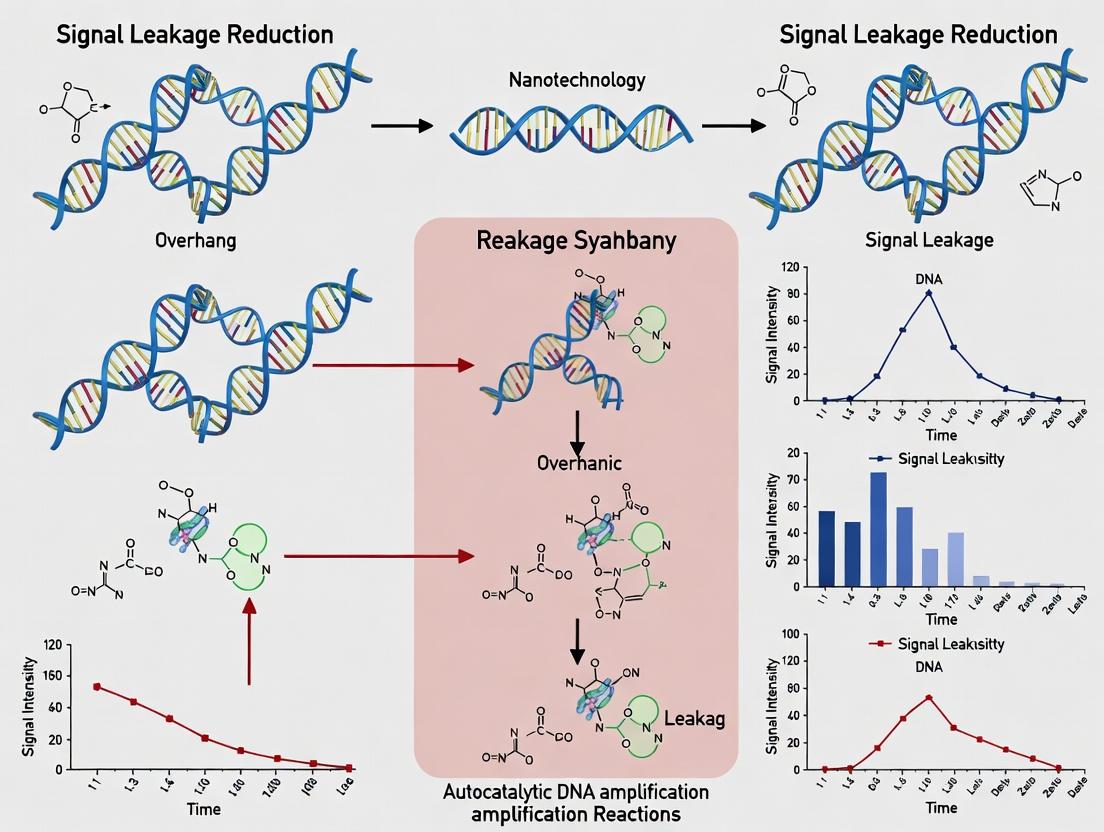
Signal leakage, or non-specific background amplification, remains a critical challenge limiting the sensitivity and specificity of autocatalytic DNA amplification techniques like loop-mediated isothermal amplification (LAMP) and rolling circle amplification (RCA).
Strategies to Minimize Signal Leakage in Autocatalytic DNA Amplification: A Technical Guide for Molecular Diagnostics
Abstract
Signal leakage, or non-specific background amplification, remains a critical challenge limiting the sensitivity and specificity of autocatalytic DNA amplification techniques like loop-mediated isothermal amplification (LAMP) and rolling circle amplification (RCA). This article provides a comprehensive, technical guide for researchers and drug development professionals. We explore the fundamental causes of leakage, from primer dimerization to contaminant carryover. We then detail proven methodological strategies, including primer design algorithms, reaction environment optimization, and novel enzyme formulations. A dedicated troubleshooting section addresses practical laboratory challenges, while a final comparative analysis validates the efficacy of containment strategies against gold-standard methods. The goal is to equip scientists with the knowledge to design robust, leak-resistant assays essential for point-of-care diagnostics, low-abundance target detection, and quantitative applications.
Understanding Signal Leakage: Root Causes and Impact on Assay Fidelity
Troubleshooting Guides & FAQs
Q1: What are the primary indicators of significant signal leakage in a real-time autocatalytic amplification assay? A: The primary indicators are: 1) A non-template control (NTC) showing an amplification curve with a Ct/Cq value earlier than expected (e.g., < 35 cycles), 2) A late, non-exponential rise in fluorescence in the NTC, 3) High baseline fluorescence drift before amplification, and 4) Inconsistent replicate results for low-concentration targets.
Q2: Our primer-dimers are causing leakage. What are the key design and reaction condition adjustments to minimize them? A: Implement a multi-faceted approach:
- Primer Design: Use software to check for 3' complementarity (limit to ≤ 3 bp). Increase primer length (18-25 bp) and aim for a Tm of 58-62°C. Avoid GC-rich 3' ends.
- Reaction Conditions: Increase annealing temperature in a gradient test. Reduce primer concentration (try 50-200 nM each). Add DMSO or betaine to reduce secondary structures. Switch to a "hot-start" polymerase with stringent chemical modification.
- Chemistry: Use probe-based detection (e.g., TaqMan) instead of intercalating dyes, as dyes will bind to primer-dimer products.
Q3: How do we systematically determine if leakage is from primer-dimers vs. non-specific amplification of genomic DNA? A: Perform the following diagnostic assay set and analyze the melt curve or gel electrophoresis data:
| Assay Component | Presence of Primer-Dimers | Presence of Genomic DNA Amplification |
|---|---|---|
| Full Reaction Mix (with Template) | Yes - Secondary peak in melt curve ~65-75°C | Yes - May show multiple peaks or a peak distinct from target. |
| Non-Template Control (NTC) | Yes - Low Tm peak in melt curve. | No. |
| No-Primer Control | No. | No. |
| No-Polymerase Control | No. | No. |
| With Non-Target Genomic DNA | Yes. | Yes - Distinct melt peak or gel band vs. target. |
Q4: Contamination is a recurrent issue. What is a definitive decontamination protocol for work areas and equipment? A: Follow this strict workflow:
- Physical Cleaning: Wipe all surfaces, pipettes, and equipment with 10% (v/v) commercial bleach (sodium hypochlorite) solution. Allow 1-2 minutes of contact time.
- Neutralization & Rinsing: Wipe thoroughly with nuclease-free water to remove residual bleach, which can degrade DNA/RNA in future experiments.
- UV Irradiation: Place pipettes, reaction tube racks, and other small, non-plastic items in a UV crosslinker/cabinet for 30 minutes. UV light (~254 nm) creates thymine dimers in contaminating nucleic acids.
- Reagent Aliquotting: Always use small, single-use aliquots of all master mix components. Dedicate sets of pipettes and tips for pre- and post-amplification areas.
Q5: What are the optimal strategies for establishing a rigorous limit of detection (LOD) that accounts for signal leakage? A: Use a probit or logit statistical analysis based on the following experimental data table, which incorporates leakage:
| Target Copy Number | Replicates (n) | Positive Calls (with leakage considered) | Proportion Positive |
|---|---|---|---|
| 0 (NTC) | 20 | [e.g., 1] | 0.05 |
| 1 | 20 | [e.g., 6] | 0.30 |
| 5 | 20 | [e.g., 15] | 0.75 |
| 10 | 20 | [e.g., 20] | 1.00 |
Protocol: Run at least 20 replicates per concentration, including at least 20 NTCs. A positive call is defined as a Ct value earlier than the mean NTC Ct + 3 standard deviations. Fit the proportion positive vs. log10(copy number) to a probit model. The LOD is the concentration at which 95% of replicates test positive.
Experimental Protocols
Protocol 1: Evaluating Polymerase Fidelity and Hot-Start Efficiency Objective: To compare different polymerase formulations for their propensity to cause signal leakage via non-specific amplification. Materials: Test polymerases (standard Taq, antibody-based hot-start, chemical-modified hot-start), master mix components, primer set, nuclease-free water, template DNA (low copy), real-time PCR instrument. Method:
- Prepare a master mix containing buffer, dNTPs, MgCl2, primers, and intercalating dye.
- Aliquot the master mix into four tubes. Add a different polymerase to each.
- For each polymerase type, set up three reaction wells: a) High-copy positive control (10^4 copies), b) Low-copy near-LOD sample (5 copies), c) Non-Template Control (NTC).
- Run the real-time PCR protocol with an extended cycle number (e.g., 50 cycles).
- Analysis: Record the Ct for the low-copy sample and note if the NTC amplifies. Calculate the ΔCt between the low-copy sample and the NTC. A larger ΔCt indicates better suppression of leakage.
Protocol 2: Diagnostic Asymmetric Amplification to Induce Primer-Dimer Formation Objective: To stress-test a primer pair for its tendency to form primer-dimers. Materials: Primer pair, master mix, polymerase, real-time PCR instrument with melt curve capability. Method:
- Prepare a master mix with an asymmetric primer ratio (e.g., 500 nM Forward Primer, 50 nM Reverse Primer). This imbalance promotes primer-dimer artifact formation.
- Run the reaction in the presence of an intercalating dye for 50 cycles, followed by a melt curve analysis (65°C to 95°C, continuous measurement).
- Analysis: The melt curve will show a dominant low-temperature peak (~65-75°C) if primer-dimers are formed. Compare this to a symmetric primer ratio control.
Diagrams
Signal Leakage Pathways in Autocatalysis
Troubleshooting Signal Leakage Workflow
The Scientist's Toolkit: Key Research Reagent Solutions
| Reagent / Material | Function in Reducing Signal Leakage |
|---|---|
| Chemical Hot-Start DNA Polymerase | Polymerase is inactive until a high-temperature activation step (>95°C), preventing primer-dimer extension and mis-priming during setup. |
| UDG (Uracil-DNA Glycosylase) + dUTP | Prevents carryover contamination. Prior amplifications use dUTP. UDG cleaves uracil-containing contaminants before new amplification, inactivated by heat. |
| Nuclease-Free Water (Certified) | Guaranteed free of RNase, DNase, and nucleic acid contamination, eliminating a common source of false signals. |
| Probe-Based Detection Chemistry | Uses a sequence-specific probe (e.g., TaqMan). Fluorescence is generated only upon probe cleavage, not by binding to primer-dimer artifacts. |
| PCR Inhibitor-Removal Columns | For sample prep, removes contaminants from crude samples (e.g., hemoglobin, humic acid) that can cause erratic polymerase activity and leakage. |
| Molecular Grade Bleach (10%) | Standard lab bleach diluted for surface and equipment decontamination; effectively degrades nucleic acids. |
| DMSO or Betaine | Additives that reduce secondary structure in DNA templates and primers, promoting specificity and reducing mis-priming. |
Troubleshooting Guides & FAQs
Q1: How can I distinguish between a true low-copy target amplicon and a primer dimer artifact on an agarose gel? A1: Primer dimers typically appear as a low molecular weight smear or a discrete band below 100 bp. True target amplicons will be at the expected size. Confirm by performing a melt curve analysis (if using intercalating dyes) or by sequencing the band. Increasing the annealing temperature by 3-5°C in a gradient PCR can often suppress primer dimer formation while retaining specific amplification.
Q2: What are the primary experimental steps to diagnose off-target priming in my qPCR assay? A2: 1) Run a no-template control (NTC). Any amplification indicates primer-dimer artifacts. 2) Run a melt curve analysis post-amplification; multiple peaks suggest non-specific products or primer dimers. 3) Use BLAT or in silico PCR tools (e.g., UCSC Genome Browser) to check for other genomic binding sites of your primer pair. 4) Analyze early amplification cycles (Cq >30) for inconsistent, low-amplitude signals indicative of off-target initiation.
Q3: Which primer design parameters are most critical for minimizing signal leakage in autocatalytic amplifications like PCR or loop-mediated amplification (LAMP)? A3: The most critical parameters are:
- 3'-End Stability: Avoid complementary sequences, especially at the 3'-ends (more than 4 complementary bases can promote dimerization).
- Melting Temperature (Tm): Maintain a Tm of 58-62°C for primers, with less than 2°C difference between forward and reverse primers.
- Secondary Structures: Minimize self-complementarity (hairpins) and cross-dimerization. Use tools like Primer-BLAST or NUPACK.
- Specificity: Ensure a final primer BLAST against the appropriate genome database.
Q4: What are the recommended positive control experiments to prove that observed amplification is on-target? A4:
- Sequencing: Sanger sequence the purified amplicon.
- Restriction Digest: If the amplicon contains a known restriction site, digest the product to see the expected fragment sizes.
- Probe-based Detection: Use a target-specific internal probe (e.g., TaqMan) in addition to intercalating dye; probe-based Cq should align with dye-based Cq.
- Dilution Series: A linear standard curve (R² > 0.99) with a slope reflecting high efficiency (90-110%) strongly suggests specific, single-target amplification.
Data Presentation
Table 1: Impact of Primer Properties on Non-Specific Amplification
| Primer Property | Optimal Range | High-Risk Condition | Typical Effect on Signal Leakage (ΔCq in NTC) |
|---|---|---|---|
| 3' End Complementarity | 0-2 complementary bases | ≥4 complementary bases | Cq decrease of 5-10 cycles (earlier artifact detection) |
| Primer Length | 18-25 bases | <17 bases | Cq decrease of 3-8 cycles |
| GC Content | 40-60% | >70% or <30% | Cq decrease of 2-6 cycles |
| ΔTm (Fwd vs Rev) | < 2°C | > 5°C | Cq decrease of 1-4 cycles, promotes mis-priming |
| Self-Complementarity (ΔG) | > -5 kcal/mol | < -9 kcal/mol | Cq decrease of 4-12 cycles (strong dimer formation) |
Table 2: Comparison of Hot-Start Polymerase Mechanisms for Leakage Suppression
| Mechanism | Example Enzyme | Activation Requirement | Key Advantage for Reducing Pre-Amplification Priming |
|---|---|---|---|
| Wax Barrier | Traditional Hot-Start | High temperature melt | Physically separates components pre-heating. |
| Antibody Inhibition | Taq DNA Polymerase, Antibody-bound | Denaturation at ~95°C | Effective inhibition until first denaturation step. |
| Chemical Modification | Chemically modified Taq | Prolonged incubation at 95°C (5-10 min) | Irreversible activation; prevents reannealing of primers during setup. |
| Aptamer-based Inhibition | Newer engineered polymerases | Temperature-dependent aptamer release | Fast, reversible, and highly effective at room temperature. |
Experimental Protocols
Protocol 1: Two-Step PCR Optimization to Eliminate Primer Dimers Objective: To establish a robust cycling protocol that minimizes low-temperature mis-priming. Reagents: High-fidelity hot-start DNA polymerase, optimized buffer, dNTPs, template DNA, primers. Procedure:
- Master Mix Setup: Prepare reactions on ice. Include a No-Template Control (NTC).
- Initial Denaturation: 98°C for 30 seconds.
- Two-Step Cycling (25-35 cycles):
- Denaturation: 98°C for 5-10 seconds.
- Combined Annealing/Extension: Use a temperature 3-5°C above the calculated Tm of the primers (e.g., 68-72°C) for 15-30 seconds/kb. Skip the separate low-temperature annealing step.
- Final Extension: 72°C for 2 minutes.
- Analysis: Run products on a high-resolution gel (e.g., 4% agarose) or use a fragment analyzer.
Protocol 2: Using DMSO or Betaine as Additives to Suppress Secondary Structure Objective: To improve primer specificity when amplifying GC-rich or complex templates. Reagents: Standard PCR components, Molecular biology grade DMSO or Betaine (5M stock). Procedure:
- Titration Setup: Prepare a master mix. Aliquot into separate tubes for additive titration.
- Additive Addition: Add DMSO at final concentrations of 2%, 4%, or 6% (v/v). Alternatively, add Betaine at 1.0 M or 1.5 M final concentration.
- Cycling: Use a standard or two-step cycling protocol. Consider lowering the annealing temperature by 1-2°C per 1% DMSO if using a three-step protocol.
- Analysis: Compare yield, specificity (gel band clarity), and Cq values (in qPCR) across conditions. Determine the optimal concentration that minimizes NTC amplification and maximizes target yield.
Mandatory Visualization
Title: Sources and Consequences of Non-Specific Amplification
Title: Diagnostic Workflow for Signal Leakage
The Scientist's Toolkit
Table 3: Research Reagent Solutions for Minimizing Amplification Artifacts
| Item | Function | Key Benefit for Reducing Leakage |
|---|---|---|
| Hot-Start DNA Polymerase (Antibody or Chemically modified) | Enzyme remains inactive until a high-temperature activation step. | Prevents primer extension during reaction setup at lower temps, the primary window for dimer formation and mis-priming. |
| PCR Enhancers (e.g., DMSO, Betaine, Formamide) | Destabilize DNA secondary structures, homogenize DNA melting temps. | Improves primer specificity, especially for GC-rich targets, reducing off-target binding. |
| dNTP Mix (Optimized Concentration) | Provides balanced nucleotides for extension. | Prevents misincorporation due to imbalance, which can lead to polymerase stalling and spurious priming. |
| MgCl₂ Solution (Titrated) | Essential cofactor for polymerase activity. | Excess Mg²⁺ stabilizes non-specific primer-template binding; precise titration is critical. |
| UDG (Uracil-DNA Glycosylase) + dUTP | Incorporates dUTP in place of dTTP; UDG degrades uracil-containing contaminants. | Prevents carryover contamination from previous PCRs, a source of false-positive signals. |
| Blocking Oligonucleotides (PNA, LNA) | Sequence-specific competitors that bind to off-target sites. | Physically blocks polymerase access to homologous genomic regions, increasing specificity. |
| High-Fidelity Buffer Systems | Optimized pH, salt, and stabilizer composition. | Provides ideal conditions for stringent primer annealing, favoring perfect matches. |
Troubleshooting Guide & FAQs
Q1: During my autocatalytic amplification reaction (e.g., LAMP, RCA), I am observing false-positive signals in my no-template controls (NTCs). What is the most likely cause and how can I diagnose it?
A: Amplicon carryover contamination is the primary suspect. To diagnose:
- Spatial Separation: Run your NTCs in a separate room or PCR workstation dedicated to pre-amplification steps. If NTCs from this area are negative, your main lab space is contaminated.
- UV Irradiation Test: Treat your master mix with short-wavelength UV light (254 nm) for 5-10 minutes on ice before adding the template. This cross-links any contaminating double-stranded amplicons. If post-UV NTCs are clean, carryover is confirmed.
- Enzymatic Decontamination: Incorporate dUTP and uracil-DNA glycosylase (UDG) into your protocol. Pre-incubate reactions to degrade any uracil-containing carryover amplicons from previous runs.
Q2: My amplification reactions show inconsistent and low-yield signal, suggesting degradation. Could environmental nucleases be the problem?
A: Yes, especially with sensitive, isothermal reactions. RNases and DNases are ubiquitous.
- Surface Test: Swab bench surfaces, pipettes, and tube racks with nuclease-free water. Add the swab solution to a sensitive amplification reaction with a known high-titer template. Signal loss indicates surface nuclease contamination.
- Reagent Test: Aliquot and replace suspect reagents (e.g., water, buffer, BSA). Test the new aliquot alongside the old in parallel reactions.
- Inhibitor Check: Ensure you are using nuclease-free, molecular-grade water and reagents. Check that your BSA or protein additives are nuclease-free.
Q3: What specific lab practices are most critical for preventing amplicon carryover in a lab focused on autocatalytic amplification research?
A: Implement unidirectional workflow and rigorous decontamination.
- Physical Separation: Maintain separate, dedicated areas for: 1) Reagent Prep, 2) Template Addition, and 3) Amplification/Product Analysis. Use separate sets of pipettes, lab coats, and supplies for each.
- Chemical Decontamination: Use fresh 10% (v/v) bleach or DNA-ExitusPlus for surface and equipment decontamination. Allow at least 5 minutes of contact time.
- Procedural Discipline: Always use aerosol-barrier pipette tips. Open reaction tubes only in the dedicated post-amplification area. Centrifuge tubes briefly before opening.
Q4: Are there specific experimental protocols to quantify the impact of nuclease contamination on signal leakage?
A: Yes, a controlled nuclease spike-in experiment can quantify impact.
Protocol: Quantifying Nuclease-Induced Signal Loss
- Prepare Master Mix: Create a standard master mix for your autocatalytic reaction (e.g., LAMP) targeting a well-characterized template (e.g., lambda DNA).
- Spike Contaminant: Prepare a dilution series of a commercial DNase I (or RNase A) in nuclease-free buffer. Spike a fixed, sub-saturating volume (e.g., 2 µL) of each dilution into individual reaction tubes. Include a no-nuclease control.
- Add Template: Add a known, low-copy number of template (e.g., 50 copies/reaction) to all tubes.
- Run Amplification: Perform the reaction under standard conditions.
- Quantify: Measure time to threshold (Tt) or end-point fluorescence. Plot Tt or relative signal intensity vs. nuclease concentration (mU/reaction).
Expected Data Summary:
| Nuclease Spike (mU/reaction) | Mean Time to Threshold (Tt, min) | Signal Reduction (%) | Positive Replicates / Total |
|---|---|---|---|
| 0 (Control) | 25.2 ± 1.5 | 0% | 10/10 |
| 0.1 | 28.7 ± 2.1 | 14% | 10/10 |
| 1.0 | 35.6 ± 3.4* | 41%* | 8/10 |
| 10.0 | >60* | >99%* | 1/10* |
*Indicates significant signal leakage/failure.
Q5: What is the most effective method to decontaminate reusable labware from amplicon carryover?
A: A combination of chemical and physical methods is required for porous materials like plastic.
- Sodium Hypochlorite (Bleach) Immersion: Soak items in fresh 1-2% (v/v) bleach for 30 minutes. This hydrolyzes DNA.
- Rinsing & Neutralization: Rinse thoroughly with nuclease-free water, then with 70% ethanol to neutralize residual bleach.
- UV Irradiation: Place the cleaned items under a 254 nm UV crosslinker for at least 1 hour per side. This creates thymine dimers in any residual DNA.
- Validation: Periodically test decontaminated items by swabbing them and using the swab as a template in a highly sensitive NTC reaction.
The Scientist's Toolkit: Key Research Reagent Solutions
| Reagent / Material | Primary Function in Contamination Control |
|---|---|
| Uracil-DNA Glycosylase (UDG) + dUTP | Enzymatic prevention of carryover: Amplicons incorporate dUTP. UDG pre-treatment degrades them before amplification. |
| Psoralen Derivatives (e.g., AMPLIWAY) | Post-amplification crosslinker: Incorporated into master mix, it crosslinks new amplicons upon light exposure, preventing re-amplification. |
| DNA-ExitusPlus / DNAZap | Chemical decontaminants for surfaces and equipment. Degrade nucleic acids rapidly. |
| Plasmid-Safe ATP-Dependent DNase | Degrades linear dsDNA (amplicons) but not circular DNA, useful for purifying plasmid preps from carryover. |
| Molecular Biology Grade BSA | Stabilizes enzymes, can competitively inhibit and sequester non-specific nuclease contaminants. |
| Aerosol-Barrier (Filter) Pipette Tips | Prevents aerosolized amplicons from contaminating pipette shafts and subsequent reactions. |
| dUTP (in place of dTTP) | Substrate for UDG-based carryover prevention systems. Incorporated into amplicons, marking them for degradation. |
| High-Purity, Nuclease-Free Water | Foundational reagent free of RNases, DNases, and background DNA/RNA. |
Title: UDG/dUTP Carryover Prevention Mechanism
Title: Unidirectional Workflow to Prevent Carryover
Troubleshooting Guides & FAQs
Q1: During my autocatalytic DNA amplification reaction (e.g., EXPAR, RCA), I am observing an amplification signal in my no-template control (NTC), indicating false positives. What are the likely causes and solutions?
A: This is a classic sign of signal leakage, often due to contaminating oligonucleotides or nonspecific amplification.
- Primary Cause & Fix: Oligonucleotide Contamination. Trace amounts of template or primer carryover during reagent handling can seed reactions. Solution: Implement strict physical separation of pre- and post-amplification workspaces (separate rooms or dead-air boxes), use dedicated pipettes and aerosol-resistant filter tips, and employ UV irradiation of workstations. Treat all reaction mix components (except enzymes) with Uracil-DNA Glycosylase (UDG) prior to amplification if using dUTP-incorporated products in a previous run.
- Secondary Cause & Fix: Primer-Dimer or Non-Specific Amplification. Primers may form stable duplexes or hairpins that get extended. Solution: Redesign primers using software to minimize self-complementarity and secondary structure. Optimize Mg²⁺ concentration (often lower than standard protocols) and thermal cycling conditions. Include DMSO or Betaine in the reaction to improve stringency.
Q2: My assay sensitivity has dropped unexpectedly, failing to detect low-copy-number targets. How can I troubleshoot reduced sensitivity?
A: Reduced sensitivity suggests inefficient amplification, often due to reagent degradation or suboptimal reaction conditions.
- Step 1: Check Reagent Integrity. Aliquot and test a new batch of the key polymerase (e.g., Bst 2.0/3.0, Phi29) and dNTPs. Ensure reagents are stored at correct temperatures and have not undergone multiple freeze-thaw cycles.
- Step 2: Optimize Cofactor Concentration. Titrate Mg²⁺ (range 4-10 mM) and dNTPs (range 0.2-1.0 mM). Excessive dNTPs can chelate Mg²⁺, inhibiting the polymerase.
- Step 3: Verify Template Accessibility. For circular templates in RCA, ensure complete ligation. For EXPAR, confirm the nicking enzyme site is intact and the template is free of secondary structure that blocks nicking or polymerization. Use a thermostable single-stranded DNA binding protein (SSB) to improve efficiency.
Q3: My standard curve shows poor linearity, and I am getting inconsistent quantification (Cq or time-to-threshold) values for replicates, indicating quantification error. How can I improve reproducibility?
A: Quantification errors stem from reaction inconsistency, often linked to pipetting inaccuracies or inhibitor carryover.
- Critical Action: Master Mix Preparation. Always prepare a bulk Master Mix for all replicates of a given sample to minimize pipetting error. Include an internal control (IC) to detect inhibition.
- Identify Inhibitors: Common inhibitors in sample lysates include heparin, EDTA, and proteins. Solution: Dilute the sample, use a column-based purification method designed for low-abundance nucleic acids, or add BSA (0.1-1 μg/μL) to the reaction to bind nonspecific inhibitors.
- Instrument Calibration: Ensure your real-time fluorometer is calibrated according to the manufacturer's schedule. Check for consistent well-to-well temperature in the thermal block.
Summarized Quantitative Data on Signal Leakage Mitigation
Table 1: Impact of Key Mitigation Strategies on Assay Metrics
| Mitigation Strategy | Typical Reduction in NTC False Positive Rate | Impact on Sensitivity (LOD) | Effect on Quantification Error (CV%) | Key Reference (Example) |
|---|---|---|---|---|
| UDG/dUTP Carryover Prevention | 95-99% reduction | No negative impact | Reduces between-run variation | (PCT/US99/01702) |
| Primer Redesign (ΔG optimization) | 50-80% reduction | Can improve by 0.5-1 log | Improves replicate consistency | (Nucleic Acids Res. 2020, 48(8), e45) |
| Mg²⁺ Concentration Optimization | 60-90% reduction | Critical; optimal boosts sensitivity | Reduces well-to-well variability | (Anal. Chem. 2019, 91, 1, 743-752) |
| Addition of SSB Protein | 30-50% reduction | Improves by up to 1 log | Minimizes stochastic effects at LOD | (Sci. Rep. 2017, 7, 14586) |
| DMSO/Betaine Inclusion | 40-70% reduction | Can improve for GC-rich targets | Stabilizes amplification efficiency | (Biotechniques. 2004, 36(5), 862-6) |
Experimental Protocols for Key Mitigation Experiments
Protocol 1: Validating UDG Treatment for Carryover Prevention
- Prepare Master Mix: For a 25 μL reaction, combine 1X Isothermal Amplification Buffer, 6 mM MgSO₄, 1.4 mM dNTPs (including dUTP in place of dTTP), 0.4 U/μL Bst 2.0 WarmStart Polymerase, 0.1 U/μL UNG, primers/template as required.
- Incubation: Incubate the complete master mix (without enzyme if not hot-start) at 25°C for 10 minutes. This allows UDG to cleave uracil-containing contaminants.
- Activation: Transfer to the isothermal amplification temperature (e.g., 55-60°C). The UNG will be inactivated, and the hot-start polymerase activated.
- Amplification & Detection: Proceed with amplification for 60-90 minutes with real-time fluorescence monitoring. Compare NTC signals with and without UDG treatment.
Protocol 2: Optimizing Mg²⁺ Concentration to Reduce Leakage
- Stock Solution: Prepare a 100 mM MgSO₄ stock solution in nuclease-free water.
- Master Mix Setup: Prepare a master mix containing all components except Mg²⁺ and template. Aliquot equal volumes into 8 PCR tubes.
- Titration: Spike in MgSO₄ to create a concentration series (e.g., 2, 4, 6, 8, 10, 12, 14, 16 mM final concentration).
- Run Assay: Add template (positive, low-positive, NTC) to each tube and run the amplification.
- Analysis: Plot time-to-positive (TTP) vs. Mg²⁺ concentration for the low-positive. The optimal concentration provides the fastest TTP for the true positive while maintaining a flat, negative baseline in the NTC for the longest duration.
Visualizations
Diagram 1: Signal Leakage Pathways in Autocatalytic Amplification
Diagram 2: Workflow for Troubleshooting Quantification Error
The Scientist's Toolkit: Research Reagent Solutions
Table 2: Essential Reagents for Reducing Signal Leakage
| Reagent | Function in Leakage Mitigation | Key Consideration |
|---|---|---|
| Uracil-DNA Glycosylase (UDG/UNG) | Enzymatically degrades uracil-containing prior amplicons, preventing carryover contamination. | Must use dUTP in previous amplifications. Inactivate before current amplification. |
| Hot-Start Isothermal Polymerases (e.g., Bst 2.0 WarmStart) | Remain inactive at room temp, preventing primer-dimer extension during setup. | Crucial for minimizing pre-amplification non-specific events. |
| Single-Stranded DNA Binding Protein (SSB) | Binds ssDNA, preventing secondary structure and nonspecific primer binding in templates. | Improves sensitivity and reaction speed, reducing stochastic errors. |
| DMSO or Betaine | Destabilizes DNA secondary structure, improving primer annealing specificity and enzyme processivity. | Use at optimized concentrations (typically 1-10% v/v for DMSO, 0.5-1.5M for Betaine). |
| Molecular Grade BSA | Binds nonspecific inhibitors that may be co-purified with sample DNA, stabilizing the polymerase. | Especially important for clinical or complex biological samples. |
| Agarose-Linked Nicking Enzyme | Immobilized nicking enzyme for EXPAR reduces enzyme-induced background and allows its removal post-reaction. | Helps create cleaner reaction systems for multi-step processes. |
The Thermodynamic and Kinetic Drivers of Spurious Amplification Initiation
Technical Support Center: Troubleshooting Spurious Amplification in Autocatalytic Reactions
Frequently Asked Questions (FAQs)
Q1: What are the primary thermodynamic indicators of potential spurious amplification in my reaction setup? A1: Spurious initiation is often driven by favorable Gibbs free energy changes for non-specific primer binding or dimer formation. Key indicators include calculated ΔG values for off-target interactions below -5 kcal/mol at your reaction temperature, and a melting temperature (Tm) difference of less than 5°C between specific and non-specific amplicons. High local GC content in non-target regions can also provide a thermodynamic sink.
Q2: How can I kinetically discriminate between true and spurious amplification products during early cycles? A2: Monitor real-time amplification curves. Spurious products typically exhibit inconsistent amplification efficiencies, late and irregular Ct values, and sigmoidal curves with lower slopes. Implement a high-resolution melt (HRM) analysis post-amplification; spurious products usually show broad, low-temperature melt peaks distinct from the true target peak.
Q3: My negative controls are consistently amplifying. Which kinetic parameter should I adjust first? A3: First, increase the annealing temperature incrementally (e.g., by 0.5°C steps) to reduce the kinetic window for non-specific primer binding. If the problem persists, implement a "hot-start" protocol or use a chemically modified hot-start polymerase to kinetically suppress enzyme activity during reaction setup, preventing primer dimer extension during initial heating.
Q4: What experimental step most effectively reduces signal leakage from primer-dimer artifacts? A4: Incorporating a structured, slow ramping rate (0.5-1.0°C/sec) from the annealing to extension phase is critical. This provides a kinetic barrier, allowing poorly bound primers and dimers to dissociate before mis-extension can occur. Combining this with a reduced primer concentration (50-100 nM) lowers the collision frequency driving dimerization.
Troubleshooting Guides
Issue: High Background Fluorescence in Early PCR Cycles (Pre-Ct)
- Potential Cause: Thermodynamically stable primer dimers or non-specific hybrids generating fluorescent signal.
- Step-by-Step Diagnosis:
- Run reaction products on a high-percentage (4%) agarose gel. Look for a low molecular weight smear or band.
- Perform a no-template control (NTC) with all reagents. If NTC is positive, the issue is reagent-mediated.
- Test primers individually in separate NTC reactions to identify which primer is forming self-structures.
- Solutions:
- Re-design Primers: Use tools to check for self-complementarity (especially at 3' ends) and stable inter-primer homology. Aim for a ΔG of dimer formation > -6 kcal/mol.
- Optimize Buffer: Increase Mg2+ concentration cautiously (0.5 mM steps) as it stabilizes all duplexes. Try additives like betaine (1-1.5 M) or DMSO (3-5%) to alter duplex thermodynamics.
- Modify Protocol: Use a two-step PCR (combine annealing/extension) or a touchdown protocol to favor specific binding kinetically.
Issue: Inconsistent Amplification Efficiency Between Replicates
- Potential Cause: Stochastic kinetically-driven initiation of spurious products competing for reagents.
- Step-by-Step Diagnosis:
- Analyze real-time data for variation in early amplification curves (cycles 5-15).
- Perform digital PCR or limiting dilution assays to see if the inconsistency follows a Poisson distribution, indicating low-copy template competition with spurious events.
- Solutions:
- Increase Template Integrity: Use high-quality, sheared-free DNA.
- Use Enzyme Blends: Employ polymerases with high fidelity and built-in proofreading to kinetically penalize mis-extension.
- Seal Plates Properly: Ensure consistent thermal conductivity to avoid well-to-well thermal kinetic variation.
Data Presentation
Table 1: Thermodynamic Parameters Predicting Spurious Amplification Risk
| Parameter | Safe Range | High-Risk Range | Measurement Method |
|---|---|---|---|
| 3' End Self-Complementarity ΔG | > -4 kcal/mol | ≤ -6 kcal/mol | Oligo Analyzer Software |
| Inter-Primer Dimer ΔG | > -5 kcal/mol | ≤ -8 kcal/mol | Oligo Analyzer Software |
| Tm Mismatch Tolerance | ΔTm > 5°C | ΔTm ≤ 2°C | Nearest-Neighbor Calculation |
| Local GC Content (Off-Target) | < 60% | ≥ 70% | Genome Browser Analysis |
Table 2: Kinetic Protocol Adjustments to Mitigate Spurious Amplification
| Protocol Adjustment | Typical Value | Effect on Spurious Amplification | Key Consideration |
|---|---|---|---|
| Annealing Time | 10-15 sec | Reduces time for mis-priming | Below 5 sec may reduce specific yield. |
| Ramp Rate (Annealing to Extension) | 0.5-1.0 °C/sec | Allows dissociation of weak duplexes | Very slow ramps increase cycle time. |
| Hot-Start Activation Time | 1-2 min at 95°C | Inactivates polymerase during setup | Essential for manual setups. |
| Initial Denaturation | 30 sec - 2 min at 98°C | Melts secondary structure | Longer times can degrade polymerase. |
Experimental Protocols
Protocol 1: Determining Primer Dimer Propensity via Gel Electrophoresis
- Reagent Setup: Prepare a standard 25 µL PCR mix containing 1X buffer, 200 µM dNTPs, 1.5 mM MgCl2, 0.5 U/µL polymerase, and 200 nM of each primer. Omit template DNA.
- Thermal Cycling: Run for 35 cycles: 95°C for 15s, 55°C for 30s, 72°C for 30s.
- Analysis: Mix 10 µL of product with 2X DNA loading dye. Load onto a 4% agarose gel (pre-stained with GelRed) alongside a 25 bp DNA ladder. Run at 5 V/cm for 60 min. Visualize under blue light. A distinct low molecular weight band (~30-50 bp) indicates primer-dimer formation.
Protocol 2: High-Resolution Melt (HRM) Analysis for Product Specificity
- Post-PCR Setup: After a standard real-time PCR using a saturating DNA dye (e.g., EvaGreen), prepare the product for HRM.
- Instrument Programming: On your real-time cycler, set the HRM step: Denature at 95°C for 15s, anneal at 60°C for 1 min, then continuously monitor fluorescence from 65°C to 95°C with a slow ramp (0.1°C/sec) and frequent data acquisition.
- Data Interpretation: Use the instrument's software to plot the negative derivative of fluorescence vs. temperature (-dF/dT). A single sharp peak indicates a specific product. Multiple or broad peaks suggest spurious products or primer dimers.
Mandatory Visualization
Title: Drivers and Outcomes of Spurious Amplification
Title: Troubleshooting Workflow for Spurious Amplification
The Scientist's Toolkit
Research Reagent Solutions for Reducing Signal Leakage
| Item | Function in Mitigating Spurious Amplification |
|---|---|
| Hot-Start DNA Polymerase (Chemically Modified or Antibody-Bound) | Kinetically suppresses polymerase activity at low temperatures during reaction setup, preventing extension of primer dimers and non-specific hybrids. |
| Betaine (5M Stock Solution) | A chemical chaperone that equalizes the stability of AT and GC base pairs, homogenizes melting temperatures, and reduces secondary structure, improving primer specificity. |
| DMSO (100%) | Destabilizes DNA duplexes by interfering with base stacking. Added at 3-5%, it can help by lowering the Tm of non-specific interactions more than perfect matches. |
| dNTP Mix (Balanced, High-Purity) | High-quality, equimolar dNTPs prevent misincorporation events that can lead to polymerase pausing and primer extension of mismatched templates. |
| MgCl2 Solution (25-50 mM) | Critical cofactor for polymerase. Titration is essential as it stabilizes all nucleic acid duplexes; optimal concentration favors specific over non-specific binding. |
| SYBR Green or EvaGreen Dye (20X) | Saturating DNA-binding dyes for real-time monitoring and High-Resolution Melt (HRM) analysis, enabling kinetic curve assessment and post-amplification specificity verification. |
| Uracil-DNA Glycosylase (UDG) | Enzyme used in carryover prevention. Degrades uracil-containing contaminants from previous PCRs, reducing template-based spurious signals. |
Proactive Design and Protocol Strategies for Leakage Suppression
Troubleshooting Guide
Q1: My primer design algorithm consistently produces primers that form stable dimers or hairpins, leading to high background signal and signal leakage in my autocatalytic reaction. How can I resolve this? A1: This indicates insufficient constraints in the dimer and secondary structure prediction steps. Modern algorithms use thermodynamic parameters (nearest-neighbor model) to calculate ΔG. Set a stricter threshold (e.g., ΔG > -6 kcal/mol for dimers). Ensure your algorithm uses up-to-date salt correction formulas (e.g., Santalucia 2004 parameters) and evaluates all possible conformations, not just the 3' end. Increase the penalty weight for self-complementarity in the scoring function.
Q2: After implementing algorithm-designed primers, I observe non-specific amplification in no-template controls (NTCs). What specific steps should I take to diagnose and fix this? A2: Non-specific amplification in NTCs often points to primer-dimer artifacts or genomic DNA contamination.
- Diagnosis: Run the amplification products on a high-resolution gel (e.g., 4-6% agarose) or use melt-curve analysis. Primer-dimers produce lower molecular weight bands or a distinct, lower-temperature melt peak.
- Solution: Re-run the primer design with a more stringent specificity check. Use BLASTn against the relevant genome database and in-silico PCR on the entire transcriptome/genome. Increase primer length (aim for >24 bases) and adjust annealing temperature upward in a gradient PCR to find the optimal stringent condition.
Q3: How do I effectively balance the need for high primer specificity (to reduce off-target binding and signal leakage) with the requirement for stable duplex formation during the annealing step? A3: This is a core optimization problem. Implement a multi-objective scoring algorithm that weights both criteria.
- For Specificity: Use a comprehensive alignment algorithm (like Smith-Waterman) against a non-redundant database, penalizing matches to non-target sequences. A longer continuous exact match at the 3' end (last 5 bases) is critical for specificity.
- For Stability: Calculate Tm using the unified NN parameters. Ensure both primers in a pair have closely matched Tms (±1°C). The optimal stability is not maximum stability; aim for a Tm between 58-65°C for most applications. The final primer pair should be selected from the Pareto front of optimal solutions balancing these two competing objectives.
Frequently Asked Questions (FAQs)
Q4: Which algorithm parameters are most critical to adjust for designing primers in GC-rich regions to prevent mis-priming and signal leakage? A4: Key parameters include:
- GC Clamp: Avoid a strong GC clamp (e.g., >3 G/C in last 5 bases) which can promote mis-priming. Allow 1-2 G/C at the 3' end.
- Tm Calculation: Use salt-adjusted thermodynamic calculations. Consider adding co-solvents like DMSO or betaine to your protocol, which lower effective Tm, and design with this in mind.
- Specificity Check Stringency: Increase the minimum required free energy (ΔG) for off-target binding. Require a longer perfect match for an off-target site to be flagged (e.g., 12+ contiguous bases instead of 10).
Q5: What are the recommended in-silico validation steps for primer pairs intended for use in autocatalytic amplification systems (like HCR or LAMP) where signal leakage is a major concern? A5: A rigorous in-silico pipeline is essential:
- Primary Specificity: BLAST against the appropriate refseq_genomic database.
- Secondary Structure: Analyze monomer and heterodimer formation using mfold or NUPACK at your precise reaction temperature and cation concentration.
- In-silico PCR: Perform a whole-genome in-silico PCR using tools like
ipcressorucsc_in-silico PCRto find all potential amplicons. - Cross-Dimer Check: Systematically check for complementarity between all primer sequences present in the reaction mix (including catalysts and initiators in autocatalytic systems).
Q6: How can I use algorithms to predict and mitigate primer binding site accessibility in folded nucleic acid templates? A6: For structured templates (e.g., RNA):
- Algorithm Input: Use tools that predict secondary structure (RNAfold, mfold) for your target region under simulated reaction conditions (temperature, ionic strength).
- Design Strategy: Configure your primer search algorithm to preferentially select primer binding sites located in predicted single-stranded loops or regions with low base-pairing probability (<0.5). Some advanced algorithms can integrate this accessibility score directly into the primer ranking function.
Experimental Protocol: Validating Primer Specificity to Reduce Signal Leakage
Objective: To empirically validate the specificity of algorithm-designed primers and quantify background signal leakage in an autocatalytic DNA amplification system.
Materials:
- Designed primer sets (target and negative control sets).
- Target DNA template.
- Non-target genomic DNA (e.g., human genomic DNA if targeting a pathogen).
- Autocatalytic amplification reaction mix (polymerase, nucleotides, buffers, fluorescent reporter).
- Real-time PCR instrument or fluorometer.
- Gel electrophoresis system.
Procedure:
- Reaction Setup: Prepare four reaction tubes in triplicate:
- A: Target template + Primer set.
- B: Non-target genomic DNA + Primer set.
- C: No template (NTC) + Primer set.
- D: Target template + Scrambled/off-target primer set.
- Amplification: Run the autocatalytic amplification protocol per established methods (e.g., 37°C for 60-120 min) with continuous or endpoint fluorescence measurement.
- Data Analysis:
- Calculate the time-to-threshold (Tt) or fluorescence intensity at endpoint for each reaction.
- The difference in Tt or signal between A and B/C is a direct measure of specificity.
- Significant signal in B indicates off-target binding. Signal in C indicates primer-dimer or reagent contamination.
- Post-Amplification Analysis: Run products on an agarose gel. Specific amplification should show a single, clean band of expected size. Smearing or multiple bands indicate non-specific amplification.
Table 1: Comparison of Primer Design Algorithm Performance Metrics
| Algorithm Feature | Specificity Check Method | Dimer Prediction Model | Recommended Use Case | Impact on Signal Leakage |
|---|---|---|---|---|
| Basic BLAST | Local alignment (BLASTn) | Simple complementarity check | Initial screening, simple templates | High risk if used alone |
| Thermodynamic | Smith-Waterman + NN ΔG | Full ΔG calculation (e.g., NUPACK) | Standard PCR, qPCR | Moderate to Low risk |
| Multi-Objective | Genome-wide in-silico PCR + Structure | Partition function equilibrium | Autocatalytic systems, multiplex assays | Lowest risk |
Table 2: Troubleshooting Outcomes for Common Primer Issues
| Observed Problem | Likely Algorithmic Cause | Recommended Parameter Adjustment | Expected Outcome |
|---|---|---|---|
| High NTC Signal | Inadequate dimer/ hairpin check | Lower max ΔG for secondary structures (-5 kcal/mol) | Reduced background fluorescence |
| Off-target amplification | Weak specificity filtering | Increase minimum off-target mismatch penalty; require longer 3' exact match | Increased ΔCt between target and non-target |
| Low yield/ efficiency | Overly stringent GC% or Tm limits | Widen acceptable Tm range (55-68°C); adjust GC% range (40-60%) | Lower Tt (faster amplification) |
| Reaction failure | Binding site in stable template hairpin | Integrate RNA/DNA folding accessibility score | Successful amplification of structured targets |
The Scientist's Toolkit: Research Reagent Solutions
| Item | Function in Advanced Primer Design/Validation |
|---|---|
| High-Fidelity DNA Polymerase | Provides accurate amplification with low mis-incorporation rates, crucial for validating specificity. |
| Nuclease-Free Water | Prevents degradation of primers and templates, eliminating a source of false-positive signals. |
| Betaine (5M Solution) | PCR additive that equalizes nucleic acid stability, improving amplification of GC-rich targets and primer binding. |
| DMSO | Additive that reduces secondary structure in templates and primers, improving accessibility and specificity. |
| dNTP Mix | Balanced nucleotides for efficient elongation; use high-purity grade to prevent contamination. |
| MgCl₂ Solution | Critical co-factor for polymerase; concentration must be optimized as it affects primer annealing stringency. |
| Fluorescent DNA-Binding Dye (e.g., SYBR Green II) | For real-time monitoring of autocatalytic amplification and melt-curve analysis to detect non-specific products. |
| Molecular Grade BSA | Stabilizes polymerase, reduces surface adsorption in low-template reactions, and improves reaction consistency. |
Visualizations
Diagram 1: Primer Design & Validation Workflow
Diagram 2: Sources of Signal Leakage in NTC
Technical Support Center
Troubleshooting Guide & FAQs
Q1: My autocatalytic DNA amplification (e.g., HCR, EXPAR) reaction shows high background fluorescence (signal leakage). Which parameter should I optimize first? A: Begin with magnesium ion (Mg²⁺) concentration. It is the most critical cofactor for polymerase and nuclease activity. Suboptimal Mg²⁺ is a primary cause of non-specific amplification. Perform a gradient from 1 mM to 10 mM in 0.5 mM increments to identify the narrow window that supports the target reaction while suppressing leakage. Refer to Table 1 for typical optimal ranges.
Q2: How does temperature interact with magnesium concentration to affect leakage? A: Temperature and Mg²⁺ have a synergistic relationship. Higher temperatures (e.g., 45-50°C) increase enzyme fidelity and DNA duplex stringency but can also increase primer-dimer artifacts if Mg²⁺ is too high. Lower temperatures (e.g., 25-37°C) may require slightly lower Mg²⁺ to maintain specificity. A matrix experiment (see Protocol 1) is recommended to map this relationship.
Q3: What types of chemical additives are most effective for reducing signal leakage, and when should I use them? A: Additives function via different mechanisms. Choose based on the suspected leakage pathway:
- Betaine (1-2 M): Used to equalize DNA melting temperatures and reduce secondary structure, ideal if leakage is from primer hairpins.
- DMSO (2-10% v/v): Disrupts weak, non-specific interactions, useful for complex templates.
- Single-Stranded DNA Binding Proteins (SSBs, 0.1-0.5 µg/µL): Bind to ssDNA to prevent primer oligomerization and non-template extension.
- Dithiothreitol (DTT, 1-5 mM): A reducing agent that stabilizes enzymes, use if enzyme instability is causing late-cycle drift.
Q4: My negative control amplifies after many cycles. Is this a reagent contamination issue or a chemistry issue? A: While contamination must always be ruled out, delayed amplification in negatives is often a chemistry issue termed "late-cycle leakage." This is frequently due to the slow accumulation of primer-dimer products that eventually cross the detection threshold. To address this: 1) Lower Mg²⁺, 2) Increase temperature, 3) Add SSBs or DMSO, and 4) Redesign primers with stricter 3'-end complementarity checks.
Q5: I've optimized Mg²⁺, temperature, and additives individually, but leakage persists. What is the next step? A: The interactions between these parameters are non-linear. You must perform a Design of Experiments (DoE) approach, such as a factorial design, to find the optimal combination. Test Mg²⁺, temperature, and your top additive candidate in a single, systematic grid experiment (Protocol 2). The optimal point is often a narrow "sweet spot" not found by one-at-a-time optimization.
Data Presentation
Table 1: Effects of Reaction Parameters on Signal Leakage in Autocatalytic DNA Amplification
| Parameter | Typical Test Range | Effect on Specific Signal | Effect on Leakage/Bkg | Recommended Starting Point for Optimization |
|---|---|---|---|---|
| Mg²⁺ Concentration | 1.0 - 10.0 mM | Sharp optimum; essential for catalysis. | Increases exponentially outside optimum. | 3.0 mM for polymerase-based systems; 5.0 mM for nuclease-based systems (e.g., EXPAR). |
| Temperature | 25°C - 55°C | Increases with fidelity up to enzyme limit. | Generally decreases with higher stringency. | 37°C for mesophilic enzymes (Bst), 45-50°C for thermophilic (exo- Bst, polymerases). |
| Betaine | 0.5 - 2.5 M | Stabilizes, can enhance yield. | Significantly reduces structure-based leakage. | 1.0 M. |
| DMSO | 2% - 10% | Can slightly reduce maximum yield. | Reduces weak hybridization events. | 3% (v/v). |
| SSB Protein | 0.05 - 1.0 µg/µL | Minimal impact on true target. | Drastically reduces primer-dimer formation. | 0.2 µg/µL. |
Experimental Protocols
Protocol 1: Mg²⁺ and Temperature Matrix Optimization Objective: Identify the optimal combination of Mg²⁺ concentration and reaction temperature to maximize specific signal while minimizing leakage.
- Prepare a master mix containing all reaction components except Mg²⁺. Aliquot into 25 tubes.
- Prepare a MgCl₂ stock dilution series to final reaction concentrations of: 2.0, 3.0, 4.0, 5.0, and 6.0 mM.
- For each Mg²⁺ concentration, set up 5 reactions to be run at: 37°C, 40°C, 43°C, 46°C, and 50°C.
- Include a no-template control (NTC) for each condition.
- Run the amplification with real-time fluorescence monitoring. Plot the time-to-threshold (Ct or Tt) for positives and the fluorescence curve shape for NTCs.
- The optimal condition is the one with the lowest Ct for the target and the highest Ct or no signal for the NTC.
Protocol 2: Factorial Design for Additive Screening Objective: Systematically evaluate the interaction between Mg²⁺, temperature, and a selected additive.
- Select three levels for each factor:
- Mg²⁺: Low, Medium, High (e.g., 2.5, 4.0, 5.5 mM).
- Temperature: Low, Medium, High (e.g., 37°C, 43°C, 49°C).
- Additive (e.g., Betaine): 0 M, 1.0 M, 2.0 M.
- This creates a 3x3x3 (27) condition matrix. Prepare reactions for all 27 combinations for both target and NTC.
- Run amplification with real-time monitoring.
- Analyze data by plotting a 3D response surface for Signal-to-Background ratio. The peak of this surface indicates the global optimum.
Mandatory Visualization
Diagram 1: Parameter Impact on Signal Leakage Pathways
Diagram 2: Troubleshooting Workflow for Leakage Reduction
The Scientist's Toolkit
Table 2: Key Research Reagent Solutions for Leakage Optimization
| Reagent / Material | Primary Function | Role in Reducing Signal Leakage |
|---|---|---|
| MgCl₂ (High Purity) | Essential cofactor for DNA polymerases and nucleases. | Precise titration finds the narrow concentration window that supports catalysis while minimizing non-template priming and primer-dimer extension. |
| Thermostable Polymerase (e.g., Bst 2.0, exo- Bst) | Enzymatic driver of amplification. | High-fidelity variants reduce mis-incorporation. Strand-displacing activity eliminates need for thermocycling, simplifying temperature optimization. |
| Single-Stranded DNA Binding Protein (SSB) | Binds to ssDNA with high affinity. | Coats ssDNA regions, preventing primer oligomerization and non-specific hybridization of circuit components, a major source of leakage. |
| Betaine | Osmolyte and nucleic acid chaperone. | Homogenizes DNA melting temperatures, destabilizes secondary structures in primers that can cause mis-priming, and stabilizes enzymes. |
| Fluorogenic Probe (e.g., FAM-Quencher) | Real-time signal generation. | Enables kinetic monitoring of amplification, allowing differentiation between early specific signal and late-cycle leakage in negative controls. |
| UDG/dUTP System | Carryover contamination prevention. | While not directly suppressing chemical leakage, it prevents amplicon contamination from confounding optimization experiments. |
Technical Support Center
Troubleshooting Guides & FAQs
Q1: We observe residual amplification in our negative controls when using UDG/dUTP carryover prevention. What are the most likely causes? A: This signal leakage is typically due to incomplete uracil removal or dUTP contamination. First, verify the UDG incubation step: ensure a full 2-10 minute incubation at 25-37°C prior to initiating the amplification thermal cycling. UDG is heat-labile; confirm your thermocycler holds the pre-incubation temperature accurately. Second, check for contamination of dNTP stocks with dUTP. Use fresh, aliquoted dNTPs and consider using a master mix certified for UDG compatibility. Third, ensure your reaction contains an adequate concentration of dUTP (typically 200-400 µM) to fully replace dTTP. Incomplete substitution leads to amplicons with low uracil content that are poor substrates for UDG.
Q2: Our amplification efficiency drops significantly when using dUTP instead of dTTP. How can we mitigate this? A: dUTP incorporation can reduce polymerase processivity. Optimize by: 1) Polymerase Selection: Use engineered polymerases (e.g., Thermostable UDG-resistant polymerases) optimized for dUTP incorporation. 2) Magnesium Adjustment: Increase MgCl₂ concentration by 0.5-1.0 mM, as dUTP incorporation may require higher Mg²⁺. 3) dUTP:dTTP Ratio: For sensitive targets, consider a partial substitution (e.g., a 3:1 ratio of dUTP:dTTP) rather than complete replacement, though this slightly reduces containment efficacy. See Table 1 for optimization data.
Q3: How do we validate that our UDG system is functionally active and containing amplicons effectively? A: Perform a containment validation assay. Run two parallel reactions:
- Test Reaction: Standard UDG/dUTP protocol with a known positive template.
- UDG-Inactive Control: Include 1 mM Ugi (UDG inhibitor) or heat-inactivate UDG in the master mix. Amplify both and compare yields via gel electrophoresis or qPCR Cq values. A >5 Cq delay or drastic yield reduction in the Test vs. Control indicates effective containment. See Protocol 1 for details.
Q4: Can UDG degrade single-stranded DNA probes or primers containing uracil? A: Yes, UDG can act on single-stranded DNA, albeit less efficiently. To prevent degradation of uracil-containing probes (e.g., TaqMan, molecular beacons), use heat-labile UDG (HL-UDG). HL-UDG is fully inactivated by a brief (1-2 minute) 50°C step before amplification, protecting your probes. Standard E. coli UDG requires higher temperature (95°C) for inactivation, which may degrade probe integrity.
Q5: What is the recommended protocol for implementing UDG/dUTP containment in a one-step RT-qPCR assay? A: The order of addition is critical. Assemble the reaction with UDG, dUTP-based master mix, and template. Incubate at 25°C for 2-10 minutes for UDG activity. Then, proceed directly to the reverse transcription step at 50-55°C. The RT step will also inactivate HL-UDG. Ensure your RT enzyme is active in the presence of dUTP. See the workflow diagram below.
Data Presentation
Table 1: Optimization of dUTP Concentration for Amplification Efficiency vs. Containment
| dUTP:dTTP Ratio | Final [dUTP] (µM) | Relative Amplification Efficiency (%)* | Containment Efficacy (ΔCq) |
|---|---|---|---|
| 0:1 (No dUTP) | 0 | 100.0 | 0.0 |
| 1:3 | 100 | 85.2 | 3.5 |
| 1:1 | 200 | 78.5 | 6.8 |
| 3:1 | 300 | 72.1 | 9.2 |
| 1:0 (Full) | 400 | 65.0 | >12.0 |
Efficiency relative to standard dTTP reaction, measured via qPCR slope. *ΔCq between a fresh reaction and one spiked with 10⁶ copies of uracil-containing amplicon.
Table 2: Common UDG Enzyme Properties and Selection Guide
| UDG Type | Source | Optimal Temp | Inactivation Temp/Time | Probe Safe? | Cost |
|---|---|---|---|---|---|
| Standard UDG | E. coli | 37°C | 95°C / 2-5 min | No | $ |
| Heat-Labile UDG | Recombinant | 25°C | 50°C / 1-2 min | Yes | $$ |
| UNG (Commercial) | Recombinant E. coli | 37°C | 95°C / 2-5 min | No | $$ |
Experimental Protocols
Protocol 1: Validation of UDG/dUTP System Containment Efficacy
Purpose: To quantitatively assess the system's ability to prevent amplicon carryover contamination.
Reagents:
- UDG/dUTP-ready master mix (with polymerase)
- UDG inhibitor (Ugi) or water (for control)
- Target-specific primers/probe
- Synthetic uracil-containing amplicon (10⁶ copies/µL)
- Nuclease-free water
Method:
- Prepare two reaction mixes:
- Mix A (Containment Test): 15 µL master mix, 0.5 µL UDG (1 U/µL), primers/probe, water to 24 µL.
- Mix B (Inactive Control): 15 µL master mix, 0.5 µL UDG (1 U/µL), 1 µL Ugi (1 U/µL) or heat-inactivated UDG, primers/probe, water to 24 µL.
- Spike both mixes: Add 1 µL of the uracil-containing amplicon (10⁶ copies) to each mix. Final volume 25 µL.
- Run UDG treatment: Place both tubes in a thermocycler. Incubate at 25°C for 10 minutes.
- Run Amplification: Start the PCR/qPCR program immediately after step 3.
- Analysis: Compare the Cq values of Mix A and Mix B. A ΔCq > 10 indicates effective containment.
Protocol 2: Implementing HL-UDG in a One-Step RT-qPCR
Purpose: To prevent carryover while protecting single-stranded uracil-containing probes.
Workflow Diagram:
Diagram Title: HL-UDG RT-qPCR Containment Workflow
The Scientist's Toolkit: Key Research Reagent Solutions
| Reagent/Material | Function in UDG/dUTP System | Key Consideration |
|---|---|---|
| Heat-Labile UDG (HL-UDG) | Catalyzes excision of uracil bases from DNA contaminants prior to amplification. Inactivated at 50°C, protecting probes. | Essential for assays using uracil-labeled probes (TaqMan, scorpions). |
| dUTP (Deoxyuridine Triphosphate) | Replaces dTTP in amplification, generating uracil-containing amplicons that are susceptible to future UDG cleavage. | Use high-quality, PCR-grade. Concentration requires optimization (see Table 1). |
| UDG Inhibitor (Ugi) | Protein inhibitor of UDG. Used in validation experiments as a negative control to confirm UDG activity is responsible for containment. | Critical for troubleshooting and validating the system's functionality. |
| UDG-Compatible Polymerase | Engineered DNA polymerase that efficiently incorporates dUTP and is resistant to any trace UDG activity post-inactivation. | Standard Taq may have reduced efficiency. Use blends like ThermoFisher's Platinum Taq or similar. |
| Uracil-Containing Amplicon Standard | Positive control for containment validation. Pre-made amplicon from a previous dUTP-PCR to spike into validation assays. | Must be aliquoted and stored at -20°C to prevent degradation. |
| dNTP Mix (with dUTP) | Ready-to-use nucleotide mix where dTTP is fully substituted by dUTP. Ensures consistency and reduces pipetting error. | Simplifies reaction setup. Verify it is compatible with your specific buffer system. |
Technical Support Center: Troubleshooting & FAQs
This support center is designed for researchers working on Reducing Signal Leakage in Autocatalytic DNA Amplification Reactions, such as Recombinase Polymerase Amplification (RPA) or Loop-Mediated Isothermal Amplification (LAMP), by employing engineered high-fidelity and strand-displacing polymerases.
Frequently Asked Questions (FAQs)
Q1: Our non-specific amplification (signal leakage) in late-stage no-template control (NTC) reactions remains high even with a high-fidelity polymerase. What could be the cause? A: This is often due to polymerase-mediated primer-dimer extension. High-fidelity polymerases correct mismatches during elongation but may still initiate synthesis from imperfectly annealed primers. Combine fidelity with stringent reaction assembly: 1) Use hot-start enzyme formulations, 2) Prepare master mixes on ice and use pre-chilled tubes, 3) Physically separate pre- and post-amplification areas, and 4) Consider adding proofreading-active polymerase blends that possess 3'→5' exonuclease activity to cleave mispaired primer termini.
Q2: When switching from a conventional strand-displacing polymerase to a high-fidelity variant, our amplification sensitivity drops significantly. How can we recover it? A: High-fidelity enzymes often have reduced processivity or strand-displacement activity. Optimize: 1) Increase incubation time (e.g., from 20 to 40 minutes) to compensate for slower kinetics, 2) Supplement with single-stranded binding proteins (SSBs) like gp32 or T4 SSB (at 0.2-0.5 µM) to stabilize displaced strands and improve polymerase progression, 3) Titrate magnesium concentration (increase by 0.5-2 mM increments), as fidelity enzymes often have stricter cofactor requirements.
Q3: What is the best way to quantify signal leakage reduction when testing a new polymerase blend? A: Use a qPCR or real-time fluorimeter to establish threshold time (Tt) or amplification curves. Run a dilution series of target DNA alongside at least 8 NTC replicates. Key quantitative metrics are summarized in Table 1.
Table 1: Quantitative Metrics for Evaluating Signal Leakage
| Metric | Calculation Method | Target for Improved Fidelity |
|---|---|---|
| NTC Positive Rate | (Number of NTCs with Tt < max cycle or time) / (Total NTCs) | < 10% |
| ΔTt (Specific vs. NTC) | Mean Tt of low-copy target (e.g., 10 copies) - Mean Tt of NTCs | > 15 minutes |
| Signal-to-Leakage Ratio | Fluorescence amplitude (Fn) of target / Mean Fn of NTCs at endpoint | > 50 |
| Late-Leakage Onset | The timepoint at which the derivative of the NTC fluorescence curve first exceeds a baseline threshold | Maximize (delay) |
Q4: Can we engineer a reaction to have both high strand-displacement efficiency and high fidelity? A: Yes, through polymerase blending. A common protocol is to mix a small amount of a high-processivity, strong strand-displacing polymerase (e.g., Bst 2.0 or Bsu polymerase) with a high-fidelity, proofreading polymerase (e.g., Phi29 or Vent exo+). The ratio is critical; start with a 1:9 (high-fidelity:high-displacement) ratio and adjust. See the protocol below.
Experimental Protocol: Polymerase Blending to Minimize Leakage Objective: To create an amplification mix that minimizes primer-derived non-specific amplification while maintaining robust target detection. Reagents: See "Research Reagent Solutions" table. Procedure:
- Prepare Polymerase Stock Blends: On ice, prepare 100 µL blends of the high-fidelity (HF) and strand-displacing (SD) polymerases in the following ratios (HF:SD): 1:9, 1:4, 1:1, 4:1. Use the manufacturer's supplied storage buffers for dilution.
- Assemble Reactions: For each blend and each control polymerase alone, assemble 25 µL reactions containing:
- 1x supplied reaction buffer (often isothermal amplification buffer).
- 3.5 mM Mg(OAc)₂ (final concentration, adjust as needed).
- 400 µM each dNTP.
- 0.24 µM forward and reverse primers (for RPA-like systems) or specified primer sets for LAMP.
- 0.5 µM fluorescent probe (e.g., exo probe for RPA) or 1x intercalating dye (e.g., SYTO 9).
- 1 µL of polymerase blend (or single polymerase) as per manufacturer's unit recommendations.
- 5 µL of template (10 copies/µL synthetic target) or nuclease-free water for NTC.
- Run Amplification: Incubate in a real-time isothermal fluorimeter at the optimal temperature (e.g., 39°C for RPA, 65°C for LAMP) for 40 minutes, acquiring fluorescence data every 60 seconds.
- Analyze Data: Calculate the metrics from Table 1 for each blend. The optimal blend maximizes ΔTt and Signal-to-Leakage Ratio.
The Scientist's Toolkit: Research Reagent Solutions
| Reagent / Material | Function in Reducing Leakage |
|---|---|
| Hot-Start High-Fidelity Polymerase (e.g., Vent exo+) | Remains inactive until heated, preventing primer-dimer extension during reaction setup. Proofreading activity excises misincorporated bases. |
| Strong Strand-Displacing Polymerase (e.g., Bst 2.0 LF) | Efficiently unwinds dsDNA for isothermal amplification. The LF (low-filtration) version is purified to remove small primers/dimer contaminants. |
| Single-Stranded Binding Protein (T4 gp32) | Binds to displaced ssDNA, preventing reannealing and secondary structure formation, which improves polymerase processivity and reduces off-pathway priming. |
| Clean-Mix or Uracil-DNA Glycosylase (UDG) | Carryover prevention system. Using dUTP instead of dTTP allows UDG to degrade contaminating amplicons from previous runs before amplification. |
| Nuclease-Free, Ultrapure Water | Essential for preparing master mixes to avoid RNase/DNase contamination and metal ion impurities that can catalyze non-specific reactions. |
| Target-Specific Blocking Oligos | Short oligonucleotides designed to bind and block known non-target priming sites on the template or within primer-dimers. |
Visualization: Experimental Workflow & Leakage Pathways
Title: Pathways to Signal Leakage and Enzyme Engineering Solutions
Title: Protocol for Optimizing Polymerase Blends to Reduce Leakage
Technical Support Center
Troubleshooting Guides & FAQs
Q1: We are observing high background fluorescence in our negative controls during qPCR runs, suggesting possible amplicon contamination. What are the first steps to diagnose this?
A1: Immediate actions include:
- Spatial Check: Verify that all pre-amplification reagent preparation is conducted in a dedicated, physically separated clean hood or room. No amplified DNA or plasmid samples should ever enter this space.
- Temporal Check: Ensure a strict unidirectional workflow is followed. All pre-amplification steps (reaction mix assembly, adding template) must be completed before any post-amplification analysis begins for that batch. Never re-enter the pre-amplification area after handling amplified products.
- Reagent & Equipment Audit: Use dedicated sets of pipettes, racks, and lab coats for pre- and post-amplification zones. Decontaminate surfaces and pipettes with a 10% bleach solution, followed by ethanol wiping and UV irradiation (if available).
Q2: Our LAMP assay yields inconsistent results and sporadic false positives. Could this be due to aerosol contamination, and how can we mitigate it?
A2: Yes, LAMP's high efficiency and large product yield make it prone to aerosol contamination.
- Mitigation Protocol:
- Physical Containment: Perform reaction assembly in a PCR workstation or dead-air box with regular UV decontamination. Use aerosol-barrier pipette tips for all liquid handling.
- Temporal Segregation: Aliquot all master mix components in the clean area. Once tubes are sealed for amplification, they should not be opened in the clean area again.
- Chemical Decontamination: Incorporate dUTP and uracil-DNA glycosylase (UNG) into your LAMP master mix where possible, allowing enzymatic degradation of contaminating carryover amplicons prior to amplification.
Q3: What is the most effective method to validate that our spatial segregation setup is working to prevent signal leakage?
A3: Implement a routine environmental monitoring protocol.
- Experimental Protocol:
- Prepare a "sentinel" qPCR or LAMP reaction mix in your clean area. Use a master mix with primers for a common, high-copy target (e.g., a plasmid or amplicon frequently used in your lab).
- Do not add any template DNA. Instead, add nuclease-free water.
- Place open tubes of this sentinel mix at various locations within the clean area (near pipettes, centrifuge, workstation surface) for 15-30 minutes during normal lab activity.
- Close the tubes, transfer them to the amplification area, and run the reaction.
- Any amplification (Ct value > 0) in the sentinel tubes indicates contamination at that specific location. This data should guide targeted decontamination.
Q4: How long should we wait (temporal separation) between running different amplification assays in the same thermal cycler to prevent cross-contamination?
A4: The primary risk is from amplified product aerosols on the cycler lid or block. The wait time is less critical than an effective decontamination step.
- Mandatory Protocol: After each run, before opening the cycler, clean the sealing surface of the heat block and the interior of the lid with a solution of 10% bleach, followed by distilled water or ethanol to prevent corrosion. This immediate cleaning is the key temporal control point.
Table 1: Impact of Workflow Segregation on qPCR False Positive Rate
| Segregation Level Implemented | Mean Ct of Negative Controls (n=24) | % of Negatives with Amplification (Ct < 40) | Contamination Source Identified |
|---|---|---|---|
| None (Standard Lab) | 36.7 ± 2.1 | 87.5% | Aerosols, surfaces, pipettes |
| Spatial Only (Dedicated Hood) | 38.9 ± 1.5 | 33.3% | Reagents, hood surfaces |
| Temporal Only (Unidirectional Day) | 37.5 ± 3.0 | 54.2% | Cyclers, post-PCR area |
| Full (Spatial + Temporal + UNG) | Undetermined ( >40) | 0% | None |
Table 2: Decontamination Efficacy on Common Surfaces
| Decontaminant | Exposure Time | Application Method | Log10 Reduction of DNA (qPCR assay) |
|---|---|---|---|
| 10% Sodium Hypochlorite (Bleach) | 1 minute | Wet wipe, air dry | > 6.0 |
| DNA-ExitusPlus | 5 minutes | Spray, wipe | > 5.5 |
| 70% Ethanol | 1 minute | Wet wipe, air dry | ~ 1.0 |
| UV Irradiation (254 nm) | 30 minutes | Direct exposure (in hood) | > 4.0 |
Experimental Protocols
Protocol: Validating Clean Area Integrity with Sentinel Reactions
- Objective: To detect low-level amplicon contamination in a designated pre-amplification workspace.
- Materials: Dedicated pre-PCR pipettes & barrier tips, sentinel master mix (primers, polymerase, dNTPs, buffer, probe), nuclease-free water, sterile 0.2 mL tubes.
- Method:
- In the clean area, aliquot 19 µL of sentinel master mix into 8 PCR tubes.
- Add 1 µL of nuclease-free water to each tube as a "no-template" control. Cap tubes loosely.
- Place tubes in strategic locations: near pipette set, centrifuge, tube rack, workstation surface. Leave uncapped for 30 minutes.
- Cap tubes tightly, transfer to post-amplification area.
- Run on real-time cycler using standard protocol for the target.
- Analysis: Any tube with a detectable Ct value indicates a contamination breach. The location pinpoints the source.
Protocol: Implementing UNG Carryover Prevention in dPCR
- Objective: To enzymatically degrade contaminating dU-containing amplicons from previous runs.
- Methodology: Incorporate dUTP (e.g., at a dUTP:dTTP ratio of 4:1) in all amplification reactions. In subsequent master mixes, include 0.2 units/µL of UNG enzyme.
- Thermal Profile Addition: Program the thermal cycler/droplet generator to hold at 50°C for 2-10 minutes before the initial denaturation step (95°C). This hold activates UNG, which cleaves uracil bases in contaminating DNA, rendering it non-amplifiable. The subsequent 95°C step then inactivates the UNG to prevent degradation of the new dUTP-containing target DNA.
Visualizations
The Scientist's Toolkit: Research Reagent Solutions
Table 3: Essential Materials for Contamination-Free Amplification Workflows
| Item | Function & Rationale |
|---|---|
| Aerosol-Barrier Pipette Tips | Prevent liquid and aerosol carryover into pipette shafts, a major contamination vector. |
| Dedicated Pre-PCR Pipettes | Physically separate instruments used for master mix assembly from those used for analyzing amplified DNA. |
| 10% (v/v) Sodium Hypochlorite (Bleach) | Oxidizes and fragments contaminating DNA on surfaces and equipment. Must be freshly diluted and followed by ethanol/water rinse. |
| Uracil-DNA Glycosylase (UNG) + dUTP | Enzymatic carry-over prevention system. dUTP incorporated into amplicons; UNG in subsequent reactions destroys them before thermal cycling. |
| Plasma-Derived Bovine Serum Albumin (BSA) | Stabilizes polymerases and can reduce adsorption of reagents to tube walls, improving consistency in low-template reactions. |
| Nuclease-Free Water (Certified) | Guaranteed free of nucleases and contaminating DNA/RNA, used for all critical reagent preparations. |
| UV-C Lamp (254 nm) | For decontaminating surfaces inside biosafety cabinets, hoods, and pipettes (where compatible) by cross-linking nucleic acids. |
| Single-Use, Sterile Lab Coats | Worn only in the pre-amplification zone to prevent clothing-borne contamination. |
| Color-Coded Tubes & Racks | Visual cue for workflow segregation (e.g., white for pre-PCR, yellow for post-PCR). |
Diagnosing and Resolving Signal Leakage in Experimental Workflows
Technical Support Center: Troubleshooting Leakage in DNA Amplification Assays
Framing Thesis Context: This guide supports research aimed at Reducing signal leakage in autocatalytic DNA amplification reactions. Leakage—non-specific amplification or background signal prior to intended target initiation—compromises assay sensitivity and specificity. Precise diagnostic workflows are essential for identifying the source and optimizing reaction conditions.
FAQs & Troubleshooting Guides
Q1: My no-template control (NTC) shows unexpected bands in gel electrophoresis. What does this indicate and how should I proceed? A: This is a clear sign of amplification leakage, typically from primer-dimer formation or non-specific amplification.
- Primary Cause: Primer-dimer artifacts due to complementary 3' ends of primers.
- Diagnostic Action:
- Run a high-percentage gel (3-4% agarose). This better resolves low molecular weight primer-dimer bands (~30-100 bp) from specific product.
- Include a ladder to confirm band size.
- Troubleshooting Steps:
- Re-design primers using software to minimize self- and cross-complementarity, especially at 3' ends.
- Optimize primer concentration (often reducing it from 500nM to 100-200nM).
- Increase annealing temperature in a thermal gradient test.
- Switch to a "hot-start" DNA polymerase, which remains inactive until a high-temperature activation step.
Q2: My melt curve analysis shows a peak in the NTC, but gel shows no band. What is happening? A: This indicates the presence of fluorescent signal from very small, non-specific amplicons or SYBR Green dye binding to primer-dimer duplexes. These products are often too small to visualize on a standard gel but generate a detectable melt peak.
- Diagnostic Action:
- Analyze the Melt Peak Temperature (Tm). Primer-dimers typically melt at a lower temperature (e.g., 70-75°C) than the specific product.
- Cross-reference with gel: Use a high-percentage gel as in Q1. A faint, fast-migrating smear may be visible.
- Troubleshooting Steps:
- Implement a melt curve acquisition starting at a higher temperature (e.g., 75°C instead of 65°C) to ignore low-Tm noise.
- Follow optimization steps from Q1. Adjusting primer design and concentration is critical.
- Validate with a probe-based assay (e.g., TaqMan). The requirement for probe binding adds another layer of specificity, often eliminating primer-dimer signal.
Q3: My positive control shows a specific melt peak, but I also see a secondary lower-Tm peak. Is this leakage? A: Likely yes. This suggests both specific and non-specific amplification are occurring in the same reaction, often due to suboptimal primer annealing.
- Diagnostic Action:
- Note the Tm values of both peaks.
- Run the product on a gel to see if two distinct bands are present.
- Troubleshooting Steps:
- Perform an annealing temperature gradient (e.g., 55°C to 70°C) to find the temperature that maximizes the specific peak and minimizes the non-specific peak.
- Optimize MgCl₂ concentration (often reducing it by 0.5-1.0 mM can increase specificity).
Q4: After optimizing with SYBR Green, I switched to a probe-based assay, but still see early amplification in the NTC. What could cause probe-based leakage? A: Probe-based assays are highly specific but not immune to leakage. Causes differ from intercalating dye assays.
- Primary Causes:
- Probe degradation or non-specific probe cleavage by the polymerase.
- Fluorescent contaminants in reagents.
- Diagnostic Action:
- Run a gel of the NTC. The absence of a band suggests the fluorescence is not from amplicon generation.
- Perform a no-enzyme control. If the background signal remains, it points to fluorescent contaminants.
- Troubleshooting Steps:
- Aliquot and protect probes from light to prevent degradation.
- Use a probe with a minor groove binder (MGB) or locked nucleic acids (LNAs) for higher specificity and stability.
- Ensure fresh, high-quality nuclease-free water and buffer components.
- Verify probe sequence specificity and avoid regions with secondary structure.
Table 1: Diagnostic Signatures of Leakage in Common Detection Methods
| Detection Method | Leakage Indicator in NTC | Typical Quantitative Threshold for Concern | Primary Implication |
|---|---|---|---|
| SYBR Green Gel Electrophoresis | Visible band or smear. | Any distinct band. | Primer-dimer or non-specific amplification. Requires primer/condition optimization. |
| SYBR Green Melt Curve | Distinct peak or shoulder. | ΔTm < 5°C from main product peak. | Low-Tm duplex formation (e.g., primer-dimers). May not correlate with gel band. |
| Hydrolysis Probe (TaqMan) | Early amplification curve (low Cq). | Cq < 40 cycles. | Possible probe degradation, contaminating target, or non-specific cleavage. |
| Intercalating Dye (Real-Time) | Amplification curve above baseline. | Cq > 5 cycles earlier than your validated negative cutoff. | General non-specific amplification. Must be diagnosed with post-run melt/gel. |
Experimental Protocols for Leakage Diagnostics
Protocol 1: High-Resolution Agarose Gel Electrophoresis for Primer-Dimer Detection Purpose: To visualize and size small, non-specific amplification products. Reagents: See "Scientist's Toolkit" below. Procedure:
- Prepare a 4% agarose gel by dissolving 4g of high-resolution agarose in 100mL 1x TAE buffer. Add a safe DNA stain.
- Cast the gel in a wide, small-toothed comb setup.
- Post-amplification, mix 10µL of each reaction (Sample, NTC) with 2µL of 6x gel loading dye.
- Load mixtures alongside a 50-100bp DNA ladder.
- Run gel at 5-6 V/cm for 60-90 minutes in 1x TAE buffer.
- Image using a gel documentation system. Primer-dimers appear as sharp, fast-migrating bands (often 30-100bp).
Protocol 2: Two-Step Melt Curve Analysis for Assay Specificity Validation Purpose: To characterize amplicon duplex stability and identify non-specific products. Procedure:
- Set up a real-time PCR run with the following cycling conditions:
- Enzyme Activation: 95°C for 2 min.
- 40 Cycles: Denature at 95°C for 5 sec, Anneal/Extend at 60°C for 30 sec (with plate read).
- Configure the Melt Curve Step:
- Step 1: 95°C for 15 sec.
- Step 2: 60°C for 1 min.
- Step 3: Ramp from 60°C to 95°C at a slow rate (0.15°C/sec) with a continuous plate read.
- Analyze the resulting melt curve derivative plot (-d(RFU)/dT vs. Temperature). A single sharp peak indicates a single, specific product. Multiple or low-Tm peaks indicate leakage or contamination.
Visualization: Diagnostic Workflows
Diagram 1: Gel and Melt Curve Leakage Diagnosis Path
Diagram 2: Leakage Sources, Diagnostics, and Mitigation Flow
The Scientist's Toolkit: Research Reagent Solutions
Table 2: Essential Materials for Leakage Diagnostics & Prevention
| Reagent / Material | Function & Role in Leakage Control | Example Product Types |
|---|---|---|
| Hot-Start DNA Polymerase | Remains inactive at room temp, preventing primer-dimer extension during setup. Critical for reducing pre-amp leakage. | Antibody-bound, chemical modification, or aptamer-based hot-start enzymes. |
| High-Resolution Agarose | Provides fine pore matrix for separating small primer-dimer products (<100 bp) from specific amplicons. | Metaphor, NuSieve, or standard agarose for 3-4% gels. |
| SYBR Green I Dye | Intercalates into any double-stranded DNA. The primary reporter for non-specific amplification in melt curve analysis. | Commercial master mixes or concentrated stock solutions. |
| Hydrolysis Probes (TaqMan) | Provide sequence-specific detection. Reduces false signals from primer-dimers compared to SYBR Green. | Dye-quencher probes (FAM-BHQ1), often with MGB or LNA modifications. |
| Nuclease-Free Water | Prevents degradation of primers, probes, and template. Contaminated water is a major source of false-positive leakage. | DEPC-treated or ultrapure filtered molecular biology grade water. |
| Low-Binding Microtubes | Minimizes adsorption of nucleic acids, ensuring accurate concentrations and reducing cross-contamination risk. | PCR tubes and tips with polymer coatings. |
| dNTP Mix | Balanced nucleotides for elongation. Imbalances can increase misincorporation and non-specific priming. | Neutral pH, PCR-grade, pre-mixed solutions. |
| MgCl₂ Solution | Cofactor for polymerase. Concentration is critical; excess Mg²⁺ can stabilize non-specific primer binding and increase leakage. | Separate component for fine-tuning (typically 1.5-3.5 mM final conc.). |
Technical Support Center
Troubleshooting Guides & FAQs
Q1: Despite using a warm-start technique, my autocatalytic amplification reaction (e.g., HCR, RCA) shows high background fluorescence. What could be wrong? A: High background in warm-start protocols often stems from incomplete enzyme inactivation or premature template interaction. Verify the following:
- Enzyme Activation Temperature: Ensure your heating block or thermocycler reaches and maintains the strict activation temperature (often 95°C for 2-5 minutes for many polymerases) before cooling to the incubation temperature. Use an external thermometer to calibrate.
- Pre-incubation Separation: In manual warm-start setups, ensure the reaction mix (containing enzyme) and the substrate/template mix are physically separated (e.g., in tube lids or separate compartments) until the activation step is complete. A brief centrifugation step post-activation before mixing is critical.
- Template Concentration: Re-evaluate your template input. Excessive template can lead to non-catalytic primer-independent background signals. Perform a template titration (see Table 1).
Q2: How do I determine the optimal template input concentration to minimize leaky amplification? A: Optimal template input is system-specific and must be empirically determined. We recommend running a dose-response experiment:
- Prepare a master mix with all components except the target DNA template.
- Serially dilute your target template (e.g., from 10 nM to 1 fM).
- Run the amplification protocol with a fixed incubation time.
- Measure the output signal (e.g., fluorescence) at multiple time points.
- Identify the concentration that yields the best signal-to-noise ratio (SNR) at your desired endpoint. The goal is to find the lowest concentration that gives a robust catalytic signal well above the negative control (0 template). Refer to the protocol below and Table 1.
Q3: What is the relationship between incubation time and signal leakage, and how can I optimize it? A: Incubation time is directly proportional to both desired signal and leaky background in autocatalytic systems. Excessive time allows minor, non-specific initiation events to amplify into detectable background.
- Optimization Protocol: Conduct a time-course experiment. Run multiple identical reactions with your optimized template input and warm-start protocol. Terminate reactions (e.g., by adding EDTA or cooling to 4°C) at different time intervals (e.g., 30, 60, 90, 120 minutes). Plot signal vs. time. The optimal incubation time is typically within the linear phase of amplification for the target sample, where the delta between positive and negative control is greatest.
Q4: My negative controls (no template) occasionally show amplification after long incubations. Is this expected? A: Yes, this is a classic sign of signal leakage inherent to many isothermal autocatalytic systems. It underscores the need for precise protocol fine-tuning.
- Actions: 1) Shorten Incubation Time: Do not exceed the necessary time determined in time-course experiments. 2) Optimize Warm-Start: Ensure your warm-start method is 100% effective. Consider using chemical or physical separation methods. 3) Reagent Purity: Use ultrapure, nuclease-free water and reagents. Check oligonucleotide stocks for short oligomers that can act as spurious initiators. 4) Add Inhibitors: Consider including single-stranded binding proteins or low concentrations of competitor DNA to suppress non-specific priming.
Summarized Quantitative Data
Table 1: Effect of Template Input and Incubation Time on Signal and Leakage Data from a model autocatalytic DNA amplification reaction (e.g., HCR) with warm-start activation at 95°C for 3 minutes. Fluorescence measured in Relative Fluorescence Units (RFU).
| Template Concentration | Incubation Time (min) | Signal (RFU) | Negative Control (RFU) | Signal-to-Noise Ratio (SNR) |
|---|---|---|---|---|
| 100 pM | 60 | 12500 | 450 | 27.8 |
| 10 pM | 60 | 9800 | 420 | 23.3 |
| 1 pM | 60 | 5200 | 400 | 13.0 |
| 100 fM | 60 | 1500 | 380 | 3.9 |
| 10 pM | 30 | 3200 | 210 | 15.2 |
| 10 pM | 90 | 18500 | 850 | 21.8 |
| 10 pM | 120 | 22500 | 1550 | 14.5 |
| 0 (NTC) | 120 | 1550 | 1550 | 1.0 |
Experimental Protocols
Protocol 1: Template Input Titration for Leakage Reduction
- Prepare Substrate Mix: Combine buffer, dNTPs, fluorescence reporter (e.g., SYTOX Green, EvaGreen), primers/initiators, and enzyme in nuclease-free water.
- Prepare Template Dilutions: Serially dilute target DNA template in Tris-EDTA buffer across 8 orders of magnitude (e.g., 10 nM to 1 fM). Include a zero-template control.
- Warm-Start Setup: Aliquot the substrate mix into reaction tubes. For manual warm-start, pipette the template dilutions onto the inside of the tube lids, ensuring no contact with the main mix.
- Activation: Place tubes in a pre-heated thermocycler or heat block at 95°C for 3 minutes.
- Initiation: Briefly centrifuge tubes to mix the template into the main reaction mix.
- Incubation: Immediately transfer reaction to a stable incubation temperature (e.g., 37°C for 60 minutes).
- Detection: Measure fluorescence at the endpoint or in real-time.
Protocol 2: Time-Course Optimization for Incubation
- Follow Protocol 1 steps 1-6 using your preliminarily optimized template concentration.
- Set Up Time Points: Prepare at least 6 identical reaction tubes.
- Start Reactions: Initiate all reactions simultaneously using the warm-start technique.
- Termination: At predetermined time points (e.g., 15, 30, 45, 60, 90, 120 min), remove a tube and terminate the reaction. Termination method depends on the system (e.g., add 10 mM EDTA, heat-inactivate at 80°C, or place immediately on ice).
- Measurement: Measure the fluorescence signal for all terminated tubes in a single batch to ensure consistent measurement conditions.
Visualizations
Diagram 1: Warm-Start Technique Workflow
Diagram 2: Variables Affecting Signal Leakage
The Scientist's Toolkit: Research Reagent Solutions
Table 2: Essential Materials for Fine-Tuning Autocatalytic Amplification
| Item | Function & Rationale for Leakage Reduction |
|---|---|
| Hot-Start DNA Polymerase (e.g., Bst 2.0 WarmStart, Taq HS) | Enzyme is reversibly inactivated at room temperature, preventing activity until a high-temperature activation step, crucial for suppressing non-specific initiation. |
| Chemical Initiation Inhibitors (e.g., Aptamer-based inhibitors) | Binds to and inhibits polymerase activity at low temperatures, dissociating upon heating for precise reaction control. |
| Ultra-Pure Nuclease-Free Water | Eliminates RNase/DNase and microbial contaminants that can degrade components or contribute to background. |
| HPLC-Purified Oligonucleotides | Removes short failure sequences that can act as spurious primers or initiators, a major source of leakage. |
| Single-Stranded DNA Binding Protein (SSB) | Can be added to stabilize single-stranded templates and prevent primer dimerization or non-specific hybridization. |
| Fluorescent Intercalating Dye (e.g., EvaGreen, SYTOX Green) | Allows real-time monitoring of amplification kinetics, enabling precise determination of optimal incubation time before leakage rises. |
| Physical Separation Tubes (e.g., thermo-lid tubes) | Facilitates reliable manual warm-start protocols by keeping key components physically separate until activation is complete. |
Technical Support Center
Troubleshooting Guide: High Background/Leakage in No-Template Controls (NTCs)
Q1: My No-Template Controls (NTCs) consistently show early amplification (leakage). What are the primary causes and solutions?
A: Leakage in NTCs is a critical failure mode. Systematic troubleshooting is required.
- Cause 1: Contamination. Amplicon or template carryover is the most common cause.
- Solution: Implement strict uni-directional workflow (pre- to post-PCR separation), use UV decontamination workstations, and employ dedicated equipment. Use uracil-DNA glycosylase (UDG/UNG) systems if your master mix contains dUTP.
- Cause 2: Master Mix Enzyme/Formulation Issues. The polymerase may have intrinsic residual activity or be prone to primer-dimer formation.
- Solution: Select a master mix with hot-start fidelity. Evaluate mixes with antibody-based, chemical modification, or aptamer-based hot-start mechanisms. Chemical modification often provides the most robust room-temperature stability. Refer to Table 1 for comparison.
- Cause 3: Primer Design and Quality. Poorly designed primers promote dimerization and non-specific amplification.
- Solution: Re-evaluate primers using design software (e.g., Primer-BLAST). Ensure specificity and optimal Tm. Purify primers using HPLC or PAGE methods.
- Cause 4: Inadequate Reaction Setup. Low-fidelity pipetting can cross-contaminate wells.
- Solution: Use master mix aliquots, change tips for every sample/NTC, and utilize barrier tips.
Q2: How do I experimentally determine which master mix offers the best leakage control for my assay?
A: Perform a standardized Leakage Control Performance Assay.
Experimental Protocol: Leakage Control Performance Assay
- Select Master Mixes: Choose 3-5 commercial mixes advertising hot-start and low background. Include one standard Taq polymerase as a control.
- Template Design: Use a synthetic, highly repetitive DNA sequence prone to primer-dimer formation (e.g., from a difficult SNP assay) at your target concentration (e.g., 10,000 copies/µL). Prepare a dilution series (e.g., 10^6 to 10^0 copies/µL).
- NTC Replication: Set up a minimum of 8 replicate NTCs per master mix. High replication is key for statistical significance.
- Run Cycling: Use your standard qPCR protocol with a fluorescent DNA-binding dye (SYBR Green) or probe. Extend the cycle number to 50-55 cycles to stress the system.
- Data Analysis: Calculate the leakage rate (% of NTCs amplifying before a threshold Cq, e.g., Cq 40) and the mean Cq of NTCs. Use statistical tests (e.g., ANOVA) to compare mixes.
Q3: What specific chemical or enzymatic features in a master mix formulation contribute to leakage reduction?
A: Modern master mixes incorporate multiple strategies.
- Advanced Hot-Start Mechanisms:
- Antibody Inhibition: Anti-Taq antibodies inhibit polymerase until denaturation.
- Chemical Modification: Polymerase is reversibly inactivated by chemical modifiers (e.g., citraconic anhydride, maleic anhydride derivatives) until a high-temperature activation step.
- Aptamer-Based: DNA aptamers bind and inhibit the polymerase at low temperatures.
- Additives: Compounds like DMSO, betaine, or proprietary enhancers can stabilize polymerase and improve specificity, reducing off-target initiation.
- UDG/UNG System: Pre-incubation with UDG degrades dU-containing contaminants from previous reactions, preventing their amplification. It is then inactivated at 50-55°C.
FAQs
Q: What is the difference between "initial denaturation/activation" time and its role in leakage control? A: For chemically modified hot-start polymerases, an extended initial hold (e.g., 2 minutes at 95°C vs. 30 seconds) is critical. This step ensures complete re-activation of the enzyme. Insufficient activation can lead to reduced sensitivity and paradoxically increase leakage in later cycles due to staggered enzyme activation.
Q: Can I simply increase the annealing temperature to reduce leakage? A: Yes, but with caution. A higher annealing temperature (e.g., +3-5°C) increases stringency, reducing primer-dimer formation and non-specific binding. However, it may also reduce the efficiency of your specific target amplification. A gradient PCR is recommended to find the optimal balance.
Q: Are there master mixes specifically designed for ultra-sensitive digital PCR (dPCR) that also address leakage? A: Yes. dPCR master mixes place a premium on leakage control because false-positive partitions critically impact absolute quantification. They often feature ultra-potent hot-start mechanisms, optimized buffer chemistry, and are validated for partition stability. They may also include a higher fidelity polymerase blend.
Table 1: Comparison of Hot-Start Mechanisms in Commercial Master Mixes
| Hot-Start Type | Mechanism | Typical Activation | Leakage Control | Room-Temp Stability | Example Brands/Formulations |
|---|---|---|---|---|---|
| Antibody-Based | Antibody binds polymerase active site; denatured at ~95°C. | Fast (~1 min) | Good | Moderate | Applied Biosystems AmpliTaq Gold, many standard SYBR mixes |
| Chemical Modification | Polymerase is covalently modified; reversal requires extended high temp. | Requires longer hold (2-3 min) | Excellent | Very High | Thermo Scientific Platinum, Invitrogen AccuPrime, Qiagen HotStarTaq |
| Aptamer-Based | DNA/RNA aptamer inhibits polymerase; dissociates at high temp. | Fast (~1 min) | Good to Excellent | High | TaqStart Antibody (older), some newer proprietary mixes |
Table 2: Leakage Performance in a Model Difficult Assay (n=8 NTCs per mix)
| Master Mix (Hot-Start Type) | Mean NTC Cq (SD) | Leakage Rate (Cq < 40) | Detection in 10-copy Reaction (% Positive) |
|---|---|---|---|
| Mix A (Chemical Modification) | 45.2 (1.8) | 0% (0/8) | 100% |
| Mix B (Aptamer-Based) | 42.5 (2.1) | 12.5% (1/8) | 100% |
| Mix C (Antibody-Based) | 38.7 (1.5) | 75% (6/8) | 100% |
| Standard Taq (None) | 32.4 (0.9) | 100% (8/8) | 100% |
Experimental Protocols
Protocol: Evaluating Leakage via Primer-Dimer Formation Assay This protocol assesses a master mix's intrinsic propensity for primer-dimer amplification.
- Reagent Setup: Prepare a qPCR reaction with your chosen master mix according to manufacturer instructions for a 20 µL reaction. Omit template DNA. Use standard primer concentrations (e.g., 200 nM each).
- Cycling Conditions:
- Enzyme Activation: 95°C for 2-5 min (per mix specs).
- 50 Cycles: Denature 95°C for 15 sec, Anneal/Extend 60°C for 1 min (with SYBR Green data acquisition).
- Analysis: Analyze the melt curve after cycling. A single, low-temperature peak (~75-80°C) indicates primer-dimer formation. The Cq of this amplification (often >35) indicates the mix's resistance to leakage.
Protocol: UDG/UNG Contamination Control Validation Validates the functionality of the carryover prevention system.
- Prepare Contaminated Mix: Spike a master mix containing dUTP (instead of dTTP) and UDG with a known amount of a previous dU-containing amplicon (e.g., 1x10^3 copies).
- Set Up Reactions: Aliquot the contaminated mix. Treat one set with a UDG incubation step (e.g., 37°C for 2-10 min) before PCR. The other set proceeds directly to PCR.
- Run PCR: Perform standard cycling.
- Expected Result: Reactions with UDG incubation should show no amplification. Reactions without UDG incubation should amplify normally, confirming the contamination was functional.
Diagrams
Diagram 1: Mechanisms of Hot-Start Polymerase Activation
Diagram 2: Workflow for Leakage Control Assay & Analysis
The Scientist's Toolkit: Research Reagent Solutions
| Item | Function in Leakage Control Research |
|---|---|
| Chemically Modified Hot-Start Master Mix | Provides the highest level of room-temperature stability and robust inhibition until thermal activation, minimizing pre-cycling activity. |
| UDG/UNG-containing dUTP Master Mix | Enzymatically degrades PCR products from previous reactions, critical for preventing amplicon carryover contamination. |
| qPCR Plates with Optical Seals | Ensure a secure seal to prevent well-to-well contamination (cross-talk) and evaporation during cycling. |
| Barrier/Aerosol-Resistant Pipette Tips | Prevent liquid and aerosol carryover during pipetting, a key source of contamination. |
| Synthetic gBlock or Oligo Template | Provides a consistent, contamination-free standard for creating dilution series and challenging the assay. |
| Nuclease-Free Water (Certified) | The diluent for standards and NTCs; must be free of contaminating nucleic acids and nucleases. |
| Digital PCR Master Mix (Ultra-sensitive) | For the highest level of leakage control requirement; optimized for single-molecule amplification without spurious signals. |
| Primer Design Software (e.g., Primer-BLAST) | Enables design of highly specific primers with optimal Tm to minimize dimerization and off-target binding. |
Technical Support Center
Troubleshooting Guides & FAQs
Q1: My assay shows high background fluorescence (signal leakage) even in no-template control (NTC) wells. What are the primary causes and solutions?
A: High NTC signal in Low-Copy Number (LCN) SNP assays is often due to primer-dimer formation or non-specific amplification. Ensure stringent thermal cycling conditions.
- Solution A (Protocol): Perform a primer annealing temperature gradient (e.g., 58°C to 65°C) using your standard master mix and NTCs. Select the highest temperature that yields maximal specific signal and minimal NTC signal.
- Solution B (Protocol): Implement a "hot-start" polymerase activation step (e.g., 95°C for 2-5 minutes) and prepare reactions on ice. Consider using chemical or antibody-based hot-start enzymes.
- Data: A typical optimization reduces NTC ΔRn from > 0.5 to < 0.1.
Q2: I am getting inconsistent detection (dropout) of the mutant allele below 10 copies. How can I improve sensitivity and reproducibility?
A: Inconsistent low-copy detection stems from stochastic template sampling and amplification inefficiency.
- Solution (Protocol): Optimize reaction volume and chemistry. Scale down to a 10-µL reaction volume to increase effective template concentration. Include betaine (0.8-1 M final) or TMAC (tetramethylammonium chloride) to reduce secondary structure and improve primer binding efficiency, especially for GC-rich targets.
- Critical Step: Perform at least 10 technical replicates for low-copy (<10 copies/µL) samples to statistically validate the SNP call.
Q3: How do I minimize cross-talk between fluorescence channels during multiplexed LCN SNP detection?
A: Cross-talk, a form of spectral signal leakage, is critical in multiplex assays.
- Solution (Protocol): Conduct a fluorescence spectrum calibration experiment.
- Run singleplex reactions for each probe/dye (e.g., FAM, HEX/VIC, CY5) in separate wells.
- Acquire fluorescence in all channels.
- Generate a spectral compensation matrix using your instrument's software or manual calculation to subtract bleed-through from adjacent channels.
- Data: Post-compensation, channel crosstalk is often reduced from >15% to <1%.
Q4: My allelic discrimination plot shows poor cluster separation. What parameters can I adjust?
A: Poor separation indicates suboptimal probe specificity or imbalanced amplification.
- Solution A (Protocol): Re-design or re-synthesize TaqMan probes. Ensure the SNP is centered within the probe, keep Tm 5-10°C above primer Tm, and minimize secondary structure. For existing probes, optimize probe concentration (50-250 nM range).
- Solution B (Protocol): Titrate primer ratios. For asymmetric amplification to favor one strand, test forward:reverse primer ratios from 1:10 to 10:1 to improve probe binding and signal strength.
Table 1: Impact of Hot-Start Polymerase on Signal-to-Noise Ratio (SNR) in LCN SNP Assays
| Polymerase Type | Mean NTC ΔRn | Mean 5-copy Target ΔRn | SNR (Target/NTC) | % Reactions with False-Positive NTC (n=24) |
|---|---|---|---|---|
| Standard Taq | 0.45 | 1.2 | 2.7 | 33% |
| Hot-Start Taq | 0.08 | 1.5 | 18.8 | 0% |
Table 2: Effect of Betaine on Allelic Discrimination Power at Low Copy Number
| Target Copy Number | Standard Buffer (∆RFU between Alleles) | Buffer + 1M Betaine (∆RFU between Alleles) | Improvement |
|---|---|---|---|
| 100 copies | 450,000 | 480,000 | 7% |
| 10 copies | 85,000 | 150,000 | 76% |
| 5 copies | 25,000 (Cluster Merge) | 95,000 (Clear Separation) | 280% |
Experimental Protocols
Protocol 1: Optimizing Primer/Probe Concentrations for LCN Assays
- Prepare a master mix containing 1X PCR buffer, 3.5 mM MgCl2, 200 µM dNTPs, and 0.5 U/µL Hot-Start polymerase.
- Create a matrix of forward/reverse primer concentrations (50, 100, 200 nM) and probe concentrations (50, 100, 200 nM).
- Aliquot master mix into tubes, add primer/probe combinations, and then add template (5-10 copies/reaction) and NTC water.
- Run qPCR: 95°C 2 min; 50 cycles of (95°C 15 sec, 60°C 60 sec with acquisition).
- Analyze Cq, ΔRn, and cluster separation. Select the combination with the lowest Cq, highest ΔRn for target, and lowest ΔRn for NTC.
Protocol 2: Validating Assay Specificity and Limit of Detection (LOD)
- Prepare a standard dilution series of genomic DNA or synthetic gBlock containing the SNP: 1000, 100, 10, 5, 2, 1, 0 copies/µL.
- Run the optimized assay from Protocol 1 in 20 replicates per concentration level.
- Calculate the probabilistic LOD (pLOD). The pLOD is the lowest concentration at which ≥95% of replicates are positive (Cq < pre-defined cutoff, e.g., 40).
- Perform linear regression on Cq vs. log10(copy number) for concentrations above pLOD to assess amplification efficiency (slope of -3.32 indicates 100% efficiency).
Visualizations
LCN SNP Assay Optimization Workflow
Signal Leakage Pathways and Mitigation
The Scientist's Toolkit: Research Reagent Solutions
Table 3: Essential Materials for LCN SNP Assay Optimization
| Item | Function in LCN SNP Context | Key Consideration |
|---|---|---|
| Hot-Start DNA Polymerase | Prevents non-specific extension during reaction setup, reducing primer-dimer artifacts and NTC background. | Choose chemically modified or antibody-based for robust inactivation. |
| UDG (Uracil-DNA Glycosylase) | Carries out carryover contamination prevention by degrading uracil-containing previous amplicons. | Use with dUTP in master mix for pre-PCR sterilization. |
| Betaine (or TMAC) | PCR enhancer that equalizes DNA strand melting temperatures, improves efficiency of GC-rich target amplification, and reduces secondary structure. | Optimize concentration (0.5-1.5 M); reduces stochastic dropout. |
| Blocked (MGB or ZEN) TaqMan Probes | Increases probe binding affinity (Tm), allowing shorter, more specific probes. Improves allelic discrimination. | MGB probes are superior for differentiating single base mismatches at low copy numbers. |
| Digital PCR Master Mix | For absolute quantification and LOD validation. Provides partitioning to overcome PCR inhibition and stochastic effects. | Use to validate copy number of your stock template and establish ground truth for qPCR assays. |
| Synthetic gBlock Gene Fragments | Provides consistent, quantifiable, and contaminant-free template for assay development and optimization. | Ideal for creating dilution series to test LOD and efficiency without host genomic DNA variability. |
Benchmarking Leakage Control Strategies Against Gold-Standard Methods
Technical Support & Troubleshooting Center
This support center addresses common issues in autocatalytic DNA amplification experiments aimed at reducing signal leakage, with a focus on quantifying improvements in Limit of Detection (LOD) and False-Positive Rate (FPR).
Frequently Asked Questions (FAQs)
Q1: My negative controls consistently show false-positive amplification. What are the primary sources of this signal leakage and how can I identify them? A: Signal leakage in negative controls typically stems from three sources: 1) Amplicon or template contamination from previous runs, 2) Non-specific primer binding and amplification, 3) Inefficient enzymatic reaction partitioning. To identify the source, perform a systematic isolation test: Run reactions with individually omitted core components (e.g., primers only, enzyme only, template only). Amplification in the "enzyme only" or "primers only" wells points to contaminating nucleic acids. Amplification with primers but no template suggests primer-dimer artifacts or non-specific binding. Implement strict unidirectional workflow and UV decontamination of workspaces.
Q2: After optimizing my assay chemistry, how do I rigorously calculate the new Limit of Detection (LOD) and confirm it's statistically improved? A: A statistically rigorous LOD determination requires a probit or logistic regression analysis. Prepare a minimum of 20 replicates per concentration across a dilution series spanning the expected LOD (e.g., from 0 to 100 copies/µL). Run the complete assay. Record the binary outcome (positive/negative) for each replicate. Fit the data using a probit model (statistical software is required). The LOD({95}) is the concentration at which 95% of replicates test positive. Compare confidence intervals of the new and old LOD({95}) estimates. Overlapping intervals suggest no significant improvement; non-overlapping intervals indicate a statistically significant change.
Q3: My false-positive rate seems unacceptably high (>5%). What experimental steps can I take to suppress it? A: A high FPR requires a multi-pronged approach:
- Pre-PCR Area: Dedicate equipment, use aerosol-resistant filter tips, and routinely clean surfaces with DNA decontamination solutions (e.g., 10% bleach, followed by ethanol).
- Reagent Design: Increase primer annealing temperature, use "hot-start" polymerase, and incorporate dUTP/UNG systems to degrade carryover amplicons. Consider adding betaine or formamide to increase stringency.
- Physical Partitioning: Implement digital or droplet-based amplification (ddPCR) to physically separate molecules, preventing cross-talk.
- Data Analysis: Apply stringent thresholding methods and use machine learning classifiers to distinguish true amplification curves from non-specific noise.
Q4: What is the minimum number of replicate experiments needed to reliably compare FPR between two assay versions? A: The required number (N) depends on the current FPR and the magnitude of improvement you aim to detect. Use a power analysis for comparing two proportions. For example, to detect a reduction from 5% FPR to 1% FPR with 80% power and 95% confidence, you need approximately 380 negative control replicates per assay version. This large number highlights the challenge in reliably quantifying low FPRs. Pilot with at least 96 negative controls per version to get an initial estimate.
Q5: How do I differentiate between signal leakage from carryover contamination versus intrinsic enzymatic background noise? A: Perform a "no-template control (NTC) vs. no-enzyme control" experiment in parallel.
- If both NTCs and No-Enzyme controls show amplification, the source is nucleic acid contamination (amplicon or environmental).
- If only NTCs show amplification (while No-Enzyme controls are negative), the source is intrinsic enzymatic activity, such as primer-dimer extension or non-template-dependent synthesis. Solutions differ: decontaminate for the former; optimize Mg(^{2+}) concentration, use alternative polymerases, or redesign primers for the latter.
Key Experimental Protocols
Protocol 1: Determining False-Positive Rate (FPR) Objective: To quantify the proportion of negative samples that incorrectly generate a positive signal. Method:
- Prepare a master mix containing all reaction components except the target DNA template.
- Aliquot the master mix into a minimum of 60 reaction wells.
- To each well, add the same volume of nuclease-free water (or negative matrix) in place of template.
- Run the amplification protocol to completion (full cycling).
- Apply a consistent, pre-defined threshold (Cq or fluorescence threshold) to call results.
- Calculation: FPR = (Number of false-positive wells / Total number of negative control wells) * 100%. Note: Report FPR with 95% confidence intervals (e.g., using the Clopper-Pearson exact method).
Protocol 2: Establishing Limit of Detection (LOD) via Probit Analysis Objective: To determine the lowest concentration of analyte detected with ≥95% probability. Method:
- Prepare a serial dilution of target template (e.g., 100, 50, 20, 10, 5, 2, 1, 0 copies/µL) in the appropriate matrix.
- For each concentration level, prepare a minimum of 20 independent replicate reactions.
- Include at least 20 negative control (0 copy) replicates.
- Perform amplification under standard conditions.
- For each replicate, record a binary result (1 for positive, 0 for negative based on a predefined threshold).
- Input data (Concentration, Replicates, Positives) into statistical software (R, SAS, etc.).
- Fit a probit (or logit) regression model: Probit(Positive) = β0 + β1log10(Concentration)*.
- The LOD(_{95}) is the concentration at which the model predicts a 95% positive rate. Calculate its 95% confidence interval.
Table 1: Comparison of Assay Performance Before and After Implementing Leakage-Reduction Strategies
| Performance Metric | Original Assay (Mean ± 95% CI) | Optimized Assay (Mean ± 95% CI) | Improvement & Notes |
|---|---|---|---|
| False-Positive Rate (FPR) | 4.7% (2.5%, 7.8%) | 0.8% (0.1%, 2.9%) | Implemented dUTP/UNG & hot-start polymerase. N=128 NTCs. |
| LOD(_{95}) (copies/µL) | 12.5 (9.8, 17.1) | 3.2 (2.1, 5.0) | Probit analysis, 24 reps/level. Improved primer specificity. |
| Dynamic Range | 10(^2) to 10(^7) copies | 10(^1) to 10(^8) copies | Extended lower range due to reduced background. |
| Assay Efficiency | 89% | 98% | Calculated from standard curve slope. |
Table 2: Common Contamination Sources and Mitigation Steps
| Source Type | Example | Mitigation Strategy | Verification Experiment |
|---|---|---|---|
| Amplicon Carryover | Aerosols from post-PCR tubes. | Physical separation of pre- and post-PCR areas. UNG digestion. | Run "no-enzyme" controls with added previous amplicons. |
| Cross-Contamination | Pipette carry-over from high-concentration samples. | Use filter tips, prepare master mixes, work logically from low to high concentration. | Include a dilution series mid-plate surrounded by NTCs. |
| Reagent Contamination | Polymerase or primer stocks containing trace template. | Use dedicated reagents, aliquot upon arrival, use UV-irradiated nucleotides. | Assay all individual reagent components in "self-control" reactions. |
| Environmental DNA | Human/ bacterial genomic DNA in lab environment. | Clean surfaces with sodium hypochlorite, use dedicated lab coats/equipment. | Leave open tubes (water) in workspace during setup, then use as template. |
Visualizations
Title: Sources of Signal Leakage in Amplification Assays
Title: Workflow for Statistical LOD Determination
The Scientist's Toolkit: Key Research Reagent Solutions
| Reagent / Material | Primary Function in Leakage Reduction | Example Product / Note |
|---|---|---|
| Hot-Start DNA Polymerase | Remains inactive until a high-temperature step, preventing primer-dimer extension and non-specific synthesis at setup. | Thermostable polymerases with antibody, chemical, or aptamer-based inhibition. |
| dUTP / Uracil-N-Glycosylase (UNG) | Incorporates dUTP in amplicons. UNG degrades any carryover dU-containing amplicons before amplification, preventing re-amplification. | Must be used with dUTP in place of dTTP in master mix. Inactivated at >55°C. |
| Aerosol-Resistant Filter Tips | Creates a physical barrier to prevent pipette shaft contamination and sample aerosol carryover. | Essential for all liquid handling, especially when working with high-concentration templates. |
| Nucleic Acid Decontaminant | Degrades contaminating DNA/RNA on lab surfaces and equipment. | Sodium hypochlorite (bleach) solutions at 1-10%, or commercial DNA-ExitusPlus. |
| Betaine or Formamide | Additives that increase reaction stringency, improving primer specificity and reducing mis-priming. | Typically used at 0.5-1.5 M (Betaine) or 1-5% (Formamide). Requires concentration optimization. |
| Digital Partitioning Oil/Matrix | For ddPCR: Physically partitions sample into ~20,000 droplets, isolating molecules to prevent cross-talk and enabling absolute quantification. | Bio-Rad's QX200 or Stilla's Naica system reagents. Critical for ultra-low FPR assays. |
Technical Support Center & Troubleshooting Guides
FAQ 1: Why do I observe non-specific amplification (leakage) in my no-template LAMP controls, and how can I mitigate it?
- Answer: Leakage in LAMP is often due to primer-primer interactions and the strand-displacing activity of Bst polymerase at lower, non-specific priming temperatures. To mitigate:
- Hot Start: Use chemical or physical hot-start modifications for Bst DNA polymerase.
- Primer Design: Re-evaluate primer sets using updated software (e.g., NEB LAMP Designer, PrimerExplorer) to minimize cross-homology and secondary structure.
- Reaction Assembly: Keep tubes on ice until instantaneously transferred to a pre-heated thermal cycler or heat block.
- Additives: Include 1-2% (v/v) DMSO or 0.2 M Betaine to reduce non-specific priming.
- Protocol Adjustment: Implement an initial denaturation step (95°C for 2 min) before the isothermal incubation, then cool to 60-65°C before adding polymerase.
FAQ 2: My RCA negative controls show spurious signal. Is this a contamination issue or inherent leakage?
- Answer: RCA's rolling mechanism is highly processive but generally has low intrinsic leakage unless primed non-specifically. First, rule out plasmid/circle template contamination with DNase I treatment of all reagents. If leakage persists, it's likely due to:
- Linear DNA Fragments: Circular templates must be rigorously purified. Run gel analysis to confirm supercoiled/closed circular form.
- Primer Dimer Circularization: Free 3'-ends in the reaction can be ligated, creating artificial templates. Use phosphatase treatment on reagents like nucleotides to prevent this.
- Solution: Incorporate T4 Polynucleotide Kinase (without ATP) to phosphorylate 5'-ends, preventing ligation, or use exonuclease-resistant thiophosphate-linked nucleotides.
FAQ 3: PCR is considered low-leakage, but my SYBR Green assays show early Cq in negatives. How do I diagnose the cause?
- Answer: For PCR, this is almost always due to amplicon or primer-dimer contamination.
- Diagnostic Gel: Run products on a gel. A smear or band ~100bp indicates primer-dimer.
- Temperature Gradient: Run a melt curve analysis. A lower Tm peak (~60-75°C) confirms primer-dimer.
- Solution: Optimize primer concentration (typically reduce to 0.1-0.3 µM each), increase annealing temperature, or switch to a probe-based assay (TaqMan) for superior specificity. Implement strict UNG (uracil-N-glycosylase) and dUTP protocols to carryover amplicon contamination.
FAQ 4: For my thesis on reducing leakage, what is the most reliable experimental protocol to quantify leakage propensity?
- Answer: Use a standardized Leakage Frequency Assay.
- Preparation: Prepare master mixes for LAMP, RCA, and PCR targeting a common sequence (e.g., lambda DNA).
- Setup: For each technique, run a minimum of 32 replicate no-template control (NTC) reactions.
- Detection: Use real-time fluorescence (intercalating dye) monitoring for 60-90 minutes (LAMP/RCA) or 40 cycles (PCR).
- Threshold: Set a fluorescence threshold significantly above baseline noise (typically 5 standard deviations of the baseline mean).
- Quantification: Leakage Frequency = (Number of NTCs crossing threshold) / (Total NTCs). Record the Time-to-Positive or Cycle-to-Positive for leaking replicates.
FAQ 5: Are there specific reagent formulations designed to minimize leakage in autocatalytic amplifications?
- Answer: Yes. Several commercial kits now address this. Key components in "leak-proof" master mixes include:
- Strand Displacing Polymerases: Engineered mutants with reduced activity at room temperature.
- dNTPs: Stabilized formulations, sometimes with dUTP/UNG systems.
- Crowding Agents: Polyethylene glycol (PEG) to increase effective primer concentration and specificity.
- Chemical Hot Start: Antibodies or aptamers that inhibit polymerase until activation temperature is reached.
Table 1: Comparative Leakage Propensity of Amplification Techniques
| Technique | Typical Leakage Frequency (NTC) | Primary Cause of Leakage | Key Mitigation Strategy |
|---|---|---|---|
| LAMP | 10-25% | Primer dimer formation & non-target priming at low temperature | Chemical Hot-Start Polymerase, Optimized Primer Design |
| RCA | 1-5% | Linear template contamination or spurious ligation | Template Circularization Verification, Exonuclease Digestion |
| PCR (SYBR) | 2-10%* | Primer-dimer formation | Hot-Start Taq, Optimized Annealing Temp, Probe-based detection |
| PCR (Probe) | <1% | Amplicon contamination | UNG/dUTP system, Physical separation of pre/post-PCR areas |
*Frequency highly dependent on primer design and assay optimization.
Table 2: Leakage Frequency Assay Results (Hypothetical Data for Thesis Context)
| Technique | Replicates (N) | Leaking NTCs | Leakage Frequency | Mean Time/Cycle to Positive (min/cycles) |
|---|---|---|---|---|
| Standard LAMP | 32 | 8 | 25.0% | 42.5 min |
| Hot-Start LAMP | 32 | 2 | 6.3% | 58.1 min |
| Standard RCA | 32 | 1 | 3.1% | 71.3 min |
| PCR (SYBR Green) | 32 | 3 | 9.4% | Cycle 34.2 |
| PCR (TaqMan) | 32 | 0 | 0.0% | N/A |
Experimental Protocols
Protocol 1: Standardized Leakage Frequency Assay
- Master Mix Prep (on ice):
- For LAMP (25µL final): 1.6 µM each FIP/BIP, 0.2 µM each F3/B3, 0.8 µM each LF/LB (if used), 1x Isothermal Amplification Buffer, 6 mM MgSO4, 1.4 mM each dNTP, 0.32 M Betaine, 8 U Bst 2.0/3.0 or Hot-Start Bst polymerase.
- For RCA (25µL final): 1x Phi29 Buffer, 0.2 µg/µL BSA, 0.5 µM primer, 250 µM each dNTP, 1 U/µL Phi29 polymerase.
- For PCR (25µL final): 1x Taq Buffer, 2.5 mM MgCl2, 0.2 µM each primer, 200 µM each dNTP, 1x SYBR Green I or 0.1 µM probe, 0.625 U Hot-Start Taq polymerase.
- Dispense: Aliquot 23 µL of master mix into 32 PCR tubes/strips per technique.
- NTC Setup: Add 2 µL of nuclease-free water (not template) to each tube. Seal tightly.
- Run Amplification:
- LAMP: 65°C for 90 min, fluorescence read every 60 sec.
- RCA: 30°C for 90 min, fluorescence read every 60 sec.
- PCR: 95°C for 2 min; [95°C for 15 sec, 60°C for 60 sec (read)] x 40 cycles.
- Analysis: Apply threshold, count positive NTCs, and calculate frequency.
Protocol 2: Primer Design Optimization for Low-Leakage LAMP
- Target: Input target sequence (500-1000 bp region) into dedicated software (PrimerExplorer V5, NEB LAMP Designer).
- Parameters: Set Tm for F2/B2 primers to 58-62°C; ensure ΔG for dimer formation is > -5 kcal/mol.
- Homology Check: Blast all 6-8 primers against the host genome (e.g., human if for human samples) to avoid non-target binding.
- Synthesis: Order primers from a reputable vendor with HPLC purification. Resuspend in TE buffer to 100 µM stock.
Visualizations
Diagram 1: Leakage Sources and Mitigation Paths
Diagram 2: Leakage Frequency Assay Workflow
The Scientist's Toolkit: Research Reagent Solutions
Table 3: Essential Reagents for Leakage-Prone Amplification Research
| Item | Function in Leakage Reduction | Example Product/Brand |
|---|---|---|
| Hot-Start Bst DNA Polymerase | Remains inactive during reaction setup, preventing non-target priming at low temps. | NEB WarmStart Bst 2.0, ThermoFisher Bst 3.0 Colorimetric |
| Phi29 DNA Polymerase | High-processivity polymerase for RCA; low intrinsic strand displacement reduces off-target initiation. | NEB Phi29 DNA Polymerase |
| Hot-Start Taq DNA Polymerase | Critical for PCR; activated only at high temp, reducing primer-dimer formation. | Takara Ex Taq HS, Qiagen HotStarTaq |
| dUTP & UNG Enzyme | PCR-only. Incorporates dUTP into amplicons; UNG degrades carryover contaminants before amplification. | ThermoFisher dUTP, Applied Biosystems UNG |
| Betaine | Additive for LAMP/RCA. Reduces secondary structure in DNA, improves specificity and yield. | Sigma-Aldrich Betaine Solution |
| Exonuclease I/III | Degrades leftover linear DNA primers or templates that could cause spurious priming in RCA. | NEB Exonuclease I |
| Proofreading Ligase | For RCA template prep. Ensures complete circularization of padlock probes/templates. | NEB CircLigase II |
| SYBR Green I / Intercalating Dye | For real-time detection in LAMP/RCA/PCR. Allows monitoring of leakage kinetics. | Invitrogen SYBR Green I, EvaGreen |
| TaqMan Probes | For qPCR. Provides sequence-specific detection, vastly reducing false positives from primer-dimers. | Integrated DNA Technologies |
Technical Support Center: Troubleshooting Guides & FAQs
FAQ: General Matrix Challenges Q1: Why do my autocatalytic DNA amplification reactions (e.g., HCR, RCA) show inconsistent or failed initiation in 50% whole blood compared to buffer? A: Whole blood contains potent inhibitors like hemoglobin, lactoferrin, and immunoglobulins that sequester ions or nucleases that degrade components. Signal leakage (non-specific amplification) may paradoxically increase in diluted blood due to partial inhibition creating stochastic conditions. Always use an internal amplification control (IAC) to distinguish between true target signal and leakage.
Q2: How can I reduce non-specific background signal (leakage) in serum samples? A: Serum is rich in albumin and complex proteomes that can adsorb oligonucleotides non-specifically. Key steps include:
- Increase stringency: Add 1-2% formamide or 10-20 mM tetramethylammonium chloride (TMAC) to the reaction mix to stabilize DNA hybrids and reduce false priming.
- Blocking agents: Pre-treat reaction tubes with 0.1-1% BSA or 0.1% polyvinylpyrrolidone (PVP) to occupy non-specific binding sites.
- Purification: Implement a solid-phase reversible immobilization (SPRI) bead clean-up of your DNA circuits prior to addition to the serum matrix.
Q3: Crude cell lysates completely quench my reaction. What is the primary cause? A: Crude lysates contain genomic DNA, RNA, nucleases (DNases, RNases), and proteases. Genomic DNA causes massive non-specific background by providing spurious binding sites, while nucleases rapidly degrade circuit components.
- Solution: Incorporate a nuclease-inactivating step. Add 5-10 U/µL of RNase inhibitor (for protein-based circuits) and use proteinase K treatment (10 µg/mL, 37°C for 10 min, then 95°C for 5 min to inactivate) followed by a brief spin-column purification to remove gDNA fragments.
Troubleshooting Guide: Quantitative Performance Drop
| Symptom | Possible Cause | Diagnostic Experiment | Recommended Solution |
|---|---|---|---|
| Delayed amplification kinetics | Matrix components chelate Mg²⁺, a critical cofactor. | Titrate MgCl₂ from 2 mM to 10 mM in the matrix. | Increase MgCl₂ concentration by 2-4 mM above standard protocol. |
| High variability between replicates | Inconsistent inhibitor carryover during sample mixing. | Spike a fluorescent reporter oligonucleotide into the master mix and measure pre-amplification fluorescence variance. | Include a homogenization step with 0.1% Triton X-100 and use larger volume master mixes for precision. |
| Complete signal loss with low target | Nuclease degradation overwhelms circuit at low concentration. | Run a gel electrophoresis of circuit components after incubation with matrix (no amplification). | Pre-incubate matrix with nuclease inhibitors (e.g., 0.1 U/µL murine RNase inhibitor, 5 mM EDTA) or use phosphorothioate-modified initiator strands. |
| High background in no-target controls | Contaminating nucleic acids in matrix act as false initiators. | Treat matrix with DNase I/RNase A before spiking target. If background drops, contamination is confirmed. | Implement a "pre-amplification" digest with Benzonase (cuts all DNA/RNA) followed by heat inactivation. |
Experimental Protocol: Validating Circuits in Complex Matrices Title: Protocol for Evaluating Signal Leakage and Efficiency in 10% Serum Matrices.
- Sample Prep: Dilute commercial human serum to 10% in nuclease-free 1X PBS. Aliquot 18 µL into sterile PCR tubes.
- Circuit Dilution: Dilute your purified autocatalytic DNA amplification circuit (e.g., hairpin monomers for HCR) in nuclease-free water to 2X the desired final concentration.
- Spiking: To the 18 µL of 10% serum, add 2 µL of either:
- Test Sample: Target initiator DNA (1 nM final).
- No-Target Control (NTC): Nuclease-free water.
- Reaction Assembly: Add 20 µL of the 2X circuit mix to each sample. Mix gently by pipetting 10 times.
- Incubation: Run reaction at 37°C for 2 hours in a real-time fluorescence reader (measuring every 2 min).
- Analysis: Calculate the Signal-to-Background Ratio (SBR) at the 90-minute time point:
SBR = Fluorescence(Test) / Fluorescence(NTC). An SBR > 3 is acceptable. Plot kinetics to identify delayed amplification.
Research Reagent Solutions Toolkit
| Reagent / Material | Function in Complex Matrix Validation |
|---|---|
| Tetramethylammonium Chloride (TMAC) | Reduces sequence-specific hybridization biases, stabilizes duplexes, and minimizes false initiation in protein-rich environments. |
| Bovine Serum Albumin (BSA), Molecular Biology Grade | Blocks non-specific adsorption of oligonucleotides to tube surfaces and matrix proteins, reducing component loss. |
| Proteinase K (PCR-Inactivated) | Degrades nucleases and proteases present in crude lysates; heat-inactivated versions prevent enzyme interference. |
| Phosphorothioate-Modified DNA Initiators | Increases nuclease resistance of the crucial initiation strand, improving stability in serum and blood. |
| SPRI Magnetic Beads | For rapid post-reaction or pre-reaction clean-up to remove salts, proteins, and inhibitors for cleaner analysis. |
| Benzonase Nuclease | Broad-spectrum nuclease degrades all forms of DNA and RNA; used to pre-clear matrices of nucleic acid contaminants. |
| Murine RNase Inhibitor | Protects RNA-based circuits or templates in cytoplasmic lysates without inhibiting polymerases. |
Visualizations
Diagram Title: Inhibitor Mitigation Workflow for DNA Circuits
Diagram Title: Signal Leakage Pathways in Complex Matrices
Troubleshooting Guides & FAQs for Autocatalytic DNA Amplification Reactions
This technical support center addresses common issues encountered in experiments aimed at reducing signal leakage in autocatalytic DNA amplification reactions, a critical concern for assay specificity in diagnostic and drug development applications.
FAQ 1: Why am I observing high background fluorescence (signal leakage) in my negative controls during isothermal amplification (e.g., RPA, LAMP, or SDA)?
- Answer: Signal leakage in negative controls typically indicates non-specific amplification or spurious initiation. Common causes include:
- Carryover Contamination: Amplified products from previous runs contaminating reagents or equipment.
- Oligonucleotide Dimerization/Proneering: Primers or templates interacting to form non-target amplification substrates.
- Reagent Impurity: Enzymes or nucleotides contaminated with trace nucleic acids.
- Stringency Issues: Reaction conditions (temperature, Mg²⁺ concentration, time) are not optimal, allowing primers to bind non-specifically.
- Troubleshooting Protocol:
- Physical Separation: Dedicate pre- and post-amplification areas. Use UV workstations and filtered pipette tips.
- Reagent Aliquotting: Aliquot all enzymes, buffers, and nucleotides into single-use volumes.
- Thermal Stringency Test: Perform a temperature gradient (e.g., 37-42°C for RPA) to find the optimal balance between yield and specificity.
- Mg²⁺ Titration: Titrate Mg²⁺ (or Mg-acetate) concentration in 0.5 mM increments. High Mg²⁺ increases non-specific binding.
- Time-Course Analysis: Run the reaction for different durations (e.g., 10, 20, 30 min) and stop it precisely. Prolonged incubation often increases background.
- Probe/Primer Redesign: Use software to check for hairpins, dimers, and off-target binding. Consider adding 5' tags or using modified bases (e.g., locked nucleic acids - LNAs) to increase binding specificity.
FAQ 2: My endpoint fluorescence signal is inconsistent between replicates despite using the same master mix. What could be wrong?
- Answer: Inconsistent replicates often stem from pipetting errors of viscous reagents, inadequate mixing, or equipment malfunction.
- Troubleshooting Protocol:
- Master Mix Preparation: Prepare a single, large-volume master mix for all replicates + 10% extra. Vortex thoroughly and centrifuge briefly before aliquoting.
- Pipetting Technique: Use reverse pipetting for viscous solutions like enzyme mixes and glycerol-containing buffers. Calibrate pipettes regularly.
- Mixing: After assembling the reaction, mix by flicking the tube followed by a quick spin. Avoid creating bubbles.
- Equipment Calibration: Verify the accuracy of the incubator/reader temperature using an external probe. Ensure the fluorescence plate reader is calibrated according to the manufacturer's schedule.
FAQ 3: What advanced equipment and reagent strategies offer the best cost-benefit ratio for minimizing signal leakage in high-throughput screening?
- Answer: The optimal strategy balances upfront cost against long-term savings in reagent waste and data reproducibility. See the comparative table below.
Data Presentation: Cost-Benefit Analysis of Strategies
Table 1: Comparative Analysis of Leakage-Reduction Strategies
| Strategy | Upfront Cost | Time Impact | Reagent Cost Impact | Key Benefit for Leakage Reduction | Best Suited For |
|---|---|---|---|---|---|
| Manual Liquid Handling | Low | High (slow, variable) | High (risk of waste) | Low | Low-budget, low-throughput labs. |
| Basic Automated Liquid Handler | Medium | Medium | Medium (improved precision) | Medium | Labs with diverse mid-throughput assays. |
| Dedicated UV Workstation | Medium | Low | Low | High (controls contamination) | All labs performing amplification. |
| Single-Use, Pre-aliquoted Reagent Pods/Kits | High | Low (fast setup) | High per reaction | High (maximizes consistency) | High-throughput drug screening, point-of-care R&D. |
| Real-Time Fluorimeter vs. Endpoint Reader | High | Low | Identical | High (enables kinetic monitoring/early cutoff) | Assay development, optimizing time parameters. |
| LNA-modified Primers/Probes | High (synthesis) | Low | Identical | High (increases specificity/stringency) | Complex sample matrices (e.g., serum, cell lysate). |
Experimental Protocols
Protocol A: Titration of Mg²⁺ Concentration to Optimize Stringency
- Prepare a standard master mix for your autocatalytic reaction (e.g., RPA), omitting Mg²⁺.
- Prepare a 10 mM stock solution of Mg-acetate (common for RPA) or MgCl₂.
- Aliquot the master mix into 8 tubes. Spike with Mg²⁺ to final concentrations ranging from 4 mM to 14 mM in 1.5 mM increments.
- Initiate reactions with a low copy number target (e.g., 10 copies/µL) and a no-template control (NTC).
- Run the reaction and measure endpoint fluorescence.
- Analysis: Plot Signal (Target) / Background (NTC) ratio vs. [Mg²⁺]. The optimal concentration maximizes this ratio.
Protocol B: Kinetic Monitoring to Determine Minimum Amplification Time
- Set up reactions with target and NTCs in a real-time isothermal fluorimeter.
- Start the reaction and record fluorescence every 30 seconds.
- Run the reaction for the manufacturer's maximum recommended time (e.g., 40 min).
- Analysis: Determine the timepoint (Tcutoff) where the target curve's fluorescence intensity is 10x the standard deviation of the NTC baseline. This is the minimum reliable detection time, reducing opportunity for spurious late amplification.
Visualization: Experimental Workflow & Leakage Pathways
Diagram 1: Signal Leakage Pathways & Mitigation Strategies
Diagram 2: Optimized Low-Leakage Experimental Workflow
The Scientist's Toolkit: Key Research Reagent Solutions
Table 2: Essential Materials for Low-Leakage Autocatalytic Amplification
| Item | Function & Relevance to Leakage Reduction |
|---|---|
| UV Nucleic Acid Crosslinker/Workstation | Decontaminates surfaces and tools by degrading stray nucleic acids, preventing carryover contamination. |
| Aerosol-Resistant Filtered Pipette Tips | Prevents aerosol-borne amplicons from contaminating pipette shafts and subsequent reactions. |
| Pre-aliquoted, Lyophilized Reagent Pellets | Ensures consistent reagent mass per reaction, reduces handling contamination, and improves precision. |
| Locked Nucleic Acid (LNA) Modified Probes/Primers | Increases binding affinity and specificity, raising reaction stringency and reducing non-target initiation. |
| Hot-Start Isoenzyme Variants | Remains inactive until a high-temperature initiation step, preventing primer-dimer extension during setup. |
| Uracil-DNA Glycosylase (UDG) + dUTP System | Incorporates dUTP in amplicons; UDG pre-treatment degrades carryover from previous runs. Contamination control. |
| Single-Tube, Closed-System Detection (Lateral Flow) | Contains amplicons within a sealed device, eliminating post-amplification handling and risk of lab contamination. |
Technical Support Center: Troubleshooting Signal Leakage in Autocatalytic DNA Amplification Reactions
FAQs & Troubleshooting Guides
Q1: Despite using sealed reaction tubes and a clean workspace, we observe high background fluorescence in our no-template controls (NTCs) for autocatalytic circuits like the Eterna project's "Penny" system. What are the most likely contamination sources?
A: Signal leakage in NTCs often stems from amplicon or oligonucleotide contamination, not just environmental DNA. Key troubleshooting steps:
- Spatial Separation: Perform reagent preparation, reaction assembly, and post-amplification analysis in three physically separated areas with dedicated equipment.
- Reagent Contamination: Synthesized oligonucleotides (especially trigger strands) can contain small amounts of error products that act as unintended catalysts. Implement post-synthesis purification (e.g., HPLC or PAGE) for all functional oligonucleotides, not just primers.
- Equipment: Use UV-irradiable pipettors and workstations to decontaminate surfaces between runs. Employ aerosol-resistant filter tips universally.
Q2: Our lab can reproduce a published circuit, but a collaborating lab using the same protocol and reagents from the same vendor cannot. The signal-to-noise ratio is poor. What platform-specific variables should we investigate?
A: Reproducibility across labs is often hindered by subtle instrument calibration differences.
- Thermal Cycler Calibration: Verify block temperature uniformity and accuracy. A ±0.5°C variance can significantly alter kinetics. Use an external, NIST-traceable thermal probe to calibrate.
- Fluorescence Reader Calibration: Normalize fluorescence gains using a stable fluorophore standard (e.g., fluorescein) to ensure quantitation thresholds are consistent. Table 1 summarizes critical calibration data.
Table 1: Key Instrument Calibration Metrics for Reproducibility
| Instrument | Parameter | Acceptable Range | Calibration Standard | Frequency |
|---|---|---|---|---|
| Real-time PCR Cycler | Block Temperature Accuracy | ±0.3°C | NIST-traceable probe | Quarterly |
| Real-time PCR Cycler | Well-to-Well Uniformity | <0.5°C variance | Same probe, all wells | Quarterly |
| Plate Reader | Excitation/ Emission Bandwidth | As specified (e.g., ±15nm) | Monochromatic light source | Annual |
| Plate Reader | Fluorescence Intensity Linearity | R² > 0.99 in working range | Serial dilution of fluorescein | Quarterly |
Q3: When scaling up reaction volume from 10 µL to 50 µL for downstream analysis, signal amplification fails. How do we troubleshoot this scalability issue?
A: Autocatalytic reactions are highly sensitive to reagent mixing kinetics and local concentrations.
- Vortex and Spin Protocol: Ensure all stock solutions are homogenized thoroughly before aliquoting. After assembling the master mix, vortex for 15 seconds and centrifuge briefly.
- Pipetting Technique: Use reverse pipetting for viscous buffers and enzymes. Pre-mix all non-trigger components, then add the catalyst/trigger last.
- Tube vs. Plate: Wall adsorption effects differ. Consider adding a carrier protein (e.g., 0.1 µg/µL BSA) or increasing surfactant concentration (e.g., Tween-20) to 0.05-0.1% in the scaled-up reaction. See Protocol 1.
Experimental Protocols
Protocol 1: Standardized Setup for Low-Leakage Autocatalytic DNA Amplification Objective: To minimize signal leakage in a strand displacement-based autocatalytic circuit (e.g., Penny circuit). Materials: See "Research Reagent Solutions" table. Procedure:
- Pre-PCR Area: Thaw all oligonucleotides (purified via HPLC) and buffer components on ice. Prepare a master mix containing:
- 1X Isothermal Amplification Buffer (e.g., with Mg²⁺, dNTPs)
- 0.1 µg/µL molecular-grade BSA
- 0.05% Tween-20
- 50 nM reporter duplex (fluorophore/quencher)
- 500 nM substrate hairpin
- 8 U/µL nickase or polymerase (e.g., Bst 2.0 WarmStart)
- Aliquot the master mix into clean, UV-treated PCR tubes or plates.
- Separate Area: Add the catalyst strand (trigger) to positive reactions (e.g., 5 nM final concentration). For NTCs, add an equivalent volume of nuclease-free water.
- Seal the plate/tube thoroughly with optical seals.
- Immediately transfer to a calibrated real-time PCR instrument or plate reader.
- Run protocol: 42°C for 90 minutes, with fluorescence (FAM) acquisition every 60 seconds.
Protocol 2: Inter-Lab Calibration Verification for Critical Reagents Objective: To ensure reagent performance consistency between laboratories. Procedure:
- Central Lab prepares a large batch of a calibrator reagent kit, containing: a) pre-mixed, aliquoted master mix (frozen), b) a standardized trigger dilution series (frozen), c) a fluorescence normalization standard.
- Participating Labs receive kits and run a standardized plate layout in their calibrated instruments using Protocol 1.
- Quantitative Analysis: Compare Time-to-Threshold (Tt) values and endpoint fluorescence for the trigger dilution series. Acceptable inter-lab variance is Tt ± 10% CV for a given trigger concentration.
Visualizations
Title: Autocatalytic Reaction Setup & Analysis Workflow
Title: Common Sources and Mitigations for Signal Leakage
The Scientist's Toolkit: Research Reagent Solutions
Table 2: Essential Materials for Reducing Signal Leakage
| Reagent/Material | Function & Rationale | Example (Vendor-Neutral) |
|---|---|---|
| HPLC/PAGE-Purified Oligonucleotides | Removes truncated sequences that act as off-target catalysts, the #1 source of leakage. | All functional strands (catalyst, substrate, reporter). |
| WarmStart or HotStart Polymerase/Nickase | Prevents spurious activity during room-temperature setup, reducing pre-amplification noise. | Bst 2.0 WarmStart, Taq HotStart. |
| Molecular Grade BSA | Stabilizes enzymes, reduces adsorption of oligonucleotides to tube walls, improves scalability. | 0.1 µg/µL final concentration. |
| Non-Ionic Surfactant (e.g., Tween-20) | Further reduces surface adsorption and promotes homogeneous mixing, critical for volume scaling. | 0.05-0.1% final concentration. |
| Aerosol-Resistant Filter Tips | Prevents carryover contamination via pipettors. Mandatory for all liquid handling. | Universal use for all steps. |
| NIST-Traceable Thermal Calibration Probe | Verifies thermal cycler block uniformity; essential for inter-lab reproducibility. | Quarterly calibration. |
| Fluorescent Calibration Standard | Normalizes fluorescence intensity across different instruments and labs. | e.g., Fluorescein serial dilution. |
| UV Chamber | Decontaminates pipettors, tube racks, and workspaces by cross-linking stray DNA. | Use before and between runs. |
Conclusion
Effectively reducing signal leakage is not a single intervention but a holistic approach integrating thoughtful primer design, optimized reaction chemistry, rigorous workflow discipline, and appropriate validation. The strategies outlined—from algorithmic primer selection and additive use to physical containment with UDG/dUTP—provide a robust toolkit for enhancing the reliability of autocatalytic amplifications. As these isothermal methods move increasingly towards point-of-care and field-deployable diagnostics, achieving near-zero leakage becomes paramount for clinical trust and utility. Future directions will likely involve the continued development of engineered enzymes with superior specificity, integrated microfluidic devices that automate containment, and machine-learning models that predict off-target interactions. Mastering leakage control is fundamental to unlocking the full potential of autocatalytic DNA amplification for sensitive, specific, and quantitative applications in biomedical research and therapeutic development.