Revolutionizing Neuroscience: How CMOS Nanoelectrode Arrays Enable Intracellular Recording from Thousands of Neurons
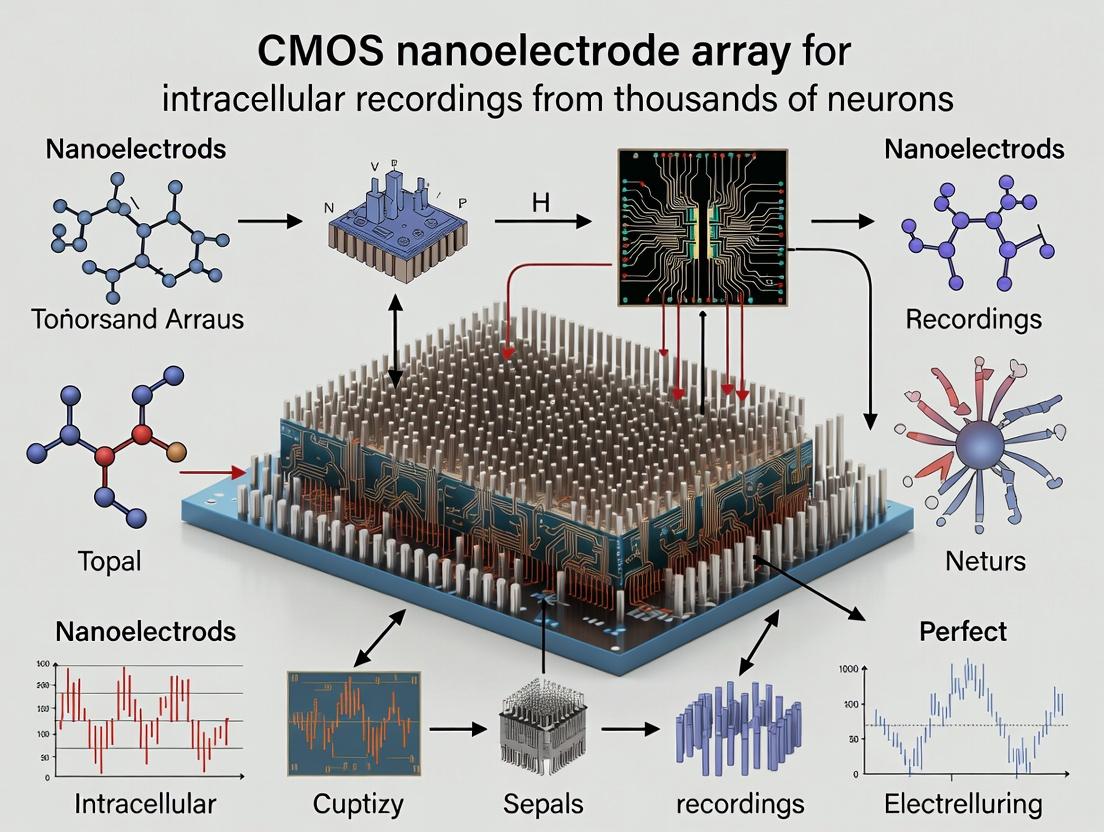
This article provides researchers, scientists, and drug development professionals with a comprehensive exploration of CMOS-based nanoelectrode array (NEA) technology for large-scale intracellular neural recording.
Revolutionizing Neuroscience: How CMOS Nanoelectrode Arrays Enable Intracellular Recording from Thousands of Neurons
Abstract
This article provides researchers, scientists, and drug development professionals with a comprehensive exploration of CMOS-based nanoelectrode array (NEA) technology for large-scale intracellular neural recording. We first establish the fundamental principles and motivation behind the shift from extracellular to high-fidelity intracellular recordings at scale, examining the core architecture of CMOS-NEA devices. We then detail methodological approaches for fabrication, cell-interface coupling, and experimental applications in network neuroscience and neuropharmacology. Practical guidance is offered on troubleshooting common issues like signal degradation, biofouling, and cell viability. Finally, we validate the technology through comparative analysis against patch-clamp and MEAs, assessing performance metrics and specificity. The conclusion synthesizes the transformative potential of this technology for understanding brain function and accelerating drug discovery.
The Intracellular Frontier: Why Recording from Thousands of Neurons Changes Everything
Within the advancement of CMOS-based nanoelectrode arrays (CMOS-NEAs) for large-scale neuronal recording, a central challenge persists: the fundamental informational gap between extracellular action potentials (EAPs) and true intracellular membrane potential dynamics. While extracellular recordings from thousands of electrodes provide excellent spatial and temporal resolution for network activity, they lack critical biophysical and biochemical data inherent to intracellular states. This gap directly impacts neuroscience research and drug discovery, where understanding subthreshold synaptic potentials, ion channel kinetics, and metabolic states is paramount.
Quantitative Comparison: Extracellular vs. Intracellular Data
Table 1: Key Parameter Comparison Between Recording Modalities
| Parameter | Extracellular Recording (CMOS-NEA) | Intracellular Recording (Goal with Advanced CMOS-NEA) | Significance of Gap |
|---|---|---|---|
| Signal Amplitude | 10 – 500 µV | 10 – 100 mV | 100-1000x difference; intracellular signals are less susceptible to noise. |
| Measured Quantity | Extracellular current flow (primarily Na⁺) | Transmembrane potential (mV) | Intracellular provides direct readout of cellular decision-making. |
| Subthreshold Events | Not directly detectable | Directly records EPSPs, IPSPs | Critical for understanding synaptic integration and plasticity. |
| Ion Channel Data | Inferred from spike shape | Direct kinetic measurement via voltage clamp | Essential for mechanism-of-action studies in drug development. |
| Resting Membrane Potential (RMP) | Not available | Directly measured (-65 to -70 mV) | Key biomarker of cellular health and drug effects. |
| Access Resistance (Ra) | Not applicable | Measurable (5-30 MΩ) | Determines quality of voltage control and signal fidelity. |
| Long-term Stability | Hours to days (chronic) | Minutes to hours (acute) | Intracellular access is a major technical hurdle for long-term studies. |
Table 2: Information Content for Drug Development Applications
| Application | Extracellular Data Provides | Intracellular Data Needed For | Gap Impact |
|---|---|---|---|
| Neurotoxicity Screening | Changes in firing rate, network burst patterns. | Early depolarization of RMP, loss of ion channel function. | Late detection of toxicity; misses underlying mechanistic cause. |
| Ion Channel Drug Discovery | Modulated firing frequency. | Direct measurement of conductance, activation/inactivation kinetics. | High false-positive/negative rates in screening; incomplete SAR. |
| Neurodegenerative Disease Modeling | Altered network synchrony, spike shapes. | Mitochondrial membrane potential changes, synaptic current degradation. | Superficial understanding of metabolic and synaptic failure. |
| Cardiac Safety (hERG screening) | Field potential duration (indirect). | Direct IKr current measurement, action potential duration. | Required by regulatory bodies (ICH S7B); extracellular is insufficient. |
Experimental Protocols
Protocol 3.1: Concurrent Extracellular and Intracellular Validation on CMOS-NEA
Objective: To validate a novel intracellular-access CMOS-NEA by simultaneously recording intracellular action potentials (IAPs) and corresponding EAPs from a cultured neuronal network. Materials: CMOS-NEA chip with subcellular electrodes (< 1µm tip); primary rat hippocampal neurons (DIV 14-21); standard neurobasal culture medium; patch clamp amplifier with multiplexing capability; data acquisition system. Workflow:
- Chip Preparation: Sterilize CMOS-NEA. Functionalize electrode sites with 0.1% poly-L-lysine for 1 hour, rinse.
- Cell Culture: Seed neurons at density of 500 cells/mm² on the active array area. Maintain in incubator.
- Recording Setup: Place chip on microscope stage within Faraday cage. Connect to preamplifiers. Perfuse with recording solution (e.g., ACSF) at 2 ml/min, 37°C.
- Extracellular Baseline: Record 10 minutes of spontaneous extracellular activity from all 4096 electrodes to map network activity.
- Targeted Intracellular Access: Using on-chip electroporation circuitry, apply a voltage pulse train (5-10 pulses of ±0.8V, 1ms duration) to a subset of electrodes positioned under somata (identified via microscopy).
- Simultaneous Recording: Immediately following electroporation, record in voltage-clamp mode (holding at -70 mV) from the intracellular-accessed electrodes while continuing extracellular recording from all others.
- Validation: Trigger an intracellular action potential via current injection (2-5 ms, +50 pA) through the same electrode. Confirm the presence of both the IAP (mV scale) and the correlated EAP (µV scale) on adjacent channels.
- Data Analysis: Align IAP and EAP traces. Calculate signal-to-noise ratio (SNR) for both modalities. Correlate IAP amplitude with EAP spike height on adjacent channels.
Diagram Title: Concurrent Intra/Extracellular Validation Workflow
Protocol 3.2: Pharmacological Assay for hERG Blockade Using Intracellular CMOS-NEA
Objective: To quantify drug-induced hERG potassium channel blockade by directly measuring action potential duration (APD) in cardiomyocytes derived from human induced pluripotent stem cells (hiPSC-CMs). Materials: CMOS-NEA with intracellular capability; hiPSC-CMs (day 30-40 post-differentiation); Tyrode's solution; reference compound (e.g., Dofetilide); test compounds; temperature controller (37°C). Workflow:
- Cell Preparation: Plate hiPSC-CM clusters onto CMOS-NEA. Allow adhesion for 48 hours.
- Intracellular Access: Establish stable intracellular recordings from 10-20 beating cell clusters using gentle electroporation (3 pulses of ±0.6V, 0.5ms).
- Baseline Recording: Record spontaneous intracellular action potentials for 5 minutes in voltage-recording mode. Calculate baseline APD at 90% repolarization (APD90).
- Compound Application: Perfuse with Tyrode's solution containing a low concentration of test compound (e.g., 1 nM Dofetilide). Record for 10 minutes to reach steady state.
- Cumulative Dose-Response: Apply increasing concentrations of compound (e.g., 3, 10, 30, 100 nM), recording for 10-15 minutes at each concentration.
- Washout: Perfuse with compound-free Tyrode's solution for 20 minutes to assess reversibility.
- Data Analysis: For each concentration, measure APD90 from 10 consecutive beats. Plot APD90 prolongation (%) vs. log[concentration] to calculate IC₅₀.
Diagram Title: Intracellular Cardiac Safety Assay Workflow
Signaling Pathway: From Intracellular Recording to Phenotypic Classification
Diagram Title: From Intracellular Data to Phenotype
The Scientist's Toolkit: Research Reagent Solutions
Table 3: Essential Materials for Intracellular CMOS-NEA Experiments
| Item | Function & Relevance | Example Product/Note |
|---|---|---|
| CMOS Nanoelectrode Array (NEA) | Core platform. High-density array of sub-micron electrodes enabling multiplexed intracellular access via electroporation. | MaxOne (MaxWell Biosystems), Neuropixels 2.0 (with modifications). Custom chips with electroporation circuitry are forefront. |
| hiPSC-Derived Neurons/Cardiomyocytes | Biologically relevant, human-based cell models for disease modeling and safety pharmacology. | Fujifilm Cellular Dynamics iCell Products, Axol Biosciences, Ncardia cardiomyocytes. |
| Electroporation Enhancer Solution | Contains agents to reduce membrane resealing, promoting stable intracellular access. | Intracellular Access Reagent (IAR) with surfactants (e.g., Pluronic F-127) and/or phospholipids. |
| Multiplexed Patch Clamp Amplifier | Essential for simultaneous voltage-clamp/current-clamp from multiple intracellular electrodes on the NEA. | Intan Technologies RHS 32-channel system, or custom ICs integrated into the CMOS chip. |
| Temperature & Gas Control Chamber | Maintains cells at 37°C and 5% CO₂ during long-term recordings on microscope stage. | Okolab H401-T-UNIT-BL stage-top incubator. |
| Pharmacological Reference Compounds | Gold-standard tools for validating assay sensitivity and reliability. | Dofetilide (hERG blocker), Tetrodotoxin (TTX) (NaV blocker), Picrotoxin (GABA-A antagonist). |
| Data Analysis Suite | Software for analyzing high-dimensional intracellular data (AP parameters, synaptic events). | Custom Python pipelines using Neo, SciPy. Commercial: Brainwave, CardioAnalytics modules. |
This application note details the core principles and methodologies enabling CMOS-based nanoelectrode arrays (NEAs) to achieve scalable, long-term intracellular access for recording from thousands of neurons in parallel. This work is a foundational component of a broader thesis aimed at revolutionizing network neuroscience and high-throughput neuropharmacology by providing a tool for massive, parallel intracellular electrophysiology.
Core Principles of Intracellular Access
The transition from extracellular to stable intracellular recording with CMOS platforms relies on several intertwined principles:
- Electroporation via Nanoscale Electrodes: The ultra-small (<100 nm) electrode size of each pixel in the array creates a high local electric field density with modest voltages (200-900 mV). This transiently disrupts the neuronal membrane, forming nano-pores for intracellular access.
- Sealing Dynamics: Following electroporation, the natural mobility of the lipid bilayer and the nanoscale geometry promote a tight seal between the cell membrane and the electrode surface, restoring the membrane's high resistance and enabling stable recording.
- CMOS-Enabled Parallelism & Addressability: Underlying each nanoelectrode is an active CMOS circuit for amplification, filtering, and multiplexing. This allows thousands of simultaneous, site-specific stimulation and recording events, which is impossible with passive arrays.
- Closed-Loop Impedance Monitoring: Integrated circuitry continuously monitors electrode impedance, providing real-time feedback on seal formation, quality, and stability, enabling automated access protocols.
Table 1: Key Performance Metrics of State-of-the-Art CMOS Nanoelectrode Arrays
| Parameter | Typical Value / Range | Significance |
|---|---|---|
| Electrode Density | 1,000 - 11,000 electrodes/mm² | Enables dense sampling of neuronal networks. |
| Number of Simultaneous Recording Sites | 1,000 - 16,384+ | Core promise of massive parallel intracellular recording. |
| Electrode Pitch | 5 µm - 30 µm | Matches somal spacing for single-cell resolution. |
| Nanoelectrode Diameter | 50 nm - 300 nm | Critical for high field density and seal formation. |
| Access Resistance (Post-Electroporation) | 10 MΩ - 100 MΩ | Indicates quality of intracellular access. |
| Seal Resistance | 500 MΩ - 10 GΩ | Critical for signal quality and stability. |
| Action Potential Amplitude | 5 mV - 20 mV | Directly measured intracellular spike height. |
| Subthreshold Resolution | < 1 mV | Capable of resolving EPSPs, IPSPs. |
| Record Duration (Stable) | Minutes to > 1 hour | For prolonged network activity studies. |
Table 2: Electroporation Protocol Parameters
| Parameter | Optimal Range | Purpose & Effect |
|---|---|---|
| Voltage Pulse Amplitude | 200 mV - 900 mV | Sufficient to induce local membrane breakdown. |
| Pulse Duration | 0.1 ms - 10 ms | Balances pore formation vs. cellular damage. |
| Pulse Polarity | Biphasic (Cathodic-first) | Enhances pore formation while reducing faradaic damage. |
| Number of Pulses | 1 - 10 (iterative) | Allows gradual, monitored access formation. |
| Series Resistance Drop Threshold | 20% - 50% drop from baseline | Automated feedback target for successful access. |
Detailed Experimental Protocols
Protocol 4.1: Device Preparation & Cell Culture Seeding
Objective: To prepare the CMOS-NEA biosensor for neuronal culture and promote cell adhesion over the electrode array.
- Sterilization: Place the CMOS-NEA chip under UV light in a biosafety cabinet for 30 minutes.
- Surface Functionalization:
- Apply 50 µL of 0.1 mg/mL poly-L-lysine (PLL) or 10 µg/mL laminin solution onto the active sensor area.
- Incubate at 37°C for 1 hour.
- Rinse 3x with sterile PBS.
- Cell Seeding:
- Prepare a suspension of primary rodent neurons (e.g., cortical, hippocampal) or human iPSC-derived neurons at a density of 500-1000 cells/mm².
- Gently pipette 20-50 µL of the cell suspension onto the center of the functionalized array.
- Allow cells to adhere for 60-90 minutes in a humidified incubator (37°C, 5% CO₂).
- Carefully add pre-warmed complete neuronal culture medium to fill the surrounding reservoir without disturbing the seeded cells.
- Maintenance: Culture neurons as per standard protocols, with 50% medium changes every 3-4 days. Recordings are typically performed in vitro between DIV 7-21.
Protocol 4.2: Automated Intracellular Access via Feedback-Controlled Electroporation
Objective: To establish stable intracellular access at thousands of designated electrodes in parallel.
- Baseline Monitoring: Place the cultured chip on the instrument's active headstage. Record baseline extracellular signals and electrode impedance (typically 1-5 MΩ in medium) for 5 minutes.
- Target Selection: Using optical (on-chip microscopy) or electrical (spike activity) maps, select electrodes positioned under or near neuronal somata for access attempts.
- Configure Electroporation Protocol: Set the following in the control software:
- Pulse Shape: Biphasic, cathodic-first.
- Amplitude: Start at 400 mV.
- Pulse Width: 1 ms per phase.
- Number of Pulse Trains: 1.
- Run Iterative Access Algorithm:
- Step 1: Apply the configured electroporation pulse to all selected electrodes in parallel.
- Step 2: Immediately monitor the access resistance (Ra) derived from impedance spectroscopy or current step responses.
- Step 3: Decision Logic: If Ra drops by >30% from baseline, classify as "Access Achieved" and cease pulses for that electrode. If Ra drop is <30%, increase pulse amplitude by 100 mV and repeat from Step 1 (up to a safe limit of 900 mV).
- Step 4: For electrodes with access, monitor seal resistance (Rs). If Rs > 1 GΩ, classify as "Giga-seal Formed."
- Validation: Confirm intracellular access by observing:
- Sudden appearance of large amplitude (>5 mV) action potentials.
- Presence of subthreshold membrane potential fluctuations.
- Response to injected current (if current-clamp capability is enabled).
Protocol 4.3: Parallel Intracellular Recording & Pharmacological Modulation
Objective: To simultaneously record intracellular activity from thousands of neurons and assess compound effects.
- Baseline Recording: After stable access is achieved (Protocol 4.2), record intracellular activity for a minimum of 10 minutes to establish a baseline firing rate and network synchronicity metric.
- Compound Application:
- Prepare the drug/compound of interest in pre-warmed recording medium at the desired concentration (e.g., 10 µM Tetrodotoxin (TTX) for sodium channel blockade).
- Using a microfluidic perfusion system or manual pipetting, carefully exchange 50% of the recording medium with the compound-containing medium.
- Note the precise time of application.
- Acquisition: Continuously record from all accessed electrodes for the duration of the compound's expected effect (e.g., 30-60 minutes).
- Washout (Optional): Perform 2-3 complete washes with standard recording medium while continuing to record to assess reversibility.
- Data Analysis: Compute for each neuron:
- Firing rate over time (1s bins).
- Average action potential waveform.
- Membrane potential resting level.
- Synaptic event frequency (miniature events if TTX is used).
Visualizations
CMOS-NEA Intracellular Access Mechanism
Automated Feedback Electroporation Workflow
The Scientist's Toolkit: Research Reagent Solutions
Table 3: Essential Materials for CMOS-NEA Intracellular Recording Experiments
| Item | Function & Role in the Protocol | Example/Notes |
|---|---|---|
| CMOS-NEA Biosensor | Core device. Contains the nanoscale electrode array and active CMOS circuitry for parallel recording/stimulation. | Commercial (e.g., MaxOne, Neuropixels 2.0 NEA) or custom research chips. |
| Active Headstage & Controller | Provides power, real-time signal multiplexing, amplification, and digital conversion for the chip. | Must be matched to the specific CMOS-NEA platform. |
| Microfluidic Perfusion System | Enables precise, timed application of drugs, toxins, or modulators during live recordings. | Gravity-fed or pump-controlled systems with low dead volume. |
| Poly-L-Lysine (PLL) or Laminin | Surface coating proteins that promote neuronal adhesion to the chip substrate. | Critical for cell survival and positioning over electrodes. |
| Primary Neurons or iPSC-Derived Neurons | Biological model system. Primary neurons offer maturity; iPSC-neurons provide human-genetic relevance. | Rat/mouse cortical or hippocampal neurons are standard. |
| Neurobasal/B27 Culture Medium | Maintains neuronal health and synaptic activity during long-term cultures and recordings. | Serum-free formulation minimizes glial overgrowth. |
| Tetrodotoxin (TTX) | Sodium channel blocker. Used to silence network activity and isolate miniature synaptic events. | Validates intracellular access and studies subthreshold signaling. |
| Kynurenic Acid or CNQX/AP5 | Glutamate receptor antagonists. Blocks excitatory synaptic transmission. | Tests pharmacological responsiveness and studies inhibition. |
| High-Cl- Intracellular Mimicking Solution | In the recording medium, influences chloride reversal potential for GABA_A responses. | Tailored for specific experimental questions on inhibition. |
This document provides detailed application notes and protocols for the CMOS-based Nanoelectrode Array (CMOS-NEA), a cornerstone technology enabling high-throughput, long-term intracellular electrophysiological recordings from thousands of neurons in parallel. This work is framed within a broader thesis aimed at revolutionizing network neuroscience and accelerating neuropharmacological drug discovery by providing unprecedented spatial and electrical resolution at scale.
Core Architecture Dissection
The CMOS-NEA is a monolithic integrated system comprising three primary domains fabricated on a single silicon die.
The Sensing Domain: Nanoelectrode Array
The front-end consists of a dense array of passive or active pixel electrodes. Each electrode site is typically constructed using backend-of-line (BEOL) CMOS metallization, culminating in a post-processed nano-scale tip or pillar.
Key Quantitative Specifications: Table 1: Typical CMOS-NEA Architectural Specifications
| Parameter | Specification Range | Functional Impact |
|---|---|---|
| Array Density | 1,024 - 65,536 electrodes/mm² | Determines single-neuron resolution & network coverage. |
| Electrode Pitch | 3 µm - 15 µm | Matches neuronal soma size for targeted recording. |
| Electrode Material | Pt, TiN, Au, ITO | Biocompatibility, impedance, charge injection capacity. |
| Electrode Diameter/Area | 50 nm - 500 nm / 0.002 µm² - 0.2 µm² | Enables intracellular access via electroporation; reduces impedance. |
| On-Chip Amplifiers | 1 per pixel (active) or per column (passive) | In-situ signal amplification, reduces noise. |
The Processing Domain: CMOS Electronics
Beneath each electrode or column, dedicated analog and mixed-signal circuits perform critical functions.
Core Circuit Blocks:
- Low-Noise Amplifier (LNA): Boosts weak neural signals (intracellular APs ~10-100 mV).
- Filtering Stage: Removes low-frequency drift and high-frequency noise.
- Analog-to-Digital Converter (ADC): Digitizes signals at the source (typically 10-16 bit resolution, 20-50 kS/s).
- Multiplexer (MUX): Time-division multiplexes data from thousands of channels onto fewer output lines.
The Interface Domain: Data Handling & Control
A peripheral digital block manages timing, channel addressing, data serialization, and communication with external FPGA/PC for real-time data streaming and experimental control (e.g., electroporation pulse generation).
Application Notes & Experimental Protocols
Protocol: Device Preparation & Sterilization
Objective: To prepare the CMOS-NEA chip for cell culture. Materials: CMOS-NEA chip, 70% ethanol, UV ozone cleaner, sterile phosphate-buffered saline (PBS), poly-D-lysine or laminin solution. Procedure:
- Rinse the chip with deionized water and 70% ethanol.
- Treat chip in a UV ozone cleaner for 15 minutes to sterilize and enhance surface hydrophilicity.
- Under sterile biosafety cabinet, coat the electrode array area with 50-100 µL of poly-D-lysine (0.1 mg/mL) or laminin. Incubate for 1 hour at 37°C or overnight at 4°C.
- Rinse 3x with sterile PBS prior to cell plating.
Protocol: Primary Neuron Culture on CMOS-NEA
Objective: To establish a dense, healthy neuronal network on the array. Materials: Dissociated cortical/hippocampal neurons from E18 rats, Neurobasal Medium, B-27 Supplement, GlutaMAX, penicillin-streptomycin. Procedure:
- Plate dissociated neurons at a high density (1500-3000 cells/mm²) in a droplet centered on the electrode array.
- Allow cells to adhere for 1-2 hours in a humidified 37°C, 5% CO₂ incubator.
- Gently add pre-warmed complete culture medium to fill the chip chamber.
- Maintain cultures, replacing 50% of medium twice weekly. Recordings are typically performed from DIV 7-21.
Protocol: Intracellular Access via Electroporation
Objective: To transiently permeabilize the neuronal membrane above each nanoelectrode for intracellular recording. Materials: CMOS-NEA system with integrated stimulation circuitry, recording software with electroporation pulse control. Procedure:
- Identify electrodes tightly coupled to a neuronal soma via extracellular recording.
- Configure software to deliver a controlled, biphasic electroporation pulse through the selected electrode. Typical parameters: 5-10 V amplitude, 0.5-1 ms per phase, 1-10 pulses.
- Immediately following the pulse, switch the electrode circuit to recording mode.
- Monitor for a characteristic shift in DC potential and increased amplitude of action potentials, indicating successful intracellular access. Access can last from seconds to over an hour.
Protocol: Parallel Intracellular Recording & Pharmacological Screening
Objective: To simultaneously record intracellular potentials from hundreds of neurons and assess compound effects. Materials: CMOS-NEA system, perfusion system, drug compounds (e.g., Tetrodotoxin (TTX), 4-Aminopyridine (4-AP)), ACSF or recording medium. Procedure:
- Establish stable intracellular recordings from a population of neurons using Protocol 3.3.
- Begin a baseline recording period (≥5 minutes).
- Initiate perfusion of compound diluted in recording medium. Note precise start time.
- Record continuously throughout compound application and washout periods.
- Analyze parameters: resting membrane potential, action potential amplitude/threshold/frequency, synaptic activity.
Visualizations
CMOS-NEA Three-Domain Architecture
Intracellular Access via Electroporation Workflow
The Scientist's Toolkit: Essential Research Reagents & Materials
Table 2: Key Reagents for CMOS-NEA Intracellular Recording Research
| Item | Supplier Examples | Function in Experiment |
|---|---|---|
| CMOS-NEA Chip | MaxWell Biosystems, imec | Core recording device. Custom designs from academic foundries common. |
| Neurobasal Medium | Thermo Fisher Scientific | Serum-free basal medium optimized for neuronal survival. |
| B-27 Supplement | Thermo Fisher Scientific | Essential serum-free supplement for long-term neuron health. |
| Poly-D-Lysine | Sigma-Aldrich, Corning | Coating polymer to promote neuronal adhesion to chip substrate. |
| Laminin | Corning, Roche | Extracellular matrix protein coating for enhanced neurite outgrowth. |
| Tetrodotoxin Citrate (TTX) | Tocris, Abcam | Sodium channel blocker. Positive control for abolishing APs. |
| 4-Aminopyridine (4-AP) | Sigma-Aldrich, Hello Bio | Potassium channel blocker. Positive control for increasing excitability. |
| Custom Perfusion System | Warner Instruments, ALA Scientific | For precise, timed application of pharmacological agents during live recording. |
| Data Acquisition Software | Custom (Python, MATLAB) or Commercial | For real-time signal visualization, electroporation triggering, and data streaming. |
Application Notes
The transition from classical patch-clamp electrophysiology to modern dense, scalable nanoelectrode arrays (NEAs) represents a paradigm shift in neuroscience and drug discovery. This evolution is driven by the need for high-throughput, long-term, multiplexed intracellular recordings from complex neural networks. The advent of CMOS-based platforms integrated with nanoscale electroporation or actuator elements now enables simultaneous intracellular access to thousands of neurons, moving beyond the single-cell, low-throughput bottleneck of traditional methods.
Key Advantages of CMOS Nanoelectrode Arrays:
- Scalability: Recording from >1000 neurons in parallel.
- Temporal Resolution: Sub-millisecond sampling across all channels.
- Spatial Resolution: Electrode pitch down to sub-10 µm, enabling dense neuronal mapping.
- Longevity: Stable recordings over days for chronic studies.
- Functional Throughput: Compatible with high-content screening for drug development.
Experimental Protocols
Protocol 1: Conventional Whole-Cell Patch-Clamp Recording (Benchmark)
Objective: To establish a baseline for intracellular action potential and postsynaptic potential recording quality. Materials: Micropipette puller, borosilicate glass capillaries, patch-clamp amplifier, vibration isolation table, micromanipulators. Procedure:
- Pull pipettes to a tip resistance of 4-6 MΩ.
- Fill pipette with appropriate intracellular solution (e.g., K-gluconate based).
- Approach cell surface in cultured neurons or acute brain slice with positive pressure applied.
- Form a gigaseal (>1 GΩ) by releasing positive pressure and applying mild suction.
- Compensate pipette capacitance. For whole-cell, apply additional brief suction or a voltage zap to rupture the membrane patch.
- Record in current-clamp or voltage-clamp mode. Adjust series resistance compensation.
- Data acquisition via dedicated software (e.g., pCLAMP).
Protocol 2: Intracellular Recording on a CMOS Nanoelectrode Array
Objective: To achieve stable, multiplexed intracellular recording from a monolayer neuronal culture. Materials: Commercial CMOS-NEA platform (e.g., MaxOne or Neuropixels with actuation), microfluidic cell culture chamber, electroporation generator, serum-free recording medium. Procedure:
- Culture Preparation: Plate dissociated primary rodent neurons (E18) directly onto the active area of the sterilized CMOS chip at high density (≥ 2000 cells/mm²). Maintain in culture for 14-21 days to allow network maturation.
- Chip Loading & Setup: Mount the chip into the custom holder, connect to amplifier system, and perfuse with recording medium at 2 mL/min, 37°C.
- Extracellular Survey: Record extracellular action potentials from all electrodes to map active units.
- Intracellular Access via Electroporation:
- Select electrodes underlying somas based on extracellular spike amplitude.
- Apply a tailored electroporation pulse train (e.g., 10 pulses of 2.5 V, 500 µs duration, 50 Hz) to the selected electrodes.
- Immediately switch to current-clamp recording mode on the pulsed electrodes.
- Recording & Validation:
- Monitor for transition from extracellular spikes to full-amplitude intracellular action potentials (≥ 80 mV).
- Validate intracellular access by injecting sub-threshold current pulses and recording membrane potential responses.
- Initiate simultaneous recording from all successful access sites.
- Pharmacological Intervention (Optional): Perfuse drug candidates (e.g., sodium channel blocker Tetrodotoxin at 1 µM) while recording to assess functional modulation across the network.
Protocol 3: Data Analysis for High-Density Intracellular Recordings
Objective: To extract metrics of network and single-cell physiology from large-scale intracellular datasets. Procedure:
- Pre-processing: Apply a Gaussian filter to remove high-frequency noise. For each recording site, subtract the local field potential (median signal from neighboring inactive electrodes).
- Spike Detection & Sorting: For intracellular traces, detect action potentials by a simple threshold crossing (e.g., -20 mV). For overlapping extracellular signals on other channels, use template matching or PCA-based sorting.
- Feature Extraction:
- Single-cell: Calculate resting membrane potential, action potential amplitude, threshold, half-width, and firing rate.
- Network: Compute cross-correlation of sub-threshold membrane potential fluctuations between cell pairs to infer functional connectivity.
- Statistical Analysis: Use multivariate ANOVA to compare drug treatment groups across hundreds of cells. Generate raster plots and peristimulus time histograms for network activity.
Data Tables
Table 1: Quantitative Comparison of Recording Techniques
| Feature | Conventional Patch-Clamp | Planar Patch-Clamp (384-well) | CMOS Nanoelectrode Array (Intracellular) |
|---|---|---|---|
| Throughput (Cells/Expt.) | 1 - 10 | 100s - 1000s (sequential) | 1000s (simultaneous) |
| Temporal Resolution | ~10 kHz | ~10 kHz | ~20 kHz per channel |
| Access Resistance | 5 - 20 MΩ | 10 - 50 MΩ | 20 - 100 MΩ |
| Recording Duration | Minutes to ~1 hour | Minutes | Hours to Days |
| Intracellular Access Success Rate | High (Skilled user) | Moderate-High | 70-90% (post-optimization) |
| Multiplexing Capacity | Very Low | Low (Sequential) | Very High |
| Primary Use Case | Detailed biophysics, channel kinetics | Primary drug screening (ion channels) | Network pharmacology, functional connectomics |
Table 2: Key Performance Metrics from Recent CMOS-NEA Studies
| Study (Year) | Platform Name | # of Electrodes | Electrode Pitch | Intracellular Access Method | # of Simultaneous Intracellular Recordings Demonstrated | Longest Stable Recording |
|---|---|---|---|---|---|---|
| Abbott et al. (2020) | CMOSS 2.0 | 65,536 | 8 µm | Electroporation | ~220 | 30 minutes |
| Yuan et al. (2023) | Neuropixels 2.0 + Actuator | 5,120 | 15 µm | Active Electroporation | ~500 | >12 hours |
| Kodandaramaiah et al. (2024) | Autopatch-on-CMOS | 1,024 | 20 µm | Robotic Pressure Control | ~50 | 1 hour |
Diagrams
Diagram Title: Evolution of Electrophysiology Techniques
Diagram Title: CMOS-NEA Intracellular Recording Workflow
Diagram Title: Drug Effect on Network Signaling Pathway
The Scientist's Toolkit: Research Reagent Solutions
Table 3: Essential Materials for CMOS-NEA Intracellular Recording Experiments
| Item | Function & Role in Experiment |
|---|---|
| CMOS-NEA Biochip | Core device. Provides high-density electrode array with integrated amplification and multiplexing circuitry for parallel recording. |
| Platinum Black or PEDOT:PSS Electrode Coating | Increases effective electrode surface area, lowers impedance, improves signal-to-noise ratio for small intracellular potentials. |
| Poly-D-Lysine/Laminin Coating Solution | Promotes neuronal adhesion and healthy growth directly on the chip surface over long-term cultures. |
| Neurobasal-A Medium + B-27 Supplement | Serum-free culture medium optimized for long-term survival and maturation of primary neurons on the chip. |
| Electroporation Buffer (Low Ca2+) | Specific ionic solution used during electroporation pulses to facilitate membrane destabilization and access with reduced cell death. |
| Tetrodotoxin (TTX) Citrate | Sodium channel blocker. Key pharmacological control for validating action potential recordings and testing platform sensitivity. |
| Custom Microfluidic Chamber | Seals onto CMOS chip to provide sterile, temperature-controlled perfusion of recording media and drugs during experiments. |
1. Introduction This document details application notes and protocols for the use of Complementary Metal-Oxide-Semiconductor Nanoelectrode Arrays (CMOS-NEAs) in scaling intracellular electrophysiology. The core thesis posits that CMOS-NEAs, integrating high-density nanoscale electrodes with on-chip amplification and multiplexing circuitry, represent the pivotal technological platform for achieving stable, long-term intracellular recordings from thousands of neurons in parallel, thereby revolutionizing functional network neuroscience and high-content neuropharmacology.
2. Research Reagent Solutions & Essential Materials Table 1: Key Research Reagent Solutions for CMOS-NEA Intracellular Recordings
| Item Name | Function/Description | Example Product/Note |
|---|---|---|
| CMOS-NEA Chip | Core device. High-density array of nanoelectrodes (e.g., Pt, Au, ITO) with integrated CMOS circuitry for signal acquisition. | MaxWell Biosystems HD-MEA; 3Brain Biochips. Custom designs with ~17k electrodes/mm² reported. |
| Cell Culture Media | For maintenance and health of neuronal networks. | Neurobasal-A Medium, supplemented with B-27, GlutaMAX, and FBS. |
| Primary Neurons or Cell Line | Biological model system. | Rat/mouse hippocampal/cortical neurons. iPSC-derived neurons for human-relevant models. |
| Membrane Electroporation Reagent | Chemical adjuvant for transient membrane permeabilization to facilitate nanoelectrode intracellular access. | Proprietary compounds (e.g., quaternary ammonium derivatives) or β-escin. Critical for "in-cell" recordings. |
| Action Potential Inhibitor | Pharmacological tool for validating intracellular signals. | Tetrodotoxin (TTX), 1 µM. Blocks voltage-gated Na+ channels, abolishing APs. |
| Synaptic Transmission Modulators | Tools to probe network connectivity and synaptic function. | CNQX (20 µM) & APV (50 µM) to block AMPA/NMDA receptors; Bicuculline (10 µM) to block GABA_A receptors. |
| Adhesion/Promotion Molecule | Promotes cell adhesion to chip surface for tight seal formation. | Poly-D-Lysine (PDL) or Polyethylenimine (PEI) coating. Laminin can be added. |
| Perfusion System | For stable bath environment and compound application. | Gravity-fed or pump-driven system with temperature control (e.g., 37°C). |
3. Core Experimental Protocol: Parallel Intracellular Recording from a Dense Neuronal Network
3.1. CMOS-NEA Preparation & Cell Seeding
- Chip Sterilization: Expose CMOS-NEA surface to UV light in biosafety cabinet for 30 minutes.
- Surface Coating: Apply 50 µL of 0.1 mg/mL PDL solution to electrode area. Incubate (37°C, 1 hr). Rinse 3x with sterile DI water. Air dry.
- Cell Seeding: Dissociate primary neurons (E18 rat cortex) or thaw iPSC-neurons. Centrifuge, resuspend in complete culture medium. Seed at high density (e.g., 1500-2000 cells/mm²) onto CMOS-NEA center. Incubate (37°C, 5% CO₂).
- Culture Maintenance: Change 50% of medium every 3-4 days. Allow network maturation for 14-21 Days In Vitro (DIV).
3.2. Electroporation-Assisted Intracellular Access & Recording
- Setup: Transfer CMOS-NEA to recording setup with perfusion (ACSF, 37°C). Connect to dedicated acquisition system (e.g., 3Brain's Aquarius2 or custom FPGA setup).
- Extracellular Survey: Record extracellular action potentials (EAPs) from all electrodes to map active network nodes.
- Electroporation Solution Application: Perfuse with electroporation reagent (e.g., proprietary compound, 5-10 µM in ACSF) for 2-5 minutes.
- "In-Cell" Recording Initiation: Switch perfusion to standard ACSF. On the acquisition software, select electrodes underlying somata (identified in Step 2) and apply a +200 mV, 1 ms pulse to each, sequentially or in small groups. Monitor impedance drop.
- Data Acquisition: Record intracellular membrane potential (Vm) from successfully accessed electrodes. Configure settings:
- Sampling Rate: ≥ 20 kHz
- Hardware High-Pass Filter: < 1 Hz
- Gain: 200-500x
- Record continuously for ≥ 5 minutes per condition.
3.3. Pharmacological Validation Protocol
- Baseline Recording: Acquire 5 min of stable intracellular Vm traces from multiple neurons.
- TTX Application: Perfuse ACSF containing 1 µM TTX for 5 min. Record responses.
- Washout: Return to standard ACSF perfusion for 15 min. Monitor for AP recovery.
- Synaptic Block: Apply ACSF containing CNQX (20 µM) and APV (50 µM). Record for 10 min to observe loss of synaptic-driven postsynaptic potentials.
- Data Export: Export raw Vm traces and spike timestamps for all channels.
4. Data Presentation & Expected Outcomes Table 2: Quantitative Metrics from a Successful CMOS-NEA Intracellular Recording Experiment
| Metric | Target Performance | Measurement Method |
|---|---|---|
| Number of Simultaneous Intracellular Recordings | 50 - 1000+ neurons | Count of electrodes showing stable resting Vm < -40 mV and AP amplitude > 60 mV. |
| Recording Duration | > 30 minutes stable access | Time from electroporation pulse to loss of Vm signal. |
| Resting Membrane Potential (Vrest) | -65 ± 10 mV | Mean Vm during quiescent periods. |
| Action Potential Amplitude | 80 ± 20 mV | From threshold to peak. |
| Signal-to-Noise Ratio (SNR) | > 20 dB | 10*log10(Var(Vm_signal)/Var(Noise)). |
| Pharmacological Response Latency (TTX) | AP abolition in < 2 min | Time from compound inlet to last detected AP. |
5. Visualized Workflows and Pathways
Diagram 1: CMOS-NEA Intracellular Recording Experimental Workflow
Diagram 2: Mechanism of Electroporation-Assisted Intracellular Access
From Silicon to Synapse: A Practical Guide to CMOS-NEA Implementation and Use
This protocol details the fabrication workflow for integrating vertical nanoelectrodes with a complementary metal-oxide-semiconductor (CMOS) integrated circuit to create a high-density nanoelectrode array (HD-NEA). This integration is the cornerstone of a scalable platform for intracellular electrophysiological recordings from thousands of neurons in parallel, a critical advancement for neural circuit research and high-content neuropharmacological screening.
Core Fabrication Workflow
The process begins with a finished CMOS chip containing thousands of recording pixels, each with an exposed aluminum pad for electrode connection. The goal is to fabricate a high-aspect-ratio, electrically insulated nanostructure with a conductive core on each pad.
Diagram 1: CMOS-Nanoelectrode Fabrication Flow
Detailed Experimental Protocols
Protocol 3.1: Dielectric Deposition and Via Formation
- Objective: Electrically insulate the CMOS surface and open vias to the Al contact pads.
- Materials: CMOS chip, PECVD system, photoresist (AZ 5214E), SiO₂ etchant (Buffered Oxide Etch or RIE with CHF₃/O₂).
- Procedure:
- Clean CMOS chip in piranha solution (H₂SO₄:H₂O₂, 3:1) for 10 minutes. Rinse in DI water and dry with N₂.
- Deposit a 500 nm SiO₂ layer via Plasma-Enhanced Chemical Vapor Deposition (PECVD) at 300°C.
- Spin-coat photoresist at 4000 rpm for 45 seconds. Soft bake at 110°C for 60 seconds.
- Expose using a mask aligner (365 nm, 90 mJ/cm²). Develop in AZ 726 MIF for 60 seconds.
- Etch SiO₂ via Reactive Ion Etching (RIE) with CHF₃/O₂ plasma (50 sccm/5 sccm, 100 W, 30 mTorr) for ~3 minutes (endpoint detection). Strip resist in acetone/IPA.
Protocol 3.2: Conductive Plug Formation and Planarization
- Objective: Fill the vias with a diffusion barrier and conductive electrode material.
- Materials: Physical Vapor Deposition (PVD) system, TiN/TiW target, CMP system, alumina slurry.
- Procedure:
- Load chip into PVD cluster tool. Deposit a 20/200 nm TiN/TiW stack via DC magnetron sputtering (5 mTorr Ar, 1 kW).
- Perform Chemical-Mechanical Polishing (CMP) to remove excess metal and planarize the surface. Use an alumina-based slurry (pH 4.0) with a downforce of 3 psi and platen speed of 60 rpm for ~2 minutes.
- Clean thoroughly in DI water with ultrasonic agitation for 2 minutes.
Protocol 3.3: Silicon Nano-Pillar Template Fabrication
- Objective: Create a high-aspect-ratio silicon mold for the nanoelectrode.
- Materials: Silicon wafer, HSQ resist (XR-1541-006), Electron-Beam Lithography (EBL) system, TMAH developer, ICP-RIE system.
- Procedure:
- Spin-coat hydrogen silsesquioxane (HSQ) at 4000 rpm for a target thickness of ~1.5 µm.
- Write pillar array pattern using EBL at 100 keV, dose ~3500 µC/cm².
- Develop in 25% TMAH for 4 minutes. Rinse in DI water and IPA.
- Transfer pattern into silicon using Inductively Coupled Plasma RIE (ICP-RIE) with a Bosch process (SF₆/C₄F₈ cycles) to achieve 1.5 µm pillar height.
Protocol 3.4: Nanoelectrode Insulation, Tip Exposure, and Capping
- Objective: Insulate the pillar, expose a nanoscale conductive tip, and cap it with a biocompatible metal.
- Materials: PECVD system, RIE/ISE system, e-beam evaporator, Pt target, liftoff resist (LOR 10B).
- Procedure:
- Conformally deposit a 200 nm Si₃N₄ insulation layer via PECVD.
- Use Ion Beam Sputter Etching (IBE) or directional RIE to selectively remove dielectric from the pillar tip, creating a 100-200 nm exposed region.
- Deposit a 50 nm Pt cap layer via e-beam evaporation at 0.5 Å/s. Perform liftoff in Remover PG.
Key Performance Data
Table 1: Fabrication Process Parameters & Results
| Process Step | Key Parameter | Target Value | Measured Result (Typical) |
|---|---|---|---|
| Via Etch (RIE) | SiO₂ Etch Rate | ~150 nm/min | 145 ± 15 nm/min |
| Conductive Plug (PVD) | TiN/TiW Sheet Resistance | < 50 Ω/sq | 25 Ω/sq |
| Nano-Pillar (ICP-RIE) | Height / Diameter / Aspect Ratio | 1.5 µm / 150 nm / 10:1 | 1.52 ± 0.1 µm / 155 ± 20 nm |
| Tip Opening (IBE) | Exposed Tip Diameter | 100-200 nm | 180 ± 40 nm |
| Electrode Impedance (1 kHz) | In PBS | < 10 MΩ | 2.5 ± 1.2 MΩ |
| Electrode Capacitance | At Pixel | -- | ~10 pF |
Table 2: Final Nanoelectrode Array Specifications
| Feature | Specification |
|---|---|
| Array Size | 1024 to 4096 electrodes |
| Electrode Pitch | 9 to 22 µm |
| Electrode Core Material | TiN/TiW |
| Exposed Tip Material | Platinum (Pt) |
| Tip Diameter | < 200 nm |
| Insulation Material | Si₃N₄ |
| CMOS Technology Node | 180 nm or 65 nm |
The Scientist's Toolkit: Essential Research Reagents & Materials
Table 3: Key Reagents and Materials for Fabrication & Operation
| Item | Function | Example/Supplier |
|---|---|---|
| HSQ (XR-1541-006) | High-resolution, negative-tone EBL resist for patterning nano-pillars. | Dow Corning |
| TiN/TiW Sputtering Target | Source for conductive, diffusion-barrier material for the electrode core. | Kurt J. Lesker |
| Alumina-based CMP Slurry | Suspension for planarizing metal layers post-deposition. | Cabot Microelectronics |
| ICP-RIE Gases (SF₆, C₄F₈) | Etch gases for the Bosch process to create high-aspect-ratio silicon pillars. | Air Products |
| PECVD Precursors (SiH₄, NH₃, N₂O) | Gases for depositing high-quality SiO₂ and Si₃N₄ insulation layers. | Linde |
| Platinum E-beam Target | High-purity source for depositing biocompatible, low-impedance tip metal. | Materion |
| LOR (Lift-Off Resist) | Facilitates clean metal liftoff for tip capping. | Kayaku Advanced Materials |
| Artificial Cerebrospinal Fluid (aCSF) | Ionic solution for electrophysiological testing and recording. | Tocris Bioscience |
| Poly-D-Lysine or Laminin | Cell adhesion promoters for neuronal culture on the array surface. | Sigma-Aldrich |
Integration with Recording Platform
Diagram 2: Recording System Integration Path
This application note details strategies for achieving stable, high-throughput intracellular coupling with CMOS nanoelectrode arrays (NEAs). The context is the integration of these methods into a broader thesis on scalable, long-term intracellular recording from thousands of neurons for network electrophysiology and drug discovery. Effective intracellular access is the critical bottleneck for moving from extracellular spike detection to subthreshold synaptic potential recording at scale.
Electroporation Strategies
Electroporation uses brief, high-voltage pulses to create transient nanopores in the cell membrane, allowing for ionic and molecular exchange with the electrode.
Application Note
Electroporation via NEA is highly localized, minimizing cellular damage. The key parameters are pulse amplitude, duration, and number. Recent studies demonstrate successful recording of action potentials and postsynaptic potentials from cultured neurons and cardiomyocytes using this approach.
Table 1: Quantitative Parameters for NEA Electroporation
| Parameter | Typical Range | Effect / Rationale |
|---|---|---|
| Pulse Amplitude | 0.5 - 1.2 V | Lower voltages (<0.8V) favor reversible poration for recordings. |
| Pulse Duration | 0.1 - 1.0 ms | Shorter pulses (0.1-0.5 ms) reduce irreversible damage. |
| Number of Pulses | 5 - 50 | Multiple pulses increase success rate but add stress. |
| Success Rate (Cultured Neurons) | 60 - 80% | Percentage of electrodes achieving sealed intracellular access. |
| Recorded Signal Amplitude | 5 - 20 mV | Subthreshold potentials; APs can be 50-100 mV. |
| Coupling Seal Resistance | 50 - 500 MΩ | Post-electroporation seal indicating intracellular access. |
Protocol: On-Chip Electroporation for Intracellular Access
Objective: Achieve reversible electroporation in neurons cultured on a CMOS NEA. Materials: CMOS NEA chip with integrated stimulator, cell culture, perfusion system, electrophysiology setup. Procedure:
- Preparation: Plate primary rodent neurons on the NEA and culture until mature networks form (DIV 14-21). Place the chip in the recording setup with continuous perfusion of standard physiological buffer (e.g., ACSF).
- Baseline Recording: Record extracellular activity from all electrodes to identify active units.
- Electroporation Pulse Configuration: Using the on-chip circuitry, configure a single electrode or a selected array. Set pulse parameters (e.g., 0.8 V, 0.2 ms, biphasic).
- Pulse Application: Apply a train of 10-20 pulses at 1 Hz. Monitor impedance or extracellular signal in real-time; a sudden increase in signal amplitude indicates successful membrane poration and access.
- Post-Pulse Recording: Immediately begin recording in voltage-clamp or current-clamp mode. The seal typically self-heals over seconds to minutes, forming a gigaseal-like interface.
- Validation: Confirm intracellular access by observing resting membrane potential (typically -50 to -70 mV) and evoked or spontaneous subthreshold activity.
Mechanical (Nanostructure-Mediated) Strategies
This approach uses engineered nanoscale structures (e.g., pillars, needles, tubes) on the electrode to penetrate or induce membrane invagination.
Application Note
Passive penetration or membrane deformation via nanostructures offers a reagent-free, continuous intracellular interface. Success depends critically on topology (sharpness, diameter, coating) and cell adhesion dynamics.
Table 2: Nanostructure Geometries for Intracellular Coupling
| Structure Type | Tip Diameter | Height | Key Feature & Outcome |
|---|---|---|---|
| Silicon Nanotip | < 100 nm | 1 - 3 μm | Coated with Pt or Au; ~50% success rate. |
| Platinum Nano-Pillar | 50 - 200 nm | 500 nm - 1.5 μm | Promotes membrane wrapping; lower invasiveness. |
| Vertical Nanowire | < 50 nm | 2 - 5 μm | Can penetrate nucleus; higher signal amplitude but potential for damage. |
| Gold Nanotube | 100 - 300 nm | 1 - 2 μm | Hollow; allows for cytoplasmic sampling or drug injection. |
| Average Seal Resistance | 100 - 1000 MΩ | Highly variable based on membrane engulfment. |
Protocol: Culturing Neurons on Nanostructured NEA for Passive Probing
Objective: Achieve spontaneous intracellular coupling via membrane engulfment of nanostructures. Materials: CMOS NEA chip with metallic (Pt/Au) nanostructured electrodes, poly-D-lysine, laminin, neuronal culture. Procedure:
- Chip Functionalization: Sterilize the NEA chip (UV/Ozone or 70% ethanol). Coat with poly-D-lysine (0.1 mg/mL) for 1 hour, rinse, then coat with laminin (5 µg/mL) for 2 hours at 37°C.
- Cell Seeding: Dissociate primary hippocampal or cortical neurons and seed at a density of 500-1000 cells/mm² onto the chip. Allow cells to adhere for 2-4 hours before adding complete neurobasal medium.
- Long-term Culture: Maintain cultures for 14-28 days, with half-medium changes twice weekly. Monitor cell health and network activity via extracellular recording.
- Recording: After sufficient maturation, initiate recordings. Cells that have adhered over nanostructures may already exhibit intracellular-like signals. Apply gentle suction (if the system allows) via the electrode to enhance seal formation.
- Signal Verification: Differentiate intracellular from high-quality extracellular signals by the presence of a stable DC offset (resting potential) and large, slow subthreshold waveforms.
Chemical & Biochemical Strategies
Chemical methods use pore-forming agents or fusogenic materials to destabilize the lipid bilayer at the electrode-cell interface.
Application Note
Chemical poration is simpler than electroporation but less localized. Newer strategies involve lipid bilayers or fusogenic vesicles pre-assembled on the electrode to promote fusion.
Table 3: Chemical Agents for Intracellular Coupling
| Agent / Material | Concentration | Mechanism & Notes |
|---|---|---|
| Quartz Nanopipette with Electrolyte | N/A | Not a chemical agent, but uses high-resistance seal with KCl electrolyte. Included for comparison. Success rate >80% but low-throughput. |
| Ionophores (e.g., Gramicidin) | 1 - 10 µM | Forms pores permeable to monovalent ions; not permanent. Useful for short-term recordings. |
| Polyethylenimine (PEI) & Ca²⁺ | 0.1% PEI, 2mM Ca²⁺ | PEI/Ca²⁺ solution applied locally induces transient permeability. |
| Fusogenic Liposomes | 0.5 mg/mL lipid | Vesicles containing DOPE, cholesterol fuse with cell membrane. |
| SLB (Supported Lipid Bilayer) | N/A | Functionalized with peptides (e.g., HIV-TAT) to promote membrane fusion. |
| Success Rate | 30 - 60% | Highly dependent on localization and cell type. |
Protocol: Localized Chemical Poration using Gramicidin
Objective: Achieve transient intracellular access with minimal disruption to overall cell health. Materials: NEA chip, gramicidin stock solution (in DMSO), pressure injection system or microfluidic manifold, recording setup. Procedure:
- Baseline Recording: Obtain stable extracellular recordings from the network.
- Agent Preparation: Prepare a fresh working solution of 5 µM gramicidin in standard extracellular recording buffer. Protect from light.
- Localized Application: Use the chip's integrated microfluidic system or a coupled pressure injector to perfuse the gramicidin solution over a select subset of electrodes (e.g., a 10x10 cluster) for 30-60 seconds.
- Monitoring: Continuously record. As gramicidin incorporates into the membrane at the electrode contact points, a gradual shift to an intracellular waveform will be observed over 2-5 minutes.
- Recording Window: Intracellular access is stable for 20-60 minutes before pore degradation. Conduct experiments within this window.
- Washout: Perfuse with standard buffer to remove gramicidin and halt poration.
The Scientist's Toolkit
Table 4: Key Research Reagent Solutions & Materials
| Item | Function in Experiment |
|---|---|
| CMOS Nanoelectrode Array (NEA) Chip | The core platform with thousands of subcellular electrodes, integrated stimulation, and readout circuitry. |
| Poly-D-Lysine & Laminin | Essential substrates for promoting neuronal adhesion and outgrowth on the inorganic chip surface. |
| Neurobasal-A Medium with B-27 | Standard serum-free culture medium for long-term maintenance of primary neurons, minimizing glial overgrowth. |
| Artificial Cerebrospinal Fluid (ACSF) | Standard physiological ionic buffer for maintaining cell health during acute recordings. |
| Gramicidin from Bacillus brevis | Ionophore used for transient, monovalent-ion selective chemical poration. |
| 1,2-dioleoyl-sn-glycero-3-phosphoethanolamine (DOPE) | A fusogenic lipid used in the formulation of liposomes for membrane fusion strategies. |
| HIV-TAT Peptide | Cell-penetrating peptide used to functionalize supported lipid bilayers on electrodes. |
| Platinum Black or PEDOT:PSS | High-surface-area electrode coatings that reduce impedance and improve signal-to-noise ratio. |
| Microfluidic Manifold Interface | Enables localized, rapid delivery of chemical agents or drugs to specific regions of the NEA. |
Visualizations
Diagram 1: Electroporation for Intracellular Recording Workflow
Diagram 2: Mechanical Coupling via Nanostructures
Diagram 3: Logical Relationship of Three Coupling Strategies
Integrating electroporation, mechanical, and chemical strategies with CMOS NEA technology provides a versatile toolkit for achieving scalable intracellular recording. The choice of method depends on the specific experimental requirements for throughput, duration, signal quality, and minimal invasiveness. Continued optimization of these protocols is essential for realizing the goal of simultaneous intracellular recording from thousands of neurons, fundamentally advancing network neuroscience and high-content neuropharmacology screening.
Within the thesis research on a CMOS nanoelectrode array (CNEA) platform for intracellular recordings from thousands of neurons, a robust experimental milieu is paramount. This application note details the protocols for integrating the CNEA with perfusion and environmental control systems to ensure physiological stability, achieve high-quality electrophysiological data, and enable long-term, high-throughput pharmacological interrogation.
System Integration Architecture
The experimental setup is a hierarchical integration of hardware and software components.
Integrated System Components & Specifications
| System Component | Key Parameter | Target Specification/Range | Function |
|---|---|---|---|
| CMOS NEA Chip | Electrode Count | 4096 - 11,000+ | High-density intracellular recording/stimulation. |
| Electrode Pitch | 5 - 10 µm | Sufficient spatial resolution for network analysis. | |
| Sampling Rate (per channel) | 20 kHz | Adequate for action potential & sub-threshold dynamics. | |
| Data Acquisition (DAQ) | Aggregate Bandwidth | >1 Gbps | Handle massive data stream from all channels. |
| Interface | PCIe/USB 3.0 | Low-latency data transfer to host PC. | |
| Microfluidic Perfusion | Chamber Volume | 100 - 200 µL | Minimizes drug volume, enables fast solution exchange. |
| Flow Rate | 0.5 - 2 mL/min | Maintains viability without inducing shear stress. | |
| Valve Switching Time | <100 ms | Enables rapid compound application for kinetic studies. | |
| Environmental Controller | Temperature Control | 34 - 37°C ± 0.2°C | Maintains physiological neuronal activity. |
| CO₂ Control (if used) | 5% ± 0.2% | Regulates pH for bicarbonate buffers (e.g., 7.3 - 7.4). | |
| Humidity Control | >95% (enclosed) | Prevents medium evaporation during long experiments. | |
| Vibration Isolation Table | Resonant Frequency | <1.5 Hz | Isolates mechanical noise for stable intracellular access. |
Diagram: CNEA Experimental Setup System Architecture
Detailed Protocols
Protocol 2.1: Integrated System Startup and Stabilization
Objective: To establish a thermally and chemically stable environment on the CNEA prior to neuronal culture or recording.
- Mounting: Secure the CNEA chip into its custom holder, ensuring electrical and fluidic seals are tight.
- Priming: Connect perfusion lines. Prime the entire microfluidic path (excluding the chip chamber) with 70% ethanol for sterilization, followed by 3x chamber volume of sterile distilled water, and finally 3x volume of pre-warmed (37°C) base culture medium (e.g., Neurobasal-A). Ensure no air bubbles are trapped.
- Environmental Ramp-Up: Enclose the chip holder within the environmental chamber. Activate temperature control, set to 37°C. If using CO₂ control, set to 5%. Allow the system to stabilize for 45-60 minutes.
- Baseline Verification: Using an inline pH/temperature sensor downstream of the chamber, verify that the perfusate has reached pH 7.4 ± 0.05 and 37.0°C ± 0.2°C before proceeding to cell seeding or recording.
Protocol 2.2: Dynamic Perfusion for Pharmacological Assays
Objective: To apply pharmacological agents while recording intracellularly from thousands of neurons on the CNEA.
- Reservoir Preparation: Load sterile-filtered compounds into separate reservoirs of the perfusion system:
- Reservoir 1: Control Artificial Cerebrospinal Fluid (aCSF) or base medium.
- Reservoir 2: aCSF + Vehicle (e.g., 0.1% DMSO).
- Reservoirs 3-N: aCSF + Target Compounds at desired concentrations (e.g., 1 µM TTX, 10 µM CNQX, 50 µM Dopamine).
- Baseline Recording: Initiate perfusion from Reservoir 1 (Control) at 1 mL/min. Begin recording from the CNEA for a 5-minute baseline period.
- Compound Application: Via software trigger, switch the selector valve to the target compound reservoir. Note the exact switch timestamp. The dead volume between valve and chamber dictates a lag; pre-calculate and account for this (e.g., 30-second lag for 150 µL dead volume at 1 mL/min flow).
- Exposure & Washout: Record neuronal responses for the full drug exposure period (e.g., 3-5 minutes). For washout, switch back to control reservoir (Reservoir 1) and record for a minimum of 5-10 minutes or until activity returns to baseline.
- Data Tagging: Synchronize all valve switch timestamps with the recorded electrophysiology data stream for analysis.
Protocol 2.3: Long-Term Culture & Recording Environmental Maintenance
Objective: To maintain neuronal viability and network stability on the CNEA for experiments lasting >24 hours.
- Continuous Perfusion: Establish a slow, continuous perfusion (0.5 mL/min) of pre-equilibrated, serum-free culture medium (e.g., BrainPhys with supplements) from a large-volume (50 mL) sterile reservoir.
- Environmental Logging: Program the environmental controller to log temperature and CO₂ levels every minute. Set alarms for deviations >0.5°C or >0.5% CO₂.
- Sterile Boundary: Maintain a positive pressure of sterile air within the environmental chamber enclosure to minimize contamination risk.
- Scheduled Recording: Automate the DAQ system to acquire data in periodic intervals (e.g., 5 minutes every hour) to monitor network development and stability over days.
The Scientist's Toolkit: Research Reagent Solutions
| Item | Function in CNEA Experiments |
|---|---|
| CMOS Nanoelectrode Array (CNEA) Chip | The core device providing thousands of subcellular electrodes for parallel intracellular recording and stimulation. |
| Poly-D-lysine & Laminin Coating | Essential substrates for promoting neuronal adhesion and growth directly on the CNEA surface. |
| BrainPhys Neuronal Medium | Optimized serum-free medium for long-term functional maturation of human neurons in vitro. |
| Artificial Cerebrospinal Fluid (aCSF) | Ionic solution (NaCl, KCl, CaCl₂, MgCl₂, HEPES/NaHCO₃, Glucose) mimicking brain extracellular fluid for acute recordings. |
| Tetrodotoxin (TTX) | Sodium channel blocker (1 µM) used as a control to confirm action potential mediation of recorded signals. |
| CNQX & D-AP5 | Glutamate receptor antagonists (10-20 µM) for blocking fast excitatory synaptic transmission during network analysis. |
| GABAzine (SR95531) | GABA_A receptor antagonist (10 µM) for blocking fast inhibitory synaptic transmission. |
| Cell-Permeant Ca²⁺ or Voltage-Sensitive Dyes (e.g., Fluo-4 AM, Di-4-ANEPPS) | Optional for correlative optical validation of electrophysiological signals recorded by the CNEA. |
| Precision Microfluidic Valves (e.g., solenoid) | Enable fast, automated switching between multiple drug reservoirs with minimal dead volume. |
| Inline pH/Temperature Sensor | Critical for real-time, non-invasive monitoring of perfusate health prior to reaching the cultured neurons. |
Signaling Pathway & Experimental Workflow
Diagram: Drug Action Pathway to CNEA Recording
Diagram: End-to-End CNEA Culture and Recording Workflow
Application Notes
This protocol details the use of high-density CMOS nanoelectrode arrays (HD-CMEA) for large-scale, long-term intracellular recording and stimulation to map functional neural networks in cultured in vitro systems. The core innovation lies in the device's ability to achieve intracellular access via electroporation at thousands of electrode sites simultaneously, enabling unprecedented parallelization in functional connectomics studies.
Key Advantages for Network Mapping:
- Scale: Record intracellular action potentials and subthreshold postsynaptic potentials from over 1,700 neurons concurrently.
- Longevity: Maintain stable intracellular recordings for durations exceeding 30 minutes.
- Bi-directionality: Combine high-fidelity recording with controlled stimulation at each electrode to perform perturbation-based network analysis.
- Temporal Resolution: Capture fast neural dynamics with sub-millisecond precision across the entire network.
Primary Research Applications:
- Functional Connectome Construction: Derive directed functional connectivity maps through sparse electrical stimulation and cross-correlation analysis of postsynaptic potentials.
- Pharmacological Screening: Quantify network-wide changes in firing patterns, bursting, and synaptic connectivity in response to neuroactive compounds.
- Disease Modeling: Investigate network-level dysfunction in cultures derived from iPSCs of neurological disease patients.
- Developmental Neurobiology: Track the emergence and stabilization of synaptic connections over days in vitro.
Experimental Protocols
Protocol 1: Functional Connectivity Mapping via Sparse Stimulation
Objective: To construct a directed functional connectivity graph of a mature in vitro neural network.
Materials: See "Research Reagent Solutions" table.
Workflow:
- Culture Preparation: Plate primary rodent hippocampal neurons or human iPSC-derived neurons (DIV 0) on the HD-CMEA coated with poly-D-lysine and laminin. Maintain in neurobasal-based culture medium, changing 50% twice weekly. Use until mature (DIV 14-28).
- Device Setup: Transfer the culture to the recording station within a maintained incubator (37°C, 5% CO₂). Connect the HD-CMEA to the amplifier system.
- Intracellular Access: For each recording electrode, apply a focused, low-amplitude electroporation pulse train (e.g., 10 pulses of 0.3 V, 1 ms duration at 200 Hz). Monitor for a characteristic shift in the recorded signal to a resting membrane potential of approximately -65 mV and the appearance of large amplitude (>50 mV) action potentials.
- Network Activity Recording: Record spontaneous intracellular activity from all successfully accessed neurons for 300 seconds (Baseline).
- Sparse Stimulation Sequence: Programmatically deliver a single, brief intracellular stimulation pulse (1 nA, 5 ms) through a randomly selected electrode. Wait 5 seconds to allow network activity to settle. Repeat for 100-200 different source neurons, ensuring each is stimulated only once per session.
- Data Analysis:
- Event Detection: Detect action potentials and postsynaptic potentials (PSPs) in all recorded traces.
- Connectivity Inference: For each stimulation trial, identify putative postsynaptic neurons by detecting PSPs that occur within a 5-50 ms latency window post-stimulus. A significant increase in PSP probability versus baseline (p<0.01, Fisher's exact test) indicates a functional connection.
- Graph Generation: Compile all source-target pairs into a directed adjacency matrix and corresponding network graph.
Protocol 2: Pharmacological Modulation Assay
Objective: To quantify the dose-dependent effects of a GABA_A receptor antagonist (Bicuculline) on network synchrony and bursting.
Materials: See "Research Reagent Solutions" table.
Workflow:
- Baseline Recording: Follow Protocol 1, Steps 2-4 to establish intracellular access and record 300 seconds of baseline activity.
- Compound Application: Apply culture medium containing a low dose of Bicuculline Methiodide (1 µM) via perfusion system. Equilibrate for 10 minutes.
- Post-Application Recording: Record intracellular activity for 300 seconds.
- Dose Escalation & Recording: Repeat steps 2-3 for sequentially higher concentrations (e.g., 10 µM, 50 µM).
- Washout Recording: Perform a full wash with standard recording medium and record recovery activity after 20 minutes.
- Analysis Metrics:
- Calculate mean firing rate (Hz) per neuron.
- Detect population bursts (synchronized firing in >30% of neurons within a 100 ms bin).
- Compute the network burst rate (bursts/minute) and intra-burst firing rate.
- Derive functional connectivity graphs at each condition using a subset of stimuli.
Data Presentation
Table 1: Representative Quantitative Outcomes from HD-CMEA Network Mapping Experiments
| Metric | Baseline Condition | After 10 µM Bicuculline | After 50 µM Bicuculline | Washout | Measurement Method |
|---|---|---|---|---|---|
| Mean Firing Rate (Hz) | 0.8 ± 0.3 | 2.5 ± 1.1 | 5.8 ± 2.4 | 1.2 ± 0.5 | Spike detection per electrode |
| Network Burst Rate (/min) | 0.5 ± 0.2 | 3.2 ± 1.5 | 15.7 ± 4.2 | 0.8 ± 0.3 | Population activity threshold |
| Mean PSP Amplitude (mV) | 0.42 ± 0.21 | 0.51 ± 0.25 | 0.89 ± 0.41 | 0.45 ± 0.22 | Avg. detected PSPs |
| Detected Functional Connections | 1250 | 1480 | 2100 | 1150 | Stimulation & correlation |
| Recording Duration (min) | >30 | >30 | >30 | >30 | Stable intracellular access |
The Scientist's Toolkit: Research Reagent Solutions
| Item | Function in Protocol | Example Product/Catalog # |
|---|---|---|
| HD-CMEA Chip | Core substrate with 26,400 electrodes; enables intracellular access/recording. | MaxOne or MaxTwo CMOS MEA (Maxwell Biosystems) |
| Primary Rat Hippocampal Neurons | Standardized, highly active in vitro network model. | E18 Rat Hippocampal Neurons (Thermo Fisher, A1084001) |
| iPSC-Derived Glutamatergic Neurons | Human-relevant, disease-modeling capable cell source. | iCell Glutaneurons (Fujifilm CDI, 01434) |
| Poly-D-Lysine | Adhesive coating for neuron attachment to CMOS chip surface. | Poly-D-Lysine, hydrobromide (Sigma, P0899) |
| Laminin | Coating protein to promote neurite outgrowth and network formation. | Mouse Laminin (Thermo Fisher, 23017015) |
| Neurobasal Plus Medium | Serum-free culture medium optimized for long-term neuron health. | Neurobasal Plus Medium (Thermo Fisher, A3582901) |
| B-27 Plus Supplement | Essential serum-free supplement for neuron culture. | B-27 Plus Supplement (Thermo Fisher, A3582801) |
| Bicuculline Methiodide | GABA_A receptor antagonist used to induce hyperexcitability and test pharmacological response. | Bicuculline methiodide (Hello Bio, HB0890) |
| Perfusion System | For stable, continuous medium exchange and compound application during live recording. | Miniature Peristaltic Pump System (Warner Instruments, 64-5001) |
Visualizations
Title: Experimental Workflow for Network Mapping
Title: Drug Action on E/I Balance
Within the broader thesis on CMOS nanoelectrode array (CNEA) technology for intracellular recordings from thousands of neurons, these Application Notes detail its deployment in next-generation neuropharmacology screens. This platform enables unprecedented high-throughput (HT) and high-content (HC) functional phenotyping of neuronal networks in response to pharmacological perturbation, accelerating the discovery of novel neuroactive compounds and mechanisms.
Key Advantages of the CNEA Platform for Neuropharmacology
The core technological advancement is a dense array of planar, nanoscale electrodes fabricated via CMOS-compatible processes, enabling simultaneous, long-term, intracellular-access recordings from >1000 neurons in a single network.
Table 1: Quantitative Comparison of Screening Platforms
| Platform Feature | Traditional MEA (Extracellular) | Patch Clamp (Intracellular) | CNEA (Intracellular) |
|---|---|---|---|
| Throughput (Cells/Experiment) | 10² - 10³ | 1 | >10³ |
| Recording Mode | Extracellular APs | Intracellular Vm, APs | Intracellular Vm, APs |
| Content Richness | Low (Network firing, bursts) | High (Subthreshold, AP kinetics) | High (Full Vm dynamics from network) |
| Temporal Resolution | ~10 kHz | ~100 kHz | ~50 kHz per channel |
| Pharmacological Assay Duration | Hours-Days | Minutes | Hours-Days (stable seal) |
| Multiplexing Capability | Moderate | Low | High (Parallel conditions on one chip) |
Application Notes: Core Screening Paradigms
Acute Compound Profiling
Objective: To classify unknown compounds based on their immediate electrophysiological impact on neuronal network function. Protocol:
- Culture Preparation: Seed primary rodent cortical/human iPSC-derived neurons at high density (e.g., 500,000 cells/cm²) onto the CNEA chip. Maintain until mature, synaptically active networks form (DIV 14-28).
- Baseline Recording: In a controlled environmental chamber (37°C, 5% CO₂), acquire 10 minutes of baseline intracellular activity from the entire network in standard physiological recording medium.
- Compound Application: Using an integrated microfluidic perfusion system, rapidly switch to a medium containing the test compound at a specified concentration (e.g., 1 µM, 10 µM). Include vehicle-only controls on separate chip sectors.
- Acute Response Recording: Record intracellular activity continuously for 30-60 minutes post-application.
- Data Extraction & Analysis: For each neuron, extract parameters pre- and post-application: Resting Membrane Potential (RMP), Action Potential Frequency, AP Threshold, AP Amplitude, Subthreshold Oscillation Power. Use cluster analysis (t-SNE, UMAP) on parameter shifts to create functional phenotype fingerprints.
Chronic Toxicity & Efficacy Screening
Objective: To assess long-term effects of chronic drug exposure on network development, resilience, and function. Protocol:
- Chronic Dosing: From DIV 7, treat cultures with low-dose test compound (or vehicle) refreshed with every medium change (every 3 days).
- Longitudinal Sampling: Perform a standardized 20-minute CNEA recording session at DIV 14, 21, and 28.
- Challenge Assay: At DIV 28, perform an acute "challenge" by applying a pro-convulsant (e.g., 100 µM 4-AP) or an established therapeutic (e.g., 10 µM valproate) while recording. This tests network stability and pharmacological responsivity.
- Endpoint Analysis: Quantify developmental trajectories of synchronicity, mean network firing rate, and burst dynamics. Assess resilience via recovery metrics post-challenge.
Mechanism-of-Action (MoA) Deconvolution
Objective: To infer the molecular target of a compound by profiling its functional signature against a reference library. Protocol:
- Reference Panel Generation: Create a database of intracellular response fingerprints for a panel of well-characterized pharmacological tools (e.g., TTX for Nav blockade, Picrotoxin for GABAA blockade, CNQX for AMPAR blockade, Nimodipine for L-type Cav blockade).
- Blind Compound Testing: Profile the unknown compound using the Acute Compound Profiling protocol (3.1).
- Signature Matching: Compare the unknown compound's multidimensional fingerprint to the reference library using machine learning classifiers (e.g., random forest) or cosine similarity metrics to predict primary and secondary targets.
Diagram Title: MoA Deconvolution via Functional Signature Matching
Detailed Experimental Protocol: High-Throughput Dose-Response Screening
Aim: To generate full concentration-response curves for compound efficacy and toxicity in a single experiment.
Materials & Reagents: See The Scientist's Toolkit below. Equipment: CNEA system with environmental control, automated microfluidic perfusion system, data acquisition computer.
Procedure:
- Chip Preparation: Sterilize CNEA chip (UV light, 30 min). Coat with poly-D-lysine (0.1 mg/mL, overnight) and laminin (5 µg/mL, 2 hrs). Seed neurons.
- Experimental Setup: On assay day (DIV 21-28), mount chip in recording station. Initiate perfusion with standard recording medium at 1 mL/min. Allow 15 min for equilibration.
- Baseline Acquisition: Record 10 minutes of baseline activity from all active electrodes.
- Dose-Response Protocol: Configure microfluidic manifold to sequentially perfuse 6 increasing concentrations of test compound (e.g., 1 nM, 10 nM, 100 nM, 1 µM, 10 µM, 100 µM), each for 12 minutes (2 min for complete chamber exchange + 10 min recording). Include a vehicle step. Use a separate chip sector as a time-matched vehicle-only control.
- Washout & Recovery: Perfuse with standard recording medium for 30 minutes to assess reversibility.
- Data Processing: Automatically detect action potentials and subthreshold events. Calculate for each neuron and concentration:
- Normalized Mean Firing Rate (% of baseline)
- Change in Resting Membrane Potential (ΔRMP in mV)
- Network Burst Frequency
- Curve Fitting: Plot normalized responses (e.g., firing rate) vs. log[concentration]. Fit data with a four-parameter logistic (4PL) equation to determine EC50/IC50, Hill coefficient, and maximal efficacy.
Diagram Title: Automated Dose-Response Protocol Workflow
The Scientist's Toolkit
Table 2: Essential Research Reagent Solutions for CNEA Screening
| Item | Function in CNEA Screen | Example Product/Specification |
|---|---|---|
| CNEA Chip | Core substrate for neuron culture and intracellular recording. Contains 1024-4096 nanoelectrodes with integrated CMOS circuitry. | Custom-fabricated; Commercial equivalent: MaxOne / MaxTwo (MaxWell Biosystems) or similar. |
| Primary Neurons / iPSC-Neurons | Biologically relevant screening model. Essential for phenotypic richness. | Primary rat E18 cortical neurons; Human iPSC-derived glutamatergic or cortical neurons. |
| Plating & Maintenance Medium | Supports neuronal survival, growth, and synaptic development over weeks. | Neurobasal-based, with B-27 supplement, GlutaMAX, and primocin. |
| Electrophysiology Recording Medium | HEPES-buffered saline for stable pH outside a CO₂ incubator during recording. | Contains (in mM): 140 NaCl, 5 KCl, 2 CaCl₂, 2 MgCl₂, 10 HEPES, 10 Glucose. |
| Automated Perfusion System | Enables precise, sequential, and rapid exchange of drug solutions during assays. | Integrated microfluidic manifold or external fast-step perfusion system (e.g., ALA Scientific). |
| Pharmacological Tool Compounds | For assay validation and building the MoA reference library. | TTX (Nav blocker), CNQX (AMPAR antagonist), Picrotoxin (GABAA antagonist), Nimodipine (Cav1 blocker). |
| Data Analysis Suite | Software for spike detection, feature extraction, and multidimensional analysis. | Custom MATLAB/Python scripts; Commercial: Neuroexplorer, Offline Sorter, or vendor-specific SDK. |
Optimizing Signal and Stability: Solving Common CMOS-NEA Experimental Challenges
In the context of high-density CMOS nanoelectrode arrays (NEAs) for intracellular recording from thousands of neurons, signal fidelity is paramount. This document details the primary sources of signal degradation and noise, and provides protocols for their diagnosis and mitigation, enabling robust, long-term electrophysiological studies for neuroscience and neuropharmacology.
The primary noise and degradation sources in CMOS NEAs can be categorized as follows. Quantitative data is summarized in Table 1.
Table 1: Quantitative Noise and Degradation Sources in CMOS Nanoelectrode Arrays
| Noise/Degradation Source | Typical Magnitude (Intracellular Context) | Spectral Characteristic | Primary Dependence |
|---|---|---|---|
| Electrode-Electrolyte Interface Noise | 50-200 µV RMS (at 1 kHz) | Low-frequency (1/f) dominant | Electrode material, surface area, impedance |
| Thermal (Johnson-Nyquist) Noise | ~5-15 µV RMS (1-10 kHz bandwidth) | White noise | Electrode impedance, bandwidth, temperature |
| Dielectric Noise (from Passivation) | 10-50 µV RMS | Broadband | Passivation layer quality, thickness, material |
| Flicker Noise (CMOS Transistor) | 20-100 µV RMS referred to input | 1/f (up to ~1 kHz) | Transistor sizing, biasing, process node |
| Crosstalk (Capacitive Coupling) | Up to 10% of adjacent signal amplitude | Signal-dependent | Electrode pitch, shielding, routing density |
| Biofouling-Induced Signal Decay | Increases impedance 2-10x over 24h | Low-frequency drift | Surface coating, medium, recording duration |
Diagnostic Protocols
Protocol 3.1: Comprehensive Electrode Impedance and Noise Floor Characterization
Objective: Quantify the baseline electrical performance of each nanoelectrode site pre- and post-cell culture.
Materials & Reagents:
- CMOS NEA system with integrated recording electronics.
- Standard extracellular saline solution (e.g., PBS or artificial cerebrospinal fluid).
- Impedance analyzer (or onboard circuitry for swept-sine measurement).
- Low-noise voltage reference and Faraday cage.
Procedure:
- Place the clean, dry CMOS NEA chip on the reader/amplifier board.
- Immerse the electrode array in standard saline solution at 37°C within a Faraday cage.
- Using an impedance analyzer (or onboard circuitry), apply a 10 mV RMS sinusoidal signal from 1 Hz to 100 kHz across each electrode and a large Ag/AgCl reference electrode.
- Record the magnitude and phase at each frequency. Plot Bode (impedance vs. freq) and Nyquist plots.
- For noise measurement, short the input of the onboard amplifier to a quiet DC bias (e.g., VCM) and record 60 seconds of data at the target bandwidth (e.g., 10 kHz).
- Calculate the Root Mean Square (RMS) noise and plot the Power Spectral Density (PSD). Isolate 1/f and white noise regions.
Protocol 3.2: In-Situ Signal-to-Noise Ratio (SNR) and Crosstalk Assessment
Objective: Measure the functional SNR and inter-electrode crosstalk using a calibrated input signal.
Materials & Reagents:
- Calibrated voltage/current injector circuit.
- Known resistive/capacitive test load.
- Data acquisition software with cross-correlation analysis.
Procedure:
- Connect the calibrated injector to a single nanoelectrode site via a minimal, shielded connection.
- Apply a biphasic current pulse (amplitude: 1-10 nA, duration: 1 ms per phase) to simulate an action potential transient.
- Record the voltage response on the driven electrode and all immediately adjacent (first- and second-tier neighbor) electrodes simultaneously.
- Calculate the SNR on the driven electrode as: SNR = 20 log10(Vsignalpeak-peak / VnoiseRMS).
- Compute the crosstalk ratio as: Crosstalk (%) = (Vpeak-peak, neighbor / Vpeak-peak, driven) * 100.
Mitigation Strategies and Protocols
Protocol 4.1: Electrode Surface Nano-Structuring for Impedance Reduction
Objective: Lower electrode-electrolyte interface impedance and noise by increasing effective surface area.
Materials & Reagents:
- Sputter coater or electrochemical workstation.
- Platinum black plating solution (e.g., 1% chloroplatinic acid with 0.01% lead acetate).
- PEDOT:PSS dispersion or solution for electrochemical polymerization.
Procedure:
- Cleaning: Sonicate CMOS chip in acetone, isopropanol, and DI water (5 min each). Dry with N2.
- Option A (Platinization): a. Configure a three-electrode system: NEA working electrode, Pt counter electrode, Ag/AgCl reference. b. Immerse electrode sites in plating solution. c. Apply a constant current density of -10 mA/cm² for 10-30 seconds. d. Rinse thoroughly in DI water.
- Option B (PEDOT:PSS Electrodeposition): a. Prepare a solution of 0.1M EDOT and 0.1M PSS in DI water. b. Using a potentiostat, apply a constant potential of 1.0 V vs. Ag/AgCl for 5-15 seconds per site. c. Rinse and anneal at 120°C for 10 minutes.
- Characterize post-modification impedance using Protocol 3.1. Target a >10x reduction at 1 kHz.
Protocol 4.2: On-Chip, Real-Time Common-Mode and Drift Cancellation
Objective: Implement signal processing to suppress common-mode interference and low-frequency drift.
Materials & Reagents:
- CMOS NEA with differential readout channels.
- Software with real-time digital signal processing (DSP) capabilities (e.g., LabVIEW, custom Python/Matlab).
Procedure:
- Configure Differential Recording: For each active recording electrode, designate an adjacent, unused electrode as a dedicated reference.
- Common-Mode Rejection (CMR): a. Amplify the signal from the recording electrode (Vsig) and the reference electrode (Vref) using a differential amplifier. b. The output is Vout = Ad(Vsig - Vref), where Ad is the differential gain. c. Measure the Common-Mode Rejection Ratio (CMRR) by applying the same 50 Hz/1 kHz sine wave to both inputs.
- Drift Removal: a. Apply a digital high-pass filter (HPF) in software. A 4th-order Bessel or Butterworth filter with a cutoff frequency (fc) of 1-10 Hz is recommended to preserve action potential shape. b. Alternatively, implement adaptive baseline subtraction: compute a moving average of the signal over a 100-500 ms window and subtract it from the raw trace.
The Scientist's Toolkit: Key Research Reagent Solutions
Table 2: Essential Materials for CMOS-NEA Intracellular Recording Experiments
| Item | Function/Description | Example Product/Catalog |
|---|---|---|
| Poly-D-Lysine or Poly-L-Ornithine | Promotes neuronal adhesion to the CMOS chip surface by coating it with a positive charge. | Sigma-Aldrich P7280 / P4957 |
| PEDOT:PSS Conductive Polymer | Electrode coating material that drastically reduces interface impedance and improves charge transfer. | Heraeus Clevios PH 1000 |
| Platinum Black Plating Solution | For electrochemical deposition of porous Pt, increasing effective electrode surface area. | Sigma-Aldrich 206102 |
| Neurobasal/A/B-27 Medium | Serum-free culture medium optimized for long-term maintenance of primary neurons. | Gibco 21103049 / 17504044 |
| Cytosine β-D-arabinofuranoside (Ara-C) | Antimitotic agent used to suppress glial cell proliferation, ensuring a neuron-dense culture. | Tocris 1478 |
| Biofouling-Resistant Coating (e.g., PEG-Silane) | Creates a hydrophilic, anti-adhesive monolayer to reduce non-specific protein adsorption on passivation. | Nanocs PG2-SIL-5k |
| Tetrodotoxin (TTX) | Sodium channel blocker. Critical control reagent for confirming neural action potential origin. | Abcam ab120055 |
| Ionophore Cocktails (for calibration) | Used to create intracellular-like conditions for electrode performance validation (e.g., high K+, Ca2+). | Sigma I1767 / 21038 |
Visualization of Workflows and Relationships
Diagram 1: Diagnosis and Mitigation Workflow for CMOS-NEA
Diagram 2: CMOS-NEA Signal Degradation Pathways
Ensuring Long-Term Cell Health and Stable Intracellular Access
1. Introduction
Within the context of developing high-throughput CMOS nanoelectrode arrays (NEAs) for intracellular recordings from thousands of neurons, the paramount challenge is maintaining cell viability and achieving stable, long-term intracellular access. Traditional methods like patch clamping are low-throughput and invasive. CMOS NEAs promise scalability but introduce unique stressors: nanoscale electroporation pulses, prolonged cell-electrode interface, and non-physiological material surfaces. This application note details protocols and principles for ensuring long-term cell health and stable recordings, which are critical for drug discovery applications requiring chronic phenotyping.
2. Key Challenges and Mitigation Strategies
Table 1: Challenges & Solutions for Long-Term Intracellular Access on CMOS NEAs
| Challenge | Impact on Cell Health/Access | Mitigation Strategy | Key Performance Indicator |
|---|---|---|---|
| Electroporation Stress | Membrane poration trauma, calcium overload, apoptosis. | Optimized pulse protocols (amplitude, duration, count), real-time impedance monitoring for feedback. | Cell survival rate >80% at 24h post-access; Stable resting membrane potential (<-50 mV). |
| Biofouling & Interface Degradation | Increasing seal resistance (R_seal_), signal drift, neuroinflammatory response. | PEGylated phospholipid bilayer coatings, small molecule antifoulants (e.g., TWEEN-20 in perfusate). | Stable R_seal_ >100 MΩ maintained over 1 hour. |
| Oxidative Stress & Metabolic Dysfunction | ROS accumulation, ATP depletion, loss of synaptic activity. | Culture media supplementation (e.g., Antioxidants, B-27 Plus), controlled O_2_/CO_2_ microenvironment. | Normalized mitochondrial activity (MTT assay) >70% of control at 48h. |
| Glial Overgrowth | Physical insulation of electrodes, cytokine release altering neuronal excitability. | Use of mitotic inhibitors (e.g., Ara-C, FUDR) in defined intervals. | Neuronal density on electrode array >500 cells/mm²; glial coverage <20%. |
3. Core Experimental Protocols
Protocol 3.1: Lipid Bilayer Coating for Enhanced Biocompatibility and Seal Stability Objective: Apply a supported lipid bilayer on CMOS NEA surface to mimic cell membrane, reducing impedance and improving seal formation. Materials: CMOS NEA chip, 1-palmitoyl-2-oleoyl-(sn)-glycero-3-phosphocholine (POPC), 1,2-dipalmitoyl-(sn)-glycero-3-phosphoethanolamine-N-[methoxy(polyethylene glycol)-2000] (DPPE-PEG2000), chloroform, HEPES buffered saline (HBS). Procedure:
- Prepare lipid solution: Mix POPC and DPPE-PEG2000 (95:5 molar ratio) in chloroform. Dry under nitrogen gas to form a thin film.
- Hydrate film with HBS to a final lipid concentration of 1 mg/mL. Vortex vigorously to form multilamellar vesicles.
- Sonicate the vesicle solution in a bath sonicator until clear (small unilamellar vesicles form).
- Incubate the plasma-cleaned CMOS NEA chip with the vesicle solution for 1 hour at 37°C.
- Rinse gently with HBS to remove excess vesicles. The bilayer forms spontaneously on the electrode surface.
Protocol 3.2: Optimized Electroporation Protocol for Sustainable Intracellular Access Objective: Achieve high-access-yield intracellular coupling with minimal cell damage. Materials: CMOS NEA system with programmable stimulus generator, cultured neuronal network on NEA, recording solution. Procedure:
- Baseline Monitoring: Record extracellular action potentials for 5 minutes to assess network health.
- Pulse Calibration: Apply a single, low-amplitude test pulse (0.2 V, 100 µs) to each electrode to measure baseline interface impedance.
- Electroporation Sequence: Deliver a train of 50 bipolar pulses (±0.8 V, 1 ms per phase, 200 Hz) to the target electrode.
- Real-time Feedback: Monitor the electrode's electrical model parameters (seal resistance, access resistance) after each 10-pulse cycle.
- Termination Criteria: Stop pulsing when access resistance (R_a_) drops below 50 MΩ, or after a maximum of 100 pulses.
- Post-access Stabilization: Switch to voltage-clamp or current-clamp mode immediately. Monitor membrane potential for 10 minutes. Discard recordings from cells with unstable or depolarized V_m_.
Protocol 3.3: Maintenance of Neuronal Health During Chronic Recording Objective: Sustain metabolic and functional health of neurons over multi-day recordings. Materials: Neurobasal Plus medium, B-27 Plus supplement, GlutaMAX, Ara-C (cytosine β-D-arabinofuranoside), portable incubator chamber. Procedure:
- Feeding Schedule: Replace 50% of the recording medium with fresh, pre-warmed (37°C) Neurobasal Plus medium supplemented with 2% B-27 Plus and 1x GlutaMAX every 24 hours.
- Glial Suppression: On the third day in vitro (DIV3) and DIV7, add Ara-C to the medium change at a final concentration of 2 µM for 24-hour periods only.
- Environmental Control: Maintain the recording chamber within a portable incubator providing 37°C, 5% CO_2_, and 95% humidity throughout the experiment.
- Viability Assessment: At 24-hour intervals, image the network using phase-contrast microscopy. Quantify cell soma density and neurite integrity.
4. Signaling Pathways in Cell Health Post-Electroporation
Diagram 1: Cell Stress and Survival Pathways Post-Access
5. Experimental Workflow for Long-Term Recording
Diagram 2: Long-Term Intracellular Recording Workflow
6. The Scientist's Toolkit: Key Research Reagent Solutions
Table 2: Essential Materials for Long-Term Health on CMOS NEAs
| Reagent/Material | Supplier Examples | Function in Protocol |
|---|---|---|
| POPC & DPPE-PEG2000 | Avanti Polar Lipids, Sigma-Aldrich | Forms biocompatible, antifouling supported lipid bilayer on electrodes (Protocol 3.1). |
| Neurobasal Plus Medium | Thermo Fisher Scientific | Serum-free, optimized basal medium for long-term neuronal survival and reduced variability. |
| B-27 Plus Supplement | Thermo Fisher Scientific | Antioxidant-rich, optimized supplement crucial for reducing oxidative stress during chronic recording. |
| Cytosine β-D-arabinofuranoside (Ara-C) | Tocris Bioscience, Sigma-Aldrich | Mitotic inhibitor for controlled suppression of glial overgrowth (Protocol 3.3). |
| GlutaMAX Supplement | Thermo Fisher Scientific | Stable dipeptide source of L-glutamine, prevents ammonia buildup and supports metabolism. |
| Poly-D-lysine / Laminin | Corning, Sigma-Aldrich | Substrate coating for promoting neuronal adhesion and neurite outgrowth on chip surface. |
| Custom CMOS NEA System | MaxWell Biosystems, imec | Provides the hardware platform for simultaneous, multiplexed intracellular recording and electroporation. |
Strategies to Combat Biofouling and Maintain Electrode Performance
Within the development of high-density CMOS nanoelectrode arrays (NEAs) for large-scale intracellular neuronal recordings, biofouling presents a critical barrier to chronic performance. The adsorption of proteins, lipids, and other biological molecules onto electrode surfaces leads to increased impedance, signal-to-noise ratio (SNR) degradation, and loss of functional recording sites. This application note details targeted strategies and validated protocols to mitigate biofouling, ensuring sustained electrode functionality for long-term electrophysiological research and drug screening applications.
Key Anti-Bouling Strategies & Quantitative Performance Data
| Strategy Category | Specific Coating/Method | Typical Thickness | Impedance Change at 1 kHz | Recording Longevity (Neuronal Culture) | Key Mechanism |
|---|---|---|---|---|---|
| Hydrophilic Polymers | Polyethylene Glycol (PEG) & Derivatives | 2-10 nm | Increase: 10-30% | 7-14 days | Steric repulsion, hydration layer |
| Zwitterionic Materials | Poly(sulfobetaine methacrylate) (pSBMA) | 5-20 nm | Increase: 15-40% | >21 days | Electrostatic hydration, low protein adhesion |
| Biomimetic Coatings | Phosphorylcholine-based polymers | 3-15 nm | Increase: 10-25% | 14-28 days | Mimics cell membrane outer layer |
| Nanostructured Surfaces | Nanowires / Nanopillar arrays (Pt, Au) | 100-500 nm | Decrease: 50-70% | 10-21 days | Topographical barrier, increased surface area |
| Conductive Polymers | PEDOT:PSS with surfactant | 50-200 nm | Decrease: 80-90% | 14-28 days | Lower impedance, mixed wettability |
| Antifouling Peptides | Engineered "EK" repeat peptides | 1-3 nm | Negligible | 10-14 days | Electrostatic and hydration barrier |
Table 2: Performance Metrics of Treated vs. Untreated Nanoelectrodes
| Electrode Condition | Baseline Impedance (MΩ) | Impedance after 7 Days in Vitro (MΩ) | Action Potential SNR | % Functional Sites after 14 Days |
|---|---|---|---|---|
| Bare Pt/Ir Nanoelectrode | 2.5 ± 0.3 | 8.7 ± 1.2 | 4.1 ± 0.5 | 22% |
| PEG-Silane Coated | 2.8 ± 0.4 | 3.5 ± 0.6 | 7.8 ± 0.9 | 85% |
| pSBMA Coated | 3.1 ± 0.3 | 3.2 ± 0.5 | 9.2 ± 1.1 | 95% |
| PEDOT:PSS Coated | 0.4 ± 0.1 | 0.9 ± 0.2 | 12.5 ± 1.8 | 88% |
Experimental Protocols
Protocol 3.1: CVD-Based Vapor-Phase Coating with PEG-Silane
Objective: Apply a uniform, conformal anti-fouling PEGylated coating to CMOS NEA chips.
- Preparation: Clean CMOS chips via sequential 10-minute sonication in acetone, isopropanol, and deionized water. Activate surface with oxygen plasma (100 W, 2 min).
- Vapor Deposition Setup: Place chips in a vacuum desiccator with a glass vial containing 100 µl of (3-(2-(2-Methoxyethoxy)ethoxy)propyl)trimethoxysilane. Evacuate to 0.1 atm.
- Coating: Heat the desiccator to 70°C for 4 hours to allow silane vapor to react with surface hydroxyl groups.
- Curing & Post-Process: Bake chips at 110°C for 30 minutes. Rinse thoroughly in anhydrous toluene and ethanol to remove physisorbed molecules.
- Validation: Characterize via water contact angle measurement (target <30°) and X-ray photoelectron spectroscopy (XPS) for elemental signature.
Protocol 3.2: Electrochemical Deposition of PEDOT:PSS with Triton X-100
Objective: Electrochemically deposit a low-impedance, biofouling-resistant PEDOT:PSS layer on designated nanoelectrodes.
- Solution Preparation: Prepare deposition solution: 0.1% v/v EDOT monomer, 0.8% w/v PSS, and 0.1% v/v Triton X-100 surfactant in 1:1 v/v deionized water:ethanol.
- CMOS Chip Setup: Interface the NEA chip with a potentiostat using an integrated counter electrode. Isolate target electrode banks for sequential deposition.
- Deposition Parameters: Use galvanostatic deposition at a current density of 1 nA/µm² for each nanoelectrode site. Typical deposition time is 30-60 seconds per site.
- Rinsing: Post-deposition, rinse the entire chip in a gentle stream of deionized water for 60 seconds to remove residual monomers and surfactant.
- Validation: Perform electrochemical impedance spectroscopy (EIS) in PBS (100 Hz - 10 kHz). A successful coating shows a >70% reduction in |Z| at 1 kHz compared to bare metal.
Protocol 3.3: In Vitro Chronic Recording and Fouling Assessment
Objective: Quantify long-term electrophysiological performance and fouling of coated NEAs.
- Cell Culture: Plate primary rat hippocampal neurons (E18) at high density (2,000 cells/mm²) on coated CMOS NEA chips. Maintain in neurobasal medium.
- Recording Protocol: From DIV 7 to DIV 28, perform continuous or daily 30-minute extracellular recording sessions across all electrodes. Use standard intracellular recording protocols (e.g., spikes, synaptic potentials).
- Signal Analysis: For each session, calculate mean spike SNR (peak-to-peak amplitude / RMS noise) and electrode impedance at 1 kHz.
- Endpoint Analysis (Optional): Fix cultures and immunostain for neuronal markers (MAP2) and adsorbed proteins (fibronectin). Correlate fluorescence intensity at electrode sites with recorded signal degradation.
Visualizations
Title: Anti-Biofouling Strategies for Nanoelectrodes
Title: Anti-Fouling Coating Application and Validation Workflow
The Scientist's Toolkit: Key Research Reagent Solutions
Table 3: Essential Materials for Anti-Biofouling Research on NEAs
| Item | Function in Protocol | Example Product/Catalog Number |
|---|---|---|
| OEG-Silane (e.g., (EG)3-OTMS) | Forms hydrophilic, protein-resistant self-assembled monolayer on oxide surfaces. | Sigma-Aldrich, 673665 |
| Poly(sulfobetaine methacrylate) | Zwitterionic polymer for ultra-low fouling hydrogel coatings via surface-initiated ATRP. | Specific Polymer, SPI-1002 |
| EDOT Monomer | Conductive monomer for electrophysmerization of PEDOT coatings. | Sigma-Aldrich, 483028 |
| Polystyrene sulfonate (NaPSS) | Counter-ion and dopant for PEDOT electrochemical deposition. | Sigma-Aldrich, 243051 |
| Triton X-100 Surfactant | Enhances wettability and uniformity of PEDOT:PSS coating solution. | Thermo Fisher, 28314 |
| Oxygen Plasma Cleaner | Activates chip surface for covalent coating adhesion; removes organic residue. | Diener Electronic, Femto |
| Electrochemical Potentiostat | For controlled deposition of conductive polymers and EIS characterization. | Metrohm Autolab, PGSTAT204 |
| CMOS NEA Recording System | Integrated platform for simultaneous electrical addressing of thousands of electrodes. | Maxwell Biosystems, MaxOne/ MaxTwo |
| Primary Neuronal Culture Kit | Ready-to-use reagents for consistent seeding and maintenance of neurons on chips. | BrainBits, NbActiv1 & Protocol |
Data Management and Processing for Terabyte-Scale Electrophysiology Datasets
The development of high-density CMOS nanoelectrode arrays (CNEA) enabling intracellular recordings from thousands of neurons in parallel represents a paradigm shift in neurophysiology and drug discovery. This technology generates continuous, high-bandwidth voltage data from thousands of channels simultaneously, resulting in datasets that rapidly scale to tens of terabytes per experiment. This document provides detailed application notes and protocols for the end-to-end management, processing, and analysis of these terabyte-scale datasets within the context of a research thesis focused on advancing CNEA for large-scale network neuroscience.
Quantitative Data: Scale & Characteristics
The following tables summarize the quantitative challenges and specifications associated with CNEA data.
Table 1: CNEA Data Generation Rates and Volumes
| Parameter | Value Range | Notes |
|---|---|---|
| Number of Recording Channels | 4,096 to 65,536+ | Current state-of-the-art arrays. |
| Sampling Rate per Channel | 20 - 50 kHz | For full-bandwidth intracellular recording. |
| Bit Depth | 12 - 16 bits | ADC resolution. |
| Raw Data Rate | ~1.6 to 13 Gbps | Calculated for 4096 ch @ 20kHz/16bit to 65536 ch @ 50kHz/16bit. |
| Data Volume per 1-hour Experiment | ~0.7 TB to 5.7 TB | Derived from data rates. |
| Typical Experiment Duration | 10 min to 24+ hours | Chronic culture studies can run for days. |
| Annual Storage Needs (Lab Scale) | Petabyte (PB) scale | For multiple experimental lines and replicates. |
Table 2: Key Processing Steps and Computational Load
| Processing Stage | Primary Task | Output Data Reduction Factor* | Approx. Compute Time (per 1 TB raw) |
|---|---|---|---|
| Raw Acquisition & Integrity Check | Binary data stream writing, checksum verification. | 1 (raw) | Real-time + 5-10% |
| Spike Sorting & Feature Extraction | Detection, clustering, dimensionality reduction. | 0.01 - 0.001 | ~50-100 GPU hours |
| Intracellular Feature Calculation | AP shape, subthreshold dynamics, synaptic events. | 0.0001 | ~20-50 CPU hours |
| Network Inference & Connectivity | Cross-correlation, transfer entropy, graph metrics. | < 0.00001 (metadata) | ~100+ CPU/GPU hours |
| Cumulative Analyzed Data Volume | ~0.1 - 1 GB per TB raw |
*Relative to original raw data volume.
Experimental Protocols
Protocol 2.1: End-to-End Data Acquisition and Primary Storage
Objective: To reliably acquire, verify, and initially store multi-terabyte raw voltage data from a CNEA system.
Materials: CNEA recording system with dedicated acquisition PC(s), high-speed data interface (e.g., PCIe Gen4/5), enterprise-grade NVMe SSD array (RAID 0), uninterruptible power supply (UPS), checksum generation software (e.g., md5deep).
Procedure:
- Pre-Recording Setup:
- Configure acquisition software for parallel writing to at least two independent NVMe storage volumes.
- Initialize checksum logging file.
- Verify network isolation of acquisition PC to prevent background processes or threats.
Concurrent Acquisition & Write:
- Start recording. The system should write contiguous binary data blocks (
.dator.binformat) with timestamps. - A separate process should compute a real-time checksum (e.g., SHA-256) for each written file block.
- Start recording. The system should write contiguous binary data blocks (
Post-Recording Integrity Verification:
- Stop acquisition. Perform a full read-back of the raw data file(s).
- Compute checksums on the read-back data and compare to the logged acquisition checksums.
- Document verification in the experiment's metadata log. Only data passing integrity checks proceeds to the next pipeline stage.
Protocol 2.2: Distributed Spike Sorting and Feature Extraction
Objective: To detect action potentials and extract waveform features from terabytes of raw continuous data across thousands of channels.
Materials: High-performance computing (HPC) cluster or multi-GPU workstation, containerized software (e.g., Singularity/Docker images for Kilosort2/3, IronClust, MountainSort), parallel file system (e.g., Lustre, BeeGFS).
Procedure:
- Data Partitioning and Transfer:
- Partition the raw data from Protocol 2.1 into manageable chunks (e.g., 5-minute segments) using a lossless method.
- Transfer chunks to the parallel file system of the HPC cluster.
Containerized Parallel Processing:
- Launch one batch job per data chunk or per group of channels.
- Each job runs the spike sorter container (e.g., Kilosort) with consistent, version-controlled parameters (detection threshold, frequency filtering bands).
- Outputs include spike times, assigned cluster IDs, and mean waveforms for each unit.
Curation and Merging:
- Use automated (e.g.,
phy-based templates) and manual curation to merge clusters across chunks and remove noise. - Export final, curated unit data (spike times, waveforms, quality metrics) to a standardized, columnar format (e.g., Apache Parquet) for efficient downstream access.
- Use automated (e.g.,
Protocol 2.3: Network Connectivity Analysis from Sorted Spiking Data
Objective: To infer functional connectivity networks from the spike trains of thousands of sorted neurons.
Materials: Curated spike time data (Parquet format), software for network analysis (e.g., elephant library in Python, custom MATLAB scripts), computational resources for large matrix operations.
Procedure:
- Binning and Matrix Construction:
- Bin spike trains into discrete time bins (e.g., 1-5 ms) to create a Nneurons x TimeBins binary matrix.
- Compute pairwise functional connectivity metrics. For an initial pass, use cross-correlation histograms (CCH) with a short latency window (±20 ms).
Connectivity Metric Calculation:
- Calculate the significant peaks in the CCH to identify putative monosynaptic connections.
- For a subset of neurons, apply more computationally intensive metrics like Transfer Entropy or Generalized Linear Models (GLMs) to infer directionality and strength.
Graph Metric Computation:
- Construct a directed, weighted adjacency matrix from the significant connections.
- Calculate global and local graph theory metrics (degree distribution, clustering coefficient, betweenness centrality) using libraries like
igraphorNetworkX. - Store the adjacency matrix and derived metrics in a structured HDF5 file, indexed by experiment and condition.
Visualized Workflows and Pathways
Diagram 1: End-to-End CNEA Data Pipeline
Title: CNEA Data Management Pipeline: Acquisition to Analysis
Diagram 2: Spike Sorting & Curation Workflow
Title: Automated and Manual Spike Sorting Workflow
The Scientist's Toolkit: Research Reagent Solutions
Table 3: Essential Materials for CNEA Data Management
| Item | Function/Description | Example Solutions/Products |
|---|---|---|
| High-Speed Data Acquisition Card | Interfaces the CNEA analog front-end to the PC, performing analog-to-digital conversion at GHz aggregate rates. | Intel/Altera Stratix 10 FPGAs, PCIe-express digitizer cards (e.g., from Spectrum Instrumentation). |
| NVMe SSD Array (RAID 0) | Provides the sustained sequential write speed (>5 GB/s) required to keep pace with raw data generation without loss. | Samsung PM9A3, Kioxia CM7 series in a hardware RAID controller enclosure. |
| Parallel File System | Enables simultaneous read/write access to datasets from multiple compute nodes during distributed processing. | Lustre, BeeGFS, or WEKA.io software-defined storage. |
| Containerized Analysis Software | Ensures reproducibility and portability of complex analysis pipelines (spike sorting, etc.) across HPC and cloud environments. | Docker containers for Kilosort4, IronClust, or HerdingSpikes2. |
| Metadata Management Database | Catalogs all experiments, linking raw data, processing parameters, analysis outputs, and experimental conditions. | Implementation using PostgreSQL with custom schema or a specialized system like DANDI archive's nwb-guide. |
| Columnar Data Format Libraries | Enables efficient, compressed storage and rapid querying of processed, tabular data (spike times, features). | Apache Parquet libraries (via pyarrow or pandas), HDF5 with h5py. |
| Computational Resource Manager | Orchestrates batch jobs for distributed processing across CPU/GPU clusters. | Slurm, Kubernetes, or AWS Batch. |
Protocol Optimization for Different Cell Types and Culture Preparations
1. Introduction Within the broader thesis on CMOS nanoelectrode array (CNEA) platforms for high-throughput intracellular electrophysiology, the critical barrier to universal adoption is the variability in cell-nanodevice coupling. Successful intracellular recording from thousands of neurons is contingent on optimizing the bio-electrical interface for each unique cellular preparation. This Application Note details cell-type-specific protocol modifications for primary rodent neurons, human induced pluripotent stem cell-derived neurons (iPSC-Ns), and acute brain slices, ensuring reliable signal acquisition on CNEAs.
2. Cell-Type-Specific Adhesion and Coupling Protocols
Table 1: Cell Culture Preparation and Plating Parameters
| Parameter | Primary Rat Cortical Neurons | Human iPSC-Derived Neurons | Acute Mouse Hippocampal Slice |
|---|---|---|---|
| Substrate Coating | Poly-D-Lysine (PDL, 1 mg/mL) + Laminin (10 µg/mL) | Recombinant Laminin-521 (5 µg/mL) | Natural extracellular matrix (maintained) |
| Cell Density (cells/cm²) | 50,000 - 100,000 | 100,000 - 200,000 | N/A (300 µm thick slice) |
| Coupling Enhancer | 1.5 µM Enzymatic poration (Trypsin-EDTA, 0.025%, 30 sec) | 0.5 µM BTA-EG6 + 2 µM VPA (72 hr pre-treatment) | 10-30 kPa Mechanical stabilization (bio-compatible sealant) |
| Optimal Recording Window | Days In Vitro (DIV) 7-14 | Days Post-Differentiation 40-60 | 1-6 hours post-sectioning |
| Media Formulation | Neurobasal-A + B-27 + GlutaMAX | Specialized neuronal maturation medium + SMAD inhibitors | ACSF: 126 mM NaCl, 3 mM KCl, 2 mM MgSO₄, 2 CaCl₂, 1.1 NaH₂PO₄, 26 NaHCO₃, 10 glucose (carbogenated) |
| Action Potential Amplitude (avg.) | 98.2 ± 12.1 mV | 67.5 ± 9.8 mV | 82.4 ± 15.6 mV |
| Coupling Yield* (%) | 85.2% | 71.8% | 63.5% |
*Defined as percentage of electroporated electrodes yielding intracellular access resistance <50 MΩ.
3. Detailed Experimental Protocols
Protocol 3.1: For Primary Neurons on CNEA
- Chip Sterilization & Coating: Autoclave CNEA chip. Apply PDL for 1 hour at 37°C, rinse 3x with sterile water. Apply Laminin for 2 hours at 37°C.
- Cell Dissociation & Plating: Dissociate E18 rat cortices using papain. Quench with ovomucoid inhibitor. Triturate, centrifuge, and resuspend in complete medium. Plate cells at density from Table 1 directly onto chip center.
- Enzymatic Coupling (DIV 7-10): Replace medium with Trypsin-EDTA (0.025%) in Hanks' Balanced Salt Solution (HBSS). Incubate for 30 seconds. Immediately aspirate and wash 3x with pre-warmed culture medium. This mild enzymatic treatment transiently increases membrane compliance for nanoelectrode penetration.
Protocol 3.2: For Human iPSC-Derived Neurons
- Pre-Plating Maturation: Differentiate iPSCs to neural progenitor cells (NPCs) using dual-SMAD inhibition. Mature NPCs for 4 weeks with BDNF and GDNF prior to plating on CNEA.
- Substrate Optimization: Coat chip with Laminin-521 overnight at 4°C to enhance integrin-mediated adhesion specific to human neural cells.
- Biochemical Coupling: At time of plating, add 0.5 µM BTA-EG6 (a membrane-active molecule) to medium. Co-treat with 2 µM Valproic Acid (VPA) for 72 hours to enhance chromatin accessibility and neurite outgrowth, promoting passive membrane engulfment of nanostructures.
Protocol 3.3: For Acute Brain Slices
- Slice Preparation: Decapitate adult mouse (P30-60) under deep anesthesia. Extract brain into ice-cold, carbogenated sucrose-ACSF. Section 300 µm hippocampal slices on a vibratome. Recover in standard ACSF at 34°C for 30 min, then at room temperature for ≥1 hour.
- Slice Placement & Stabilization: Position slice over CNEA using a wide-bore pipette. Gently perfuse with carbogenated ACSF (28-30°C). Apply a UV-curable, bio-compatible hydrogel around the slice perimeter to immobilize tissue and minimize mechanical drift.
- Mechanical Coupling: Utilize the chip's integrated microfluidic actuator to apply gentle, localized pressure (10-30 kPa) to the slice, encouraging cell membranes to engage with underlying nanoelectrodes.
4. The Scientist's Toolkit: Essential Research Reagent Solutions
Table 2: Key Reagents and Materials
| Item | Function & Application |
|---|---|
| CMOS Nanoelectrode Array (CNEA) Chip | High-density array (e.g., 4096 electrodes) with sub-100 nm tips for parallel intracellular access. |
| Recombinant Human Laminin-521 | Xeno-free coating for optimal adhesion and maturation of human iPSC-derived neurons. |
| Membrane-Active Benzothiazole (BTA-EG6) | Small molecule that fluidizes the plasma membrane, promoting spontaneous sealing on nanoelectrodes. |
| Trypsin-EDTA (0.025%), Low Concentration | Mild enzymatic treatment to relax cortical actin cytoskeleton in primary neurons, facilitating electroporation. |
| UV-Curable Biocompatible Hydrogel (e.g., GelMA) | For mechanical stabilization of acute tissue slices on the chip substrate to prevent motion artifacts. |
| Carbogen (95% O₂/5% CO₂) Tank & Bubbler | Essential for oxygenating ACSF to maintain health of metabolically active acute brain slices. |
| SMAD Inhibitors (e.g., SB431542, LDN193189) | For efficient, directed differentiation of iPSCs toward a neuronal lineage prior to plating. |
5. Visualized Workflows and Pathways
Workflow for Cell-Type-Specific Protocol Optimization
iPSC-Neuron Coupling Enhancement Pathway
Benchmarking Performance: How CMOS-NEAs Stack Up Against Gold Standards
1. Introduction This application note provides a critical quantitative framework for evaluating next-generation high-density CMOS nanoelectrode arrays (CNEA) against the gold standard, whole-cell patch-clamp (WCPC), within a research thesis focused on achieving scalable, high-fidelity intracellular electrophysiology. As the field moves towards simultaneous recordings from thousands of neurons for network neuroscience and high-throughput neuropharmacology, establishing standardized comparison metrics and protocols is paramount.
2. Quantitative Comparison of Key Electrophysiological Metrics The following table summarizes core performance parameters, synthesizing data from recent peer-reviewed literature and pre-prints.
Table 1: Head-to-Head Quantitative Metrics: Whole-Cell Patch-Clamp vs. CMOS Nanoelectrode Array
| Performance Parameter | Whole-Cell Patch-Clamp (Gold Standard) | State-of-the-Art CMOS Nanoelectrode Array | Implications for Scalable Research |
|---|---|---|---|
| Access Resistance (Ra) | 5 - 20 MΩ | 20 - 100+ MΩ (Post-electroporation/optoporation) | Higher Ra in CNEA leads to signal attenuation and temporal filtering. |
| Signal-to-Noise Ratio (SNR) | > 50 dB (for action potentials) | 15 - 40 dB (for intracellular APs) | Lower SNR challenges subthreshold potential detection. |
| Temporal Resolution | > 10 kHz | 1 - 20 kHz (system-dependent) | Adequate for action potential shape analysis in best systems. |
| Recording Duration | Minutes to ~1 hour (stable) | Minutes to several hours (stable intracellular access remains a challenge) | CNEA offers potential for longer network stability. |
| Parallelization (# of cells) | 1 - 12 (multipatch systems) | 256 - 65,536+ (electrodes, with a subset achieving intracellular access) | CNEA's primary advantage: massive scaling for network phenotyping. |
| Throughput (Cells/Day) | Low (tens) | Very High (potentially thousands) | Transformative for drug screening and large-scale studies. |
| Subthreshold Detection | Excellent (full Vm recording) | Fair to Good (requires optimal Ra and high SNR) | Critical for synaptic potential and integrative property analysis. |
3. Detailed Experimental Protocols for Fidelity Validation
Protocol 3.1: Side-by-Side Benchmarking on Cultured Neurons Objective: To directly compare electrical fidelity metrics from the same neuronal preparation.
- Cell Culture: Plate rat hippocampal neurons (E18) on a CNEA chip or compatible coverslip at a density of 500 cells/mm².
- Dual Setup Configuration: Install the CNEA chip into its recording system adjacent to a rig equipped for WCPC. Use the same bath solution (e.g., ACSF: 125 mM NaCl, 2.5 mM KCl, 2 mM CaCl₂, 1 mM MgCl₂, 1.25 mM NaH₂PO₄, 26 mM NaHCO₃, 25 mM glucose, bubbled with 95% O₂/5% CO₂).
- Simultaneous Recording Attempt: For a neuron accessible to a CNEA nanoelectrode, attempt a WCPC recording on the same cell soma using a patch pipette (4-6 MΩ resistance). Note: This is technically challenging and low-yield.
- Sequential Stimulus-Response: Apply a standardized current injection waveform (e.g., -100 pA to +300 pA steps) via the WCPC pipette. Record the intracellular response simultaneously via WCPC and the adjacent CNEA electrode.
- Data Analysis: Calculate Ra, membrane time constant (τ), and input resistance (Rin) from the WCPC response. Measure the attenuated amplitude and shape distortion of the same response as recorded by the CNEA. Compute cross-correlation and signal transfer efficiency.
Protocol 3.2: Pharmacological Validation of Subthreshold Detection Objective: To validate CNEA's ability to detect pharmacologically-induced subthreshold potentials.
- Baseline Recording: Establish intracellular access via the CNEA using electroporation (e.g., 5-10 pulses of 0.8-1.2 V, 100-500 µs).
- Agonist Application: Perfuse the bath with a low concentration of Glutamate receptor agonist (e.g., AMPA: 1 µM) or a GABAA antagonist (e.g., Bicuculline, 10 µM) to induce network bursting and postsynaptic potential (PSP) activity.
- Block/Modulation: Apply corresponding antagonists (e.g., CNQX 20 µM for AMPA) or modulators (e.g., Positive allosteric modulator for GABAA).
- Metric Comparison: Quantify the change in PSP frequency, amplitude, and decay kinetics recorded by CNEA. Where possible, compare to WCPC data from separate but identical preparations treated with the same pharmacological regimen.
4. Visualizing the Experimental and Signaling Workflow
Title: Workflow for Validating CMOS-NEA Intracellular Fidelity
Title: Pharmacological Validation Signaling Pathway
5. The Scientist's Toolkit: Essential Research Reagents & Materials
Table 2: Key Research Reagent Solutions for Intracellular CNEA Experiments
| Item | Function/Description | Example/Notes |
|---|---|---|
| High-Density CMOS-NEA Chip | Core device containing thousands of nanoelectrodes and integrated circuitry for signal multiplexing and readout. | Commercial (e.g., MaxWell Biosystems, Mindstorm) or custom academic designs. |
| Electroporation Solution | Low-conductivity solution used during electroporation pulses to minimize current shunting and facilitate membrane breakdown. | e.g., 150 mM Sucrose, 10 mM HEPES, 3 mM KCl, 3 mM MgCl₂, pH 7.4. |
| Neurobasal/B27 Media | For long-term culture and maintenance of primary neurons on the chip, supporting network health. | Essential for pre-experiment maturation (e.g., 14-21 DIV). |
| Artificial Cerebrospinal Fluid (ACSF) | Standard ionic bath solution for maintaining physiological conditions during electrophysiology. | Must be bubbled with carbogen (95% O₂/5% CO₂) for pH stability. |
| Synaptic Receptor Agonists/Antagonists | Pharmacological tools for validating subthreshold potential detection and network modulation. | e.g., AMPA, NMDA, Bicuculline, CNQX, D-AP5. |
| Voltage-Sensitive Dyes (Optional) | For optical validation of electrical activity patterns recorded by the CNEA (multi-modal correlation). | e.g., FluoVolt or ANNINE-6-based dyes. |
| Patch-Clamp Pipette Solution | For simultaneous or comparative WCPC recordings. Contains internal milieu of the cell. | e.g., 135 mM K-gluconate, 10 mM HEPES, 4 mM MgCl₂, 4 mM Na₂ATP, 0.4 mM Na₂GTP. |
| Cell Adhesion Molecule Coating | Promotes neuron adherence and direct neurite-electrode coupling on the CNEA surface. | e.g., Poly-D-Lysine, Laminin, or proprietary coatings. |
Traditional Microelectrode Arrays (MEAs) have been a cornerstone in electrophysiology, enabling non-invasive, long-term extracellular recording of action potentials from neuronal networks. However, the field's trajectory is towards high-fidelity intracellular access—measuring subthreshold synaptic potentials and membrane dynamics—from thousands of neurons in parallel. This application note, framed within the context of advancing CMOS nanoelectrode array technology, details the advantages of these next-generation platforms and provides practical protocols for their use in drug discovery and basic neuroscience.
Comparative Advantages: CMOS Nanoelectrode Arrays vs. Traditional MEAs
The quantitative leap offered by CMOS-integrated nanoelectrode arrays is summarized in the table below.
Table 1: Performance Comparison: Traditional MEAs vs. CMOS Nanoelectrode Arrays
| Parameter | Traditional Passive MEAs | CMOS Nanoelectrode Arrays (State-of-Art) |
|---|---|---|
| Recording Modality | Extracellular only (Action Potentials) | Intracellular & Extracellular (Action & Subthreshold Potentials) |
| Electrode Density | 10 - 100 electrodes/mm² | 1,000 - 11,000 electrodes/mm² |
| Number of Simultaneous Recording Sites | 60 - 256 | 1,024 - 65,536+ |
| Signal-to-Noise Ratio (SNR) | ~5 - 20 dB (extracellular) | 15 - 30 dB (intracellular) |
| Access Resistance | N/A (extracellular interface) | 50 - 200 MΩ (sealed intracellular access) |
| Temporal Resolution | ~10-50 kHz aggregate | >20 kHz per channel, fully parallel |
| Spatial Resolution | 50 - 200 μm pitch | 3 - 18 μm pitch |
| Key Enabling Features | Passive electrodes, external amplifier | On-chip CMOS amplification, multiplexing, electroporation circuitry |
Key Application Notes and Protocols
Protocol: Acute Intracellular Recording from a Primary Neuronal Culture Using a CMOS Nanoelectrode Array
Objective: To achieve simultaneous intracellular recording from hundreds of neurons in a dissociated cortical culture.
Materials & Reagent Solutions:
- CMOS Nanoelectrode Array Chip (e.g., MaxOne, Neuropixels with intracellular capability, or custom research chip).
- PDMS Chamber: For forming a well around the active chip area.
- Poly-D-Lysine (PDL) Solution: 0.1 mg/mL in borate buffer. Function: Promotes neuronal adhesion to the chip surface.
- Laminin Solution: 2 μg/mL in PBS. Function: Enhances neurite outgrowth and network formation.
- Rat Cortical Neurons: E18, dissociated.
- Plating Medium: Neurobasal-A, B-27 Supplement (2%), GlutaMAX (0.5 mM), Penicillin-Streptomycin (1%).
- Recording Artificial Cerebrospinal Fluid (aCSF): 125 mM NaCl, 2.5 mM KCl, 2 mM CaCl₂, 1 mM MgCl₂, 30 mM glucose, 25 mM HEPES, pH 7.4, 310 mOsm.
- Electroporation Buffer: Low-conductivity aCSF (e.g., with sucrose replacing most NaCl).
- On-Chip Electroporation System: Integrated circuitry for applying voltage pulses.
Procedure:
- Chip Preparation & Coating: Sterilize the chip with 70% ethanol. Coat the active area with PDL for 1 hour at 37°C. Rinse with sterile water. Apply laminin solution for 1 hour at 37°C. Rinse with plating medium.
- Cell Plating: Plate dissociated cortical neurons at high density (800-1200 cells/mm²) in the PDMS chamber on the chip. Incubate at 37°C, 5% CO₂.
- Culture Maintenance: Replace 50% of the medium twice weekly. Allow network maturation for 14-21 days in vitro (DIV).
- Recording Setup: Connect the chip to the dedicated amplifier/controller system. Replace culture medium with pre-warmed, oxygenated recording aCSF.
- Seal Formation & Electroporation: Visually identify electrodes beneath somata. Initiate a "seal search" protocol via software, which may apply mild suction electrically. Once a gigaseal (>1 GΩ) is detected on multiple electrodes, trigger a brief (0.1-1 ms), low-voltage (200-400 mV) electroporation pulse train through the sealed electrodes.
- Intracellular Recording: Continuously record in voltage-clamp or current-clamp mode. Monitor resting membrane potential (target: ~ -65 mV) and action potential shape to validate intracellular access.
- Pharmacological Intervention: Perfuse drug compounds dissolved in aCSF while recording intracellular responses across the network.
Protocol: Multiplexed Drug Screening on Neuronal Network Dynamics
Objective: To quantify the dose-dependent effects of a drug candidate on synaptic potentials and firing patterns in a high-throughput format.
Procedure:
- Baseline Recording: Following Protocol 3.1, record 10 minutes of stable intracellular activity from the network as a baseline.
- Compound Application: Using a microfluidic perfusion system interfaced with the chip, apply ascending concentrations of the drug (e.g., 1 nM, 10 nM, 100 nM, 1 µM). Maintain each concentration for 15 minutes while recording continuously.
- Data Analysis (Key Metrics):
- Subthreshold Metrics: Extract miniature excitatory/inhibitory postsynaptic potential (mEPSP/mIPSP) frequency and amplitude from each neuron.
- Suprathreshold Metrics: Calculate mean firing rate, inter-spike interval, and burst characteristics.
- Network Metrics: Compute cross-correlation or transfer entropy between neuron pairs to assess functional connectivity.
- Dose-Response Modeling: Fit metrics (e.g., mean firing rate) versus log(concentration) to a sigmoidal curve to extract EC₅₀/IC₅₀ values for the compound.
Visualizing the Workflow and Signaling Interrogation
Diagram: CMOS Nanoelectrode Array Intracellular Recording Workflow
Diagram: Signaling Pathways Accessible to Intracellular Recording
The Scientist's Toolkit: Essential Research Reagents & Materials
Table 2: Key Reagent Solutions for CMOS Nanoelectrode Array Experiments
| Item | Function | Example/Notes |
|---|---|---|
| CMOS Nanoelectrode Array | Core platform for massively parallel intracellular recording. Integrates sensors, amplifiers, and stimulators. | MaxOne, Neuropixels 2.0, or custom academic designs (e.g., from Rice University, University of Calgary). |
| Cell Adhesion Molecules | Promote tight sealing between neuron membrane and nanoelectrode. Critical for low-access resistance. | Poly-D-Lysine, Laminin, PEI. Coating protocols are chip-surface dependent. |
| Low-Conductivity Electroporation Buffer | Reduces current shunt during electroporation pulses, enabling efficient membrane poration at lower, safer voltages. | Sucrose-based aCSF or commercial electroporation buffer. |
| Pharmacological Agonists/Antagonists | Tool compounds for validating recording fidelity and modulating network activity. | TTX (Na+ block), CNQX/AP5 (Glutamate receptor block), Picrotoxin (GABA_A block). |
| Fluorescent Voltage-Sensitive Dyes | Optional, for correlating electrical and optical recordings to validate data. | ANNINE-6plus, BeRST1. Useful for calibrating electrode signals. |
| Microfluidic Perfusion System | Enables precise, rapid solution exchange for drug screening and pharmacological studies on-chip. | Custom-designed manifold or commercial systems (e.g., ALA Scientific) interfaced with the chip chamber. |
| Data Acquisition & Analysis Software Suite | Handles the immense data stream (TB/hour), performs spike sorting, subthreshold detection, and network analysis. | Vendor-provided software (MaxLab, SpikeGLX) or open-source (Python with Neo, SpikeInterface libraries). |
For a thesis focused on CMOS nanoelectrode arrays for intracellular recordings from thousands of neurons, the assessment of Signal-to-Noise Ratio (SNR), Bandwidth, and Spatial Resolution is critical. These metrics determine the system's ability to resolve subthreshold synaptic potentials, fast action potentials, and the activity of individual neurons within a dense network. Optimizing these parameters in tandem is essential for high-fidelity, large-scale electrophysiology relevant to fundamental neuroscience and neuropharmacological drug screening.
Key Metrics: Definitions and Quantitative Benchmarks
Signal-to-Noise Ratio (SNR): The ratio of the amplitude of the biological signal (e.g., action potential) to the root-mean-square (RMS) amplitude of the background noise. Intracellular recording demands a high SNR to detect sub-millivolt synaptic events.
Bandwidth: The range of frequencies the system can accurately record. Intracellular signals require a bandwidth from near-DC (for slow potentials) to ~10 kHz (for fast action potential kinetics).
Spatial Resolution: The minimum center-to-center pitch between electrodes that allows discrimination of single neurons. It is dictated by electrode size, density, and the neuron-electrode coupling.
Table 1: Target Metrics for High-Density Intracellular Recording Arrays
| Metric | Target Specification for Intracellular Recording | Typical CMOS NEA Performance (Current State) | Primary Influence Factor |
|---|---|---|---|
| Signal-to-Noise Ratio | > 20 dB (for ~1 mV signals) | 15 - 25 dB (at 1 kHz) | Electrode impedance, thermal noise, amplifier noise, seal resistance. |
| Bandwidth | 0.1 Hz - 10 kHz | 0.5 Hz - 8 kHz (for AP recording) | Amplifier design, electrode interface, parasitic capacitance. |
| Spatial Resolution (Pitch) | < 10 µm | 5 - 30 µm | CMOS fabrication node, electrode layout, cell size (~20 µm). |
Detailed Experimental Protocols for Metric Assessment
Protocol 3.1: Measuring System SNR for Intracellular Recordings
Objective: Quantify the SNR of the complete CMOS nanoelectrode array recording system. Materials: CMOS NEA chip, buffer solution (e.g., PBS or extracellular solution), calibrated signal generator, Faraday cage, data acquisition system. Procedure:
- Noise Floor Measurement: Submerge the array in buffer at 37°C within a Faraday cage. Record from all electrodes for 60 seconds with no active signal source. Calculate the RMS noise (V_RMS) in the band of interest (e.g., 300-3000 Hz).
- Signal Injection: Use a calibrated sinusoidal signal (e.g., 1 mVpp at 1 kHz) via an external signal generator, coupled through a small capacitor (1 pF) to a reference electrode in the bath to simulate a biological signal.
- Recording & Calculation: Record the injected signal across the array. For each electrode, measure the peak-to-peak amplitude of the recorded signal (Vsignalpp). Calculate SNR as: SNR (dB) = 20 * log10( (Vsignalpp / (2√2)) / V_RMS ).
Protocol 3.2: Determining System Bandwidth
Objective: Characterize the frequency response of the recording system. Materials: As in Protocol 3.1, plus a network/spectrum analyzer or software for frequency sweep. Procedure:
- Swept-Sine Test: Inject a constant-amplitude sinusoidal signal (e.g., 1 mV) from 0.1 Hz to 50 kHz into the bath via the reference electrode.
- Data Acquisition: Record the output from a representative sample of electrodes across the array.
- Analysis: For each electrode, plot the output amplitude versus input frequency. The -3 dB points (where output power is halved) define the lower and upper cutoff frequencies, establishing the system bandwidth.
Protocol 3.3: Validating Spatial Resolution via Simultaneous Recording and Stimulation
Objective: Empirically determine the minimum electrode spacing for discriminating single neurons. Materials: CMOS NEA, primary neuronal culture plated on the array, intracellular dye (e.g., Calcein AM), fluorescence microscope, patch clamp rig for validation. Procedure:
- Cell Culture: Plate dissociated primary neurons onto the CMOS NEA at a known density (~500 cells/mm²).
- Dual-Modal Experiment: After 14+ days in vitro, perform simultaneous electrical recording and calcium imaging.
- Spike Triggered Averaging: Identify a putative single neuron's electrical activity on one electrode. Use its spike times to create an averaged fluorescence trace from the imaging data for all surrounding cells.
- Correlation Analysis: An electrode is considered to uniquely record from a neuron if its electrical spikes are highly correlated (>0.9) with the calcium transients of only one identified cell in its immediate vicinity. The pitch at which this 1:1 correlation consistently holds defines the effective spatial resolution.
Visualization of Experimental Workflows
Diagram 1: SNR measurement protocol workflow.
Diagram 2: Bandwidth characterization workflow.
The Scientist's Toolkit: Essential Research Reagents & Materials
Table 2: Key Reagents and Materials for CMOS NEA Intracellular Recording Experiments
| Item | Function/Role | Example/Specification |
|---|---|---|
| CMOS Nanoelectrode Array (NEA) Chip | Core recording device. Contains high-density electrodes and integrated amplification/multiplexing circuitry. | Custom or commercial (e.g., MaxOne, Neuropixels with intracellular modification). |
| Planarization/Insulation Layer | Insulates the chip surface, exposing only nanoelectrode tips to improve seal resistance. | Parylene-C, SU-8 photoresist, silicon nitride. |
| Electroporation Coating | Facilitates transient membrane electroporation for intracellular access. | Cationic lipid (e.g., DOTAP), polyethylenimine (PEI), gelatinous silica. |
| Cell Culture Medium | Supports growth and maintenance of neuronal networks on the chip. | Neurobasal-A medium, B-27 supplement, GlutaMAX. |
| Intracellular Dye | Enables optical validation of electrical recordings and cell viability. | Calcein AM (viability), Fluo-4 AM (calcium), voltage-sensitive dyes. |
| Seal Enhancer Solution | Improves gigaseal formation between cell membrane and nanoelectrode. | Solution with high divalent cations (e.g., 2-4 mM Ca²⁺). |
| Reference Electrode | Provides a stable electrical potential reference in the bath. | Ag/AgCl pellet or chlorided silver wire. |
| Perfusion System | Maintains physiological temperature, pH, and enables drug application. | Gravity-fed or pump-driven system with heated stage. |
This document provides detailed application notes and protocols for validating the specificity of intracellular recordings obtained from a high-density CMOS nanoelectrode array (HD-CMOS-NEA) platform. Within the broader thesis on enabling simultaneous intracellular recordings from thousands of neurons, these validation studies are critical. They empirically distinguish true intracellular action potentials (APs) and subthreshold postsynaptic potentials (PSPs) from artifacts or extracellular signals, establishing the platform's reliability for network neuroscience and high-content neuropharmacological screening.
Core Validation Protocols
Protocol 2.1: Pharmacological Blockade for Action Potential Specificity
Objective: To confirm that recorded fast, all-or-nothing spiking events are sodium channel-dependent neuronal action potentials. Detailed Methodology:
- Baseline Recording: Plate dissociated rat cortical neurons (DIV 14-21) on the HD-CMOS-NEA. Record spontaneous activity for 10 minutes in standard physiological recording solution (see Toolkit).
- Drug Application: Perfuse the culture with a solution containing 1 µM Tetrodotoxin (TTX), a selective voltage-gated sodium channel blocker. Allow for equilibration for 5-10 minutes.
- Post-Block Recording: Record activity for 10 minutes in the continued presence of TTX.
- Washout: Wash with standard recording solution for 15-20 minutes and record a final 10-minute recovery period.
- Analysis: Spike sorting algorithms are applied to each nanoelectrode before, during, and after TTX application. A true intracellular AP will be completely and reversibly abolished by TTX.
Protocol 2.2: Paired-Patch Clamp Correlation for Subthreshold Event Validation
Objective: To validate that subthreshold, graded signals recorded by the CMOS-NEA are genuine postsynaptic potentials. Detailed Methodology:
- Dual Recording Setup: A single neuron is simultaneously recorded via (a) the HD-CMOS-NEA and (b) a whole-cell patch-clamp pipette in current-clamp mode (ground truth).
- Stimulation: A presynaptic neuron or afferent is stimulated using a nearby microelectrode to evoke synaptic activity.
- Synchronized Data Acquisition: Recordings from both the CMOS-NEA channel under the patched cell and the patch-clamp amplifier are synchronized via a common trigger pulse.
- Cross-Correlation Analysis: The subthreshold waveforms from the two recording modalities are aligned and compared. High temporal correlation (cross-correlation coefficient >0.8) and waveform fidelity confirm the CMOS-NEA's ability to record true subthreshold events.
Protocol 2.3: Intracellular vs. Extracellular Signal Discriminant Analysis
Objective: To establish quantitative metrics that distinguish intracellular access from extracellular recordings on the same array. Detailed Methodology:
- Simultaneous Recording: Utilize the array to record from a dense neuronal culture where each nanoelectrode can potentially report a mix of signals.
- Signal Parameter Extraction: For each recorded spike event on every channel, calculate the following parameters: (a) Signal Amplitude (peak-to-peak), (b) Full Width at Half Maximum (FWHM), (c) Repolarization Slope, (d) Signal-to-Noise Ratio (SNR).
- Cluster Identification: Apply unsupervised clustering (e.g., k-means, Gaussian Mixture Model) to the multi-parameter space. Two distinct, non-overlapping clusters will emerge, corresponding to intracellular (larger amplitude, faster kinetics) and extracellular signals.
Data Presentation & Quantitative Benchmarks
Table 1: Key Metrics for Validated Intracellular Recordings
| Validation Metric | Target Benchmark | Typical Result from HD-CMOS-NEA | Interpretation |
|---|---|---|---|
| AP Amplitude | > 40 mV | 50 - 100 mV | Consistent with intracellular penetration. |
| AP Half-Width | < 2 ms | 0.8 - 1.5 ms | Confirms fast Na+/K+ dynamics. |
| TTX Blockade Efficacy | 100% Suppression | 98 - 100% Suppression | Validates AP dependence on NaV channels. |
| Subthreshold Correlation (vs. Patch Clamp) | Coefficient > 0.8 | 0.85 - 0.95 | High-fidelity PSP recording. |
| Intracellular Access Rate | Varies by design | 20-40% of electrodes in active culture | Functional yield of the nanoelectrode array. |
Table 2: Discriminant Parameters: Intracellular vs. Extracellular Signals
| Signal Parameter | Intracellular Cluster (Mean ± SD) | Extracellular Cluster (Mean ± SD) | p-value |
|---|---|---|---|
| Amplitude (mV) | 68.5 ± 22.3 | 0.35 ± 0.15 | < 0.0001 |
| FWHM (ms) | 1.2 ± 0.3 | 0.45 ± 0.1 | < 0.0001 |
| Repolarization Slope (mV/ms) | -55.0 ± 12.5 | -5.2 ± 3.1 | < 0.0001 |
| SNR | 45.2 ± 10.7 | 8.5 ± 4.2 | < 0.0001 |
Visualized Workflows & Pathways
Title: Pharmacological Validation of Action Potentials
Title: Paired Recording Validation Workflow
The Scientist's Toolkit: Essential Research Reagents & Materials
Table 3: Key Research Reagent Solutions for Validation Studies
| Item / Reagent | Function in Validation Studies | Example / Specification |
|---|---|---|
| HD-CMOS-NEA Chip | Core recording platform. Provides high-density, parallel intracellular access. | Custom 4096-electrode array, 5-10 µm pitch, with integrated CMOS circuitry. |
| Tetrodotoxin (TTX) | Selective sodium channel blocker for AP validation (Protocol 2.1). | 1 mM stock in citrate buffer, working concentration 1 µM. |
| Whole-Cell Patch Clamp Rig | Provides ground truth for subthreshold potential validation (Protocol 2.2). | Amplifier, micromanipulator, borosilicate glass pipettes (4-7 MΩ). |
| Primary Neuronal Culture | Biological model system. | Rat E18 cortical or hippocampal neurons, plated on coated CMOS-NEA (DIV 14-21). |
| Recording Solution (Physiological) | Maintains neuronal health and excitability during experiments. | Contains (in mM): 145 NaCl, 3 KCl, 2 CaCl₂, 1 MgCl₂, 10 HEPES, 10 Glucose, pH 7.4. |
| Signal Processing Software | For spike sorting, waveform analysis, and clustering (Protocol 2.3). | Custom MATLAB/Python scripts or commercial packages (e.g., SpyKING CIRCUS, KiloSort). |
| Microelectrode Stimulator | For evoked synaptic activity in paired recordings. | Isolated pulse stimulator connected to a Pt/Ir microelectrode. |
Application Notes: High-Throughput Intracellular Recording with CMOS-Nanoelectrode Arrays
The integration of Complementary Metal-Oxide-Semiconductor (CMOS) chips with nanoelectrode arrays (NEAs) represents a paradigm shift in electrophysiology, enabling simultaneous intracellular recordings from thousands of neurons. This Application Note provides a cost-benefit framework for labs adopting this technology, focusing on scalability for large-scale neuropharmacological screening and network analysis.
Current Technological & Cost Landscape
The primary trade-off lies between the high upfront capital investment and the unparalleled data throughput, which amortizes cost per data point over time. Traditional methods like patch clamping are low-throughput and labor-intensive, while emerging CMOS-NEA platforms offer massive parallelism.
Table 1: Quantitative Comparison of Intracellular Recording Platforms
| Platform | Max Neurons per Run | Throughput (Cells/Day) | Approx. System Cost (USD) | Cost per Viable Recording (USD) | Key Scalability Limitation |
|---|---|---|---|---|---|
| Manual Patch Clamp | 1-4 | 10-50 | $50,000 - $100,000 | $200 - $500 | Skilled operator time, seal stability |
| Automated Patch Clamp | 8-384 | 500-5,000 | $150,000 - $500,000 | $20 - $100 | Cell type compatibility, reagent consumption |
| CMOS-Nanoelectrode Array (Current Gen) | ~1,000 - 4,000 | 10,000 - 50,000 | $250,000 - $750,000 | ~$5 - $20 | Fabrication yield, biofouling, data handling |
| Planar MEA (Extracellular) | 1,000 - 10,000 | 50,000+ | $100,000 - $300,000 | <$1 | Signal quality (extracellular only), access resistance |
Table 2: Throughput & Cost-Benefit Analysis for a 5-Year Projection
| Metric | Year 1 | Year 3 | Year 5 | Notes |
|---|---|---|---|---|
| CMOS-NEA: Recordings Achieved | 200,000 | 1,200,000 | 2,500,000 | Assumes 250 operating days/year, ramp-up period |
| Traditional Methods Equivalent | 10,000 | 60,000 | 125,000 | Based on automated patch clamp benchmark |
| Cost per Recording (CMOS-NEA) | $42.50 | $12.10 | $7.80 | Includes amortized capital, consumables, labor |
| Cost per Recording (Traditional) | $85.00 | $82.00 | $79.00 | High recurring labor/reagent costs |
| Net Present Value Benefit | -$400,000 | +$150,000 | +$1,200,000 | Compared to traditional method costs |
Key Considerations for Scalability
- Data Management & Compute Costs: A single 10-minute experiment on a 4,000-electrode array can generate ~1 TB of raw data. Labs must budget for high-performance computing (HPC) or cloud analysis pipelines.
- Consumable & Reagent Costs: While the CMOS chip is reusable, the nanostructured electrode surfaces require specific coating reagents and culturing materials optimized for high-density plating.
- Personnel Skill Transition: Requires training in microfluidics, high-density cell culture, and big-data bioinformatics, offsetting reductions in manual electrophysiology skill.
Detailed Experimental Protocols
Protocol 1: Primary Neuron Culture on CMOS-Nanoelectrode Array for High-Throughput Pharmacological Screening
Objective: To establish a reproducible, high-density, functional network of primary rodent cortical neurons on a CMOS-NEA chip for scalable intracellular recording and drug application.
Materials: See "The Scientist's Toolkit" below.
Procedure:
- Chip Preparation & Functionalization:
- Sterilize the CMOS-NEA chip using 70% ethanol vapor in a desiccator for 2 hours.
- Under a sterile laminar flow hood, mount the chip in its custom culture chamber.
- Apply 50 µl of 0.1 mg/ml Poly-D-Lysine (PDL) in borate buffer (pH 8.4) to fully cover the electrode area. Incubate at 37°C for 1 hour.
- Aspirate PDL and wash 3x with sterile, cell-culture grade water.
- Apply 50 µl of 10 µg/ml laminin in Neurobasal medium. Incubate at 37°C for 1 hour. Do not let surface dry.
High-Density Neuron Seeding:
- Prepare a single-cell suspension of dissociated E18 rat cortical neurons in complete Neurobasal-A medium (with B-27, GlutaMAX, and Pen/Strep).
- Critical Density: Target a density of 1,500 - 2,000 cells/mm². For a standard 4 mm² active area, prepare 80,000 cells in 40 µl of medium.
- Aspirate laminin from the chip and immediately apply the 40 µl cell suspension dropwise onto the center of the electrode array.
- Place the chip in a humidified incubator (37°C, 5% CO₂) for 90 minutes to allow cell adhesion.
- Gently add 1.5 ml of pre-warmed complete medium to the chamber, taking care not to dislodge cells. Return to incubator.
Maintenance & Maturation:
- Perform a 50% medium exchange every 3 days with pre-warmed complete Neurobasal-A medium.
- On Day 3 in vitro (DIV3), add 5 µM cytosine β-D-arabinofuranoside (Ara-C) to inhibit glial overgrowth.
- Allow networks to mature until DIV14-21, when robust synaptic activity is observed.
Recording & Pharmacological Intervention:
- Connect the chip chamber to the custom amplifier/recording system on a vibration-isolation table.
- Maintain temperature at 37°C using an inline heater.
- Perfuse with artificial cerebrospinal fluid (aCSF) at 2 ml/min.
- Establish a stable baseline recording of intracellular activity (voltage or current clamp) for 10 minutes.
- Drug Application: Switch perfusion to aCSF containing the compound of interest (e.g., 10 µM CNQX for AMPA receptor blockade). Use a fast-perfusion system (<500 ms solution exchange time) for accurate kinetics.
- Record post-application activity for a minimum of 20 minutes.
- Perform a washout with standard aCSF to assess reversibility.
Data Acquisition:
- Acquire data from all electrodes simultaneously at a sampling rate of 30 kHz with 16-bit resolution.
- Apply a real-time digital filter (300 Hz high-pass, 6 kHz low-pass).
Protocol 2: Calibration and Validation of Recording Fidelity
Objective: To validate the intracellular access and signal quality of the CMOS-NEA system against the gold standard (patch clamp) prior to large-scale experiments.
Procedure:
- Co-culture with Fluorescent Reporters:
- Seed neurons as in Protocol 1, but include 5% of cells transduced with a genetically encoded calcium indicator (e.g., jGCaMP8s).
- Dual-Modal Validation:
- Mount the chip on a combined epifluorescence/recording setup.
- Identify a fluorescent neuron positioned over a nanoelectrode.
- Simultaneously record electrical activity via the nanoelectrode and calcium transients via fluorescence.
- Apply a brief, controlled puff of 50 mM KCl to depolarize cells. Correlate the recorded action potentials (APs) from the nanoelectrode with the fluorescence spike for validation of true intracellular access.
- Benchmarking:
- Using the same culture, perform whole-cell patch clamp recordings on neurons adjacent to the array.
- Compare AP amplitude, resting membrane potential, and input resistance between the patch clamp (gold standard) and the nanoelectrode recordings. A correlation coefficient (R²) > 0.85 for AP properties is considered acceptable validation.
Visualizations
Title: CMOS-NEA Pharmacological Screening Workflow
Title: Cost-Benefit Decision Factors for CMOS-NEA
The Scientist's Toolkit: Key Research Reagent Solutions
Table 3: Essential Materials for CMOS-NEA Intracellular Recording
| Item | Function in Protocol | Example Product/Catalog # | Critical Specification |
|---|---|---|---|
| CMOS-Nanoelectrode Array Chip | Core recording device; integrates amplifiers and multiplexers. | MaxWell Biosystems (MaxOne), Neuropixels 2.0 (with adaptation). | Electrode density (>1k/mm²), integrated CMOS circuitry. |
| Poly-D-Lysine (PDL) | Positively charged coating to promote neuron adhesion to the chip surface. | Sigma-Aldrich, P7280. | Molecular weight >300,000, tissue-culture grade, sterile. |
| Laminin | Extracellular matrix protein that enhances neuronal survival, differentiation, and neurite outgrowth. | Thermo Fisher Scientific, 23017015. | Mouse natural, phenol-red free, low endotoxin. |
| Neurobasal-A Medium | Serum-free medium optimized for long-term survival of primary neurons. | Thermo Fisher Scientific, 10888022. | Must be used with B-27 supplement for full formulation. |
| B-27 Supplement | Serum-free supplement containing hormones, antioxidants, and proteins essential for neuron health. | Thermo Fisher Scientific, 17504044. | Use 1:50 dilution. |
| Cytosine β-D-arabinofuranoside (Ara-C) | Antimitotic agent used to suppress the proliferation of non-neuronal cells (glia). | Sigma-Aldrich, C6645. | Prepare a 10 mM stock in DMSO; use at 5 µM final concentration. |
| Artificial Cerebrospinal Fluid (aCSF) | Ionic solution mimicking the extracellular environment of the brain for physiological recordings. | To prepare in-lab: 126 mM NaCl, 3 mM KCl, 1.25 mM NaH₂PO₄, 26 mM NaHCO₃, 10 mM Glucose, 2 mM MgSO₄, 2 mM CaCl₂. | Must be oxygenated with 95% O₂/5% CO₂ to pH 7.4; osmolality ~300 mOsm. |
| Fast-Perfusion System | Enables rapid exchange of solutions surrounding the cells for precise pharmacological kinetics. | ALA Scientific Instruments, VCS-8. | Solution exchange time <500 ms at the sample site is critical. |
| Genetically Encoded Calcium Indicator (GECI) | Fluorescent protein for optical validation of electrical activity (e.g., jGCaMP8s). | Addgene, plasmid #162375. | Use via lentiviral transduction at low MOI prior to seeding. |
Conclusion
CMOS nanoelectrode array technology represents a paradigm shift in electrophysiology, successfully bridging the critical gap between the cellular-resolution detail of intracellular recording and the large-scale network analysis previously only possible with extracellular methods. By enabling simultaneous, long-term intracellular access to thousands of neurons, this platform unlocks unprecedented capabilities for deciphering the computational principles of neural circuits and for performing transformative, physiology-based drug discovery. The synthesis of foundational design, robust methodology, optimized protocols, and validated performance establishes CMOS-NEAs as a powerful, indispensable tool. Future directions point toward even higher density arrays, closed-loop electrophysiology-optogenetics integration, and the translation of these detailed in vitro findings to more complex brain-on-a-chip and therapeutic screening platforms, promising profound impacts on both fundamental neuroscience and clinical translation.