Nanoparticle Contrast Agents for MRI: Advancing Bioimaging from Fundamentals to Clinical Translation
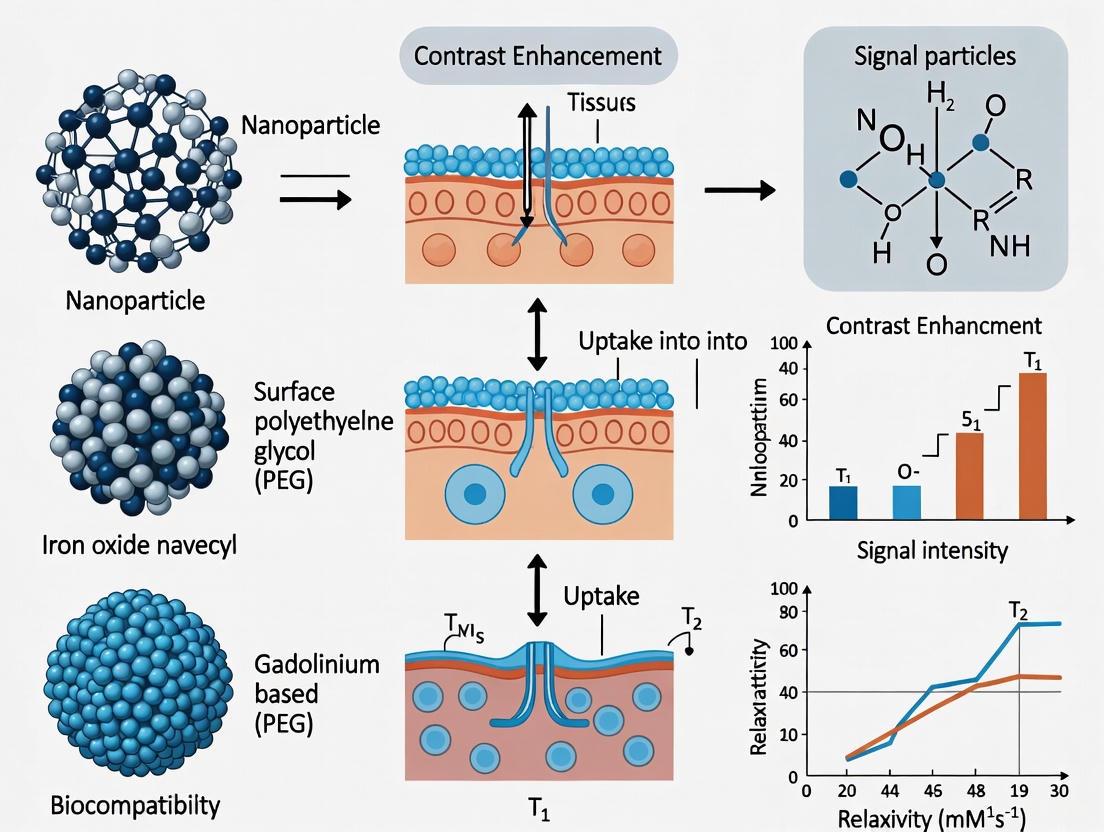
This comprehensive review explores the rapidly evolving field of nanoparticle-based contrast agents for magnetic resonance imaging, addressing critical needs for researchers and drug development professionals.
Nanoparticle Contrast Agents for MRI: Advancing Bioimaging from Fundamentals to Clinical Translation
Abstract
This comprehensive review explores the rapidly evolving field of nanoparticle-based contrast agents for magnetic resonance imaging, addressing critical needs for researchers and drug development professionals. The article covers fundamental principles of MRI contrast mechanisms, synthesis methodologies for iron oxide, gadolinium, and manganese-based nanomaterials, and strategies to overcome toxicity and specificity challenges. It provides a detailed analysis of optimization approaches for enhanced relaxivity and biocompatibility, examines in vivo validation models, and discusses the integration of artificial intelligence for image enhancement. By synthesizing recent advances in targeted imaging, theranostic applications, and safety profiles, this work serves as a strategic resource for advancing nanoparticle contrast agents toward clinical implementation.
Fundamental Principles and Evolution of MRI Nanoparticle Contrast Agents
Magnetic Resonance Imaging (MRI) is a powerful, non-invasive diagnostic tool renowned for its superior soft tissue contrast and high spatial resolution [1] [2]. The technique detects radiofrequency signals from the magnetic moments of hydrogen protons, primarily in water and lipids within biological tissues [1]. Unlike other imaging modalities, MRI uniquely captures both anatomical detail and a wide range of physiological parameters in a single session, with capabilities unmatched by other techniques [1]. In conventional MR imaging, intrinsic tissue contrast primarily arises from differences in proton density and longitudinal (T1) and transverse (T2) relaxation times [1]. However, many pathological states do not produce sufficient native contrast, necessitating the use of exogenous contrast agents (CAs) to locally alter relaxation behavior and enhance diagnostic sensitivity [1] [3].
The development of effective CAs, particularly nanoparticle-based agents, represents a frontier in bioimaging research aimed at improving diagnostic accuracy and enabling new therapeutic applications [2]. This document outlines the fundamental physics of MRI contrast mechanisms and provides detailed protocols for evaluating novel nanoparticle contrast agents within a research setting.
Core Physics of Relaxation and Contrast
T1 and T2 Relaxation Mechanisms
MRI contrast originates from the behavior of proton spins in water molecules under an external magnetic field. The T1 (spin-lattice) relaxation time characterizes the recovery of longitudinal magnetization along the main magnetic field direction after excitation. The T2 (spin-spin) relaxation time describes the decay of transverse magnetization due to interactions between spins and local magnetic field inhomogeneities [4] [5]. A third parameter, T2*, further accounts for signal decay in the presence of permanent magnetic field inhomogeneities [4].
The relaxation rates (1/T1 and 1/T2) are fundamental to contrast generation. In the presence of a contrast agent, these rates are enhanced according to the following relationships:
Where T1(0) and T2(0) are the native relaxation times of the tissue, r1 and r2 are the specific relaxivities of the contrast agent, and [CA] is the concentration of the contrast agent [4]. T1-weighted imaging benefits from contrast agents that predominantly shorten T1, resulting in bright signal enhancement. Conversely, T2-weighted imaging utilizes agents that shorten T2, leading to signal loss (dark contrast) [2] [6].
The Principle of Relaxivity
Relaxivity is the efficacy of a contrast agent at enhancing proton relaxation rates per unit concentration, typically measured in mM⁻¹s⁻¹ [1] [6]. The parameters r1 (longitudinal relaxivity) and r2 (transverse relaxivity) are critical figures of merit for any contrast agent. The ratio r2/r1 determines whether an agent is better suited for T1-weighted (r2/r1 ≈ 1-2) or T2-weighted (r2/r1 > 5) imaging [6]. For T1 agents, a low r2/r1 ratio is desirable to avoid signal cancellation effects that can diminish the desired bright contrast [6].
The relaxivity of a paramagnetic agent depends on several key factors:
- Number of unpaired electrons: Determines the magnetic moment (Gd³⁺: 7 unpaired electrons; Mn²⁺: 5 unpaired electrons) [3] [7]
- Water exchange kinetics: Rate of exchange between inner-sphere water molecules and bulk solvent [1]
- Rotational correlation time: Affected by nanoparticle size and surface functionalization [2] [7]
- Magnetic field strength: Relaxivities are field-dependent, with optimal performance varying by agent [6]
Table 1: Magnetic Properties of Contrast Agent Ions
| Ion | Unpaired Electrons | Spin Quantum Number (S) | Relative Relaxivity Potential |
|---|---|---|---|
| Gd³⁺ | 7 | 7/2 | High [7] |
| Mn²⁺ | 5 | 5/2 | Medium [3] |
| Fe³⁺ | 5 | 5/2 | Medium [6] |
Nanoparticle Contrast Agents: Mechanisms and Applications
Nanoparticle-based contrast agents offer significant advantages over molecular chelates, including enhanced relaxivities, prolonged circulation times, and multifunctionality for theranostic applications [2] [8]. Their large surface-to-volume ratio enables high payloads of paramagnetic ions and facile surface modification for targeted imaging [2] [7].
Classification of Nanoparticle Contrast Agents
Table 2: Major Classes of Nanoparticle MRI Contrast Agents
| Agent Type | Primary Mechanism | Key Features | Research Applications |
|---|---|---|---|
| SPIONs [2] [6] | T2/T2* shortening | Superparamagnetic, biocompatible, surface modifiable | Liver imaging, cellular tracking, tumor targeting |
| Manganese-based NPs [1] [3] | T1 shortening | Biogenic element, natural biological role | Hepatobiliary imaging, brain connectivity studies |
| Gadolinium Oxide NPs [7] | T1 shortening | High r1 relaxivity, high Gd³⁺ density | Blood pool imaging, tumor theranostics |
| Ln-based NPs [8] | T1/T2 tuning | Precise size/shape control, multifunctionality | Multimodal imaging, responsive agents |
Relaxivity Performance Across Agent Classes
Table 3: Comparative Relaxivity Values of Nanoparticle Contrast Agents
| Contrast Agent | Field Strength | r1 (mM⁻¹s⁻¹) | r2 (mM⁻¹s⁻¹) | r2/r1 Ratio |
|---|---|---|---|---|
| Gd-chelate (clinical reference) [7] | 1.5-3 T | 3-5 | 4-6 | ~1.2 |
| SPIONs (4.9 nm) [6] | 64 mT | 67 | ~67 | ~1.0 |
| SPIONs (same, 3 T) [6] | 3 T | 7 | 62 | ~8.9 |
| Gd₂O₃ NPs [7] | 1.5 T | 15.9 | - | - |
| Mn-PyC3A [5] | 1.5 T | ~25 | - | - |
Field-Dependent Relaxivity Behavior
The performance of contrast agents varies significantly with magnetic field strength [6]. SPIONs exhibit remarkable T1 contrast capabilities at low fields (64 mT) with r1 values up to 67 mM⁻¹s⁻¹ and favorable r2/r1 ratios接近 1, making them excellent positive contrast agents in this regime [6]. However, at clinical field strengths (3 T), the same particles display significantly reduced r1 and increased r2/r1 ratios, rendering them more suitable as T2 agents [6]. This field-dependent behavior must be considered when developing novel nanoparticle agents for specific clinical applications.
Experimental Protocols for Contrast Agent Evaluation
Protocol 1: Synthesis of Manganese-Based Metal-Organic Framework (MOF) Contrast Agent
Background: Metal-organic frameworks (MOFs) represent an emerging class of nanoparticle contrast agents with tunable structures and high metal loading capacity [9]. The following protocol outlines the synthesis of BVR-19, a manganese-based MOF with demonstrated efficacy as an MRI contrast agent.
Materials:
- Manganese salt precursor (e.g., MnCl₂·xH₂O)
- L-cystine organic linker
- Double-distilled water
- NaOH
- Standard laboratory glassware
Procedure:
- Precursor Preparation: Dissolve the manganese salt and L-cystine in double-distilled water within a reaction vessel. The molar ratio of manganese to linker should be optimized for framework formation (typically 1:1 to 1:2).
- Basification: Slowly add NaOH solution to the reaction mixture while stirring until the pH reaches 8-10.
- Reaction: Stir the mixture at room temperature for 12-24 hours under atmospheric conditions. No toxic solvents or harsh conditions are required.
- Purification: Isolate the resulting precipitate by centrifugation (10,000 × g, 15 minutes) and wash three times with double-distilled water to remove unreacted precursors.
- Characterization: Confirm successful synthesis using transmission electron microscopy (TEM) for morphology, dynamic light scattering (DLS) for hydrodynamic size, and inductively coupled plasma mass spectrometry (ICP-MS) for manganese content [9].
Applications: The synthesized BVR-19 MOF has demonstrated brighter, clearer images at lower doses compared to commercial gadolinium-based agents, making it a promising alternative with reduced toxicity concerns [9].
Protocol 2: Relativity Measurement for Contrast Agent Characterization
Background: Precise measurement of relaxivity parameters is essential for quantifying contrast agent performance and comparing novel agents to established references.
Materials:
- Contrast agent solution at known concentration
- Reference standard (e.g., commercial Gd-chelate)
- Phosphate-buffered saline (PBS) or appropriate buffer
- NMR tubes or multi-well phantom setup
- Clinical or preclinical MRI scanner with T1 and T2 mapping sequences
Procedure:
- Sample Preparation: Prepare a dilution series of the contrast agent in PBS (typically 6-8 concentrations covering 0-1.0 mM metal concentration). Include a blank (buffer only) as reference.
- Phantom Setup: Transfer solutions to NMR tubes or arrange in multi-well phantom plates ensuring elimination of air bubbles.
- MRI Acquisition: Place phantom in MRI scanner and acquire:
- T1 mapping: Using inversion recovery or variable flip angle sequences
- T2 mapping: Using multi-echo spin-echo sequences
- Data Analysis:
- Measure T1 and T2 values for each concentration using scanner software or external analysis tools
- Plot 1/T1 and 1/T2 against contrast agent concentration
- Perform linear regression; slopes correspond to r1 and r2 relaxivities respectively
- Validation: Include a reference agent (e.g., Gd-DOTA) in parallel measurements to validate protocol accuracy [4] [6].
Applications: This protocol enables standardized comparison of novel contrast agents against clinical benchmarks and facilitates optimization of agent design.
Protocol 3: In Vivo Evaluation of Contrast Enhancement
Background: Preclinical evaluation of contrast agents in animal models provides critical data on pharmacokinetics, biodistribution, and in vivo efficacy.
Materials:
- Animal model (e.g., rat, mouse) with appropriate disease model
- Anesthesia equipment and agents
- Tail vein catheter for injection
- Preclinical MRI scanner
- Physiological monitoring equipment (respiration, temperature)
Procedure:
- Animal Preparation: Anesthetize animal and secure in MRI-compatible holder. Maintain body temperature throughout imaging.
- Baseline Imaging: Acquire pre-contrast T1-weighted and T2-weighted images of target anatomy.
- Contrast Administration: Inject contrast agent via tail vein catheter at predetermined dose (typically 0.05-0.1 mmol/kg for metal-based agents).
- Post-contrast Imaging: Acquire serial post-contrast images at multiple time points (e.g., immediately, 5, 15, 30, 60 minutes post-injection).
- Image Analysis:
- Quantify signal enhancement in regions of interest (ROIs)
- Calculate contrast-to-noise ratios (CNR) between target and background tissues
- Plot signal intensity versus time curves for pharmacokinetic analysis
- Histological Validation: After final imaging time point, euthanize animal and harvest tissues for histological analysis and metal quantification (e.g., ICP-MS) [1] [7].
Applications: This protocol provides critical preclinical data on contrast agent performance, biodistribution, and potential toxicity before clinical translation.
Visualization of Contrast Agent Mechanisms
MRI Relaxation and Contrast Mechanism
Nanoparticle Contrast Agent Design Workflow
The Scientist's Toolkit: Essential Research Reagents and Materials
Table 4: Essential Research Reagents for Nanoparticle Contrast Agent Development
| Reagent/Material | Function | Application Notes |
|---|---|---|
| SPIONs [2] [6] | T2/T2* contrast agent core | Available in various sizes (4-15 nm); coating affects biodistribution |
| Manganese salts (e.g., MnCl₂) [1] [9] | Paramagnetic ion source for T1 agents | Enables synthesis of Mn-based MOFs and chelates |
| Gadolinium salts (e.g., GdCl₃) [7] | High-relaxivity ion source for T1 agents | Requires careful handling due to toxicity concerns |
| Polyethylene glycol (PEG) [2] [7] | Surface coating for stealth properties | Reduces opsonization, extends circulation half-life |
| Targeting ligands (e.g., peptides, antibodies) [2] | Active targeting to specific tissues | Enhances accumulation at disease sites |
| Chelators (e.g., NOTA, PyC3A) [1] [3] | Metal ion coordination for stability | Critical for reducing toxic metal release in vivo |
The development of nanoparticle-based MRI contrast agents represents a dynamic intersection of materials science, chemistry, and biomedical imaging. Understanding the fundamental physics of T1, T2, and relaxivity mechanisms provides the foundation for rational agent design. Current research focuses on addressing the limitations of conventional gadolinium-based agents, particularly concerns regarding long-term retention and potential toxicity [9] [5].
Emerging trends include the development of manganese-based alternatives [1] [3] [9], optimization of iron oxide nanoparticles for T1 contrast at low field strengths [6], and creation of multimodal agents that combine MRI with other imaging modalities [2]. The experimental protocols outlined herein provide standardized methodologies for evaluating novel agents, while the visualization tools facilitate understanding of complex mechanisms and workflows. As the field advances, emphasis on comprehensive safety assessments and clinical translation will be essential for bringing next-generation contrast agents from the laboratory to clinical practice.
The evolution of magnetic resonance imaging (MRI) contrast agents represents a pivotal chapter in biomedical imaging, marked by a continuous pursuit of enhanced diagnostic clarity and patient safety. The journey began with the dominance of gadolinium-based chelates (GBCAs), which have provided exceptional soft tissue contrast since their initial approval in the 1980s [10] [11]. However, growing safety concerns regarding gadolinium retention and toxicity have catalyzed the investigation of alternative agents, most notably superparamagnetic iron oxide nanoparticles (SPIONs) [12] [13]. This transition is underpinned by significant advances in nanotechnology, enabling the precise engineering of nanoparticles for improved imaging performance, targeted delivery, and multifunctional theranostic applications [11] [2]. This document details the key milestones, quantitative comparisons, and experimental protocols that define the historical development from GBCAs to iron oxide nanoparticles, providing a resource for researchers and drug development professionals working in the field of bioimaging.
Gadolinium-Based Contrast Agents (GBCAs): The Clinical Foundation
Mechanism of Action and Clinical Impact
Gadolinium, a rare-earth metal, is highly effective as an MRI contrast agent due to its seven unpaired electrons in the 4f orbital, which confer strong paramagnetic properties [10]. The primary mechanism of action for GBCAs involves the shortening of the longitudinal (T1) relaxation time of water protons in surrounding tissues. This occurs through dipole-dipole interactions between the gadolinium ion (Gd³⁺) and hydrogen nuclei in water molecules, resulting in a brighter signal on T1-weighted images [10]. This signal enhancement allows for superior visualization of vascular structures, tumor boundaries, and areas of inflammation, thereby significantly improving diagnostic accuracy in neurology, oncology, and angiography [10] [11].
Safety Concerns and the Drive for Alternatives
Despite their diagnostic efficacy, the use of GBCAs is accompanied by significant safety concerns. Free Gd³⁺ ions are highly toxic and can disrupt cellular processes, notably those dependent on calcium [10]. To mitigate this, gadolinium is administered in a chelated form bound to organic ligands [10]. However, two major clinical complications have emerged:
- Nephrogenic Systemic Fibrosis (NSF): A debilitating condition characterized by skin and organ fibrosis, primarily occurring in patients with severe renal impairment [14] [12]. The risk of NSF is associated with the dissociation of Gd³⁺ from its chelate in the body [12].
- Gadolinium Deposition: Studies have confirmed gadolinium retention in the brain, bone, and other tissues even in patients with normal renal function [14] [12]. The long-term clinical implications of this deposition are an active area of investigation, with anecdotal reports linking it to symptoms collectively referred to as "gadolinium deposition disease" [12].
These safety profiles, combined with the inherent limitations of GBCAs such as low relaxivity and non-specific distribution, have fueled the search for safer and more effective alternatives [11].
Table 1: Key Characteristics and Safety Profiles of Clinically Used GBCAs
| Commercial Name (Generic) | Chemical Structure | Pharmacokinetics & Safety | Primary Clinical Applications |
|---|---|---|---|
| Magnevist (Gadopentetate Dimeglumine) | Linear, ionic | Moderate stability, risk of Gd release, associated with NSF | Brain, liver imaging [10] |
| Omniscan (Gadodiamide) | Linear, non-ionic | Less stable, potential Gd retention, associated with NSF | Tumor perfusion [10] [15] |
| Gadovist (Gadobutrol) | Macrocyclic, non-ionic | Excellent safety profile, minimal NSF risk, reduced brain deposition | Whole-body MRI, oncologic imaging [10] |
| Dotarem (Gadoterate) | Macrocyclic, ionic | High stability, minimal NSF risk | Neurology, angiography [10] |
Iron Oxide Nanoparticles: A Promising Alternative
Classification and Mechanism of Action
Iron oxide nanoparticles represent a major class of alternative contrast agents, valued for their biocompatibility and superparamagnetic properties [11]. They are broadly categorized by size:
- Superparamagnetic Iron Oxide Nanoparticles (SPIONs): Typically with core diameters >5 nm, these are primarily used as T2/T2* contrast agents. They create local magnetic field inhomogeneities that accelerate the transverse relaxation of water protons, resulting in signal loss (dark contrast) on T2-weighted images [13] [11].
- Ultrasmall SPIONs (USPIONs): With core diameters <5 nm, these particles exhibit distinct properties, including prolonged blood circulation and potential for renal clearance. Notably, at low magnetic field strengths, USPIONs can function as highly effective T1 contrast agents [6] [2].
The relaxivity of iron oxide nanoparticles is strongly dependent on their size and the external magnetic field. At low fields (e.g., 64 mT), SPIONs demonstrate a unique combination of high longitudinal relaxivity (r1) and a low r2/r1 ratio, making them exceptional positive (T1) contrast agents [6].
Comparative Advantages over GBCAs
Iron oxide nanoparticles offer several compelling advantages that have driven their development:
- Superior Safety Profile: Iron is a native element in human metabolism, and iron oxide nanoparticles can be broken down and incorporated into the body's iron stores (e.g., hemoglobin), reducing risks of long-term retention and toxicity [6] [11].
- High Relaxivity: SPIONs can exhibit relaxivities an order of magnitude higher than those of GBCAs. For example, at 64 mT, SPIONs have demonstrated r1 values of up to 67 L mmol⁻¹ s⁻¹, outperforming gadolinium-based agents by more than eight-fold [6].
- Multifunctional and Theranostic Potential: Their large surface-to-volume ratio allows for surface functionalization with targeting ligands, drugs, or other imaging probes, enabling targeted drug delivery, hyperthermia therapy, and dual-mode imaging [13] [11] [2].
Table 2: Performance Comparison of Gd-based Agents and Iron Oxide Nanoparticles at Different Field Strengths
| Contrast Agent Type | Field Strength | Relaxivity (r1) | r2/r1 Ratio | Primary Contrast |
|---|---|---|---|---|
| Gadolinium Chelates [14] | 1.5 - 3 T | 3 - 5 s⁻¹mM⁻¹ | ~1 | T1 (Bright) |
| Gadolinium Oxide NPs [14] | 1.5 - 3 T | >15 s⁻¹mM⁻¹ | ~1 | T1 (Bright) |
| SPIONs (4.9 nm) [6] | 64 mT | 67 L mmol⁻¹ s⁻¹ | ~1 | T1 (Bright) |
| SPIONs (4.9 nm) [6] | 3 T | 4.7 L mmol⁻¹ s⁻¹ | >1 | T2 (Dark) |
| Ferumoxytol (FDA-approved SPION) [6] | 64 mT | High | ~1 | T1 (Bright) |
Experimental Protocols
Protocol 1: One-Pot Polyol Synthesis of Surface-Modified Gd₂O₃ Nanoparticles
This protocol describes the synthesis of ultrasmall, water-dispersible gadolinium oxide nanoparticles with enhanced relaxivity and improved biocompatibility [14].
Research Reagent Solutions:
- Gadolinium (III) Chloride Hexahydrate (GdCl₃·6H₂O): Serves as the gadolinium precursor.
- Polyacrylic Acid (PAA, Mw ~2,000 g/mol): Acts as a hydrophilic and biocompatible surface-coating ligand.
- Triethylene Glycol (TEG): Functions as both the high-boiling-point solvent and a stabilizing agent.
- Sodium Hydroxide (NaOH) Solution: Prepared in TEG (1 M) to initiate the precipitation and condensation reaction.
Procedure:
- Precursor Preparation: In a three-necked round-bottom flask, dissolve 1 mmol of GdCl₃·6H₂O and 1 g of PAA in 50 mL of TEG. Stir magnetically at room temperature under atmospheric conditions until a clear solution is obtained.
- Nucleation and Growth: Slowly add the TEG-based NaOH solution (~5 mL, 1 M) to the precursor solution until the pH reaches 9-10. Heat the reaction mixture to 110°C and maintain with vigorous stirring for 12 hours.
- Purification: Allow the solution to cool to room temperature. Precipitate the nanoparticles by adding a 3:1 volume ratio of diethyl ether. Recover the particles via centrifugation at 12,000 rpm for 20 minutes.
- Washing and Storage: Re-disperse the pellet in absolute ethanol and centrifuge again (repeat twice). Finally, disperse the purified PAA-coated Gd₂O₃ nanoparticles in deionized water or phosphate-buffered saline (PBS) for storage and characterization. Characterize the final product using transmission electron microscopy (TEM) and dynamic light scattering (DLS) to determine core size and hydrodynamic diameter, respectively.
Protocol 2: Evaluating SPIONs as T1 Contrast Agents at Low-Field (64 mT) MRI
This protocol outlines the methodology for characterizing the T1 contrast efficacy of SPIONs at low magnetic field strengths, relevant to portable point-of-care MRI systems [6].
Research Reagent Solutions:
- Carboxylic Acid-Coated SPIONs: Monodispersed particles with defined core diameters (e.g., 4.9 nm, 8.5 nm).
- Gadobenate Dimeglumine: A commercial Gd-based agent, used as a reference standard.
- Agarose Phantoms (1% w/v): Prepared in PBS for immobilizing nanoparticle samples during MRI.
- Phosphate Buffered Saline (PBS, pH 7.4): Used for serial dilution of contrast agents.
Procedure:
- Sample Preparation: Prepare a dilution series of SPIONs (iron concentration range: 0.01 - 0.5 mM) and the reference GBCA (gadolinium concentration range: 0.1 - 2.0 mM) in PBS. Mix each concentration with molten agarose (1% w/v) at a 1:1 ratio and cast in a multi-well phantom plate.
- MRI Relaxometry: Place the phantom in a 64 mT MRI scanner (e.g., Hyperfine Swoop). Acquire T1-weighted images using a spin-echo sequence with varying repetition times (TR). For comparison, acquire images at a clinical field strength (e.g., 3 T) using a standard clinical scanner.
- Data Analysis: Measure the signal intensity (SI) for each sample across different TR values. Fit the SI vs. TR data to a mono-exponential recovery curve [S(TR) = S₀ (1 - e^(-TR/T1))] to calculate the T1 relaxation time for each concentration.
- Relaxivity Calculation: Plot the measured relaxation rate (R1 = 1/T1) against the metal concentration (mM of Fe or Gd). The longitudinal relaxivity (r1) is obtained from the slope of the linear regression fit to this data.
Diagram 1: Workflow for determining the longitudinal relaxivity (r1) of SPIONs.
The Scientist's Toolkit: Essential Research Reagents
Table 3: Key Reagents for Developing Nanoparticle MRI Contrast Agents
| Research Reagent | Function/Application | Example Use-Case |
|---|---|---|
| GdCl₃·6H₂O | Paramagnetic ion precursor for GBCAs and Gd₂O₃ NPs. | Synthesis of gadolinium-based nanoparticles via polyol or thermal decomposition methods [14]. |
| Iron Acetylacetonate (Fe(acac)₃) | Common iron precursor for the thermal decomposition synthesis of monodisperse SPIONs [6]. | Production of high-quality, crystalline SPIONs with precise size control. |
| Polyacrylic Acid (PAA) | Hydrophilic polymer for surface coating; confers colloidal stability and biocompatibility. | One-pot synthesis of water-dispersible Gd₂O₃ NPs and SPIONs [14]. |
| Polyethylene Glycol (PEG) | Polymer for "stealth" coating; reduces opsonization and extends blood circulation half-life. | PEGylation of SPIONs to improve in vivo stability and biodistribution [11] [2]. |
| Dextran | Natural polysaccharide coating for iron oxide nanoparticles; enhances biocompatibility. | Used in clinical SPION formulations (e.g., ferumoxytol) for macrophage imaging and vascular contrast [6]. |
| Citric Acid | Small molecule capping agent; provides carboxyl groups for subsequent bioconjugation. | Colloidal stabilization of ultrasmall SPIONs (USPIONs) [14]. |
Magnetic Resonance Imaging (MRI) is a powerful, non-invasive diagnostic tool renowned for its exceptional soft tissue contrast and high-resolution imaging capabilities without the use of ionizing radiation [11] [16]. The inherent contrast in MRI is derived from differences in the relaxation times (T1 and T2) of water protons in various tissues. To significantly enhance this contrast and improve diagnostic accuracy for specific pathologies, exogenous contrast agents (CAs) are routinely administered [11]. In the context of a broader thesis on nanoparticle contrast agents for bioimaging MRI research, this document details the key material classes of superparamagnetic, paramagnetic, and chemical exchange systems. These advanced nanomaterials offer enhanced control over relaxivity, targeting, and safety profiles compared to traditional agents [11] [8]. Their development is crucial for advancing targeted diagnostic and theranostic applications in oncology, neurology, and cardiovascular diseases.
Superparamagnetic Systems
Mechanism of Action
Superparamagnetic agents, primarily Superparamagnetic Iron Oxide Nanoparticles (SPIONs), function as potent T2 and T2* contrast agents. Their core consists of iron oxides such as magnetite (Fe₃O₄) or maghemite (γ-Fe₂O₃). When exposed to an external magnetic field, these nanoparticles become strongly magnetized, creating large, localized magnetic field inhomogeneities. These inhomogeneities dephase the spins of surrounding water protons, leading to a rapid decay of the transverse magnetization and a pronounced signal loss (darkening) on T2-weighted or T2*-weighted MR images [17] [11]. A key advantage is their superparamagnetic nature, meaning they exhibit no residual magnetism once the external field is removed, thus preventing aggregation and enabling their safe use in vivo [17].
Key Materials and Properties
SPIONs are characterized by their high magnetic susceptibility and large relaxivity (r2), which is the efficiency at shortening T2 relaxation time [11]. Their performance is highly dependent on their physicochemical properties, including core size, surface coating, and colloidal stability. Surface functionalization with biocompatible polymers like polyethylene glycol (PEG), dextran, or silica is critical to enhance stability, prevent opsonization, and minimize immune recognition [17] [11]. Furthermore, SPIONs can be engineered for dual-mode imaging (e.g., PET/MRI) and targeted therapies by conjugating specific ligands, antibodies, or therapeutic drugs to their surface [11].
Table 1: Representative Superparamagnetic (T2) Contrast Agents
| Material/Commercial Name | Core Composition | Size Range | Relaxivity (r2, s⁻¹mM⁻¹) | Key Applications |
|---|---|---|---|---|
| Ferumoxytol (Feraheme) | Iron Oxide (Fe₃O₄) | ~30 nm | Very High (field-dependent) | Vascular Imaging, Off-label MRI, Inflammation Imaging |
| SPIONs (Generic) | Fe₃O₄ / γ-Fe₂O₃ | 5–100 nm | High | Tumor Imaging, Liver Imaging, Cell Tracking |
| PEGylated SPIONs | Iron Oxide | 4–14 nm | 385 (reported for 14nm core) | In vivo Tumor Imaging, Blood-Pool Imaging |
| SPION@[Mn(Dopa-EDTA)] | Iron Oxide / Manganese | Nanoscale | Effective as dual-mode | Organ and Vascular Imaging |
Experimental Protocol: SPION-Enhanced Ultra-Low Field (ULF) MRI
Objective: To utilize SPIONs for generating positive T1-weighted contrast and phase-sensitive vascular contrast in ultra-low field (6.5 mT) MRI [18].
Materials:
- SPIONs (e.g., 25 nm core with PEG20K coating)
- Animal model (e.g., rat)
- Ultra-low field MRI scanner (6.5 mT)
- Phantoms (e.g., cylindrical containers with DI water/agarose)
Method:
- Agent Characterization: Prior to in vivo administration, characterize the SPIONs for relaxivity (r1 and r2) and magnetic susceptibility at the target field strength (e.g., 6.5 mT) [18].
- Phantom Imaging: Acquire 3D images of SPION-containing phantoms using:
- Balanced Steady-State Free Precession (bSSFP) Sequence: To generate T2/T1-weighted images. Contrast is modulated by varying the flip angle (e.g., 30°, 60°, 90°) to leverage the SPIONs' magnetic susceptibility [18].
- Spoiled Gradient Echo (SPGR) Sequence: To generate T1-weighted images and to acquire data for phase map reconstruction [18].
- In Vivo Imaging:
- Administer SPIONs intravenously to the animal model at a predetermined dosage (e.g., equivalent to 4-5 mg Fe/kg for ferumoxytol) [18].
- Acquire pre-contrast baseline images using bSSFP and SPGR sequences.
- Acquire post-contrast images at multiple time points to monitor agent biodistribution.
- Data Analysis:
- Identify regions of positive contrast (signal enhancement) in magnitude images, particularly in organs like the spleen and pancreas.
- Reconstruct phase maps from SPGR data to visualize the vascular system based on magnetic susceptibility effects [18].
Paramagnetic Systems
Mechanism of Action
Paramagnetic agents are primarily T1 contrast agents that cause brightening of images on T1-weighted scans. They contain metal ions with unpaired electrons, such as Gadolinium (Gd³⁺), Manganese (Mn²⁺), or certain Lanthanides. The fluctuating magnetic fields generated by the unpaired electrons in these ions interact with nearby water protons, efficiently promoting relaxation and significantly shortening the longitudinal (T1) relaxation time. This results in a heightened signal intensity in regions where the agent accumulates [19] [16]. Traditional gadolinium-based agents are chelated to reduce the toxicity of free Gd³⁺ ions; however, concerns about long-term retention in the brain and other tissues, as well as the risk of nephrogenic systemic fibrosis (NSF) in patients with renal impairment, have driven the development of safer alternatives [19] [16].
Key Materials and Properties
The field of paramagnetic CAs is evolving towards high-relaxivity formulations and nanoparticle-based systems. Nanoparticles offer a platform to incorporate a high payload of paramagnetic ions, thereby amplifying the relaxivity per particle and allowing for lower doses or improved sensitivity [8]. Lanthanide-based nanoparticles, for instance, are promising due to their strong paramagnetic properties, and their design focuses on optimizing size, shape, and surface coatings to maximize relaxivity and biocompatibility [8]. Furthermore, manganese-based agents are experiencing a resurgence as a potentially safer alternative to gadolinium, with modern chelation and nanoparticle encapsulation strategies mitigating toxicity concerns [19].
Table 2: Representative Paramagnetic (T1) Contrast Agents
| Material/Commercial Name | Active Ion / Composition | Type / Structure | Key Applications & Notes |
|---|---|---|---|
| Gadopiclenol | Gadolinium (Gd³⁺) | Macrocyclic, High-Relaxivity | Broad Clinical Use; Allows for lower Gd dose [19] |
| Gadoquatrane | Gadolinium (Gd³⁺) | Macrocyclic, Next-Generation | In Phase III trials; <50% of standard Gd dose [19] |
| Gadobutrol (Gadovist) | Gadolinium (Gd³⁺) | Macrocyclic Chelate | Vascular Imaging, High Relaxivity [11] |
| Manganese-based Agents | Manganese (Mn²⁺) | Chelates or Nanoparticles | Cardiovascular and Neurological Imaging; Physiological roles may offer safety advantages [19] |
| Lanthanide-based Nanoparticles | e.g., Dy³⁺, Ho³⁺ | Paramagnetic Nanoparticles | T2-weighted Imaging; High magnetic moment [8] |
Experimental Protocol: Evaluating a Nanoscale Lanthanide-Based T1 Agent
Objective: To synthesize and characterize the relaxivity and stability of a novel lanthanide-based nanoparticle for T1-weighted MRI.
Materials:
- Lanthanide precursors (e.g., acetates or chlorides)
- Ligands and surfactants (e.g., oleic acid, oleylamine)
- Organic solvents (e.g., octadecene)
- Dialysis membranes or centrifugation equipment
Method:
- Synthesis via Thermal Decomposition:
- Dissolve lanthanide precursors in a high-boiling point organic solvent with surfactants under an inert atmosphere [17].
- Heat the mixture to a specific temperature (e.g., 250-320°C) to induce nucleation and growth of crystalline nanoparticles [17] [8].
- Allow the reaction to proceed for a controlled duration to achieve the desired particle size.
- Purification and Phase Transfer:
- Cool the reaction mixture and precipitate the nanoparticles using a polar solvent like ethanol.
- Centrifuge and wash the nanoparticles multiple times to remove excess precursors and surfactants.
- Perform a phase transfer ligand exchange to render the nanoparticles water-dispersible, if necessary for biological applications [8].
- Characterization:
- Size and Morphology: Use Transmission Electron Microscopy (TEM) to determine core size and shape [20] [8].
- Relaxivity Measurement: Prepare aqueous dilutions of the nanoparticles at known metal concentrations. Measure T1 relaxation times at the target clinical field strength (e.g., 1.5 T, 3 T) using an NMR relaxometer. Calculate r1 relaxivity from the slope of the plot of 1/T1 vs. concentration [8].
- Colloidal Stability: Monitor the hydrodynamic size and relaxivity of the nanoparticles in physiological buffers (e.g., PBS) over several days to assess stability [8].
Chemical Exchange Saturation Transfer (CEST) Systems
Mechanism of Action
CEST agents represent a "smart" contrast mechanism that does not necessarily rely on direct relaxation enhancement by metals. These agents contain exchangeable protons, such as those in amide (-NH), hydroxyl (-OH), or amine (-NH₂) groups, which resonate at a chemical shift distinct from bulk water [20] [16]. The CEST MRI technique involves applying a selective radiofrequency (RF) saturation pulse at the specific resonance frequency of these exchangeable protons. This pulse saturates their magnetization. Through continuous chemical exchange with the vast pool of bulk water protons, this saturation is transferred, leading to a detectable decrease in the water signal [20]. The degree of signal loss is dependent on the exchange rate, which can be sensitive to environmental factors such as pH, temperature, or enzyme activity, enabling molecular and functional imaging [20] [19].
Key Materials and Properties
CEST agents can be diamagnetic (diaCEST) or paramagnetic (paraCEST), with the latter offering larger chemical shifts that facilitate selective saturation [20]. A significant advancement is the development of nanoscale CEST agents, such as polymers and liposomes, which carry a high payload of exchangeable sites, dramatically improving sensitivity [20]. A key application is acidoCEST MRI, which uses the pH-dependent exchange rate of certain protons (e.g., on iopamidol or salicylic acid derivatives) to non-invasively measure the extracellular pH (pHe) of the tumor microenvironment, a valuable biomarker for cancer metabolism [20].
Table 3: Representative Chemical Exchange Saturation Transfer (CEST) Agents
| Agent Type | Composition / Example | Exchangeable Proton Pools | Key Applications & Properties |
|---|---|---|---|
| Diamagnetic (diaCEST) | Iopamidol, Salicylic Acid Polymers, Sugars | -OH, -NH | acidoCEST pH Imaging, Molecular Imaging [20] [19] |
| Nanoscale diaCEST | Poly(4-acrylamidosalicylic acid) | -OH, -NH | High payload of exchange sites; can measure tumor pHe [20] |
| Perfluorocarbon (Non-metal) | Perfluoro-15-crown-5-ether (PFCE) | N/A (¹⁹F MRI) | No background signal; quantitative cell tracking [21] [16] |
| Label-free Nanoparticle Detection | Perfluorocarbon Nanoemulsions | Endogenous -CH protons | Detects nanoparticles without functionalization via ¹H CSI [21] |
Experimental Protocol: acidoCEST MRI with a Nanoscale Polymer Agent
Objective: To measure tumor extracellular pH (pHe) using acidoCEST MRI with a diamagnetic polymer agent based on 4-acrylamidosalicylic acid [20].
Materials:
- Nanoscale polymer agent (e.g., poly(4-acrylamidosalicylic acid))
- MRI system (preclinical ≥ 7 T recommended)
- Tumor-bearing mouse model (e.g., MDA-MB-231 xenograft)
- Customized phantom holder with agarose gel for B0 homogenization [20]
Method:
- Agent Synthesis and Characterization:
- Synthesize the linear polymer via radical polymerization of 4-acrylamidosalicylic acid monomer using an initiator like 4,4'-azobis(4-cyanovaleric acid) [20].
- Purify the polymer by dialysis (e.g., using a 10 kDa MWCO membrane) [20].
- Characterize using UV-Vis, GPC, and TEM to confirm structure, molecular weight, and morphology [20].
- In Vitro CEST Fingerprinting:
- Prepare solutions of the polymer agent across a range of pH values (e.g., pH 5.5 to 7.5) and concentrations.
- Acquire Z-spectra by applying a series of saturation pulses across a frequency range (e.g., ±5 ppm from water). Fit the Z-spectra with Lorentzian line shapes to extract CEST signals at specific offsets (e.g., 5.0 and 9.2 ppm for salicylic acid derivatives) [20].
- Generate a pH calibration curve by plotting the ratio of the two CEST signals (e.g., S@5.0ppm / S@9.2ppm) against the known pH [20].
- In Vivo acidoCEST MRI:
- Administer the polymer agent to the tumor-bearing mouse intravenously.
- Acquire CEST data from the tumor region using the optimized saturation parameters determined in vitro.
- Perform B0 field mapping and correction to ensure accurate saturation frequency placement.
- Data and pH Analysis:
- Process the in vivo CEST data to generate maps of the CEST signal ratio.
- Apply the in vitro calibration curve to convert the signal ratio maps into quantitative maps of tumor pHe [20].
The Scientist's Toolkit: Research Reagent Solutions
Table 4: Essential Research Reagents and Materials
| Item | Function / Description | Example Use Case |
|---|---|---|
| SPIONs (Ferumoxytol) | Iron oxide nanoparticle; FDA-approved for iron therapy, used off-label as an MRI CA. | A biocompatible T2 agent for vascular, inflammation, and tumor imaging [19] [18]. |
| Perfluorocarbon (PFC) Nanoemulsions | Fluorinated compounds with high ¹⁹F density for background-free MRI. | ¹⁹F MRI for specific cell tracking and quantitative imaging [21] [16]. |
| Gadolinium Chelates (e.g., Gadobutrol) | Standard clinical T1 agents; paramagnetic. | Benchmark for comparing the performance of novel T1 agents [11]. |
| CEST Agent Monomers (e.g., 4-acrylamidosalicylic acid) | Small molecules with exchangeable protons for pH sensing. | Building blocks for synthesizing nanoscale polymer-based CEST agents [20]. |
| Polyethylene Glycol (PEG) | Biocompatible polymer for surface functionalization. | Coating nanoparticles to improve stealth properties, colloidal stability, and circulation time [17] [11]. |
| Dialysis Membranes (e.g., 10 kDa MWCO) | Size-selective purification tool. | Purifying synthesized nanoparticles from excess reactants and solvents [20]. |
In the development of nanoparticle-based contrast agents for magnetic resonance imaging (MRI), a deep understanding of the interplay between critical physicochemical properties and diagnostic performance is essential. These properties—size, shape, magnetic moment, and surface characteristics—do not act in isolation but synergistically define the agent's magnetic behavior, relaxivity, biodistribution, and ultimate efficacy in bioimaging [22]. This document provides a structured overview of these properties, supported by quantitative data, detailed experimental protocols, and visual workflows, serving as a practical guide for researchers and scientists in the field of bioimaging MRI research.
The following tables consolidate key quantitative relationships between nanoparticle properties and their performance as MRI contrast agents, providing a reference for rational design.
Table 1: Influence of Nanoparticle Core Properties on MRI Performance
| Property | Impact on Relaxivity & Magnetic Behavior | Optimal Range / Value | Key Rationale & Experimental Evidence |
|---|---|---|---|
| Size [13] [22] | - T~1~ relaxivity: Enhanced with smaller sizes (<20 nm).- T~2~ relaxivity: Increases significantly with larger core size. | - T~1~ agents: < 20 nm [22]- Ultra-small T~1~ agents: ~2-5 nm [14] [13]- Superior T~2~ agents: > 20 nm [13] | Smaller particles have a higher surface-to-volume ratio, increasing water proton access to the paramagnetic center. Larger particles possess a greater magnetic volume, enhancing the local field inhomogeneity for T~2~ shortening. |
| Shape [8] | Anisotropic shapes (e.g., rods, cubes) can enhance relaxivity compared to spherical particles. | Anisotropic shapes preferred for higher relaxivity. | Anisotropic shapes can create stronger local magnetic field gradients or offer more surface area for water interaction, thereby increasing relaxivity. |
| Magnetic Moment [14] [23] | Higher electron spin magnetic moment directly increases longitudinal water relaxation (r~1~). | Gd^3+^ (s = 7/2) > Mn^2+^ (s = 5/2) > Fe^3+^ (s = 5/2) | Gd^3+^, with seven unpaired electrons, induces stronger T~1~ proton spin relaxations than Mn- or Fe-based nanoparticles. |
| Crystallinity [14] | Improved crystallinity can enhance the magnetic properties and stability of the nanoparticle. | High crystallinity. | Methods like thermal decomposition produce highly crystalline, monodisperse NPs, which can lead to more predictable and enhanced magnetic performance. |
Table 2: Impact of Surface and Compositional Properties on Efficacy and Safety
| Property | Impact on Colloidal Stability, Biodistribution & Toxicity | Optimal Characteristics | Key Rationale & Experimental Evidence |
|---|---|---|---|
| Surface Coating [8] [14] [24] | - Stability: Prevents aggregation and improves colloidal stability.- Relaxivity: Hydrophilic coatings facilitate water access; coating thickness can influence relaxivity.- Biocompatibility: Reduces cytotoxicity and prevents leakage of toxic ions. | Polyacrylic acid (PAA), Polyethylene Glycol (PEG), Polyvinylpyrrolidone (PVP), Carboxymethyl-dextran (CM-D), Dimercaptosuccinic acid (DMSA), Silica. | Coatings like PEG provide a hydrophilic barrier that reduces protein opsonization, prolonging circulation time. PAA coating was shown to double the r~2~ relaxivity for 11 nm IONPs [24]. |
| Hydrodynamic Size [14] | Determines renal excretion pathway. Particles that are too large cannot be cleared by the kidneys, leading to potential long-term retention. | < ~3 nm (for renal clearance) | Formulations smaller than ~3 nm are suitable for renal excretion, a critical requirement for clinical translation to avoid long-term tissue accumulation [14]. |
| Concentration [22] | - Signal Intensity: Low to moderate concentrations enhance signal.- Signal Quenching & Cytotoxicity: High concentrations can cause signal loss and increase cytotoxic effects. | 0.1 - 0.5 mg/mL (optimal range to avoid signal quenching) | Concentrations above 0.5 mg/mL often lead to signal quenching and increased cytotoxicity, as identified in a systematic review of nanoparticle agents [22]. |
Experimental Protocols
Protocol: One-Pot Polyol Synthesis of Ultrasmall Gd~2~O~3~ Nanoparticles
This protocol describes the synthesis of ultrasmall, surface-coated gadolinium oxide nanoparticles, adapted from methods detailed in the literature [14].
I. Research Reagent Solutions
- Gadolinium (III) Chloride Hexahydrate (GdCl~3~·6H~2~O): Serves as the Gd^3+^ ion precursor.
- Triethylene Glycol (TEG): Acts as the high-boiling-point polyol solvent and stabilizing agent.
- Polyacrylic Acid (PAA): Functions as the hydrophilic surface-coating ligand.
- Sodium Hydroxide (NaOH): Provides the hydroxide ions necessary for oxide precipitation.
- Deionized Water: Used for purification steps.
II. Procedure
- Precursor Preparation: In a three-necked round-bottom flask, dissolve GdCl~3~·6H~2~O (1 mmol) and PAA (200 mg) in TEG (50 mL). Stir magnetically at room temperature under atmospheric conditions until complete dissolution is achieved.
- Base Addition: In a separate beaker, prepare a 1 M solution of NaOH in TEG. Slowly add this solution (~5-10 mL) to the precursor mixture until the pH reaches 8–10.
- Reaction: Heat the reaction mixture to 110 °C with continuous magnetic stirring for 12 hours. The solution will gradually become translucent, indicating nanoparticle formation.
- Purification: Allow the mixture to cool to room temperature. Precipitate the nanoparticles by adding a 3:1 volume ratio of acetone to the reaction mixture, followed by centrifugation at 15,000 rpm for 20 minutes. Discard the supernatant and re-disperse the pellet in deionized water or a physiological buffer. Repeat this purification cycle three times.
- Characterization: The final product can be characterized using Transmission Electron Microscopy (TEM) for core size and morphology, Dynamic Light Scattering (DLS) for hydrodynamic diameter, and Inductively Coupled Plasma Mass Spectrometry (ICP-MS) for elemental concentration.
Protocol: Relaxivity Measurement for Contrast Agent Characterization
I. Research Reagent Solutions
- Synthesized Nanoparticle Contrast Agent: The sample to be characterized.
- Agarose Phosphate-Buffered Saline (PBS) Solution: (1% w/v agarose in PBS) for phantom preparation to prevent convection.
- Gadolinium-Based Clinical Contrast Agent (e.g., Gadobutrol): Used as a reference standard.
II. Procedure
- Sample Preparation: Prepare a series of dilutions of the nanoparticle agent in 1% agarose-PBS, covering a concentration range (e.g., 0.05, 0.1, 0.2, 0.5 mM Gd or Fe). Prepare identical dilutions of the reference standard. Transfer each solution to sealed tubes to prevent evaporation.
- MRI Scanning: Place all samples in a phantom holder and image them using a clinical or preclinical MRI system (e.g., 3 T). Run standard T~1~-weighted (e.g., spin-echo) and T~2~-weighted sequences.
- Relaxation Time Measurement: Use the scanner's software or external analysis tools to precisely measure the T~1~ and T~2~ relaxation times for each sample concentration. This often involves fitting signal intensity data from multi-TR or multi-TE sequences to exponential recovery/decay curves.
- Relaxivity Calculation:
- Plot the reciprocal of the measured T~1~ (1/T~1~, s⁻¹) against the molar concentration of the metal (mM). Perform a linear regression fit. The slope of this line is the longitudinal relaxivity (r~1~).
- Similarly, plot 1/T~2~ against the molar concentration. The slope of the linear fit is the transverse relaxivity (r~2~).
Visualization and Workflows
The following diagram illustrates the logical relationship between the critical properties of a nanoparticle contrast agent, its resulting behavior in a biological system, and its final MRI performance.
The Scientist's Toolkit
Table 3: Essential Reagents and Materials for Nanoparticle Contrast Agent Research
| Category | Item | Function in Research |
|---|---|---|
| Precursors & Ligands | Gadolinium (III) Salts (e.g., GdCl~3~), Iron Acetylacetonate (Fe(acac)~3~) | Source of magnetic metal ions for the nanoparticle core. |
| Polyacrylic Acid (PAA), Polyethylene Glycol (PEG), Citric Acid, Dextran | Hydrophilic coatings to stabilize nanoparticles, prevent aggregation, and confer biocompatibility. | |
| Solvents & Reagents | Polyols (e.g., Triethylene Glycol - TEG), Oleic Acid, Oleylamine | High-boiling-point solvents for synthesis; can also act as surfactants or coordinating ligands. |
| Dimethyl Sulfoxide (DMSO) | Solvent for low-temperature synthesis routes. | |
| Characterization | Agarose | For preparing MRI phantoms to hold liquid samples during imaging. |
| Clinical Reference Agents (e.g., Gadobutrol) | Benchmark for comparing the relaxivity and performance of novel agents. |
Gadolinium-based contrast agents (GBCAs) have served as fundamental tools for magnetic resonance imaging (MRI) for over three decades, providing essential enhancement for diagnosing tumors, inflammatory conditions, and vascular diseases [25] [26]. These agents utilize the paramagnetic properties of gadolinium ions (Gd³⁺) to shorten the T1 relaxation time of water protons, resulting in increased signal intensity on T1-weighted images [26]. However, the established safety profile of GBCAs has been fundamentally challenged by the discovery of gadolinium retention in tissues, including the brain, bone, and skin, even in patients with normal renal function [25] [26] [5]. This deposition phenomenon has been linked to potentially severe clinical conditions such as Nephrogenic Systemic Fibrosis (NSF) in renally impaired patients and the controversial Gadolinium Deposition Disease (GDD) [25] [26] [27].
The driving force behind contemporary GBCA research centers on addressing two interconnected limitations: (1) the inherent toxicity of gadolinium ions when released from their chelates, and (2) the limited specificity of conventional agents for molecular targets. This application note explores the mechanisms underlying gadolinium toxicity, evaluates emerging nanoparticle-based solutions, and provides detailed protocols for developing safer, more targeted contrast agents within the broader context of advanced bioimaging research.
Toxicity Mechanisms: From Clinical Manifestations to Molecular Pathways
Clinical Spectrum of Gadolinium Toxicity
The toxicity profile of GBCAs manifests across a spectrum of clinical conditions, primarily driven by the structural class of the agent and patient-specific factors [25] [26] [27]. Table 1 summarizes the key clinical manifestations associated with gadolinium exposure.
Table 1: Clinical Manifestations of Gadolinium Toxicity
| Clinical Condition | At-Risk Population | Key Characteristics | Primary GBCA Association |
|---|---|---|---|
| Nephrogenic Systemic Fibrosis (NSF) | Patients with severe renal impairment (GFR <30 mL/min) | Skin and organ fibrosis, thickening, and hardening; potentially fatal | Linear agents (gadodiamide, gadopentetate) [26] [27] |
| Gadolinium Deposition Disease (GDD) | Patients with normal renal function after GBCA exposure | Persistent symptoms: pain, cognitive disturbance, skin changes | All GBCA classes, predominantly linear agents [25] [26] |
| Neurological Deposition | Patients with repeated GBCA administrations | T1 hyperintensity in dentate nucleus and globus pallidus; no confirmed clinical symptoms | All GBCA classes, higher with linear agents [5] |
Molecular Mechanisms of Toxicity
The fundamental mechanism of gadolinium toxicity stems from the dissociation of Gd³⁺ from its chelating ligand. The free Gd³⁺ ion exhibits significant toxicity due to its similar ionic radius to calcium (Ca²⁺), allowing it to compete for and disrupt calcium channels and calcium-dependent biological processes [26] [27]. Recent research has revealed multiple pathways through which this dissociation and subsequent toxicity occur:
- Transmetallation: Endogenous metals (zinc, copper, calcium) displace Gd³⁺ from its chelate, particularly with linear agents that have lower thermodynamic stability and kinetic inertness [26].
- Endogenous Nanoparticle Formation: Emerging evidence indicates that Gd³⁺ can form insoluble nanoparticles in vivo through interaction with endogenous anions like oxalate, providing a novel mechanism for long-term tissue retention [25] [26] [28]. Studies demonstrate that commercial GBCAs (Omniscan, Dotarem) dechelate in the presence of oxalic acid, forming gadolinium oxalate (Gd₂[C₂O₄]₃) [28].
- Cellular Toxicity Pathways: At the cellular level, free Gd³⁺ activates multiple pathogenic signaling pathways including MAPK/ERK, PI3K/Akt, and EGFR, leading to upregulated inflammation, oxidative stress, and apoptosis [27]. This includes increased production of reactive oxygen species (ROS), profibrotic cytokines, and collagen production, initiating tissue fibrosis [27].
The following diagram illustrates the key molecular and cellular toxicity mechanisms of gadolinium:
Structural Classification and Stability Parameters
The safety profile of GBCAs is fundamentally determined by their structural characteristics and corresponding stability parameters. Table 2 compares key properties of major GBCA classes, highlighting the critical differences that influence their toxicity risks.
Table 2: GBCA Classification and Stability Parameters
| GBCA (Brand Name) | Structure | Charge | Thermodynamic Stability (log KGdL) | Kinetic Inertness (kobs, s-1) | Relative Gd Retention Risk |
|---|---|---|---|---|---|
| Gadodiamide (Omniscan) | Linear | Non-ionic | ~16.9 | ~10⁻⁴ | High [26] |
| Gadopentetate (Magnevist) | Linear | Ionic | ~22.1 | ~10⁻⁴ | High [26] |
| Gadobenate (MultiHance) | Linear | Ionic | ~22.6 | ~10⁻⁵ | Medium-High [26] |
| Gadoterate (Dotarem) | Macrocyclic | Ionic | ~25.8 | ~10⁻⁷ | Low [26] |
| Gadobutrol (Gadavist) | Macrocyclic | Non-ionic | ~21.8 | ~10⁻⁷ | Low [26] |
| Gadoteridol (ProHance) | Macrocyclic | Non-ionic | ~23.8 | ~10⁻⁷ | Low [26] |
Macrocyclic GBCAs demonstrate significantly greater kinetic inertness (approximately 1000-fold higher) compared to linear agents, explaining their superior in vivo stability and reduced gadolinium release [26]. This critical difference has led to regulatory restrictions on many linear agents, particularly for patients with compromised renal function.
Emerging Solutions: Nanoparticle-Based Contrast Agents
Gadolinium Oxide Nanoparticles
Gadolinium oxide nanoparticles (Gd₂O₃ NPs) represent promising next-generation T1 MRI contrast agents, addressing several limitations of conventional GBCAs [7]. These nanoparticles offer:
- Enhanced Relaxivity: Gd₂O₃ NPs exhibit considerably higher longitudinal relaxivity (r₁) values compared to clinical Gd(III)-chelates (3-5 s⁻¹mM⁻¹), due to their high density of Gd³⁺ ions per nanoparticle [7].
- Surface Functionalization: Gd₂O₃ NPs can be surface-modified with hydrophilic, biocompatible ligands including polyacrylic acid (PAA), polyvinylpyrrolidone (PVP), citric acid, dextran, and polyethylene glycol (PEG), enhancing colloidal stability and biocompatibility while reducing toxicity [7].
- Theranostic Potential: The high surface-to-volume ratio enables drug loading and targeting ligand conjugation, facilitating combined diagnostic and therapeutic applications [7].
Non-Gadolinium Alternatives
Several non-gadolinium approaches are under investigation to eliminate gadolinium-associated toxicity entirely:
- Manganese-Based Agents: Manganese (Mn²⁺) has favorable paramagnetic properties, with Mn-PyC3A showing promise as a safer alternative due to efficient renal and hepatobiliary elimination, even in renal impairment [25] [5].
- Iron Oxide Nanoparticles (IONPs): IONPs serve as effective T2 contrast agents, with ultra-small IONPs (<5 nm) demonstrating strong T1 contrast enhancement [13]. Recent developments in T1/T2 switchable IONPs enable dynamic contrast modulation through controlled size, shape, and stimuli-responsive surface modifications [13].
- Non-Metal Agents: Fluorine-19 (¹⁹F) compounds, chemical exchange saturation transfer (CEST) agents, nitroxide radicals, and hyperpolarized carbon agents provide metal-free alternatives with unique molecular imaging capabilities [29].
Experimental Protocols
Protocol: Synthesis of Surface-Modified Gd₂O₃ NPs via Polyol Method
The polyol method enables one-pot synthesis of ultrasmall Gd₂O₃ NPs (approximately 2.0 nm) with simultaneous surface modification [7].
Materials:
- Gd³⁺ precursor: GdCl₃·xH₂O
- Surface coating ligand: Polyacrylic acid (PAA, Mw ~1,800)
- Solvent/Stabilizer: Triethylene glycol (TEG)
- Precipitating agent: Sodium hydroxide (NaOH)
- Purification: Ethanol, Centrifugal filters (MWCO 10 kDa)
Procedure:
- Precursor Preparation: Dissolve GdCl₃·xH₂O (0.5 mmol) and PAA (1.0 g) in TEG (20 mL) in a three-necked round-bottom flask under magnetic stirring at room temperature.
- Basification: Prepare a NaOH solution (5 mmol in 5 mL TEG) and add dropwise to the precursor solution until pH reaches 8-10.
- Reaction: Heat the mixture to 110°C with continuous magnetic stirring for 12 hours under atmospheric conditions.
- Purification: Cool the reaction mixture to room temperature and precipitate NPs by adding excess ethanol (2:1 v/v ethanol-to-reaction mixture ratio). Recover NPs by centrifugation (10,000 rpm, 15 minutes).
- Washing: Redisperse the pellet in deionized water and purify using centrifugal filters (MWCO 10 kDa) with 3-5 wash cycles.
- Characterization: Determine hydrodynamic diameter by dynamic light scattering, analyze surface coating by FT-IR spectroscopy, and measure relaxivity at clinical field strengths (1.5T, 3T).
Protocol: Accelerated Multi-Parametric MRI for GBCA Concentration Quantification
This MR-STAT protocol enables time-efficient quantification of GBCA concentration, valuable for pharmacokinetic studies and toxicity assessment [30].
Materials:
- MRI System: 3T clinical scanner with appropriate RF coils
- Phantom Solutions: Manganese chloride (Mn²⁺) in distilled water (0.1 mM) for T1/T2 calibration
- GBCA Standards: Gadobutrol (Gadovist) solutions (0.05-0.9 mM) for calibration curve
- Software: MATLAB for data reconstruction and analysis
Procedure:
- Sequence Design:
- Implement accelerated 2D MR-STAT protocol with "low-high" phase encoding sampling
- Pre-injection: Fully sampled acquisition (10 seconds)
- Post-injection: Accelerated keyhole acquisition (25% sampling, 2.5 seconds)
Data Acquisition:
- Imaging parameters: FOV 224×224 mm², in-plane resolution 1×1 mm², slice thickness 3 mm, TE/TR=4.5/8.5 ms
- Acquire pre-injection data with full k-space sampling
- Following GBCA administration, acquire post-injection data with keyhole sampling (central 25% of k-space)
Data Processing:
- Reconstruct low-resolution images from keyhole k-space data using FFT
- Perform motion correction by co-registering pre- and post-injection datasets
- Combine high-frequency data from pre-injection acquisition with registered keyhole data from post-injection acquisition
Concentration Calculation:
- Reconstruct T1 maps for both pre-injection (T1,pre) and post-injection (T1,post) using MR-STAT reconstruction algorithms
- Calculate GBCA concentration using the relaxivity model: C = (1/T1,post - 1/T1,pre) / r₁ where r₁ = 3.6 L·mmol⁻¹·s⁻¹ for gadobutrol [30]
The following workflow diagram illustrates this quantitative imaging protocol:
Protocol: In Vitro Assessment of GBCA Dechelation
This protocol evaluates GBCA stability under biologically relevant conditions, simulating potential decomposition pathways [28].
Materials:
- Test GBCAs: Linear (e.g., gadodiamide) and macrocyclic (e.g., gadoterate) agents
- Endogenous challenge: Oxalic acid solution (0.1-10 mM in PBS, pH 4.5-7.4)
- Protein additive: Bovine serum albumin (BSA, 0.1-1.0 mg/mL)
- Analytical instrumentation: UV-Vis spectrophotometer, NMR spectrometer, dynamic light scattering instrument
Procedure:
- Sample Preparation:
- Prepare GBCA solutions (10 mM in PBS) at physiological pH (7.4) and lysosomal pH (4.5)
- Add oxalic acid to achieve final concentrations of 0.1, 1.0, and 10 mM
- Include experimental groups with BSA (0.5 mg/mL) to assess protein effect on dechelation
Incubation:
- Incubate samples at 37°C with continuous shaking (200 rpm)
- Collect aliquots at predetermined timepoints (0, 1, 2, 4, 8, 24, 48 hours)
Analysis:
- Monitor dechelation kinetics via UV-Vis spectroscopy at characteristic wavelengths
- Characterize nanoparticle formation by dynamic light scattering
- Confirm gadolinium oxalate formation by NMR spectroscopy
- Quantitate free Gd³⁺ using colorimetric assays with arsenazo III
The Scientist's Toolkit: Essential Research Reagents
Table 3: Key Research Reagents for Nanoparticle Contrast Agent Development
| Reagent/Category | Function | Examples & Applications |
|---|---|---|
| Gd₂O₃ NP Precursors | Source of gadolinium for nanoparticle synthesis | GdCl₃·xH₂O, Gd(NO₃)₃, Gd(acetate)₃ [7] |
| Surface Coating Ligands | Enhance biocompatibility and colloidal stability | PAA, PVP, PEG, citric acid, dextran, PMVEMA [7] |
| Non-Gadolinium Alternatives | Safer contrast agent development | Mn-PyC3A, EVP-1001 (manganese); ¹⁹F perfluorocarbons; IONPs [25] [29] [5] |
| Stability Challenge Agents | Assess GBCA decomposition under physiological conditions | Oxalic acid, phosphate buffers, human serum albumin [28] |
| Characterization Tools | Physicochemical and biological assessment | DLS (size), FT-IR (surface chemistry), relaxometry (r₁/r₂), ICP-MS (Gd quantification) [7] |
Addressing gadolinium toxicity and specificity limitations represents a critical driving force in MRI contrast agent development. The future landscape will likely include:
- Advanced Nanoparticle Platforms: Continued refinement of Gd₂O₃ NPs with optimized surface chemistry to minimize toxicity while maintaining enhanced relaxivity [7].
- Multi-Modal Agents: Development of theranostic nanoparticles combining diagnostic imaging with targeted drug delivery [7].
- Biomimetic Approaches: Utilization of biological pathways and endogenous molecules to create more physiologically compatible agents [29].
- Clinical Translation: Bridging the gap between promising preclinical results and clinical implementation through rigorous safety and efficacy studies [25] [7].
The protocols and analytical approaches outlined in this application note provide a framework for developing next-generation contrast agents that maintain the diagnostic utility of GBCAs while addressing their fundamental toxicity and specificity limitations.
The field of magnetic resonance imaging (MRI) contrast agents is undergoing a significant transformation, moving from traditional small-molecule agents toward sophisticated nanoparticle-based systems. This evolution is driven by the need for improved safety profiles, enhanced imaging capabilities, and more personalized diagnostic approaches. Nanoparticle contrast agents leverage unique physicochemical properties, including high payload capacity, tunable surface characteristics, and multifunctionality, to address limitations associated with conventional agents [31]. Their design allows for prolonged circulation times, targeted delivery to specific tissues, and even integration of therapeutic functions, creating new opportunities in theranostic applications [32].
The development of these agents represents a convergence of materials science, chemistry, and medical imaging, aiming to provide researchers and clinicians with more precise tools for disease characterization. This document provides a comprehensive overview of the current landscape, focusing on FDA-approved agents and promising research-stage nanomaterials, with detailed experimental protocols to support their application in preclinical and clinical research settings.
FDA-Approved Contrast Agents
Currently Approved Agents
The U.S. Food and Drug Administration (FDA) has recently approved novel contrast agents that expand diagnostic options, particularly for patient populations unsuitable for traditional gadolinium-based contrast agents (GBCAs).
Ferabright (ferumoxytol injection), approved in October 2025, represents a breakthrough as the first and only iron-based contrast agent specifically indicated for MRI of the brain in adults with known or suspected malignant neoplasms [33] [34]. This superparamagnetic iron oxide nanoparticle agent is engineered for high relaxivity, significantly enhancing image contrast and precision in brain tumor delineation compared to non-contrast MRI. Its approval provides a crucial alternative for patients with renal insufficiency, who face risks from gadolinium retention, and for those who either decline or are contraindicated for gadolinium administration [33].
Ferabright offers an extended imaging window due to its long half-life, supporting flexible MRI protocols without repeated contrast administrations. As an iron-based agent, it is processed through the body's natural iron metabolism pathways, potentially reducing concerns related to long-term retention associated with other contrast agents [33]. It is supplied in single-dose vials of 300 mg elemental iron per 10 mL (30 mg/mL) and 510 mg elemental iron per 17 mL (30 mg/mL) for intravenous infusion over at least 15 minutes [33].
Table 1: Recently FDA-Approved Novel Contrast Agents
| Agent Name | Active Ingredient | Approval Date | Indication | Administration | Key Advantages |
|---|---|---|---|---|---|
| Ferabright | ferumoxytol injection | October 2025 | MRI of the brain in adults with known or suspected malignant neoplasms | IV infusion over ≥15 minutes | First iron-based agent; suitable for patients with renal insufficiency; long imaging window |
| Gadoquatrane* | gadolinium-based | Under FDA Review (as of Aug 2025) | Contrast-enhanced MRI of CNS and other body regions for adults and pediatric patients | Not yet finalized | 60% reduced gadolinium dose compared to standard macrocyclic GBCAs |
*Gadoquatrane represents an important development in the pipeline of FDA-reviewed agents. Although not yet approved, its New Drug Application (NDA) is currently under review by the FDA as of August 2025 [35]. This investigational extracellular macrocyclic contrast agent features a distinct tetrameric structure with high stability and high relaxivity. The submitted dose of 0.04 mmol gadolinium per kilogram body weight corresponds to a 60 percent reduction compared to macrocyclic GBCAs dosed at 0.1 mmol Gd/kg body weight [35]. This reduction addresses growing concerns about gadolinium accumulation in patients requiring multiple examinations over their lifetimes.
Safety Considerations for Approved Agents
Important Safety Information for Ferabright: Ferabright carries a BOXED WARNING for anaphylaxis and other serious hypersensitivity reactions. Fatal and serious reactions, including anaphylaxis, have occurred in patients receiving ferumoxytol products [33].
- Contraindications: Patients with known hypersensitivity to ferumoxytol, any of Ferabright's components, or any other intravenous iron products [33].
- Warnings and Precautions:
- Only administer as an intravenous infusion over at least 15 minutes with immediate availability of personnel and therapies for anaphylaxis treatment.
- Observe patients for signs of hypersensitivity during and for at least 30 minutes after administration.
- May cause clinically significant hypotension.
- Can lead to iron overload; avoid use in patients with iron overload.
- May transiently affect diagnostic ability of other MRI studies for up to 3 months [33].
- Adverse Reactions: The most common adverse reactions (≥0.65%) include nausea, pruritus, constipation, headache, diarrhea, increased blood pressure, bleeding, hyperpigmentation, vein injury, taste alteration, burning/tingling sensation with injection, red sclera, allergic rhinitis, back pain, vomiting, and increased ALT [33].
Research-Stage Nanomaterial Contrast Agents
Iron Oxide Nanoparticles (IONPs)
Beyond the newly approved Ferabright, iron oxide nanoparticles continue to be explored for advanced applications. These agents appeal to researchers because iron is endogenous to the human body and generally associated with a more favorable long-term safety profile compared to gadolinium [19]. Their superparamagnetic properties provide strong T2/T2* contrast effects, but they can also be engineered for T1 weighting depending on size and coating [31].
Research applications include vascular imaging, cell tracking, and imaging of inflammation and tumor microenvironments. Ferumoxytol's long intravascular half-life enables steady-state imaging rather than the rapid, time-sensitive bolus tracking required with conventional gadolinium agents [19]. This allows researchers to acquire high-resolution vascular images, perform detailed 4D flow assessments, and explore slower perfusion processes with greater flexibility. Furthermore, uptake of iron oxide nanoparticles by macrophages offers opportunities for imaging inflammation and immune responses [19].
Advanced Gadolinium Formulations
The development of gadolinium-based agents continues to evolve, with a focus on reducing gadolinium exposure while maintaining diagnostic performance. Gadopiclenol represents one such advancement - a macrocyclic non-ionic agent designed to provide stronger T1 shortening at lower administered doses [19]. Its enhanced relaxivity helps maintain image quality even when the total gadolinium burden is substantially reduced, and its macrocyclic structure improves kinetic stability compared with earlier linear agents, reducing the potential for free gadolinium ion release [19].
Gadoquatrane, currently under FDA review, exemplifies the next generation of macrocyclic agents that have shown promising results in Phase III trials at significantly reduced gadolinium doses [19] [35]. These developments reflect a wider industry shift aimed at addressing concerns about gadolinium retention in the brain and other tissues, particularly for patients undergoing multiple scans over many years [19].
Manganese-Based Alternatives
Interest in manganese as an MRI contrast agent has resurged due to its paramagnetic properties and physiological roles in the body, potentially offering safety advantages over gadolinium [19]. Early manganese-based agents were limited by toxicity concerns, mainly due to the release of free Mn²⁺ ions. Modern approaches seek to prevent this through more stable chelation, nanoparticle encapsulation, or controlled-release technologies [19].
Novel manganese chelates and nanostructures are being explored for cardiovascular imaging, tumor characterization, and neurological applications. Certain manganese agents can accumulate in metabolically active cells, providing a form of activity-dependent imaging particularly valuable in neuroscience and cardiac imaging, where distinguishing viable from non-viable tissue is clinically important [19]. However, ensuring the stability and safety of manganese-based agents remains a critical research area.
Metal-Free and "Smart" Contrast Agents
Beyond metal-based approaches, research is advancing toward metal-free MRI contrast agents and responsive systems. Nitroxide radicals are a leading example - organic molecules containing stable unpaired electrons that can generate T1 contrast without introducing metals into the body [19]. While their performance does not yet match gadolinium agents, recent efforts have focused on stabilizing nitroxides through macromolecular scaffolds or polymeric designs that prolong circulation and improve relaxivity.
Researchers are also developing responsive, or "smart", contrast agents that change behavior according to the local biochemical environment [19]. These include:
- pH-sensitive systems that highlight acidic tissue regions
- Enzyme-responsive agents that reveal specific metabolic activity
- Redox-sensitive molecules that respond to oxidative stress
In parallel, chemical exchange saturation transfer (CEST) agents offer indirect contrast based on proton exchange rather than direct relaxation effects, bringing MRI closer to molecular imaging and enabling clinicians to capture functional information without radioisotopes [19].
Table 2: Research-Stage Nanomaterial Contrast Agents
| Agent Type | Contrast Mechanism | Research Applications | Advantages | Development Stage |
|---|---|---|---|---|
| Advanced Iron Oxide Nanoparticles | T2/T2* shortening (primarily); tunable to T1 | Vascular imaging, inflammation mapping, cell tracking, tumor microenvironment | Biodegradable, potentially lower toxicity, long circulation time | Clinical development for new indications |
| Manganese-Based Agents | T1 shortening | Cardiovascular imaging, neural activity mapping, tumor characterization | Biological relevance, strong T1 effect | Preclinical to early clinical trials |
| Metal-Free Nitroxides | T1 shortening | Patients requiring repeated imaging, metal-sensitive applications | No metal content, favorable safety profile | Preclinical development |
| Responsive "Smart" Agents | Environment-dependent contrast change | Molecular imaging, pH mapping, enzyme activity detection | Functional information beyond anatomy | Early preclinical research |
| CEST Agents | Proton exchange transfer | Molecular imaging, metabolic activity mapping | "Switchable" contrast, no direct metal deposition | Preclinical to early clinical development |
Experimental Protocols for Nanomaterial Contrast Agents
Protocol: Synthesis of Organic Nanoparticle-Doped Hydrogel Microdroplets for Dual-Modality Imaging
This protocol details the synthesis of hydrogel-based microdroplets as carriers for contrast agents, adapted from research demonstrating their application for both ultrasound flow and photoacoustic imaging [36]. While optimized for photoacoustic applications, this methodology provides a framework for developing multifunctional nanoparticle carriers adaptable to MRI contrast applications.
Research Reagent Solutions:
Table 3: Essential Research Reagents for Microdroplet Synthesis
| Reagent | Function | Alternative/Note |
|---|---|---|
| Alginate hydrogel | Outer layer structure providing biocompatibility and structural integrity | Concentration typically 1-3% (w/v) in aqueous solution |
| HFE 7500 (oil phase) | Inner layer sealing the nanoparticle solution | Perfluorinated oils commonly used in microfluidics |
| Conjugated polymer (CP) nanoparticles | Photoabsorber providing contrast | For MRI applications, replace with iron oxide or manganese-based nanoparticles |
| Alpha-tocopherol and Tween 80 | Surfactants stabilizing droplet formation | Critical for controlling size distribution |
| Calcium chloride solution | Cross-linking agent for hydrogel solidification | Typically 100-200 mM concentration |
Methodology:
Microfluidic Device Preparation: Utilize a flow-focusing microfluidic chip designed for generating double emulsions. Ensure proper surface treatment of microfluidic channels to achieve desired wettability.
Phase Preparation:
- Innermost phase: Prepare nanoparticle solution (e.g., conjugated polymer nanoparticles for photoacoustic application or iron oxide nanoparticles for MRI) in aqueous buffer at appropriate concentration.
- Middle phase: Use HFE 7500 oil containing 1% (w/w) alpha-tocopherol as surfactant.
- Outermost phase: Prepare 2% (w/v) alginate hydrogel solution in deionized water.
Droplet Generation:
- Set innermost phase flow rate: 400 μL/h
- Set middle phase flow rate: 800 μL/h
- Set outermost phase flow rate: 2000 μL/h
- Collect droplets in a solution containing 100 mM calcium chloride for cross-linking.
- Maintain collection under continuous gentle stirring for 30 minutes to complete hydrogel solidification.
Purification and Storage:
- Wash microdroplets three times with phosphate-buffered saline (PBS) to remove excess calcium ions and oil.
- Resuspend in PBS at desired concentration.
- Store at 4°C for up to 1 week before use.
Characterization:
- Analyze size distribution using microscopy image analysis of至少100 microdroplets.
- Determine encapsulation efficiency via fluorescence measurement (for fluorescent nanoparticles) or iron content analysis (for iron oxide nanoparticles).
- Evaluate stability in serum-containing media at 37°C for intended application duration.
The following workflow diagram illustrates the microdroplet synthesis process:
Diagram 1: Microdroplet synthesis workflow.
Protocol: In Vivo Evaluation of Contrast Agents in Tumor Models
This protocol outlines the methodology for evaluating novel nanoparticle contrast agents in animal tumor models, incorporating elements from multiple research studies [19] [36].
Research Reagent Solutions:
Table 4: Essential Reagents for In Vivo Evaluation
| Reagent/Equipment | Function | Specifications |
|---|---|---|
| Tumor-bearing nude mice | Animal model for evaluation | Typically 6-8 weeks old, subcutaneously implanted with tumor cells |
| Small animal MRI system | Imaging equipment | Preferably high-field (7T or higher) for improved resolution |
| Isoflurane anesthesia system | Animal anesthesia during imaging | Maintain at 1-2% in oxygen during imaging procedures |
| Physiological monitoring system | Monitoring animal vital signs | Respiration rate, body temperature particularly critical |
| Customized animal cradle | Immobilization during imaging | Include heating pad to maintain body temperature |
Methodology:
Animal Preparation:
- Use nude mice with subcutaneously implanted tumors (e.g., U87 MG glioblastoma cells) grown to approximately 5-8 mm in diameter.
- Fast animals for 4-6 hours before contrast administration to reduce variability in agent metabolism.
- Anesthetize using isoflurane (3-4% for induction, 1-2% for maintenance in oxygen).
Baseline Imaging:
- Secure animal in MRI-compatible cradle with temperature maintenance system.
- Acquire pre-contrast T1-weighted and T2-weighted images using appropriate pulse sequences.
- For tumor imaging, include fat suppression techniques to improve lesion conspicuity.
Contrast Agent Administration:
- Administer test agent via tail vein injection at predetermined dosage.
- For iron oxide nanoparticles (e.g., ferumoxytol), use dose of 3-5 mg Fe/kg.
- Maintain anesthesia and physiological monitoring throughout experiment.
Post-Contrast Imaging:
- Acquire immediate post-contrast images for dynamic studies.
- For agents with long circulation half-lives (e.g., ferumoxytol), additional time points may be acquired at 24, 48, and 72 hours post-injection.
- Use consistent imaging parameters across all time points for valid comparison.
Image Analysis:
- Region of interest (ROI) analysis for signal intensity measurements in tumor versus normal tissue.
- Calculate contrast-to-noise ratios (CNR) and signal-to-noise ratios (SNR).
- For targeted agents, compare accumulation in target versus non-target tissues.
- Use appropriate statistical tests to determine significance (typically p < 0.05).
The following diagram illustrates the in vivo evaluation workflow:
Diagram 2: In vivo evaluation workflow.
Protocol: Assessing Gadolinium Nanoparticle Formation Risk
This protocol is based on research investigating the formation of gadolinium nanoparticles from contrast agents, a phenomenon potentially linked to adverse effects including nephrogenic systemic fibrosis [37].
Methodology:
Sample Preparation:
- Prepare gadolinium-based contrast agent solutions at clinical concentration in physiological buffer.
- Add oxalic acid at concentrations ranging from 0.1-10 mM to simulate physiological conditions after high-oxalate food consumption or vitamin C supplementation.
- Incubate mixtures at 37°C for varying time periods (1-24 hours).
Nanoparticle Detection:
- Use dynamic light scattering (DLS) to detect nanoparticle formation and size distribution.
- Employ transmission electron microscopy (TEM) for visual confirmation and morphological characterization.
- Utilize energy-dispersive X-ray spectroscopy (EDS) to confirm gadolinium presence in nanoparticles.
Cell Culture Studies:
- Expose cultured human fibroblasts to formed nanoparticles at varying concentrations.
- Assess cell viability using MTT assay after 24-72 hours exposure.
- Measure inflammatory cytokine production (IL-6, TGF-β1) using ELISA.
- Examine expression of fibrosis-related genes (collagen I, α-SMA) using RT-PCR.
Applications: This protocol helps identify factors that influence gadolinium nanoparticle formation in biological systems and assesses their potential cellular toxicity, contributing to safety profiling of gadolinium-based contrast agents.
The landscape of FDA-approved and research-stage nanoparticle contrast agents for MRI is rapidly evolving, driven by safety considerations and the demand for more informative imaging biomarkers. The recent approval of Ferabright represents a significant milestone in providing clinically validated iron-based alternatives to traditional gadolinium agents, particularly valuable for patients with renal impairment or concerns about gadolinium retention.
Research-stage nanomaterials show promising directions, including manganese-based agents with biological relevance, metal-free organic contrast agents, and responsive "smart" systems that provide functional information beyond anatomical visualization. The integration of these advanced contrast agents with improved MRI hardware, novel pulse sequences, and computational methods like artificial intelligence will further enhance their research and clinical utility.
As the field progresses, standardized experimental protocols for synthesizing and evaluating these agents become increasingly important for comparing results across studies and accelerating clinical translation. The protocols provided here offer foundational methodologies that researchers can adapt and optimize for their specific nanoparticle systems and research questions, contributing to the continued advancement of this dynamic field.
Synthesis, Functionalization, and Targeted Application Strategies
The development of high-performance nanoparticle contrast agents for magnetic resonance imaging (MRI) is fundamentally dependent on the synthesis methods employed. These techniques directly control critical nanoparticle properties—including size, morphology, crystallinity, and surface characteristics—that dictate both imaging efficacy and biological behavior [14]. Selecting an appropriate synthesis pathway is crucial for optimizing relaxivity, ensuring colloidal stability in biological environments, and minimizing potential toxicity [38] [14]. This document details three core synthesis methodologies—coprecipitation, thermal decomposition, and modern advanced approaches—providing application notes and detailed protocols tailored for research and development of MRI contrast agents.
The quest for superior alternatives to conventional gadolinium chelates has intensified due to concerns regarding gadolinium deposition and nephrogenic systemic fibrosis [19] [14]. Nanoparticle systems, such as gadolinium oxide (Gd₂O₃) and iron oxide nanoparticles (IONPs), offer promising platforms due to their high payload of paramagnetic ions and potential for surface functionalization [14] [39]. The synthesis strategy forms the foundation upon which these advanced nanoscale contrast agents are built, influencing their performance in preclinical and, ultimately, clinical settings.
Comparative Analysis of Synthesis Methods
Table 1: Comparative overview of core synthesis methods for nanoparticle MRI contrast agents.
| Synthesis Method | Primary Solvent/Medium | Key Advantages | Key Limitations | Typical NP System |
|---|---|---|---|---|
| Coprecipitation | Water (Aqueous) | Simple, cost-effective, high yield, easily scalable, suitable for hydrophilic coatings [40] [39] | Broader size distribution, poor crystallinity, difficult precise size control [14] | Iron Oxide NPs (IONPs) [40] |
| Thermal Decomposition | High-boiling organic solvents (e.g., Oleic acid, Oleylamine) | Excellent size & morphology control, high crystallinity, narrow size distribution [14] [7] | Complex process, expensive, requires inert atmosphere, requires post-synthesis surface modification [14] | Gd₂O₃ NPs, IONPs [14] |
| Polyol Method | Polyols (e.g., TEG, DEG, PEG) | One-pot synthesis & surface modification, ultrasmall NPs (< 3 nm), good crystallinity [14] [7] | Small-scale synthesis, potential for poor crystallinity [14] | Gd₂O₃ NPs [14] [7] |
| Hydrothermal/Solvothermal | Water or other solvents | Environmentally friendly (if water), high crystallinity, suitable for large-scale synthesis [14] | Requires autoclave, high pressure [14] | Gd₂O₃ NPs [14] |
| MW/US-Assisted Coprecipitation | Water (Aqueous) | Rapid, homogeneous heating, uniform size/shape, enhanced reproducibility [40] | Requires specialized equipment, protocol optimization needed [40] | Iron Oxide NPs (IONPs) [40] |
Table 2: Impact of synthesis method on nanoparticle characteristics and performance.
| Synthesis Method | Typical Size Range | Crystallinity | Surface Chemistry | Key MRI-Relevant Outcome |
|---|---|---|---|---|
| Coprecipitation | Variable, often >10 nm [2] | Moderate | In-situ hydrophilic coating (e.g., dextran, citrate) [40] | Good T2 contrast; suitable for macrophage imaging [2] |
| Thermal Decomposition | 4 - 20 nm, highly tunable [14] | High | Hydrophobic ligands (initially), requires ligand exchange [14] | High r1 relaxivity for Gd₂O₃ NPs; precise size-dependent properties [14] |
| Polyol Method | ~2 nm (ultrasmall) [14] [7] | Good | Direct hydrophilic ligand coating (e.g., PAA, PASA) [14] [7] | Renal clearable ultrasmall NPs; high r1 relaxivity [14] |
| MW/US-Assisted | < 10 nm, narrow distribution [40] | High | In-situ stable coating (e.g., β-cyclodextrin/citrate) [40] | Improved relaxivity due to better coating control and water access [40] |
Detailed Experimental Protocols
Protocol 1: Coprecipitation for Iron Oxide Nanoparticles
Method: Conventional Alkaline Coprecipitation of Iron Salts [40] [39]. Application: Synthesis of superparamagnetic iron oxide nanoparticles (SPIONs) for T2 or T1-weighted MRI, depending on final size [39] [2].
Procedure:
- Solution Preparation: Dissolve a mixture of FeCl₃·6H₂O and FeCl₂·4H₂O in a molar ratio of 2:1 in 100 mL of deoxygenated, ultrapure water under an inert nitrogen atmosphere to prevent oxidation.
- Precipitation Reaction: Heat the solution to 80°C with vigorous mechanical stirring (≥ 1000 rpm). Rapidly add 10 mL of ammonium hydroxide (NH₄OH, 28-30%) to the solution. A black precipitate will form immediately.
- Maturation: Continue heating and stirring the reaction mixture for 60 minutes to allow for complete growth and crystallization of the nanoparticles.
- Coating (In-situ): For in-situ coating, add 1 g of coating ligand (e.g., citric acid, carboxymethyl dextran) dissolved in 10 mL of water to the reaction mixture after the precipitation step and continue stirring for an additional 60 minutes at 80°C [40].
- Purification: Cool the mixture to room temperature. Separate the nanoparticles using a strong neodymium magnet. Discard the supernatant and re-disperse the pellet in ultrapure water. Repeat this washing process 5-7 times until the supernatant reaches a neutral pH.
- Storage: Re-suspend the final nanoparticle pellet in PBS or ultrapure water at a desired concentration (e.g., 10 mg Fe/mL) and store at 4°C.
Modern Variation: Microwave-Ultrasound (MW/US) Assisted Coprecipitation [40]
- Setup: Utilize a synergistic microwave ultrasound reactor equipped with a Pyrex immersion horn.
- Reaction: Subject the precursor solution (from Step 1 above) to simultaneous MW/US irradiation. Maintain temperature at 80°C for 30 minutes. US frequency: 20 kHz, power: 30 W; average MW power: ~46 W.
- Advantage: This method yields MNPs with more homogeneous size distribution and shape compared to conventional heating, due to efficient and uniform heating and enhanced mass transfer [40].
Protocol 2: Thermal Decomposition for Gadolinium Oxide Nanoparticles
Method: High-Temperature Organic Phase Synthesis [14] [7]. Application: Production of highly crystalline, monodisperse Gd₂O₃ nanoparticles with high longitudinal relaxivity (r1) for T1-weighted MRI [14].
Procedure:
- Precursor Preparation: In a three-neck flask, combine 1 mmol of gadolinium(III) acetylacetonate [Gd(acac)₃] with 10 mL of a high-boiling point solvent mixture (e.g., oleic acid and oleylamine in a 1:1 ratio). Add 5 mmol of 1,2-hexadecanediol as a stabilizing agent.
- Deoxygenation: Purge the mixture with argon or nitrogen for 30 minutes while stirring to remove oxygen.
- Reaction: Rapidly heat the reaction mixture to 300°C under an inert gas flow at a constant heating rate of 10-15°C per minute. Maintain this temperature for 60-120 minutes. The solution will typically change color, indicating nanoparticle formation and growth.
- Termination and Precipitation: Cool the reaction mixture to room temperature. Add 40 mL of ethanol to precipitate the nanoparticles. Isolate the particles via centrifugation at 12,000 rpm for 15 minutes.
- Post-synthesis Surface Modification (Ligand Exchange): This is a critical step to render the hydrophobic NPs water-dispersible. a. Dissolve the pellet of as-synthesized NPs in 10 mL of cyclohexane. b. Add this solution to a 20 mL aqueous solution containing 200 mg of the desired hydrophilic ligand (e.g., poly(acrylic acid) - PAA). c. Stir the biphasic mixture vigorously for 24-48 hours at 40-50°C to facilitate ligand exchange across the interface. d. Separate the aqueous phase containing the water-dispersible NPs. Purify via dialysis or ultrafiltration against ultrapure water for 24 hours.
- Storage: Store the final aqueous dispersion of surface-modified Gd₂O₃ NPs at 4°C.
Protocol 3: Polyol Method for Ultrasmall Nanoparticles
Method: One-Pot Polyol Synthesis [14] [7]. Application: Facile synthesis of ultrasmall (< 3 nm) Gd₂O₃ nanoparticles with intrinsic hydrophilic coating, promoting renal clearance and enhancing safety profile [14].
Procedure:
- Precursor Mixing: In a three-necked round-bottom flask, dissolve 1 mmol of GdCl₃·xH₂O and 2 g of the hydrophilic polymer ligand (e.g., polyacrylic acid - PAA, M_w ~1800) in 50 mL of triethylene glycol (TEG). Stir magnetically at room temperature under atmospheric conditions until fully dissolved.
- Nucleation: In a separate beaker, dissolve 10 mmol of sodium hydroxide (NaOH) in 10 mL of TEG. Slowly add this NaOH solution to the Gd³⁺ precursor solution, causing a gradual increase in pH to 8-10.
- Growth and Coating: Heat the reaction mixture to 110°C and maintain with constant stirring for 12 hours. This extended reaction time allows for simultaneous nanoparticle growth and surface ligand coordination in a one-pot process.
- Purification: Cool the reaction mixture. Transfer to cellulose ester dialysis tubing (MWCO: 10-14 kDa) and dialyze against ultrapure water for 48 hours, changing the water every 6-8 hours to remove excess ligands, salts, and polyol solvent.
- Characterization and Storage: Sterilize the final dispersion by filtration through a 0.22 µm membrane. Determine concentration via ICP-MS or a colorimetric assay. Store at 4°C.
Synthesis Workflow Visualization
Synthesis Pathway Selection
The Scientist's Toolkit: Essential Research Reagents
Table 3: Key reagents and materials for synthesizing nanoparticle MRI contrast agents.
| Reagent/Material | Typical Function/Application | Key Considerations for Selection |
|---|---|---|
| Gadolinium(III) Acetylacetonate [Gd(acac)₃] | Metal-organic precursor for thermal decomposition of Gd₂O₃ NPs [14] | High purity (>99.9%) is critical for reproducibility and minimizing impurities that affect relaxivity. |
| Iron Salts (FeCl₃, FeCl₂) | Inexpensive inorganic precursors for coprecipitation of IONPs [40] [39] | Must be stored anhydrously and dissolved in deoxygenated water to prevent oxidation (Fe²⁺ → Fe³⁺). |
| Oleic Acid & Oleylamine | High-boiling solvents, surfactants, and coordinating ligands in thermal decomposition [14] | Ratio controls nanoparticle shape and size. Acts as initial hydrophobic coating requiring subsequent exchange. |
| Polyols (TEG, DEG, PEG) | Solvent, stabilizing agent, and mild reducing agent in polyol synthesis [14] [7] | Chain length (e.g., DEG vs. PEG) can influence final nanoparticle size [14]. |
| Polyacrylic Acid (PAA) | Hydrophilic, biocompatible coating ligand for Gd₂O₃ NPs [14] [7] | Provides colloidal stability in water and carboxyl groups for further bioconjugation. Molecular weight affects coating density. |
| Citric Acid | Small molecule coating agent for IONPs and Gd₂O₃ NPs [14] [40] | Provides negative surface charge (zeta potential) preventing aggregation via electrostatic repulsion. |
| β-Cyclodextrin (βCD) | Coating agent for IONPs, enabling host-guest chemistry for drug delivery [40] | Enhances dispersibility and stability. Its cavity allows for inclusion complex formation with therapeutic agents. |
| Ammonium Hydroxide (NH₄OH) | Strong base used as a precipitating agent in coprecipitation [40] | Concentration and addition speed are critical parameters controlling nucleation and growth rates. |
In the field of nanoparticle-based contrast agents for Magnetic Resonance Imaging (MRI), surface engineering is a critical discipline that transforms core nanoparticles into functional, biocompatible, and target-specific diagnostic tools. While the magnetic core (e.g., iron oxide, gadolinium oxide) dictates intrinsic relaxivity properties, the surface coating determines the nanoparticle's stability, hemodynamics, and biocompatibility within a biological environment [13] [41]. Uncoated magnetic nanoparticles (MNPs) are prone to aggregation, opsonization, and rapid clearance by the mononuclear phagocyte system, severely limiting their diagnostic utility [11] [17]. Furthermore, the release of free metal ions can lead to cytotoxic effects, such as the generation of reactive oxygen species (ROS) from iron oxides or the risk of nephrogenic systemic fibrosis (NSF) from gadolinium ions [42] [43]. Advanced surface functionalization techniques address these challenges by applying tailored coatings that impart colloidal stability, stealth properties to evade immune recognition, and functional handles for conjugating targeting ligands [41] [17]. This document outlines the primary coating materials, quantitative performance data, and detailed experimental protocols essential for developing effective MRI contrast agents.
Classes and Properties of Biocompatible Coatings
The selection of coating material is paramount and depends on the desired application, required functional groups, and the intended in vivo pathway. Coatings can be broadly categorized into organic polymers, inorganic shells, and hybrid materials. The table below summarizes the key characteristics of prevalent coating types used for MRI contrast agents.
Table 1: Common Biocompatible Coating Materials for Nanoparticle Contrast Agents
| Coating Material | Coating Type | Key Properties & Advantages | Common Applications in MRI |
|---|---|---|---|
| Polyethylene Glycol (PEG) [11] [41] | Organic Polymer | "PEGylation" creates a hydrophilic layer that reduces nonspecific protein adsorption (preventing opsonization), leading to prolonged circulation times and enhanced biocompatibility [41]. | Stealth coating for long-circulating T1 and T2 agents; reduces immune recognition. |
| Dextran [11] [7] | Polysaccharide | Biodegradable, hydrophilic, and exhibits good biocompatibility; enhances colloidal stability in aqueous media. | Historically used with superparamagnetic iron oxide nanoparticles (SPIONs) for liver and lymph node imaging. |
| Silica [13] [41] | Inorganic Shell | Provides high chemical stability, tunable porosity (e.g., mesoporous silica), and a surface rich in silanol groups for easy further functionalization. | Used for creating multifunctional platforms that combine MRI with drug delivery or other imaging modalities. |
| Polyvinylpyrrolidone (PVP) [43] [7] | Organic Polymer | A non-ionic, water-soluble polymer that acts as a effective stabilizer and dispersant for nanoparticles. | Enhances colloidal stability and can be used in the synthesis of various metal oxide nanoparticles. |
| Prussian Blue (PB) [43] | Inorganic Complex | A biocompatible, FDA-approved complex that forms a chemically inert layer, reducing ion leaching and particle toxicity. | Coating for ferrite nanoparticles (e.g., MnFe2O4) to improve biocompatibility for T2-weighted imaging. |
| Polyacrylic Acid (PAA) [7] | Organic Polymer | Provides a high density of carboxylic acid (–COOH) groups that can be used for covalent conjugation of targeting ligands or drugs. | Surface ligand for gadolinium oxide (Gd2O3) and iron oxide nanoparticles, enabling further biofunctionalization. |
Quantitative Impact of Surface Engineering on Nanoparticle Performance
Surface coatings profoundly influence the physicochemical and magnetic properties of nanoparticle contrast agents. The following table consolidates experimental data from recent studies, demonstrating how different surface modifications affect critical performance parameters such as relaxivity (r1 and r2), hydrodynamic size, and toxicity.
Table 2: Quantitative Performance of Surface-Engineered Nanoparticle Contrast Agents
| Nanoparticle Core | Surface Coating/ Functionalization | Hydrodynamic Size (nm) | Relaxivity (s⁻¹mM⁻¹) | Key Experimental Findings |
|---|---|---|---|---|
| Iron Oxide (Fe₃O₄) [11] | PEG (5k Da) | ~8 nm (core) | r2 = 385 (at 1.5T) [11] | PEGylated SPIOs showed excellent relaxivity and stability, functioning as a T2 agent at 3.0T [11]. |
| Manganese Ferrite (MnFe₂O₄) [43] | Prussian Blue (PB) & PVP | 43 ± 13 (core) | r1: 0.01; r2: 0.77; r2*: 1.48 [43] | PB coating resulted in a significant reduction of toxicity on HEK293 cells, creating a promising T2 agent [43]. |
| Gadolinium Oxide (Gd₂O₃) [7] | Polyacrylic Acid (PAA) | ~2 nm | r1 = 15.9 [7] | Ultrasmall PAA-coated Gd₂O₃ NPs showed an r1 much higher than clinical Gd-chelates (3-5 s⁻¹mM⁻¹) [7]. |
| Iron Oxide-based MNP [44] | BPLP with Silane/HA spacer (mDICT-NPs) | 200 - 350 nm | N/A (Dual MRI/Fluorescence imaging) | Surface modification enhanced fluorescence by ~50% by limiting MNP-core quenching and improved tumor cell uptake [44]. |
Detailed Experimental Protocols
Protocol 4.1: Silane-Based Surface Modification of Iron Oxide Nanoparticles (MNPs)
This protocol details the functionalization of iron oxide nanoparticles (MNPs) with vinyltrimethoxysilane (VTMS), creating a reactive template for subsequent polymer grafting, such as with biodegradable photoluminescent polymers (BPLP) for dual-modal imaging [44].
I. Materials and Reagents
- Magnetic Nanoparticles (MNPs): 10 nm diameter, e.g., from Meliorum Technologies.
- Silane Agent: Vinyltrimethoxysilane (VTMS).
- Solvents: Ethanol (200 proof), Deionized (DI) Water, Acetic Acid.
- Equipment: Ultrasonic bath or probe sonicator, magnetic stirrer, round-bottom flask, vacuum filtration setup.
II. Step-by-Step Procedure
- MNP Dispersion: Disperse 100 mg of MNPs in a 100 mL mixture of DI water and ethanol (1:99 v/v) in a round-bottom flask.
- Sonication: Sonicate the mixture using a probe sonicator at 40 W for 10 minutes to achieve a homogeneous dispersion.
- Acidification: Add 3 mL of acetic acid to the dispersion and continue sonication for another 10 minutes. The acidic environment catalyzes the silanization reaction.
- Silane Addition: Slowly add a stoichiometric amount of VTMS (e.g., 1 mL) to the reaction mixture under constant magnetic stirring.
- Reaction: Heat the reaction mixture to 60°C and stir vigorously for 6 hours to allow for complete coupling of VTMS to the MNP surface.
- Purification: Separate the resulting VTMS-modified MNPs (MNP-Si) using a magnet or centrifugation. Wash the particles sequentially with ethanol and DI water 3-4 times to remove unreacted silane and reaction by-products.
- Drying: Lyophilize the purified MNP-Si to obtain a dry powder for characterization and long-term storage.
III. Validation and Characterization
- Fourier-Transform Infrared Spectroscopy (FTIR): Confirm the success of functionalization by identifying characteristic peaks for Si-O bonds (around 1000-1100 cm⁻¹) and vinyl C-H stretches (around 1600 cm⁻¹ and 3000-3100 cm⁻¹).
- Thermogravimetric Analysis (TGA): Quantify the organic content (VTMS coating) on the MNPs.
- Dynamic Light Scattering (DLS): Measure the hydrodynamic size and zeta potential to confirm stability and surface charge change.
Diagram 1: Two-step surface engineering workflow for dual-modal imaging nanoparticles.
Protocol 4.2: Synthesis of Ultrasmall Gd₂O₃ Nanoparticles via the Polyol Method
This protocol describes the one-pot synthesis of ultrasmall, biocompatible gadolinium oxide (Gd₂O₃) nanoparticles, surface-modified with polyacrylic acid (PAA) for use as a high-relaxivity T1 contrast agent [7].
I. Materials and Reagents
- Gadolinium Precursor: Gadolinium(III) chloride hexahydrate (GdCl₃·6H₂O).
- Surface Coating Ligand: Polyacrylic acid (PAA), average molecular weight ~1,800.
- Polyol Solvent: Triethylene glycol (TEG).
- Base: Sodium hydroxide (NaOH) pellets.
- Equipment: Three-necked round-bottom flask, condenser, magnetic stirrer with heating mantle, syringe pump, dialysis tubing.
II. Step-by-Step Procedure
- Precursor Solution: In a three-necked round-bottom flask, dissolve 1 mmol of GdCl₃·6H₂O and 1 g of PAA in 50 mL of TEG. Stir magnetically at room temperature until complete dissolution.
- Base Preparation: In a separate beaker, dissolve 10 mmol of NaOH in 10 mL of TEG.
- Nucleation and Growth: Using a syringe pump, slowly add the NaOH/TEG solution to the Gd³⁺/PAA/TEG solution under vigorous stirring. Heat the reaction mixture to 110°C and reflux for 12 hours.
- Cooling and Precipitation: Allow the reaction mixture to cool to room temperature. Precipitate the nanoparticles by adding an excess of acetone (approx. 200 mL).
- Purification: Recover the precipitated PAA-coated Gd₂O₃ nanoparticles via centrifugation (e.g., 15,000 rpm for 30 minutes). Re-disperse the pellet in DI water and dialyze (using a 12-14 kDa cutoff membrane) against DI water for 24 hours to remove excess ligands, polyol, and salts.
- Storage: Filter the final dispersion through a 0.22 µm membrane filter and store at 4°C.
III. Validation and Characterization
- Transmission Electron Microscopy (TEM): Determine core size and morphology. Expected size is ~2-3 nm.
- Inductively Coupled Plasma Mass Spectrometry (ICP-MS): Determine the concentration of Gd.
- MRI Relaxometry: Measure the longitudinal (r1) and transverse (r2) relaxivities on a NMR analyzer or clinical MRI scanner at a specific field strength (e.g., 1.5T or 3.0T).
The Scientist's Toolkit: Essential Research Reagents
Table 3: Key Reagent Solutions for Surface Engineering and Functionalization
| Reagent / Material | Function / Application | Specific Example |
|---|---|---|
| Vinyltrimethoxysilane (VTMS) | Silane coupling agent to introduce reactive vinyl groups on MNP surfaces for radical polymerization [44]. | Creating a template on MNPs for grafting BPLP in dual-imaging nanoparticles [44]. |
| Polyacrylic Acid (PAA) | Hydrophilic, biocompatible ligand providing carboxyl groups for covalent bioconjugation; used in polyol synthesis [7]. | Coating for ultrasmall Gd₂O₃ nanoparticles to ensure water dispersibility and high r1 relaxivity [7]. |
| Polyvinylpyrrolidone (PVP) | Non-ionic, water-soluble polymer acting as a stabilizer and dispersant for nanoparticles during and after synthesis [43]. | Used to embed and stabilize Prussian blue-coated MnFe₂O₄ nanoparticles, allowing for storage in solid form and easy re-dispersion [43]. |
| Prussian Blue (PB) | Biocompatible, inorganic complexing agent that forms a chemically inert coating, reducing metal ion leaching and particle toxicity [43]. | Coating on amine-functionalized MnFe₂O₄ nanoparticles to significantly reduce cytotoxicity [43]. |
| Polyethylene Glycol (PEG) | "Stealth" polymer to reduce protein adsorption (opsonization), prolong circulation half-life, and improve biocompatibility [11] [41]. | PEGylation of SPIONs to enhance stability and blood circulation time for tumor imaging [11]. |
Diagram 2: Logical relationship between coating components and function.
Active targeting represents a paradigm shift in the development of magnetic resonance imaging (MRI) contrast agents. By conjugating nanoparticles to biological ligands such as antibodies, peptides, and aptamers, researchers can achieve specific accumulation at pathological sites based on molecular recognition, moving beyond the passive distribution of conventional agents. This approach is particularly valuable in oncology, where targeted agents can dramatically improve the detection, characterization, and monitoring of tumors by binding to specific biomarkers overexpressed on cancer cells or associated vasculature [45] [46].
The fundamental principle underlying active targeting involves engineering nanoscale contrast agents that navigate to and bind with specific molecular targets. Functionalized nanomaterials play a pivotal role in advancing biomedical imaging by offering enhanced sensitivity, specificity, and multiplexing capabilities [45]. These targeted agents typically consist of a magnetic nanoparticle core, such as superparamagnetic iron oxide or carbon-encapsulated iron, surface-functionalized with targeting ligands that confer specificity for receptors upregulated in disease states [45] [47]. Common targeting mechanisms include antibody-antigen recognition, peptide-receptor interactions, and aptamer-biomarker binding, each offering distinct advantages for molecular imaging applications.
Comparative Analysis of Targeting Ligands
The selection of appropriate targeting ligands is crucial for developing effective molecular imaging agents. Antibodies, peptides, and aptamers each possess unique characteristics that influence their targeting efficacy, pharmacokinetics, and practical implementation. The table below provides a structured comparison of these three primary ligand classes.
Table 1: Comparative Analysis of Targeting Ligands for Molecular MRI
| Characteristic | Antibodies | Peptides | Aptamers |
|---|---|---|---|
| Molecular Weight | High (∼150 kDa) | Low (1-3 kDa) | Medium (5-15 kDa) |
| Affinity | High (nM-pM range) | Moderate (µM-nM range) | High (nM-pM range) |
| Specificity | Excellent | Good to excellent | Excellent |
| Production Method | Biological systems | Chemical synthesis | Chemical synthesis (SELEX) |
| Stability | Moderate; susceptible to denaturation | High; stable at various temperatures | High; tolerant to temperature changes |
| Immunogenicity | Moderate to high | Low | Low |
| Tissue Penetration | Limited due to size | Excellent due to small size | Good |
| Conjugation Chemistry | Amine, sulfhydryl groups | Carboxyl, amine groups | Terminal modifications (amine, thiol) |
| Representative Targets | Integrins (αvβ3), HER2, EGFR | Integrins (αvβ3), RGD motifs | Nucleolin, PSMA, tenascin-C |
| Clinical Translation Status | Multiple agents in preclinical development | Several candidates in clinical trials | Early preclinical development |
Antibodies offer high affinity and specificity due to their extensive binding interfaces, making them ideal for targets with high expression specificity, such as the β3 subunit (CD61) of the αvβ3 integrin receptor targeted in glioma imaging [45]. Peptides provide excellent tissue penetration and favorable pharmacokinetics, with the RGD peptide sequence being particularly well-established for targeting αvβ3 integrins expressed on tumor vasculature [45]. Aptamers, synthetically selected oligonucleotides, combine high affinity with low immunogenicity and offer precise control over modification sites for conjugation [45].
Experimental Protocols for Targeted Contrast Agent Development
Protocol 1: Antibody-Conjugated Iron Oxide Nanoparticles for Glioma Targeting
This protocol details the synthesis and evaluation of carbon-encapsulated iron nanoparticles functionalized with anti-CD61 monoclonal antibodies for targeting αvβ3 integrin in gliomas, based on established methodology [45].
Materials and Reagents:
- Carbon-encapsulated iron nanoparticles (Fe@C), synthesized via carbon arc discharge
- Monoclonal antibody against CD61 (β3 subunit of αvβ3 integrin)
- Linker: (CH₂)₂-CONH- (or similar crosslinker chemistry)
- Phosphate-buffered saline (PBS), pH 7.4
- Purification columns or dialysis membranes
- Sterile filtration units
- Cell culture media and reagents for in vitro validation
- C6 glioma cell line for targeting validation
Bioconjugation Procedure:
- Nanoparticle Activation: Suspend carbon-encapsulated iron nanoparticles (Fe@C) in anhydrous solvent and activate surface carboxyl groups using carbodiimide chemistry (e.g., EDC/NHS) at room temperature for 30 minutes with gentle agitation.
- Antibody Preparation: Dialyze anti-CD61 monoclonal antibody against conjugation buffer (e.g., PBS, pH 7.4) to remove stabilizing agents that might interfere with conjugation.
- Conjugation Reaction: Combine activated nanoparticles with antibodies at optimized ratio (typically 1:5 to 1:20 nanoparticle:antibody molar ratio) and incubate at 4°C for 12-16 hours with gentle rotation.
- Quenching and Purification: Quench unreacted groups by adding quenching buffer (e.g., Tris-HCl, glycine). Purify Fe@C-(CH₂)₂-CONH-anti-CD61 bioconjugates using size exclusion chromatography or dialysis to remove unbound antibodies.
- Characterization: Determine hydrodynamic size and zeta potential using dynamic light scattering. Confirm antibody conjugation through spectrophotometric analysis (e.g., BCA assay for protein quantification) and FTIR spectroscopy to verify chemical bonds.
In Vitro Validation:
- Cell Culture: Maintain C6 glioma cells in appropriate medium supplemented with fetal bovine serum at 37°C in 5% CO₂.
- Binding Assay: Incubate cells with Fe@C-(CH₂)₂-CONH-anti-CD61 bioconjugates (200 μg mL⁻¹ concentration) for 60 minutes at 37°C.
- Competitive Binding: Perform blocking experiments by pre-incubating cells with excess free anti-CD61 antibody before adding bioconjugates.
- Internalization Studies: Fix cells at various time points and process for confocal or transmission electron microscopy to visualize nanoparticle binding and uptake.
In Vivo MRI Protocol:
- Animal Model: Use Wistar rats bearing orthotopically implanted C6 gliomas.
- Contrast Administration: Inject Fe@C-(CH₂)₂-CONH-anti-CD61 bioconjugates as a single bolus (0.5 mL) through tail vein at concentration of 200 μg mL⁻¹.
- MRI Acquisition: Perform dynamic susceptibility contrast MRI (DSC-MRI) using T₂-weighted echo planar imaging (T₂ EPI) technique at 3T or higher field strength.
- Image Analysis: Quantify signal intensity changes in tumor region compared to contralateral normal brain tissue over time.
Protocol 2: Peptide-Targeted Manganese Nanoparticles
This protocol outlines the development of manganese-based nanoparticles functionalized with targeting peptides as alternatives to gadolinium-based agents [48] [1].
Materials and Reagents:
- Manganese oxide (MnO) nanoparticles or manganese-doped silica nanoparticles
- Targeting peptides (e.g., RGD, chlorotoxin, or other receptor-specific sequences)
- Polyethylene glycol (PEG) spacer molecules
- Crosslinkers: Maleimide, NHS ester, or click chemistry reagents
- Purification equipment: Dialysis membranes, centrifugal filters
- Cell culture reagents for validation studies
Synthesis and Functionalization:
- Nanoparticle Synthesis: Prepare manganese-based nanoparticles through thermal decomposition or coprecipitation methods. For MnO nanoparticles, thermal decomposition of manganese oleate precursors at 300°C under inert atmosphere yields monodisperse nanoparticles.
- Surface Modification: Introduce functional groups (e.g., carboxyl, amine) onto nanoparticle surface using silane chemistry (for silica-based particles) or ligand exchange (for oxide particles).
- Peptide Conjugation: Activate carboxyl groups on nanoparticle surface with EDC/NHS chemistry. For thiol-containing peptides, use maleimide chemistry. Incubate activated nanoparticles with targeting peptides (typical peptide density: 50-200 peptides per nanoparticle) for 4-6 hours at room temperature.
- PEGylation: Co-conjugate PEG molecules (5-10 kDa) to improve biocompatibility and circulation time.
- Purification and Characterization: Purify using dialysis or gel filtration. Characterize hydrodynamic diameter, zeta potential, manganese concentration (ICP-MS), and peptide loading efficiency (fluorescence assay or amino acid analysis).
Relaxivity Measurement:
- Prepare serial dilutions of purified nanoparticles in PBS.
- Measure T₁ relaxation times at clinical field strength (e.g., 1.5T or 3T) using inversion recovery or variable flip angle method.
- Calculate r₁ relaxivity from slope of 1/T₁ versus manganese concentration plot (mM⁻¹s⁻¹).
In Vivo Evaluation:
- Animal Models: Use murine models with subcutaneously or orthotopically implanted tumors known to express target receptor.
- MRI Protocol: Acquire pre-contrast T₁-weighted images, administer peptide-targeted Mn nanoparticles intravenously (typical dose: 0.05-0.1 mmol Mn/kg), and acquire post-contrast images at multiple time points (e.g., 5, 15, 30, 60 minutes).
- Biodistribution: Quantify signal enhancement in tumors versus muscle tissue. Confirm target specificity through blocking studies with free peptide.
Table 2: Quantitative Performance of Targeted Contrast Agents from Literature
| Contrast Agent | Targeting Ligand | Target | Relaxivity (r₁, mM⁻¹s⁻¹) | Tumor Enhancement | Reference Model |
|---|---|---|---|---|---|
| Fe@C-anti-CD61 | Anti-CD61 antibody | αvβ3 integrin | N/A (T₂* agent) | Strong contrast in glioma tissue | C6 glioma rats [45] |
| Mn-DPDP | No targeting (pancreatic) | Hepatocytes | ~2.5-3.0 (1.5T) | Liver-specific enhancement | Clinical liver imaging [1] |
| Mn-PyC3A | No targeting | Extracellular fluid | ~3.0 (3T) | Vascular and tissue enhancement | Preclinical models [1] |
| SPION-RGD | RGD peptide | αvβ3 integrin | N/A (T₂ agent) | Significant signal decrease in tumor vasculature | Tumor-bearing mice [45] |
Signaling Pathways and Molecular Targets
The efficacy of actively targeted contrast agents depends on specific molecular interactions between the conjugated ligands and their biological targets. Understanding these pathways is essential for rational contrast agent design.
Diagram 1: Ligand-Target Interactions in Molecular MRI. This diagram illustrates the molecular pathways through which antibody-, peptide-, and aptamer-conjugated nanoparticles achieve targeted contrast enhancement in molecular MRI.
Key molecular targets for actively targeted MRI contrast agents include integrins, receptor tyrosine kinases, and other cell surface markers overexpressed in pathological conditions. The αvβ3 integrin represents a particularly well-validated target, as it is highly expressed on glioma cells and tumor vasculature but has minimal expression in normal tissues [45]. Upon binding of targeted nanoparticles to these receptors, several downstream effects occur that enhance imaging capabilities: receptor clustering increases local nanoparticle concentration, cellular internalization can prolong retention at target sites, and physiological processes like enhanced permeability and retention (EPR) effect further promote accumulation in tumor tissues.
The Scientist's Toolkit: Essential Research Reagents and Materials
Successful development of targeted contrast agents requires specialized materials and characterization tools. The following table details essential components for constructing antibody-, peptide-, and aptamer-conjugated nanoparticles for molecular MRI.
Table 3: Essential Research Reagents for Targeted Contrast Agent Development
| Category | Specific Reagents/Materials | Function/Purpose | Example Vendors/Notes |
|---|---|---|---|
| Nanoparticle Cores | Superparamagnetic iron oxide nanoparticles (SPIONs), Carbon-encapsulated iron nanoparticles, Manganese oxide nanoparticles, Gadolinium-based nanoparticles | Provide magnetic resonance contrast through effects on T₁/T₂ relaxation times | Sigma-Aldrich, Nanocs, Cytodiagnostics |
| Targeting Ligands | Anti-CD61 monoclonal antibody, RGD-containing peptides, AS1411 aptamer, HER2-targeting affibodies | Mediate specific binding to molecular targets of interest | BioLegend, AnaSpec, AptaChem |
| Conjugation Chemistry | EDC (1-ethyl-3-(3-dimethylaminopropyl) carbodiimide), NHS (N-hydroxysuccinimide), Maleimide crosslinkers, DBCO-azide for click chemistry | Facilitate covalent attachment of targeting ligands to nanoparticle surfaces | Thermo Fisher, BroadPharm, Click Chemistry Tools |
| Surface Modifiers | Polyethylene glycol (PEG), Polyacrylic acid, Dendrimers, Silane coupling agents | Improve biocompatibility, circulation time, and provide functional groups for conjugation | Creative PEGWorks, Sigma-Aldrich |
| Characterization Instruments | Dynamic light scattering (DLS), Zeta potential analyzer, FTIR spectrometer, UV-Vis spectrophotometer, MRI scanner (preclinical/clinical) | Determine hydrodynamic size, surface charge, chemical bonding, concentration, and relaxivity | Malvern Panalytical, Bruker, Agilent, Philips, Siemens |
| Cell Culture Materials | C6 glioma cell line, MCF-7 breast cancer cells, HUVECs, Cell culture media, Fetal bovine serum | Provide in vitro models for validating targeting specificity and efficacy | ATCC, Thermo Fisher |
| Animal Models | Wistar rats, Nude mice, Orthotopic glioma models, Transgenic tumor models | Enable in vivo evaluation of targeting efficiency and contrast enhancement | Charles River, Jackson Laboratory |
When selecting reagents for targeted contrast agent development, several considerations are crucial: nanoparticles should have narrow size distribution and appropriate surface chemistry for conjugation; targeting ligands must maintain binding affinity after conjugation; and conjugation chemistry should provide stable bonds without compromising ligand functionality. Additionally, comprehensive characterization is essential before proceeding to biological validation.
Experimental Workflow for Development and Validation
The development of effective targeted contrast agents follows a systematic workflow from design and synthesis through in vitro and in vivo validation. The following diagram illustrates this comprehensive process.
Diagram 2: Experimental Workflow for Targeted Contrast Agent Development. This diagram outlines the systematic process for developing and validating antibody-, peptide-, and aptamer-conjugated contrast agents for molecular MRI.
Each stage of this workflow requires careful optimization and validation. During agent design, researchers must consider the biological target, appropriate ligand selection, and potential clinical applications. Synthesis and conjugation steps must be rigorously controlled to ensure batch-to-batch reproducibility. In vitro validation should include appropriate control experiments (e.g., blocked receptors, non-targeted nanoparticles) to confirm specific binding. Finally, in vivo studies must be designed to demonstrate not only enhanced contrast but also improved diagnostic capability compared to non-targeted approaches.
Active targeting through antibody, peptide, and aptamer conjugation represents a powerful strategy for advancing molecular MRI. By enabling specific interaction with disease-associated biomarkers, these targeted agents can provide enhanced contrast at pathological sites while minimizing background signal. The protocols and methodologies outlined in this document provide a framework for developing and validating such agents, with particular emphasis on quantitative characterization and functional validation. As the field progresses, standardization of conjugation techniques, characterization methods, and validation protocols will be essential for translating these promising agents from research laboratories to clinical application. The integration of targeted contrast agents with quantitative MRI techniques further promises to transform diagnostic imaging from anatomical description to molecular characterization, ultimately enabling earlier disease detection and personalized treatment monitoring.
Magnetic Resonance Imaging (MRI) is a cornerstone of non-invasive diagnostic imaging, but its inherent sensitivity limitations are often overcome through the administration of contrast agents (CAs). Traditional gadolinium-based contrast agents (GBCAs), while effective, raise significant safety concerns including long-term tissue retention and the risk of nephrogenic systemic fibrosis in patients with renal impairment [49] [16]. These limitations have driven intensive research into novel nanoparticle architectures that offer improved safety profiles, enhanced relaxivity, and targeted capabilities. This Application Note details cutting-edge developments in four key architectural classes: ultrasmall superparamagnetic iron oxides (USPIOs), micelles, dendrimers, and protein-inspired designs, providing standardized protocols for their evaluation in bioimaging research.
The evolution of CA design focuses on optimizing key physicochemical parameters that influence performance, including hydrodynamic size, surface charge, targeting moiety integration, and relaxivity. Nanoparticle platforms address multiple limitations of conventional GBCAs by enabling prolonged circulation times, reduced toxicity, and specific accumulation at disease sites through the enhanced permeability and retention (EPR) effect or active targeting strategies [50]. This document provides researchers with a standardized framework for synthesizing, characterizing, and evaluating these advanced nanomaterials in preclinical MRI studies.
Quantitative Comparison of Novel Contrast Agent Architectures
Table 1: Performance Characteristics of Novel MRI Contrast Agent Architectures
| Architecture | Core Composition | Relaxivity (r₁, mM⁻¹s⁻¹) | Hydrodynamic Size (nm) | Key Advantages | Primary Applications |
|---|---|---|---|---|---|
| USPIOs/SPIONs | Iron Oxide (Fe₃O₄) | Exceptional at ULF [18] | Variable (core & coating dependent) | Superior biocompatibility, dual T₁/T₂ capability, positive contrast at ULF [18] [16] | Ultra-low field MRI, vascular imaging, macrophage imaging [18] |
| Micelles | Fe(III)-coordinated poly(α-amino acid) | 5.56 [50] | ~50-100 | EPR-driven tumor accumulation, prolonged circulation, high payload capacity [50] [51] | Tumor-specific imaging (e.g., colorectal cancer), long-duration DCE-MRI [50] |
| Radical Dendrimers | TEMPO radicals | >24 (G5) [52] | Increases with generation (G0-G5) | Metal-free, tunable water solubility, high biocompatibility (G3, G3.5) [52] | Redox-sensitive imaging, glioblastoma targeting [52] |
| Lanthanide Dendrimers | Gd³⁺-PAMAM conjugate | ~3x increase vs. small molecules [53] | ~5-10 nm (G5) | Increased relaxivity per ion, controlled synthesis, multifunctional surface [53] | Solvent paramagnetic relaxation enhancement (sPRE) studies, vascular imaging [53] |
| Protein-Based Agents | Gd³⁺-binding proteins | Greatly enhanced vs. clinical GBCAs [54] | ~7-80 kDa (design-dependent) | Unprecedented metal selectivity, molecular targeting of biomarkers [54] | Molecular imaging of cancer biomarkers (e.g., EGFR, HER2), early metastasis detection [54] |
Table 2: Physicochemical and Safety Profiling of Representative Agents
| Agent | Surface Coating/Modification | Blood Circulation Half-life | Clearance Pathway | Toxicity Concerns | Metal Ion Selectivity |
|---|---|---|---|---|---|
| Fe@POS Nanomicelles | Polysarcosine block | Prolonged | Renal/Hepatic | No acute toxicity observed [50] | High for Fe(III) [50] |
| TPGS-L-NETA-Gd Micelles | Vitamin E TPGS | Up to 2 hours enhancement [51] | - | Favorable in vivo safety profile [51] | High kinetic inertness (TACN-based chelator) [51] |
| TEMPO Dendrimers (G3, G3.5) | Glutamic acid anion residues | - | Predominantly renal [52] | Good biocompatibility [52] | Metal-free [52] |
| PAMAM G5-Gd Dendrimers | DOTA-functionalized surface | Extended vs. small molecules [53] | - | Reduced Gd toxicity risk | High for Gd³⁺ (~88 Gd/dendrimer) [53] |
| Protein-Based ProCAs | Engineered protein scaffold | Sufficient for tumor accumulation | - | Reduced toxicity vs. small molecule GBCAs [54] | Exceptional selectivity for Gd³⁺ over physiological ions [54] |
Ultrasuperparamagnetic Iron Oxide (USPIO/SPION) Architectures
Mechanism of Action and Applications
Superparamagnetic iron oxide nanoparticles (SPIONs) exhibit exceptional magnetic susceptibility and relaxivity at ultra-low field (ULF) strengths (<10 mT), where their transverse-to-longitudinal relaxivity ratio approaches unity, enabling their use as positive contrast agents [18]. This property distinguishes them from their behavior at conventional high field strengths, where they typically produce negative contrast. The core size, surface coating, and aggregation state fundamentally determine their relaxometric properties and biological interactions [18].
SPIONs generate contrast primarily through susceptibility effects, creating local magnetic field inhomogeneities that enhance proton relaxation. At ULF, this mechanism is particularly efficient, allowing for significant signal enhancement on T1-weighted sequences [18]. Research applications include vascular imaging, cell tracking, and tumor detection, leveraging their biocompatibility and FDA approval as iron replacement therapies [18] [16].
Experimental Protocol: SPION-Enhanced ULF MRI
Materials: SPION samples (e.g., ferumoxytol, or custom synthesized), 1% agarose in deionized water, phosphate-buffered saline (PBS), rodent model, ultra-low field MRI system (e.g., 6.5 mT), NMR relaxometer.
Procedure:
- SPION Characterization:
- Determine T₁ and T₂ relaxivities at 6.5 mT using NMR relaxometry.
- Calculate transverse-to-longitudinal relaxivity ratio (r₂/r₁); values approaching 1 indicate optimal positive contrast potential [18].
- Measure magnetic susceptibility via SQUID magnetometry.
Phantom Imaging:
- Prepare SPION samples in 1% agarose at concentrations from 10-100 μg Fe/mL.
- Acquire T2/T1-weighted images using 3D balanced steady-state free precession (bSSFP) sequence.
- Parameters: TR/TE = 5/2.5 ms, flip angles = 30°, 60°, 90°, matrix = 128 × 128, slices = 10-20.
- Acquire T1-weighted images using 3D spoiled gradient echo (SPGR) sequence.
- Reconstruct phase maps from SPGR data to visualize susceptibility effects [18].
In Vivo Rodent Imaging:
- Administer SPIONs via tail vein injection (dose: 2-5 mg Fe/kg).
- Anesthetize animal and position in MRI scanner.
- Acquire pre-contrast baseline images using bSSFP and SPGR sequences.
- Acquire post-contrast images at 5, 30, 60, and 120 minutes.
- Analyze signal enhancement in organs (spleen, liver, pancreas) and vasculature.
Image Analysis:
- Quantify signal-to-noise ratio (SNR) in regions of interest.
- Generate signal enhancement curves for kinetic analysis.
- Process phase maps to visualize vascular structures.
SPION ULF MRI Workflow
Polymeric Micelle Architectures
Mechanism of Action and Applications
Polymeric micelles represent versatile nanocarriers formed through the self-assembly of amphiphilic block copolymers in aqueous solutions. These architectures typically feature a hydrophobic core surrounded by a hydrophilic corona, enabling the encapsulation of contrast agents and providing prolonged circulation times through reduced reticuloendothelial system clearance [50] [51]. The hydrophilic shell, often composed of polyethylene glycol (PEG) derivatives, minimizes protein adsorption and extends blood half-life.
Micelle-based contrast agents exploit the enhanced permeability and retention (EPR) effect for passive tumor targeting, allowing selective accumulation in malignant tissues [50]. Recent innovations include Fe(III)-coordinated nanomicelles that eliminate gadolinium while maintaining diagnostic efficacy, and gadolinium-chelating micelles that improve relaxivity and safety profiles through advanced chelator chemistry [50] [51].
Experimental Protocol: Micelle Synthesis and Evaluation
Materials: Amphiphilic copolymer (e.g., PDOPA-b-PSar, TPGS), Fe(NO₃)₃·9H₂O or Gd chloride, dialysis membrane (MWCO 3.5-14 kDa), dynamic light scattering instrument, transmission electron microscope, inductively coupled plasma mass spectrometer (ICP-MS).
Procedure:
- Fe@POS Nanomicelle Synthesis:
- Dissolve POS diblock copolymer (PDOPA-b-PSar) in deionized water at 10 mg/mL.
- Add Fe(NO₃)₃·9H₂O solution (10 mg/mL in DI water) dropwise under stirring at molar ratio 1:3 (Fe(III):catechol).
- Stir for 24 hours at room temperature protected from light.
- Purify via dialysis against DI water (MWCO 3.5 kDa) for 24 hours.
- Lyophilize to obtain solid Fe@POS nanomicelles [50].
TPGS-L-NETA-Gd Micelle Preparation:
- Synthesize TPGS-SA by conjugating TPGS with succinic anhydride in DCM with DMAP catalyst.
- Purify via silica column chromatography (gradient: 5-10% MeOH in DCM).
- Chelate Gd³⁺ with L-NETA in water at 100°C for 6 hours (monitor with xylenol orange test).
- Conjugate TPGS-SA with L-NETA-Gd using EDC/NHS chemistry.
- Dialyze against PBS (pH 7.4) and sterilize by filtration (0.22 μm) [51].
Physicochemical Characterization:
- Determine critical micelle concentration (CMC) using fluorescent probe method.
- Measure hydrodynamic diameter and polydispersity index via dynamic light scattering.
- Analyze morphology by transmission electron microscopy (negative staining with uranyl acetate).
- Quantify metal content using ICP-MS.
In Vitro MRI Evaluation:
- Prepare micelle solutions in PBS at various concentrations (0.01-0.5 mM metal).
- Acquire T1-weighted images using clinical 3T MRI scanner.
- Parameters: TR/TE = 500/12 ms, slice thickness = 2 mm, matrix = 256 × 256.
- Calculate T1 relaxation times and determine relaxivity (r₁) from slope of 1/T1 vs. concentration.
In Vivo Tumor Imaging:
- Establish tumor xenograft models (e.g., colorectal cancer in nude mice).
- Inject micelle formulation intravenously (dose: 0.1 mmol Gd or Fe/kg).
- Acquire pre-contrast and post-contrast MRI at multiple time points (1, 4, 24, 48 hours).
- Quantify tumor contrast-to-noise ratio and compare to commercial agents (e.g., Gd-DTPA).
Micelle Contrast Agent Development
Dendrimer Architectures
Mechanism of Action and Applications
Dendrimers represent highly branched, monodisperse macromolecules with precisely controllable architectures that make them ideal platforms for contrast agent development. Their multivalent surfaces allow for high payloads of paramagnetic metal ions or organic radicals, while their tunable size influences biodistribution and clearance pathways [52] [53]. Two primary categories have emerged: metal-free radical dendrimers and lanthanide-chelating dendrimers, each with distinct advantages.
Radical dendrimers incorporating stable nitroxide radicals (e.g., TEMPO) offer metal-free alternatives with demonstrated utility in redox-sensitive imaging and tumor targeting [52]. Conversely, gadolinium-functionalized polyamidoamine (PAMAM) dendrimers significantly enhance relaxivity per ion compared to small molecule analogs, benefiting from slowed molecular tumbling and increased water coordination [53]. The dense surface functionalization enables precise control over pharmacokinetics and targeting capabilities.
Experimental Protocol: Dendrimer Synthesis and Evaluation
Materials: PAMAM dendrimer generation 5, p-NCS-Bn-DOTA, gadolinium chloride, ubiquitin protein, NMR spectrometer, ICP-MS, size exclusion chromatography.
Procedure:
- G5-Gd Dendrimer Synthesis:
- Prepare gadolinium complex by mixing equimolar gadolinium chloride and p-NCS-Bn-DOTA in deionized water.
- Maintain pH at 5.5 with 1M NaOH until pH stabilizes, then adjust to 7.4-7.6.
- Filter and lyophilize the Gd-Bn-DOTA complex.
- Add Gd-Bn-DOTA complex (128 equivalents) to G5 dendrimer solution (10 mg/mL in 100 mM HEPES, pH 8.6).
- Stir reaction for 24 hours at 40°C.
- Purify using Amicon-Ultra centrifugal filter (30 kDa cutoff) with deionized water (5 exchanges).
- Lyophilize to obtain G5-Gd conjugate [53].
Radical Dendrimer Synthesis:
- Utilize cyclotriphosphazene core and lysine-derived branching units.
- Employ iterative synthesis to build generations G0 through G5.
- Incorporate TEMPO radicals at terminal positions (up to 192 units for G5).
- Modify with glutamic acid residues to enhance water solubility [52].
Physicochemical Characterization:
- Determine molecular weight and purity via SEC-HPLC.
- Confirm structure using ¹H NMR and FT-IR spectroscopy.
- Quantify metal content using ICP-MS (approximately 88 Gd per G5 dendrimer).
- Assess radical content using electron paramagnetic resonance (EPR) spectroscopy.
Relaxivity Measurements:
- Prepare dendrimer solutions in PBS at concentrations from 0.01-0.5 mM (metal or radical).
- Measure T1 relaxation times at clinical field strengths (1.5T, 3T, 7T).
- Calculate r₁ relaxivity from the slope of 1/T1 vs. concentration.
- For G5-TEMPO, expect r₁ > 24 mM⁻¹s⁻¹ at higher generations [52].
In Vivo MRI Evaluation:
- Administer dendrimer agent intravenously to tumor-bearing mice (dose: 0.05-0.1 mmol/kg).
- Acquire T1-weighted images pre-injection and at multiple time points post-injection.
- For G5-TEMPO, monitor tumor accumulation and renal excretion.
- Sacrifice animals, collect tissues for histology and metal quantification.
Protein-Inspired Architectures
Mechanism of Action and Applications
Protein-based MRI contrast agents (ProCAs) represent a sophisticated approach that leverages natural protein scaffolds or engineered proteins to create highly efficient and targeted contrast agents. These designs typically incorporate paramagnetic metal ions within specifically engineered binding sites that optimize water coordination and exchange, resulting in dramatically enhanced relaxivities compared to conventional GBCAs [54]. The protein architecture provides multiple coordination spheres that contribute to relaxivity while offering precise molecular targeting capabilities.
ProCAs demonstrate exceptional metal selectivity, particularly for Gd³⁺ over physiological calcium and zinc ions, addressing critical toxicity concerns associated with metal dissociation [54]. Their modular design enables incorporation of targeting domains such as affibodies, nanobodies, or peptides specific to cancer biomarkers including EGFR, HER2, and integrins. This allows for molecular imaging of tumor phenotypes and early detection of micrometastases below conventional resolution limits.
Experimental Protocol: Protein Contrast Agent Development
Materials: Expression vector with protein gene, E. coli expression system, chromatography system (affinity, ion exchange, size exclusion), gadolinium chloride, ICP-MS, fluorescence detector.
Procedure:
- Protein Expression and Purification:
- Clone gene construct encoding contrast protein with N-terminal His-tag.
- Transform into E. coli expression strain (e.g., BL21(DE3)).
- Induce expression with 0.5 mM IPTG at 16°C for 16-20 hours.
- Lyse cells via sonication in lysis buffer (20 mM Tris, 300 mM NaCl, pH 8.0).
- Purify via Ni-NTA affinity chromatography.
- Further purify using size exclusion chromatography (Superdex 75) [54].
Metal Binding and Characterization:
- Incubate purified protein with GdCl₃ at 1:1 molar ratio in Chelex-treated buffer.
- Remove unbound Gd³⁺ using desalting column or dialysis.
- Verify complete metal incorporation via xylenol orange test.
- Quantify bound Gd³⁺ using ICP-MS.
Relaxivity and Binding Studies:
- Measure T1 and T2 relaxation times at multiple field strengths.
- Determine relativity (r₁, r₂) across physiological temperature range.
- Assess binding affinity to target receptors using surface plasmon resonance.
- Evaluate metal selectivity against physiological ions (Ca²⁺, Zn²⁺, Cu²⁺).
In Vivo Molecular MRI:
- Establish tumor xenografts expressing target biomarker.
- Inject ProCA intravenously (dose: 0.05 mmol Gd/kg).
- Acquire T1-weighted images pre-injection and serially post-injection.
- Use T1 mapping sequences for quantitative assessment.
- Employ T2/T1 ratio imaging for detection of small metastases.
- Validate targeting via ex vivo immunohistochemistry.
The Scientist's Toolkit: Essential Research Reagents
Table 3: Key Research Reagents for Nanoparticle Contrast Agent Development
| Reagent/Category | Specific Examples | Function/Application | Key Characteristics |
|---|---|---|---|
| Iron Oxide Cores | Ferumoxytol, Custom SPIONs | USPIO/SPION foundation | Core size 5-50 nm, various coatings [18] [16] |
| Polymeric Scaffolds | PDOPA-b-PSar, TPGS, PAMAM dendrimers | Micelle & dendrimer formation | Amphiphilic structure, controllable size [50] [53] [51] |
| Metal Chelators | L-NETA, DOTA, DTPA, p-NCS-Bn-DOTA | Gd³⁺/Fe³⁺ coordination | High stability constants, kinetic inertness [53] [51] |
| Organic Radicals | TEMPO (2,2,6,6-Tetramethylpiperidinyloxy) | Metal-free contrast | Stable radical, redox sensitivity [52] |
| Protein Scaffolds | Engineered calcium-binding proteins, affibodies | Protein-based agent core | Molecular targeting, high relaxivity [54] |
| Characterization Tools | DLS, NMR relaxometer, ICP-MS, TEM | Physicochemical analysis | Size, relaxivity, metal content, morphology [52] [50] [53] |
The architectural innovations detailed in this Application Note represent significant advances toward overcoming the limitations of conventional MRI contrast agents. USPIOs demonstrate exceptional performance at ultra-low field strengths, micelles provide tumor-selective delivery through the EPR effect, dendrimers offer precise control over size and loading capacity, and protein-inspired designs enable unprecedented molecular targeting capabilities. Each platform presents unique advantages for specific research applications, from fundamental mechanistic studies to translational investigations.
Future development will likely focus on combining architectural elements to create hybrid agents with synergistic capabilities, such as dendrimer-micelle composites or protein-iron oxide conjugates. Additionally, increased emphasis on comprehensive biocompatibility profiling and streamlined regulatory pathways will be essential for clinical translation. These novel architectures not only address current limitations in diagnostic imaging but also pave the way for theranostic applications that integrate precise diagnostic capability with targeted therapeutic intervention.
Theranostic platforms represent a paradigm shift in biomedical science, integrating diagnostic and therapeutic functions into a single agent for personalized medicine. In oncology, these platforms enable real-time visualization of disease sites, targeted delivery of therapeutics, and simultaneous monitoring of treatment response, thereby improving therapeutic efficacy while minimizing systemic toxicity [55] [56]. The convergence of advanced nanoparticle contrast agents with magnetic resonance imaging (MRI) has been particularly transformative, offering unprecedented opportunities for non-invasive diagnosis and image-guided therapy.
Within the context of nanoparticle contrast agents for bioimaging MRI research, theranostic platforms leverage nanoscale materials functionalized with both imaging moieties and therapeutic compounds. This integration is especially valuable for cancer management, where precise tumor delineation and targeted treatment are critical. As these platforms continue to evolve, they hold promise for addressing complex challenges in drug delivery, treatment monitoring, and personalized therapeutic interventions [55] [56].
Quantitative Data on Selected Theranostic Nanoparticle Platforms
The development of effective theranostic platforms requires careful consideration of material composition, physicochemical properties, and functional performance. The table below summarizes key characteristics of representative nanoparticle platforms used in MRI-based theranostics.
Table 1: Characteristics of Representative Theranostic Nanoparticle Platforms
| Platform Type | Core Material | Surface Coating/Modification | Size Range (nm) | Relaxivity, r₁ (s⁻¹mM⁻¹) | Theranostic Payload/Function |
|---|---|---|---|---|---|
| Gadolinium Oxide Nanoparticles | Gd₂O₃ | PAA, PMVEMA, PAAMA, PASA, D-glucuronic acid, PEG, PVP | ~2.0 | 15.9–33.4 (varies with coating) | Drug loading, tumor targeting [14] |
| Ultra-Small Manganese Ferrite Nanoparticles | MnFe₂O₄ | Unfunctionalized | ~3.0 | Data not specified | Multi-modal tumor imaging [57] |
| Low-Density Lipoprotein (LDL) Nanoparticles | Natural lipid core | Gd-DTPA-bis(stearylamide) | ~22 | Data not specified | LDL receptor targeting [58] |
| Manganese-Based Single-Atom Agents | Mn single-atoms | Not specified | Atomic scale | Data not specified | High T₁-weighted enhancement [57] |
| Gadolinium Chelates | Gd³⁺ ions | Macrocyclic or linear ligands (e.g., DOTA, DTPA) | Molecular | 3–5 (clinical agents) | Extracellular fluid imaging [14] [59] |
The performance of these platforms depends significantly on their design parameters. Gadolinium oxide nanoparticles demonstrate markedly higher relaxivity compared to conventional gadolinium chelates, addressing MRI's inherent sensitivity limitations while providing opportunities for therapeutic functionalization [14]. Similarly, manganese-based systems offer an alternative to gadolinium with potentially lower toxicity concerns. The emerging class of single-atom agents represents a novel approach to contrast enhancement, potentially maximizing relaxivity per metal atom while minimizing overall metal load [57].
Experimental Protocols for Theranostic Agent Development and Evaluation
Protocol: One-Pot Polyol Synthesis of Surface-Modified Gadolinium Oxide Nanoparticles
Principle: This method enables single-step synthesis and surface functionalization of ultrasmall Gd₂O₃ nanoparticles using high-boiling point polyol solvents as both reaction media and stabilizing agents [14].
Materials:
- Gadolinium(III) chloride hexahydrate (GdCl₃·6H₂O)
- Polyacrylic acid (PAA, MW ~1,800)
- Triethylene glycol (TEG)
- Sodium hydroxide (NaOH)
- Three-necked round-bottom flask
- Magnetic stirrer with heating capability
- Nitrogen gas supply
- Dialysis membrane (MWCO 10-50 kDa)
- 0.22 µm membrane filters
Procedure:
- Precursor Preparation: Dissolve GdCl₃·6H₂O (1 mmol) and PAA (200 mg) in TEG (50 mL) within a three-necked round-bottom flask under magnetic stirring at room temperature.
- Basification: Prepare a separate NaOH solution (5 mmol) in TEG (10 mL) and add dropwise to the precursor solution until pH reaches 8-10.
- Reaction: Heat the mixture to 110°C while stirring under nitrogen atmosphere for 12 hours.
- Purification: Cool the reaction mixture to room temperature and transfer to dialysis membrane. Dialyze against deionized water for 24 hours with frequent water changes.
- Filtration: Pass the final product through a 0.22 µm membrane filter to remove any aggregates.
- Characterization: Analyze particle size by dynamic light scattering, crystallinity by X-ray diffraction, and relaxivity by NMR field analyzer.
Technical Notes: The polyol method produces ultrasmall particles (~2 nm) with narrow size distribution. The choice of surface ligand (PAA, PMVEMA, PAAMA, etc.) significantly influences colloidal stability, biocompatibility, and relaxivity [14]. This one-pot approach facilitates high payloads of gadolinium ions while maintaining water solubility.
Protocol: In Vitro Evaluation of Targeted Theranostic Nanoparticles
Principle: This protocol assesses the targeting specificity, cellular uptake, and therapeutic efficacy of theranostic nanoparticles against relevant cancer cell models.
Materials:
- CD4+ T cells (for immunotherapy applications) [57]
- Human hepatoblastoma G2 (HepG2) cells (for LDL receptor studies) [58]
- Cell culture media and supplements
- Targeted theranostic nanoparticles (e.g., CD4-targeted microbeads, Gd-labeled LDL)
- Confocal microscopy setup
- MRI scanner (preclinical, 3T or higher)
- Cell viability assay kit (MTT or Alamar Blue)
- Flow cytometer
Procedure:
- Cell Culture: Maintain relevant cell lines in appropriate media under standard conditions (37°C, 5% CO₂).
- Targeting Validation: Incubate cells with targeted nanoparticles (50-200 µg/mL) for 2-4 hours at 37°C. For controls, use non-targeted nanoparticles or add excess free targeting ligand.
- Cellular Uptake Assessment: Analyze internalization by confocal microscopy (for fluorescently labeled nanoparticles) or inductively coupled plasma mass spectrometry (for metal-containing nanoparticles).
- MRI Phantom Imaging: Prepare cell pellets after nanoparticle incubation and image using T₁-weighted sequences at 3T. Quantify signal enhancement compared to untreated controls.
- Therapeutic Efficacy: Treat cells with therapeutic-loaded nanoparticles for 24-72 hours. Assess viability using standardized assays and determine IC₅₀ values.
- Specificity Evaluation: For receptor-targeted systems (e.g., LDL nanoparticles), perform competitive binding assays with excess native ligand (LDL) to confirm receptor-mediated uptake [58].
Technical Notes: The CD4-targeted microbead approach has demonstrated safety, specificity, and sensitivity for tracking CD4+ T cells in vivo, enabling assessment of adoptive cell therapies [57]. For LDL-based systems, confirm retention of LDL receptor recognition capability after nanoparticle modification [58].
Protocol: In Vivo MRI of Tumor Targeting and Treatment Response
Principle: This procedure evaluates the biodistribution, tumor accumulation, and treatment monitoring capabilities of theranostic nanoparticles in animal tumor models.
Materials:
- Immunodeficient mice (e.g., nude mice) bearing human tumor xenografts
- Theranostic nanoparticle formulation
- Preclinical MRI system (3T or higher)
- Animal anesthesia system
- Tail vein catheter for injection
- Image analysis software
Procedure:
- Tumor Model Establishment: Implant relevant cancer cells (e.g., HepG2 for LDL receptor studies) subcutaneously in mice and allow tumors to reach 100-300 mm³ [58].
- Baseline MRI: Anesthetize animals and acquire pre-contrast T₁-weighted MR images using appropriate coils and sequence parameters.
- Nanoparticle Administration: Inject theranostic nanoparticles via tail vein at optimized dose (e.g., 0.1 mmol Gd/kg for gadolinium-based agents).
- Longitudinal Imaging: Perform MRI at multiple time points (1, 24, 48 hours post-injection) to evaluate pharmacokinetics and tumor accumulation.
- Treatment Monitoring: For therapy studies, administer multiple doses of therapeutic-loaded nanoparticles and monitor tumor volume changes by MRI over 1-4 weeks.
- Image Analysis: Quantify contrast enhancement in tumors and major organs. Calculate signal-to-noise ratio and contrast-to-noise ratio for objective assessment.
Technical Notes: Gd-labeled LDL nanoparticles have demonstrated significant contrast enhancement in HepG2 xenografts 24 hours post-administration, confirming their utility for in vivo tumor detection [58]. Multi-parametric MRI incorporating T2-weighted, DWI, and DCE sequences provides comprehensive information for differential diagnosis of solid tumors [57].
Signaling Pathways and Experimental Workflows
Diagram 1: Mechanism of Action for Targeted Theranostic Nanoparticles. This workflow illustrates the sequential processes from nanoparticle administration to therapeutic effect and treatment monitoring, highlighting both passive (EPR effect) and active (receptor-mediated) targeting mechanisms critical for cancer theranostics [55] [58].
Diagram 2: Integrated Workflow for Theranostic Nanoparticle Development and Evaluation. This comprehensive experimental pathway demonstrates the iterative process from nanoparticle fabrication through in vitro and in vivo testing to clinical application, emphasizing the feedback loop for optimization based on treatment monitoring data [14] [56].
The Scientist's Toolkit: Research Reagent Solutions
Table 2: Essential Research Reagents for Theranostic Nanoparticle Development
| Reagent Category | Specific Examples | Function and Application |
|---|---|---|
| Metal Precursors | GdCl₃·xH₂O, Mn(acac)₂, Fe(acac)₃ | Core nanoparticle synthesis providing MRI contrast functionality [14] |
| Surface Ligands | Polyacrylic acid (PAA), Polyethylene glycol (PEG), Polyvinylpyrrolidone (PVP) | Enhance colloidal stability, biocompatibility, and plasma half-life [14] |
| Targeting Moieties | Antibodies, Affibodies, Peptides, Folic acid, RGD peptides | Enable specific recognition of cancer cell receptors (e.g., LDL receptors, PSMA) [57] [58] |
| Therapeutic Payloads | Chemotherapeutic drugs, Lutetium-177, Photosensitizers | Provide therapeutic action (chemotherapy, radiotherapy, photodynamic therapy) [55] [56] |
| Characterization Tools | Dynamic Light Scattering, NMR Field Analyzer, ICP-MS | Assess particle size, relaxivity, and metal content quantification [58] [14] |
| Imaging Equipment | Preclinical MRI (3T-7T), PET/CT, Optical Imaging Systems | Evaluate biodistribution, tumor targeting, and treatment response [57] [56] |
| Cell Lines | HepG2 (hepatoblastoma), MDA-MB-468 (breast cancer), Patient-derived xenografts | Model human cancers for in vitro and in vivo evaluation [57] [58] |
This toolkit encompasses the critical components required for developing and evaluating theranostic nanoparticle platforms. The selection of appropriate metal precursors and surface ligands fundamentally determines the MRI contrast properties and biocompatibility of the resulting agents [14]. Targeting moieties enable receptor-specific delivery, with approaches like CD4-targeted microbeads demonstrating particular utility for tracking immune cells in adoptive cell therapies [57]. Advanced characterization techniques and imaging equipment are essential for validating both the diagnostic and therapeutic functions of these integrated platforms.
Theranostic platforms represent the forefront of precision medicine, seamlessly integrating diagnostic imaging and therapeutic intervention. The continued refinement of nanoparticle contrast agents for MRI addresses fundamental challenges in oncology, particularly regarding target specificity, treatment monitoring, and personalized therapeutic regimens. Current research directions include the development of novel materials with enhanced relaxivity, improved biocompatibility profiles, and sophisticated targeting strategies to overcome biological barriers.
Future perspectives in the field point toward increasingly intelligent systems capable of biomarker-responsive drug release, multi-modal imaging compatibility, and combination therapies targeting multiple cancer pathways simultaneously. As these platforms evolve from preclinical validation to clinical translation, they hold exceptional promise for revolutionizing cancer management through truly personalized treatment approaches based on real-time assessment of therapeutic efficacy at the molecular level.
Blood-Brain Barrier Penetration and Organ-Specific Targeting Methodologies
Quantitative Design Parameters for BBB-Penetrating Nanoparticles
The rational design of nanoparticles (NPs) for blood-brain barrier (BBB) penetration requires optimization of key physicochemical properties. These parameters govern interactions with the BBB's cellular components and directly influence transport efficiency. The following table consolidates evidence-based design values linked to enhanced transcytosis.
Table 1: Optimized Physicochemical Parameters for BBB-Penetrating Nanoparticles
| Parameter | Optimal Range | Impact on BBB Permeability | Key Evidence |
|---|---|---|---|
| Size | 10 – 100 nm | Enables entry while minimizing renal clearance; NPs ~20 nm show efficient endocytosis [60] [61]. | Preclinical glioma models show receptor-targeted NPs in this range achieve up to 17.2% injected dose per gram (%ID/g) brain uptake [60]. |
| Shape (Aspect Ratio) | ~2 – 5 | Rod-shaped and non-spherical geometries enhance localization on brain endothelium and transport into the parenchyma [60] [62]. | Non-spherical shapes reduce uptake by peripheral phagocytes, facilitating CNS retention [62]. |
| Surface Charge (ζ-potential) | Near-neutral | Minimizes non-specific electrostatic interactions with the negatively charged glycocalyx of the BBB endothelium, improving transit potential [60]. | Quantitatively linked to improved transcytosis efficiency in design windows [60]. |
| Lipophilicity | Moderate to High | Increases passive diffusion across the highly lipophilic endothelial cell membranes [62]. | Critical for permeability, though balanced with other parameters to avoid rapid systemic clearance [62]. |
Experimental Protocol: Evaluating BBB Permeability via Dynamic Contrast-Enhanced MRI (DCE-MRI)
Background and Principle
DCE-MRI is a quantitative method for detecting subtle, regional changes in BBB integrity in vivo. It involves serial T1-weighted imaging to track the leakage of a paramagnetic gadolinium-based contrast agent (GBCA, ~1 kDa) from the intravascular space into the brain's extracellular extravascular space. The primary kinetic parameter derived is the blood-to-brain transfer constant, Ktrans (min-1), which reflects BBB permeability [63].
Materials and Equipment
- MRI System: Preclinical or clinical MRI scanner with capabilities for dynamic imaging.
- Contrast Agent: Gadolinium-based agent (e.g., Gadolinium-DTPA, Gadobutrol).
- Animal Preparation: Anesthesia system (e.g., isoflurane), physiological monitoring (respiration, temperature), and a tail vein or catheter for injection.
- Software: For T1 mapping and kinetic modeling (e.g., Patlak model analysis).
Step-by-Step Procedure
Animal Preparation and Positioning:
- Anesthetize the animal and secure its head in a dedicated radiofrequency coil.
- Place a catheter in the tail vein for contrast agent administration without moving the animal.
- Maintain body temperature at 37°C and monitor physiological parameters throughout the experiment.
Pre-Contrast T1 Mapping:
- Acquire a quantitative T1 map of the brain prior to contrast injection. The Variable Flip Angle (VFA) method is commonly used due to its speed, utilizing a Spoiled Gradient Echo (SPGR) sequence with 3-7 different flip angles [63].
- This map is essential for converting the subsequent signal intensity changes into GBCA concentration.
Dynamic T1-Weighted Image Acquisition:
- Initiate a dynamic T1-weighted SPGR (or Fast Spoiled Gradient Echo, FSPGR) sequence.
- Acquire a series of baseline images (typically 5-10).
- Administer the GBCA as a rapid bolus via the tail vein catheter at a standardized dose (e.g., 0.1-0.2 mmol/kg).
- Continue dynamic imaging for 30-60 minutes to capture the agent's first pass and its slow accumulation in case of subtle BBB leakage [63]. The temporal resolution for early time points should be high (a few seconds).
Data Processing and Kinetic Modeling:
- Convert Signal to Concentration: Use the pre-contrast T1 map and the dynamic signal intensity curves to calculate the concentration-time curve of the GBCA in each voxel or region of interest (Ct(t)) and in the blood plasma (Cp(t)) [63].
- Apply Kinetic Model: Fit the concentration-time data using the Patlak model, which is suitable for tracers that undergo irreversible leakage across the BBB over the imaging period. The model solves for:
- Ktrans: The permeability-surface area product, or blood-to-brain transfer constant.
- Vp: The blood plasma volume fraction.
- Generate Parametric Maps: Calculate Ktrans and Vp for every voxel to create whole-brain maps of BBB permeability.
Data Interpretation
- A low Ktrans value (on the order of 10-4 to 10-3 min-1) is indicative of an intact or subtly leaky BBB, as seen in aging or neurodegenerative diseases [63].
- A high Ktrans value (≥10-2 min-1) is characteristic of significant BBB disruption, such as in brain tumors [63].
DCE-MRI Workflow for BBB Assessment
Core Mechanisms of Nanoparticle Transport Across the BBB
Nanoparticles exploit specific physiological transport pathways to cross the BBB. The primary active mechanisms are:
- Receptor-Mediated Transcytosis (RMT): NPs are functionalized with ligands (e.g., antibodies, peptides, transferrin) that bind to specific receptors (e.g., Transferrin Receptor, TfR) highly expressed on brain endothelial cells. This binding triggers endocytosis and vesicular transport across the cell, releasing the NP into the brain parenchyma [60] [61]. This strategy can significantly enhance brain uptake, achieving levels of up to 17.2% ID/g in preclinical models [60].
- Adsorptive-Mediated Transcytosis (AMT): NPs with cationic surfaces (e.g., from cell-penetrating peptides) interact electrostatically with the negatively charged glycocalyx of the endothelial membrane, inducing non-specific endocytosis and transcellular transport [61].
- Carrier-Mediated Transport (CMT): NPs can be designed to mimic endogenous nutrients (e.g., glucose) to "hitchhike" on specific solute carriers (e.g., GLUT1) [64].
Receptor-Mediated Transcytosis Pathway
Advanced Protocol: Quantifying Molecular BBB Permeability with High-Temporal Resolution PET
Background
While DCE-MRI assesses structural integrity, a novel Positron Emission Tomography (PET) method allows non-invasive measurement of the BBB permeability of molecular radiotracers that cross via specific transport mechanisms. This method leverages high-sensitivity, long axial field-of-view PET scanners to perform high-temporal resolution (HTR) dynamic imaging [64] [65].
Key Procedure Steps
- HTR Dynamic PET Scanning: Administer a radiotracer (e.g., 18F-FDG, 18F-fluciclovine, 11C-butanol) and initiate a dynamic PET scan with high frame rates (e.g., 1-2 seconds per frame for the first 2 minutes) to capture the tracer's first pass [64].
- Image-Derived Input Function: Use the extended field-of-view to obtain a fully quantitative arterial input function from a major blood pool (e.g., ascending aorta), eliminating the need for invasive arterial blood sampling [64].
- Advanced Kinetic Modeling: Apply the Adiabatic Approximation to the Tissue Homogeneity (AATH) model to the first two minutes of HTR data. This model accounts for intravascular tracer transport and extravascular exchange, allowing joint estimation of:
- Cerebral Blood Flow (CBF)
- Tracer-specific BBB transport rate (K1)
- The Permeability-Surface area product (PS) is then calculated from K1 and CBF [64].
Table 2: Comparison of BBB Permeability Imaging Modalities
| Feature | DCE-MRI | HTR PET |
|---|---|---|
| Primary Measure | Structural integrity (Ktrans) | Molecular permeability (PS) of specific transporters |
| Contrast Agent/ Tracer | Gadolinium-based (non-specific) | Molecular PET radiotracers (e.g., 18F-FDG via GLUT1) |
| Typical PS Range | ~10-3 ml/min/cm³ (Gadolinium) [64] | ~10-1 ml/min/cm³ (18F-FDG via GLUT1) [64] |
| Key Advantage | Widely available; excellent anatomical context | Probes specific BBB transport functions; multiparametric (CBF + PS) |
| Key Challenge | Quantifying very low permeability | Requires advanced scanner and modeling; radiotracer use |
The Scientist's Toolkit: Essential Reagents and Materials
Table 3: Key Research Reagent Solutions for BBB Nanocarrier Development
| Item | Function/Description | Example Application |
|---|---|---|
| PAMAM Dendrimers | Highly branched, monodisperse polymers with tunable surface groups for drug conjugation or encapsulation [61]. | OP-101 (PAMAM-NAC conjugate) in Phase II trials for neuroinflammation; 18F-OP-801 for CNS imaging [61]. |
| Superparamagnetic Iron Oxide Nanoparticles (SPIONs) | T2 contrast agents for MRI; superparamagnetic properties cause local magnetic field inhomogeneities, darkening T2-weighted images [11]. | PEGylated SPIONs used for high-efficiency tumor imaging; can be functionalized for targeted drug delivery and PET/MRI [11]. |
| Targeting Ligands (e.g., Peptides, Antibodies) | Conjugated to NP surface to engage receptor-mediated transcytosis pathways (e.g., targeting Transferrin Receptor) [60] [61]. | Enables active targeting, significantly enhancing brain uptake compared to non-targeted NPs [60]. |
| Gadolinium-Based Contrast Agents (GBCAs) | Paramagnetic T1 agents that shorten longitudinal relaxation time (T1), brightening signal in T1-weighted MRI [11] [63]. | Standard for DCE-MRI BBB integrity assessment (e.g., Gadovist, Dotarem) [11] [63]. |
| Bioresponsive Nanoprobes | "Smart" agents that switch state in response to specific physiological triggers (e.g., pH, enzymes) [66]. | LP-GZF liposomal probe provides "OFF-to-ON" signal enhancement in tumor microenvironment for precise MRI [66]. |
Overcoming Toxicity, Stability, and Performance Challenges
Gadolinium-based contrast agents (GBCAs) are essential for enhancing magnetic resonance imaging (MRI) diagnostics but pose significant toxicity risks, including nephrogenic systemic fibrosis (NSF) and gadolinium deposition disease, even in patients with normal renal function [25] [12]. The stability of the gadolinium chelate and its interaction with endogenous biological molecules are critical factors influencing toxicity [28] [27]. This document details the mechanisms of gadolinium toxicity, provides protocols for assessing stability and deposition, and explores next-generation safer contrast agents within the context of nanoparticle research for bioimaging.
The table below summarizes key parameters of discussed GBCAs and emerging alternatives, highlighting the relationship between structure, stability, and safety profile.
Table 1: Characteristics of Gadolinium-Based and Emerging Contrast Agents
| Agent Name / Type | Chemical Structure | Key Stability Parameter | Primary Excretion Route | Associated Risks / Advantages |
|---|---|---|---|---|
| Gadodiamide (Omniscan) | Linear, non-ionic | Low kinetic stability | Renal | High risk of NSF; significant Gd deposition [27] |
| Gadoterate (Dotarem) | Macrocyclic, ionic | High kinetic stability | Renal | Lower risk of NSF; considered safer [27] |
| Gd-DO3A-fen | Macrocyclic, NSAID-conjugated | High kinetic inertness | Renal & Hepatobiliary | COX-2 targeting; anti-inflammatory theragnostic [67] |
| LanND-Gd | Protein-based (Lanmodulin mutant) | High affinity (Ka ~1.4×10⁻¹² M) | Renal | High relaxivity (>50 mM⁻¹s⁻¹); prolonged imaging window [68] |
| Mn-PyC3A | Manganese-based macrocyclic | N/A (Non-gadolinium) | Renal & Hepatobiliary | Safer alternative; efficient elimination [25] |
Mechanisms of Gadolinium Toxicity and Nanoparticle Formation
The primary mechanism of gadolinium toxicity involves the release of free Gd³⁺ ions from their chelators, which can trigger oxidative stress, inflammation, and apoptosis [27]. A critical pathway for this dechelation is the endogenous formation of gadolinium-rich nanoparticles.
Key Signaling Pathways in Gadolinium Toxicity
Exposure to free Gd³⁺ ions activates several detrimental cellular signaling pathways, leading to cytotoxicity and tissue damage. The following diagram illustrates the core mechanisms.
Figure 1: Core signaling pathways in gadolinium toxicity. Free Gd³⁺ ions induce reactive oxygen species (ROS) and inflammation, leading to apoptosis and tissue fibrosis like nephrogenic systemic fibrosis (NSF) [27].
Endogenous Nanoparticle Formation Pathway
The formation of gadolinium-rich nanoparticles in tissues is a crucial step in gadolinium-induced metallosis. This process can be initiated by endogenous molecules like oxalic acid.
Figure 2: Oxalic acid-induced nanoparticle formation. Endogenous oxalic acid displaces Gd³⁺ from its chelator, leading to precipitation as gadolinium oxalate and formation of toxic nanoparticles [37] [28].
Experimental Protocols
Protocol: Assessing GBCA Kinetic Stability via Transmetalation
This protocol evaluates the kinetic inertness of GBCAs by measuring the rate of Gd³⁺ displacement by endogenous Zn²⁺, a key predictor of in vivo stability [67].
Research Reagent Solutions:
- Gadolinium Chelate Solution: 0.1 mM solution of the GBCA under test.
- Zinc Chloride (ZnCl₂) Solution: 100 mM in ultrapure water.
- Phosphate Buffered Saline (PBS): 0.1 M, pH 7.4.
- Relaxometer: For measuring longitudinal relaxation rates (R1 = 1/T1).
Procedure:
- Sample Preparation: Mix the GBCA solution with ZnCl₂ solution in a 1:1 volume ratio in PBS. Final concentrations should be 0.05 mM GBCA and 50 mM Zn²⁺.
- Incubation: Incubate the reaction mixture at 37°C.
- Relaxation Rate Measurement: At predetermined time points (e.g., 0, 1, 2, 4, 8, 24, 48, 72 hours), withdraw an aliquot and measure the longitudinal relaxation rate (R1P(t)) at 37°C and a clinical field strength (e.g., 1.5T or 3T).
- Data Analysis: Normalize the relaxation rates to the initial value (R1P(0)). Plot R1P(t)/R1P(0) versus time. A stable agent will show a near-constant ratio, while a less stable agent will show a significant decrease as Gd³⁺ is displaced, reducing relaxivity [67].
Protocol: In Vivo MRI and Biodistribution in an Inflammation Model
This protocol assesses the targeting efficacy, pharmacokinetics, and biodistribution of novel contrast agents using a turpentine oil-induced inflammation model in mice [67].
Research Reagent Solutions:
- Test Agent: e.g., Gd-DO3A-fen or other targeted GBCA (0.1 mmol/kg dose).
- Control Agent: e.g., Gd-DO3A-BT (commercial extracellular fluid agent).
- Turpentine Oil: For inducing sterile inflammation.
- Saline: For injections and dilution.
Procedure:
- Model Induction: Anesthetize the mouse. Inject 50 μL of turpentine oil into the left thigh muscle to create an inflammatory lesion. The right thigh serves as an internal control.
- MRI Acquisition: 24 hours post-induction, anesthetize the mouse and acquire baseline T1-weighted MR images.
- Contrast Administration: Intravenously inject the test or control agent via the tail vein at a dose of 0.1 mmol/kg.
- Post-Injection Imaging: Acquire T1-weighted MR images at multiple time points (e.g., 10 min, 30 min, 1 h, 2 h) post-injection.
- Image Analysis: Calculate the contrast-to-noise ratio (CNR) in the inflamed region versus muscle for each time point.
- Biodistribution Study: After the final imaging time point, euthanize the animal. Collect tissues of interest (e.g., inflamed tissue, kidney, liver, blood). Digest tissues in nitric acid and measure gadolinium content using inductively coupled plasma atomic emission spectrometry (ICP-AES) to determine the percentage of injected dose per gram of tissue (%ID/g) [67].
Table 2: The Scientist's Toolkit: Key Research Reagents
| Reagent / Material | Function / Application | Experimental Context |
|---|---|---|
| Oxalic Acid | Endogenous molecule used to induce GBCA dechelation and nanoparticle formation in vitro [28]. | Mechanism of Toxicity Studies |
| Zinc Chloride (Zn²⁺) | Competing endogenous ion used in transmetalation assays to probe the kinetic stability of Gd-chelates [67]. | GBCA Stability Testing |
| Turpentine Oil | Used to create a sterile, inflammatory lesion in rodent thigh muscle for evaluating targeted contrast agents [67]. | In Vivo Inflammation Model |
| Inductively Coupled Plasma Optical Emission Spectroscopy (ICP-OES) | Analytical technique for precise quantification of elemental gadolinium in biological tissues [67] [68]. | Biodistribution & Deposition Analysis |
| Lanmodulin (LanM) Protein | A high-affinity lanthanide-binding protein engineered as a scaffold for high-relaxivity, renal-clearable MRI agents [68]. | Next-Generation Contrast Agent Development |
Protocol: Evaluating Gadolinium Nanoparticle Formation with Oxalic Acid
This protocol demonstrates how an endogenous molecule can destabilize GBCAs and lead to the formation of insoluble, toxic nanoparticles [28].
Research Reagent Solutions:
- GBCA Stock Solutions: Omniscan (gadodiamide) and Dotarem (gadoterate meglumine) at clinical concentrations.
- Oxalic Acid Solution: 100 mM, prepared in a suitable buffer.
- Bovine Serum Albumin (BSA): 10% solution to test the effect of protein.
Procedure:
- Reaction Setup: In a series of vials, mix the GBCA with oxalic acid solution at a molar ratio relevant to physiological conditions (e.g., 1:10 GBCA:oxalate).
- Protein Addition: To select vials, add BSA to a final concentration of 1-5% to simulate the protein-rich biological milieu.
- Incubation and Monitoring: Incubate the mixtures at 37°C and pH levels simulating different compartments (e.g., lysosomal pH ~4.5-5.0). Monitor the solutions for precipitation (turbidity) over time.
- Characterization: Isolate the precipitate by centrifugation. Analyze the solid using techniques such as X-ray diffraction (XRD) or electron microscopy to confirm the formation of gadolinium oxalate nanoparticles [28].
Emerging Solutions and Safer Alternatives
Protein-Based Contrast Agents
Engineered lanmodulin proteins (e.g., LanND-Gd) represent a breakthrough. The single-point mutation N108D increases Gd³⁺ binding sites and affinity, resulting in a complex with high molecular relaxivity (>50 mM⁻¹s⁻¹), efficient renal clearance, and an extended imaging window, enabling high-resolution visualization of fine vasculature [68].
Non-Gadolinium Alternatives
- Manganese-Based Agents: Complexes like Mn-PyC3A offer efficient renal and hepatobiliary elimination with a better safety profile, even in models of renal impairment [25].
- Ultrasmall Iron Oxide Nanoparticles (USPIOs): These agents serve as T2-weighted contrast agents and can be engineered for renal clearance, avoiding gadolinium-associated risks entirely [69].
The transition from conventional GBCAs to safer, smarter contrast agents is paramount. Understanding the mechanisms of gadolinium toxicity, particularly the role of endogenous nanoparticle formation, is critical for risk assessment. The experimental protocols outlined here provide a framework for evaluating the stability and safety of new agents. Future research must prioritize the development of high-relaxivity, target-specific, and readily clearable agents, such as protein-based complexes or non-gadolinium alternatives, to advance the field of bioimaging MRI while minimizing patient risk.
Iron Oxide Nanoparticles (IONPs) represent a promising class of contrast agents for magnetic resonance imaging (MRI), offering a potential alternative to gadolinium-based compounds. Their utility hinges on two fundamental characteristics: relaxivity, which defines their efficacy in enhancing image contrast, and biocompatibility, which determines their safety and in vivo behavior. Achieving an optimal balance between these properties is paramount for their successful translation into clinical practice. This document provides a detailed overview of the key properties of IONPs, structured experimental protocols, and essential research tools to guide scientists in the development and application of these nanomaterials for advanced bioimaging research.
Core Properties & Quantitative Data
Size-Dependent Relaxivity and Applications
The magnetic properties and resulting relaxivity of IONPs are profoundly influenced by their size, which dictates their application in MRI.
Table 1: Size-Dependent Properties and Applications of IONPs
| Particle Size Category | Core Magnetic Material | Relaxivity Dominance | Primary MRI Application | Key Characteristics |
|---|---|---|---|---|
| Ultrasmall (USPIOs)< 5 nm | Magnetite (Fe₃O₄)Maghemite (γ-Fe₂O₃) | T1-weighted(Positive contrast) | T1-weighted AngiographyLymph node imaging | Strong T1 contrast enhancement; appears bright on T1-weighted images [13] |
| Small (SPIOs)10 - 100 nm | Magnetite (Fe₃O₄)Maghemite (γ-Fe₂O₃) | T2-weighted(Negative contrast) | Liver and spleen imagingCell tracking and labeling | Superior T2 contrast; high r2 relaxivity; appears dark on T2-weighted images [13] [70] |
| Large / Core-Shell> 20 nm | Magnetite (Fe₃O₄)Maghemite (γ-Fe₂O₃) | T2-weighted(Negative contrast) | Tumor imagingMagnetic hyperthermia | Highest r2 relaxivity; used for T2 contrast and therapeutic functions [13] [71] |
Surface Chemistry and Biocompatibility
Bare IONPs are prone to aggregation and protein opsonization, limiting their biomedical utility. Surface coatings are essential for enhancing colloidal stability, biocompatibility, and circulation time.
Table 2: Common Surface Coating Materials for IONPs
| Coating Material Category | Specific Examples | Primary Function | Impact on Biocompatibility & Performance |
|---|---|---|---|
| Polymers | Polyethylene Glycol (PEG), Chitosan, Polydopamine (PDA), Dextran, Polyvinylpyrrolidone (PVP) | Enhances hydrophilicity, provides steric stabilization, reduces protein corona formation, improves circulation half-life | PEGylation reduces uptake by the reticuloendothelial system (RES); biodegradable polymers like chitosan enhance biocompatibility [71] |
| Organic Macromolecules | Bovine Serum Albumin (BSA), Proteins, Polysaccharides | Provides a biocompatible shell, facilitates further functionalization with targeting ligands | Improves stability in physiological environments; can be engineered for specific biological interactions [13] [71] |
| Inorganic Coatings | Silica (SiO₂), Mesoporous Silica | Provides a robust, inert shell, enables high drug loading, allows for easy surface modification | Offers high stability but requires careful assessment of biodegradability and long-term fate [13] |
| Lipids & Hybrids | Lipid bilayers, Polymer-lipid hybrids | Mimics biological membranes, enhances in vivo stability, allows for versatile functionalization | Excellent biocompatibility; can be designed for fusion with cell membranes or specific targeting [13] |
Experimental Protocols
Protocol: Synthesis of PEG-Coated IONPs via Co-precipitation
This protocol describes a standard method for synthesizing water-dispersible, biocompatible IONPs [71].
Objective: To synthesize ~15 nm spherical IONPs stabilized with a PEG coating for use as an MRI contrast agent.
Reagents:
- Iron (III) chloride hexahydrate (FeCl₃·6H₂O)
- Iron (II) chloride tetrahydrate (FeCl₂·4H₂O)
- Ammonium hydroxide (NH₄OH, 28-30%)
- Polyethylene Glycol-COOH (PEG-COOH, MW: 5000 Da)
- Deionized (DI) water, degassed
- Nitrogen (N₂) gas
Procedure:
- Solution Preparation: In a three-neck flask under N₂ atmosphere, dissolve 1.0 g of FeCl₃·6H₂O and 0.36 g of FeCl₂·4H₂O in 50 mL of degassed DI water. Heat the solution to 70°C with constant mechanical stirring.
- Precipitation and Coating: Rapidly add 5 mL of NH₄OH to the iron solution. Immediately add 200 mg of PEG-COOH. A black precipitate will form instantly.
- Reaction and Aging: Maintain the reaction at 70°C for 1 hour with vigorous stirring under N₂ to allow for complete growth and PEGylation of the nanoparticles.
- Purification: Cool the mixture to room temperature. Separate the nanoparticles using a laboratory magnet and discard the supernatant. Re-disperse the pellet in DI water. Repeat this washing process 3-4 times until the supernatant reaches neutral pH.
- Storage: Re-suspend the final pellet in 20 mL of DI water or phosphate-buffered saline (PBS). Filter the suspension through a 0.22 µm membrane filter and store at 4°C.
Quality Control:
- Size and Morphology: Analyze by Transmission Electron Microscopy (TEM). Expect spherical particles with a diameter of 15 ± 3 nm.
- Hydrodynamic Size and Zeta Potential: Measure by Dynamic Light Scattering (DLS). The hydrodynamic diameter should be < 50 nm, and the zeta potential should be moderately negative due to the terminal -COOH groups.
- Crystallinity: Confirm the magnetite (Fe₃O₄) crystal structure using X-ray Diffraction (XRD).
Protocol: In Vitro Cytotoxicity Assessment (MTT Assay)
Evaluating cytotoxicity is a critical step in assessing the biocompatibility of synthesized IONPs [71].
Objective: To determine the in vitro cytotoxicity of IONPs against a macrophage cell line (e.g., RAW 264.7).
Reagents:
- RAW 264.7 cell line
- Dulbecco's Modified Eagle Medium (DMEM) with 10% Fetal Bovine Serum (FBS)
- IONP dispersions in PBS (at 2x the desired final concentration)
- MTT reagent (3-(4,5-dimethylthiazol-2-yl)-2,5-diphenyltetrazolium bromide)
- Dimethyl sulfoxide (DMSO)
Procedure:
- Cell Seeding: Seed cells in a 96-well plate at a density of 1 x 10⁴ cells/well in 100 µL of complete medium. Incubate for 24 hours at 37°C and 5% CO₂ to allow cell attachment.
- IONP Treatment: Prepare a dilution series of IONPs (e.g., 10, 25, 50, 100 µg/mL) in complete medium. Remove the medium from the plate and add 100 µL of each IONP concentration to the wells. Include wells with medium only (blank) and cells with medium only (untreated control). Incubate for 24 hours.
- MTT Incubation: After incubation, carefully remove the IONP-containing medium. Add 100 µL of fresh medium containing 0.5 mg/mL MTT to each well. Incubate for 4 hours.
- Formazan Solubilization: Carefully remove the MTT-medium. Add 100 µL of DMSO to each well to solubilize the formed formazan crystals. Shake the plate gently for 10 minutes.
- Absorbance Measurement: Measure the absorbance of each well at a wavelength of 570 nm using a microplate reader.
Data Analysis:
Calculate the cell viability as a percentage relative to the untreated control:
Cell Viability (%) = (Absorbance of treated well - Absorbance of blank) / (Absorbance of control well - Absorbance of blank) * 100
The half-maximal inhibitory concentration (IC₅₀) can be determined from the dose-response curve.
Protocol: Relativity Measurement at Clinical Field Strengths
Characterizing the relaxivity of IONPs is essential for quantifying their efficacy as MRI contrast agents [72].
Objective: To determine the longitudinal (r1) and transverse (r2) relaxivities of IONP suspensions at 1.5T and 3.0T.
Reagents:
- Purified IONP suspension (from Protocol 3.1)
- Agarose (1% w/v in PBS)
- MRI-compatible phantom tubes
Procedure:
- Sample Preparation: Prepare a series of IONP dispersions in 1% agarose with iron concentrations of 0, 0.01, 0.02, 0.05, 0.1, and 0.2 mM. Load the samples into phantom tubes, ensuring no air bubbles are present.
- MRI Scanning: Place the phantom in a clinical MRI scanner. Use a standard clinical T1-mapping sequence (e.g., variable flip angle) and a T2-mapping sequence (e.g., multi-echo spin-echo).
- Key Parameters for T1: Record the sequence parameters, including repetition time (TR), echo time (TE), and flip angles (αF) [72].
- Key Parameters for T2: Use a multi-echo sequence with multiple TEs.
- Data Acquisition: Acquire images for all samples at both 1.5T and 3.0T field strengths, keeping imaging parameters consistent across concentrations.
Data Analysis:
- For each IONP concentration, extract the mean T1 and T2 values from regions of interest (ROIs) within each phantom tube.
- Calculate the relaxation rates: R1 = 1/T1 and R2 = 1/T2 (in s⁻¹).
- Plot R1 and R2 against the iron concentration (mM). The longitudinal relaxivity (r1) and transverse relaxivity (r2) are the slopes of the respective linear regressions, with units of mM⁻¹s⁻¹.
Visualization of IONP Structure and Properties
IONP Core-Shell Structure
The diagram below illustrates the multi-functional architecture of a biocompatible IONP.
IONP Development Workflow
This workflow outlines the key stages in the development and evaluation of IONPs for MRI applications.
The Scientist's Toolkit: Research Reagent Solutions
Table 3: Essential Materials for IONP Research and Development
| Item / Reagent | Function / Role | Specific Examples & Notes |
|---|---|---|
| Iron Precursors | Source of iron for nanoparticle synthesis | FeCl₂·4H₂O, FeCl₃·6H₂O, Iron(III) acetylacetonate (for thermal decomposition) |
| Co-precipitation Agents | Facilitates the formation of IONPs from solution in aqueous synthesis | Ammonium Hydroxide (NH₄OH), Sodium Hydroxide (NaOH) |
| Polymer Coatings | Provides colloidal stability, steric hindrance, and reduced protein opsonization | Polyethylene Glycol (PEG), Dextran, Chitosan, Polyacrylic Acid (PAA) |
| Targeting Ligands | Enables active targeting to specific cell types or disease markers | Antibodies, Peptides (e.g., RGD), Folic Acid, Aptamers |
| Characterization Tools | For determining size, morphology, crystal structure, and magnetic properties | TEM, DLS, XRD, SQUID magnetometer |
| MRI Phantoms | Customizable holders for relaxivity measurements and protocol optimization | Agarose gel phantoms in MRI-compatible tubes |
| Cell Culture Models | For in vitro assessment of cytotoxicity, cellular uptake, and efficacy | Macrophage cell lines (e.g., RAW 264.7), relevant cancer cell lines |
In magnetic resonance imaging (MRI), contrast agents are crucial for enhancing diagnostic accuracy by improving image contrast between healthy and diseased tissues. The efficacy and safety of these agents are largely governed by their structural stability and biocompatibility. Within the context of nanoparticle contrast agents for bioimaging MRI research, stability prevents the premature release of potentially toxic metal ions and ensures the agent performs reliably in physiological environments. This Application Note details two predominant strategies for enhancing nanoparticle stability: chemical cross-linking of molecular complexes and the fabrication of inorganic core-shell nanostructures. Cross-linking reinforces molecular architectures through covalent bonds, while core-shell designs utilize inert coatings to protect reactive magnetic cores. The following sections provide a quantitative comparison of these strategies, detailed experimental protocols for their implementation, and visual guides to their design principles.
The following tables summarize key performance data for cross-linked and core-shell nanoparticle contrast agents, as identified from recent research.
Table 1: Performance Metrics of Cross-Linked and Core-Shell Contrast Agents
| Nanoparticle Type | Core/Active Component | Shell/Stabilizing Component | Size (nm) | Relaxivity (r1 or r2) | Key Performance Findings |
|---|---|---|---|---|---|
| Cross-linked Metallo Coiled Coils [73] | Gadolinium (Gd) | Covalently cross-linked peptide structure | Molecular scale | 30% higher relaxivity than non-cross-linked counterpart | Improved stability and 30% higher relaxivity at clinical field strengths; retained performance in human serum matrix [73]. |
| Core-Shell Fe3O4@C NPs [74] | Magnetite (Fe3O4) | Amorphous Carbon with -OH/-COOH | 35.1 (avg) | High r2; negligible r1 | Ideal for T2-weighted imaging; excellent biocompatibility and hydrophilicity; effective for in vivo liver imaging [74]. |
| Iron-FexOy Core-Shell Nanowires [75] | Iron (Fe) | Iron Oxide (FexOy) | Diameter: 30-40; Length: ~700 | High r2 (T2 agent) | Enabled detection of ~10 labeled cells in mouse brain for over 40 days; high r2 relaxivity due to strong magnetization [75]. |
| Carboxylic Acid-Coated SPIONs (Low-Field) [6] | Iron Oxide (Fe3O4) | Carboxylic Acid | 4.9 - 15.7 | r1 up to 67 L mmol⁻¹ s⁻¹ (at 64 mT) | Effective as T1 contrast agent at low fields (64 mT); r2/r1 ratio ~1 favorable for T1-weighted imaging [6]. |
Table 2: Impact of Physical Parameters on Contrast Agent Performance
| Parameter | Influence on Stability | Influence on Relaxivity/MRI Performance | Research Evidence |
|---|---|---|---|
| Cross-linking | Enhances chemical and biological stability by locking structure [73]. | Increases relaxivity by optimizing metal ion coordination geometry and water access [73]. | Cross-linked coiled coils showed 30% increased relaxivity and bio-inertness in serum [73]. |
| Core Size | Larger magnetic cores may be more prone to aggregation without proper coating [13]. | Larger cores increase saturation magnetization and transverse relaxivity (r2) [74] [13]. | Large Fe3O4@C NPs (d~35nm) showed high r2 and negligible r1, ideal for T2 imaging [74]. |
| Shell/Coating | Inert shells (carbon, silica, polymers) prevent aggregation and degradation, enhancing colloidal stability [74] [11]. | Thick or dense coatings can reduce relaxivity by increasing distance between water protons and magnetic core [23]. | Carbon shell with hydrophilic groups imparted excellent biocompatibility and hydrophilicity to Fe3O4 NPs [74]. |
| Magnetic Field | Stability is a material property, independent of field strength. | Relaxivity is highly field-dependent. SPIONs can switch from T2 agents at high fields to efficient T1 agents at low fields [6]. | At 64 mT, SPIONs had r1 values an order of magnitude higher than at 3T, with an r2/r1 ratio of ~1 [6]. |
Experimental Protocols
Protocol: Covalent Cross-Linking of Metallo Coiled Coils
This protocol outlines the covalent stabilization of peptide-based coiled coils designed to bind gadolinium for MRI, based on the strategy developed by Professor Anna Peacock's group [73].
1. Principle: A covalent cross-linking strategy reinforces synthetic metallo coiled coils, locking the metal-binding peptides into a stable configuration. This enhances the complex's structural stability against denaturation and increases its relaxivity by optimizing the gadolinium coordination environment [73].
2. Materials:
- Synthesized Peptide Strands: Designed to self-assemble into coiled coils with binding sites for gadolinium ions.
- Cross-linking Reagent: A homo-bifunctional or hetero-bifunctional cross-linker (e.g., targeting amine or carboxyl groups on the peptide). The specific reagent used in the source is proprietary, but common examples include glutaraldehyde or NHS-ester based linkers.
- Gadolinium Salt: e.g., Gadolinium (III) chloride (GdCl₃).
- Buffers: A suitable aqueous buffer (e.g., phosphate or HEPES) for maintaining pH during reaction and purification.
- Purification Equipment: Dialysis membrane or size-exclusion chromatography system.
3. Procedure: 1. Peptide Preparation: Dissolve the synthesized peptide strands in a suitable buffer to allow for self-assembly into the coiled coil structure. 2. Metalation: Add a stoichiometric amount of GdCl₃ to the peptide solution to load the coiled coils with gadolinium ions. Incubate with gentle mixing. 3. Cross-linking: Introduce the cross-linking reagent to the metallo coiled coil solution. The reaction conditions (pH, temperature, incubation time) must be optimized for the specific cross-linker used. 4. Quenching and Purification: Terminate the cross-linking reaction by adding a quenching agent (e.g., glycine for amine-reactive linkers). Purify the cross-linked product from unreacted peptides, cross-linker, and free gadolinium ions using dialysis or size-exclusion chromatography. 5. Characterization: Validate successful cross-linking and metal retention using techniques such as Mass Spectrometry and Circular Dichroism. Measure relaxivity (r1) at clinically relevant magnetic fields (e.g., 1.5T or 3T) and compare against the non-cross-linked counterpart [73].
Protocol: Synthesis of Core-Shell Fe₃O₄@C Nanoparticles
This protocol describes the synthesis of carbon-coated magnetite nanoparticles via dextrose carbonization, resulting in highly effective T2 contrast agents, as demonstrated in in vitro and in vivo studies [74].
1. Principle: Large, magnetic Fe₃O₄ nanoparticles are synthesized and subsequently coated with an amorphous carbon layer via the carbonization of dextrose in an alkaline aqueous solution. The carbon shell, terminated with hydrophilic groups (-OH, -COOH), imparts excellent colloidal stability and biocompatibility, while the large core ensures high r2 relaxivity [74].
2. Materials:
- Iron Precursor: Iron (II) sulfate heptahydrate (FeSO₄·7H₂O).
- Precipitating Agent: Sodium hydroxide (NaOH).
- Carbon Source: Dextrose (C₆H₁₂O₆).
- Solvent: Triple-distilled or deionized water.
- Purification Equipment: Dialysis tubing (MWCO ~2 kDa), centrifuge.
3. Procedure: 1. Synthesis of Fe₃O₄ NPs: - Dissolve 0.5 mmol of FeSO₄·7H₂O in 20 mL of water with stirring under atmospheric conditions. - Gradually add 20 mL of an NaOH solution (10 mmol) to the iron solution to achieve a pH of 8-9. Stir for 30 minutes. - Transfer the solution to a large volume of water (e.g., 400 mL) and stir for an additional 30 minutes. - Allow the Fe₃O₄ NPs to precipitate in a refrigerator (~5°C). Remove the supernatant and wash the NPs with water [74]. 2. Carbon Coating: - Redisperse the as-synthesized Fe₃O₄ NPs in a solution of 1 mmol dextrose in 10 mL of water. - Gradually add 5 mL of an NaOH solution (4 mmol) to raise the pH to 9-10. - Heat the reaction mixture to ~95°C with magnetic stirring for 2 hours to facilitate dextrose carbonization and carbon shell formation. - Repeat the dextrose addition and heating process twice to increase the coating thickness [74]. 3. Purification: - Cool the solution to room temperature and filter to remove large aggregates. - Purify the Fe₃O₄@C NPs via dialysis against deionized water for 3 days, changing the water regularly. - Remove free carbon nanoparticles by centrifugation (4000 rpm for 0.7 hours) and redisperse the settled NPs in water. Repeat 3 times [74]. 4. Characterization: - Size and Morphology: Analyze using High-Resolution Transmission Electron Microscopy (HRTEM). - Crystal Structure: Use X-ray Diffraction (XRD). - Surface Functionalization: Confirm with Fourier Transform Infrared (FT-IR) spectroscopy. - Magnetic Properties: Measure with a Vibrating Sample Magnetometer (VSM). - Relaxivity: Determine transverse relaxivity (r2) and longitudinal relaxivity (r1) at target field strengths [74].
Schematic Workflows and Relationships
The following diagrams illustrate the core concepts and experimental workflows described in this note.
Diagram 1: Nanoparticle Stability Enhancement Strategies
Diagram 2: Experimental Workflow for Core-Shell NP Synthesis
The Scientist's Toolkit: Research Reagent Solutions
Table 3: Essential Materials for Nanoparticle Contrast Agent Development
| Reagent / Material | Function in Research | Example Application in this Context |
|---|---|---|
| Gadolinium Salts (e.g., GdCl₃) | Serves as the paramagnetic center for T1 contrast enhancement. | Active metal ion in cross-linked metallo coiled coils [73]. |
| Iron Salts (e.g., FeSO₄·7H₂O) | Precursor for synthesizing superparamagnetic iron oxide nanoparticle (SPION) cores. | Used in the synthesis of Fe3O4 cores for carbon-shell NPs [74]. |
| Dextrose | Acts as a carbon source for forming an amorphous, hydrophilic carbon coating on nanoparticles. | Carbon shell formation on Fe3O4 NPs via carbonization [74]. |
| Cross-linking Reagents (e.g., homo-bifunctional linkers) | Creates covalent bonds between peptide strands or polymer chains, enhancing structural integrity. | Stabilization of metallo coiled coil structures to improve stability and relaxivity [73]. |
| Surface Coating Agents (e.g., PEG, Carboxylic Acids, Polymers) | Imparts hydrophilicity, colloidal stability, and biocompatibility; reduces non-specific protein adsorption. | Coating for SPIONs to ensure stability in physiological fluids and reduce toxicity [11] [6]. |
Magnetic resonance imaging (MRI) contrast agents are indispensable in modern diagnostic radiology, significantly improving the detection and characterization of diseases. The advancement of nanoparticle-based contrast agents represents a paradigm shift, offering solutions to the limitations of conventional small-molecule agents, particularly concerning biocompatibility and functionality [11]. A central challenge in their design lies in optimizing a critical trade-off: achieving a sufficiently long blood circulation time to enable effective imaging of target tissues, while ensuring timely clearance from the body to minimize long-term toxicity risks [69]. This application note details the principles and protocols for navigating this trade-off, with a specific focus on size-dependent pharmacokinetics.
The fate of intravenously administered nanoparticles is profoundly governed by their hydrodynamic diameter. The kidney's glomerular filtration apparatus acts as a precise biological sieve, with a size cutoff of approximately 5.5–6 nm for efficient renal clearance [69] [31]. Nanoparticles smaller than this threshold can be rapidly eliminated via the urine, reducing potential side effects. Conversely, particles with a hydrodynamic diameter larger than about 10 nm tend to exhibit prolonged circulation times as they are less readily filtered by the kidneys. However, these larger particles are often sequestered by the mononuclear phagocyte system (MPS), leading to accumulation in organs like the liver and spleen [69] [76]. Therefore, meticulous size control is not merely a manufacturing specification but a fundamental determinant of both diagnostic efficacy and biosafety.
Quantitative Data on Size-Dependent Properties
The relationship between nanoparticle size and its in vivo behavior can be quantitatively summarized. The following tables consolidate key data to guide the design process.
Table 1: Size-Dependent Pharmacokinetics and Biodistribution of Nanoparticles
| Hydrodynamic Size Range | Primary Clearance Pathway | Blood Circulation Time | Major Accumulation Organs | Implications for Imaging |
|---|---|---|---|---|
| < 6 nm [69] [31] | Renal clearance [69] | Short (minutes to a few hours) [77] | Kidneys | Rapid excretion limits imaging window; suitable for dynamic renal function studies [78]. |
| 6 - 10 nm [69] | Balanced renal and hepatic clearance | Intermediate | Kidneys, Liver | Ideal for balancing a useful imaging window with eventual clearance [69]. |
| > 10 nm [69] | Hepatic clearance / MPS sequestration [69] [76] | Long (hours to days) [77] [79] | Liver, Spleen, Lymph Nodes | Long vascular residence enables blood-pool and tumor imaging (via EPR effect) but raises toxicity concerns [69] [79]. |
Table 2: Relaxivity and Pharmacokinetic Parameters of Selected Contrast Agents
| Contrast Agent | Hydrodynamic Size | r1 Relaxivity (mM⁻¹s⁻¹) | Blood Half-Life | Clearance Time |
|---|---|---|---|---|
| Gd-DTPA (Magnevist) [69] [77] | Small molecule | ~4 (at 1.5T) | ~1.5 hours [77] | Rapid, within hours [77] |
| PG-Gd [79] | Macromolecular polymer | 14.8 (at 1.5T) [79] | Prolonged; MRT* 15 hours (in primates) [79] | Mostly cleared from major organs within 2 days [79] |
| BSA-Gd₂O₃ NPs [39] | Ultrasmall nanoparticle | Higher than Gd-DTPA | ~2 hours (sustained enhancement) [39] | Renal clearance [69] |
| SPION@PEG5k (8 nm core) [11] | Nanoscale, core-shell | Varies with field | Long circulation | T2 agent at 3.0 T [11] |
| SPION (14 nm core) [11] | Nanoscale | r2 = 385 s⁻¹mM⁻¹ [11] | Long circulation | Hepatic clearance [69] |
*MRT: Mean Residence Time
Experimental Protocols
Protocol: Evaluating the Size-Clearance Trade-off Using a Biodegradable Polymer Agent
This protocol is adapted from studies on poly(L-glutamic acid)-DTPA-Gd (PG-Gd), a biodegradable macromolecular MRI contrast agent [77] [79].
1. Agent Synthesis and Characterization
- Synthesis: Conjugate the chelator DTPA to a poly(L-glutamic acid) (PG) polymer backbone via carbodiimide chemistry. Subsequently, load the polymer with Gd³⁺ ions in a sodium acetate buffer (pH 5.8). Purify the final product (PG-DTPA-Gd) using dialysis or size-exclusion chromatography [77] [79].
- Characterization:
- Size and Molecular Weight: Determine the weight-average molecular weight and polydispersity using Gel Permeation Chromatography (GPC). Typical Mw for PG-Gd is ~98,000 Da [79].
- Hydrodynamic Diameter: Measure by Dynamic Light Scattering (DLS). The goal is to create a polydisperse sample that, upon injection, will have fractions above and below the renal threshold.
- Relaxivity: Measure the T1 relaxation times at various concentrations (e.g., 0.1-1.0 mM Gd) in aqueous solution at the target field strength (e.g., 1.5T, 3.0T) to calculate r1 relaxivity [79].
2. In Vivo Pharmacokinetics and Biodistribution
- Animal Model: Use healthy rodents (e.g., Swiss mice) or non-human primates (e.g., Rhesus macaques) under an IACUC-approved protocol [79].
- Administration: Administer PG-DTPA-Gd intravenously at a standard dose (e.g., 0.08 mmol Gd/kg).
- Blood Sampling: Collect blood samples at predetermined intervals (e.g., 5, 30 min, 1, 2, 4, 8, 24, 48 hours) via catheter or cardiac puncture.
- Gd Quantification: Measure Gd concentration in blood and plasma using Inductively Coupled Plasma Mass Spectrometry (ICP-MS). Plot the concentration-time profile to calculate pharmacokinetic parameters like half-life and Mean Residence Time (MRT) [79].
- Biodistribution: At endpoint (e.g., 2 hours, 2 days, 7 days post-injection), harvest major organs (heart, liver, spleen, kidneys). Measure Gd content via ICP-MS and express as percentage of injected dose per gram of tissue (%ID/g) [79].
3. In Vivo MRI Evaluation
- Imaging: Anesthetize the animal and place it in an MRI scanner. Acquire T1-weighted baseline images of the region of interest (e.g., abdomen for kidneys and liver, thorax for vasculature).
- Post-Injection Imaging: Acquire repeated image sets at multiple time points after contrast agent injection (e.g., immediately, 30 min, 1, 2, 4, 24 hours).
- Data Analysis: Quantify signal enhancement in target tissues (vessels, kidneys, liver) over time. Correlate the temporal pattern of enhancement with the pharmacokinetic data to link imaging window to circulation and clearance kinetics [79].
Protocol: Assessing Renal Clearance of Ultrasmall Nanoparticles
This protocol focuses on characterizing agents designed specifically for rapid renal clearance [69].
1. Agent Design and Validation
- Synthesis: Synthesize ultrasmall nanoparticles, such as sub-5 nm iron oxide (Fe₃O₄) or gadolinium oxide (Gd₂O₃) nanodots. Employ a high-temperature organic phase synthesis or aqueous co-precipitation method with precise control over reaction time and temperature.
- Surface Coating: Functionalize the nanoparticles with a neutral or negatively charged coating like PEG or citrate to minimize opsonization and MPS uptake, favoring renal clearance [69].
- Characterization:
- Core and Hydrodynamic Size: Determine core diameter by Transmission Electron Microscopy (TEM). Confirm hydrodynamic diameter and surface charge (zeta potential) by DLS.
- Relaxivity: Measure r1 and r2 relaxivities as described in Protocol 3.1.
2. In Vivo Clearance and Imaging Study
- Animal Model and Administration: Use a rodent model. Inject the ultrasmall nanoparticle agent intravenously.
- Urine and Blood Collection: House animals in metabolic cages for timed urine collection. Collect blood samples in parallel.
- Elemental Analysis: Use ICP-MS to measure the concentration of the nanoparticle's metal (e.g., Fe, Gd) in both urine and blood plasma. Calculate the cumulative renal excretion over time [69].
- MR Urography: Perform dynamic MRI of the kidneys and bladder. The rapid passage of the agent through the kidneys and its concentration in the ureters and bladder provides a direct visual assessment of renal clearance function [78].
Visualization of Design Logic and Workflow
The following diagrams illustrate the critical relationships and processes involved in optimizing nanoparticle contrast agents.
Nanoparticle Design Trade-offs
Nanoparticle Design Trade-offs Diagram
Experimental Clearance Workflow
Experimental Clearance Workflow Diagram
The Scientist's Toolkit: Essential Research Reagents & Materials
Table 3: Key Reagents and Materials for Contrast Agent Development
| Reagent/Material | Function/Description | Application Example |
|---|---|---|
| Poly(L-glutamic acid) (PG) | Biodegradable polymer backbone. Degraded by lysosomal enzymes (e.g., cathepsin B) into natural metabolites, facilitating clearance [77]. | Macromolecular blood-pool agent (e.g., PG-DTPA-Gd) [79]. |
| DTPA (Diethylenetriaminepentaacetic acid) | A common chelator that strongly binds Gd³⁺ ions, preventing premature release of toxic free Gd³⁺ [77]. | Conjugated to polymers or proteins to create Gd-based T1 agents. |
| PEG (Polyethylene glycol) | A hydrophilic polymer used for surface coating ("PEGylation"). Reduces protein adsorption (opsonization), prolonging circulation time and enhancing stability [69] [11]. | Coating on SPIONs (e.g., SPION@PEG5k) and other nano-sized agents [11]. |
| Superparamagnetic Iron Oxide Nanoparticles (SPIONs) | Core material for T2/T2* agents. Provides strong dark contrast. Can be engineered for T1 weighting by controlling size and surface [11] [39]. | Liver imaging, lymph node mapping, and as a biocompatible alternative to GBCAs [11] [39]. |
| Sodium Citrate | A common reducing agent and stabilizer in nanoparticle synthesis. Provides a negative surface charge, influencing colloidal stability and biological interactions [76]. | Synthesis and stabilization of ultrasmall gold and iron oxide nanoparticles [76]. |
| Arsenazo III | A colored dye used in a spectrophotometric competitive assay to measure the thermodynamic stability of Gd-complexes, critical for safety assessment [79]. | In vitro stability testing of novel Gd-chelates [79]. |
| ICP-MS (Inductively Coupled Plasma Mass Spectrometry) | Highly sensitive analytical technique for quantifying elemental metals (Gd, Fe) in biological samples (blood, tissue, urine) for pharmacokinetic and biodistribution studies [79]. | Determining Gd concentration in primate blood to calculate half-life [79]. |
Magnetic Resonance Imaging (MRI) is a powerful, non-invasive diagnostic tool renowned for its exceptional soft tissue contrast and high spatial resolution [2] [1]. The efficacy of MRI often relies on the use of contrast agents (CAs) to enhance the visibility of pathological tissues by altering the relaxation rates of water protons in the body [80] [4]. Relaxivity, defined as the efficiency of a contrast agent at enhancing the longitudinal (r1) or transverse (r2) relaxation rates of water protons per mM of metal ion, is the critical parameter determining CA performance [4]. The pursuit of higher relaxivity is driven by the need for improved diagnostic sensitivity, the potential for lower dosing, and the development of advanced techniques such as targeted molecular imaging and theranostics [80] [2].
Inorganic nanoparticles represent a frontier in contrast agent development, offering significant advantages over traditional small-molecule chelates [80] [8]. Their optical and magnetic properties can be precisely tuned by engineering their composition, structure, size, and shape. Furthermore, their surfaces can be modified with targeting ligands, and they can be designed to integrate multiple functions for multimodal imaging [80]. However, the relaxivity of these nanoscale agents is not a fixed property; it is profoundly influenced by their molecular architecture and the external magnetic field strength (B0) of the MRI scanner [81] [6]. This document details the core principles and experimental protocols for engineering nanoparticle contrast agents to achieve superior relaxivity, with a specific focus on navigating their field-dependent performance characteristics.
Molecular Engineering Strategies for Enhanced Relaxivity
The relaxivity of nanoparticle-based contrast agents is governed by a complex interplay of several factors. Strategic engineering of these parameters is essential for optimizing performance.
Core Composition and Magnetic Properties
The choice of magnetic material forms the foundation of relaxivity.
- Iron Oxide Nanoparticles: Superparamagnetic iron oxide nanoparticles (SPIONs and USPIONs) are classic T2/T2* agents that create magnetic field inhomogeneities, dephasing proton spins and shortening T2 relaxation times [2] [81]. Recent studies show that at low magnetic fields (e.g., 64 mT), SPIONs can exhibit dominant T1 effects due to their unique magnetization properties, acting as positive contrast agents [6].
- Lanthanide-Based Nanoparticles: Gadolinium (Gd3+) has been the cornerstone of T1 contrast due to its seven unpaired electrons. However, safety concerns regarding Gd deposition and nephrogenic systemic fibrosis have spurred the development of alternatives [2] [1]. Manganese (Mn2+/Mn3+), with its favorable magnetic properties and natural biological role, presents a promising alternative for T1 agents [1]. Other lanthanides are also being explored for their paramagnetic properties [8].
Size and Shape Control
The dimensions of a nanoparticle critically influence its magnetic moment and interaction with water molecules.
- Size-Tunable Relaxivity: For iron oxide nanoparticles, size directly determines magnetic susceptibility and relaxation pathways. Ultrasmall SPIONs (usSPIONs) with core diameters below 5 nm demonstrate a significant shift from T2 to T1 contrast, as their smaller magnetic moment and rapid Néel relaxation reduce dephasing effects and enhance water proton exchange [82] [6].
- Anisotropic Shapes: Emerging evidence suggests that non-spherical morphologies (e.g., rods, plates) can enhance relaxivity compared to their spherical counterparts due to increased surface area and altered magnetic field distributions [8].
Table 1: Impact of Iron Oxide Nanoparticle Size on Relaxivity Properties
| Nanoparticle Type | Core Diameter | Primary Relaxivity | Key Characteristics & Applications |
|---|---|---|---|
| Ultrasmall SPION (usSPION) | < 5 nm | T1 (at low/clinical fields) | High r1, potential for renal clearance, positive contrast [82] [6] |
| SPION | 5 - 20 nm | T2/T2* (at clinical fields) | Strong magnetic susceptibility, negative contrast [2] |
| Large SPION | > 20 nm | T2/T2* | Very high r2, used for specialized applications [2] |
Surface Engineering and Dipolar Interactions
The nanoparticle surface is the interface for water interaction and biological response.
- Surface Coatings: Coatings with organic ligands (e.g., PEG, carboxylic acids), silica shells, or inorganic nanolayers are essential for colloidal stability, biocompatibility, and preventing aggregation [2] [83]. A study on SPIONs coated with silica shells of varying thickness demonstrated that the distance between magnetic cores, controlled by the shell, directly modulates dipolar interaction strength [81].
- Dipolar Interactions: This inter-particle magnetic interaction is a key but often overlooked parameter. Strong dipolar interactions can create large magnetic field inhomogeneities, boosting transverse relaxivity (r2). The same study found that controlling these interactions led to up to a sevenfold enhancement in r2 compared to interaction-free systems. This effect is particularly pronounced at ultra-high fields (UHF-MRI) [81].
- Water Coordination: For T1 agents, engineering the surface to allow fast coordination and exchange of inner-sphere water molecules with the bulk solvent is crucial for achieving high r1 relaxivity [1] [83].
The following diagram illustrates the core engineering strategies and their impact on the magnetic properties governing relaxivity.
Field-Dependent Performance of Contrast Agents
The performance of an MRI contrast agent is intrinsically linked to the operating field strength (B0) of the scanner. This relationship, known as Nuclear Magnetic Resonance Dispersion (NMRD), is critical for agent selection and design.
Performance at Ultra-High Field (UHF-MRI)
UHF-MRI (typically ≥ 7 T) offers increased signal-to-noise but presents unique challenges for contrast agents.
- T2 Agent Enhancement: The transverse relaxivity (r2) of magnetic nanoparticles often exhibits a non-linear increase at higher fields. Research indicates that controlling dipolar interactions is a key parameter for optimizing T2-agent performance at UHF-MRI, as these interactions are amplified and contribute significantly to magnetic field inhomogeneities [81].
- T1 Agent Challenge: The longitudinal relaxivity (r1) of many traditional paramagnetic complexes can plateau or even decrease at very high fields, which can limit their effectiveness [81] [4].
Performance at Low-Field MRI
The recent development of portable, low-field MRI scanners (e.g., 64 mT) has revealed new opportunities for nanoparticle agents.
- SPIONs as T1 Agents: At 64 mT, the large magnetic moments of SPIONs are highly effective at shortening T1 relaxation. Studies report r1 values for SPIONs as high as 67 L mmol⁻¹ s⁻¹, which is more than an order of magnitude greater than their r1 at 3 T and over eight times higher than a commercial Gd-based agent at the same low field [6].
- Favorable r2/r1 Ratio: A key metric for a good T1 agent is an r2/r1 ratio close to 1. At 64 mT, SPIONs exhibit an r2/r1 ratio of approximately 1, indicating a favorable balance for producing bright contrast in T1-weighted images without significant signal loss from T2 effects [6].
Table 2: Field-Dependent Relaxivity Performance of Selected Contrast Agents
| Contrast Agent Type | Field Strength | r1 (L mmol⁻¹ s⁻¹) | r2 (L mmol⁻¹ s⁻¹) | r2/r1 Ratio | Primary Contrast |
|---|---|---|---|---|---|
| SPION (4.9-15.7 nm) | 64 mT | Up to 67 [6] | ~67 [6] | ~1 [6] | T1 (Positive) |
| SPION | 3 T | Significantly lower than at 64 mT [6] | High | >>1 [6] | T2/T2* (Negative) |
| Gadobenate Dimeglumine (Gd) | 64 mT | ~8x lower than SPIONs [6] | - | - | T1 (Positive) |
| Iron Oxide with Silica Shell | 1.4 T to 11.7 T | - | r2 increases non-linearly with B0, enhanced by dipolar interactions [81] | - | T2/T2* (Negative) |
Experimental Protocols
This section provides detailed methodologies for key experiments in the synthesis and relaxivity characterization of nanoparticle contrast agents.
Protocol: Synthesis of Carboxylic Acid-Coated SPIONs
This protocol outlines the synthesis of monodispersed SPIONs for investigating size-dependent relaxivity, adapted from foundational research [6].
I. Research Reagent Solutions
- Iron Oleate Precursor: Iron chloride (FeCl₃) and sodium oleate dissolved in a solvent mixture of water, ethanol, and hexane.
- Organic Solvent: 1-Octadecene or similar high-booint solvent.
- Stabilizing Ligand: Oleic acid or other carboxylic acids.
- Precipitation Solvents: Ethanol, hexane, acetone.
II. Step-by-Step Procedure
- Precursor Preparation: Combine 2 mmol of FeCl₃ with 6 mmol of sodium oleate in a mixture of 4 mL water, 8 mL ethanol, and 14 mL hexane. Heat at 70°C for 4 hours with stirring. Separate the organic layer containing the iron oleate complex.
- Reaction Setup: In a three-neck flask, mix the iron oleate precursor with 5-10 mL of 1-octadecene and a specific molar ratio of oleic acid (e.g., 1:1 to 1:3 relative to iron).
- Nanoparticle Growth: Purge the reaction mixture with nitrogen and heat to 320°C at a constant rate of 3-5°C per minute. Maintain this temperature for 30 minutes to allow for nanocrystal growth.
- Size Control: Vary the final particle diameter by adjusting the heating rate, reaction time, or iron-to-ligand ratio.
- Purification and Storage: Cool the reaction to room temperature. Precipitate the nanoparticles by adding excess ethanol, followed by centrifugation at 15,000 rpm for 20 minutes. Re-disperse the pellet in a non-polar solvent like hexane. Store at 4°C.
III. Quality Control
- Transmission Electron Microscopy (TEM): Deposit a diluted nanoparticle solution onto a carbon-coated copper grid. Image to determine core size, shape, and monodispersity.
- Dynamic Light Scattering (DLS): Measure the hydrodynamic diameter in a relevant solvent to assess aggregation and coating stability.
Protocol: Measuring Relaxivity as a Function of Magnetic Field
This protocol describes how to characterize the relaxivity of a contrast agent across different magnetic field strengths using a NMRD analyzer or multiple MRI scanners [81] [6].
I. Research Reagent Solutions
- Contrast Agent Stock Solution: A concentrated, well-characterized aqueous dispersion of the nanoparticle (e.g., synthesized per Protocol 4.1). Determine the exact metal concentration (e.g., [Fe]) via Inductively Coupled Plasma Mass Spectrometry (ICP-MS).
- Phosphate Buffered Saline (PBS): 1x, pH 7.4.
- Agarose Phantoms: 1% agarose in PBS for MRI measurements.
II. Step-by-Step Procedure
- Sample Preparation:
- Prepare a dilution series of the contrast agent in PBS (e.g., 0, 0.05, 0.1, 0.2, 0.3 mM of metal). Use at least five different concentrations.
- For MRI, load each concentration into a separate tube and embed in a 1% agarose phantom to minimize magnetic susceptibility artifacts at air-water interfaces.
- NMRD Measurement (Preferred Method):
- Use a commercial NMRD analyzer (e.g., Spinnaster FFC, Stelar).
- Follow manufacturer instructions to load each sample. The instrument will automatically measure T1 at a continuous range of magnetic field strengths (e.g., from 0.01 MHz to 40+ MHz proton Larmor frequency).
- Multi-Scanner MRI Measurement (Alternative Method):
- Image the phantoms on MRI scanners of different field strengths (e.g., 64 mT, 1.5 T, 3 T, 7 T).
- Acquire T1-weighted images using a standard spin-echo sequence with multiple repetition times (TR) for T1 mapping.
- Acquire T2-weighted images using a multi-echo spin-echo sequence for T2 mapping.
- Data Acquisition: For each concentration and field strength, record the precise T1 and T2 values.
III. Data Analysis
- Calculate Relaxivity: For each field strength, plot the relaxation rate (1/T1 or 1/T2) against the metal concentration [CA]. The slope of the linear fit to this data is the relaxivity (r1 or r2).
1/T1 = 1/T1(0) + r1 * [CA]1/T2 = 1/T2(0) + r2 * [CA]where T1(0) and T2(0) are the relaxation times of the solvent (PBS).
- Generate NMRD Profile: Plot the calculated r1 and r2 values against the magnetic field strength (B0) to visualize the field-dependent performance of the agent.
- Determine r2/r1 Ratio: Calculate this ratio at each field strength to classify the agent's predominant contrast mechanism (T1 if ~1-2, T2 if >>1).
The workflow for this characterization is summarized below.
Advanced Applications and Future Outlook
The strategic engineering of relaxivity opens the door to sophisticated biomedical applications.
- Correlation MRI: This emerging technique uses T1 and T2-specific agents as "two colors" to visualize different tissues or physiological parameters simultaneously. A critical consideration is that the relaxivities of mixed agents are not perfectly additive; a 3D calibration curve is required for accurate quantification [4].
- Theranostic Platforms: Engineered nanoparticles can combine high-relaxivity contrast with therapeutic functions like targeted drug delivery, hyperthermia, photodynamic therapy, and gene therapy, enabling real-time monitoring of treatment [2] [1].
Future developments will focus on creating "smart" or activatable agents whose relaxivity changes in response to specific biomarkers (e.g., pH, enzymes) [1], and on refining the safety and pharmacokinetic profiles of next-generation manganese-based and iron oxide agents to facilitate their clinical translation [1] [82]. A deep understanding of molecular engineering and field-dependent performance is paramount for driving these innovations forward.
The translation of nanoparticle-based contrast agents from promising laboratory results to clinically available pharmaceuticals is critically dependent on overcoming significant manufacturing hurdles. Reproducibility, scalability, and sterilization present interconnected challenges that can determine the ultimate success or failure of a candidate agent [14]. For bioimaging MRI research, these challenges are exacerbated by the complex physicochemical properties required for effective contrast enhancement and the stringent regulatory requirements for human use. Nanoparticle contrast agents must demonstrate not only high relaxivity and targeting efficiency but also consistent production with well-defined characteristics including size, shape, surface chemistry, and magnetic properties [84]. The inability to precisely control these parameters across production batches represents a fundamental barrier to clinical translation, necessitating robust protocols and characterization methods to ensure that promising research concepts can evolve into reliable diagnostic tools.
Reproducibility Challenges in Nanoparticle Synthesis
Key Reproducibility Parameters and Their Impact
Achieving batch-to-batch reproducibility in nanoparticle contrast agent synthesis requires precise control over multiple interdependent parameters that directly influence diagnostic performance. Size distribution, shape uniformity, crystallinity, and surface functionalization must be consistently maintained, as variations in any of these factors can significantly alter magnetic properties and biological behavior [8]. For instance, minor deviations in nanoparticle size can dramatically impact relaxivity (r1 and r2 values), potentially compromising imaging consistency and diagnostic accuracy [39]. The table below summarizes critical reproducibility parameters and their documented effects on contrast agent performance.
Table 1: Key Parameters Affecting Reproducibility of Nanoparticle Contrast Agents
| Parameter | Target Range | Impact of Variation | Characterization Methods |
|---|---|---|---|
| Core Size | 3-20 nm (varies by type) | Alters magnetic properties & relaxivity; affects biodistribution & clearance [39] | TEM, DLS, XRD |
| Size Distribution (PDI) | <0.2 (monodisperse) | Batch inconsistency; variable in vivo performance [84] | DLS, NTA |
| Surface Coating Thickness | 5-20 nm | Affects hydrodynamic size, protein corona formation, & blood circulation time [84] | DLS, TGA, FTIR |
| Relaxivity (r1/r2) | Varies by composition (e.g., Gd2O3 NPs: >5 s⁻¹mM⁻¹) | Directly impacts contrast efficacy & required dosage [14] | MRI relaxometry |
| Zeta Potential | ±10-30 mV (for colloidal stability) | Influences nanoparticle stability & cellular uptake [84] | Electrophoretic light scattering |
Synthesis Method Variability and Optimization
Different synthesis approaches present distinct reproducibility challenges, with each method offering specific advantages and limitations for nanoparticle contrast agent production. The polyol method, while effective for producing ultrasmall gadolinium oxide nanoparticles (approximately 2.0 nm) in a one-pot process that allows simultaneous surface modification, often results in poor crystallinity and is primarily suitable for small-scale synthesis [14]. Thermal decomposition enables excellent control over monodisperse nanoparticles with high crystallinity but requires expensive organic solvents, inert gas atmospheres, and post-synthesis surface modification, making consistent reproduction challenging [14]. Hydrothermal methods offer environmental benefits and scalability potential but require specialized equipment (autoclaves) and can present difficulties in controlling size distribution [14]. A study on gadolinium oxide-based nanoparticles highlighted the profound effects of functionalization, chemisorption, and reaction conditions on size reproducibility, demonstrating that even minor variations in OH⁻ concentration, temperature, and reflux time significantly impact the final product characteristics [84].
Experimental Protocol: Reproducible Polyol Synthesis of Gd₂O₃ Nanoparticles
Objective: To synthesize surface-modified Gd₂O₃ nanoparticles with consistent size and relaxivity properties using a supervised polyol method [14] [84].
Materials:
- Gadolinium(III) chloride hexahydrate (GdCl₃·6H₂O), 99.9%
- Triethylene glycol (TEG), purified
- Poly(acrylic acid) (PAA, Mw ~1,800), as coating ligand
- Sodium hydroxide (NaOH), analytical grade
- Dialysis membrane (1,000 MWCO)
- Deionized water (18.2 MΩ·cm)
Equipment:
- Three-necked round-bottom flask with reflux condenser
- Magnetic stirrer with temperature control
- Syringe pump for controlled addition
- Centrifuge with temperature control
- Dynamic Light Scattering (DLS) instrument
- Transmission Electron Microscope (TEM)
- Fourier Transform Infrared (FTIR) spectrophotometer
Procedure:
- Precursor Solution Preparation: Dissolve 0.9 mmol GdCl₃·6H₂O and 150 mg PAA in 5 mL TEG within the three-necked flask. Stir magnetically at 140°C under atmospheric conditions until completely dissolved (approximately 30 minutes).
NaOH Solution Preparation: Dissolve 0.5 mmol NaOH in 5 mL TEG separately. Sonicate for 15 minutes to ensure complete dissolution.
Nanoparticle Formation: Using a syringe pump, slowly add the NaOH solution to the precursor solution at a rate of 1 mL/min while maintaining temperature at 110°C. After complete addition, increase temperature to 180°C and reflux for 4 hours with constant magnetic stirring.
Purification: Cool the reaction mixture to room temperature. Centrifuge at 2,000 rpm for 30 minutes at 40°C to remove large aggregates. Transfer supernatant to dialysis membrane and dialyze against deionized water for 24 hours with water changes every 8 hours.
Characterization:
- Size Analysis: Perform DLS measurements in triplicate to determine hydrodynamic diameter and polydispersity index.
- Morphology: Prepare TEM samples by drop-casting diluted nanoparticles onto carbon-coated copper grids.
- Surface Modification: Confirm successful coating using FTIR spectroscopy (4000-400 cm⁻¹ range).
- Relaxivity: Measure T1 relaxation times at clinical field strengths (1.5T or 3T) using serial dilutions.
Critical Control Parameters:
- Maintain NaOH:Gd molar ratio of 0.55:1 for consistent size
- Control temperature ramp rate during nanoparticle formation (2°C/min)
- Standardize centrifugation speed and time to ensure reproducible separation of aggregates
- Use consistent dialysis protocols to control final free Gd³⁺ concentration
Figure 1: Supervised Polyol Synthesis Workflow with Critical Control Points for Reproducible Gd₂O₃ Nanoparticle Production
Scalability Limitations in Production Processes
Synthesis Method Scalability Comparison
Transitioning from laboratory-scale synthesis (milligram quantities) to industrial production (gram to kilogram quantities) presents substantial challenges in maintaining nanoparticle characteristics while achieving economically viable production rates. The table below compares the scalability potential of different synthesis methods based on current research.
Table 2: Scalability Assessment of Nanoparticle Synthesis Methods for Contrast Agents
| Synthesis Method | Current Scale | Scalability Potential | Major Limitations | Economic Considerations |
|---|---|---|---|---|
| Polyol Method | Small-scale (lab) | Moderate | Poor crystallinity; difficult reaction control at large scale [14] | Moderate cost of polyol solvents; potential for recycling |
| Thermal Decomposition | Small-scale (lab) | Low | Requires expensive solvents & inert atmosphere; post-synthesis modification needed [14] | High operational costs; significant solvent waste |
| Hydrothermal Method | Pilot-scale demonstrated | High | Requires specialized high-pressure equipment; safety concerns [14] | High capital investment; better for continuous processing |
| Microfluidic Systems | Lab-scale only | Very High | Precision mixing & temperature control; emerging technology [39] | High development cost; potential for continuous manufacturing |
Scalability Protocol: Pilot-Scale Hydrothermal Synthesis of Iron Oxide Nanoparticles
Objective: To scale up iron oxide nanoparticle production while maintaining consistent size, crystallinity, and magnetic properties for T1 contrast applications [39].
Materials:
- Iron(III) acetylacetonate (Fe(acac)₃, 97%)
- Oleic acid (technical grade)
- Oleylamine (technical grade)
- 1,2-Hexadecanediol
- Benzyl ether
- Ethanol (industrial grade)
- Hexane (industrial grade)
Equipment:
- 5 L High-pressure stainless steel reactor with temperature and pressure controls
- Mechanical stirrer with torque control
- Product separation and purification system
- High-speed continuous centrifugation system
- Spray dryer for powder collection (optional)
Procedure:
- Reaction Mixture Preparation: Charge the reactor with 2.5 L benzyl ether, 200 g Fe(acac)₃, 160 mL oleic acid, 160 mL oleylamine, and 260 g 1,2-hexadecanediol. Purge with N₂ for 30 minutes while stirring at 200 rpm.
Nanoparticle Formation: Heat the mixture to 200°C at a controlled rate of 3°C/min with continuous mechanical stirring (300 rpm). Maintain at 200°C for 30 minutes, then heat to 300°C at 2°C/min and reflux for 1 hour.
Product Recovery: Cool the reaction mixture to room temperature. Precipitate nanoparticles by adding 5 L ethanol and collect by continuous centrifugation at 8,000 rpm.
Purification: Wash the precipitate three times with ethanol/hexane mixtures (2:1 v/v) and redisperse in hexane.
Surface Modification for Aqueous Compatibility: Ligand exchange with PEG-silane by mixing nanoparticles with 15 mg/mL mPEG-silane in aqueous solution, sonicating for 2 hours at 40°C [84].
Scale-Up Considerations:
- Maintain consistent mixing efficiency by calculating Reynolds number equivalence across scales
- Control nucleation and growth phases through precise temperature gradients
- Implement real-time monitoring of particle size using in-line DLS probes
- Establish quality control checkpoints for relaxivity measurements at each production batch
Sterilization and Stability Considerations
Sterilization Method Impact on Nanoparticle Properties
Sterilization represents a critical manufacturing step that can profoundly alter nanoparticle characteristics and performance. Different sterilization methods present unique challenges for nanoparticle contrast agents, potentially causing aggregation, surface modification, or degradation of functional components. Autoclaving (121°C, 15 psi) can induce nanoparticle aggregation or degrade temperature-sensitive targeting ligands [14]. Gamma irradiation, while effective for terminal sterilization, may generate free radicals that oxidize nanoparticle surfaces or damage conjugated biomolecules [39]. Filter sterilization (0.22 μm) is generally preferred but requires careful optimization to prevent membrane clogging and ensure complete removal of microorganisms while maintaining colloidal stability [84]. Studies on gadolinium oxide nanoparticles have demonstrated that appropriate surface coatings not only enhance biocompatibility but also improve stability during sterilization processes by preventing Gd³⁺ ion release and nanoparticle aggregation [14].
Sterilization Protocol: Aseptic Processing and Filtration for Nanoparticle Contrast Agents
Objective: To implement a sterilization protocol that maintains nanoparticle stability, sterility, and functionality.
Materials:
- Sterilizing grade polyethersulfone (PES) membrane filters (0.22 μm)
- Sterile receiving vessels
- Laminar flow hood or isolator
- Sterility testing media (FTM and TSB)
- Pyrogen testing reagents (LAL)
Procedure:
- Pre-filtration Preparation:
- Pre-filter nanoparticle suspension through 1.2 μm and 0.45 μm filters to remove large aggregates
- Perform particle size and PDI analysis to establish pre-sterilization baseline
Sterilization Filtration:
- Using aseptic technique, pass nanoparticle suspension through 0.22 μm PES membrane filter
- Apply constant pressure not exceeding 15 psi to prevent shear-induced aggregation
- Collect filtrate in sterile containers
Post-sterilization Quality Control:
- Test for sterility according to USP <71> using fluid thioglycollate medium (FTM) and soybean-casein digest medium (TSB)
- Conduct bacterial endotoxin testing using Limulus Amebocyte Lysate (LAL) assay
- Compare pre- and post-sterilization particle size, PDI, and relaxivity values
- Assess Gd³⁺ ion leaching using colorimetric assays (for Gd-based agents)
Stability Monitoring:
- Store sterilized nanoparticles at recommended conditions (typically 4°C)
- Monitor size distribution and relaxivity at 1, 3, 6, and 12 months
- Assess visual appearance for precipitation or discoloration
Figure 2: Sterilization Decision Pathway for Nanoparticle Contrast Agents Based on Physical Properties
The Scientist's Toolkit: Research Reagent Solutions
Table 3: Essential Reagents and Materials for Nanoparticle Contrast Agent Development
| Reagent/Material | Function | Application Examples | Critical Considerations |
|---|---|---|---|
| Poly(acrylic acid) (PAA) | Surface coating ligand | Gd₂O₃ NP stabilization via polyol method [14] | Molecular weight affects coating density & hydrodynamic size |
| mPEG-Silane | PEGylation agent | Surface functionalization of SPGO; improves biocompatibility & circulation time [84] | Chain length (550-2000 Da) affects stealth properties & relaxivity |
| Diethylene Glycol (DEG) | Polyol solvent & coating agent | One-pot synthesis of Gd₂O₃-DEG nanocrystals [84] | Oxygen-containing groups bind Gd atoms; requires purity control |
| Oleic Acid/Oleylamine | Surfactant pair | Thermal decomposition synthesis of IONPs; controls crystal growth [39] | Ratio determines shape & size; requires ligand exchange for water solubility |
| Citric Acid | Surface modifier & stabilizer | Coating for Gd₂O3 NPs & IONPs; provides carboxyl groups for further functionalization [14] [39] | Concentration affects binding density & colloidal stability |
| Polyvinylpyrrolidone (PVP) | Steric stabilizer | Coating for Gd₂O₃ NPs; prevents aggregation & improves biocompatibility [14] | Molecular weight affects thickness & protein corona formation |
Addressing the manufacturing hurdles of reproducibility, scalability, and sterilization requires an integrated approach that considers these challenges as interconnected rather than isolated issues. Successful translation of nanoparticle contrast agents from research to clinical application depends on implementing quality by design (QbD) principles early in development, establishing critical process parameters (CPPs) that directly impact critical quality attributes (CQAs), and developing robust analytical methods for comprehensive characterization [14] [84] [39]. Future advancements will likely incorporate continuous manufacturing approaches, process analytical technology (PAT) for real-time monitoring, and artificial intelligence for optimization of synthesis parameters. By addressing these manufacturing challenges systematically, researchers can accelerate the development of next-generation nanoparticle contrast agents that fulfill their promise for advanced MRI bioimaging applications.
Preclinical Validation, Clinical Translation, and Performance Benchmarking
The development of nanoparticle-based contrast agents for magnetic resonance imaging (MRI) requires rigorous in vitro characterization to ensure both efficacy and safety prior to preclinical and clinical studies. Two cornerstone assessments in this validation process are relaxivity measurements, which quantify the agent's ability to enhance image contrast, and cellular toxicity assays, which evaluate its biocompatibility. This document provides detailed application notes and standardized protocols for these critical analyses, framed within the context of a broader thesis on advancing bioimaging research for drug development.
The need for robust in vitro methods is underscored by the ongoing search for alternatives to gadolinium-based agents, which have raised safety concerns including nephrogenic systemic fibrosis and gadolinium retention in the brain [5] [85]. Iron oxide nanoparticles (IONPs), manganese-based agents, and other novel nanomaterials show significant promise but require systematic evaluation of their relaxometric properties and toxicological profiles [86] [1] [39].
Relaxivity Measurements
Relaxivity is a paramount parameter that defines the efficiency of an MRI contrast agent. It represents the increase in the water proton relaxation rate per unit concentration of the contrast agent. High relaxivity allows for lower doses to achieve the desired contrast, potentially improving safety profiles.
Theoretical Principles
MR contrast agents enhance image contrast by shortening the longitudinal (T1) and transverse (T2) relaxation times of water protons in their vicinity [85]. The observed relaxation rate (1/T1 or 1/T2) is a linear combination of the intrinsic relaxation rate of the solvent and the contribution from the contrast agent, as described by the following equations:
1/T1_obs = 1/T1_int + r1 * [CA]1/T2_obs = 1/T2_int + r2 * [CA]
Where:
T1_obsandT2_obsare the observed relaxation times.T1_intandT2_intare the intrinsic relaxation times of the solvent.r1andr2are the longitudinal and transverse relaxivities (in mM⁻¹s⁻¹).[CA]is the concentration of the contrast agent (in mM).
The ratio r2/r1 is a critical parameter that determines the suitability of an agent for T1-weighted (bright contrast, r2/r1 ~1-5) or T2-weighted (dark contrast, r2/r1 >10) imaging [86] [39]. The relaxivity of a nanoparticle is influenced by multiple factors, including its size, surface chemistry, magnetic properties, and aggregation state [86] [13] [39].
Experimental Protocol for Relaxivity Measurement
Principle: This protocol details the procedure for determining the r1 and r2 relaxivities of a nanoparticle contrast agent by measuring T1 and T2 relaxation times across a series of dilutions in a standardized matrix.
Materials:
- Nanoparticle suspension of known metal concentration (e.g., [Fe] or [Gd])
- Phosphate Buffered Saline (PBS), pH 7.4, or cell culture medium for more physiologically relevant conditions
- Deuterated solvent (e.g., D₂O) for field locking (if required by the relaxometer)
- Analytical balance
- Laboratory tubes and pipettes
- NMR tubes or suitable containers for the relaxometer
- Temperature-controlled bath or incubator
Equipment:
- Nuclear Magnetic Resonance (NMR) Relaxometer or MRI Scanner. For high-field data, a preclinical MRI system (e.g., 1.5 T, 3 T, or 7 T) is required.
Procedure:
- Sample Preparation: a. Precisely determine the stock concentration of the nanoparticle suspension (e.g., via ICP-MS for metal content). b. Prepare a dilution series of the nanoparticle agent in PBS (e.g., 0, 0.01, 0.02, 0.05, 0.1, 0.2 mM metal concentration). Ensure a minimum volume of 0.5 mL per sample. c. Vortex each dilution thoroughly to ensure homogeneity. d. Equilibrate all samples to the desired measurement temperature (e.g., 37 °C) for at least 15 minutes before measurement.
Relaxation Time Measurement: a. Calibrate the relaxometer or MRI scanner according to the manufacturer's instructions. b. Set the temperature control to 37 °C. c. For each sample, measure the longitudinal relaxation time (T1) using an inversion-recovery pulse sequence. d. For each sample, measure the transverse relaxation time (T2) using a Carr-Purcell-Meiboom-Gill (CPMG) pulse sequence.
Data Analysis: a. For each concentration, plot the measured relaxation rate (1/T1 or 1/T2) against the concentration of the contrast agent
[CA]. b. Perform a linear regression analysis on the data points. The slope of the resulting line is the relaxivity (r1 or r2). c. Calculate the r2/r1 ratio to classify the agent's imaging preference.
Troubleshooting Notes:
- Precision: Ensure accurate pipetting and concentration calculations. Triplicate measurements are recommended.
- Temperature Stability: Fluctuations in temperature can significantly affect relaxation times; maintain strict temperature control.
- Aggregation: Visually inspect samples for precipitation or aggregation, which can alter relaxivity.
The following workflow summarizes the key steps in the relaxivity measurement protocol:
Representative Relaxivity Data
The table below summarizes relaxivity values for various classes of nanoparticle contrast agents, as reported in the literature. These values serve as benchmarks for evaluating novel agents.
Table 1: Representative Relaxivity Values of Nanoparticle Contrast Agents
| Contrast Agent Type | Core Size (nm) | Coating | Magnetic Field | r1 (mM⁻¹s⁻¹) | r2 (mM⁻¹s⁻¹) | r2/r1 Ratio | Primary MRI Weighting |
|---|---|---|---|---|---|---|---|
| Ultrasmall SPIONs [39] | < 5 | PEG / Carboxy Silane | 1.5 T | 5 - 15 | 20 - 40 | ~2 - 5 | T1 / Dual T1-T2 |
| Larger SPIONs [86] | 6 - 12 | Dextran / Chitosan | 1.5 T | 1.5 - 5.5 | 40 - 180 | > 10 | T2 |
| Gadolinium Oxide NPs [7] | ~2 | PAA / PMVEMA | 1.5 T | 10 - 15 | 12 - 20 | ~1 - 2 | T1 |
| Clinical Gd-chelate (Gd-DOTA) [85] | Molecular | Macrocyclic ligand | 1.5 T | 3.3 - 3.4 | 4.3 - 4.5 | ~1.3 | T1 |
| Mn-based Chelate (Mn-PyC3A) [1] [5] | Molecular | Macrocyclic ligand | 1.5 T | ~2.8 - 3.5 | N/R | ~1 - 2 | T1 |
N/R: Not explicitly reported in the sourced context.
Cellular Toxicity Assays
Comprehensive in vitro toxicity profiling is essential to ensure that promising relaxivity properties are not accompanied by adverse cellular effects. A tiered approach using multiple assays is recommended to assess different aspects of cell health.
Cytotoxicity Assessment Workflow
A multi-faceted approach is crucial for a comprehensive understanding of nanoparticle biocompatibility. The following workflow outlines a recommended sequence of assays:
Experimental Protocol for Cytotoxicity Testing
Principle: This protocol utilizes the MTT assay, a standard colorimetric method, to measure cell metabolic activity as an indicator of viability and proliferation after exposure to nanoparticles.
Materials:
- Relevant cell lines (e.g., VERO, HEK-293, HepG2, or primary cells) [86]
- Cell culture medium and supplements
- Nanoparticle suspensions, sterile-filtered
- Phosphate Buffered Saline (PBS), pH 7.4
- Trypsin-EDTA solution
- MTT reagent (3-(4,5-dimethylthiazol-2-yl)-2,5-diphenyltetrazolium bromide)
- Dimethyl sulfoxide (DMSO) or another solvent for formazan dissolution
- 96-well cell culture plates
- Cell culture incubator (37 °C, 5% CO₂)
- Multi-well plate reader
Procedure:
- Cell Seeding: a. Harvest and count cells to determine density. b. Seed cells into a 96-well plate at an optimal density (e.g., 10,000 cells/well) in complete medium. Include wells for background (medium only). c. Incubate the plate for 24 hours to allow cell attachment.
Nanoparticle Exposure: a. Prepare a series of nanoparticle concentrations in fresh culture medium (e.g., 0, 10, 25, 50, 100 µg/mL). Ensure suspensions are sonicated immediately prior to use to prevent aggregation. b. Aspirate the medium from the seeded plate and replace it with the nanoparticle-containing medium. c. Incubate the plate for the desired exposure period (e.g., 24 h and 48 h).
MTT Assay: a. After exposure, carefully add MTT reagent to each well (e.g., 10 µL of 5 mg/mL stock per 100 µL medium). b. Incubate for 2-4 hours to allow formazan crystal formation. c. Carefully aspirate the medium without disturbing the crystals. d. Add DMSO (e.g., 100 µL/well) to dissolve the formazan crystals. Shake the plate gently for 10 minutes.
Data Acquisition and Analysis: a. Measure the absorbance of each well at 570 nm, using a reference wavelength of 630-690 nm to subtract background. b. Calculate the percentage of cell viability:
% Viability = (Abs_sample - Abs_blank) / (Abs_control - Abs_blank) * 100c. Plot % viability versus nanoparticle concentration to determine the TC50 (toxic concentration 50) or IC50 (inhibitory concentration 50).
Troubleshooting Notes:
- Nanoparticle Interference: Some nanoparticles can react with MTT. Run a control with nanoparticles in cell-free medium to check for interference. Consider alternative assays (e.g., AlamarBlue, Calcein-AM) if interference is significant.
- Sterility: Always use sterile-filtered nanoparticle suspensions to avoid confounding effects from microbial contamination.
- Dispersion: Aggregation can lead to inconsistent dosing; ensure nanoparticles are well-dispersed via sonication prior to dosing.
Complementary Toxicity Assays
Lactate Dehydrogenase (LDH) Release Assay:
- Principle: Measures the release of the cytosolic enzyme LDH into the culture medium upon cell membrane damage, indicating cytotoxicity.
- Procedure: After nanoparticle exposure, collect the culture supernatant. Incubate with the LDH assay reaction mixture and measure the absorbance at ~490 nm. High LDH in the supernatant correlates with high membrane damage [86].
Reactive Oxygen Species (ROS) Detection:
- Principle: Uses fluorescent probes (e.g., DCFH-DA) to detect intracellular ROS generation, a common mechanism of nanoparticle-induced oxidative stress.
- Procedure: Load cells with the probe after nanoparticle exposure. Measure fluorescence intensity (Ex/Em ~485/535 nm). An increase in fluorescence indicates elevated ROS levels.
The Scientist's Toolkit: Research Reagent Solutions
Table 2: Essential Materials for In Vitro Validation of MRI Contrast Agents
| Item | Function / Application | Examples / Specifications |
|---|---|---|
| NMR Relaxometer | Core instrument for precise measurement of T1 and T2 relaxation times in solution. | Bruker mq-series, SpinCore; operates at specific field strengths (e.g., 0.47 T, 1.5 T). |
| Preclinical MRI Scanner | For high-field, clinically relevant relaxivity measurements and phantom imaging. | 7 T, 9.4 T, or 11.7 T systems from Bruker, Agilent, etc. |
| MTT Assay Kit | Colorimetric measurement of cell metabolic activity for viability and proliferation. | Commercial kits from Sigma-Aldrich, Thermo Fisher, Abcam. |
| LDH Assay Kit | Colorimetric quantification of lactate dehydrogenase release, indicating membrane damage. | Commercial kits from Roche, Promega, Cayman Chemical. |
| ROS Detection Kit | Fluorometric measurement of intracellular reactive oxygen species generation. | DCFH-DA-based kits from Thermo Fisher, Abcam, Sigma-Aldrich. |
| ICP-MS Instrument | Critical for the accurate quantification of metal concentration in nanoparticle suspensions. | Ensures precise relaxivity calculations (normalized per mM of metal). |
| Dynamic Light Scattering (DLS) & Zeta Potential Analyzer | Characterizes nanoparticle hydrodynamic size, size distribution (PDI), and surface charge (zeta potential) in physiological buffers. | Malvern Zetasizer, Brookhaven Instruments. |
| Cell Lines | Models for in vitro toxicity testing; choice depends on the intended application. | VERO [86], HEK-293, HepG2, macrophage lines (e.g., RAW 264.7). |
Within the framework of a broader thesis on nanoparticle contrast agents for bioimaging MRI research, this document provides detailed application notes and protocols for preclinical studies in animal models. The accurate evaluation of novel contrast agents is paramount for successful clinical translation, and these protocols are designed to provide robust, reproducible methods for assessing agents in tumor imaging, vascular mapping, and inflammation detection. This guide outlines specific methodologies for utilizing advanced animal models, quantitative imaging techniques, and innovative nanoparticle-based agents to address key challenges in biomedical MRI, including the need for improved targeting, sensitivity, and biological relevance in preclinical screening.
Application Note: Chimeric Mouse Models for Improved Pharmacokinetic Profiling
Background and Rationale
A significant challenge in contrast agent development is the frequent discrepancy in organ clearance profiles between rodent models and humans, which can misrepresent an agent's clinical performance. For instance, the hepatospecific contrast agent Gd-BOPTA exhibits approximately 50% hepatic clearance in rodents but only ~5% in humans [87]. This translational gap can be bridged by using chimeric mouse models engineered to express human hepatic transporters, specifically the organic anion-transporting polypeptides OATP1B1 and OATP1B3, instead of their murine counterparts [87]. These models provide a more physiologically relevant platform for the early evaluation of novel MRI contrast agents destined for clinical use.
Experimental Protocol: Evaluation in Chimeric Mice
Objective: To evaluate the hepatic clearance and MRI signal enhancement of a novel nanoparticle contrast agent in chimeric OATP1B1/1B3 knock-in mice compared to wild-type controls.
Materials:
- Animals: Male wild-type FVB mice (control) and chimeric OATP1B1/1B3 knock-in mice (on an FVB background), n=3 per group [87].
- Contrast Agents: Test nanoparticle agent; control agents (e.g., Gd-EOB-DTPA, Gd-BOPTA, Gd-DTPA).
- Equipment: 7T (or higher) MRI system, tail vein catheterization setup, inductively coupled plasma optical emission spectrometry (ICP-OES).
Procedure:
- Animal Preparation: Anesthetize mice and establish tail vein catheterization. Maintain body temperature at 34–35°C and monitor respiration throughout the procedure [87].
- MRI Acquisition:
- Use a T1-weighted dynamic contrast-enhanced (DCE-MRI) sequence.
- Acquire a baseline over three acquisitions.
- Administer a 0.050 mmol/kg dose of contrast agent via the tail vein, followed by a 100 µL saline flush [87].
- Continue image acquisition for 57 minutes at 1-minute temporal resolution.
- Data Analysis:
- Draw regions of interest (ROIs) within the liver.
- Calculate percent hepatic MRI signal enhancement for each time point normalized to baseline.
- Determine the area-under-the-curve (AUC) and peak percent enhancement from the time-enhancement curve [87].
- Elimination Pathway Analysis:
- House mice in metabolic cages for 24 hours post-injection.
- Collect feces and urine at specified time intervals (e.g., 2, 4, 6, 12, 18, 24 hours).
- Digest samples with nitric acid and quantify gadolinium or iron content using ICP-OES.
- Calculate the percentage of the injected dose eliminated via fecal vs. urinary routes [87].
Expected Outcome: A clinically translatable pharmacokinetic profile. For an agent with human-like characteristics, chimeric mice will show significantly different hepatic enhancement and fecal elimination (%) compared to wild-type mice, more closely mimicking known human data [87].
Application Note & Protocol: SPIONs for Ultra-Low Field (ULF) Vascular and Organ Imaging
Background and Rationale
Superparamagnetic iron oxide nanoparticles (SPIONs) are emerging as superior contrast agents for ultra-low field (ULF) MRI (<10 mT) due to their exceptional magnetic susceptibility and unique relaxivity properties at low field strengths [88]. At ULF, the transverse-to-longitudinal relaxivity (r2/r1) ratio of SPIONs approaches unity, allowing them to function as positive T1 contrast agents, which are preferred in clinical imaging for their unambiguous bright contrast [88]. This application note details their use for enhancing organ and vascular contrast in rodents.
Experimental Protocol: ULF MRI with SPIONs
Objective: To leverage SPIONs for positive-contrast organ imaging and phase-sensitive vascular mapping in a rodent model at 6.5 mT.
Materials:
- Animals: Rats (e.g., Sprague-Dawley).
- Contrast Agent: SPIONs (e.g., ferumoxytol or custom-synthesized PEGylated SPIONs). USPIONs (ultrasmall SPIONs) are particularly effective for vascular imaging due to their prolonged circulation [89] [88].
- Equipment: ULF MRI system (e.g., 6.5 mT), equipment for animal anesthesia and monitoring.
Procedure:
- Pre-Imaging: Anesthetize the rat and secure within the MRI scanner. Obtain baseline scans.
- Contrast Administration: Administer SPIONs intravenously at a dose of 2-5 mg Fe/kg.
- MRI Acquisition:
- For T2/T1-weighted Positive Contrast: Use a 3D balanced Steady-State Free Precession (bSSFP) sequence. Experiment with flip angles (30°, 60°, 90°) to modulate contrast, as the bSSFP signal is highly sensitive to magnetic field inhomogeneities induced by SPIONs [88].
- For T1-weighted Contrast: Use a 3D Spoiled Gradient Echo (SPGR) sequence.
- For Vascular Mapping: Reconstruct phase maps from the acquired SPGR data. The magnetic susceptibility of SPIONs creates significant phase shifts in blood vessels, allowing for clear visualization of the vascular system [88].
- Data Analysis: Qualitatively and quantitatively assess contrast-to-noise ratio (CNR) in target organs (e.g., liver, spleen, pancreas) and vessels on both magnitude and phase-reconstructed images.
The workflow for this ULF MRI protocol is summarized in the diagram below.
Quantitative Data on SPIONs at ULF
The table below summarizes the relaxivity properties of different SPIONs at 6.5 mT, which underpin their efficacy as ULF MRI contrast agents [88].
Table 1: Relaxivity and Susceptibility of SPIONs at 6.5 mT
| SPION Type | Core Size (nm) | Longitudinal Relaxivity, r1 (mM⁻¹s⁻¹) | Transverse Relaxivity, r2 (mM⁻¹s⁻¹) | r2/r1 Ratio | Mass Susceptibility (x10⁻³) |
|---|---|---|---|---|---|
| SPION (25 nm, PEG20K) | 25 | 7.7 | 8.4 | 1.09 | 2.51 |
| SPION (50 nm, PEG20K) | 50 | 13.6 | 14.2 | 1.04 | 3.12 |
| Ferumoxytol | 27 | 6.5 | 7.6 | 1.17 | 2.45 |
Application Note & Protocol: Responsive Nanoparticles for Inflammation Detection
Background and Rationale
Inflammation is a key component of many diseases but can be difficult to detect conclusively with conventional MRI. Smart, stimulus-responsive contrast agents offer a solution. IPC-SPIOs are superparamagnetic iron oxide nanoparticles coated with a superoxide-responsive polymer that "activates" in the presence of superoxide (O₂•⁻), a key reactive oxygen species (ROS) overproduced at inflammatory sites [90]. This activation leads to an enhancement of MRI contrast, providing a targeted readout of inflammatory activity.
Experimental Protocol: In Vitro Validation of Responsive Agents
Objective: To validate the superoxide-responsive MRI contrast enhancement and drug release capabilities of IPC-SPIOs.
Materials:
- Contrast Agent: IPC-SPIOs (superoxide-responsive polymer-coated SPIONs).
- Control Agent: Uncoated SPIONs.
- Stimulus: Xanthine/Xanthine Oxidase (X/XO) enzyme system for generating superoxide in vitro.
- Therapeutic Payload: Curcumin (an anti-inflammatory compound).
- Equipment: MRI scanner, HPLC system for drug release quantification, cell culture setup.
Procedure:
- Agent Preparation: Load IPC-SPIOs with curcumin. Determine encapsulation efficiency and drug loading capacity (typically 20-50% and up to 24%, respectively) [90].
- In Vitro MRI Phantom Study:
- Prepare samples containing IPC-SPIOs or uncoated SPIONs in buffer.
- Divide into two groups: one treated with the X/XO superoxide-generating system, and one untreated control.
- Acquire T2-weighted MR images of the phantoms.
- Measure and compare signal intensity or R2 relaxation rates between groups.
- Drug Release Study:
- Place curcumin-loaded IPC-SPIOs in dialysis membranes.
- Incubate in buffer with and without the X/XO system.
- Collect release medium at scheduled intervals and quantify curcumin concentration via HPLC.
- Biological Validation:
- Treat cultured macrophages or monocytes with curcumin-loaded IPC-SPIOs in the presence of an inflammatory stimulus (e.g., LPS).
- Measure the reduction of inflammatory cytokines (e.g., TNF-α, IL-6) in the culture supernatant using ELISA.
The mechanism of the responsive agent is illustrated in the following diagram.
The development of advanced nanoparticle constructs is crucial for enhancing MRI capabilities. The table below summarizes key agents discussed in these application notes.
Table 2: Advanced Nanoparticle Contrast Agents for MRI
| Agent Name / Type | Core Composition | Key Coating / Functionalization | Primary Imaging Mode(s) | Key Features and Applications |
|---|---|---|---|---|
| Fe3O4@HFn [91] | Iron Oxide (Fe3O4) | Human Heavy-Chain Ferritin (HFn) shell | T1 & T2 Dual-Mode MRI | Targets Transferrin Receptor (TfR1/CD71) for tumor imaging; high biocompatibility. |
| PUSIONPs [89] | Ultrasmall Iron Oxide | Polyethylene Glycol (PEG) | MR Angiography (MRA) | Prolonged circulation time; superior vascular contrast; real-time therapy monitoring. |
| IPC-SPIOs [90] | Iron Oxide | Superoxide-Responsive Polymer | T2-weighted MRI | Activatable contrast for inflammation; combined drug delivery (e.g., Curcumin). |
| Radiolabeled SPIONs [92] | Iron Oxide | Varied; functionalized for radiolabeling | PET/MRI or SPECT/MRI | Enables multimodal imaging; high sensitivity (PET/SPECT) + high resolution (MRI). |
The Scientist's Toolkit: Essential Research Reagents and Materials
Table 3: Key Reagents and Materials for Preclinical MRI Studies with Nanoparticles
| Item | Function / Application | Examples / Specifications |
|---|---|---|
| Chimeric OATP Mice | Preclinical model for human-like hepatobiliary clearance profiling of contrast agents [87]. | OATP1B1/1B3 knock-in mice (e.g., from Taconic Biosciences). |
| SPIONs / USPIONs | Core contrast agent for T2/T2* imaging; can be engineered for T1 contrast, especially at ULF [88] [92]. | Ferumoxytol (Feraheme); custom synthesized particles with controlled core size and PEG coating. |
| Responsive Polymer | Coating material to create "smart" agents that activate in response to specific disease biomarkers [90]. | Superoxide (O₂•⁻)-responsive polymer (e.g., for IPC-SPIOs). |
| Human Ferritin (HFn) | A biocompatible protein cage for encapsulating nanoparticles, enabling active targeting and improved biocompatibility [91]. | Recombinant human heavy-chain ferritin, expressed and purified from E. coli. |
| Radionuclides | For radiolabeling nanoparticles to create dual-modality probes for PET/MRI or SPECT/MRI [93] [92]. | e.g., Zirconium-89 (⁸⁹Zr), Copper-64 (⁶⁴Cu) for PET; Technetium-99m (⁹⁹ᵐTc) for SPECT. |
Within magnetic resonance imaging (MRI), contrast agents (CAs) are indispensable for enhancing diagnostic capability by modulating the relaxation rates of water protons in tissue. The efficacy of these agents is quantified by their relaxivity, defined as the increase in relaxation rate per millimole of contrast agent, denoted as r1 for longitudinal relaxivity and r2 for transverse relaxivity [94]. In the context of an expanding thesis on nanoparticle contrast agents for bioimaging MRI research, understanding relaxivity is paramount. This parameter is not an immutable constant; it is profoundly influenced by extrinsic factors such as the magnetic field strength of the scanner and the physiological temperature (37°C) at which measurements are made [95] [96]. Furthermore, for nanoparticle-based agents, intrinsic factors including core size, chemical composition, and surface coating critically determine relaxivity profiles [86] [97]. This Application Note provides a structured comparison of relaxivity values for various CAs and details the standardized experimental protocols essential for their accurate determination, providing a critical resource for researchers and drug development professionals in the field.
Theoretical Foundations of Relaxivity
The fundamental action of a paramagnetic or superparamagnetic contrast agent is to catalytically enhance the relaxation rates of surrounding water protons. The observed relaxation rates in the presence of an agent are given by:
1/Ti,obs = 1/Ti,0 + ri • [CA] (i = 1, 2)
where Ti,obs is the observed relaxation time, Ti,0 is the native relaxation time of the solvent or tissue, ri is the relaxivity, and [CA] is the concentration of the contrast agent [94] [98]. The relaxivity, ri, is thus the slope of the linear relationship between the relaxation rate and the CA concentration.
The relaxivity of an agent is governed by a complex interplay of molecular properties. For gadolinium-based agents (GBCAs), these include the number of inner-sphere water molecules (q), the water molecule residency time (τm), and the rotational correlation time (τR) of the complex [96]. For superparamagnetic iron oxide nanoparticles (SPIONs), relaxivity is heavily influenced by the magnetic core size and the nature of the hydrophilic coating (e.g., dextran, PEG, silica), which affects the diffusion of water molecules near the magnetic core [86] [97]. The following diagram illustrates the key factors and their interactions that determine the ultimate relaxivity of an MRI contrast agent.
Quantitative Relaxivity Data
The following tables consolidate experimental relaxivity values for prominent contrast agents, highlighting their dependence on magnetic field strength and temperature. All data were acquired at the physiologically relevant temperature of 37°C.
| Contrast Agent | r1 at 1.5 T (L/mmol·s) | r1 at 3 T (L/mmol·s) | r1 at 7 T (L/mmol·s) | r1 in Blood at 3 T (L/mmol·s) |
|---|---|---|---|---|
| Gadobutrol | 4.78 ± 0.12 | 4.97 ± 0.59 | 3.83 ± 0.24 | 3.47 ± 0.16 |
| Gadoteridol | 3.80 ± 0.10 | 3.28 ± 0.09 | 3.21 ± 0.07 | 2.61 ± 0.16 |
| Gadoterate | 3.32 ± 0.13 | 3.00 ± 0.13 | 2.84 ± 0.09 | 2.72 ± 0.17 |
| Nanoparticle Type | Core Size (nm) | Coating | r1 (L/mmol·s) | r2 (L/mmol·s) | Field Strength |
|---|---|---|---|---|---|
| SPIONs | 6 - 12 | Dextran | Varies with field | Varies with field | 0.47 - 4.7 T |
| SPIONs | 6 - 12 | Chitosan | Varies with field | Varies with field | 0.47 - 4.7 T |
| SPIONs | 6 - 12 | Polyethylene Glycol (PEG) | Varies with field | Varies with field | 0.47 - 4.7 T |
| SPIONs | 6 - 12 | Silica | Varies with field | Varies with field | 0.47 - 4.7 T |
| γ-Fe₂O₃ NS11 | 11 | Polyacrylic Acid (PAA) | Specific values depend on field behavior | Can double for small sizes | NMRD profile |
| γ-Fe₂O₃ NS14 | 14 | Carboxymethyl-Dextran (CM-D) | Specific values depend on field behavior | - | NMRD profile |
| Magnetic Field Strength | r1 of Gd(ABE-DTTA) (L/mmol·s) | Notes |
|---|---|---|
| < 0.01 T | ~23 - 28 | Maximum relaxivity |
| 1.5 T | 18.1 | Local maximum, higher than clinical agents |
| 7 T | ~13 | Considerably high level |
Detailed Experimental Protocols
Protocol 1: Determining Relaxivity in Plasma/Blood via MRI
This protocol is adapted from studies comparing macrocyclic GBCAs and is suitable for determining R1 relaxivity in physiologically relevant media [99].
1. Sample Preparation:
- Obtain human plasma or heparinized whole blood with consent. Plasma can be pooled from multiple donors and stored frozen at -20°C.
- Prepare a 5% diluted media sample by mixing 5.7 mL of plasma/blood with 0.3 mL of a saline solution containing the contrast agent.
- Create a dilution series with final Gadolinium concentrations of, for example, 0.5, 1, 2, and 6 mmol/L.
- Verify exact Gd concentrations using Inductively Coupled Plasma Optical Emission Spectrometry (ICP-OES) to ensure accuracy within ±3% of nominal values.
- Transfer 1.8 mL of each sample into tightly sealed plastic tubes.
2. Data Acquisition:
- Use clinical MRI scanners (e.g., 1.5 T, 3 T, 7 T) with appropriate RF coils.
- Maintain sample temperature at 37°C ± 1°C using a heated sample holder with a circulating fluid.
- To prevent sedimentation in blood samples, manually rotate the sample holder along its horizontal axis between measurements.
- Acquire data using an Inversion Recovery Turbo Spin Echo (IR-TSE) sequence.
- Use a range of inversion times (TIs) such as 0, 23, 50, 100, 250, 375, 500, 750, and 1500 ms to adequately sample the relaxation curve.
- Set repetition time (TR) to be much longer than the expected T1 (e.g., >5 × T1) to allow for full longitudinal recovery. Use the shortest possible echo time (TE) to minimize T2 weighting.
3. Data Analysis:
- Draw a rectangular region of interest (ROI) in the center of each sample's image to measure mean signal intensity (SI) for each TI.
- For each sample, fit the SI data versus TI to the following equation to extract the T1 time:
SI(TI) = SI_inf • |1 - 2 • exp(-TI / T1)| - Calculate the relaxation rate R1 for each sample as
R1 = 1 / T1. - Perform a linear regression of R1 (s⁻¹) against the verified Gd concentration (mM). The slope of this line, determined by a 1/y-weighted fit, is the R1 relaxivity.
The workflow for this protocol is summarized below.
Protocol 2: Characterizing Iron Oxide Nanoparticles (SPIONs)
This protocol outlines the synthesis, coating, and relaxometric characterization of SPIONs for application as T2 or dual-mode contrast agents [86] [97].
1. Synthesis and Coating:
- Synthesis: Utilize a green microwave polyol-assisted method. For example, mix iron(II) acetate with diethylene glycol (DEG) and milliQ water. Heat the mixture to ~170°C in a microwave reactor and maintain the temperature for several hours to form the magnetic core [97].
- Coating Functionalization: Disperse the synthesized nanoparticles in deionized water and acidify to pH 2.5-3. Add solutions of coating agents—such as carboxymethyl-dextran (CM-D), polyacrylic acid (PAA), or dimercaptosuccinic acid (DMSA)—dropwise during sonication. After sonication, raise the pH to 9-10 and dialyze the product for at least 24 hours using membranes with a molecular weight cutoff (e.g., 12 kDa) to remove excess reactants [97].
2. Physicochemical Characterization:
- Determine core size and morphology using Transmission Electron Microscopy (TEM).
- Confirm crystal structure via X-ray Diffraction (XRD).
- Measure hydrodynamic size and zeta potential in suspension using Dynamic Light Scattering (DLS).
3. Relaxometry Measurements:
- Use a field-cycling NMR relaxometer to measure T1 and T2 relaxation times across a wide magnetic field range (e.g., 0.0002 T to 1.0 T) at 37°C [86] [100].
- For higher field strengths (e.g., 1.5 T, 3 T, 4.7 T, 9.4 T), use preclinical or clinical MRI scanners with appropriate sequences (e.g., T1-FISP for T1, T2-MSME for T2) [86] [101].
- Analyze the data according to the standard relaxivity equation to generate r1 and r2 values and Nuclear Magnetic Relaxation Dispersion (NMRD) profiles.
Advanced Application: Simultaneous Quantification of Multiple Contrast Agents
The Dual Contrast - Magnetic Resonance Fingerprinting (DC-MRF) technique enables simultaneous quantification of two different contrast agents, a capability pivotal for advanced molecular imaging research [98].
Principle: The method leverages the fact that different CAs have unique relaxivity "fingerprints," characterized by their specific r1 and r2 values. When two agents, A and B, are present in a mixture, the combined effect on the relaxation rates is given by:
1/T1 = 1/T10 + r1A • [A] + r1B • [B]
1/T2 = 1/T20 + r2A • [A] + r2B • [B]
By using MRF to acquire rapid, co-registered T1 and T2 maps, this system of two linear equations can be solved for the two unknown concentrations, [A] and [B].
Procedure:
- Pre-Calibration: Determine the relaxivities (r1A, r2A, r1B, r2B) for each agent individually in the desired medium at the target field strength.
- MRF Acquisition: Following the simultaneous administration of both agents, perform a rapid MRF acquisition on a clinical MRI scanner (e.g., 3 T) to generate quantitative T1 and T2 maps.
- Concentration Mapping: Solve the system of equations for each pixel in the T1 and T2 maps to compute inherently co-registered concentration maps for both Agent A and Agent B.
The Scientist's Toolkit: Research Reagent Solutions
Table 4: Essential Materials and Reagents for Contrast Agent Relaxivity Studies
| Category | Item | Function / Relevance |
|---|---|---|
| Contrast Agents | Macrocyclic GBCAs (Gadobutrol, Gadoteridol, Gadoterate) | Reference standards for T1-weighted imaging [99]. |
| Iron Precursors (e.g., Iron(II) acetate) | Starting material for synthesis of iron oxide nanoparticles [97]. | |
| Surface Coatings | Carboxymethyl-Dextran (CM-D), Polyacrylic Acid (PAA), Dimercaptosuccinic Acid (DMSA) | Provide colloidal stability, biocompatibility, and modulate relaxivity by affecting water access [86] [97]. |
| Biological Media | Human Plasma / Whole Blood | Physiologically relevant solvent for in vitro relaxivity measurements; protein binding can alter relaxivity [95] [99]. |
| Analytical Tools | Inductively Coupled Plasma (ICP) Spectrometry | Precisely determines metal (Gd, Fe) concentration in samples, critical for accurate relaxivity calculation [100] [99]. |
| Field-Cycling NMR Relaxometer | Measures relaxivity (NMRD profiles) across a very wide range of magnetic field strengths [100]. | |
| Clinical/Preclinical MRI Scanners | Measure relaxation times at specific, clinically relevant field strengths (e.g., 1.5 T, 3 T, 7 T) [86] [99]. |
Current Clinical Landscape of MRI Contrast Agents
The global MRI contrast media market, valued at $1.56 billion in 2024, is projected to grow at a compound annual growth rate (CAGR) of 6.1%, reaching $2.11 billion by 2029 [102]. This growth is largely driven by the high volume of contrast-enhanced MRI procedures performed annually, which is estimated at approximately 30 million worldwide [103]. Paramagnetic gadolinium-based agents dominate the market, holding a 64.7% share of the MRI contrast agents market in 2024, while super-paramagnetic iron-oxide nanoparticles represent a smaller but rapidly growing segment projected to register a 10.8% CAGR [104].
Approved gadolinium-based contrast agents (GBCAs) are categorized by their chelate structure, which significantly influences their safety profile. Linear GBCAs have been associated with safety concerns, including nephrogenic systemic fibrosis (NSF) in patients with renal impairment and gadolinium deposition in the brain [14] [1]. In response, the market has shifted toward macrocyclic GBCAs, which exhibit superior kinetic and thermodynamic stability, reducing the risk of gadolinium release in vivo [104]. Recent innovations include high-relaxivity macrocyclic agents such as gadopiclenol (Elucirem), which offers enhanced imaging capabilities at potentially lower gadolinium doses [102].
Table 1: Currently Approved Major Classes of MRI Contrast Agents
| Agent Class | Chief Component(s) | Primary Applications | Key Safety Considerations |
|---|---|---|---|
| Gadolinium-Based (Macrocyclic) | Gadoterate, Gadobutrol, Gadopiclenol | Neurological, cardiovascular, body imaging, musculoskeletal | Highest stability profile; preferred to minimize gadolinium deposition risk [104] |
| Gadolinium-Based (Linear) | Gadodiamide, Gadopentetate | Extracellular fluid imaging, some specialized applications | Associated with NSF and gadolinium retention; use declining [1] |
| Hepatobiliary Agents | Gadoxetate, Gd-BOPTA | Liver-specific imaging | Combined extracellular and hepatocyte-specific enhancement [104] |
| Iron Oxide-Based | Ferumoxytol, Ferucarbotran | Liver lesion characterization, lymph node imaging, vascular studies | Superparamagnetic T2 agents; niche applications [104] |
| Manganese-Based | Mangafodipir (Mn-DPDP) | Liver-specific imaging (historically approved) | Approved but later withdrawn; demonstrates potential of Mn chemistry [1] |
Pipeline Developments and Emerging Agents
Gadolinium Formulations in Development
The pipeline for MRI contrast agents remains active, with gadolinium-based agents constituting the highest number of pipeline products as of October 2024 [105]. Current development focuses on nanoparticulate formulations of gadolinium, particularly gadolinium oxide (Gd₂O₃) nanoparticles, which offer significantly higher longitudinal relaxivity (r₁) values compared to conventional Gd(III)-chelates (3–5 s⁻¹mM⁻¹) [14]. These nanoparticles provide a high density of Gd³⁺ ions per particle, enabling stronger T1 proton spin relaxations and serving as promising platforms for theranostic applications by facilitating drug loading and conjugation of targeting ligands [14].
A prominent agent in late-stage development is gadoquatrane, a novel macrocyclic GBCA being developed by Bayer. Phase III trials have demonstrated that it can achieve a 60% dose reduction while maintaining diagnostic efficacy comparable to existing agents [104]. The global gadoquatrane market was valued at USD 1.9 billion in 2023 and is projected to reach USD 2.97 billion by 2032, growing at a CAGR of 5.1% [103]. These advanced gadolinium formulations require surface modifications with hydrophilic and biocompatible ligands such as polyacrylic acid (PAA), polyethylene glycol (PEG), or polyvinylpyrrolidone (PVP) to ensure colloidal stability, biocompatibility, and reduced toxicity by preventing the release of free Gd³⁺ ions [14].
Manganese-Based Alternatives
Manganese-based contrast agents represent one of the most promising alternatives to GBCAs, leveraging manganese's favorable magnetic properties (five unpaired electrons) and natural biological role as an essential trace element [1] [106]. These agents are being developed in various formulations, including small-molecule chelates, nanoparticles, theranostic platforms, responsive agents, and controlled-release systems [1].
Development efforts focus on enhancing the kinetic and thermodynamic stability of manganese chelates to prevent the release of free Mn²⁺ ions, which can cause neurotoxicity resembling Parkinson's disease (manganism) [1]. Strategies include using macrocyclic ligands such as NOTA and PyC3A, which exhibit high chelation strength and inertness, making them favorable candidates for clinical translation [1]. Manganese agents can also leverage targeted uptake mechanisms, such as hepatocyte-specific transport via organic anion-transporting polypeptides, allowing for enhanced tissue contrast [1].
Non-Metal and Innovative Approaches
Research into non-metal-based contrast agents addresses growing safety concerns regarding metal retention in the body. Major categories under development include [16]:
- Fluorine-19 (¹⁹F) Compounds: These agents, particularly perfluorocarbons (PFCs), offer negligible background signals due to the virtual absence of endogenous ¹⁹F in biological systems, enabling unambiguous imaging of labeled cells and molecules.
- Chemical Exchange Saturation Transfer (CEST) Agents: These compounds enable molecular imaging without metals by exploiting the exchange of protons between the agent and surrounding water.
- Nitroxide Radicals: Organic radicals that function as redox-sensitive contrast agents.
- Hyperpolarized Carbon Agents: Particularly ¹³C compounds, which allow for real-time metabolic assessment with dramatically enhanced signal intensity.
Table 2: Emerging Contrast Agents in the Development Pipeline
| Agent Type | Development Stage | Key Advantages | Major Challenges |
|---|---|---|---|
| Gadolinium Oxide Nanoparticles | Preclinical | High r₁ relaxivity; theranostic platform potential [14] | Long-term toxicity assessment; size optimization for renal excretion [14] |
| Manganese Chelates (e.g., Mn-PyC3A) | Preclinical to Phase II | Favorable biological role; strong T1 shortening [1] | In vivo stability against Mn²⁺ release; potential neurotoxicity [1] |
| Albumin-Based Nanoparticles | Preclinical | Extremely high relaxivity (>100 mM⁻¹s⁻¹); natural targeting capability [107] | Complex formulation; potential immunogenicity |
| Fluorine-19 (¹⁹F) Probes | Preclinical to early clinical | Zero background signal; quantitative capability [16] | Limited sensitivity; requires specialized hardware [16] |
| Iron Oxide Nanoparticles | Preclinical to approved niches | Excellent T2 contrast; biocompatible degradation profile [104] | Signal darkening artifacts; predominantly T2 weighted [104] |
Experimental Protocols for Contrast Agent Evaluation
Synthesis of Gadolinium Oxide Nanoparticles
Polyol Method for Ultrasmall Gd₂O₃ NPs
The polyol method is effective for synthesizing ultrasmall Gd₂O₃ nanoparticles (approximately 2.0 nm) via a one-pot process that simultaneously enables surface modification [14].
Materials:
- Gadolinium precursor: GdCl₃·xH₂O
- Surface-coating ligands: Polyacrylic acid (PAA), poly(methyl vinyl ether-alt-maleic acid) (PMVEMA), or poly(acrylic acid-co-maleic acid) (PAAMA)
- Solvent: High-boiling point polyol (ethylene glycol, diethylene glycol, triethylene glycol, or polyethylene glycol)
- Precipitating agent: Sodium hydroxide (NaOH)
Procedure:
- Dissolve GdCl₃·xH₂O and the selected coating ligand (e.g., PAA) in triethylene glycol (TEG) within a three-necked round-bottom flask under atmospheric conditions with magnetic stirring until complete dissolution.
- Prepare a separate NaOH solution by dissolving NaOH in TEG.
- Slowly add the NaOH solution to the Gd³⁺-ligand mixture until the pH reaches 8–10.
- Heat the reaction mixture to approximately 110°C with continuous magnetic stirring for 12 hours.
- Recover the ligand-coated Gd₂O₃ NPs through precipitation with a non-solvent (e.g., acetone or ethanol) followed by centrifugation.
- Purify the nanoparticles by repeated dispersion and centrifugation cycles.
- Characterize the final product using transmission electron microscopy (TEM) for size distribution, dynamic light scattering (DLS) for hydrodynamic diameter, and relaxometry for r₁ and r₂ relaxivity measurements [14].
Diagram 1: Synthesis workflow for gadolinium oxide nanoparticles via the polyol method.
In Vitro Relaxivity Measurement
Determining r₁ and r₂ Relaxivity Values
Relaxivity measurements quantify the efficacy of contrast agents by measuring their ability to shorten the longitudinal (T₁) and transverse (T₂) relaxation times of water protons.
Materials:
- MRI contrast agent solution at varying concentrations (0.1-0.5 mM)
- Phosphate-buffered saline (PBS, pH 7.4) or serum-mimicking media
- NMR tubes or appropriate MR-compatible vials
- Clinical or preclinical MRI scanner (e.g., 1.5T or 3.0T)
Procedure:
- Prepare a series of dilutions of the contrast agent in PBS to cover a concentration range of 0-0.5 mM.
- Transfer each solution to labeled NMR tubes or MR-compatible vials, ensuring no air bubbles are present.
- Place samples in the MRI scanner and acquire T₁-weighted images using a spin-echo sequence with varying repetition times (TR).
- Acquire T₂-weighted images using a spin-echo sequence with varying echo times (TE).
- Measure signal intensity for each sample at different TR and TE values.
- Calculate T₁ and T₂ relaxation times by fitting the signal intensity data to the appropriate exponential recovery (T₁) and decay (T₂) equations.
- Plot 1/T₁ and 1/T₂ against contrast agent concentration; the slope of the linear regression provides the r₁ and r₂ relaxivity values, respectively [14] [1].
In Vivo Biodistribution and Toxicity Assessment
Comprehensive Safety and Distribution Profiling
Rigorous preclinical assessment is essential, particularly for nanoparticle-based agents that may exhibit different pharmacokinetics and potential accumulation compared to small-molecule agents.
Materials:
- Animal models (typically rodents, with consideration of disease models)
- Contrast agent at proposed clinical dosage
- Histology supplies (fixatives, staining solutions)
- ICP-MS (Inductively Coupled Plasma Mass Spectrometry) equipment for metal quantification
- Clinical observation scoring system
Procedure:
- Administer the contrast agent to animal models via the intended clinical route (typically intravenous bolus).
- At predetermined time points (e.g., 5 minutes, 1 hour, 24 hours, 7 days, 30 days post-injection), euthanize subsets of animals and collect major organs (heart, liver, spleen, lungs, kidneys, brain).
- For biodistribution analysis, digest tissue samples and quantify elemental composition (Gd, Mn, or Fe) using ICP-MS.
- For histopathological assessment, fix tissue samples in formalin, embed in paraffin, section, and stain with hematoxylin and eosin (H&E).
- Evaluate stained sections for signs of toxicity, inflammation, or tissue damage under light microscopy.
- Monitor animals for clinical signs of toxicity (behavior, weight, food intake) throughout the study period.
- Assess renal and hepatic function through serum biochemistry analysis (creatinine, BUN, ALT, AST) [14] [1].
Diagram 2: In vivo biodistribution and toxicity assessment workflow.
The Scientist's Toolkit: Research Reagent Solutions
Table 3: Essential Reagents and Materials for Contrast Agent Development
| Reagent/Material | Primary Function | Application Notes |
|---|---|---|
| Gadolinium Salts (GdCl₃·xH₂O) | Precursor for gadolinium-based agents | High purity (>99.9%) essential to minimize impurities; hygroscopic, requires anhydrous handling [14] |
| Polymer Coating Ligands (PAA, PEG, PVP) | Surface modification for nanoparticles | Enhances colloidal stability, biocompatibility, and circulation time; reduces toxic ion release [14] |
| Macrocyclic Chelators (NOTA, DOTA, PyC3A) | Manganese or gadolinium coordination | Provides high thermodynamic and kinetic stability; reduces metal ion release in vivo [1] |
| Perfluorocarbons (PFCs) | Core component for ¹⁹F MRI agents | High density of ¹⁹F nuclei; biologically inert with strong carbon-fluorine bonds [16] |
| Cell Culture Media | In vitro cytotoxicity assessment | Should include serum-containing options to study protein corona effects on nanoparticles |
| ICP-MS Standards | Elemental quantification in tissues | Essential for accurate biodistribution studies of metal-based agents [14] |
This comprehensive analysis of the clinical trial status for MRI contrast agents demonstrates a dynamic field transitioning from conventional gadolinium chelates toward safer, more efficient alternatives including nanoparticle formulations, manganese-based agents, and innovative non-metal approaches. Each category presents unique advantages and challenges requiring specialized experimental protocols for proper evaluation. The continued development of these advanced contrast agents holds significant promise for enhancing diagnostic capabilities while addressing critical safety concerns in medical imaging.
Multimodal imaging represents a paradigm shift in biomedical diagnostics and therapeutic monitoring by integrating complementary anatomical, functional, and molecular information into a single comprehensive examination [108]. Hybrid nanoparticle systems serve as the cornerstone of this approach, enabling simultaneous acquisition across multiple imaging modalities while overcoming the inherent limitations of individual techniques [109]. The strategic combination of computed tomography (CT) with magnetic resonance imaging (MRI) and positron emission tomography (PET) with MRI has unlocked unprecedented capabilities in precision medicine, particularly in oncology, cardiology, and neurology [110] [111]. These advanced nanoplatforms provide clinicians and researchers with enhanced spatial resolution, superior soft tissue contrast, exceptional molecular sensitivity, and quantitative functional data—all acquired within a single imaging session [108] [110]. This application note details the fundamental principles, synthesis protocols, and cutting-edge applications of CT-MRI and PET-MRI hybrid nanoparticle systems, providing researchers with practical methodologies for their development and implementation within bioimaging and drug delivery research frameworks.
The evolution of diagnostic imaging has progressively moved toward hybrid systems that synergistically combine the strengths of multiple modalities. Nanoparticle contrast agents are engineered to contain multiple functional components that interact with different energy forms or detection systems, thereby enabling multimodal imaging capabilities [109]. For CT-MRI systems, this typically involves combining high electron-density materials for X-ray attenuation with paramagnetic or superparamagnetic components for proton relaxation enhancement [109] [112]. Similarly, PET-MRI systems integrate radionuclides for metabolic imaging with magnetic materials for anatomical delineation [110] [111].
The rationale for hybridization stems from the complementary nature of these imaging technologies. MRI excels in providing high-resolution anatomical images with excellent soft tissue contrast but suffers from relatively low sensitivity. Conversely, PET and optical imaging techniques offer exceptionally high sensitivity for detecting molecular targets but provide limited anatomical context [108] [109]. CT delivers excellent bone visualization and rapid acquisition but involves ionizing radiation and offers poor soft tissue differentiation. By combining these modalities through engineered nanoparticles, researchers can achieve a comprehensive diagnostic picture that no single modality could provide independently [108] [109].
Table 1: Comparison of Imaging Modalities Enabled by Hybrid Nanoparticles
| Imaging Modality | Primary Nanoparticle Components | Key Advantages | Inherent Limitations |
|---|---|---|---|
| MRI | Gadolinium oxides, SPIONs | Excellent soft tissue contrast, no ionizing radiation, high spatial resolution | Relatively low sensitivity, long acquisition times |
| CT | Gold nanoparticles, Bismuth sulfide | Excellent bone visualization, fast acquisition, high spatial resolution | Ionizing radiation, poor soft tissue contrast, low sensitivity |
| PET | Cu-64, F-18, Zr-89 radiolabels | Exceptional sensitivity (pico-molar), quantitative metabolic data, unlimited penetration | Ionizing radiation, poor spatial resolution, limited anatomical context |
| Optical | Quantum dots, NIR fluorophores | Ultra-high sensitivity, real-time imaging, multiplexing capability | Limited tissue penetration, light scattering issues |
CT-MRI Hybrid Nanoparticle Systems
System Composition and Mechanism
CT-MRI hybrid nanoparticles typically employ core-shell architectures where a high atomic number (high-Z) material core for CT contrast is encapsulated within or conjugated to a magnetic material for MRI contrast [109] [112]. The most extensively researched configuration involves gold-iron oxide hybrid nanoparticles, which combine the exceptional X-ray attenuation properties of gold (due to its high electron density, Z=79) with the superparamagnetic characteristics of iron oxide nanoparticles for T2-weighted MRI [109] [112]. This combination creates a single nanoscale agent capable of generating contrast in both CT and MRI systems simultaneously.
The imaging mechanism operates through distinct physical principles for each modality. For CT imaging, the gold core efficiently absorbs X-rays through photoelectric interactions, creating areas of differential attenuation that manifest as contrast in the resulting images [109] [112]. For MRI, the iron oxide component creates local magnetic field inhomogeneities that accelerate proton spin dephasing, resulting in signal loss (negative contrast) on T2-weighted sequences [109]. Recent advances have also enabled the development of gadolinium-based nanomaterials that function as positive (T1) contrast agents for MRI while providing sufficient electron density for CT visualization [14].
Synthesis Protocol: Gold-Iron Oxide Core-Shell Nanoparticles
Materials Required:
- Hydrogen tetrachloroaurate(III) trihydrate (HAuCl₄·3H₂O)
- Iron(III) acetylacetonate (Fe(acac)₃)
- Oleylamine, Oleic acid
- 1,2-Hexadecanediol
- Phenyl ether
- DSPE-mPEG (1,2-distearoyl-sn-glycero-3-phosphoethanolamine-N-[methoxy(polyethylene glycol)-2000])
- Chloroform, Ethanol
Synthesis Procedure:
- Iron Oxide Core Synthesis: In a three-neck flask, combine 2 mmol Fe(acac)₃, 10 mmol 1,2-hexadecanediol, 6 mmol oleic acid, 6 mmol oleylamine, and 20 mL phenyl ether. Heat the mixture to 210°C under nitrogen atmosphere with vigorous stirring and maintain for 30 minutes. Then reflux at 265°C for an additional 30 minutes. Cool to room temperature and precipitate with ethanol. Collect the magnetic nanocrystals by centrifugation at 8,000 rpm for 10 minutes and redisperse in chloroform [109].
Gold Shell Growth: Dissolve 0.5 mmol HAuCl₄·3H₂O in 10 mL oleylamine. Add the iron oxide nanoparticle solution (equivalent to 0.1 mmol iron) dropwise under stirring at 60°C. Continue stirring for 4 hours to allow complete reduction of gold onto the iron oxide cores. Purify the resulting core-shell nanoparticles by ethanol precipitation and centrifugation [109].
Phase Transfer and PEGylation: Prepare a thin film of DSPE-mPEG (50 mg) by rotary evaporation. Redisperse the nanoparticle pellet in chloroform and add to the DSPE-mPEG film. Sonicate for 15 minutes until fully dispersed. Evaporate chloroform under reduced pressure and hydrate the film with phosphate-buffered saline (PBS, pH 7.4) at 60°C. Filter through a 0.22 µm membrane to remove aggregates and sterilize the final product [109] [112].
Characterization Parameters:
- Size Distribution: Dynamic light scattering (DLS)
- Core-Shell Morphology: Transmission electron microscopy (TEM)
- Crystallinity: X-ray diffraction (XRD)
- Magnetic Properties: Vibrating sample magnetometry (VSM)
- CT Attenuation: Hounsfield unit measurement at various concentrations
- MRI Relaxivity: T1 and T2 measurements at clinical field strengths (1.5T, 3T)
Experimental Application Protocol
In Vivo Imaging Protocol:
- Animal Preparation: Anesthetize mice using isoflurane (2-3% in oxygen). Secure animals in imaging chambers maintaining body temperature at 37°C.
- Nanoparticle Administration: Administer gold-iron oxide nanoparticles intravenously via tail vein at a dose of 200 µL containing 10 mg Fe/kg and 20 mg Au/kg.
- CT Imaging Protocol: At predetermined time points (pre-injection, 1h, 24h post-injection), acquire CT images using the following parameters: 80 kVp tube voltage, 500 µA current, 360 projections, 8 cm field of view, 100 µm isotropic resolution.
- MRI Imaging Protocol: Following CT acquisition, transfer animals to MRI system and acquire T2-weighted images using fast spin-echo sequence: TR/TE = 4000/60 ms, matrix = 256×256, FOV = 6×6 cm, slice thickness = 1 mm, NEX = 4.
- Image Co-registration: Use multimodal registration software to align CT and MRI datasets based on anatomical landmarks.
Table 2: Quantitative Performance Metrics of CT-MRI Hybrid Nanoparticles
| Parameter | Gold-Iron Oxide Nanoparticles | Clinical Gold Standard (Separate Agents) |
|---|---|---|
| Longitudinal Relaxivity (r1) | 3.5-4.2 mM⁻¹s⁻¹ (at 3T) | Gd-DTPA: 3.8-4.3 mM⁻¹s⁻¹ (at 3T) |
| Transverse Relaxivity (r2) | 120-160 mM⁻¹s⁻¹ (at 3T) | Ferumoxytol: 70-90 mM⁻¹s⁻¹ (at 3T) |
| CT Hounsfield Units | 250-350 HU per mg Au/mL | Iodinated contrast: 150-200 HU per mg I/mL |
| Blood Circulation Half-life | 4-6 hours | Gd-chelate: 1.5-2 hours |
| Tumor Accumulation | 8-12% ID/g (at 24h) | Gd-chelate: 1-2% ID/g |
PET-MRI Hybrid Nanoparticle Systems
System Composition and Mechanism
PET-MRI hybrid nanoparticles represent a more complex engineering challenge due to the potential interference between magnetic components and radiation detection systems [110] [111]. The most successful designs incorporate radiolabeled magnetic nanoparticles where a magnetic core (typically iron oxide or gadolinium-based) is conjugated with chelators that complex positron-emitting radionuclides [109] [111]. These systems enable simultaneous acquisition of high-sensitivity metabolic information from PET and high-resolution anatomical data from MRI.
The imaging mechanism capitalizes on the decay of positron-emitting radionuclides (e.g., Cu-64, F-18, Zr-89) which emit two coincident gamma photons upon annihilation with electrons. These coincident photons are detected by the PET scanner to precisely localize the radiotracer distribution [110]. Simultaneously, the magnetic component (iron oxide or gadolinium) modulates proton relaxation in its immediate vicinity, creating contrast in MRI. The combination provides unparalleled information about both the anatomical location and metabolic activity of tissues, particularly valuable in oncology for distinguishing malignant from benign lesions and for monitoring early treatment response [110] [109].
Synthesis Protocol: Radiolabeled Superparamagnetic Iron Oxide Nanoparticles (SPIONs)
Materials Required:
- Superparamagnetic iron oxide nanoparticles (10 nm core, commercial or synthesized)
- DOTA-NHS ester (1,4,7,10-tetraazacyclododecane-1,4,7,10-tetraacetic acid tetrakis N-hydroxysuccinimide ester)
- Copper-64 chloride ([⁶⁴Cu]CuCl₂) in 0.1 M HCl
- Sodium acetate buffer (0.1 M, pH 5.5)
- Ammonium acetate (1 M, pH 5.5)
- Phosphate buffered saline (PBS, pH 7.4)
- Size exclusion PD-10 desalting columns
Radiolabeling Procedure:
- Surface Functionalization: Incubate SPIONs (10 mg Fe in 1 mL PBS) with DOTA-NHS ester (5 mg in 100 µL DMSO) for 2 hours at room temperature with gentle shaking. Purify DOTA-conjugated SPIONs using PD-10 columns equilibrated with 0.1 M ammonium acetate buffer (pH 5.5) [109].
Radiolabeling Reaction: Mix purified DOTA-SPIONs (5 mg Fe in 0.5 mL ammonium acetate buffer) with [⁶⁴Cu]CuCl₂ (100-200 MBq) in 0.1 M HCl. Adjust pH to 5.5 using 1 M sodium acetate buffer. Heat the reaction mixture at 45°C for 30 minutes with continuous stirring [109].
Purification and Quality Control: Purify the ⁶⁴Cu-DOTA-SPIONs using PD-10 columns equilibrated with PBS. Determine radiochemical purity by instant thin-layer chromatography (ITLC) using 0.1 M citrate buffer (pH 4.0) as mobile phase. Verify that free [⁶⁴Cu]Cu²⁺ migrates with the solvent front (Rf = 0.9-1.0) while ⁶⁴Cu-DOTA-SPIONs remain at the origin (Rf = 0-0.1). The product should achieve >95% radiochemical purity [109].
Characterization Parameters:
- Radiolabeling Efficiency: Gamma counting
- Radiochemical Purity: ITLC or HPLC
- Magnetic Properties: Relaxivity measurements (r1, r2)
- Stability: In vitro serum stability over 24 hours
- Biodistribution: Gamma counting of tissues post-administration
Experimental Application Protocol: HuaXi Protocol for Integrated PET-MRI
The HuaXi Protocol represents a validated methodology for comprehensive oncologic and cardiac assessment using PET-MRI hybrid imaging, particularly valuable in cardio-oncology applications where cancer therapeutics may induce cardiac complications [110].
Patient Preparation and Imaging Protocol:
- Patient Preparation: Initiate a high-fat, low-carbohydrate ketogenic diet 72 hours prior to imaging to suppress physiological myocardial FDG uptake. Fast overnight (12 hours) before the procedure. Verify blood glucose levels are <11.1 mmol/L prior to FDG administration [110].
Radiopharmaceutical Administration: Administer ¹⁸F-FDG intravenously at 0.1 mCi/kg dose. Allow 45 minutes for tracer uptake while the patient rests comfortably in a quiet environment [110].
Cardiac MRI Acquisition: Perform dedicated cardiac MRI using the following sequences:
- Localizers: Scout images for two-, three-, and four-chamber views (3 minutes)
- Cine Imaging: Consecutive short-axis slices and long-axis cine images for functional assessment (5-8 minutes)
- Mapping: Native T1 mapping using MOLLI sequence and T2 mapping in short- and long-axis views (3-5 minutes)
- Feature-Tracking: Myocardial strain analysis [110]
Whole-Body PET/MRI Acquisition: Following CMR, perform simultaneous whole-body PET and MRI acquisition:
- PET Acquisition: 2-3 minutes per bed position, 8-9 bed positions covering vertex to mid-thigh
- MRI Sequences: WB 3D T1-weighted Dixon, WB axial T2-weighted, WB diffusion-weighted imaging (DWI) with ADC calculation
- Total Acquisition Time: 40-55 minutes for WB imaging [110]
Image Reconstruction and Analysis:
- Reconstruct PET data using 3D ordinary Poisson ordered-subset expectation maximization (2 iterations, 28 subsets)
- Generate quantitative T1 maps from MR data
- Co-register PET and MRI datasets using integrated software
- Calculate standardized uptake values (SUVs) for metabolic activity assessment
- Assess cardiac function, tissue characteristics, and oncologic burden in fused images [110]
Table 3: Performance Characteristics of PET-MRI Hybrid Nanoparticles
| Parameter | ⁶⁴Cu-Labeled SPIONs | ⁸⁹Zr-Labeled Liposomes | ¹⁸F-FDG (Clinical Standard) |
|---|---|---|---|
| PET Sensitivity | 10⁻¹¹-10⁻¹² mol/L | 10⁻¹¹-10⁻¹² mol/L | 10⁻¹¹-10⁻¹² mol/L |
| MRI Transverse Relaxivity (r2) | 60-100 mM⁻¹s⁻¹ | N/A | N/A |
| Blood Half-life | 6-10 hours | 12-24 hours | 30-60 minutes |
| Tumor Uptake | 5-8% ID/g | 8-15% ID/g | 3-5% ID/g |
| Spatial Resolution | 1-2 mm (PET) < 1 mm (MRI) | 1-2 mm (PET) < 1 mm (MRI) | 4-6 mm (PET only) |
The Scientist's Toolkit: Essential Research Reagents and Materials
Table 4: Essential Research Reagents for Hybrid Nanoparticle Development
| Reagent/Material | Function/Purpose | Application Notes |
|---|---|---|
| Gadolinium(III) chloride hexahydrate | Precursor for gadolinium-based MRI contrast agents | Handle in fume hood; hygroscopic material [14] |
| Iron(III) acetylacetonate | Precursor for superparamagnetic iron oxide nanoparticles | Air-sensitive; store under inert atmosphere [109] |
| Hydrogen tetrachloroaurate(III) | Gold source for CT-active nanoparticles | Light-sensitive; prepare fresh solutions [109] |
| DOTA-NHS ester | Bifunctional chelator for radiolabeling | Moisture-sensitive; store desiccated at -20°C [109] |
| DSPE-mPEG | Surface functionalization for stealth properties | Enhances circulation half-life; reduces RES uptake [108] [109] |
| Copper-64 chloride | Positron-emitting radionuclide for PET | Requires radiation safety protocols; half-life 12.7 hours [109] |
| ¹⁸F-FDG | Clinical standard PET tracer | Requires on-site cyclotron; half-life 110 minutes [110] |
| Polyacrylic acid (PAA) | Surface coating for Gd₂O₃ nanoparticles | Enhances colloidal stability and biocompatibility [14] |
Advanced Applications and Future Directions
Theranostic Applications
Hybrid nanoparticle systems have evolved beyond purely diagnostic applications to encompass theranostic platforms that combine diagnostic capabilities with therapeutic functions [112] [113]. A prominent example is AGuIX nanoparticles, gadolinium-based platforms that serve as both radiation sensitizers and MRI contrast agents [113]. In a groundbreaking Phase II clinical trial (NCT04899908) for brain metastases, AGuIX nanoparticles demonstrated preferential accumulation in tumors with concentrations ranging from 0.012 to 0.17 mg/mL, quantified via T1 mapping using MP2RAGE sequences at 3T [113]. This precise quantification enables personalized radiation therapy planning, where the radiation dose can be optimized based on actual nanoparticle distribution within tumors.
The mechanism of theranostic action involves gadolinium's high atomic number (Z=64), which enhances photoelectric interactions with radiation, increasing local radiation dose deposition within tumors [113]. Simultaneously, the paramagnetic properties of gadolinium provide contrast enhancement on T1-weighted MRI, allowing visualization of nanoparticle distribution. This dual functionality represents a significant advancement in image-guided radiation therapy, potentially improving therapeutic outcomes while minimizing damage to surrounding healthy tissues [113].
Emerging Trends and Technological Integration
The future development of hybrid nanoparticle systems is increasingly influenced by artificial intelligence and computational modeling [108] [109]. AI-driven approaches are revolutionizing image reconstruction, segmentation, and quantitative analysis of multimodal imaging data. Monte Carlo simulations play a pivotal role in optimizing nanoparticle design by modeling their interactions with biological tissues and predicting contrast enhancement patterns [109]. These computational methods accelerate the development of next-generation contrast agents by enabling in silico testing of various formulations before resource-intensive synthesis and validation.
Additional emerging trends include:
- Bioresponsive nanoconstructs that alter their imaging properties in response to specific biomarkers
- Personalized nanomedicine approaches using patient-specific data to customize nanoparticle formulations
- Advanced targeting strategies incorporating antibodies, peptides, and aptamers for improved specificity
- Multimodal theranostic systems combining imaging with controlled drug release capabilities [108] [109] [112]
CT-MRI and PET-MRI hybrid nanoparticle systems represent a transformative advancement in biomedical imaging, offering unprecedented capabilities for comprehensive disease characterization. The protocols and applications detailed in this document provide researchers with practical methodologies for developing, validating, and implementing these sophisticated nanoplatforms. As the field continues to evolve, integration with artificial intelligence, development of bioresponsive agents, and refinement of theranostic applications will further expand the diagnostic and therapeutic potential of hybrid nanoparticle systems. The ongoing clinical translation of these technologies, evidenced by trials such as NanoBrainMets [113] and the implementation of standardized protocols like the HuaXi method [110], underscores their growing importance in precision medicine and personalized healthcare.
The integration of Artificial Intelligence (AI), particularly deep learning, is revolutionizing magnetic resonance imaging (MRI). These technologies provide powerful solutions for enhancing image quality, accelerating acquisition, and improving diagnostic analysis. Within bioimaging research, especially studies involving novel nanoparticle contrast agents, AI-driven tools are becoming indispensable. They enable researchers to obtain high-fidelity images and quantitative data from accelerated scans or low-field systems, thereby facilitating more precise evaluation of emerging contrast agents like gadolinium-based nanoparticles [14] and superparamagnetic iron oxide nanoparticles (SPIONs) [6]. This document provides detailed application notes and experimental protocols for leveraging machine learning in MRI studies focused on nanoparticle contrast agents.
Quantitative Performance of Deep Learning Image Enhancement
Deep learning models have demonstrated significant improvements in image quality metrics across multiple MRI sequences, which is crucial for accurately assessing contrast agent distribution and efficacy.
Table 1: Quantitative Metrics of DL Enhancement in Multiparametric Glioma MRI
| MRI Sequence | Metric | Conventional Image | DL-Enhanced Image | P-value |
|---|---|---|---|---|
| T2-Weighted (T2W) | Signal-to-Noise Ratio (SNR) | Baseline | Significantly Higher [114] | < 0.001 |
| T2 FLAIR | Signal-to-Noise Ratio (SNR) | Baseline | Significantly Higher [114] | < 0.001 |
| Postcontrast T1-Weighted | Signal-to-Noise Ratio (SNR) | Baseline | Significantly Higher [114] | < 0.001 |
| T2-Weighted (T2W) | Contrast-to-Noise Ratio (CNR) | Baseline | Significantly Higher [114] | < 0.001 |
| T2 FLAIR | Contrast-to-Noise Ratio (CNR) | Baseline | Significantly Higher [114] | < 0.001 |
| Postcontrast T1-Weighted | Contrast-to-Noise Ratio (CNR) | Baseline | Significantly Higher [114] | < 0.001 |
| Simulated Looping Star fMRI | Mean Square Error (vs. Ground Truth) | Baseline | 97% Reduction [115] | N/A |
Table 2: Performance of ML Models in Brain MRI Analysis Tasks
| Task | ML Model Architecture | Performance Metric | Reported Result |
|---|---|---|---|
| Tumor Classification | Convolutional Neural Networks (CNNs) | Accuracy | 95% to 99% [116] |
| Tumor Classification | Hybrid CNN-SVM | Accuracy | 98.5% [116] |
| Tumor Classification | Transformer-based Models | Accuracy | Up to 99.9% [116] |
| Tumor Segmentation | U-Net and 3D CNN Ensemble | Dice Coefficient (Whole Tumor) | 0.906 [116] |
| Tumor Segmentation | U-Net and 3D CNN Ensemble | Dice Coefficient (Tumor Core) | 0.846 [116] |
| Tumor Segmentation | Various Deep Learning Models | Dice Coefficient Range | 0.83 to 0.94 [116] |
Experimental Protocols
Protocol 1: Deep Learning Image Enhancement for Multiparametric MRI
This protocol outlines the procedure for applying a commercially available, vendor-neutral deep learning model to enhance image quality in a study evaluating nanoparticle contrast agents [114].
- Application: Enhancing image quality of T2W, T2 FLAIR, and postcontrast T1W MRI for improved visualization and assessment of contrast agent uptake.
- Materials:
- MRI datasets (DICOM format) acquired from standard clinical scanners (1.5T or 3.0T).
- Commercially available DL image enhancement software (e.g., SwiftMR, v3.0.3.0, AIRS Medical).
- Standard workstation meeting the software's computational requirements.
- Procedure:
- Image Acquisition: Acquire multiparametric brain MRI scans (T2W, T2 FLAIR, 3D precontrast and postcontrast T1W) according to consensus recommendations. The specific imaging parameters (e.g., TR, TE, voxel size) can vary across institutions and scanner vendors [114].
- Data Export: Anonymize and export the acquired image series in DICOM format from the Picture Archiving and Communication System (PACS).
- DL Processing: Load the DICOM images into the DL enhancement software. The software operates as a post-processing tool in the image domain.
- Execution: Run the enhancement algorithm. Typical processing times are approximately 3 seconds for T2W and T2 FLAIR images, and 35 seconds for postcontrast T1W images [114].
- Output: The software generates enhanced DICOM images, which should be saved with a distinct series description for easy identification.
- Quality Control:
- Quantitative Evaluation: Calculate Signal-to-Noise Ratio (SNR) and Contrast-to-Noise Ratio (CNR) on both conventional and DL-enhanced images. Place regions of interest (ROIs) in consistent anatomical locations (e.g., putamen and internal capsule) for both sets [114].
- Qualitative Evaluation: Perform blinded, randomized reader studies with expert radiologists or researchers. Use a 5-point scale to evaluate parameters like overall image quality, noise, gray-white matter differentiation, and main lesion or nanoparticle deposition conspicuity [114].
Protocol 2: AI-Assisted Evaluation of Nanoparticle Contrast Agents at Low-Field MRI
This protocol describes a methodology for using AI to enhance images from a low-field MRI system, optimized for evaluating novel SPION-based T1 contrast agents [6].
- Application: Characterizing the efficacy of iron oxide nanoparticles as positive T1 contrast agents at low magnetic field strengths (e.g., 64 mT).
- Materials:
- Portable low-field MRI scanner (e.g., 64 mT system).
- SPIONs of varying sizes (e.g., 4.9 nm, 8.5 nm, 15.7 nm) with carboxylic acid coatings [6].
- Commercial Gd-based chelate (e.g., gadobenate dimeglumine) for comparison.
- Phantoms for in vitro relaxation measurements.
- Procedure:
- Sample Preparation: Prepare phantom samples containing a series of known concentrations of the SPIONs and the Gd-based control agent.
- Low-Field MRI Acquisition: Image the phantoms using the 64 mT scanner. Acquire T1-weighted sequences optimized for low-field.
- AI-Based Reconstruction/Enhancement: Employ deep learning-based reconstruction methods, which are particularly critical for recovering signal at low-field strengths where SNR is inherently low [6]. These models can be trained to denoise and enhance images from under-sampled k-space data.
- Relaxivity Calculation: From the AI-enhanced T1-weighted images, measure the signal intensity in each phantom. Calculate the longitudinal (T1) relaxation times. Plot the relaxation rate (1/T1) against the metal concentration (mM of Fe or Gd) for each agent. The slope of this linear fit is the longitudinal relaxivity (r1).
- Data Analysis:
- Compare the r1 relaxivities of different SPIONs and the Gd-control at 64 mT.
- Calculate the r2/r1 ratio to determine the agent's suitability for T1-weighting (a ratio close to 1 is ideal for positive contrast) [6].
- Correlate the relaxivity results with the particles' structural and magnetic properties (e.g., core size from TEM, magnetization from SQUID magnetometry) [6].
Workflow Visualization
The following diagram illustrates the integrated workflow for using AI in the development and evaluation of nanoparticle MRI contrast agents, from synthesis to final analysis.
AI-Driven Nanoparticle Evaluation Workflow
This workflow highlights the central role of AI modules in processing raw MRI data to generate high-quality images for robust quantitative analysis of novel contrast agents.
The Scientist's Toolkit: Research Reagent Solutions
Table 3: Essential Research Reagents and Materials for AI-Enhanced MRI with Nanoparticles
| Item | Function/Application | Examples / Specifications |
|---|---|---|
| Gadolinium Oxide (Gd₂O₃) Nanoparticles | High-relaxivity T1 contrast agent candidate. Surface modification is critical for colloidal stability and biocompatibility. | Synthesized via polyol, thermal decomposition, or hydrothermal methods. Coated with PAA, PMVEMA, PEG, or PVP [14]. |
| Superparamagnetic Iron Oxide Nanoparticles (SPIONs) | T1 agent at low-field; T2 agent at high-field. Potentially lower toxicity than Gd. | Carboxylic acid-coated SPIONs (4.9–15.7 nm) for size-dependent studies; FDA-approved ferumoxytol [6]. |
| Non-Metal-Based Contrast Agents | Safer alternatives for molecular and metabolic imaging. | Perfluorocarbons (PFCs) for ¹⁹F MRI; CEST agents; hyperpolarized ¹³C compounds [16]. |
| Deep Learning Enhancement Software | Vendor-neutral post-processing tool for denoising, resolution enhancement, and artifact reduction in DICOM images. | SwiftMR (AIRS Medical) or similar; based on U-Net or 3D U-Net architectures [114] [115]. |
| Public MRI Datasets | For training and validating custom deep learning models. Provides ground-truth data. | Human Connectome Project (HCP) [115]; BraTS for tumor segmentation [116]. |
| Low-Field MRI Scanner | Evaluating contrast agent performance at point-of-care relevant field strengths. | Portable 64 mT scanner (e.g., Hyperfine Swoop) [6]. |
Conclusion
The development of nanoparticle contrast agents for MRI represents a paradigm shift in biomedical imaging, offering solutions to critical limitations of conventional agents through enhanced specificity, improved safety profiles, and multifunctional capabilities. The convergence of materials science with biological targeting has enabled unprecedented precision in molecular imaging, while innovations in synthesis and surface engineering address longstanding challenges of toxicity and stability. Future directions will focus on clinical translation of advanced iron oxide and manganese-based agents, expansion of theranostic platforms, and integration of artificial intelligence for automated image analysis. As regulatory pathways become clearer and manufacturing processes more robust, nanoparticle contrast agents are poised to revolutionize diagnostic medicine, enabling earlier disease detection, personalized treatment monitoring, and ultimately improving patient outcomes across numerous clinical specialties.
References
- 1. Manganese-Based Contrast Agents as Alternatives to ... [https://pmc.ncbi.nlm.nih.gov/articles/PMC12384406/]
- 2. Utilization of nanomaterials in MRI contrast agents and ... [https://www.frontiersin.org/journals/bioengineering-and-biotechnology/articles/10.3389/fbioe.2024.1484577/full]
- 3. Current advancement in the development of manganese ... [https://www.sciencedirect.com/science/article/abs/pii/S0162013422003075]
- 4. Specific Contrast Agents as “Two Colors” MRI Correlation [https://www.mdpi.com/1996-1944/18/10/2290]
- 5. MRI contrast agents and retention in the brain [https://insightsimaging.springeropen.com/articles/10.1186/s13244-024-01763-z]
- 6. Iron oxide nanoparticles as positive T1 contrast agents for ... [https://www.nature.com/articles/s41598-023-38222-6]
- 7. Current Status and Future Aspects of Gadolinium Oxide ... [https://www.mdpi.com/2079-4991/15/17/1340]
- 8. Recent advances in lanthanide-based nanoparticle ... [https://www.sciencedirect.com/science/article/pii/S2352952024000276]
- 9. New MRI contrast agent designed at OSU represents ... [https://ktvz.com/health/2025/11/10/new-mri-contrast-agent-designed-at-osu-represents-breakthrough-in-safer-medical-imaging/]
- 10. Emerging Innovations in Gadolinium-Based Imaging and ... [https://tpt.scione.com/cms/fulltext.php?id=2]
- 11. Utilization of nanomaterials in MRI contrast agents and their ... [https://pmc.ncbi.nlm.nih.gov/articles/PMC11611570/]
- 12. Editorial: Magnetic resonance imaging contrast agents [https://www.frontiersin.org/journals/toxicology/articles/10.3389/ftox.2025.1664840/full]
- 13. Iron oxide nanoparticles enhancing magnetic resonance ... [https://www.sciencedirect.com/science/article/pii/S2468217925000280]
- 14. Current Status and Future Aspects of Gadolinium Oxide ... [https://pmc.ncbi.nlm.nih.gov/articles/PMC12430390/]
- 15. Tailoring Image Contrast for Cellular Magnetic Resonance ... [https://link.springer.com/10.1007/s11307-025-02044-x]
- 16. Novel non‑metal‑based contrast agents for MR imaging [https://www.spandidos-publications.com/10.3892/ijo.2025.5776]
- 17. Promising biomedical applications using superparamagnetic ... [https://eurjmedres.biomedcentral.com/articles/10.1186/s40001-025-02696-z]
- 18. Enhancing organ and vascular contrast in preclinical ultra- ... [https://www.nature.com/articles/s42003-024-06884-1]
- 19. New MRI Contrast Agents Diagnostic Imaging [https://openmedscience.com/how-new-mri-contrast-agents-are-transforming-medical-imaging/]
- 20. Development of a Nanoscale Chemical Exchange ... [https://pmc.ncbi.nlm.nih.gov/articles/PMC11847439/]
- 21. MRI detection of free-contrast agent nanoparticles [https://pubmed.ncbi.nlm.nih.gov/39344270/]
- 22. A Comprehensive Review of Physicochemical Properties ... [https://publish.kne-publishing.com/index.php/fbt/article/view/19828]
- 23. Recent Advances of Bioresponsive Nano-Sized Contrast ... [https://www.frontiersin.org/journals/chemistry/articles/10.3389/fchem.2020.00203/full]
- 24. Iron oxide nanospheres: dual functionality as MRI contrast ... [https://pubs.rsc.org/en/content/articlelanding/2025/dt/d5dt00609k]
- 25. Gadolinium toxicity: mechanisms, clinical manifestations, ... [https://pubmed.ncbi.nlm.nih.gov/40608128/]
- 26. Gadolinium toxicity: mechanisms, clinical manifestations, ... [https://link.springer.com/article/10.1007/s00204-025-04124-x]
- 27. Toxicity Mechanisms of Gadolinium and Gadolinium-Based ... [https://www.mdpi.com/1422-0067/25/7/4071]
- 28. Precipitation of gadolinium from magnetic resonance ... [https://www.sciencedirect.com/science/article/pii/S0730725X25000670]
- 29. Novel non-metal-based contrast agents for MR imaging [https://pmc.ncbi.nlm.nih.gov/articles/PMC12274189/]
- 30. Efficient estimation of gadolinium‐based contrast agent ... [https://pmc.ncbi.nlm.nih.gov/articles/PMC12630068/]
- 31. Nanomaterial-based contrast agents - PMC [https://pmc.ncbi.nlm.nih.gov/articles/PMC10732545/]
- 32. Novel advancements in nanomaterials-based contrast ... [https://pubs.rsc.org/en/content/articlelanding/2025/na/d5na00596e]
- 33. Azurity Pharmaceuticals Announces the FDA Approval of ... [https://azurity.com/azurity-pharmaceuticals-announces-the-fda-approval-of-ferabrighttm-ferumoxytol-injection-the-first-and-only-iron-based-contrast-agent-indicated-for-magnetic-resonance-imaging-of-the-brain/]
- 34. Azurity Pharmaceuticals Receives FDA Approval for ... [https://www.biopharmaboardroom.com/news/56/3900/azurity-pharmaceuticals-receives-fda-approval-for-ferabright-the-first-iron-based-mri-contrast-agent-for-brain-tumour-imaging.html]
- 35. Gadoquatrane New Drug Application Accepted for Review ... [https://www.bayer.com/en/us/news-stories/gadoquatrane]
- 36. Organic nanoparticle-doped microdroplets as dual ... [https://www.nature.com/articles/s41598-020-72795-w]
- 37. UNM Scientists Discover How Nanoparticles of Toxic Metal ... [https://hscnews.unm.edu/news/unm-scientists-discover-how-nanoparticles-of-toxic-metal-used-in-mri-scans-infiltrate-human-tissue]
- 38. Harnessing big data for precision medicine: radiomics based ... [https://pmc.ncbi.nlm.nih.gov/articles/PMC12580344/]
- 39. Iron Oxide Nanoparticle-Based T1 Contrast Agents for ... [https://www.mdpi.com/2079-4991/15/1/33]
- 40. Amphoteric β-cyclodextrin coated iron oxide magnetic ... [https://pubs.rsc.org/en/content/articlehtml/2025/na/d4na00692e]
- 41. Recent Advances in Surface Functionalization of Magnetic ... [https://www.mdpi.com/2079-6412/13/10/1772]
- 42. Innovative perspectives on metal free contrast agents for MRI [https://www.sciencedirect.com/science/article/abs/pii/S1742706125000145]
- 43. Development of manganese ferrite coated with Prussian ... [https://www.nature.com/articles/s41598-025-98348-7]
- 44. Dual-imaging nanoparticles based on surface-modified ... [https://www.frontiersin.org/journals/bioengineering-and-biotechnology/articles/10.3389/fbioe.2025.1558817/full]
- 45. Dynamic Susceptibility Contrast Magnetic Resonance Imaging ... [https://pmc.ncbi.nlm.nih.gov/articles/PMC12388652/]
- 46. Antibody conjugates as CT/MRI Theranostics for diagnosis ... [https://www.sciencedirect.com/org/science/article/pii/S2635099824001146]
- 47. A review of combined imaging and therapeutic applications ... [https://www.frontiersin.org/journals/chemistry/articles/10.3389/fchem.2025.1595376/full]
- 48. Beyond Gadolinium: The Potential of Manganese ... [https://www.sciencedirect.com/science/article/pii/S1742706125003848]
- 49. Contrast Agents in Breast MRI: State of the Art and Future ... [https://pmc.ncbi.nlm.nih.gov/articles/PMC12025004/]
- 50. Fe(III)-Based Nanomicelles for Magnetic Resonance Imaging ... [https://pmc.ncbi.nlm.nih.gov/articles/PMC12295550/]
- 51. Preparation and In Vitro Evaluation of a Gadolinium- ... [https://www.mdpi.com/1999-4923/15/2/401]
- 52. Synthesis and Relaxivity study of amino acid-branched ... [https://www.sciencedirect.com/science/article/pii/S1742706124007153]
- 53. Evaluating the use of lanthanide containing dendrimers for ... [https://pmc.ncbi.nlm.nih.gov/articles/PMC12378495/]
- 54. Protein MRI Contrast Agents as an Effective Approach for ... [https://www.semanticscholar.org/paper/Protein-MRI-Contrast-Agents-as-an-Effective-for-Li-Kirberger/85fd5fd16d1839099e376c8770d9c0023bd98c31]
- 55. Theranostic Pretargeting Drug Delivery and Imaging ... [https://pmc.ncbi.nlm.nih.gov/articles/PMC7387661/]
- 56. Theranostic Strategies: Dual-Function Agents for Imaging ... [https://blog.crownbio.com/theranostics-imaging-therapy-precision-medicine]
- 57. ISMRM25 - Current Advancements in Contrast Agents [https://www.ismrm.org/25/program-files/D-88.htm]
- 58. Low-Density Lipoprotein Nanoparticles as Magnetic ... [https://pmc.ncbi.nlm.nih.gov/articles/PMC1601463/]
- 59. MRI contrast agent [https://en.wikipedia.org/wiki/MRI_contrast_agent]
- 60. Cracking the Blood–Brain Barrier Code: Rational ... [https://pmc.ncbi.nlm.nih.gov/articles/PMC12473768/]
- 61. Crossing the blood–brain barrier: advances in dendrimer ... [https://pubs.rsc.org/en/content/articlehtml/2025/nr/d5nr02548f?page=search]
- 62. Recent advances in potential drug nanocarriers for CNS ... [https://biomedical-engineering-online.biomedcentral.com/articles/10.1186/s12938-025-01474-6]
- 63. Magnetic Resonance Imaging of Blood-Brain Barrier ... [https://pmc.ncbi.nlm.nih.gov/articles/PMC8528227/]
- 64. Quantitative PET imaging and modeling of molecular blood ... [https://www.nature.com/articles/s41467-025-58356-7]
- 65. Quantitative PET imaging and modeling of molecular blood ... [https://pubmed.ncbi.nlm.nih.gov/40159510]
- 66. The Burst Enhancement of MRI Using Magnetic ... [https://pubmed.ncbi.nlm.nih.gov/41108221/]
- 67. Nonsteroidal Anti-Inflammatory Drug Conjugated with ... [https://pmc.ncbi.nlm.nih.gov/articles/PMC10095586/]
- 68. Single-point mutated lanmodulin as a high-performance ... [https://www.nature.com/articles/s41467-024-54167-4]
- 69. The Renal Clearable Magnetic Resonance Imaging Contrast ... [https://pmc.ncbi.nlm.nih.gov/articles/PMC7662352/]
- 70. Superparamagnetic Iron - Oxide and... Nanoparticles Current [https://pubmed.ncbi.nlm.nih.gov/30791358/]
- 71. Frontiers | Iron empowering melanoma therapy... oxide nanoparticles [https://www.frontiersin.org/journals/bioengineering-and-biotechnology/articles/10.3389/fbioe.2025.1655677/full]
- 72. Contrast Agent-Specific Parameter Optimization for T1 ... [https://pmc.ncbi.nlm.nih.gov/articles/PMC12490333/]
- 73. Next-gen MRI agents improve stability and effectiveness [https://www.drugtargetreview.com/news/190494/next-gen-mri-agents-improve-stability-and-effectiveness/]
- 74. Core-Shell Fe3O4@C Nanoparticles as Highly Effective T2 ... [https://www.mdpi.com/2079-4991/14/2/177]
- 75. Magnetic core–shell nanowires as MRI contrast agents for cell ... [https://jnanobiotechnology.biomedcentral.com/articles/10.1186/s12951-020-00597-3]
- 76. The sequestration of metal nanoparticles in the liver [https://www.sciencedirect.com/science/article/abs/pii/S1001074225003717]
- 77. DTPA-Gd as a blood pool MRI contrast agent [https://www.sciencedirect.com/science/article/abs/pii/S0142961212003948]
- 78. Nano-sized Contrast Agents to Non-Invasively Detect Renal ... [https://pmc.ncbi.nlm.nih.gov/articles/PMC3828648/]
- 79. Pharmacokinetics and Magnetic Resonance Imaging of ... [https://pmc.ncbi.nlm.nih.gov/articles/PMC3435886/]
- 80. Inorganic nanoparticle-based contrast agents for molecular ... [https://pmc.ncbi.nlm.nih.gov/articles/PMC3052982/]
- 81. Unveiling Dipolar Interaction-Driven Magnetic Field ... [https://pubmed.ncbi.nlm.nih.gov/41186103/]
- 82. Ultrasmall Superparamagnetic Iron Oxide Nanoparticles as ... [https://www.sciopen.com/article/10.1002/ird3.70035]
- 83. Engineering of inorganic nanoparticles as magnetic ... [https://pubs.rsc.org/en/content/articlelanding/2017/cs/c7cs00316a]
- 84. Size Reproducibility of Gadolinium Oxide Based ... [https://brieflands.com/journals/ijpr/articles/127514]
- 85. "Basic MR Relaxation Mechanisms & Contrast Agent Design ... [https://pmc.ncbi.nlm.nih.gov/articles/PMC4537356/]
- 86. Relaxivity and cytotoxicity of iron oxide nanoparticles with ... [https://www.sciencedirect.com/science/article/abs/pii/S0254058425013197]
- 87. Chimeric Mouse Model for MRI Contrast Agent Evaluation [https://pmc.ncbi.nlm.nih.gov/articles/PMC6491262/]
- 88. Enhancing organ and vascular in preclinical ultra-low field... contrast [https://www.nature.com/articles/s42003-024-06884-1?error=cookies_not_supported&code=9279d720-f77f-4632-a404-88aa21790694]
- 89. PEGylated Ultrasmall Iron Oxide Nanoparticles as MRI ... Contrast [https://pubmed.ncbi.nlm.nih.gov/39818797/]
- 90. Superoxide-responsive MRI contrast agent for inflammation ... [https://scholarworks.uvm.edu/src/2025/Engineering/4/]
- 91. Ferritin-Encapsulated Iron Oxide Nanoparticles for Dual ... [https://www.sciencedirect.com/science/article/abs/pii/S0003267025012577]
- 92. Multimodal imaging in cancer detection: the role of SPIONs ... [https://pubmed.ncbi.nlm.nih.gov/40531182/]
- 93. Emerging nanoparticle-based strategies for advanced ... [https://www.sciencedirect.com/science/article/abs/pii/S037851732500883X]
- 94. Relaxivity [https://mriquestions.com/what-is-relaxivity.html]
- 95. Comparison of magnetic properties of MRI media solutions at... contrast [https://pubmed.ncbi.nlm.nih.gov/16230904/]
- 96. High relaxivity MRI contrast agents part 1: Impact of single ... [https://pmc.ncbi.nlm.nih.gov/articles/PMC3021469/]
- 97. Iron oxide nanospheres: dual functionality as MRI contrast ... [https://pubs.rsc.org/en/content/articlehtml/2025/dt/d5dt00609k]
- 98. Dual Contrast - Magnetic Resonance Fingerprinting (DC ... [https://www.nature.com/articles/s41598-017-08762-9]
- 99. Comparison of the Relaxivities of Macrocyclic Gadolinium- ... [https://pmc.ncbi.nlm.nih.gov/articles/PMC6738537/]
- 100. In Vitro Longitudinal Relaxivity Profile of Gd(ABE-DTTA)... | PLOS One [https://journals.plos.org/plosone/article?id=10.1371/journal.pone.0149260]
- 101. Utilizing T1- and T2-Specific Contrast Agents as “Two ... [https://pmc.ncbi.nlm.nih.gov/articles/PMC12113452/]
- 102. MRI Contrast Media Market Report 2025 [https://www.researchandmarkets.com/reports/5972776/mri-contrast-media-market-report?srsltid=AfmBOoqRMyjWlPVWDO3zY8-4lkJ6N5VygbytkFV9ftRZpYmWgOeLM22u]
- 103. Gadoquatrane Market Size, Share, and Growth Analysis [https://www.skyquestt.com/report/gadoquatrane-market]
- 104. MRI Contrast Agents Market Size & Share Analysis [https://www.mordorintelligence.com/industry-reports/mri-contrast-agents-market]
- 105. Magnetic Resonance Imaging (MRI) Contrast Agents ... [https://www.globaldata.com/store/report/magnetic-resonance-imaging-contrast-agents-medical-devices-pipeline-product-analysis/]
- 106. Manganese-Based Contrast Agents as Alternatives to ... [https://www.mdpi.com/2039-7283/15/8/137]
- 107. Magnetic resonance imaging contrast agents based on ... [https://pubs.rsc.org/en/content/articlelanding/2025/bm/d4bm01226g]
- 108. Advances in multimodal imaging techniques in nanomedicine [https://pmc.ncbi.nlm.nih.gov/articles/PMC12308829/]
- 109. Nanomaterial-Based Molecular Imaging in Cancer [https://www.mdpi.com/2218-273X/15/3/444]
- 110. An innovative hybrid imaging protocol for whole-body 18F- ... [https://pmc.ncbi.nlm.nih.gov/articles/PMC12492524/]
- 111. Advances in nuclear hybrid imaging: The role of SPECT/CT ... [https://pubmed.ncbi.nlm.nih.gov/40962131/]
- 112. Engineered nanoparticles for imaging and targeted drug ... [https://ehoonline.biomedcentral.com/articles/10.1186/s40164-025-00658-z]
- 113. Quantifying gadolinium-based nanoparticle uptake ... [https://www.nature.com/articles/s41598-024-62389-1]
- 114. A multinational study of deep learning-based image ... [https://www.nature.com/articles/s41598-025-17993-0]
- 115. Deep learning based image enhancement for dynamic non ... [https://www.sciencedirect.com/science/article/pii/S0010482525002719]
- 116. Machine Learning in MRI Brain Imaging: A Review of ... [https://www.mdpi.com/2075-4418/15/21/2692]