Nanocrystal Formation: Decoding Nucleation, Growth Mechanisms, and Advanced Drug Delivery Applications
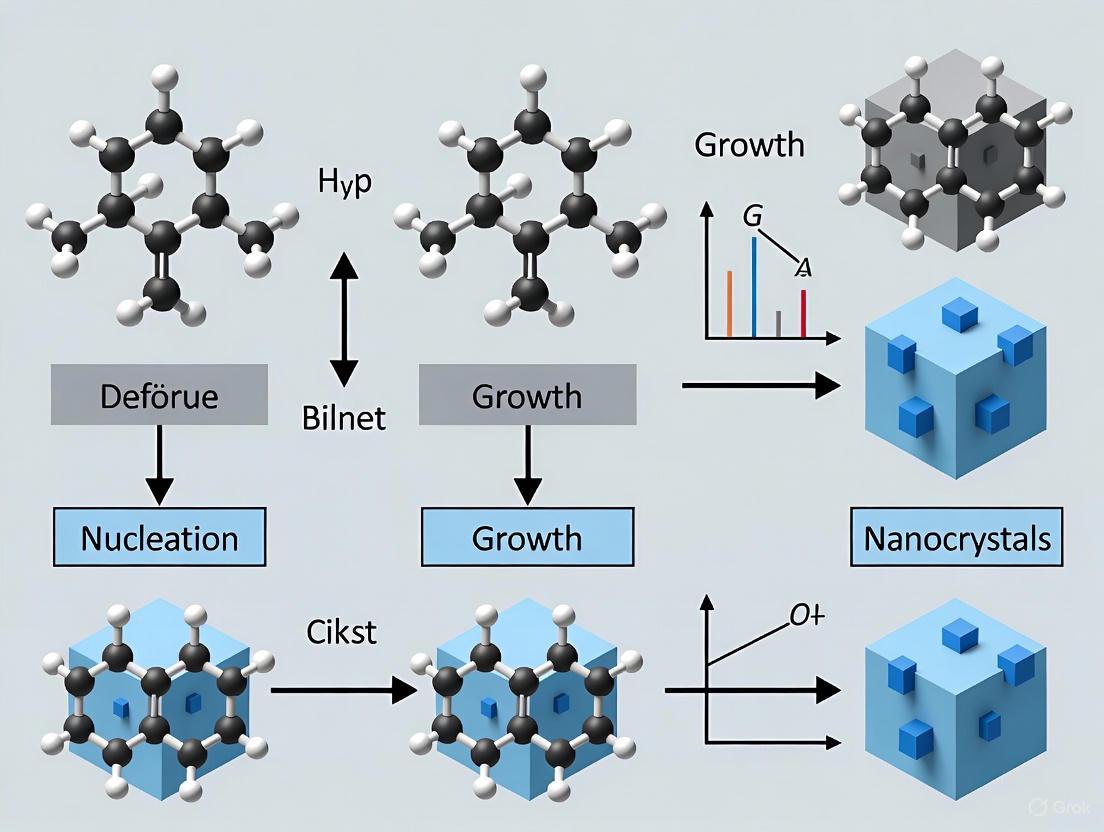
This article provides a comprehensive exploration of the nucleation and growth mechanisms governing nanocrystal formation, a critical technology for enhancing the bioavailability of poorly water-soluble drugs.
Nanocrystal Formation: Decoding Nucleation, Growth Mechanisms, and Advanced Drug Delivery Applications
Abstract
This article provides a comprehensive exploration of the nucleation and growth mechanisms governing nanocrystal formation, a critical technology for enhancing the bioavailability of poorly water-soluble drugs. Tailored for researchers and drug development professionals, it delves into foundational theories, from classical and non-classical nucleation to thermodynamic and kinetic growth models. The scope extends to practical methodologies like top-down and bottom-up synthesis, advanced applications in targeted drug delivery and dermal products, and essential troubleshooting for stability and polymorph control. Finally, it covers the critical validation and regulatory pathways, including in vitro-in vivo correlations and the analysis of approved nanocrystal drug products, offering a complete roadmap from fundamental science to clinical application.
The Science of Initiation: Unraveling Nucleation and Growth Mechanisms in Nanocrystal Formation
The formation of nanocrystals is a fundamental process underpinning advancements in fields ranging from drug development to materials science. For decades, Classical Nucleation Theory (CNT) has provided the primary conceptual framework for understanding this process, depicting a direct, single-step pathway where dissolved monomers assemble into critical nuclei that then grow into crystals [1]. However, advanced experimental techniques have revealed a more complex reality, uncovering non-classical pathways that proceed through intermediate phases and particle-based attachment [2] [3]. This in-depth technical guide examines the core principles, experimental evidence, and mechanistic distinctions between classical and non-classical nucleation, with a specific focus on the role of amorphous precursors and two-step pathways in the context of nanocrystal formation research.
Theoretical Foundations of Nucleation
Classical Nucleation Theory (CNT)
Established in the 1930s, Classical Nucleation Theory describes crystal formation as a single-step process driven by stochastic fluctuations in a supersaturated solution. The theory posits that the free energy change ( \Delta G ) for forming a spherical nucleus of radius ( r ) is given by:
( \Delta G = -\frac{4\pi kB T \ln S}{3vm}r^3 + 4\pi\gamma r^2 )
where ( kB ) is Boltzmann's constant, ( T ) is temperature, ( S ) is the supersaturation ratio, ( vm ) is the molecular volume, and ( \gamma ) is the interfacial tension [1]. This equation reveals a fundamental competition between the bulk free energy driving the phase transformation (favorable, scaling with ( r^3 )) and the surface energy cost of creating a new interface (unfavorable, scaling with ( r^2 )).
A critical concept in CNT is the critical radius ( r_{crit} ), which represents the size at which a nucleus becomes stable and can grow spontaneously. This is derived by setting ( \partial\Delta G/\partial r = 0 ), yielding:
( r{crit} = -\frac{2\gamma vm}{k_B T \ln S} )
The corresponding activation barrier ( \Delta G_{crit} ) is:
( \Delta G{crit} = \frac{16\pi\gamma^3 vm^2}{3(k_B T \ln S)^2} )
CNT makes several key assumptions, including the "capillary assumption" that nascent nuclei possess the same interfacial tension and structure as the macroscopic bulk material. While this simplification makes the theory mathematically tractable, it often fails to quantitatively predict experimental nucleation phenomena, particularly for crystals forming from solution [1].
Non-Classical Nucleation Theories
Non-classical nucleation encompasses several pathways that deviate from the classical monomer-by-monomer addition model. The most prominent is the two-step nucleation mechanism, which involves the formation of a metastable intermediate prior to crystallization [1]. This pathway often proceeds through the initial formation of dense liquid phases or amorphous precursors that subsequently reorganize into crystalline materials [3].
In the prenucleation cluster (PNC) pathway, ions or molecules first form thermodynamically stable, highly dynamic clusters that exist as solutes without a defined phase interface. Upon reaching a critical ion activity product, these clusters undergo a structural change, becoming phase-separated nanodroplets. These nanodroplets then aggregate and coalesce into larger liquid intermediates, which eventually dehydrate and solidify into amorphous phases before transforming into crystals [1].
Another significant non-classical mechanism is crystallization by particle attachment (CPA), where crystals grow not by individual atom or ion addition, but through the assembly of larger nanoparticles. A specific biological manifestation of this is crystallization by amorphous particle attachment (CAPA), prevalent in biogenic minerals where it allows organisms to intervene at multiple stages of crystal growth [3].
Table 1: Core Principles of Classical vs. Non-Classical Nucleation Theories
| Feature | Classical Nucleation Theory (CNT) | Non-Classical Nucleation |
|---|---|---|
| Fundamental Pathway | Single-step, direct | Multi-step, indirect |
| Intermediate States | None | Amorphous phases, dense liquid droplets, pre-nucleation clusters |
| Growth Mechanism | Monomer-by-monomer addition | Particle attachment, aggregation |
| Critical Size Concept | Well-defined critical radius based on energy balance | Multiple stability thresholds for different stages |
| Interfacial Assumptions | Macroscopic interfacial tension applies to nuclei | Evolving interfaces, non-bulk structure in intermediates |
| Predicted Morphology | Faceted crystals following equilibrium habit | Complex, non-equilibrium morphologies, mesocrystals |
Experimental Methodologies and Visualization
Advanced Imaging Techniques
Direct observation of nucleation and growth processes requires sophisticated imaging technologies capable of resolving structures at the nanoscale and atomic level.
In-situ Liquid Phase Scanning Transmission Electron Microscopy (STEM) enables real-time observation of nucleation events in liquid environments. The development of graphene liquid cells (GLCs) has been particularly transformative, as graphene's atomic thinness (≤1 nm) and impermeability allow for high-resolution imaging while containing liquid reagents. This technology provides both high spatial resolution (Ångström level) and temporal resolution (up to 2 frames/second), enabling researchers to track nucleation processes atom-by-atom [2].
Conventional Transmission Electron Microscopy (TEM) remains invaluable for post-process analysis of nanoparticle morphology, size, and distribution within tissues and cells. When combined with energy-filtered TEM (EFTEM), it enables elemental mapping to distinguish nanoparticles from cellular structures. For three-dimensional structural analysis, electron tomography can reconstruct nanoparticle morphology and their interactions with cellular organelles [4].
Femtosecond X-ray scattering provides complementary information about atomic-scale dynamics during phase transformations. This technique can visualize light-induced anisotropic strains in nanocrystals with atomic-scale resolution on femtosecond timescales, capturing large-amplitude structural changes during early transformation stages [5].
Experimental Protocol: In-situ Observation of Platinum Nanocrystal Formation
The following protocol, adapted from the study visualizing platinum nanocrystal nucleation and growth [2], details the methodology for direct observation of nucleation mechanisms:
Sample Preparation:
- Prepare a 5 mM aqueous solution of Na₂PtCl₄·2H₂O as the metal precursor.
- Create graphene liquid cells (GLCs) by encapsulating the precursor solution between two graphene sheets, forming liquid nanoreactors approximately 50 nm thick.
Microscopy Setup:
- Utilize an aberration-corrected Scanning Transmission Electron Microscope (STEM) equipped with a high-speed detector.
- Operate in Annular Dark-Field (ADF) mode for Z-contrast imaging.
- Set electron dose rate to approximately 4.2 × 10³ electrons/Ųs to balance imaging resolution with minimized beam effects.
Data Acquisition:
- Initiate electron beam exposure to reduce Pt precursor, generating hydrated electrons (eₕ⁻) and hydrogen radicals (H·) that serve as reducing agents.
- Acquire image sequences at atomic resolution with temporal resolution of 2 frames/second.
- Record continuous data from initial precursor state through nucleation and growth to mature nanoparticles.
Data Analysis:
- Track particle size and count over time to identify growth stages.
- Analyze Fourier transforms (FT) of high-resolution images to assess crystallinity evolution.
- Monitor local intensity changes to detect depletion zones around growing clusters.
Diagram 1: Multi-Step Nucleation Pathway of Platinum Nanocrystals
The Scientist's Toolkit: Essential Research Reagents and Materials
Table 2: Key Research Reagents and Materials for Nucleation Studies
| Reagent/Material | Function/Application | Example Use Case |
|---|---|---|
| Sodium Tetrachloroplatinate (Na₂PtCl₄·2H₂O) | Metal precursor for nanocrystal synthesis | Formation of Pt nanoparticles in graphene liquid cells [2] |
| Graphene Liquid Cells (GLCs) | Nanoscale liquid containment for TEM | High-resolution imaging of nucleation in aqueous environment [2] |
| Silicon Nitrate Membranes | Support structure for conventional TEM | Sample mounting for nanoparticle-cell interaction studies [4] |
| Strontium & Aluminum Nitrates | Precursors for metal oxide synthesis | Solvothermal synthesis of SrAl₁₂O₁₉ precursor particles [6] |
| Polyvinylpyrrolidone (PVP) | Capping agent and stabilizer | Controlling particle growth and preventing aggregation [6] |
| Cadmium Selenide/Sulfide Nanocrystals | Model semiconductor systems | Studying ultrafast strain dynamics under photoexcitation [5] |
Comparative Analysis of Nucleation Pathways
Distinct Growth Mechanisms and Kinetics
The transition from nucleation to growth reveals fundamentally different mechanisms between classical and non-classical pathways, each with distinct kinetic profiles.
Classical Growth Modes operate through monomer addition and are well-described by the terrace-ledge-kink (TLK) model. At low supersaturation, growth proceeds via a screw-dislocation-driven (spiral growth) mechanism where dislocations provide permanent kink sites. At intermediate supersaturation, two-dimensional surface nucleation (birth and spread growth) becomes dominant, while at high supersaturation, the crystal surface becomes rough and growth occurs through immediate monomer incorporation at all surface sites [3].
Non-Classical Growth Modes include oriented attachment (OA), where crystalline nanoparticles with aligned crystallographic orientations coalesce to form larger single crystals, and amorphous particle attachment, where non-crystalline particles aggregate before crystallizing. These pathways often operate in tandem, as demonstrated in platinum nanocrystal formation where an initial atomic attachment stage (depleting the local monomer concentration) is followed by a second stage dominated by particle attachment and coalescence [2].
The kinetics of these processes can be modeled using extended versions of the Johnson-Mehl-Avrami-Kolmogorov (JMAK) equation, which can incorporate time-dependent growth and nucleation rates. For diffusion-controlled growth where the growth rate ( G(t) ) varies as ( t^{-1/2} ), the transformed fraction ( f(t) ) follows:
( f(t) = 1 - \exp(-kt^n) )
where both the rate constant ( k ) and Avrami exponent ( n ) reflect the specific growth and nucleation mechanisms operative in the system [7].
Quantitative Comparison of Nucleation Parameters
Table 3: Experimental Observations of Nucleation and Growth Parameters
| Parameter | Classical Pathway | Non-Classical Pathway | Experimental Evidence |
|---|---|---|---|
| Critical Size for Crystallization | Not applicable (direct crystallization) | ~1 nm amorphous clusters | Pt nanocrystals transition at ~1 nm diameter [2] |
| Transformation Timescale | Single activation barrier | Multiple sequential steps | Pt nanocrystals: amorphous for ~30s before crystallizing [2] |
| Maximum Strain During Growth | Typically minimal | Can exceed 1% | CdS/CdSe nanocrystals show ~1.2% radial strain [5] |
| Growth Rate Dependence | Constant or decreasing with time | Can increase during particle attachment stage | Two distinct stages in Pt growth: atomic then particle attachment [2] |
| Activation Barrier | ( \Delta G{crit} = \frac{16\pi\gamma^3 vm^2}{3(k_B T \ln S)^2} ) | Multiple barriers for different stages | Energetics include aggregation, reorganization, crystallization [1] |
Implications for Nanocrystal Engineering and Drug Development
The distinction between classical and non-classical nucleation pathways has profound practical implications for controlling nanocrystal properties in technological applications.
In pharmaceutical development, understanding and controlling crystallization pathways is essential for obtaining desired polymorphs with optimal bioavailability. Small molecular modifications can significantly alter the crystallization landscape, as demonstrated by ABT-072 and ABT-333—structural analogs that differ only by a minor substituent change but exhibit dramatically different polymorphism and solubility behavior. While ABT-072 displays diverse anhydrous polymorphism, ABT-333 forms only a single anhydrous polymorph under similar conditions, a distinction captured by crystal structure prediction (CSP) calculations [8].
For functional nanomaterials, non-classical pathways offer unique opportunities for morphological control. The crystallization of SrAl₁₂O₁₉ nanocrystals from amorphous precursors under high-temperature annealing proceeds through a complex sequence involving densification, crystallite domain formation, oriented attachment, surface nucleation, two-dimensional growth, and surface diffusion—ultimately yielding thermodynamically favored hexagonal platelet crystals [6]. Similar pathways in biogenic minerals enable the formation of complex morphologies like the spherical lenses in brittle stars and hierarchical porous microstructures in sea urchins, which defy conventional crystallographic expectations [3].
The recognition that multiple nucleation pathways may operate simultaneously or competitively under similar conditions necessitates sophisticated characterization approaches. As demonstrated by in-situ studies of CaCO₃ nucleation, classical and non-classical mechanisms can occur in parallel, with their relative dominance determined by precise solution conditions and interfacial environments [1] [2].
The paradigm of crystal formation has expanded significantly beyond the classical nucleation theory to encompass a rich landscape of non-classical pathways involving amorphous intermediates, pre-nucleation clusters, and particle-based assembly. These multi-step mechanisms, once considered exceptions, are now recognized as fundamental processes in both biological and synthetic systems. The distinction between these pathways has material consequences, enabling precise morphological and crystallographic control in biominerals and offering new strategies for engineering functional nanomaterials with tailored properties. For researchers and drug development professionals, understanding these mechanistic differences provides not only deeper fundamental insight but also practical tools for controlling crystallization outcomes—from pharmaceutical polymorph selection to the synthesis of advanced nanocrystalline materials. As characterization techniques continue to improve, particularly in-situ methods with high spatial and temporal resolution, our understanding of these complex pathways will further refine, enabling increasingly sophisticated control over one of materials science's most fundamental processes.
The formation and stability of nanocrystals are governed by fundamental thermodynamic principles that dictate nucleation, growth, and dissolution behaviors. Among these principles, the Kelvin equation represents a cornerstone relationship that describes how particle size influences solubility—a phenomenon with profound implications for nanocrystal formulation, stability, and performance in pharmaceutical applications. As the pharmaceutical industry increasingly turns to nanocrystal technology to enhance the bioavailability of poorly soluble drugs, understanding these thermodynamic drivers becomes paramount for researchers and drug development professionals.
This technical guide explores the theoretical foundations of the Kelvin equation and its critical relationship with saturation solubility within the context of nanocrystal formation mechanisms. With an estimated 70-90% of new chemical entities (NCEs) exhibiting poor solubility, which directly limits absorption and therapeutic efficacy, the manipulation of solubility through nanocrystal formation has emerged as a vital formulation strategy [9]. The precise control over nanocrystal size, shape, and surface chemistry enabled by modern synthesis techniques allows researchers to harness thermodynamic principles for optimizing drug delivery systems [10].
Theoretical Foundations
The Kelvin Equation: Core Principles
The Kelvin equation establishes the fundamental relationship between particle curvature and solubility, predicting that smaller particles exhibit higher solubility than their bulk counterparts due to increased surface energy. This relationship can be expressed mathematically as:
[ \ln\left(\frac{S}{S0}\right) = \frac{2\gamma Vm}{rRT} ]
Where:
- (S) is the solubility of the nanocrystal
- (S_0) is the solubility of the bulk material
- (\gamma) is the surface free energy
- (V_m) is the molar volume
- (r) is the radius of the particle
- (R) is the ideal gas constant
- (T) is the absolute temperature
This size-dependent solubility phenomenon has direct implications for nanocrystal stability and Ostwald ripening—a process where larger particles grow at the expense of smaller ones due to solubility differences [11]. The theoretical framework provided by the Kelvin equation enables researchers to predict and control these processes during nanocrystal formation and storage.
Saturation Solubility in Nanocrystal Systems
Saturation solubility represents the maximum concentration of a compound that can dissolve in a solution at equilibrium with its solid phase. For nanocrystals, this fundamental property is intrinsically linked to particle size through the Kelvin equation, creating a dynamic interplay that influences both nucleation kinetics and crystal growth mechanisms [11].
The dissolution process for nanocrystals involves three primary thermodynamic steps: dissociation from the crystal lattice, cavity formation in the solvent, and solvation of the free molecule. The strong intermolecular bonds and complex interaction patterns in crystal lattices often limit dissociation, particularly for high-melting-point compounds sometimes referred to as 'brick dust' molecules. Simultaneously, hydrophobic compounds with high octanol-water partition coefficients (logP > 2-3) face solvation limitations, described as 'greaseball' molecules [11]. Nanocrystal technology primarily addresses the former limitation by increasing surface area and applying the Kelvin effect to enhance dissolution.
Table 1: Key Molecular Properties Influencing Nanocrystal Solubility
| Property | Impact on Solubility | Experimental Determination | Formulation Implications |
|---|---|---|---|
| Melting Point (Tm) | Compounds with Tm > 200°C show solid-state-limited solubility [11] | Differential Scanning Calorimetry (DSC) | Amorphization, salt formation beneficial |
| logP/logD | Values > 2-3 indicate solvation-limited solubility [11] | Shake-flask method, HPLC | Lipid-based formulations preferred |
| Solvent Accessible Surface Area (SASA) | Strong correlation with solubility prediction [12] | Molecular dynamics simulations | Surface modification strategies |
| Coulombic & LJ Interaction Energies | Key descriptors for solute-solvent interactions [12] | Molecular dynamics simulations | Solvent selection optimization |
Experimental Methodologies and Validation
Advanced Crystallization Monitoring
Recent research from UC Berkeley has revealed sophisticated crystallization pathways for nanocrystals that provide experimental validation of thermodynamic principles. Using lead sulfide nanocrystals suspended in solution, researchers employed powerful X-ray scattering techniques to observe in real-time how particles organize into ordered, repeating lattices [13].
The experimental protocol involved:
- System Preparation: Lead sulfide nanocrystals were suspended in solution with carefully controlled ionic strength
- Environmental Tuning: Soluble ions were used to tune nanocrystal interactions rather than simply packing particles more tightly
- Real-Time Monitoring: X-ray scattering techniques tracked assembly processes with high temporal resolution
- Pathway Analysis: Crystallization mechanisms were classified as direct versus liquid-intermediate pathways
This methodology demonstrated that crystallization does not always occur in a single step. Instead, particles often first condense into a dense, liquid-like state before reorganizing into an ordered crystal. This temporary metastable liquid phase significantly accelerates crystallization and produces crystals with fewer defects. By carefully adjusting salt concentration, the research team controlled assembly speed over three orders of magnitude—from seconds to hours [13].
Molecular Dynamics for Solubility Prediction
Molecular dynamics (MD) simulations have emerged as powerful computational tools for modeling the physicochemical properties governing nanocrystal solubility, providing molecular-level insights that complement experimental approaches. A recent comprehensive study compiled a dataset of 211 drugs from diverse classes and subjected them to MD simulation to extract properties relevant to solubility prediction [12].
The detailed experimental protocol included:
- System Setup: Simulations conducted in the isothermal-isobaric (NPT) ensemble using GROMACS 5.1.1 software with the GROMOS 54a7 force field
- Property Calculation: Ten MD-derived properties were extracted along with experimental logP values
- Feature Selection: Statistical analysis identified the most influential properties for solubility prediction
- Machine Learning Integration: Four ensemble algorithms (Random Forest, Extra Trees, XGBoost, Gradient Boosting) were employed to develop predictive models
The research identified seven key properties with significant influence on solubility prediction: logP, Solvent Accessible Surface Area (SASA), Coulombic interaction energy (Coulombic_t), Lennard-Jones interaction energy (LJ), Estimated Solvation Free Energy (DGSolv), Root Mean Square Deviation (RMSD), and Average number of solvents in Solvation Shell (AvgShell) [12]. The Gradient Boosting algorithm achieved the best predictive performance with R² = 0.87 and RMSE = 0.537, demonstrating the power of integrating MD simulations with machine learning for solubility forecasting.
Diagram Title: Nanocrystal Formation Pathways
Computational Approaches and Predictive Modeling
In Silico Modeling for Solubility Enhancement
Predictive modeling via computational simulation represents a paradigm shift in pharmaceutical formulation, replacing empirical trial-and-error approaches with rational, efficient strategies. These advanced methodologies employ mathematical algorithms, artificial intelligence (AI), and machine learning to model complex biological, chemical, and physical processes, providing data-driven insights into drug behavior and formulation strategies [9].
The application of predictive modeling for solubility and bioavailability enhancement offers several distinct advantages:
- Efficient Formulation Optimization: Researchers can explore and optimize various formulation parameters, such as excipient selection and processing conditions, through simulation rather than extensive laboratory experimentation
- Early Issue Identification: Potential issues related to solubility and bioavailability can be identified early in the development process, allowing for proactive resolution
- Resource Conservation: By focusing experimental efforts on formulations with higher probability of success, organizations can significantly reduce resource consumption associated with materials, equipment, and time
- Mechanistic Insights: Advanced models provide unprecedented insights into the underlying molecular interactions and mechanisms governing solubility, enabling more informed decision-making [9]
Commercial platforms like Thermo Fisher Scientific's Quadrant 2 predictive platform exemplify this approach, using computational methods to analyze a drug compound's unique molecular structure and chemical characteristics to identify optimal bioavailability and solubility enhancement techniques [9].
Table 2: Key MD-Derived Properties for Solubility Prediction
| Property | Computational Method | Correlation with Solubility | Physical Significance |
|---|---|---|---|
| SASA | Molecular Dynamics | R² = 0.82 [12] | Reflects molecular surface accessible to solvent |
| logP | Experimental/QSPR | R² = 0.79 [12] | Measures hydrophobicity/hydrophilicity balance |
| DGSolv | Free Energy Calculations | R² = 0.76 [12] | Quantifies energy of solvation process |
| Coulombic_t | Nonbonded Interaction Analysis | R² = 0.71 [12] | Electrostatic solute-solvent interactions |
| LJ | Nonbonded Interaction Analysis | R² = 0.68 [12] | Van der Waals solute-solvent interactions |
Machine Learning Integration
The integration of machine learning with molecular dynamics has created powerful predictive tools for solubility assessment. By leveraging ensemble algorithms like Random Forest, Extra Trees, XGBoost, and Gradient Boosting, researchers can now accurately forecast solubility based on MD-derived properties, achieving performance comparable to traditional structure-based prediction models [12].
This approach is particularly valuable for addressing the complex challenges of biorelevant solubility prediction in media mimicking human intestinal fluids. These complex solvents contain additives such as bile salts, phospholipids, cholesterol, and lipids to reflect fasted and fed intestinal states, creating a challenging prediction environment that extends beyond simple aqueous solubility [11]. Machine learning models trained on comprehensive datasets can navigate this complexity, providing critical insights for formulation development.
Research Reagent Solutions
Table 3: Essential Materials for Nanocrystal Solubility Research
| Reagent/Material | Function in Research | Application Context |
|---|---|---|
| Lead Sulfide Nanocrystals | Model system for crystallization studies [13] | Fundamental mechanism research |
| GROMACS Software | Molecular dynamics simulation package [12] | Computational property prediction |
| GROMOS 54a7 Force Field | Molecular modeling parameters [12] | MD simulation of solute-solvent systems |
| Simulated Intestinal Fluids | Biorelevant solubility assessment [11] | Prediction of in vivo performance |
| X-ray Scattering Equipment | Real-time crystallization monitoring [13] | Experimental pathway validation |
The Kelvin equation and saturation solubility principles provide the fundamental thermodynamic framework underlying nanocrystal behavior and stability. As pharmaceutical research continues to confront the challenges posed by poorly soluble drug candidates, harnessing these relationships through advanced experimental and computational approaches becomes increasingly critical. The integration of molecular dynamics simulations, machine learning, and sophisticated crystallization monitoring techniques enables researchers to not only predict solubility behavior but also to design optimized nanocrystal formulations with enhanced bioavailability. Continuing advancement in these areas promises to accelerate drug development timelines while improving the efficacy of therapeutics for patients.
The synthesis of nanocrystals with precisely controlled dimensions remains a cornerstone of advanced materials science, with implications spanning optoelectronics, catalysis, and biomedical applications. Central to this endeavor is understanding the kinetic processes that govern nanocrystal formation, from the initial activation of molecular precursors to the final focusing of the size distribution. This guide examines the theoretical frameworks and experimental methodologies that enable researchers to navigate these complex kinetic pathways. Framed within broader research on nucleation and growth mechanisms, these models provide a predictive foundation for moving beyond empirical synthesis toward rational design of nanocrystals with tailored properties. The 2023 Nobel Prize in Chemistry recognized the profound importance of controlled nanocrystal synthesis, further highlighting the critical need for sophisticated kinetic models that bridge atomic-scale events and macroscopic observables [10].
Kinetic Framework of Nanocrystal Formation
The Five-Stage Kinetic Model
A comprehensive kinetic model for semiconductor nanocrystal synthesis reveals five distinct temporal regions that characterize the evolution from precursor compounds to final nanocrystals [14]. This model integrates an activation mechanism for precursor conversion to monomers, discrete rate equations for small cluster formation, and a continuous Fokker-Planck equation for larger cluster growth.
Table 1: Stages of Nanocrystal Formation in Kinetic Models
| Stage | Key Processes | Governing Factors | Experimental Observables |
|---|---|---|---|
| 1. Monomer Generation | Precursor conversion to reactive monomers | Activation energy, temperature | Precursor consumption rate |
| 2. Small Cluster Formation | Nucleation and early growth | Critical nucleus size, supersaturation | Initial particle count |
| 3. Size Distribution Focusing | Competitive growth | Precursor depletion | Decreasing polydispersity |
| 4. Pseudo-Steady State | Balanced attachment/detachment | Surface energy effects | Stable mean size |
| 5. Distribution Broadening | Ostwald ripening | Solubility differences | Increasing polydispersity |
The model identifies two key non-dimensional parameter combinations that serve as guiding principles for experimental design optimization. Contrary to conventional understanding that diffusion controls size distribution focusing, this model demonstrates that focusing can occur under purely reaction-controlled conditions [14]. This distinction has profound implications for synthesis design, particularly through temperature modulation or additive introduction to enhance precursor conversion rates while minimizing polydispersity.
Quantitative Parameters and Their Impact
The kinetic trajectory through these stages is governed by specific quantitative relationships that determine the final nanocrystal characteristics. Optimization requires careful balancing of these parameters to achieve desired size distributions.
Table 2: Key Kinetic Parameters and Their Impact on Nanocrystal Synthesis
| Parameter | Mathematical Expression | Impact on Size Distribution | Experimental Control Levers |
|---|---|---|---|
| Monomer Generation Rate | ( R = A e^{-E_a/RT} ) | Determines nucleation burst duration | Temperature, precursor concentration, catalysts |
| Critical Nucleus Size | ( n^* = \frac{2\sigma^3}{27(kT\ln S)^3} ) | Defines stable nucleus formation | Supersaturation (S), surface energy (σ) |
| Size Distribution Focus Parameter | ( \Gamma = \frac{kg C0}{kn n0} ) | Controls distribution narrowing | Growth vs nucleation rate balance |
| Activation-Conversion Balance | ( \Lambda = \frac{ka [A]}{kd} ) | Affects intermediate stability | Additive concentration, precursor reactivity |
For a given set of reaction parameters, an optimum exists in both the duration of high-temperature treatment and additive concentration that minimizes polydispersity [14]. This optimum represents the most efficient path through the kinetic landscape, balancing nucleation and growth rates to achieve monodisperse populations.
Computational Modeling Approaches
Kinetic Monte Carlo Methods
Kinetic Monte Carlo (KMC) simulations provide a powerful atomistic approach for modeling nanocrystal formation kinetics. KMC operates on the fundamental principle of simulating state-to-state transitions as a Markov chain, where the probability of transitioning between states depends only on the current state, not on previous history [15]. The method captures rare event dynamics that characterize many processes in nanocrystal formation, where high activation barriers create timescale disparities between atomic vibrations (picoseconds) and infrequent barrier-crossing events (potentially seconds or longer).
The time evolution of the probability ( P_i(t) ) of the system being in state ( i ) at time ( t ) is governed by the Markovian master equation:
[ \frac{dPi(t)}{dt} = -\sum{j \neq i} k{ij}Pi(t) + \sum{j \neq i} k{ji}P_j(t) ]
where ( k_{ij} ) represents the rate constant for transitioning from state ( i ) to state ( j ) [15]. For nanocrystal formation, these states represent different atomic configurations, and the rate constants describe elementary processes such as monomer attachment, detachment, diffusion, and chemical reactions.
KMC Implementation Framework
Implementing KMC for nanocrystal growth requires careful mapping of physical processes to computational algorithms. The approach is particularly valuable for simulating surface diffusion, crystal growth, and heterogeneous catalysis, covering both transient and steady-state kinetics [15].
Table 3: KMC Model Components for Nanocrystal Growth Simulations
| Model Component | Description | Implementation Considerations |
|---|---|---|
| Lattice Definition | Mapping of crystal structure to discrete sites | Lattice type, coordination, neighborhood relations |
| Elementary Processes | Atomic-scale events with associated rate constants | Attachment, detachment, diffusion, transformation |
| Rate Constants | Temperature-dependent probabilities for each process | ( k = \nu e^{-Ea/kBT} ) with preexponential factor ( \nu ) |
| Timescale Management | Algorithms for handling disparate rates | Fast-process rejection, time acceleration techniques |
| Lateral Interactions | Energetic coupling between adjacent species | Cluster expansions, nearest-neighbor parameters |
In practice, KMC simulations for nanocrystal growth must address several challenges, including timescale disparities between fast diffusion processes and slow chemical reactions. Recent acceleration algorithms help overcome these limitations, enabling more comprehensive simulations of realistic systems [15]. Commercial implementations, such as the Sentaurus Process KMC module, demonstrate the application of these methods to practical materials systems, modeling individual impurity atoms and point defects in three dimensions without requiring a continuum mesh [16].
Figure 1: Kinetic Pathway from Precursor to Mature Nanocrystal
Experimental Methodologies and Protocols
In-Situ Liquid Cell STEM for Atomic-Scale Observation
Direct experimental observation of nanocrystal formation mechanisms at atomic resolution provides critical validation for kinetic models. Recent advances in in-situ liquid cell scanning transmission electron microscopy (STEM) enable real-time tracking of nucleation and growth events. The methodology employing graphene liquid cells (GLCs) offers particularly high spatial and temporal resolution, with cell thickness below 1 nm allowing imaging at the Ångström level [2].
Protocol: In-Situ Observation of Platinum Nanocrystal Growth
Sample Preparation:
- Prepare 5 mM aqueous solution of Na₂PtCl₄·2H₂O as platinum precursor
- Encapsulate solution in graphene liquid cell, creating nanoscale reactors
- Optimize liquid thickness to <50 nm for high-resolution imaging
Imaging Parameters:
- Use aberration-corrected STEM with annular dark-field (ADF) detection
- Set electron dose rate to approximately 4.2 × 10³ electrons/Ųs
- Acquire images at 2 frames/s temporal resolution
- Calibrate magnification to achieve ≤0.3 nm/pixel resolution
Data Collection:
- Record continuous image sequences during electron beam exposure
- Track multiple nanoparticle formations simultaneously
- Monitor depleted zones around growing clusters
- Capture coalescence events during later growth stages
Analysis Methods:
- Measure particle size and count as function of time
- Compute Fourier transforms of individual nanoparticles to assess crystallinity
- Track amorphous-to-crystalline transition points
- Analyze attachment mechanisms (atomic vs. particle)
This approach has revealed a two-stage growth mechanism for platinum nanocrystals: an initial atomic attachment stage until local precursor depletion, followed by particle attachment through various atomic pathways [2]. The critical size for amorphous-to-crystalline transition was observed at approximately 1 nm diameter, providing quantitative boundaries for kinetic models.
Population Balance Modeling and Data Mining
For systems where direct atomic-scale observation is challenging, population balance models combined with statistical analysis of literature data offer an alternative approach to kinetic parameter estimation. A comprehensive data mining study analyzed 336 datapoints of kinetic parameters from 185 different sources, employing hierarchical cluster analysis and random forest classification to identify patterns in crystallization kinetics [17].
Protocol: Population Balance Model Development
Kinetic Parameter Extraction:
- Collect literature data on solute, solvent, kinetic expressions, and parameters
- Categorize by crystallization method and seeding conditions
- Normalize kinetic parameters for cross-study comparison
Cluster Analysis:
- Perform hierarchical cluster analysis on kinetic parameters
- Identify naturally occurring groupings within the data
- Validate cluster stability through statistical measures
Predictive Model Construction:
- Develop random forest classification models using solute descriptors, solvent properties, and crystallization methods as classifiers
- Train models on clustered data sets
- Validate model accuracy through cross-validation
Model Application:
- Use classified parameters as initial estimates for new systems
- Refine parameters through limited experimental validation
- Implement in population balance equations for process prediction
This data-driven approach achieved classification accuracy exceeding 70%, providing reasonable initial estimates for kinetic parameters without extensive experimentation [17]. The methodology is particularly valuable for pharmaceutical development professionals seeking to accelerate process optimization.
Figure 2: Experimental-Computational Workflow for Kinetic Analysis
Essential Research Reagents and Materials
Successful investigation of nanocrystal formation kinetics requires carefully selected materials and reagents that enable precise control over reaction pathways. The following toolkit summarizes critical components used in advanced kinetic studies.
Table 4: Research Reagent Solutions for Nanocrystal Kinetic Studies
| Category | Specific Examples | Function in Kinetic Studies | Key Characteristics |
|---|---|---|---|
| Precursor Compounds | Na₂PtCl₄·2H₂O, Lead halide perovskites, Metal acetylacetonates | Source of monomer species | Controlled reactivity, solubility, reduction potential |
| Stabilizing Ligands | Oleic acid, Oleylamine, Trioctylphosphine oxide | Surface binding to control growth kinetics | Selective facet binding, steric bulk, coordination strength |
| Solvents | Octadecene, Toluene, Water, Diphenyl ether | Reaction medium for nanocrystal formation | Boiling point, polarity, coordinating ability, viscosity |
| Reducing Agents | Diisobutylaluminum hydride, Superhydride, Sodium borohydride | Electron donors for precursor activation | Controlled reduction potential, compatibility with solvent system |
| Additives | Metal halides, Alkali acetates, Fatty acids | Modifiers of reaction kinetics | Selective complexation, surface energy modification, precursor stabilization |
| Reference Materials | CNCD-1 cellulose nanocrystals, Gold nanorods | Method validation and instrument calibration | Certified size distribution, morphology, stability |
The selection of appropriate precursor compounds is particularly critical, as their reactivity determines the monomer generation rate that initiates the kinetic cascade [14] [2]. Similarly, the choice of stabilizing ligands directly influences surface kinetics during growth, enabling size and shape control through selective facet stabilization. Recent advances demonstrate that increasing precursor reactivity enables continuous tunability of copper nanocrystals from single-crystalline to twinned and stacking fault-lined structures, highlighting the profound impact of kinetic control on material properties [10].
Kinetic control models provide an essential framework for understanding and manipulating nanocrystal formation from initial monomer activation to final size distribution focusing. The integration of theoretical models, computational simulations, and advanced characterization techniques creates a feedback loop that continuously refines our understanding of these complex processes. As experimental methods achieve higher temporal and spatial resolution, and computational models incorporate more realistic interactions, the predictive power of these kinetic models continues to improve. This progression enables increasingly precise synthesis of nanocrystals with tailored properties for specific applications in photonics, electronics, catalysis, and medicine, fulfilling the promise of nanocrystals as building blocks for next-generation technologies.
Nonstoichiometric Nucleation in Multicomponent Systems
Nonstoichiometric nucleation describes the process where the initial crystalline embryo possesses a chemical composition that differs from both the parent phase and the final stable crystalline phase. This phenomenon represents a significant departure from classical nucleation theory and has profound implications for controlling the structure and properties of multicomponent crystals. In multicomponent systems, nonstoichiometric nucleation frequently occurs through pathways involving amorphous intermediates or metastable crystalline phases that act as precursors to the final stable phase [18]. This nucleation mechanism is particularly relevant in functional materials such as intermetallic compounds, where non-equilibrium phenomena like disorder trapping and inverted partitioning occur during rapid solidification [19]. The ability to understand and control nonstoichiometric nucleation pathways enables scientists to design materials with specific architectural features and physical properties that are not accessible through equilibrium synthesis routes.
The thermodynamic driving force for nonstoichiometric nucleation originates from imbalances in the concentrations of reduced elements during the initial synthesis stages [18]. When nonstoichiometric nuclei begin to grow, secondary elements can either deposit physically on the growing nuclei or form atomic mixtures through diffusion and rearrangement processes. The competition between these pathways—mixture formation versus physical deposition—ultimately determines the final nanocrystal shape and chemical composition. When the free energy change for mixture formation is highly negative (ΔGAB < -ξ), the final product typically exhibits stoichiometric composition, with its shape determined by the size of the primary nanocrystals [18]. In contrast, when mixture formation and physical deposition compete (-ξ ≤ ΔGAB < 0), both chemical composition and structure become influenced by primary nanocrystal size and the degree of mixture formation at constituent interfaces.
Quantitative Analysis of Nonstoichiometric Growth Kinetics
Experimental investigations across multiple material systems have revealed distinctive kinetic behaviors associated with nonstoichiometric nucleation and growth. The relationship between undercooling (ΔT) and growth velocity (V) provides critical insights into the controlling mechanisms during crystal formation.
Table 1: Dendrite Growth Velocity in Undercooled Co-Si Alloys
| Alloy Composition | Undercooling Range (K) | Maximum Velocity (m/s) | Growth Characteristics |
|---|---|---|---|
| Co-50 at.% Si | 0-255 | ~0.45 | Monotonic velocity increase with undercooling |
| Co-53 at.% Si | 0-180 | ~0.08 | Dual-stage growth: sluggish then abrupt |
| Co-55 at.% Si | 0-165 | ~0.11 | Dual-stage growth: sluggish then abrupt |
Data from [19] demonstrates that alloys with compositions away from the congruently melting point (Co-53 at.% Si and Co-55 at.% Si) exhibit unique dual-stage growth behavior not observed in the stoichiometric Co-50 at.% Si alloy [19]. This dual-stage behavior consists of an initial sluggish growth stage followed by an abrupt acceleration in growth velocity at a critical undercooling threshold. The maximum growth velocity achieved in the non-stoichiometric alloys is substantially lower than in the stoichiometric composition, indicating that compositional deviations from stoichiometry introduce additional kinetic barriers to crystal growth. These experimental observations align with models that incorporate significant solute drag effects during rapid solidification of non-stoichiometric intermetallic compounds [19].
Table 2: Comparison of Theoretical Models for Rapid Solidification
| Model Characteristic | Without Solute Drag | With Solute Drag |
|---|---|---|
| Theoretical Basis | Chemical rate theory | Thermodynamic extremal principle (TEP) |
| Dissipation Processes | Pre-defined | Derived self-consistently |
| Prediction for Co-Si System | Inconsistent with dual-stage growth | Matches experimental dual-stage behavior |
| Solute Trapping | Complete disorder trapping possible | Partial trapping with significant drag |
The application of the Thermodynamic Extremal Principle (TEP) to model rapid solidification of non-stoichiometric intermetallic compounds has demonstrated that only models incorporating solute drag can be derived self-consistently in thermodynamics [19]. This theoretical framework properly accounts for the dissipation processes and their corresponding driving free energies without requiring pre-definition, as needed in chemical rate theory. Comparative studies between model predictions and experimental results in undercooled Co-Si alloys provide compelling evidence for significant solute drag effects during rapid solidification of non-stoichiometric compounds [19].
Experimental Methodologies and Protocols
Melt Fluxing Technique for Undercooling Measurements
The experimental investigation of nonstoichiometric nucleation often requires precise control of solidification conditions. The melt fluxing technique has proven effective for achieving substantial undercooling in intermetallic systems:
Sample Preparation: High-purity ingots (approximately 20g) with nominal compositions are prepared from pure elements (99.999 wt% purity). For Co-Si systems, compositions of Co-50 at.% Si, Co-53 at.% Si, and Co-55 at.% Si have been investigated [19].
Homogenization: Ingots are re-melted at least four times in a vacuum arc melting furnace under Ti-gettered high purity argon atmosphere to ensure chemical homogeneity. Mass loss should be monitored and maintained below 0.3 wt% [19].
Undercooling Procedure: The fluxing technique is applied to undercool the melt. The exact nature of the flux material depends on the specific alloy system but typically involves glassy slags that prevent heterogeneous nucleation.
Velocity Measurement: Temperature profiles and high-speed video camera images are analyzed to determine the relationship between growth velocity (V) and undercooling (ΔT). Error bars for growth velocities are typically set at ±20% based on established methodologies [19].
Molecular Dynamics with Free-Energy Seeding Method
Computational approaches provide atomic-scale insights into nonstoichiometric nucleation mechanisms:
Model Generation: Glass structural models containing 12,000-14,000 atoms are generated using Molecular Dynamics (MD) simulations through melt-and-quench approaches [20]. For lithium disilicate systems, compositions include 33.3Li₂O·66.7SiO₂ (LS2) and 33Li₂O·66SiO₂·1P₂O₅ (LS2P1) [20].
Simulation Parameters: The leap-frog algorithm encoded in packages such as DL_POLY is used to integrate equations of motion with time steps of 1-2 fs. Systems are typically heated to 3500 K and held for 100 ps to erase memory of initial configurations, then cooled to 300 K with controlled cooling rates [20].
Free-Energy Calculation: The Free-Energy Seeding Method (FESM) evaluates free energy change as a function of crystal radius by embedding subnano-scale spherical crystals in glass models [20]. This approach identifies critical sizes for crystal precipitation and enables comparison with classical nucleation theory.
Cluster Analysis: Modified exploring methods identify structurally similar crystalline clusters in glass models, allowing detection of different embryos (e.g., Li₂Si₂O₅, Li₂SiO₃, Li₃PO₄) [20].
Figure 1: Nonstoichiometric Nucleation Pathway. This diagram illustrates the multi-stage process of nonstoichiometric nucleation, beginning with compositional imbalance in the amorphous phase, proceeding through nonstoichiometric nuclei formation, metastable phase development, and culminating in final crystal structure.
Research Reagent Solutions and Materials
Table 3: Essential Research Reagents for Nonstoichiometric Nucleation Studies
| Reagent/Material | Function | Application Example |
|---|---|---|
| High-Purity Metals (99.999%) | Source materials for alloy preparation | Co and Si for intermetallic compounds [19] |
| Fluxing Agents | Create glassy slag to prevent heterogeneous nucleation | B₂O₃-based fluxes for undercooling experiments [19] |
| Nucleating Agents | Promote specific crystallization pathways | P₂O₅ in lithium disilicate systems [20] |
| Argon Atmosphere | Prevent oxidation during processing | Ti-gettered high purity argon for melting [19] |
| Molecular Dynamics Force Fields | Describe atomic interactions in simulations | Modified PMMCS force-field for oxide glasses [20] |
The selection of appropriate research reagents is critical for investigating nonstoichiometric nucleation phenomena. High-purity starting materials minimize unintended contamination that could alter nucleation pathways. Fluxing agents enable deep undercooling by preventing heterogeneous nucleation on container surfaces or impurities. deliberately introduced nucleating agents such as P₂O₅ in lithium silicate systems promote specific crystallization pathways and enable the study of how additives influence nonstoichiometric phase selection [20]. Computational studies require carefully parameterized force fields that accurately describe atomic interactions in complex multicomponent systems.
Figure 2: Experimental-Computational Workflow. This diagram outlines the integrated approach combining sample preparation, homogenization, undercooling experiments, characterization, and computational modeling that enables comprehensive investigation of nonstoichiometric nucleation phenomena.
Nonstoichiometric nucleation represents a fundamental materials synthesis paradigm with far-reaching implications for controlling microstructure and properties in multicomponent systems. The experimental and theoretical evidence summarized in this technical guide demonstrates that nucleation frequently proceeds through non-equilibrium pathways involving compositionally distinct intermediates. The recognition that solute drag significantly influences rapid solidification of non-stoichiometric intermetallic compounds [19] provides a crucial theoretical framework for understanding the kinetic limitations of these processes. Furthermore, the identification of multiple nucleation pathways in oxide glass systems [20], including the surface-preferential nucleation of metastable phases, highlights the complex interplay between composition, structure, and nucleation behavior.
These insights create exciting opportunities for materials design across diverse applications. In pharmaceutical development, controlled nonstoichiometric nucleation could enable precise crystal engineering of active ingredients with optimized bioavailability and stability. For advanced functional materials, understanding nonstoichiometric nucleation pathways facilitates the design of nanocrystals with tailored architectures and enhanced properties. Future research directions should focus on developing in situ characterization techniques to directly observe nucleation events, creating multi-scale modeling approaches that bridge atomic-scale simulations with macroscopic kinetics, and exploring how external fields (electric, magnetic, mechanical) can modulate nonstoichiometric nucleation pathways. By harnessing the principles outlined in this guide, researchers can advance from empirical materials synthesis to precisely controlled architectural control of multicrystalline materials.
The Role of Surface Energy and Interfacial Forces in Early-Stage Nucleation
Nucleation, the initial process by which a new phase emerges from a parent phase, represents a fundamental phenomenon in materials science, chemistry, and biology. The critical role of surface energy and interfacial forces in governing early-stage nucleation mechanisms has become increasingly apparent through recent research advances. When the first stable nuclei form, their creation necessitates the development of an interface, making the associated surface energy a dominant factor in determining the thermodynamic barrier to nucleation [21].
This whitepaper examines how interfacial phenomena control nucleation pathways and outcomes within the broader context of nanocrystal formation and growth mechanisms research. The precise manipulation of nucleation is paramount for technological applications ranging from pharmaceutical development to the synthesis of advanced nanomaterials. For drug development professionals, controlling polymorphic forms through nucleation conditions can determine critical product characteristics including bioavailability, stability, and manufacturing reproducibility [22] [23]. Recent experimental and computational breakthroughs now provide unprecedented insight into how interfacial properties dictate nucleation behavior across diverse systems from metallic nanocrystals to gas hydrates and organic compounds.
Theoretical Foundation
Classical Nucleation Theory and Surface Energy
Classical Nucleation Theory (CNT) provides the fundamental framework for understanding early-stage nucleation. CNT describes nucleus formation through a balance of volume and surface energy terms [21]. The free energy of formation (ΔG) for a spherical nucleus of radius r is given by:
ΔG = (4/3)πr³ΔGv + 4πr²γ
where ΔGv is the Gibbs free energy change per unit volume (driving force for phase transition), and γ is the surface free energy per unit area (resistance to interface creation) [21]. The concept of a critical nucleus emerges from this relationship—a cluster that must attain sufficient size to overcome the maximum free energy barrier (ΔG*) before stable growth can proceed.
Despite its utility, CNT has recognized limitations, particularly in accurately predicting nucleation rates, which can deviate from experimental observations by orders of magnitude [21]. These discrepancies often stem from CNT's treatment of the nucleus as a bulk phase with sharply defined interfaces and its limited ability to account for complex interfacial chemistries and non-classical nucleation pathways.
Extensions to CNT for Heterogeneous Systems
In heterogeneous nucleation, the presence of foreign interfaces modifies the nucleation barrier by introducing additional interfacial energy terms. The contact angle (θ) between the nucleating phase and substrate directly determines nucleation potency through the wetting angle factor f(θ):
f(θ) = (2 - 3cosθ + cos³θ)/4
This relationship explains why substrates that are well-matched to the crystal structure of the nucleating phase (low contact angle) dramatically reduce the energy barrier for nucleation [24]. For gas hydrates in porous media, this framework has been extended to account for complex interface geometries including concave surfaces and triple-phase boundary lines, demonstrating how substrate curvature either enhances or suppresses nucleation probability depending on wettability [24].
Table 1: Thermodynamic Influence of Interface Geometry on Nucleation Barrier
| Interface Geometry | Effect on Nucleation Barrier | Governing Parameters |
|---|---|---|
| Planar Surface | Moderate reduction | Contact angle, interfacial energies |
| Concave Surface | Significant reduction (hydrophilic) | Radius of curvature, contact angle |
| Convex Surface | Barrier increase | Radius of curvature, contact angle |
| Triple-Phase Boundary | Maximum reduction | Line tension, interfacial energies |
Experimental Evidence Across Material Systems
Nanocrystal Formation: Competing Pathways
Recent research on zinc oxide (ZnO) nanocrystal formation reveals how surface energy considerations dictate complex nucleation behavior. Advanced machine-learning force fields that incorporate long-range interactions have enabled atomistic simulations demonstrating temperature-dependent competition between different nucleation pathways [22]. At moderate supercooling, nucleation follows the classical single-step pathway to the stable wurtzite (WRZ) structure. In contrast, under high supercooling conditions, a multi-step process emerges involving metastable body-centered tetragonal (BCT) phases [22].
This pathway competition stems from the relative surface energies of different crystal polymorphs at nanoscale dimensions. While WRZ is the most stable bulk polymorph, BCT becomes increasingly favored at sufficiently small nanoparticle sizes due to its superior surface energy characteristics [22]. These findings highlight the necessity of computational approaches that accurately capture surface and interfacial interactions when predicting nanocrystal formation mechanisms.
Table 2: Surface Energy Effects on ZnO Nanocrystal Polymorph Stability
| Polymorph | Bulk Stability | Nanoparticle Stability | Dominant Surface Planes |
|---|---|---|---|
| Wurtzite (WRZ) | Most stable | Less favorable at small sizes | Nonpolar and polar surfaces |
| Body-Centered Tetragonal (BCT) | Less stable | More favorable at small sizes | Primarily nonpolar surfaces |
| Zinc Blende (ZBL) | Metastable | Moderate stability | Polar (111) facets |
Interfacial Concentration Effects in Molecular Systems
The traditional assumption that solute concentration near interfaces equals bulk concentration has been challenged by glycine nucleation studies. Molecular dynamics simulations demonstrate that hydrophobic interfaces (e.g., oil-solution) significantly enhance local glycine concentration, while hydrophilic interfaces (e.g., air-solution) deplete concentration [23]. This interfacial concentration effect facilitates heterogeneous nucleation even in the absence of specific chemical interactions or epitaxial matching.
For glycine aqueous solutions, the presence of a tridecane (oil) layer dramatically accelerated nucleation compared to air-solution interfaces, despite the nonpolar, hydrophobic nature of tridecane being seemingly incompatible with highly polar, hydrophilic glycine molecules [23]. This counterintuitive result underscores the importance of dispersion interactions in creating localized concentration gradients that drive nucleation kinetics, revealing a mechanism distinct from traditional explanations based on chemical functionality, templating, or confinement effects.
Electrochemical Nucleation and Surface Energy Control
In situ visual observation of copper nanocrystal electrodeposition has provided direct evidence for surface energy-controlled nucleation mechanisms. The surface energy of the electrode substrate profoundly influences both nucleation probability and the resulting crystal structure [25]. High-energy electrodes promote strong interphase interactions, reducing nucleation barriers and facilitating polycrystalline formation. Conversely, low-energy interfaces yield monocrystalline structures through different interfacial dynamics [25].
These surface energy differences produce measurable functional consequences. High-energy interfaces reduce crystal layer thickness by 30.92-52.21% and enhance charge transfer capability by 19.18-31.78%, promoting uniform, compact films with superior stability for long-duration electrodeposition [25]. This direct relationship between substrate surface energy and nanocrystal characteristics enables strategic manipulation of nucleation outcomes for applications in resource recovery and nanomaterial synthesis.
Interfacial Segregation in Metallic Alloys
In metallic systems, deliberate interfacial segregation of alloying elements provides a powerful approach to manipulating nucleation potency. Atomic-scale characterization reveals that alloying elements in liquid melts segregate to interfaces, forming two-dimensional compounds (2DCs) or solutions (2DSs) that dramatically alter substrate performance [26].
For example, in Al-Ti-B grain refiners, an Al₃Ti 2DC layer forms on TiB₂ substrate surfaces, creating the actual nucleation interface for α-Al rather than TiB₂ itself [26]. This interfacial segregation explains the extreme nucleation potency of these systems. Similarly, specific elements can impair nucleation potency through segregation—Zr and Si at certain concentrations form Ti₂Zr 2DC or Si-rich 2DS layers at Al/TiB₂ interfaces, causing the "poisoning" effect that diminishes grain refinement efficiency [26]. These findings demonstrate that nucleation potency is not an intrinsic substrate property but rather emerges from complex interfacial chemistry that can be deliberately engineered.
Methodologies and Experimental Protocols
Computational Approaches: Machine-Learning Force Fields
The development of advanced computational methods has been instrumental in elucidating nucleation mechanisms at atomic resolution. For ZnO nanocrystal studies, researchers created a Physical LassoLars Interaction Potential plus point charges (PLIP+Q) model that combines machine-learning for short-range interactions with a scaled point charge model for long-range electrostatics [22].
Validation Protocol:
- Lattice parameter accuracy: Error quantification against density functional theory (DFT) calculations for multiple polymorphs
- Phonon density of states: Comparison of vibrational spectra with DFT references using supercell approaches
- Surface energy reproduction: Assessment of polar, nonpolar, and reconstructed surface energies against DFT benchmarks
- Nanostructure transferability: Energy error measurement for optimized nanoclusters with varied surface terminations [22]
This approach proved particularly crucial for accurately modeling polar surfaces in nanoparticles, where traditional short-range MLIPs fail dramatically, incorrectly predicting stability ordering and producing spurious simulation results [22].
Experimental Characterization: In Situ Visualization
Real-time observation of nucleation events provides direct mechanistic insights. For electrochemical metal nanocrystal formation, in situ measurements enable correlation of interfacial properties with nucleation outcomes [25].
Experimental Workflow:
- Substrate preparation: Electrodes with controlled surface energies (high-energy vs. low-energy)
- Electrodeposition setup: Three-electrode configuration with controlled potential/current
- In situ monitoring: Real-time visualization of nucleation events
- Ex situ characterization: Raman spectroscopy, electron microscopy, electrochemical analysis
- Structure-property correlation: Linking nucleation behavior to functional performance [25]
Interface Analysis: Advanced Electron Microscopy
Atomic-scale characterization of metal/substrate interfaces reveals how segregation phenomena control nucleation behavior [26].
Sample Preparation Protocol:
- Melt filtration: Pressurized argon forces melt through porous ceramic filter
- Particle concentration: Substrate particles collected in region above filter
- Specimen preparation: Traditional metallography followed by FIB lift-out for TEM
- Atomic-scale characterization: Aberration-corrected STEM with EDS/EELS analysis [26]
This methodology enables direct observation of interfacial segregation layers and their crystallographic relationships with both substrate and nucleated phase, providing unprecedented insight into nucleation mechanisms.
The Scientist's Toolkit: Essential Research Reagents and Materials
Table 3: Key Research Reagents and Materials for Nucleation Studies
| Reagent/Material | Function in Nucleation Research | Example Application |
|---|---|---|
| Machine-Learning Force Fields (PLIP+Q) | Atomistic simulation with long-range interactions | Modeling ZnO nanocrystal polymorph competition [22] |
| TiB₂ Substrate Particles | Heterogeneous nucleation sites for aluminum | Investigating interfacial segregation effects [26] |
| Tridecane (C₁₃H₂₈) | Oil phase for liquid-liquid interface studies | Probing interfacial concentration effects on glycine nucleation [23] |
| Electrode Substrates (Varied Surface Energy) | Controlled interfaces for electrochemical nucleation | Visual observation of Cu nanocrystal formation [25] |
| Aberration-Corrected STEM | Atomic-scale interface characterization | Identifying 2D compounds at metal/substrate interfaces [26] |
Surface energy and interfacial forces constitute dominant factors controlling early-stage nucleation across diverse material systems. The experimental and computational evidence presented demonstrates that nucleation is not merely a stochastic process but can be strategically manipulated through intelligent interface engineering. Key principles emerge: (1) Local interfacial chemistry often differs substantially from bulk composition, creating distinct nucleation environments; (2) Nanoscale surface energy differences can override bulk thermodynamic stability in determining polymorph selection; (3) Interfacial segregation phenomena provide powerful levers for controlling nucleation outcomes.
For drug development professionals, these insights offer new strategies for controlling crystal form selection through careful manipulation of interfacial properties rather than solely through bulk solution conditions. The emerging ability to design interfaces with specific nucleation potencies promises enhanced control over critical pharmaceutical properties including bioavailability, stability, and manufacturing consistency. Future research directions should focus on developing quantitative predictive models that incorporate interfacial chemistry effects and expanding in situ characterization techniques to capture transient nucleation events at higher temporal and spatial resolution.
From Bench to Formulation: Synthesis Methods and Cutting-Edge Drug Delivery Applications
The pursuit of effective strategies for nanocrystal formation is fundamentally rooted in the control over nucleation and growth mechanisms, processes that dictate the critical structural, physical, and chemical properties of the resulting material. For poorly water-soluble Active Pharmaceutical Ingredients (APIs), which constitute a significant proportion of modern drug candidates, nanocrystal technology has emerged as a pivotal formulation approach to enhance bioavailability by dramatically increasing dissolution rate and saturation solubility [27]. The synthesis of these drug nanocrystals is broadly categorized into two paradigms: top-down and bottom-up approaches [28] [29]. Top-down methods, such as wet media milling (WMM) and high-pressure homogenization (HPH), involve the mechanical breakdown of large drug particles into nanoscale crystals [28]. In contrast, bottom-up techniques, typified by liquid antisolvent precipitation, build nanocrystals from molecular precursors by precipitating a dissolved drug into a nanoscale solid phase [28] [29]. The selection between these pathways is not merely a technical choice but a fundamental decision that influences crystal defects, polymorphic stability, and ultimately, the performance and shelf-life of the final pharmaceutical product. This guide provides an in-depth technical comparison of these core methodologies, framing them within the context of nucleation and growth theory for a research and development audience.
Core Principles: Nucleation and Growth in Nanocrystal Formation
The Classical Nucleation Framework
At the heart of bottom-up nanocrystal formation lies the process of nucleation, where solute molecules in a supersaturated solution aggregate into stable clusters that can grow into crystals. Classical nucleation theory describes this as a homogeneous process where the formation of a new phase is governed by the competition between the bulk free energy (which favors growth) and the surface free energy (which opposes it) [30]. A critical cluster size must be surpassed for the nucleus to become stable and proceed to grow. In metal-organic frameworks (MOFs), and by extension molecular crystals, this process can be described by the secondary building unit (SBU) model, where metal clusters act as defined building blocks for subsequent crystal growth [30]. The kinetics of this process are intensely studied using advanced in situ characterization techniques like X-ray scattering and spectroscopy to monitor the early-stage seeds and crystal growth pathways in real-time [30].
Non-Classical Pathways and Top-Down Fragmentation
Beyond the classical model, non-classical nucleation pathways involving intermediate phases such as pre-nucleation clusters or liquid precursors are increasingly recognized as important mechanisms, particularly in complex systems [30]. These pathways can lead to polymorphic competition, as observed in zinc oxide nanoparticles where different nucleation pathways compete depending on the degree of supercooling [22]. In stark contrast, top-down approaches bypass nucleation altogether. They operate on the principle of energetic comminution, applying high mechanical shear forces, collisions, and/or cavitation to fracture bulk crystalline material into nanocrystals [28] [27]. This process does not involve a phase transition but rather the physical disintegration of an existing solid phase.
Detailed Methodological Breakdown
Top-Down Approach: Wet Media Milling (WMM)
Wet Media Milling (WMM) relies on high-shear forces generated by collisions between milling media (beads) and solid API particles to achieve particle size reduction [28] [27].
- Mechanism: The drug suspension is circulated or agitated with fine milling beads. The impaction and shear forces from bead-bead and bead-chamber collisions provide the energy necessary to fracture drug microparticles into nanocrystals.
- Experimental Protocol:
- Formulation: The poorly water-soluble API (e.g., 1-10% w/w loading) is dispersed in an aqueous stabilizer solution. Common steric stabilizers include HPMC (0.5-5% w/w) or PVP K30; electrostatic stabilizers like Sodium Lauryl Sulfate (SLS, 0.1-1% w/w) may also be used [28].
- Milling: The suspension is transferred to a milling chamber filled with milling media (e.g., yttrium-stabilized zirconia beads, 0.3-0.8 mm diameter). The milling chamber is agitated at high speeds (e.g., 1000-3000 rpm) for a defined period (minutes to hours) [28].
- Separation: The milled nanosuspension is separated from the beads using a sieve or filter.
- Key Parameters: Milling time, rotational speed, bead size and material, bead loading, and stabilizer type/concentration are critical process controls. A Box-Behnken design can optimize these parameters, identifying that milling time and speed significantly impact particle size and zeta potential [28].
Top-Down Approach: High-Pressure Homogenization (HPH)
High-Pressure Homogenization (HPH) achieves particle size reduction by forcing a drug suspension through a narrow homogenization orifice under extreme pressure [27].
- Mechanism: Particle size reduction is primarily brought about by cavitation (the formation and implosive collapse of vapor bubbles), and secondarily by high-shear forces and inter-particle collisions [27].
- Experimental Protocol:
- Pre-treatment: A coarse pre-suspension of the drug in stabilizer solution is often required, which may be pre-milled using a high-shear mixer.
- Homogenization: The pre-suspension is cycled through the homogenizer (e.g., 10-30 cycles) at high pressures (500 - 2500 bar). The suspension experiences tremendous velocity and pressure drops as it passes through the homogenizing gap.
- Cooling: Due to significant heat generation, the process typically requires an efficient cooling system to protect heat-sensitive APIs.
- Key Parameters: Homogenization pressure, number of cycles, and stabilizer composition are the primary factors controlling the final particle size.
Bottom-Up Approach: Liquid Antisolvent Precipitation
Liquid Antisolvent Precipitation involves creating a supersaturated environment to induce the nucleation of nanoscale drug particles from a molecular solution [28] [29].
- Mechanism: The drug is dissolved in a water-miscible organic solvent (e.g., acetone, ethanol). This solution is then rapidly injected into a larger volume of an antisolvent (water) containing a stabilizer. The sudden shift in solvent environment creates a high degree of supersaturation, leading to rapid nucleation and the formation of nanocrystals.
- Experimental Protocol:
- Solution Preparation: The drug is dissolved in a suitable organic solvent to create a concentrated solution.
- Stabilizer Dispersion: The stabilizer (e.g., HPMC, PVP, Poloxamers) is dissolved in the aqueous antisolvent phase.
- Precipitation: The drug solution is rapidly added to the antisolvent under controlled mixing conditions (e.g., magnetic stirring or high-shear mixing). The mixture is typically stirred for an additional period to ensure complete solvent diffusion and crystal hardening.
- Solvent Removal: The residual organic solvent is removed by evaporation or dialysis.
- Key Parameters: The drug and stabilizer concentration, solvent-to-antisolvent ratio, mixing speed, and temperature are critical for controlling nucleation kinetics and crystal growth, preventing Ostwald ripening and particle aggregation [28].
The following diagram illustrates the core workflows and fundamental mechanisms of these three primary methods.
Critical Comparison and Data Analysis
Quantitative Performance Metrics
The following table summarizes key performance characteristics and experimental outcomes for the three primary nanocrystal production methods, drawing from comparative studies.
| Parameter | Wet Media Milling (WMM) | High-Pressure Homogenization (HPH) | Antisolvent Precipitation |
|---|---|---|---|
| Typical Final Particle Size (d90) | ~150-250 nm for Glipizide with PVP K30 [28] | Comparable to WMM, but distribution may differ [27] | ~243 nm for Glipizide with PVP K30 [28] |
| Impact of Stabilizer Type | PVP K30 showed highest particle size reduction [28] | Behavior similar to WMM with changes in stabilizer conc. & type [27] | SLS showed highest particle size reduction [28] |
| Energy Consumption | High (mechanical shear from collisions) [27] | High (high pressure & cavitation) [27] | Low (mixing energy only) |
| Scalability | Ease of scale-up, straightforward technology transfer [28] [27] | Scalable, but miniaturization is less straightforward [28] | Scalability can be challenging due to solvent volume & mixing control [29] |
| Processing Time | Hours (e.g., significantly influenced by milling time) [28] | Fast (process time per cycle is short) [27] | Very fast precipitation, but solvent removal is time-consuming [28] |
| Key Process Parameters | Milling time, milling speed, bead size & loading [28] | Homogenization pressure, number of cycles [27] | Solvent/antisolvent ratio, mixing intensity, stabilizer/drug ratio [28] |
| Primary Mechanisms | Shear forces, impaction [27] | Cavitation, shear, collisions [27] | Supersaturation, nucleation kinetics [29] |
Impact on Material and Stability Attributes
The choice of synthesis method profoundly affects critical quality attributes of the nanocrystals beyond mere size.
- Crystalline State and Polymorphism: Top-down processes can induce mechanical activation and create crystal defects, amorphous regions, or even polymorphic conversion due to high energy input [28] [27]. Bottom-up processes carry the risk of generating various unstable polymorphs, hydrates, or solvates during precipitation, and often result in needle-shaped particles due to anisotropic crystal growth [28].
- Physical Stability and Stabilizers: A physically stable nanosuspension requires adequate stabilization, typically achieved by steric stabilizers (e.g., HPMC, PVP) and/or electrostatic stabilizers (e.g., SLS, Tween-80) [28]. For purely electrostatic stabilization, a zeta potential of ±30 mV is considered a minimum, while a combined electrostatic and steric stabilization requires around ±20 mV [28]. The choice and concentration of stabilizer are critical, as excessive amounts can lead to a decrease in physical stability [28].
- Contamination Risk: WMM can lead to contamination of the suspension by residues from the erosion of the milling media, a factor that must be critically evaluated [27]. HPH and precipitation generally present lower risks of particulate contamination.
The Scientist's Toolkit: Essential Research Reagents and Materials
Successful development of drug nanocrystals requires careful selection of excipients and materials. The following table details key components used in the featured experiments.
| Reagent / Material | Function in Nanocrystal Synthesis | Example from Literature & Rationale |
|---|---|---|
| Hydrophobic API | Active Pharmaceutical Ingredient to be nanosized. Model compound for proof-of-concept studies. | Glipizide (BCS Class-II): Used as a model poorly soluble drug to compare top-down and bottom-up methods [28]. |
| Steric Stabilizers (Polymers) | Adsorb onto particle surface, preventing aggregation by creating a physical barrier and steric repulsion. | HPMC, PVP K30, Pluronics (F68, F127): Common polymers providing robust steric stabilization. PVP K30 showed excellent particle size reduction for Glipizide [28]. |
| Electrostatic Stabilizers (Surfactants) | Impart surface charge, creating electrostatic repulsion between particles. | Sodium Lauryl Sulfate (SLS), Polysorbate 80 (Tween-80): Provide electrostatic stabilization. SLS was effective in reducing particle size for Glipizide [28]. |
| Milling Media | Beads that provide energy for particle size reduction via collisions in WMM. | Yttrium-stabilized Zirconia Beads: High-density, inert beads that provide efficient milling with low contamination risk [27]. |
| Solvents & Antisolvents | Dissolve the API (solvent) and create a supersaturated environment for precipitation (antisolvent). | Acetone, Ethanol, Water: Common solvent/antisolvent pairs for precipitation. Must be miscible and the drug must have low solubility in the antisolvent [28] [29]. |
Emerging Trends and Future Outlook
The field of nanocrystal synthesis is rapidly evolving, integrating advanced monitoring and data-driven methodologies to gain deeper insights and improve control.
- Advanced In Situ Monitoring: Understanding nucleation and crystal growth is being revolutionized by in situ characterization techniques like X-ray scattering (PXRD, SAXS), spectroscopy (UV-Vis, Raman), and microscopy (AFM, TEM) [30]. These methods provide real-time data under actual reaction conditions, enabling the detection of transient intermediates and the accurate elucidation of reaction mechanisms without invasive ex situ analysis [30].
- Data-Driven and Robotic Synthesis: To navigate the complex parameter space of nanocrystal synthesis, robotic platforms are being deployed. These systems integrate automated synthesis, in situ characterization (e.g., UV-Vis absorption, photoluminescence), and machine learning to achieve inverse design—predicting synthesis parameters required for a desired nanocrystal morphology [31]. This approach moves beyond traditional trial-and-error, enabling high-throughput exploration and optimization [31].
- Hybrid Methods: Future developments may increasingly leverage hybrid approaches that combine the advantages of both top-down and bottom-up techniques. Furthermore, the integration of machine learning for predictive parameter tuning and real-time synthesis optimization represents a significant frontier, allowing for more precise control over the nucleation and growth processes [32].
The selection between top-down and bottom-up approaches for nanocrystal formation is a strategic decision with far-reaching implications for the resulting product. Top-down methods like WMM and HPH offer industrial robustness and scalability, making them mainstays for many marketed nanocrystal products. However, they risk introducing crystal defects and require high energy input. Bottom-up precipitation offers superior theoretical control over particle properties and operates at lower energy, but faces challenges in scalability, solvent removal, and controlling polymorphism. The ongoing integration of advanced in situ monitoring and data-driven robotic synthesis is poised to transform this field, providing unprecedented fundamental understanding and control over the nucleation and growth mechanisms that define nanocrystal quality and performance. This evolution will enable researchers to more intelligently select and optimize synthesis pathways for specific APIs, accelerating the development of next-generation nanomedicines.
Surface Engineering and Ligand Design for Targeted Drug Delivery
The surface engineering of drug nanocrystals represents a pivotal advancement in nanomedicine, creating a critical bridge between the fundamental principles of nanocrystal formation and the practical demands of targeted therapeutic delivery. Drug nanocrystals have garnered significant attention due to their ability to enhance dissolution rates and improve water solubility of hydrophobic drugs, thereby overcoming major bioavailability challenges that plague conventional drug formulations [33]. The controlled nucleation and growth of these nanocrystals provide the foundational platform upon which sophisticated surface engineering strategies are built, enabling the transformation of simple drug particles into versatile, targeted delivery systems.
The intersection of nanocrystal technology with surface ligand design has opened new pathways for precision medicine, particularly in challenging therapeutic areas such as oncology. This technical guide explores the core principles, methodologies, and applications of surface engineering strategies for drug nanocrystals, framed within the context of nanocrystal formation mechanisms and their evolution from basic drug carriers to functionalized delivery platforms capable of targeted therapeutic action.
Nanocrystal Formation: Nucleation and Growth Mechanisms
Classical and Non-Classical Nucleation Pathways
The formation of drug nanocrystals follows defined nucleation and growth pathways that ultimately determine their physicochemical properties and performance characteristics. Traditional understanding of this process has been guided by the LaMer curve, which describes atom-mediated nucleation and growth in three distinct stages: (1) atom production, (2) nucleation from atom aggregation, and (3) nanocrystal growth from atomic addition [34].
However, advanced in-situ characterization techniques have revealed that nanocrystal formation often proceeds through more complex, non-classical pathways where nanoparticles themselves act as building blocks for larger structures. Research utilizing in-situ liquid phase scanning transmission electron microscopy (STEM) has demonstrated that platinum nanocrystals grow through a multi-stage mechanism: an initial stage dominated by atomic attachment, followed by a second stage where growth occurs primarily through particle attachment via different atomic pathways [2]. These observations have fundamentally expanded our understanding of nanocrystal formation beyond the classical LaMer model.
Particle-Mediated Growth Mechanisms
Non-classical particle-mediated growth represents a significant departure from traditional models and offers unique opportunities for morphological control. This growth pathway encompasses several distinct mechanisms:
- Oriented Attachment (OA): Nearby particles with pre-aligned crystallographic orientations coalesce to form larger single crystals [2] [34].
- Non-oriented Attachment: Random aggregation of particles followed by structural reorganization.
- Coalescence Growth: Merging of nanoparticle domains with extensive cohesive interactions at their junctions [34].
- Mesocrystal Formation: Assembly of primary nanocrystals into ordered superstructures.
The transition between amorphous and crystalline states represents a critical phase in nanocrystal development. Experimental observations indicate that the critical size of amorphous clusters capable of transforming to crystalline phases is approximately 1 nm, with this transition representing a continuous improvement of crystallinity catalyzed by atomic attachment and exchange rather than an abrupt transformation [2].
Table 1: Key Mechanisms in Nanocrystal Nucleation and Growth
| Mechanism Type | Fundamental Building Block | Growth Process | Resulting Crystal Structure |
|---|---|---|---|
| Classical (Atom-Mediated) | Individual atoms | Atomic addition to crystal lattice | Typically single-crystalline |
| Non-classical (Particle-Mediated) | Nanoparticles or clusters | Particle attachment and coalescence | Single-crystalline, polycrystalline, or mesocrystalline |
| Oriented Attachment | Pre-aligned nanoparticles | Crystallographic fusion | Single-crystalline with possible defects |
| Ostwald Ripening | Dissolved atoms/molecules | Dissolution of small crystals and growth of larger ones | Single-crystalline |
Surface Engineering Strategies for Drug Nanocrystals
Surface Ligand Design Principles
Surface engineering of drug nanocrystals employs sophisticated ligand design to stabilize the nanocrystals and impart functional properties for targeted delivery. The design of these surface ligands must account for multiple factors, including:
- Molecular Architecture: Ligands typically feature anchor domains that strongly adsorb to the nanocrystal surface through hydrophobic or pi-stacking interactions, and functional domains that mediate biological interactions [35].
- Binding Affinity: Optimal ligands maintain stable association with the nanocrystal surface under physiological conditions while allowing for drug release at the target site.
- Steric Considerations: The spatial arrangement of ligands affects their accessibility to target molecules and their ability to evade immune recognition.
Surface engineering transforms drug nanocrystals from simple drug carriers into versatile drug delivery platforms by enabling precise control over their interactions with biological systems [33]. Functionalized ligands further enhance the potential for targeted delivery, moving the field toward true precision medicine applications.
Stabilization and Stealth Strategies
A primary function of surface engineering is to stabilize drug nanocrystals against aggregation and undesired clearance, with several key strategies employed:
PEGylation has represented the gold standard for creating stealth coatings that suppress clearance by the reticuloendothelial system (RES) and extend circulation time [36]. However, emerging concerns about immunogenicity due to anti-PEG antibodies have stimulated research into alternative approaches, including zwitterionic polymers and poly(2-oxazoline) coatings [36].
Advanced surface engineering also employs synthetic heteropolymers that adsorb onto nanoparticle surfaces to create selective molecular recognition capabilities, essentially functioning as "synthetic antibodies" [35]. These polymer-based coatings can be discovered through high-throughput screening of polymer libraries against target analytes, creating customized surface properties for specific therapeutic applications.
Ligand-Targeted Delivery Systems
Active Targeting Mechanisms
Ligand-based active targeting represents the most sophisticated application of surface engineering, enabling drug nanocrystals to selectively accumulate at disease sites. This approach conjugates targeting ligands to the nanocrystal surface that recognize and bind to specific molecular markers expressed on target cells [37].
The successful implementation of targeting strategies requires careful consideration of multiple biological barriers and design parameters:
- Target Selection: Identification of accessible epitopes with appropriate spatial and temporal expression patterns
- Ligand Design: Optimization of affinity, specificity, and presentation on the nanocrystal surface
- Carrier Properties: Balancing targeting efficiency with physicochemical parameters such as size, charge, and surface chemistry
Targeted systems must navigate the conflicting requirements of sustained circulation versus efficient targeting, tissue penetration versus cellular uptake, and endosomal entrapment versus cytosolic accessibility [37]. These competing demands necessitate a systems approach to ligand design that accounts for the entire journey of the drug nanocrystal from administration to intracellular delivery.
Computational Design Approaches
The growing complexity of ligand design has spurred the development of computational approaches to accelerate the discovery process. Computer-aided design strategies including machine learning, virtual screening, and molecular dynamics simulations are reshaping nanomedicine development from trial-and-error modes to rational design paradigms [38].
These computational methods enable:
- Expansion of accessible chemical space beyond human intuition
- Prediction of structure-activity relationships for ligand-target interactions
- Simulation of nano-bio interactions in near-physiological conditions
- High-throughput screening of virtual ligand libraries before synthetic investment
In one application, researchers used virtual screening to explore a library of 40,000 lipid structures, identifying promising ionizable lipids containing bulky adamantyl groups—a structural feature distinct from classical lipid designs [38]. Similarly, coarse-grained molecular dynamics has been employed to rapidly screen tripeptide combinations for self-assembly capability, revealing design rules for peptide-based nanocarriers [38].
Experimental Protocols and Methodologies
Synthesis and Surface Functionalization
The preparation of surface-engineered drug nanocrystals follows a systematic approach that integrates nucleation control with surface modification:
Protocol 1: High-Throughput Synthesis of Functionalized Nanocrystals
Nanocrystal Formation:
- Prepare drug solution in appropriate solvent system
- Induce nucleation through antisolvent addition, pH change, or temperature shift
- Control growth phase through precise manipulation of supersaturation
- Monitor particle size distribution dynamically using laser light scattering
Surface Ligand Attachment:
- Introduce ligand solution to stabilized nanocrystal suspension
- Incubate with agitation for predetermined duration (typically 2-24 hours)
- Purify functionalized nanocrystals through centrifugation or filtration
- Resuspend in appropriate buffer for characterization
Quality Control Parameters:
- Particle size and polydispersity index (PDI)
- Zeta potential measurement
- Drug loading efficiency
- Crystallinity confirmation (PXRD)
Protocol 2: Development of Synthetic Antibodies for Protein Targets
This specialized protocol creates surface-engineered nanoparticles with molecular recognition capabilities:
Candidate Library Preparation:
- Select diverse biocompatible polymers (DNA/RNA polymers, phospholipid-PEG, amphiphilic heteropolymers)
- Encapsulate single-walled carbon nanotubes (SWNT) or other nanoparticles with polymer library using probe tip sonication, bath sonication, or dialysis [35]
- Purify polymer-nanoparticle conjugates using dialysis cartridges with appropriate molecular weight cutoff
Screening and Validation:
- Incubate candidate synthetic antibodies with target protein and control analytes
- Perform near-infrared spectroscopy using customized epifluorescence microscope
- Analyze spectral shifts and fluorescence modulation in response to target binding
- Validate selectivity against library of representative analytes from native environment
Characterization Techniques
Comprehensive characterization of surface-engineered drug nanocrystals requires multidisciplinary approaches:
Table 2: Key Characterization Methods for Surface-Engineered Nanocrystals
| Characterization Technique | Information Obtained | Experimental Protocol |
|---|---|---|
| In-situ Liquid STEM | Real-time observation of nucleation and growth at atomic resolution | Encapsulate precursor in graphene liquid cell; image with aberration-corrected STEM at high temporal resolution [2] |
| Near-IR Spectroscopy | Molecular recognition and target binding | Measure fluorescence modulation of surface-functionalized SWNT in response to target analyte [35] |
| Dynamic Light Scattering | Hydrodynamic size distribution and stability | Analyze intensity fluctuations of scattered laser light from nanocrystal suspension |
| Zeta Potential Measurement | Surface charge and colloidal stability | Determine electrophoretic mobility in electric field using laser Doppler velocimetry |
| X-ray Photoelectron Spectroscopy | Surface elemental composition and chemical states | Irradiate sample with X-rays and measure kinetic energy of emitted electrons |
The Scientist's Toolkit: Essential Research Reagents
Successful implementation of surface engineering strategies requires specialized materials and reagents with precise functions:
Table 3: Essential Research Reagents for Surface Engineering Studies
| Reagent Category | Specific Examples | Function in Research |
|---|---|---|
| Nanoparticle Cores | HiPco SWNT, PLGA nanoparticles, Metal nanocrystals | Foundation for surface engineering; provide platform for ligand attachment [35] |
| Surface Ligands | Phospholipid-PEG, DNA/RNA polymers, Peptoids, Amphiphilic heteropolymers | Stabilize nanoparticles and impart targeting capabilities [33] [35] |
| Targeting Moieties | Antibodies, Peptides, Aptamers, Small molecules | Enable specific binding to cellular receptors [37] |
| Characterization Tools | InGaAs detectors, Near-IR optimized objectives, Graphene liquid cells | Facilitate analysis of nanoparticle properties and biological interactions [2] [35] |
| Stabilizing Excipients | Poloxamers, Polysorbates, Cyclodextrins, Albumin | Prevent aggregation during synthesis and storage [33] |
Translational Considerations and Challenges
Bridging the Translational Gap
Despite promising laboratory results, the translation of surface-engineered nanomedicines to clinical applications has faced significant challenges. Estimates indicate that while over 100,000 scientific articles on nanomedicines have been published, only approximately 90 products have obtained global marketing approval by 2023—a conversion rate of less than 0.1% [36]. This translational gap stems from multiple factors:
- Biological Complexity: Over-reliance on the Enhanced Permeability and Retention (EPR) effect, which demonstrates significant heterogeneity in human patients compared to animal models [36]
- Manufacturing Challenges: Difficulties in scaling up production while maintaining batch-to-batch consistency in surface properties
- Immunological Concerns: Unanticipated immune responses to surface ligands, particularly with repeated administration of PEGylated systems [36]
Formulation Strategies for Clinical Translation
Advanced formulation strategies are essential to bridge the gap between laboratory proof-of-concept and clinically viable products. These include:
- Sterile Injectables: For intravenous administration requiring precise control of particle size and surface properties
- Lyophilized Formulations: Enhancing stability during storage while maintaining functional surface characteristics
- Hybrid Systems: Combining nanocrystals with secondary delivery platforms (hydrogels, microspheres, implants) for route-specific optimization [36]
The integration of surface-engineered nanocrystals into these formulation platforms requires careful attention to preserving ligand functionality and targeting capability throughout manufacturing, storage, and administration.
Future Perspectives and Emerging Trends
The future of surface engineering and ligand design for targeted drug delivery is evolving toward increasingly sophisticated and rational design strategies. Several emerging trends are shaping the next generation of technologies:
- Multi-specific Ligands: Engineering ligands capable of engaging multiple targets simultaneously for enhanced specificity and avidity
- Stimuli-Responsive Systems: Designing surface coatings that undergo programmed changes in response to disease-specific environmental cues
- Computational Material Design: Expanding use of machine learning and molecular dynamics to predict optimal ligand-nanocrystal combinations [38]
- Personalized Nanomedicines: Tailoring surface properties based on individual patient characteristics and disease biomarkers
The continued integration of fundamental nanocrystal science with advanced surface engineering promises to yield increasingly sophisticated therapeutic platforms capable of addressing complex and chronic diseases while broadening the application of targeted drug delivery systems [33]. As these technologies mature, they will likely transform treatment paradigms across multiple therapeutic areas, particularly in oncology, inflammatory diseases, and genetic disorders where targeted delivery offers significant potential benefits.
The challenge of poor aqueous solubility continues to be a significant hurdle in pharmaceutical development, affecting approximately 90% of new chemical entities in the discovery pipeline [39]. Within this context, nanocrystal technology has emerged as a robust and versatile platform for salvaging poorly soluble drugs across multiple administration routes. Drug nanocrystals are defined as crystalline particles of pure active pharmaceutical ingredient (API) with dimensions in the nanometer range (typically <1000 nm), stabilized by minimal amounts of surfactants or polymers [40] [41]. Their fundamental advantage lies in their carrier-free nature, achieving nearly 100% drug loading while significantly enhancing saturation solubility and dissolution rate through increased surface area-to-volume ratio according to the Noyes-Whitney equation [41] [42].
The formation of nanocrystals through controlled nucleation and growth mechanisms represents a critical advancement in formulation science. The crystalline nature of these particles provides superior stability compared to amorphous systems, while their nanoscale dimensions bridge the properties of bulk materials and molecular entities [42]. This review examines how nanocrystal technology has expanded delivery options for poorly soluble drugs, focusing on oral, dermal, ocular, and parenteral routes, with particular emphasis on the physiological barriers unique to each pathway and the strategies employed to overcome them.
Fundamental Principles of Nanocrystal Technology
Nucleation, Growth, and Stabilization Mechanisms
The production of drug nanocrystals relies on precise control over nucleation and crystal growth processes, which can be achieved through either top-down or bottom-up approaches. Top-down methods, such as wet bead milling and high-pressure homogenization, begin with larger drug particles and apply mechanical energy to reduce them to nanoscale dimensions through shear, friction, and impact forces [43] [44]. In contrast, bottom-up approaches, such as antisolvent precipitation, create nanocrystals through nucleation from a molecularly dissolved drug solution when supersaturation is induced [43] [42].
The stabilization of nanocrystals presents a critical challenge due to their high surface energy, which makes them susceptible to aggregation and Ostwald ripening [41] [42]. Stabilizers function through two primary mechanisms: ionic stabilizers provide electrostatic repulsion between particles, while non-ionic stabilizers, preferred for dermal applications due to better skin compatibility, create a protective steric barrier [41] [45]. The effectiveness of a stabilizer depends on its affinity for the drug crystal surface, with adequate surface coverage being essential to prevent particle aggregation and ensure long-term physical stability [43].
Key Properties Influencing Drug Delivery Performance
The enhanced delivery performance of nanocrystals stems from several unique physicochemical properties. According to the Noyes-Whitney equation, the dissolution rate (dC/dt) is directly proportional to the surface area (S) available for dissolution [41] [45]:
Where D is the diffusion coefficient, Cs is the saturation solubility, C is the concentration in the bulk medium, V is the volume of the dissolution medium, and h is the thickness of the diffusion layer. Nanocrystals dramatically increase the surface area (S), leading to faster dissolution rates. Furthermore, based on the Kelvin equation, the increased curvature of nanoscale particles raises their dissolution pressure, thereby enhancing their kinetic solubility and creating a supersaturated state that drives passive diffusion across biological membranes [41] [45].
Table 1: Critical Properties of Nanocrystals Influencing Drug Delivery Performance
| Property | Impact on Delivery | Route-Specific Considerations |
|---|---|---|
| Particle Size | Determines dissolution velocity, biological interaction, and tissue penetration | Dermal: <400 nm for skin penetration; Ocular: <300 nm for corneal retention |
| Crystalline Form | Affects physical stability and dissolution profile | Maintenance of crystalline state prevents rapid precipitation |
| Surface Charge | Influces stability and interaction with biological membranes | Near-neutral zeta potential preferred for dermal applications |
| Morphology | Impacts cellular uptake and tissue penetration | Anisotropic shapes (rods, wires) show enhanced skin penetration |
Oral Drug Delivery Applications
Overcoming Gastrointestinal Barriers
The oral route remains the most preferred administration pathway due to its non-invasiveness, patient compliance, and well-established manufacturing protocols [44] [42]. However, orally administered nanocrystals face multiple physiological barriers, including the harsh gastrointestinal environment with enzymatic and pH variations, the mucosal layer, and the unstirred water layer (UWL) adjacent to the intestinal membrane [44] [42]. Nanocrystals address these challenges through several mechanisms: their small size enhances mucoadhesion, prolonging gastrointestinal retention time; their rapid dissolution creates a supersaturated state that increases the concentration gradient across the intestinal epithelium; and their particulate nature may facilitate uptake through M-cells of Peyer's patches [44].
Experimental Evidence and Clinical Translation
Pharmacokinetic studies in animal models have demonstrated the significant advantages of nanocrystal formulations. For instance, cinacalcet nanocrystals prepared by antisolvent precipitation showed a 2-fold increase in C~max~ and 1.5-fold increase in AUC~0-t~ in the fasted state compared to commercial products, effectively eliminating food effects that commonly plague poorly soluble drugs [44]. Similarly, megestrol acetate nanocrystals produced via wet bead milling exhibited a 2.7-fold increase in C~max~ and 3.6-fold increase in AUC~0-2h~ compared to microsuspensions [44].
The successful clinical translation of oral nanocrystals is evidenced by multiple FDA-approved products. Rapamune (sirolimus), launched in 2000, was the first marketed nanocrystal pharmaceutical product, demonstrating a 21% increase in bioavailability compared to the oral suspension [44] [39]. Other successful products include Emend (aprepitant), which achieved a 25-30% dose reduction from conventional products, and Tricor (fenofibrate), which eliminated fed/fasted variation in absorption [43] [44].
Oral Nanocrystal Absorption Mechanisms
Dermal Drug Delivery Applications
Skin Penetration Enhancement Strategies
Dermal drug delivery faces the significant challenge of overcoming the stratum corneum (SC), the outermost skin layer composed of 15-20 layers of corneocytes embedded in a lipid matrix, which serves as a formidable barrier to drug penetration [40]. Nanocrystals enhance dermal delivery through multiple mechanisms: increased saturation solubility creates a higher concentration gradient that drives passive diffusion; nanoscale dimensions enable deeper penetration into skin layers and hair follicles; and their crystalline nature provides sustained release properties [40] [41]. Research has demonstrated that nanocrystal-based formulations provide more rapid skin permeation and greater drug deposition in the dermis layer compared to conventional nanocarriers, which typically retain most drugs in the epidermis [40].
The small size of nanocrystals (typically below 400 nm) dramatically increases their surface area-to-volume ratio, facilitating enhanced interaction with the SC and more expedited transcutaneous delivery [40]. Additionally, the morphology of nanocrystals significantly influences their penetration capability, with anisotropic shapes such as nanowires or nanorods exhibiting superior performance in crossing intercellular spaces of the SC due to their elongated geometry [40].
Therapeutic Applications and Formulation Considerations
Nanocrystal technology has shown remarkable efficacy in treating various skin disorders, including melanoma, psoriasis, acne vulgaris, bacterial and fungal infections, eczema, and herpes simplex virus infections [40]. A study on curcumin nanocrystals demonstrated effective therapeutic outcomes without causing skin irritation, exhibiting an average skin irritation index value of zero [40]. Similarly, lutein nanocrystals showed enhanced saturation solubility and skin penetration compared to microcrystals [40].
Formulation stability represents a critical consideration for dermal nanocrystals. The increased kinetic solubility creates a supersaturated environment that is thermodynamically unstable, with inherent risk of precipitation during storage [41] [45]. This challenge can be addressed through narrow particle size distributions to avoid Ostwald ripening, addition of protective colloids to prevent recrystallization, and lyophilization to enhance long-term stability [41] [45]. For dermal applications, non-ionic stabilizers are generally preferred over ionic surfactants due to their superior skin compatibility and reduced irritation potential [41].
Table 2: Dermal Nanocrystal Formulations for Skin Disorders
| Therapeutic Application | NC Properties | Reported Advantages |
|---|---|---|
| Anti-inflammatory | Curcumin NCs with zero irritation index | No erythema or edema formation; Enhanced skin penetration |
| Antioxidant | Lutein NCs with increased saturation solubility | Superior skin penetration vs. microcrystals |
| Corticosteroid | Dexamethasone NCs | Enhanced skin penetration vs. conventional creams and nanocarriers |
| Antifungal/Antibacterial | Anisotropic shapes (nanorods, nanowires) | Deeper penetration through SC; Follicular targeting |
Ocular Drug Delivery Applications
Addressing Ocular Physiological Barriers
Ocular drug delivery presents unique challenges due to the complex anatomy and multiple protective barriers of the eye. Dynamic barriers include tear turnover, reflex blinking, and nasolacrimal drainage, while static barriers encompass the cornea, conjunctiva, blood-aqueous barrier, and blood-retina barrier [46] [47]. These sophisticated protective mechanisms result in extremely low bioavailability (typically less than 5%) for conventional ophthalmic formulations such as eye drops [46] [47].
Nanocrystals address these limitations through several mechanisms: their small size enhances pre-corneal retention and facilitates penetration through ocular tissues; their crystalline nature provides sustained release properties, reducing dosing frequency; and their high drug loading capacity enables therapeutic efficacy with lower drug concentrations [48] [46]. Research has demonstrated that nanocrystal-based formulations achieve increased retention time, improved bioavailability, and enhanced permeability across corneal and conjunctival epithelium compared to conventional formulations [48].
Advanced Formulation Strategies
The application of nanocrystals in ocular delivery has been explored for both anterior and posterior segment diseases. For anterior segment conditions such as glaucoma and conjunctivitis, nanocrystals can be formulated as eye drops that resist washout due to increased adhesion to the ocular surface [48] [46]. For posterior segment diseases including age-related macular degeneration and diabetic retinopathy, nanocrystals can be administered via intravitreal injection, where their small size and sustained release properties prolong residence time in the vitreous cavity [46].
Combining nanocrystals with other advanced delivery systems represents a promising frontier in ophthalmic therapeutics. Embedding nanocrystals within in-situ gelling systems can further enhance residence time on the ocular surface, while their incorporation into contact lenses or ocular inserts enables continuous drug delivery over extended periods [46]. These innovative approaches address the key limitations of traditional ocular formulations, potentially revolutionizing treatment for sight-threatening conditions.
Parenteral Drug Delivery Applications
Formulation Challenges and Solutions
Parenteral administration of nanocrystals offers a direct pathway to systemic circulation, completely bypassing gastrointestinal absorption barriers. This route is particularly valuable for drugs with extensive first-pass metabolism or severe solubility limitations that preclude oral administration [43] [42]. However, parenteral nanocrystals must meet stringent requirements for sterility, apyrogenicity, and physical stability that are less critical for other administration routes.
The small size of nanocrystals prevents capillary occlusion and embolization, a significant risk with larger microparticles [43]. Stabilizer selection becomes crucial for parenteral formulations, as excipients must be pharmaceutically acceptable for injection while providing effective protection against aggregation and Ostwald ripening [43]. Biologically active stabilizers such as vitamin E TPGS (D-α-tocopheryl polyethylene glycol succinate) offer additional benefits; TPGS functions as an effective P-glycoprotein inhibitor, enabling paclitaxel nanocrystals to overcome multidrug resistance in cancer therapy [43].
Therapeutic Applications and Biodistribution Considerations
Parenteral nanocrystals have been successfully deployed in oncology, with applications in intraperitoneal chemotherapy and targeted delivery to tumors [43]. Their small size enables passive accumulation in tumor tissue through the enhanced permeability and retention (EPR) effect, while their high drug loading capacity ensures delivery of therapeutic concentrations to the target site [43] [42]. Research in nude mouse models bearing multidrug-resistant NCI/ADR-RES human ovarian cancer cells has demonstrated the effectiveness of paclitaxel nanocrystals stabilized with TPGS in overcoming multidrug resistance [43].
Biodistribution patterns of intravenously administered nanocrystals show significant accumulation in mononuclear phagocyte system (MPS) organs such as the liver and spleen, which can be advantageous for treating infections or cancers affecting these tissues [39]. Surface modification with polyethylene glycol (PEG) or other hydrophilic polymers can reduce MPS uptake and extend systemic circulation time, enabling targeted delivery to non-MPS tissues [42] [39].
The Scientist's Toolkit: Key Research Reagents and Methodologies
Table 3: Essential Research Reagents for Nanocrystal Development
| Reagent Category | Specific Examples | Function and Application Notes |
|---|---|---|
| Stabilizers (Non-ionic) | Pluronics (F68, F127), Polysorbates (Tween 80), Polyvinyl alcohol | Provide steric stabilization; Preferred for dermal and parenteral routes |
| Stabilizers (Ionic) | Sodium lauryl sulfate, Sodium cholate, Dioctyl sulfosuccinate | Electrostatic stabilization; Require high zeta potential |
| Functional Stabilizers | Vitamin E TPGS, TPGS | P-glycoprotein inhibition; Enhances cellular uptake and bypasses efflux |
| Polymeric Stabilizers | HPMC, PVP, Soluplus | Steric stabilization; Viscosity enhancement for stability |
| Size Reduction Media | Yttria-stabilized zirconia beads, Cross-linked polystyrene beads | Wet bead milling; Material determines contamination risk |
Experimental Protocols: Preparation Methodologies
High-Pressure Homogenization Protocol:
- Prepare coarse pre-suspension of drug (10-20% w/v) in stabilizer solution
- Pre-mill using high-shear mixer to reduce particle size to approximately 50-100 μm
- Homogenize using piston-gap homogenizer (e.g., Micron LAB 40) at 500-2,000 bar
- Apply 10-20 homogenization cycles with temperature control (maintain below 40°C for thermolabile compounds)
- Monitor particle size distribution after every 5 cycles using laser diffraction
Wet Bead Milling Protocol:
- Charge milling chamber (e.g., Dyno-Mill) with yttria-stabilized zirconia beads (0.3-0.6 mm diameter)
- Prepare drug suspension (10-30% w/v) in appropriate stabilizer solution
- Circulate suspension through milling chamber at controlled flow rate (typically 100-500 mL/min)
- Mill for predetermined time (2-24 hours) with monitoring of particle size
- Separate beads from nanosuspension using mesh filter or centrifugal separation
Antisolvent Precipitation Protocol:
- Dissolve drug in water-miscible organic solvent (e.g., acetone, ethanol) to create organic phase
- Prepare aqueous phase containing stabilizer dissolved in antisolvent (typically water)
- Rapidly mix organic phase into aqueous phase under high-shear conditions
- Immediate nucleation and crystal formation occurs upon mixing
- Remove organic solvent by evaporation or ultrafiltration
- Optional: Post-homogenization to improve crystal stability and size distribution
Nanocrystal Preparation Workflow
Nanocrystal technology has fundamentally expanded the delivery options for poorly soluble drugs across all major administration routes. By leveraging controlled nucleation and growth mechanisms, nanocrystals overcome fundamental biopharmaceutical challenges while maintaining a carrier-free composition that maximizes drug loading. The continued evolution of this platform will likely focus on several key areas: enhanced targeting through surface modification with ligands specific to different tissues; smart nanocrystals responsive to physiological stimuli such as pH or enzymes; and combination with other advanced delivery technologies including microneedles for enhanced transdermal delivery [41] [42].
The translational success of nanocrystal technology is evidenced by multiple FDA-approved products across oral, dermal, and parenteral routes, with ongoing research expanding into ocular and other specialized applications. As understanding of nucleation and growth mechanisms deepens, along with advances in manufacturing technologies and stabilizer design, nanocrystal formulations will continue to address the critical challenge of poor solubility that impedes the development of potentially therapeutic compounds. Their versatility across administration routes, coupled with relatively straightforward scale-up and manufacturing processes, positions nanocrystal technology as a cornerstone strategy in the formulation of poorly soluble drugs now and in the foreseeable future.
The integration of nanocrystals into advanced dosage forms represents a pivotal innovation in drug development, directly leveraging foundational research on nanocrystal formation nucleation and growth mechanisms. Nanocrystals, typically ranging from 10 to 1000 nanometers in diameter, address the critical challenge of poor bioavailability for Biopharmaceutics Classification System (BCS) Class II and IV drugs by significantly increasing the surface area-to-volume ratio, thereby enhancing dissolution rates and saturation solubility. The controlled nucleation and growth processes during nanocrystal formation determine essential physicochemical properties including crystal polymorph, size distribution, morphology, and surface energy—all of which ultimately dictate performance within final dosage forms [22] [36].
Advanced dosage platforms—including tablets, hydrogels, and microneedles—provide versatile delivery vehicles for these engineered nanocrystals, each offering distinct advantages for specific therapeutic applications. Tablets benefit from nanocrystal integration through enhanced bioavailability and more predictable absorption profiles. Hydrogels offer a hydrated, three-dimensional network that can protect nanocrystals from aggregation and provide tunable, stimuli-responsive release kinetics. Microneedles (MNs) represent a minimally invasive platform that combines the bioavailability advantages of nanocrystals with painless transdermal delivery, bypassing first-pass metabolism and gastrointestinal degradation [36] [49] [50]. This technical guide examines the formulation strategies, experimental methodologies, and performance characteristics of these three advanced dosage forms, with particular emphasis on their synergy with nanocrystal technology.
Nanocrystal-Hydrogel Composite Systems: Design and Characterization
Rationale and Material Selection
Hydrogels provide an ideal environment for nanocrystal stabilization and controlled release. Their hydrophilic, cross-linked polymer networks can be tailored to modulate drug release profiles through diffusion control, swelling behavior, and environmental responsiveness. The integration of nanocrystals within hydrogel matrices addresses common challenges in nanocrystal formulation, including physical instability, premature dissolution, and difficult handling [36].
Table 1: Key Polymer Systems for Nanocrystal-Loaded Hydrogels
| Polymer Category | Specific Materials | Key Properties | Research Application |
|---|---|---|---|
| Natural Polymers | Hyaluronic Acid (HA), Silk Fibroin (SF), Gelatin Methacryloyl (GelMA), Sodium Alginate (SA) | Excellent biocompatibility, biodegradability, resemblance to extracellular matrix | Sustained release of vascular endothelial growth factor (VEGF) from SF hydrogels for diabetic wound healing [51] |
| Synthetic Polymers | Polyvinyl Alcohol (PVA), Polyethylene Glycol (PEG), Poly(methyl vinyl ether-co-maleic acid) (PMVE/MA) | Tunable mechanical properties, precise control over degradation rates, chemical flexibility | PVA cross-linked with citric acid for sustained transdermal delivery of macromolecules [51] [50] |
| Stimuli-Responsive Polymers | Poly(N-Isopropylacrylamide) (pNIPAM), Phenylboronic acid-based polymers | Response to physiological cues (pH, glucose, temperature) for on-demand drug release | Glucose-responsive insulin delivery via phenylboronate ester cross-linking [50] |
Experimental Protocol: Fabrication and Evaluation of Nanocrystal-Loaded Hydrogels
Protocol 1: In Situ Hydrogel Formation with Encapsulated Nanocrystals
- Objective: To fabricate a stable hydrogel composite with uniformly dispersed drug nanocrystals for sustained release.
Materials:
- Drug nanocrystals (e.g., 100-500 nm diameter, fully characterized)
- Polymer precursor (e.g., Methacrylated Hyaluronic Acid - MeHA)
- Photoinitiator (e.g., Irgacure 2959, 0.1% w/w)
- Cross-linker (if required, e.g., Na₂CO₃ for ionic cross-linking)
- Deionized water or buffer (pH 7.4)
Methodology:
- Nanocrystal Stabilization: Suspend the pre-formed drug nanocrystals in a mild surfactant solution (e.g., 0.1% polysorbate 80) to prevent aggregation during processing.
- Pre-gel Solution Preparation: Dissolve the polymer precursor (e.g., 5% w/v MeHA) in the nanocrystal suspension under gentle magnetic stirring (300 rpm, 30 minutes). Avoid vortexing to prevent foam formation.
- Initiation: Add the photoinitiator to the pre-gel solution and stir until fully dissolved.
- Cross-linking: Pour the mixture into a mold and expose to UV light (λ = 365 nm, intensity = 10 mW/cm²) for 60-180 seconds to initiate free-radical polymerization and form the cross-linked hydrogel network.
- Post-processing: Wash the formed hydrogel with deionized water to remove unreacted components and photoinitiator residues. The hydrogel can be used as-is or subjected to freeze-drying for specific applications.
Key Characterization Techniques:
- Mechanical Properties: Texture analyzer for compressive and tensile modulus.
- Swelling Behavior: Gravimetric analysis by measuring weight increase in PBS at 37°C.
- Nanocrystal Distribution: Scanning Electron Microscopy (SEM) of cryo-fractured hydrogel surfaces.
- Drug Release Profile: USP Apparatus II (paddle method) in dissolution medium; samples analyzed via HPLC.
Diagram 1: Hydrogel Nanocrystal Fabrication Workflow.
Microneedle Platforms for Nanocrystal Delivery: From Design to Application
Microneedle Typology and Selection Criteria
Microneedles (MNs) create transient microchannels (100-1000 µm deep) across the stratum corneum, enabling efficient intracutaneous delivery of nanocrystals. The choice of MN type is critical and depends on the nanocrystal properties and therapeutic goals.
Table 2: Comparison of Microneedle Platforms for Nanocrystal Delivery
| MN Type | Mechanism of Action | Advantages for Nanocrystals | Limitations |
|---|---|---|---|
| Dissolving MNs | Polymer matrix dissolves in skin interstitial fluid, releasing payload. | Simple production; no sharp biohazard waste; high drug-loading capacity. | Poor mechanical strength; prolonged action duration; demand for specific matrix materials [51] [49]. |
| Hydrogel MNs (HMNs) | Swell upon fluid uptake, forming conduits for controlled drug release without dissolution. | Controlled drug release; can be removed intact; tunable swelling properties. | Limited mechanical strength; potential stability issues; lack of standardization [51] [50]. |
| Coated MNs | Nanocrystals coated on the surface of solid MNs. | Large drug load; dosage control possible. | Complex preparation; risk of coating loss in stratum corneum; potential for needle blockage [51]. |
Experimental Protocol: Fabrication of Dissolving Hydrogel Microneedles (HMNs) Loaded with Nanocrystals
- Objective: To fabricate a dissolving HMN patch that penetrates the skin and releases drug nanocrystals in a controlled manner.
Materials:
- Drug nanocrystals (lyophilized, characterized)
- Polymer blend (e.g., PVA/PVP, HA, or PMVE/MA)
- Cross-linker (e.g., Citric acid for PVA/PVP)
- Silicone MN mold (e.g., 11x11 array, 600 µm needle height)
- Centrifuge or vacuum chamber
Methodology:
- Polymer Solution Preparation: Dissolve the polymer blend (e.g., 30% w/w PVA and PVP in a 1:4 ratio) in deionized water at 90°C with stirring until a clear solution is obtained. Allow to cool to room temperature.
- Nanocrystal Incorporation: Gently mix the lyophilized nanocrystals into the polymer solution at a defined concentration (e.g., 10% w/w of solid content). Use a SpeedMixer or gentle vortexing to achieve a homogeneous suspension without introducing bubbles.
- Molding and Centrifugation: Apply the nanocrystal-polymer mixture onto the silicone MN mold. Place the mold in a centrifuge and spin at 3500 rpm for 20 minutes to force the material into the needle cavities.
- Cross-linking and Drying: For systems requiring chemical cross-linking, expose the filled mold to the cross-linking agent (e.g., citric acid vapor) or heat (e.g., 90°C for 30 minutes for PVA). Subsequently, dry the patch at room temperature for 24 hours.
- Backing Layer Formation: Once the needles are dry, pour a backing layer solution (e.g., a more flexible polymer) over the base and allow it to set.
- Demolding and Packaging: Carefully demold the final MN patch and store in a desiccated environment until use.
Key Characterization Techniques:
- Mechanical Strength: Axial force compression test to determine failure force.
- Skin Penetration: Ex vivo studies using porcine or human skin with histological sectioning.
- Drug Release Kinetics: In vitro release studies using Franz diffusion cells.
- Stability: Long-term stability studies under ICH guidelines (25°C/60% RH).
Diagram 2: HMN Fabrication Process.
The Scientist's Toolkit: Essential Reagents and Materials
Successful formulation of nanocrystals into advanced dosage forms requires a carefully selected toolkit of reagents and materials.
Table 3: Essential Research Reagent Solutions for Formulation
| Reagent/Material | Function | Example Application/Note |
|---|---|---|
| Methacrylated Hyaluronic Acid (MeHA) | Photocrosslinkable polymer for hydrogel formation; provides biocompatible network. | Used for biofilm penetration and aptamer-based biosensing in HMNs [50]. |
| Polyvinyl Alcohol (PVA) | Synthetic polymer providing structural integrity and controlling release kinetics. | Cross-linked with citric acid to form a stable matrix for sustained drug release [51] [50]. |
| Poly(ethylene glycol) (PEG) 10,000 Da | Enhances hydrophilicity and flexibility; used in super-swelling HMN formulations. | Improves drug diffusion through the microneedle matrix [50]. |
| Silk Fibroin Methacrylate | Natural polymer offering strong mechanical network and biocompatibility. | Used for delivery of bioactive molecules (e.g., alpha-MSH for vitiligo) [50]. |
| Irgacure 2959 | Photoinitiator for UV-induced free-radical polymerization of methacrylated polymers. | Standard initiator for biocompatible hydrogels; use at concentrations ~0.1% w/w. |
| Poly(methyl vinyl ether-co-maleic acid) (PMVE/MA) | Key polymer for swellable HMNs with high drug-loading capacity. | Often combined with Na₂CO₃ to significantly improve swelling and drug retention [51] [50]. |
| Gantrez S-97 | Copolymer used in super-swelling HMN formulations for high-dose drug delivery. | Combined with PEG and Na₂CO₃ for rapid interstitial fluid absorption [50]. |
The integration of nanocrystals into tablets, hydrogels, and microneedles represents a powerful strategy to overcome the bioavailability challenges of poorly soluble drugs. The progression from understanding fundamental nanocrystal nucleation and growth mechanisms [22] to designing sophisticated, application-specific dosage forms is critical for advancing translational nanomedicine. Future developments will likely focus on intelligent, stimuli-responsive systems that provide spatiotemporal control over drug release, the adoption of 3D printing for personalized dosage form manufacturing [52], and the creation of hybrid drug-device platforms integrating biosensing and feedback loops for autonomous therapy. By systematically applying the formulation principles and experimental protocols outlined in this guide, researchers can effectively bridge the gap between nanocrystal science and clinical application, accelerating the development of next-generation therapeutics.
Hair Follicle Targeting and Synergy with Physical Enhancement Methods like Microneedles
The strategic targeting of hair follicles represents a paradigm shift in treating hair loss conditions, particularly androgenetic alopecia (AGA). This approach capitalizes on the follicle's natural structure as a conduit for drug delivery, allowing therapeutics to bypass the skin's formidable stratum corneum barrier. Recent advances in materials science have illuminated the critical importance of nucleation and growth mechanisms in designing next-generation therapeutic formulations. The precise control over nanocrystal formation—governing size, shape, and polymorphic structure—directly determines drug solubility, bioavailability, and ultimately, therapeutic efficacy [22] [53].
The synergy between physical enhancement methods, primarily microneedles (MNs), and nanocrystal-based formulations creates a powerful platform for hair regeneration. MNs mechanically breach the skin barrier, creating temporary microchannels that facilitate the delivery of drug nanocrystals deep into the hair follicle microenvironment. This combination addresses fundamental limitations of conventional treatments: poor solubility of active compounds, inadequate penetration to target sites, and suboptimal bioavailability. By framing this technology within the context of nanocrystal nucleation pathways, researchers can engineer more precise and effective interventions for hair loss, leveraging controlled crystallization processes to maximize therapeutic potential [54] [29].
Hair Follicle Anatomy and the Pathophysiology of Androgenetic Alopecia
Hair Follicle Structure: A Target for Precision Delivery
The hair follicle is a complex, dynamic mini-organ that extends from the skin surface into the dermis. Its intricate anatomy presents both challenges and opportunities for drug targeting:
- Outer Root Sheath (ORS): The outermost layer, providing structural support and housing blood vessels. The ORS bulge region serves as a critical niche for hair follicle stem cells (HFSCs), which are essential for hair regeneration and cycle activation [55].
- Inner Root Sheath (IRS): Situated between the ORS and the hair shaft, it functions as a structural barrier guiding hair shaft formation. Keratin 71 (KRT71) is essential for its integrity and proper hair shaft formation [55].
- Dermal Papilla (DP): A specialized cluster of fibroblasts at the follicle base that acts as the primary signaling center. DP cells secrete growth factors and morphogens that orchestrate the hair growth cycle by activating HFSCs [55].
- Hair Shaft: The visible portion of hair, comprising the medulla, cortex, and protective cuticle layers [55].
Understanding this anatomy is crucial for designing effective targeted therapies, as each component presents specific molecular targets for intervention.
Molecular Mechanisms of Androgenetic Alopecia
Androgenetic alopecia involves a complex interplay of hormonal, genetic, and environmental factors that disrupt the normal hair growth cycle:
- Androgen Pathway Activation: Testosterone is converted to the more potent dihydrotestosterone (DHT) by the enzyme 5α-reductase within the follicle. DHT binds to androgen receptors, triggering miniaturization of susceptible follicles [54] [56].
- Hair Follicle Aging: Recent research highlights the role of cellular senescence in AGA pathogenesis. DHT-induced DNA damage accelerates accumulation of mitochondrial reactive oxygen species (mtROS) and calcium ions in DP cells, leading to premature senescence and the development of a pro-inflammatory senescence-associated secretory phenotype (SASP) [54].
- Microenvironment Dysregulation: The hair follicle microenvironment in AGA exhibits oxidative stress and vascular insufficiency, causing excessive ROS accumulation and inadequate nutrient delivery. This aberrant environment accelerates hair follicle aging and impedes the transition from telogen (resting) to anagen (growth) phase [54].
Table 1: Key Cellular Components and Their Roles in Hair Regeneration
| Cellular Component | Primary Function | Role in Hair Regeneration |
|---|---|---|
| Hair Follicle Stem Cells (HFSCs) | Self-renewal and differentiation | Activate to initiate new growth phases; respond to mechanical and biochemical signals [55] |
| Dermal Papilla (DP) Cells | Growth factor secretion | Regulate hair cycle via Wnt/β-catenin, FGF7 signaling; induce new follicle formation [55] |
| Outer Root Sheath (ORS) | Structural support, stem cell niche | Houses HFSCs; provides mechanical support and nutrient supply [55] |
Nanocrystal Technology: Fundamentals and Therapeutic Advantages
Nanocrystal Formation: Nucleation and Growth Mechanisms
Nanocrystal development revolves around precisely controlling nucleation and growth phases, where atoms or molecules organize into stable crystalline structures. Advanced modeling reveals that the shape of nascent nanocrystal seeds comprising fewer than 200 atoms depends critically on specific size, temperature, and solvent composition. Remarkably, seed particle shapes can change dramatically with the addition or removal of a single atom at certain critical sizes, highlighting the exquisite sensitivity of these processes [57].
Competing Nucleation Pathways: Research on zinc oxide nanocrystals demonstrates that different nucleation pathways compete depending on the degree of supercooling. At high supercooling, a multi-step process involving metastable crystal phases dominates, while moderate supercooling follows a classical nucleation pathway. This polymorphic competition is crucial for controlling final nanocrystal properties, as each crystal phase possesses distinct physical and chemical characteristics [22].
Surface Engineering Considerations: The surface-free energy of developing nanocrystals dictates their morphological evolution. Computational studies using machine-learning interaction potentials with long-range physics (PLIP+Q) have enabled accurate modeling of polar and nonpolar surface energies, which ultimately determine nanoparticle shape and stability [22]. Surface engineering strategies further stabilize drug nanocrystals through functionalized ligands, making them suitable for targeted delivery applications [33].
Preparation Methods for Drug Nanocrystals
Multiple technical approaches exist for producing drug nanocrystals, each with distinct advantages:
Top-Down Methods: These approaches begin with larger drug particles that are mechanically reduced to nanoscale dimensions:
- Wet Media Milling (WMM): Drug particles are dispersed in a liquid medium and ground using milling beads. Key parameters affecting outcome include grinding time, rotational speed, and media volume [29].
- High-Pressure Homogenization (HPH): Drug suspension is forced through a narrow homogenization gap at high pressure, utilizing cavitation and shear forces to reduce particle size. This method offers lower impurity content compared to WMM [29].
Bottom-Up Methods: These techniques build nanocrystals from molecular precursors:
- Acid-Base Precipitation: Leverages pH-dependent solubility of drugs. The drug is dissolved in an acidic or basic medium, then precipitated by neutralization. This simple, cost-effective method avoids organic solvents and complex equipment [53].
- Solvent-Antisolvent Precipitation: A drug solution is mixed with a counter-solvent that is miscible but cannot dissolve the drug, creating supersaturation that triggers nucleation and nanocrystal formation [29].
Combined Methods: Hybrid approaches that sequentially apply bottom-up and top-down techniques to optimize particle size and stability.
Table 2: Comparison of Nanocrystal Preparation Techniques
| Method | Mechanism | Advantages | Limitations | Drug Example |
|---|---|---|---|---|
| Wet Media Milling | Mechanical particle size reduction | Simple, scalable to mass production | Potential metal contamination, prolonged processing [29] | Emend (aprepitant) [29] |
| High-Pressure Homogenization | Cavitation and shear forces | Low impurity content, established technology | High energy input, thermal degradation risk [29] | Focalin XR (dexmethylphenidate) [29] |
| Acid-Base Precipitation | pH-shift induced nucleation | Simple, cost-effective, organic solvent-free | Limited to ionizable compounds, stability challenges [53] | Etoricoxib nanocrystals [53] |
| Solvent-Antisolvent Precipitation | Counter-solvent induced nucleation | High saturation achievable, rapid | Organic solvent use, Ostwald ripening [29] | Quercetin-Puerarin-Fe³⁺ NPs [54] |
Therapeutic Advantages of Drug Nanocrystals for Follicular Delivery
Nanocrystal technology offers compelling benefits for treating hair loss conditions:
- Enhanced Solubility and Dissolution Rate: Reduction in particle size to nanoscale dramatically increases surface area, leading to significantly improved dissolution velocity and saturation solubility. Etoricoxib nanocrystals demonstrated a 57% enhancement in aqueous solubility (87.70 ± 1.41 µg/mL to 137.75 ± 1.34 µg/mL) compared to pure drug [53].
- Improved Bioavailability: The combination of enhanced solubility and dissolution directly translates to better absorption and higher systemic availability, allowing for lower dosing and reduced side effects.
- High Drug Loading: Nanocrystals approach theoretical drug loading capacity of 100%, as they consist primarily of the active pharmaceutical ingredient with minimal stabilizers [29].
- Flexible Administration Routes: Nanocrystals can be formulated for various delivery methods, including oral, injectable, transdermal, pulmonary, and ocular routes [29].
Microneedle Platforms: Physical Enhancement for Follicular Targeting
Microneedle Classifications and Characteristics
Microneedles create transient microchannels through the stratum corneum, enabling efficient delivery of therapeutics to specific skin layers and hair follicles. MN platforms are categorized based on their design and drug release mechanisms:
- Solid MNs: Composed of metal, silicon, or ceramics, these create micron-level channels for subsequent drug application. They offer high mechanical strength and reusability but risk fracture and infection [58] [56].
- Coated MNs: Feature drug coatings on their surfaces that dissolve upon skin insertion, enabling rapid drug release. Coating thickness and needle tip geometry limit drug loading capacity [58] [56].
- Hollow MNs: Contain internal cavities for liquid drug formulation infusion, supporting higher drug loads and precise dosing. Potential needle blockage by dermal tissue presents a limitation [58] [56].
- Dissolving MNs (DMNs): Fabricated from biodegradable polymers (e.g., hyaluronic acid, PVP, PVA), these encapsulate drugs within the needle matrix that release upon dissolution in skin interstitial fluid. DMNs offer high drug loading, biocompatibility, and eliminate sharp waste [56] [59].
- Hydrogel-Forming MNs: Composed of water-expandable polymers (e.g., gelatin) that swell upon skin insertion, forming continuous porous conduits for drug diffusion. They are removable after use but may have limited mechanical strength [58] [56].
Microneedle Fabrication Methods
Dissolving MNs are predominantly fabricated using mold casting techniques:
- Vacuum Filling: The polymer-drug solution is poured into polydimethylsiloxane (PDMS) molds and evacuated under negative pressure (-0.1 MPa) to remove air bubbles, ensuring complete mold cavity filling. Subsequent drying (40-60°C) evaporates solvent and solidifies the polymer matrix [59].
- Centrifugal Filling: Utilizes centrifugal force to drive the polymer-drug solution into mold cavities, effectively removing bubbles and ensuring complete filling [59].
- Pressurized Filling: Applies positive pressure to force the solution into mold microcavities.
- Photopolymerization: Uses UV light to crosslink liquid monomer formulations into solid MNs.
Integrated Nanocrystal-Microneedle Systems for Hair Regeneration
Synergistic Mechanisms of Action
The combination of nanocrystal technology with microneedle delivery creates a powerful synergistic system for hair regeneration through multiple mechanisms:
- Enhanced Follicular Penetration: MNs create direct physical pathways for nanocrystal entry into hair follicle structures, bypassing the stratum corneum barrier that typically limits topical drug delivery [56].
- Sustained Drug Release: Nanocrystals encapsulated within dissolving MNs can provide prolonged therapeutic exposure as the polymer matrix gradually degrades in the skin microenvironment, maintaining effective drug concentrations [59].
- Mechano-Activation of Hair Follicle Stem Cells: MN penetration itself delivers mechanical stimulation that activates key regenerative pathways. This mechanical stimulation induces growth factor release (HGF, IGF-1) and activates Wnt/β-catenin signaling, crucial for HFSC activation and hair cycle promotion [55].
- Targeted Delivery to Follicular Microenvironment: The unique structure of hair follicles facilitates accumulation of nanocrystals around key regenerative components, particularly dermal papilla cells, enabling precise targeting of the pathological processes in AGA [54].
Advanced Formulation Strategies
Recent research has developed sophisticated MN-nanocrystal combinations with enhanced functionality:
- Gas-Propelled Anti-Hair Follicle Aging MN Patch: This innovative system incorporates quercetin (antioxidant) and puerarin (vasodilator) coordinated with Fe³⁺ into nanoparticles (PQFN) loaded into effervescent MNs. Upon skin insertion, the MN matrix dissolves, releasing PQFN nanocrystals. Interaction with skin interstitial fluid generates CO₂ bubbles via reaction between NaHCO₃ and citric acid, creating a local gas vortex that actively pumps nanocrystals deeper into hair follicle structures [54].
- Active vs. Passive Delivery Assessment: In vitro skin permeation studies demonstrated that gas-propelled MNs significantly enhanced drug delivery efficiency compared to passive diffusion systems, driving nanocrystals to greater depths within the follicular microenvironment for superior regenerative outcomes [54].
The following diagram illustrates the multicomponent synergistic mechanism of integrated nanocrystal-microneedle systems for hair regeneration:
Experimental Protocols and Assessment Methodologies
Protocol: Preparation of Gas-Propelled Dissolving Microneedles Loaded with PQFN Nanocrystals
Nanocrystal Synthesis:
- Preparation of QFN Nanoparticles: Dissolve FeCl₃, quercetin, and stabilizers in ethanol. Add dropwise to deionized water under continuous stirring (500 rpm, 30 minutes). Observe color change from light yellow to black indicating coordination complex formation [54].
- Puerarin Incorporation: Add puerarin to the suspension at 1:1:1 molar ratio (Que:Pue:Fe³⁺). Maintain stirring for additional 60 minutes.
- Purification: Centrifuge at 12,000 rpm for 15 minutes, collect precipitate, and wash twice with deionized water.
- Lyophilization: Freeze-dry nanoparticles for 24 hours to obtain PQFN nanocrystal powder.
Microneedle Fabrication:
- MN Matrix Preparation: Dissolve PVP K90 (30% w/v) and effervescent components (NaHCO₃:citric acid, 1:1 molar ratio) in deionized water.
- Drug Loading: Incorporate PQFN nanocrystals (10% w/w) into polymer solution and homogenize.
- Mold Casting: Pour formulation into PDMS molds under vacuum (-0.1 MPa, 30 minutes) to ensure complete cavity filling.
- Drying and Demolding: Dry at 40°C for 24 hours, carefully demold MN patches, and store in desiccators [54] [59].
Protocol: In Vitro Skin Permeation and Follicular Targeting Assessment
Skin Model Preparation:
- Obtain fresh porcine or human skin samples, shave carefully without damaging follicle structure.
- Mount skin between donor and receptor compartments of Franz diffusion cells.
Permeation Study:
- Apply PQFN-loaded MN patches to skin surface with gentle pressure (10 N/cm², 2 minutes).
- Maintain receptor phase (pH 7.4 PBS) at 37°C with continuous stirring.
- Collect samples at predetermined intervals (0.5, 1, 2, 4, 8, 12, 24 hours) from receptor chamber.
- Analyze drug content using validated HPLC-UV method at λ max 235 nm [54] [53].
Follicular Distribution Assessment:
- After 24-hour permeation study, carefully separate skin layers.
- Isolate hair follicles by microdissection.
- Extract drugs from follicular content using methanol:PBS (1:1) solution.
- Quantify follicular drug accumulation using LC-MS/MS [54].
Molecular Signaling Pathways in Hair Follicle Regeneration
The therapeutic efficacy of nanocrystal-MN systems derives from their ability to modulate key signaling pathways involved in hair follicle cycling and regeneration:
- Wnt/β-Catenin Pathway: Mechanical stimulation from MNs and specific therapeutic compounds (e.g., quercetin) activate Wnt signaling, stabilizing β-catenin which translocates to the nucleus and transcriptionally activates genes responsible for HFSC proliferation and anagen initiation [55].
- BMP Pathway Modulation: Bone Morphogenetic Protein signaling maintains HFSC quiescence during telogen. MN-mediated mechanical stimulation and antioxidant nanocrystals modulate BMP activity, facilitating the transition to anagen phase [55].
- Oxidative Stress Response: Quercetin nanocrystals potently scavenge mitochondrial ROS in DPCs, restoring impaired mitochondrial function and preventing premature senescence induced by DHT [54].
- Angiogenic Signaling: Puerarin promotes microvascular blood flow and angiogenesis through activation of potassium channels in vascular smooth muscle, enhancing nutrient and oxygen delivery to regenerating follicles [54].
The following diagram illustrates the key molecular signaling pathways activated by integrated nanocrystal-microneedle systems:
The Scientist's Toolkit: Essential Research Reagents and Materials
Table 3: Key Research Reagent Solutions for Nanocrystal-Microneedle Development
| Category | Reagent/Material | Function/Application | Examples/Notes |
|---|---|---|---|
| Polymer Matrix for MNs | Hyaluronic Acid (HA) | Biodegradable MN material, excellent biocompatibility | High molecular weight preferred for mechanical strength [59] |
| Polyvinylpyrrolidone (PVP) | Water-soluble polymer for rapid dissolving MNs | Various molecular weights (K30, K90) for tuning dissolution [59] | |
| Polyvinyl Alcohol (PVA) | Film-forming polymer for MN matrix | Adjustable crystallinity controls dissolution rate [59] | |
| Chitosan (CS) | Natural polymer with inherent antimicrobial properties | Enhances wound healing in perifollicular area [59] | |
| Nanocrystal Stabilizers | Poloxamer 407 (F127) | Non-ionic surfactant for nanocrystal stabilization | Prevents aggregation during storage [53] |
| Soybean Lecithin | Natural phospholipid stabilizer | Improves biocompatibility and dispersibility [53] | |
| Polyvinylpyrrolidone (PVP) | Steric stabilization of nanocrystals | Prevents Ostwald ripening [29] | |
| Therapeutic Agents | Quercetin | Natural flavonoid with antioxidant/anti-aging properties | Reverses DHT-induced senescence in DPCs [54] |
| Puerarin | Isoflavone with vasodilatory activity | Increases microvascular blood flow to follicles [54] | |
| Finasteride | 5α-reductase inhibitor | Approved for AGA; nanocrystals enhance localized delivery [54] | |
| Minoxidil | Potassium channel activator | Promotes vascularization; nanocrystals improve penetration [54] | |
| Effervescent Components | Sodium Bicarbonate (NaHCO₃) | Gas-generating agent for active delivery | Reacts with citric acid to produce CO₂ propulsion [54] |
| Citric Acid | Acid component for effervescent system | Triggers gas formation upon contact with skin fluid [54] | |
| Characterization Tools | Dynamic Light Scattering (DLS) | Measures nanocrystal size distribution and PDI | Malvern Zetasizer Nano Series [53] |
| Zeta Potential Analyzer | Determines surface charge and stability | Values > ±30 mV indicate good physical stability [53] | |
| Transmission Electron Microscopy (TEM) | Visualizes nanocrystal morphology and distribution | Confirms cubic/rod-shaped nanoparticles [54] [53] |
The integration of nanocrystal technology with microneedle-mediated delivery represents a sophisticated approach to hair follicle targeting that leverages fundamental principles of nucleation and growth mechanisms. By controlling nanocrystal formation at the molecular level and utilizing physical enhancement methods to bypass biological barriers, this combined strategy addresses critical limitations in current hair loss treatments.
Future research directions should focus on optimizing nanocrystal polymorph selection for specific therapeutic applications, developing smart MN systems with triggered release capabilities, and exploring personalized medicine approaches based on individual follicle characteristics. The continued refinement of nucleation pathway control and surface engineering strategies will further enhance targeting precision and therapeutic outcomes.
As understanding of hair follicle biology and materials science deepens, the synergy between nanocrystal formulations and physical enhancement methods promises to revolutionize the treatment of androgenetic alopecia and other forms of hair loss, offering new hope for millions affected by these conditions while advancing the broader field of targeted drug delivery.
Navigating Challenges: Strategies for Optimizing Stability, Polymorphism, and Scalability
Physical instability in nanocrystalline systems, primarily driven by Ostwald ripening and particle aggregation, presents a significant challenge in various fields, from pharmaceutical development to catalyst design. Ostwald ripening is a thermodynamically-driven process where larger particles grow at the expense of smaller ones due to differences in solubility and surface energy [60]. Concurrently, aggregation involves the physical clustering of particles, leading to increased particle size and reduced surface area [61]. Within the broader context of nanocrystal formation nucleation and growth mechanisms research, understanding and controlling these destabilizing processes is paramount for developing stable, high-performance nanomaterials. This technical guide explores the fundamental mechanisms behind these phenomena and details advanced strategies for their mitigation, providing researchers with both theoretical foundations and practical experimental protocols.
Theoretical Foundations of Instability
The Ostwald Ripening Mechanism
Ostwald ripening is a dissolution-redeposition process rooted in the dependence of solubility on particle curvature. The fundamental driving force is the pressure difference (ΔP) across a curved liquid/liquid interface, governed by the Young-Laplace equation [60]:
ΔP = 2γ/r
where γ is the interfacial tension and r is the radius of curvature. This pressure difference leads to a higher chemical potential (μ) for molecules in smaller droplets or crystals compared to larger ones [60]. Consequently, molecules from smaller particles dissolve into the continuous phase, diffuse through the medium, and redeposit onto larger particles. This process progressively increases the average particle size while reducing the total number of particles, thereby lowering the overall system free energy.
The rate of Ostwald ripening is enhanced by two primary factors: a wide droplet size distribution (monodisperse systems exhibit minimal ripening) and high solubility of the dispersed phase in the continuous phase [60]. The presence of surfactants above their critical micelle concentration (CMC) can sometimes accelerate this process by solubilizing molecules within micelles, increasing their effective concentration in the continuous phase [60].
Aggregation and Coalescence Pathways
In contrast to Ostwald ripening, aggregation involves the physical association of particles through collisions followed by attachment. This "non-classical" growth mechanism can occur alongside or independently of Ostwald ripening [61]. Aggregation is typically driven by diffusion-limited processes where mobile nanoparticles undergo Brownian motion, collide, and form aggregates [61]. While coalescence (the fusion of aggregated particles into a single crystal) may follow aggregation, observations confirm that aggregates often persist without coalescing [61].
The distinction between these mechanisms has profound implications for the resulting particle size distribution (PSD). Ostwald ripening produces a characteristic PSD that peaks to the right of the normalized radius (r/⟨r⟩ = 1) with a distinct cutoff at r/⟨r⟩ = 1.5 [61]. In contrast, aggregation-dominated growth yields broader, more symmetric PSDs without such a sharp cutoff [61].
Table 1: Comparative Analysis of Destabilization Mechanisms
| Characteristic | Ostwald Ripening | Aggregation |
|---|---|---|
| Primary Driver | Difference in solubility and surface energy | Particle collisions and attachment |
| Mass Transport | Dissolution → Diffusion → Redeposition | Physical association of particles |
| Effect on Particle Count | Progressive decrease | Rapid decrease |
| Particle Size Distribution | Asymmetric with upper cutoff | Broad and symmetric |
| Key Influencing Factors | Solubility in continuous phase, size distribution | Particle mobility, surface charge, stabilizers |
Experimental Methodologies for Investigation
Molecular Dynamics Simulations for Catalyst Systems
Objective: To investigate the growth and coalescence processes of metal atoms deposited on support surfaces and identify strategies to delay Ostwald ripening.
Protocol:
- System Setup: Construct substrate surfaces with varying topographies. For example, in a study of Ni catalysts on SiO₂, researchers created three surfaces: a flat surface (FS1), a regular rough surface (RS1) with pyramidal protrusions, and a complex rough surface (RS2) with randomized pyramids [62].
- Simulation Parameters: Utilize large-scale atomic/molecular massively parallel simulators (LAMMPS) for deposition simulations. Employ suitable interatomic potentials, such as the Ziegler-Biersack-Littmark potential for atomic interactions [62].
- Deposition Process: Simulate the physical vapor deposition (PVD) process by introducing metal atoms (e.g., Ni) onto the substrate with specific incident energies (ranging from 0.2 to 2.0 eV) and substrate temperatures (300-700 K) [62].
- Data Analysis: Use visualization tools (e.g., OVITO) to analyze final growth morphologies. Statistically calculate critical nucleus sizes and examine internal structural changes during nucleation and growth [62].
Key Findings: Modifying the SiO₂ substrate surface to increase the local energy barrier (ESB) significantly alters Ni catalyst growth morphology, thereby reducing Ostwald ripening. Rough substrates (RS1, RS2) demonstrate superior inhibition of coalescence compared to flat surfaces (FS1), with the complex rough surface (RS2) showing the most pronounced effect [62].
Wet Media Milling for Nanosuspension Preparation
Objective: To produce stable drug nanocrystals with inhibited Ostwald ripening and aggregation for pharmaceutical applications.
Protocol:
- Formulation Preparation: Prepare a crude slurry containing the poorly water-soluble drug (e.g., 1-400 mg/ml), stabilizers (e.g., polymers like Pluronic F-68 or Myrj 52), and water [63].
- Milling Process: Charge the slurry into a milling chamber filled with milling media (e.g., yttrium-stabilized zirconium dioxide beads, 0.3-1.0 mm diameter) occupying 10%-50% of the slurry volume [63].
- Size Reduction: Agitate the chamber using a motor to generate mechanical attrition and shear forces. Recirculate the slurry to reduce milling time and achieve homogeneous nanoparticles. Maintain temperature control with a coolant system [63].
- Stability Optimization: To further inhibit Ostwald ripening, adjust the system pH to decrease drug solubility. For instance, reducing pH to 4.0 for florasulam decreased the Ostwald ripening rate by 39.2% [64].
- Characterization: Monitor particle size distribution, crystallinity (via XRPD), and dissolution profile. Assess long-term stability under accelerated conditions (e.g., 6-month stability testing) [65].
Key Findings: The mechanism of particle size increase in nanosuspensions is primarily Ostwald ripening rather than coalescence [64]. Stabilizers with high surface modulus (e.g., Pluronic F-68) effectively prevent crystal growth and aggregation, producing stable nanocrystals (~74 nm) with enhanced dissolution profiles and superior physical stability [65].
In Situ Liquid Cell Electron Microscopy
Objective: To directly observe and quantify nanoparticle growth mechanisms and differentiate between Ostwald ripening and aggregation pathways.
Protocol:
- Sample Preparation: Enclose a dilute aqueous precursor solution (e.g., silver nitrate for silver nanoparticle growth) between silicon nitride windows in a liquid cell holder [61].
- Nucleation and Growth: Induce nanoparticle nucleation and growth via controlled electron beam irradiation in scanning transmission electron microscopy (STEM) mode. Use low magnification (e.g., 100,000x) and low beam current (e.g., 20 pA) to minimize beam-induced artifacts [61].
- Image Acquisition: Capture time-lapsed image series of the growing nanoparticle ensemble. Track individual nanoparticle trajectories, sizes, and interactions over time [61].
- Data Analysis: Measure the projected area of each nanoparticle and calculate the approximate radius. Correlate nanoparticle positions between frames to accurately track growth and interaction events. Quantify aggregation rates by counting aggregation and disaggregation events between time-lapse images [61].
- Model Fitting: Analyze the mean growth rate and particle size distribution. Compare experimental data with theoretical models (LSW for Ostwald ripening vs. Smoluchowski kinetics for aggregation) [61].
Key Findings: Nanoparticle growth often follows a length-scale dependent mechanism, where individual nanoparticles grow by monomer attachment but ensemble-scale growth is dominated by aggregation [61]. Although the mean growth exponent (⟨β⟩ = 0.31) may appear consistent with LSW predictions for Ostwald ripening, the PSD is often broader and more symmetric than LSW predicts, indicating aggregation dominance [61].
Advanced Control Strategies
Surface and Interface Engineering
Engineering surfaces and interfaces represents a powerful approach for controlling nanocrystal instability. The strategic design of substrate topography can significantly inhibit Ostwald ripening by creating energy barriers to atomic migration. Molecular dynamics simulations demonstrate that complex topological features on SiO₂ substrates (e.g., randomized pyramidal structures) delay Ostwald ripening during Ni catalyst growth by increasing the local energy barrier (ESB) for atom migration [62]. These topological constraints effectively compartmentalize deposited atoms, reducing their mobility and thus the rate of coalescence.
Surface modification with high-modulus surfactants provides another effective strategy. Surfactants forming condensed adsorption layers with solid-like molecular packing dramatically reduce gas permeability in foams, leading to much slower bubble coarsening via Ostwald ripening [66]. The surface modulus of the adsorption layer directly correlates with its resistance to gas diffusion, making it a critical parameter in surfactant selection for stabilization.
Table 2: Surface Engineering Strategies for Instability Control
| Strategy | Mechanism of Action | Application Examples | Effectiveness |
|---|---|---|---|
| Complex Topological Substrates | Increases local energy barriers to atomic migration | Ni catalyst growth on rough SiO₂ [62] | Reduces Ostwald ripening by compartmentalization |
| High Modulus Surfactants | Reduces permeability across interfaces | Bubble stabilization in foams [66] | Slows Ostwald ripening rate significantly |
| pH Modification | Decreases active compound solubility | Florasulam nanosuspensions (pH=4) [64] | 39.2% reduction in Ostwald ripening rate |
| Steric Stabilizers | Creates physical barrier to aggregation | Paclitaxel nanocrystals with Pluronic F-68 [65] | Stable nanosuspensions for 6+ months |
Compositional Modification
Adjusting system composition provides additional avenues for controlling nanocrystal instability. The addition of poorly-soluble components to the dispersed phase can effectively counteract Ostwald ripening. As a droplet or crystal decreases in size, the concentration of the insoluble component increases, creating a counteracting osmotic pressure that opposes further dissolution [60]. This approach leverages Le Chatelier's principle to inherently stabilize smaller particles against disappearance.
Modifying the continuous phase properties represents another compositional strategy. Adding viscosity modifiers like glycerol to the aqueous phase reduces gas solubility and diffusivity, thereby slowing Ostwald ripening in foams without affecting the permeability of surfactant adsorption layers [66]. Similarly, in pharmaceutical nanosuspensions, adjusting the pH to decrease drug solubility effectively reduces the driving force for Ostwald ripening, as demonstrated by the 39.2% reduction in ripening rate achieved for florasulam at pH 4 [64].
Stabilizer Selection and Design
The strategic selection of stabilizers is crucial for preventing both Ostwald ripening and aggregation. Effective stabilizer systems must address multiple stabilization mechanisms simultaneously. Research on paclitaxel nanocrystals demonstrates that combinations of stabilizers—such as Pluronic F-68 with Myrj 52—produce superior results compared to single stabilizer systems, yielding redispersible particles of approximately 74 nm that remain stable for approximately 8 hours following reconstitution [65].
The effectiveness of stabilizers varies significantly based on the preparation method. For instance, polyethylene glycol (PEG) derivatives used in melt-based precipitation approaches outperform stabilizers employed in ultrasonication methods [65]. This highlights the importance of matching stabilizer selection to specific processing conditions and intended applications.
Analytical Techniques and Characterization
Accurately distinguishing between Ostwald ripening and aggregation mechanisms requires sophisticated characterization approaches. In situ liquid cell transmission electron microscopy has emerged as a powerful technique for directly observing nanoparticle growth dynamics in real-time [61]. This method allows researchers to simultaneously track individual nanoparticle trajectories, size evolution, and interaction events, providing unambiguous evidence of the dominant growth mechanism.
Particle size distribution analysis serves as a key differentiator between growth mechanisms. The Lifshitz-Slyozov-Wagner (LSW) theory predicts a specific, asymmetric PSD for Ostwald ripening-dominated systems, with a distinct cutoff at r/⟨r⟩ = 1.5 [61]. In contrast, aggregation-dominated growth produces broader, more symmetric distributions without sharp cutoffs. Monitoring PSD evolution over time therefore provides critical insights into the operative destabilization mechanisms.
Advanced analytical models including Smoluchowski kinetics for aggregation and LSW theory for Ostwald ripening enable quantitative interpretation of experimental data [61]. By comparing experimental growth exponents and PSDs with these theoretical predictions, researchers can identify the relative contributions of different destabilization pathways and validate the effectiveness of control strategies.
The Scientist's Toolkit: Research Reagent Solutions
Table 3: Essential Materials for Ostwald Ripening and Aggregation Control Research
| Reagent/Material | Function | Application Context | Key References |
|---|---|---|---|
| Zirconium Dioxide Milling Beads (0.3-1.0 mm) | Provides mechanical attrition for particle size reduction | Top-down nanocrystal production via wet media milling [63] | [63] |
| Pluronic F-68 | Steric stabilization against aggregation | Pharmaceutical nanocrystals (e.g., paclitaxel) [65] | [65] |
| Myrj 52 | Surface stabilization and crystal growth inhibition | Drug nanocrystal formulations [65] | [65] |
| Polyethylene Glycol Derivatives | Stabilization and crystal habit modification | Melt-based precipitation nanocrystallization [65] | [65] |
| Silicon Nitride Windows | Liquid containment for in situ TEM | Direct observation of nanoparticle growth mechanisms [61] | [61] |
| Silver Nitrate Precursor | Model nanoparticle growth system | In situ studies of silver nanoparticle formation [61] | [61] |
| Glycerol | Modifies continuous phase properties | Reduces gas solubility/diffusivity to slow Ostwald ripening [66] | [66] |
Effectively mitigating physical instability in nanocrystalline systems requires a multifaceted approach that addresses both Ostwald ripening and aggregation mechanisms. Through strategic surface engineering, compositional modification, and optimized stabilizer selection, researchers can significantly enhance the stability and performance of nanocrystalline materials across diverse applications. The continued development of advanced characterization techniques, particularly in situ liquid cell electron microscopy, provides unprecedented insights into nanoscale dynamics, enabling more precise control over particle growth and stabilization. As these strategies evolve, they promise to overcome fundamental limitations in fields ranging from pharmaceutical development to catalytic materials design, ultimately enabling the creation of more stable, efficient, and reliable nanocrystalline systems.
The selection of appropriate surfactants is a critical determinant in the synthesis of nanocrystals, directly influencing nucleation, growth, and long-term colloidal stability. Within nanocrystal formation research, the choice between ionic and non-ionic surfactants dictates the fundamental stabilization mechanism—electrostatic or steric—which in turn controls particle size, morphology, and resistance to aggregation. This whitepaper provides an in-depth technical guide comparing these surfactant classes, detailing their distinct roles in governing nanocrystal kinetics and thermodynamics. Supported by structured experimental data and protocols, this resource is designed to inform the decision-making process of researchers and drug development professionals in designing robust and reproducible nanocrystal formulations.
The synthesis of nanocrystals via bottom-up approaches is a nucleation-controlled process where surfactant molecules play an indispensable role beyond mere stabilizers; they are active directors of particle formation and growth [67]. The high surface-area-to-volume ratio of nanocrystals results in significant surface energy, rendering them thermodynamically driven to aggregate or undergo Ostwald ripening to minimize this energy [68]. Surfactants, as amphiphilic compounds, mitigate this instability by adsorbing to particle surfaces, with their hydrophilic and hydrophobic moieties enabling compatibility with the dispersion medium [69] [70].
The core challenge in nanocrystal research lies in the deliberate selection of surfactants whose physicochemical properties align with the intended nucleation and growth pathway. This selection hinges on understanding two primary stabilization mechanisms [70]:
- Electrostatic Stabilization: Achieved primarily with ionic surfactants, which confer a net charge to the nanocrystal surface. This charge creates a repulsive force between particles, counteracting the attractive van der Waals forces, as described by DLVO theory.
- Steric Stabilization: Achieved primarily with non-ionic surfactants, which possess bulky hydrophobic chains (e.g., polyethers, polyols) that create a physical barrier preventing particle approach and aggregation.
The applicability of these mechanisms is profoundly influenced by the surfactant's structure, binding group affinity, and the system conditions, which collectively dictate the final nanocrystal attributes critical for drug development, such as size, morphology, and batch-to-batch reproducibility [67] [71].
Theoretical Foundations: Surfactant Interactions with Nucleation and Growth
Surfactant Influence on Nucleation Kinetics
The nucleation phase involves the formation of stable clusters (nuclei) from a supersaturated solution of molecular precursors. The presence of surfactants can significantly alter the energy barrier for nucleation and the stability of initial nuclei. Research on gold nanoparticles (Au NPs) has demonstrated that the chemical nature of the surfactant's functional group (e.g., C, O, N, S) critically impacts the nucleation rate by modifying nuclei solubility and interfacial energy [67]. For instance, surfactants with weaker affinity for the metal surface (e.g., carboxylic acids) allow for faster gold cluster formation, whereas strong chelators like citrate can slow nucleation by increasing the stability of molecular precursors in solution [67]. The binding strength often follows Pearson's Hard and Soft Acid-Base (HSAB) principle, with a general trend of S > N > O > C in affinity for gold surfaces, which directly influences the critical nucleation radius and the subsequent number of nuclei formed [67].
Surfactant Control Over Growth and Final Morphology
Following nucleation, the growth stage determines the final particle size and shape. Surfactants control growth through two principal means:
- Modification of Surface Energy: By adsorbing to specific crystal facets, surfactants can lower the surface energy of those facets, leading to anisotropic growth and resulting in various morphologies such as rods, plates, or spheres [72].
- Steric or Electrostatic Barrier Formation: A surfactant layer creates a kinetic barrier that controls the diffusion of growth species to the nanoparticle surface and prevents Oswald ripening [68] [71].
The surfactant's structure is paramount. The length of the hydrophobic chain and the size of the hydrophilic head group determine the thickness of the steric barrier or the strength of the electrostatic repulsion, thereby dictating the final particle size distribution [67] [70]. For example, in the synthesis of HgS nanoparticles, different surfactants with varying head groups and chain lengths were shown to control growth assessment effectively, producing dispersed spherical nanoparticles and preventing self-aggregation [71].
Comparative Analysis: Ionic vs. Non-Ionic Surfactants
The choice between ionic and non-ionic surfactants is fundamental, as each class employs a distinct mechanism to confer stability, with direct implications for nanocrystal properties and application suitability.
Table 1: Fundamental Characteristics of Ionic and Non-Ionic Surfactants
| Feature | Ionic Surfactants | Non-Ionic Surfactants | ||||
|---|---|---|---|---|---|---|
| Head Group Charge | Cationic (positive) or Anionic (negative) [69] | Uncharged (e.g., ethers, alcohols, phenols) [69] | ||||
| Primary Mechanism | Electrostatic Repulsion [70] | Steric Hindrance [70] | ||||
| Stability Dependence | Sensitive to electrolyte concentration and pH [69] | Generally insensitive to electrolytes and pH [69] | ||||
| Typical Zeta Potential | High (typically > | 20 mV | ) [70] | Low to moderate (can be stable even below | 20 mV | ) [70] |
| Common Examples | CTAB (cationic), SDS (anionic) [69] [72] | Polysorbates, Poloxamers, PVA [70] | ||||
| Reported Toxicity | Generally higher (Cationic > Anionic) [69] | Generally lower [69] |
Ionic Surfactants: Electrostatic Control
Ionic surfactants provide stability through electrostatic repulsion. Upon adsorption, they form an electrical double layer around the nanoparticle. The repulsive force generated when two particles approach prevents aggregation.
- Cationic Surfactants: Cetyltrimethylammonium bromide (CTAB) is a quintessential example. It is extensively used in the synthesis of gold and gold@silver nanoparticles, where it not only stabilizes the particles but also acts as a morphology-directing agent, promoting the formation of nanorods [72]. The cationic ammonium head group strongly adsorbs to specific crystal facets, while the long alkyl chain provides additional stability.
- Anionic Surfactants: Sodium dodecyl sulfate (SDS) is another widely used stabilizer. Studies on gold nanosols have shown that the anionic head group of SDS significantly affects the surface plasmon resonance (SPR) band position and the kinetics of nanoparticle formation, often resulting in different nucleation and growth rates compared to cationic surfactants like CTAB [72].
The primary limitation of electrostatic stabilization is its susceptibility to ionic strength and pH. High electrolyte concentrations can compress the double layer, neutralizing the repulsive forces and leading to aggregation [69].
Non-Ionic Surfactants: Steric Stabilization
Non-ionic surfactants stabilize nanocrystals through steric hindrance. Their bulky, hydrophilic chains (e.g., polyethylene oxide) extend into the solvent, creating a physical barrier that prevents particles from coming close enough for van der Waals forces to cause aggregation [70].
This mechanism is highly effective and offers several key advantages:
- Robustness: Stability is maintained over a wide range of pH values and ionic strengths [69].
- Biocompatibility: Non-ionic surfactants like polysorbates (Tween), poloxamers (Pluronic), and polyvinyl alcohol (PVA) are renowned for their low toxicity and low irritation, making them the preferred choice for pharmaceutical applications and nanomedicine [69] [70]. For instance, Tween-80 has been effectively used as an electrolyte additive in zinc-ion batteries to form a protective layer on the anode, showcasing its versatile stabilizing properties [73].
The effectiveness of steric stabilization depends on the density and thickness of the adsorbed surfactant layer. A dense, sufficiently long polymer chain provides a formidable steric barrier that ensures long-term colloidal stability [70].
Table 2: Impact of Surfactant Type on Nanocrystal Properties and Applications
| Aspect | Ionic Surfactants | Non-Ionic Surfactants |
|---|---|---|
| Size Control | Precise control via concentration; affects nucleation/growth rates [67] [72] | Control through chain length and adsorption density; affects steric barrier [67] [70] |
| Morphology Control | Strong directive influence (e.g., nanorods with CTAB) [72] | Typically leads to more isotropic shapes (e.g., spheres) [70] |
| Colloidal Stability | High in low-ionic-strength media; prone to salt-induced aggregation [69] | High in various media; resistant to aggregation by electrolytes [69] [70] |
| Preferred Applications | Morphology-tuned catalysis, sensors [72] | Drug delivery, nanomedicine, food nanotechnology [69] [70] |
| Considerations | Potential cytotoxicity (especially cationic) [69] | Generally biocompatible; requires careful purification [70] |
Experimental Protocols for Surfactant Evaluation
Protocol: Investigating Surfactant Efficacy in Metal Nanocrystal Synthesis
This protocol is adapted from studies on the synthesis of gold and HgS nanoparticles [67] [71] [72].
Objective: To synthesize gold nanocrystals stabilized by different ionic and non-ionic surfactants and characterize their size, morphology, and stability.
Materials:
- Precursor: Hydrogen tetrachloroaurate(III) trihydrate (HAuCl₄·3H₂O)
- Reducing Agent: Sodium citrate (for Turkevich method) or anthocyanin extract (for green synthesis)
- Surfactants:
- Ionic: Cetyltrimethylammonium bromide (CTAB, cationic), Sodium dodecyl sulfate (SDS, anionic)
- Non-Ionic: Polysorbate 80 (Tween-80), Poloxamer 188
- Solvent: Deionized water
Methodology:
- Solution Preparation: Prepare separate aqueous solutions of the precursor (1 mM HAuCl₄) and each surfactant (at varying concentrations, e.g., 1-10 mM).
- Nucleation and Growth: Under constant stirring and controlled temperature (e.g., 343 K), rapidly mix the surfactant solution with the precursor solution. Introduce the reducing agent to initiate nucleation.
- Kinetic Monitoring: Withdraw aliquots at regular time intervals (e.g., 0, 5, 15, 30, 60 mins). Monitor the reaction progress using UV-Visible Spectroscopy by tracking the evolution and shift of the Surface Plasmon Resonance (SPR) band [72].
- Purification: After reaction completion, purify the nanocrystals by repeated centrifugation and redispersion to remove unbound surfactant and reaction by-products.
- Characterization:
- Dynamic Light Scattering (DLS): Determine the hydrodynamic diameter and polydispersity index (PDI).
- Zeta Potential Measurement: Quantify the surface charge. Expect high values (|>30 mV|) for ionic surfactants and lower values for non-ionic surfactants [70].
- Electron Microscopy (TEM/SEM): Analyze the primary particle size, size distribution, and morphology.
Diagram 1: Experimental workflow for surfactant evaluation.
Protocol: Assessing Nanocrystal Colloidal Stability
Objective: To evaluate the long-term stability of surfactant-coated nanocrystals under different stress conditions.
Methodology:
- Storage Stability: Divide purified nanocrystal suspensions into vials and store at 4°C, 25°C, and 40°C. Monitor particle size and PDI via DLS over 1-3 months.
- Aggregation Resistance Test: Subject suspensions to accelerated stability testing by adding incremental amounts of a salt solution (e.g., NaCl). Measure the zeta potential and particle size after each addition to determine the critical coagulation concentration (CCC) [68].
- Ostwald Ripening Evaluation: Store a concentrated suspension and analyze the particle size distribution over time. A broadening of the distribution and an increase in mean size indicate Ostwald ripening, which effective steric stabilization can suppress [68].
The Scientist's Toolkit: Essential Research Reagents
Table 3: Key Reagents for Surfactant-Mediated Nanocrystal Synthesis
| Reagent Category | Specific Examples | Function in Nanocrystal Research |
|---|---|---|
| Ionic Surfactants | CTAB (Cetyltrimethylammonium Bromide) [72] | Cationic stabilizer; directs morphology (e.g., gold nanorods) [72]. |
| SDS (Sodium Dodecyl Sulfate) [72] | Anionic stabilizer; provides electrostatic repulsion; affects nucleation kinetics [72]. | |
| Non-Ionic Surfactants | Polysorbates (Tween 20, 80) [70] | Provide steric stabilization; commonly used in biopharmaceutical formulations [70]. |
| Poloxamers (Pluronic F68, F127) [70] | Triblock copolymers; excellent for steric stabilization and enhancing biocompatibility [70]. | |
| Polyvinyl Alcohol (PVA) [70] | Polymer stabilizer; widely used in manufacturing polymeric nanoparticles [70]. | |
| Precursor Salts | HAuCl₄·3H₂O [72] | Gold precursor for model nanocrystal synthesis studies. |
| AgNO₃ [72] | Silver precursor for bimetallic nanoparticle studies. | |
| Characterization Tools | Zeta Potential Analyzer | Measures surface charge to confirm stabilization mechanism. |
| DLS / UV-Vis Spectrophotometer | Determines size distribution and monitors synthesis kinetics [72]. |
The strategic selection of surfactants is a cornerstone of successful nanocrystal synthesis. Ionic surfactants, operating through electrostatic repulsion, offer powerful control over nucleation kinetics and particle morphology but are sensitive to the physiological environment. In contrast, non-ionic surfactants, functioning via robust steric hindrance, provide superior stability across diverse conditions and enhanced biocompatibility, making them particularly valuable for pharmaceutical applications. The decision is not merely a choice of excipient but a fundamental parameter in the experimental design that directly dictates the physicochemical properties and ultimate applicability of the nanocrystals. An integrated understanding of the nucleation and growth mechanisms, combined with systematic experimental evaluation as outlined in this guide, empowers researchers to make informed, rational decisions in stabilizer selection for their specific research and development goals.
Polymorphic Form Control and Managing the Crystalline vs. Amorphous State
The control over polymorphic forms and the crystalline versus amorphous state is a critical determinant in the performance of materials, particularly in the pharmaceutical industry and advanced nanotechnology. These solid-state characteristics directly influence essential properties such as solubility, chemical and physical stability, dissolution rate, and bioavailability for active pharmaceutical ingredients (APIs) [74] [75]. The challenge of controlling these forms is intrinsically linked to the fundamental mechanisms of nanocrystal nucleation and growth. As revealed by recent studies, nanocrystal formation often involves a competition between different nucleation pathways and can proceed through classical atom-mediated growth or non-classical particle-mediated mechanisms where nanoparticles themselves act as building blocks [34] [22]. Furthermore, spontaneous polymorphic transformations, leading to the phenomenon of "disappearing polymorphs," pose significant risks to product reproducibility and quality in the pharmaceutical industry [76]. This technical guide provides an in-depth examination of the principles, analytical techniques, and control strategies for managing polymorphic and amorphous content within the broader context of nanocrystal formation research, offering scientists a framework for ensuring solid-state consistency.
Fundamental Principles and Mechanisms
Polymorphism and Nanocrystal Nucleation Pathways
Polymorphism occurs when the same chemical substance exists in multiple different crystalline forms, each with distinct spatial arrangements of molecules in the crystal lattice. The selection between these forms is often determined at the nucleation stage during crystallization. Computational studies on zinc oxide nanoparticles have revealed that different nucleation pathways compete depending on the degree of supercooling, ranging from a multi-step process involving a metastable crystal phase to a classical nucleation picture [22]. This polymorphic competition is exacerbated in nanoscale systems due to the preponderance of surface effects which expand the structural landscape of possible polymorphic structures [22].
The relationship between crystalline and amorphous states is equally crucial. An amorphous material lacks the long-range order characteristic of crystals, which typically results in higher energy states and enhanced solubility but reduced physical stability. The glass transition temperature (Tg) serves as a critical parameter governing the stability of amorphous systems and their tendency to crystallize [74].
Nucleation, Growth, and Transformation Mechanisms
Traditional crystal formation follows the LaMer model, which describes a clear separation between the nucleation and growth stages [34]. However, recent evidence from in situ fluorescence imaging of perovskite nanocrystals reveals coupled nucleation-and-growth mechanisms where these stages overlap temporally, providing an alternative pathway to achieve narrow size distribution in nanocrystals [77].
Beyond classical atom-mediated growth, non-classical particle-mediated pathways have been identified, wherein nanoparticles or clusters serve as fundamental building blocks for larger crystalline structures through mechanisms such as oriented attachment [34]. These pathways can yield unique hierarchical morphologies and crystal structures not accessible through classical growth routes.
Mechanical processing, such as milling, can induce structural transformations through a two-step mechanism: initial amorphization of the starting polymorphic form under mechanical stress, followed by recrystallization into a different polymorphic form. The kinetics of this transformation depend on the accidental formation of clusters of the new form during milling and the relative position of the milling temperature relative to the material's Tg [74].
Table 1: Key Mechanisms in Polymorphic Transformations and Nanocrystal Growth
| Mechanism | Key Features | Governing Factors | Final Outcome |
|---|---|---|---|
| Classical Nucleation & Growth (LaMer Model) | Clear temporal separation of nucleation and growth stages [34] | Atomic supersaturation, surface energy [34] | Size-focusing, narrow distribution [77] |
| Coupled Nucleation-and-Growth | Overlapping nucleation and growth stages [77] | Precursor concentration, diffusion rates [77] | Narrow size distribution without separation [77] |
| Particle-Mediated Growth | Nanoparticles as building blocks [34] | Interface energy, ligand effects, crystallographic alignment [34] | Mesocrystals, polycrystals, complex morphologies [34] |
| Milling-Induced Transformation | Two-step amorphization-recrystallization process [74] | Milling energy, Tg, polymorph stability relationship [74] | Polymorphic transformation or complete amorphization [74] |
| Solvent-Mediated Phase Transformation (SMPT) | Dissolution-recrystallization via solution phase [76] | Solvent properties, temperature, relative solubility [76] | Conversion to thermodynamically stable polymorph [76] |
Analytical Techniques for Identification and Quantification
Primary Solid-State Characterization Methods
International guidelines from the European Medicines Agency (EMA) and International Council for Harmonisation (ICH) recommend several core techniques for polymorph identification and quantification [75]:
Powder X-ray Diffraction (PXRD): Considered the "gold standard" for identifying and quantifying crystalline phases. PXRD can detect different polymorphs through their distinctive diffraction patterns and can quantify amorphous content in predominantly crystalline materials, with a practical detection limit of approximately 10% amorphous content using typical equipment [75] [78].
Thermal Analysis: Differential Scanning Calorimetry (DSC) measures phase transitions, melting points, and glass transitions, providing information on polymorphic stability and enantiotropic or monotropic relationships.
Spectroscopic Methods: Solid-state Infrared (IR) and Raman spectroscopy detect subtle differences in molecular vibrations between polymorphs.
Solid-State Nuclear Magnetic Resonance (ssNMR): A "nuclei-counting" technique that does not require external standards to quantitate amorphous content, making it valuable for method validation [78].
Advanced and Specialized Approaches
For nanocrystal formation studies, advanced techniques enable in situ monitoring of crystallization processes:
Structured Illumination Super-Resolution Fluorescence Microscopy: This technique has been used to monitor perovskite nanocrystal crystallization at the single-particle level, revealing growth kinetics and nucleation rates through temporal fluorescence intensity analysis [77].
Liquid-Phase Transmission Electron Microscopy (LP-TEM) and Synchrotron X-ray Scattering: These provide high-resolution insights into nanocrystal formation mechanisms, though they require specialized equipment [77].
Machine-Learning Interaction Potentials (MLIP): Advanced computational methods like Physical LassoLars Interaction Potential (PLIP) with long-range interactions enable precise modeling of nucleation processes in nanomaterials, correctly predicting surface energies and stability of different polymorphic nanostructures [22].
Table 2: Analytical Techniques for Polymorph and Amorphous Content Characterization
| Technique | Primary Applications | Detection Limits | Key Advantages | Limitations |
|---|---|---|---|---|
| Powder X-ray Diffraction (PXRD) | Polymorph identification, amorphous content quantification, phase analysis [75] [78] | ~10% amorphous content (practical limit) [78] | Gold standard, non-destructive, provides structural information | Limited sensitivity for low amorphous content, requires careful data interpretation |
| Differential Scanning Calorimetry (DSC) | Melting point determination, polymorphic stability, glass transition detection [75] | Varies with system; typically 1-5% for crystalline phases | Provides thermodynamic information, fast analysis | Destructive, may induce phase transitions during analysis |
| ssNMR | Quantification of amorphous content, polymorph identification [75] [78] | Low % range (nuclei counting technique) [78] | Does not require standards for quantification, provides molecular environment information | Expensive, requires specialized expertise, time-consuming |
| Raman Spectroscopy | Polymorph identification, desmotrope distinction [75] | Varies with system; can be very sensitive for specific forms | Non-destructive, requires minimal sample preparation, can be used for in-process monitoring | Fluorescence interference, may require calibration for quantification |
| Super-Resolution Fluorescence Microscopy | Single-particle nanocrystal growth monitoring, nucleation rate determination [77] | Single nanocrystal resolution | Lab affordable, high spatiotemporal resolution, enables kinetic studies | Limited to fluorescent materials, specialized equipment |
Experimental Protocols for Polymorphic Control
Protocol for Milling-Induced Polymorphic Transformations
Milling is commonly used in pharmaceutical processing but can induce unintended polymorphic transformations through a mechanochemical mechanism [74]:
Sample Preparation: Characterize the starting polymorphic form using PXRD and DSC to establish a baseline. Determine the glass transition temperature (Tg) of the material, as this critically influences the transformation pathway.
Milling Conditions:
- Use a high-energy ball mill with controlled temperature capability.
- For temperature control: If Tmill < Tg, the material will typically amorphize; if Tmill > Tg, polymorphic transformation is more likely [74].
- Milling time varies with material: Bezafibrate transforms in <3 hours, while Mannitol requires several hours [74].
Transformation Monitoring:
- Collect time-point samples throughout the milling process.
- Analyze by PXRD to track the decrease in starting form and appearance of new polymorphic peaks.
- Monitor for transient amorphous halos in PXRD patterns, indicating the two-step amorphization-recrystallization mechanism [74].
Kinetic Analysis: Model transformation kinetics to understand the underlying mechanism. The presence of an S-shaped transformation curve suggests a nucleation and growth mechanism.
Protocol for Solvent-Mediated Polymorphic Transformations (Slurry Experiment)
Solvent-mediated phase transformations (SMPTs) represent a crucial approach for converting metastable forms to stable polymorphs [76]:
Slurry Preparation:
- Select solvents with appropriate properties: protic solvents (e.g., methanol) may favor direct formation of stable polymorphs, while aprotic solvents (e.g., acetone) may promote transient metastable forms [76].
- Use a vessel with controlled stirring and temperature regulation.
- Prepare a saturated slurry of the starting solid form in the chosen solvent.
Conversion Monitoring:
- Withdraw samples at predetermined time intervals.
- Filter and dry samples immediately to stop the transformation.
- Analyze by PXRD to quantify the progression of polymorphic conversion.
Kinetic Modeling:
- Apply the Kolmogorov-Johnson-Mehl-Avrami (KJMA) equation to model transformation kinetics: ( f = 1 - e^{-k(t-t_0)^n} ), where ( f ) represents the transformed fraction, ( k ) is the rate constant, ( t ) is time, and ( n ) is the Avrami exponent related to the transformation mechanism [76].
- Determine kinetic parameters that describe the transformation pathway.
Solubility Measurements: Determine the relative solubility of different polymorphic forms to establish the thermodynamic stability relationship.
Protocol for In Situ Monitoring of Nanocrystal Crystallization
Advanced microscopy techniques enable direct observation of nanocrystal formation [77]:
Sample Preparation:
- Prepare precursor solution (e.g., FAPbBr3 perovskite precursors in DMF).
- Add polymer matrix (e.g., poly-vinylidene difluoride, PVDF) to control crystallization kinetics.
- Deposit solution on cleaned glass substrate for observation.
Imaging Conditions:
- Use structured illumination microscopy (SIM) system with high-speed acquisition capabilities.
- Set appropriate temperature and controlled solvent evaporation conditions.
- Acquire time-lapse fluorescence images with high temporal resolution.
Data Analysis:
- Track fluorescence intensity of individual nanocrystals over time.
- Correlate fluorescence intensity with particle size using established relationships (e.g., based on Brus equation for quantum dots).
- Analyze growth kinetics of individual nanocrystals and nucleation rates of ensemble populations.
- Fit individual nanocrystal growth curves to diffusion-controlled growth models.
Diagram 1: Nanocrystal Crystallization Monitoring Workflow
The Scientist's Toolkit: Essential Research Reagents and Materials
Successful polymorph control requires careful selection of materials and reagents that influence crystallization pathways and stability:
Table 3: Essential Research Reagents for Polymorph Control Studies
| Reagent/Material | Function/Application | Key Considerations |
|---|---|---|
| Polymorphic Standards | Reference materials for method development and validation [75] | Purity >99%, confirmed by PXRD and DSC; should include all known polymorphs |
| Solvent Systems for SMPT | Mediating polymorphic transformations through dissolution-recrystallization [76] | Protic (methanol) vs. aprotic (acetone) selectivity; purity to avoid interference |
| Polymer Matrices | Controlling nanocrystal crystallization kinetics [77] | PVDF for perovskite nanocrystals; compatibility with precursor solutions |
| Zero Background Plates | PXRD sample preparation for low amorphous content detection [78] | Silicon or quartz; requires theta/theta diffractometers for horizontal samples |
| Machine Learning Potentials | Modeling nucleation pathways and polymorph stability [22] | PLIP+Q for long-range interactions; accurate surface energy prediction |
| Milling Equipment | Mechanochemical polymorphic transformations [74] | Temperature control capability; variable energy input settings |
Case Study: Tegoprazan Polymorphic Control
A comprehensive investigation of Tegoprazan (TPZ), a potassium-competitive acid blocker, illustrates the practical application of polymorph control strategies [76]. TPZ exists in three solid forms: amorphous, Polymorph A (thermodynamically stable), and Polymorph B (metastable). The study revealed:
Conformational Analysis: Solution-phase conformational preferences, determined through relaxed torsion scans and NOE-based NMR, guided polymorph selection, with dominant solution conformers corresponding to the packing motif of Polymorph A.
Intermolecular Interactions: DFT-D calculations showed that the hydrogen-bonding network in Polymorph A was energetically more favorable than in Polymorph B.
Transformation Pathways: Solvent-mediated phase transformations followed distinct pathways: methanol induced direct formation of Polymorph A, while acetone showed a B→A transition.
Kinetic Profiles: Transformation kinetics followed the KJMA model, with accelerated conversion under elevated temperature and humidity.
This case highlights the importance of integrating computational and experimental approaches for rational polymorph control, particularly for flexible molecules with tautomerism.
Diagram 2: Tegoprazan Polymorphic Transformation Pathways
The control of polymorphic forms and the management of crystalline versus amorphous states represent a critical challenge in materials science, particularly in pharmaceutical development and nanocrystal engineering. This guide has outlined the fundamental mechanisms governing polymorphic transformations, the analytical techniques for their characterization, and practical experimental protocols for controlling solid-state forms. The integration of advanced computational methods, in situ monitoring techniques, and traditional solid-state characterization provides a comprehensive toolkit for researchers addressing these challenges. As nucleation and growth mechanisms continue to be elucidated through studies of nanocrystal formation, our ability to precisely control polymorphic outcomes will continue to improve, enabling more robust and reproducible material systems across various technological applications.
In the realm of nanocrystal formation, mastering the interplay of process parameters is fundamental to exerting precise control over nucleation and growth mechanisms. These mechanisms dictate critical nanocrystal characteristics, including size, size distribution, phase purity, and morphology, which in turn govern their final physical and chemical properties. This guide provides an in-depth examination of the optimization of three core parameters—energy input, time, and temperature—framed within the modern understanding of nanocrystal crystallization. Contemporary research reveals that nucleation is not always a single-step process but can involve competing pathways, where different crystal polymorphs may emerge depending on the specific conditions of supercooling and energy landscape [22]. A nuanced understanding of these parameters enables researchers to steer the synthesis towards desired outcomes, whether for enhancing the performance of quantum dots, optimizing drug bioavailability in pharmaceuticals, or controlling the surface properties of catalytic nanoparticles.
Fundamental Mechanisms in Nanocrystal Formation
The formation of nanocrystals proceeds through two principal stages: nucleation and growth. The precise management of process parameters directly influences the kinetics and thermodynamics of these stages.
Nucleation Pathways
Nucleation is the initial step where solute atoms or molecules in a supersaturated solution begin to organize into clusters. When these clusters reach a critical size, they become stable and form nuclei. Recent computational studies on materials like zinc oxide have uncovered a complex landscape of competing nucleation pathways [22].
- Classical Nucleation Theory (CNT): This traditional model posits a single, free energy-driven pathway from a disordered liquid to a stable crystalline phase. It is often sufficient for describing nucleation at moderate degrees of supercooling.
- Non-Classical, Multi-Step Nucleation: At high degrees of supercooling, the nucleation process can become more complex. Simulations indicate that a multi-step process may occur, where a metastable crystal phase forms first before transitioning to the thermodynamically stable polymorph [22]. The dominance of one pathway over another is highly sensitive to external parameters, particularly temperature.
The following diagram illustrates the competition between these two nucleation pathways, influenced by the degree of supercooling.
Growth Kinetics
Following nucleation, the stable nuclei grow into nanocrystals. The growth kinetics are not necessarily governed by a single mechanism but can be described by a model that incorporates two sequential processes [79]:
- Bulk Diffusion: The mass transport of crystallizing materials from the bulk solution to the crystal-solution interface.
- Surface Reaction: The incorporation of these materials into the crystal lattice at the interface.
The overall growth rate of a spherical nanoparticle of radius ( r ) is given by:
[ \frac{dr}{dt} = Vm \frac{(Cb - C_{eq})}{\frac{1}{k} + \frac{r}{\alpha}} ]
Where:
- ( V_m ) is the molar volume of the solid.
- ( C_b ) is the bulk solute concentration.
- ( C_{eq} ) is the equilibrium concentration.
- ( k ) is the surface reaction rate constant.
- ( \alpha ) is the mass transfer coefficient.
A key dimensionless variable, ( H = \frac{\alpha}{kr} ), indicates the rate-determining step. When ( H \gg 1 ), growth is surface-reaction-controlled; when ( H \ll 1 ), it is diffusion-controlled [79]. In practice, a growth process may transition between these stages, as was demonstrated in the synthesis of CdSe quantum dots, where early-stage growth was dominated by diffusion, and later stages involved contributions from both processes [79].
Optimization of Core Process Parameters
The careful optimization of energy input, time, and temperature is critical for directing the nucleation and growth mechanisms described above.
Temperature Control
Temperature is a pivotal parameter that influences both the thermodynamic driving force and the kinetics of crystallization. Its effects are multifaceted.
- Supercooling and Nucleation Pathway: The degree of supercooling (the difference between the equilibrium melting point and the actual temperature) directly affects the nucleation rate and the pathway selection. For zinc oxide, moderate supercooling favors the classical nucleation pathway leading directly to the stable wurtzite (WRZ) polymorph, while high supercooling promotes a multi-step pathway through a metastable body-centered tetragonal (BCT) phase [22].
- Solubility and Supersaturation: Temperature directly affects solute solubility. In cooling crystallization, a decrease in temperature lowers solubility, creating the supersaturation required for nucleation and growth. The relationship between temperature and solubility can be direct or inverse, and this dependence can even be reversed by changing the chemical composition of the solvent for the same compound [80].
- Final Crystal Properties: The incubation temperature during crystallization has been shown to significantly affect crystal morphology, size, and optical quality across a wide range of biological macromolecules and nanomaterials. The optimum temperature is often unique to the specific material and solution chemistry [80].
Time
The temporal dimension of a crystallization process governs the progression through nucleation, growth, and Ostwald ripening stages.
- Growth and Annealing: After an initial burst of nucleation and rapid growth, a prolonged growth period allows for a "crystal annealing" process. During this stage, crystal perfection can improve, and the size distribution may focus, though extended times can eventually lead to broadening of the distribution [79].
- Ostwald Ripening: In the final stage, when supersaturation is depleted, Ostwald ripening occurs. This is a process where larger crystals grow at the expense of smaller ones, which dissolve due to their higher surface energy. This leads to an increase in average crystal size and a broadening of the size distribution over time [79]. Monitoring the process time is essential to halt it before ripening adversely affects product quality.
Energy Input
Energy input can be considered in terms of thermal energy and mechanical energy, both of which influence the crystallization environment.
- Thermal Energy (Evaporative Crystallization): In evaporative crystallization, thermal energy is supplied to the solution to remove solvent, thereby increasing solute concentration to achieve supersaturation. This is a highly effective method for a wide range of inorganic salts and organic products [81]. The rate of energy input controls the rate of supersaturation generation, which is a key lever for controlling nucleation and crystal size.
- Mechanical Energy (Agitation): In industrial crystallizers, energy is input mechanically via agitation or forced circulation. For example, Forced Circulation (FC) crystallizers use a pump to maintain a high flow rate, promoting high secondary nucleation rates which are suitable for producing smaller crystals. Draft Tube Baffled (DTB) crystallizers use a low-speed propeller for gentler suspension, favoring the production of larger crystals [81]. Agitation affects mass transfer and can help prevent unwanted agglomeration and wall scaling.
Table 1: Interplay of Process Parameters and Their Impact on Crystallization
| Parameter | Impact on Nucleation | Impact on Growth | Influence on Final Product |
|---|---|---|---|
| Temperature | Determines nucleation pathway & rate; influences supersaturation via solubility. | Affects growth kinetics (diffusion and surface reaction rates). | Controls crystal polymorph, morphology, and purity. |
| Time | Dictates the duration of the nucleation event. | Determines crystal size; prolonged time leads to Ostwald ripening. | Directly controls average crystal size and size distribution. |
| Energy Input | Agitation influences secondary nucleation; thermal input drives evaporative supersaturation. | Affects mass transfer to the crystal surface. | Influences crystal size distribution, morphology, and prevents agglomeration. |
Experimental Protocols for Parameter Optimization
This section outlines specific methodologies for investigating and optimizing the key parameters discussed.
High-Throughput Drop Volume Ratio and Temperature (DVR/T) Method
This efficient optimization method is adapted from protein crystallization but is applicable to nanocrystal synthesis. It systematically varies the concentrations of the macromolecule (nanocrystal precursor) and precipitant (cocktail solution) alongside temperature without requiring solution reformulation [80].
Detailed Methodology:
- Sample Preparation: Prepare a stock solution of the nanocrystal precursor and the crystallization cocktail solution identified from initial screening.
- Experiment Setup: Using a liquid handling system or micropipettes in a non-automated setting, dispense a matrix of experiments. For each trial, mix the precursor and cocktail solutions at varying volume ratios (e.g., from Vprecursor > Vcocktail to Vprecursor < Vcocktail) into individual wells of a microassay plate.
- Temperature Incubation: Repeat the entire matrix of volume ratios across several plates and incubate each plate at a different, controlled temperature (e.g., 4°C, 12°C, 18°C, 23°C).
- Analysis: Monitor the outcomes (clear, precipitate, crystals) microscopically for each condition. Correlate the crystal quality (morphology, size) with the specific combination of volume ratio and temperature to identify the optimum condition set.
The workflow for this high-throughput method is summarized below:
Determining Growth Kinetics via In-Situ Monitoring
Understanding whether growth is diffusion or surface-reaction-controlled is essential for model-based optimization. This protocol, based on the study of CdSe quantum dots, outlines the steps [79].
Detailed Methodology:
- Synthesis and Sampling: Conduct a synthesis of CdSe nanocrystals. At precise time intervals, extract aliquots from the reaction flask and immediately dilute them with a cold solvent (e.g., toluene) to quench further growth.
- Concentration and Size Measurement: Precisely weigh the masses of the samples and dilution solvent to calculate the concentration of nanocrystals in the reaction solution. Determine the average particle size at each time point using the first excitonic absorption peak in UV-Vis spectroscopy, leveraging known size-absorption relationships.
- Data Correlation: Plot the temporal evolution of particle size and concentration. The bulk solute concentration ( C_b ) over time can be calculated from the particle concentration and size data.
- Model Fitting: Fit the experimental size vs. time data to the integrated growth rate equation [79]: [ t = A \left[ \frac{r^2}{2} + \frac{r}{B} \right] - C ] (where A, B, and C are constants combining model parameters) to determine the relative contributions of diffusion and surface reaction (the value of ( H )).
Parameter Estimation for Crystallization Models
For advanced control, crystallization processes are often modeled using Population Balance Equations (PBEs). Estimating the parameters of these models is a critical step.
Detailed Methodology:
- Process Modeling: Develop a PBE model for the crystallization process, incorporating expressions for crystal growth rate and potentially aggregation.
- Simulated Experiments: Generate in-silico data (e.g., concentration profiles, crystal size distributions) using the model with a defined set of parameters.
- Global Optimization: Apply global optimization algorithms, such as Simulated Annealing (SAA) or Particle Swarm Optimization (PSO), to search the parameter space and find a set that minimizes the difference between model predictions and simulated data.
- Local Refinement: Use the result from the global optimizer as the initial guess for a local optimization routine (e.g., the Nelder-Mead simplex method) to refine and precisely estimate the final parameter values. Research has shown that this hybrid global-local approach is significantly more effective than using either type of algorithm alone [82].
Table 2: Summary of Parameter Estimation Methods for Crystallization Models [82]
| Method | Principle | Application in Crystallization | Advantages | Limitations |
|---|---|---|---|---|
| Simulated Annealing (SAA) | Mimics the annealing process in metallurgy, allowing probabilistic acceptance of worse solutions to escape local minima. | Determining parameters in growth rate expressions and aggregation kernels from concentration profiles. | Effective global search capability. | Ineffective when used alone; requires high computational cost. |
| Particle Swarm Optimization (PSO) | A population-based algorithm where candidate solutions ("particles") move through the parameter space based on their own and the swarm's best experience. | Estimating kinetic parameters from process data. | Good convergence speed and global search ability. | Performance degrades with noisy data; often requires hybridization. |
| Hybrid (SAA/PSO + Nelder-Mead) | Combines a global optimizer (SAA or PSO) to find a region of the global minimum, followed by a local optimizer (Nelder-Mead) for refinement. | Robust estimation of growth and aggregation parameters, even in the presence of noisy data. | High accuracy and reliability; can handle complex, non-linear models. | Increased implementation complexity. |
The Scientist's Toolkit: Research Reagent Solutions
The following table details key reagents and materials commonly used in nanocrystal crystallization research, along with their specific functions.
Table 3: Essential Research Reagents and Materials for Nanocrystal Synthesis
| Reagent/Material | Function in the Crystallization Process | Example Application |
|---|---|---|
| Cadmium Oxide (CdO) | Metal precursor providing the cadmium cation source for nanocrystal formation. | Synthesis of CdSe quantum dots [79]. |
| Selenium/Tributylphosphine (Se/TBP) | Anion precursor solution; the phosphine acts as a complexing agent to stabilize the reactive selenium. | Formation of CdSe nuclei upon injection [79]. |
| Octadecylphosphonic Acid (ODPA) | A strong coordinating ligand; controls the growth rate and stability of nanocrystals by binding to the surface. | Preparation of cadmium precursor for CdSe QDs [79]. |
| 1-Octadecene (ODE) | A non-coordinate high-boiling point solvent; provides the medium for the high-temperature reaction. | Solvent in the synthesis of CdSe and other II-VI QDs [79]. |
| Polyethylene Glycol (PEG) | A precipitating agent that excludes volume and drives the solution into a supersaturated state. | Common precipitant in crystallization screening cocktails for proteins and nanomaterials [80]. |
| Ammonium Salts (e.g., NH₄SCN, NH₄Br) | Common precipitating agents or additives that can modify solubility and influence crystal habit via ion-specific effects. | Components of crystallization cocktail solutions [80]. |
| Machine-Learning Interaction Potential (MLIP) | A computational reagent; a force field that accurately models atomic interactions to simulate nucleation pathways. | Studying competing nucleation pathways in ZnO nanocrystals [22]. |
Computational Modeling and Molecular Dynamics for Predictive Formulation Design
Formulation design represents a critical phase in the development of pharmaceutical products, wherein active drug components are combined with excipients to achieve desired stability, solubility, and efficacy profiles. Traditional formulation design relies heavily on trial-and-error experimental approaches, which are time-consuming, expensive, and often fail to provide mechanistic insights into molecular interactions [83]. The emergence of computational modeling and molecular dynamics (MD) simulations has revolutionized this field by enabling researchers to predict formulation properties, understand molecular interactions, and guide experimental efforts through in silico screening.
Within the broader context of nanocrystal formation nucleation and growth mechanisms research, computational approaches provide an essential bridge between theoretical predictions and experimental observations. This technical guide examines the integration of computational modeling with a specific focus on MD simulations for predictive formulation design, emphasizing methodologies, applications, and recent advances driven by machine learning. By framing formulation design within the fundamental principles of nucleation and growth mechanisms, researchers can better control polymorph selection, stability, and performance of pharmaceutical products—factors directly influenced by early-stage nucleation events that determine crystal structure, grain size, and texture of the forming product phase [84].
Fundamental Principles: Linking Nucleation Mechanisms to Formulation Design
Classical and Non-Classical Nucleation Theory
Understanding crystal nucleation pathways is essential for controlling formulation outcomes, particularly for active pharmaceutical ingredients (APIs) where polymorphic structure dictates critical quality attributes. Classical Nucleation Theory (CNT) describes the formation of stable nuclei from a parent phase through a stochastic process characterized by a critical nucleus size and an associated energy barrier. According to CNT, the free energy change (ΔG) associated with nucleus formation depends on the balance between the volume free energy gain and the surface free energy penalty [85]. The nucleation rate (J) follows an Arrhenius-type relationship expressed as:
J = ρDZexp(-W*/k₋T)
where ρ represents the molecular volume of the liquid, D* is the atomic transport coefficient, Z* is the Zeldovich factor, W* is the work of critical nucleus formation, k₋ is Boltzmann's constant, and T is temperature [85].
Despite its utility, CNT cannot explain all nucleation phenomena observed in formulation systems. Recent MD simulations of bcc-phase nucleation in fcc iron have revealed non-classical processes, including stepwise "fcc→intermediate→bcc" transformation pathways and the aggregation of discrete subnuclei [84]. These deviations from classical theory highlight the complexity of nucleation in real formulation systems and underscore the value of MD simulations in uncovering mechanisms that transcend simplified theoretical models.
Polymorphic Control and Nucleation Pathway Competition
The competition between different nucleation pathways represents a significant challenge in formulation design, particularly for nanocrystal systems where surface effects expand the structural landscape of possible polymorphic structures [22]. Research on zinc oxide nanoparticles has demonstrated that different nucleation pathways compete depending on the degree of supercooling, with simulations revealing a multi-step process involving metastable crystal phases at high supercooling versus a classical nucleation picture at moderate supercooling [22].
Table 1: Key Nucleation Mechanisms and Their Implications for Formulation Design
| Mechanism | Description | Formulation Implications |
|---|---|---|
| Classical Nucleation | Single-step barrier crossing with defined critical nucleus size | Predictable but often insufficient for complex systems |
| Non-classical Pathways | Multi-step processes with intermediate phases | Enables stabilization of metastable polymorphs with enhanced properties |
| Oriented Attachment | Pre-formed nanoparticles align and fuse | Alternative route for nanocrystal formation with anisotropic morphologies |
| Pre-nucleation Clusters | Stable clusters precede crystal nucleation | Impacts solvent-mediated polymorph transformations |
This polymorphic competition has direct relevance to pharmaceutical formulation, where different crystal forms of the same API can exhibit dramatically different solubility, stability, and bioavailability profiles. Computational approaches enable researchers to predict and control these polymorphic outcomes by simulating nucleation pathways under various formulation conditions.
Computational Methodologies for Formulation Design
Molecular Dynamics Simulations
MD simulations solve Newton's equations of motion for all atoms in a system, generating trajectories that reveal time-dependent structural and dynamic properties. In formulation design, MD provides insights into molecular-level interactions between drugs and excipients, prediction of thermodynamic properties, and simulation of nucleation events. The accuracy of MD simulations depends critically on the force field parameters that describe interatomic interactions [83].
Advanced machine-learning interaction potentials (MLIPs) have recently enhanced MD simulation capabilities by incorporating long-range interactions essential for modeling complex formulation systems. For instance, a Physical LassoLars Interaction Potential plus point charges (PLIP+Q) model developed for zinc oxide systems demonstrated superior performance in reproducing polar surface energies compared to short-range MLIPs, correctly predicting stability ordering and nanostructure properties [22]. This accuracy is crucial for studying nucleation in nanoparticles where surface effects dominate.
Machine Learning and Quantitative Structure-Property Relationships
Machine learning approaches, particularly quantitative structure-property relationship (QSPR) models, have shown significant promise in predicting formulation properties based on molecular structure and composition. Recent research has evaluated three machine learning approaches for connecting molecular structure and composition to properties: formulation descriptor aggregation (FDA), formulation graph (FG), and Set2Set-based method (FDS2S) [86]. The FDS2S approach demonstrated superior performance in predicting simulation-derived properties, identifying promising formulations two to three times faster than random guessing [86].
Schrödinger's Formulation Machine Learning tool exemplifies the industrial application of these approaches, using data-driven methods to correlate ingredient structure and composition to formulation properties. This tool employs advanced cheminformatics descriptors and automatic hyperparameter tuning to build accurate ML models that can screen ~100,000 formulations in minutes to hours [87].
Table 2: Computational Tools for Formulation Design
| Computational Tool | Primary Function | Formulation Applications |
|---|---|---|
| Molecular Dynamics (MD) | Simulates time-dependent atomic trajectories | Study drug-excipient interactions, nucleation mechanisms, solvation behavior |
| Quantitative Structure-Property Relationship (QSPR) | Predicts properties from structural descriptors | Excipient selection, solubility prediction, toxicity assessment |
| Discrete Element Modeling (DEM) | Models particle-level interactions | Powder flow, tablet compression, blending uniformity |
| Finite Element Method (FEM) | Solves partial differential equations | Drug release kinetics, diffusion processes, mechanical properties |
| Computational Fluid Dynamics (CFD) | Simulates fluid flow and mass transfer | Mixing processes, coating uniformity, bioreactor design |
| Physiologically Based Pharmacokinetics (PBPK) | Predicts in vivo drug absorption and distribution | Bioequivalence studies, formulation optimization for target profiles |
Enhanced Sampling Techniques
Since nucleation is a rare event with high energy barriers, standard MD simulations may not adequately sample the relevant configuration space within practical computational timeframes. Enhanced sampling techniques such as metadynamics, umbrella sampling, and seeded MD simulations enable more efficient exploration of nucleation pathways [22]. For example, seeded MD simulations of zinc oxide nanocrystals complemented brute-force approaches to demonstrate temperature-dependent nucleation pathways [22].
Experimental Protocols and Workflows
Integrated Computational-Experimental Workflow
A robust protocol for computational formulation design combines multiple modeling approaches with experimental validation:
System Preparation: Construct molecular models of API and candidate excipients using chemical database information or quantum chemistry calculations. For nanocrystal formation, define initial configuration appropriate for the simulated process (e.g., liquid droplet for melt crystallization) [22].
Force Field Selection and Validation: Choose appropriate force fields parameterized for the specific chemical systems. Machine-learning potentials trained on DFT configurations offer quantum accuracy while maintaining computational efficiency for large systems [85]. Validate against experimental or high-level computational data for key properties.
Equilibration Simulations: Perform energy minimization followed by equilibration in the appropriate ensemble (NPT, NVT) to establish correct density and temperature conditions.
Production Runs and Analysis: Conduct extended MD simulations with enhanced sampling techniques as needed. Analyze trajectories for structural evolution using order parameters, clustering algorithms, and visualization tools.
Experimental Correlation: Compare computational predictions with experimental data such as X-ray diffraction, spectroscopy, or dissolution profiles to validate models [86].
Data-Driven Analysis of Nucleation Events
Characterizing nucleation events in MD simulations requires sophisticated analysis methods to identify and classify local ordering in complex structural landscapes. Recent approaches employ data-driven clustering based on Gaussian-mixture models to characterize local structure at the atomistic level [22]. The pair entropy fingerprint (PEF) method enables discovery of crystalline structures without relying on predefined patterns, providing a "crystal-unbiased" approach to identifying emerging phases [85].
Figure 1: Computational Workflow for Studying Nucleation in Formulation Design
Applications in Pharmaceutical Formulation Design
Solubility and Bioavailability Enhancement
Computational modeling plays a crucial role in addressing poor solubility, a common challenge in formulation development. MD simulations can predict drug solubility in pure and binary solvent mixtures, enabling rational selection of solubilizing excipients [87]. For instance, Formulation ML tools have accurately predicted temperature-dependent drug solubility for pure or binary mixture solutions given approximately 27,000 examples, achieving a test set R² of 0.93 [87].
Host-guest interaction studies using MD simulations have proven valuable for designing cyclodextrin-based inclusion complexes. Researchers have used computational simulation studies to investigate host-guest interactions of Efavirenz with hydroxypropyl-β-cyclodextrin and L-arginine, leading to the preparation and characterization of supramolecular complexes with enhanced solubility profiles [83].
Polymorph Control and Stability Assessment
Controlling polymorphic form is essential for ensuring consistent product quality and performance. MD simulations provide insights into polymorph stability and transformation pathways under different formulation conditions. Research has shown that nucleation during phase transformations plays an important role in crystal structure, grain size, and texture of the forming product phase, ultimately determining the properties of the obtained material [84].
The energy landscape approach to predicting stable and metastable compounds as a function of temperature and pressure has shown particular promise for understanding and predicting organic crystal structures and polymorphism [88]. This approach helps formulators identify conditions that favor the desired polymorph and avoid problematic phase transformations during storage.
Nanocrystal and Nanoparticle Formulations
For nanocrystal formulations, MD simulations enable researchers to study the nucleation and growth processes that determine particle size and morphology—critical factors influencing dissolution rate and bioavailability. Studies of zinc oxide nanoparticle formation have revealed competing nucleation pathways depending on the degree of supercooling, with implications for controlling nanocrystal size and phase composition [22].
In pharmaceutical applications, computational and experimental approaches have been combined to develop methotrexate nanosuspensions by bottom-up nanoprecipitation [83]. MD simulations provided insights into the molecular interactions governing nanoparticle formation and stabilization.
Table 3: Research Reagent Solutions for Computational Formulation Design
| Tool Category | Specific Software/Methods | Function in Formulation Design |
|---|---|---|
| Molecular Dynamics Engines | GROMACS, LAMMPS, Desmond, Schrödinger | Perform atomic-scale simulations of formulation components |
| Machine Learning Potentials | PLIP, PLIP+Q, Neural Network Potentials | Enable quantum-accurate MD simulations of large systems |
| Structure Analysis | VMD, PyMOL, OVITO, Gaussian Mixture Models | Visualize and quantify structural evolution during nucleation |
| Property Prediction | QSPR, Formulation ML, Schrödinger Tools | Predict formulation properties from structure and composition |
| Enhanced Sampling | Metadynamics, Umbrella Sampling, Seeded MD | Accelerate rare events like nucleation and polymorph transformation |
| Quantum Chemistry | Gaussian, VASP, CP2K | Provide reference data for force field parameterization |
Current Challenges and Future Perspectives
Limitations in Current Approaches
Despite significant advances, computational modeling for formulation design faces several challenges. The early stage of crystal growth remains difficult to characterize due to transient intermediates and complex reaction media involving solvents, metal ions, ligands, and modulators [30]. Additionally, the computational cost of simulating large multicomponent systems with more than approximately 10 different components remains prohibitive for many industrial applications [86].
Transferability of force fields across diverse chemical spaces and the accurate representation of long-range interactions in complex electrostatic environments continue to present difficulties. For nucleation studies specifically, the gap between simulation timescales and experimental nucleation rates remains a fundamental challenge, necessitating enhanced sampling methods that may introduce their own biases [85].
Emerging Trends and Future Directions
The integration of machine learning with molecular simulations represents the most promising direction for advancing predictive formulation design. ML-trained potentials enable quantum-accurate simulations of large systems, as demonstrated in studies of aluminum crystallization where ML models trained solely on liquid-phase DFT configurations successfully predicted nucleation behavior without prior knowledge of crystal properties [85].
High-throughput MD simulations coupled with active learning frameworks are emerging as powerful approaches for exploring vast formulation design spaces. Researchers have used this methodology to generate comprehensive datasets of over 30,000 solvent mixtures, enabling the development and benchmarking of formulation-property relationship models [86].
Figure 2: ML-MD Integrated Framework for Accelerated Formulation Design
The future will likely see increased use of multi-scale modeling approaches that connect molecular-level interactions to macroscopic formulation properties, ultimately enabling comprehensive in silico formulation design with minimal experimental iteration.
Computational modeling and molecular dynamics simulations have transformed formulation design from an empirically-guided process to a rationally-driven discipline grounded in molecular-level understanding. By elucidating nucleation mechanisms and predicting formulation properties, these approaches enable researchers to overcome key challenges in pharmaceutical development, particularly polymorph control, solubility enhancement, and nanocrystal design.
The integration of machine learning with molecular simulations represents a paradigm shift, accelerating property prediction and providing insights that guide experimental efforts. As these computational methodologies continue to evolve, they will play an increasingly central role in formulation design, reducing development timelines and costs while improving product quality and performance. For researchers focused on nanocrystal formation nucleation and growth mechanisms, computational approaches offer an indispensable toolkit for connecting molecular-level processes to macroscopic formulation properties.
Proving Efficacy: Analytical Techniques, In Vivo Performance, and Regulatory Pathways
In the realm of pharmaceutical development, particularly for nanocrystal-based drug formulations, a deep understanding of Critical Quality Attributes (CQAs) is paramount to ensuring product efficacy, safety, and quality. CQAs are defined as physical, chemical, biological, or microbiological properties or characteristics that should be within an appropriate limit, range, or distribution to ensure the desired product quality [89]. Within the context of nanocrystal formation, nucleation, and growth mechanisms, three CQAs emerge as fundamentally critical: Particle Size Distribution (PSD), Polymorphism, and Zeta Potential [90] [91]. These attributes are intrinsically linked to the nanocrystal's performance, influencing everything from dissolution rate and bioavailability to physical stability and shelf-life [53] [90]. This guide provides an in-depth examination of these CQAs, detailing their impact, measurement methodologies, and strategic control within a Quality by Design (QbD) framework, offering researchers and drug development professionals a structured approach to navigating the complexities of nanocrystal product development.
Foundational Concepts: QbD and the Role of CQAs
The Quality by Design (QbD) framework, as outlined in ICH guidelines, provides a systematic approach to pharmaceutical development that begins with predefined objectives [89]. It emphasizes product and process understanding and control, based on sound science and quality risk management. The foundational steps of QbD involve defining a Quality Target Product Profile (QTPP), which is a prospective summary of the quality characteristics of the drug product. From the QTPP, the CQAs are identified [89] [92].
A CQA is a property or characteristic that must be controlled to ensure the product meets its intended safety, efficacy, and stability. For nanocrystals, attributes like particle size, polymorphic form, and surface charge are frequently classified as critical due to their direct impact on in vivo performance [90]. The relationship between QbD elements and the ultimate product quality is a cascading one, where Critical Material Attributes (CMAs) and Critical Process Parameters (CPPs) are linked to the CQAs through rigorous scientific study [93] [89]. For instance, the solvent system and cooling profile (CPPs) during crystallization can directly impact the polymorphism and particle size (CQAs) of the resulting nanocrystals [91].
The following diagram illustrates the logical relationship and workflow within the QbD framework for nanocrystal development, from initial goal setting to final quality assurance.
Deep Dive into Particle Size Distribution (PSD)
Impact on Product Quality and Performance
Particle Size Distribution (PSD) is a pivotal CQA for drug substances and nanocrystals, profoundly impacting downstream processability and drug product performance [91]. A primary mechanism by which PSD influences performance is through the specific surface area. Reducing particle size to the nanoscale (typically 10-1000 nm) dramatically increases the surface area in contact with the dissolution medium, thereby enhancing the dissolution rate according to the Noyes-Whitney equation [53] [90]. This is crucial for improving the bioavailability of BCS Class II and IV drugs with poor solubility [90]. Furthermore, PSD affects flowability and bulk density; needle-shaped crystals with high aspect ratios, for example, are typified by poor flowability, low bulk density, and high compressibility, which can lead to operational difficulties in hopper discharge, die filling, and other volumetric dosing operations [93]. PSD also influences content uniformity, as an even distribution is necessary to ensure consistent dosing, and the grittiness of solid particles in topical or chewable dosage forms [93].
Experimental Protocols for PSD Measurement
Dynamic Light Scattering (DLS), also known as Photon Correlation Spectroscopy, is a widely used technique for characterizing nanoparticles in suspension [90]. The methodology is as follows:
- Sample Preparation: The nanocrystal suspension is diluted 100-fold with an appropriate dispersant (e.g., distilled water or a buffer) to achieve a suitable concentration for measurement and to avoid multiple scattering effects [53].
- Instrumentation: A Malvern Zetasizer Nano Series instrument or equivalent is typically used.
- Measurement Principle: The instrument measures the fluctuation in the intensity of laser light scattered by particles undergoing Brownian motion. The rate of these fluctuations is related to the diffusion coefficient of the particles, which is in turn used to calculate the hydrodynamic diameter of the particles via the Stokes-Einstein equation.
- Data Output: The technique provides the Z-average mean particle size (an intensity-weighted mean hydrodynamic diameter) and the Polydispersity Index (PDI), a dimensionless measure of the breadth of the size distribution. A PDI value below 0.3 is generally considered acceptable for a monodisperse system [53] [90].
Laser Diffraction is another common technique, often used for a broader size range. It measures the angular variation in intensity of light scattered as a laser beam passes through a dispersed particulate sample. The data is then analyzed to calculate the size of the particles that created the scattering pattern, providing a volume-based size distribution [94].
Microscopy Techniques (SEM and TEM) offer direct visual information about particle size and morphology.
- For Transmission Electron Microscopy (TEM), a 5 µL aliquot of the prepared NCs suspension is placed onto a carbon-coated copper grid. After allowing the NCs to settle for 3-5 minutes, the excess fluid is blotted away. The grid is then negatively stained with 2% uranyl acetate for 3-5 minutes before digital images are captured [53]. TEM is valuable for visualizing the core particle morphology and confirming the size data obtained from DLS.
- Scanning Electron Microscopy (SEM) is used for topographical information about particles and requires a dry sample mounted on a stage under vacuum conditions [90].
Table 1: Summary of Particle Size Measurement Techniques
| Technique | Detection Principle | Information Obtained | Data Type | Sample Form | Key Considerations |
|---|---|---|---|---|---|
| Dynamic Light Scattering (DLS) [90] | Fluctuation of scattered light from Brownian motion | Hydrodynamic diameter, Polydispersity Index (PDI) | Hydrodynamic size distribution | Suspension | Suitable for nanometer range; viscosity and temperature affect results. |
| Laser Diffraction [94] | Angular variation of scattered light | Particle size distribution | Volume-based size distribution | Suspension or dry powder | Broader size range; can detect populations from nano to micro. |
| Scanning Electron Microscopy (SEM) [90] | Backscattering of electrons | Topography, particle morphology, size | Image | Dry powder | Destructive sample prep; provides direct visual confirmation. |
| Transmission Electron Microscopy (TEM) [53] [90] | Transmission of electrons | Particle morphology, size, stabilizer interaction | Image | Suspension (diluted) | Destructive sample prep; high-resolution imaging of individual particles. |
Deep Dive into Polymorphism
Impact on Product Quality and Performance
Polymorphism refers to the ability of a solid material to exist in more than one crystal form or structure. The solid state form—including polymorphic crystal form, solvates (hydrates), and the degree of crystallinity—is a critical CQA because it directly affects the apparent solubility and dissolution rate of the drug [90]. Different polymorphs can have vastly different thermodynamic solubility and dissolution rates, which in turn can impact bioavailability. Furthermore, the physical and chemical stability of the drug substance is tied to its polymorphic form. Metastable forms may convert to a more stable polymorph over time or under certain storage conditions (e.g., temperature and humidity), leading to changes in dissolution profiles and potentially compromising product efficacy [90]. The mechanical properties of the powder, such as flowability and compressibility, which are essential for downstream manufacturing steps like blending and tableting, can also be influenced by crystal habit and form [93].
Experimental Protocols for Polymorph Characterization
X-ray Powder Diffraction (XRPD) is the gold standard for identifying and quantifying polymorphic forms.
- Sample Preparation: The nanocrystal powder, paste, or slurry is placed in a sample holder. Several presentation setups are possible depending on the instrument.
- Measurement Principle: The technique involves irradiating the sample with X-rays and measuring the angles and intensities of the diffracted beams. Each polymorph produces a unique diffraction pattern (a "fingerprint") based on its crystal lattice structure.
- Data Analysis: The resulting diffractogram is analyzed for characteristic peak positions (2θ angles) and relative intensities. This allows for qualitative identification of the polymorphic form. The degree of crystallinity can be quantified by comparing the intensity of crystalline peaks to the amorphous background. It is important to note that anisotropic particle shape can lead to preferred orientation effects, altering relative peak intensities [90].
Differential Scanning Calorimetry (DSC) provides thermal behavior information.
- Sample Preparation: A few milligrams of the nanocrystal powder are placed in a sealed or open pan.
- Measurement Principle: The sample and a reference are heated under a controlled temperature program, and the difference in heat flow required to maintain both at the same temperature is measured.
- Data Analysis: Thermal events such as melting (endothermic) and crystallization (exothermic) are recorded. The melting temperature and enthalpy of fusion are characteristic of a specific polymorph. The technique can also detect amorphous content through the observation of a glass transition temperature (Tg). It is a destructive technique, and results can differ between open and hermetically sealed pans [90].
Spectroscopic Techniques include Mid-IR and Raman spectroscopy.
- Mid-IR Spectroscopy: This technique detects changes in dipole moment during molecular vibrations. Samples can be analyzed as powder or tablets using techniques like attenuated total reflection (ATR). Polymorphic forms exhibit distinct peak shifts and relative intensities in their IR spectra [90].
- Raman Spectroscopy: This technique is based on changes in polarisability during molecular vibrations. It is particularly useful as it can analyze samples in aqueous suspensions and is less affected by water interference compared to IR. Like IR, it provides unique spectral fingerprints for different polymorphs [90].
Table 2: Summary of Polymorph Characterization Techniques
| Technique | Detection Principle | Information Obtained | Data Type | Sample Form | Key Considerations |
|---|---|---|---|---|---|
| X-ray Powder Diffraction (XRPD) [90] | Diffraction of X-rays from lattice planes | Polymorphic form, degree of crystallinity | Diffractogram | Powder, paste, slurry | Preferred orientation can affect peak intensities; peak broadening for nano-crystals. |
| Differential Scanning Calorimetry (DSC) [90] | Change in heat flow during heating/cooling | Melting point, enthalpy of fusion, glass transition | Thermogram | Powder (few mg) | Destructive; results vary with open/closed pans. |
| Mid-IR Spectroscopy [90] | Change in dipole moment during vibrations | Polymorphic form (peak shifts, intensities) | Spectrum | Powder, tablet | Sample preparation pressure may induce form change. |
| Raman Spectroscopy [90] | Change in polarisability during vibrations | Polymorphic form, crystallinity | Spectrum | Powder, suspension | Suitable for aqueous samples; fluorescence can interfere. |
Deep Dive into Zeta Potential
Impact on Product Quality and Performance
Zeta potential (ζ) is the electrokinetic potential at the slipping plane of a colloidal particle relative to a point in the bulk medium. It is a key indicator of the electrostatic stability of a nanocrystal suspension [92] [90]. The magnitude of the zeta potential predicts the tendency of particles to aggregate. As a general rule, formulations with a zeta potential of ≥ ±30 mV are considered physically stable due to strong repulsive forces that prevent aggregation, while values around ±20 mV indicate only short-term stability, and values below ±5 mV tend to aggregate rapidly [92]. Beyond stability, zeta potential influences biological interactions. The surface charge affects the protein adsorption (opsonization) of nanoparticles upon intravenous administration, which dictates their clearance by the mononuclear phagocyte system and thus their circulation time [92]. Furthermore, the cellular uptake of nanoparticles is influenced by their charge; positively charged particles often exhibit stronger binding to negatively charged cell membranes, leading to higher levels of cellular uptake, which can be leveraged for targeted delivery through barriers like the blood-brain barrier [92].
Experimental Protocols for Zeta Potential Measurement and Optimization
Zeta potential is typically measured using the same Malvern Zetasizer instrument used for DLS.
- Sample Preparation: The nanocrystal suspension is diluted 100-fold with distilled water or the original dispersion medium to achieve a suitable concentration. The pH and ionic strength of the dilution medium must be controlled, as they significantly influence the zeta potential value [92].
- Measurement Principle: The technique, known as Laser Doppler Micro-electrophoresis, applies an electric field across the sample. Charged particles migrate towards the electrode of opposite charge with a velocity (electrophoretic mobility) that is proportional to their zeta potential. The instrument measures this velocity and calculates the zeta potential using the Henry equation.
- Data Output: The result is reported in millivolts (mV). A high absolute value indicates a stable system.
Modification of Zeta Potential is often necessary to achieve desired stability and performance. This is accomplished by incorporating charge-imparting agents (stabilizers) during formulation. For example:
- Stearylamine (SA): A cationic lipid used to impart a positive surface charge [92].
- Dicetyl phosphate (DCP): An anionic lipid used to impart a negative surface charge [92]. The optimal type and molar ratio of these stabilizers to other components (e.g., phosphatidylcholine and cholesterol in liposomes) can be systematically determined using a Quality by Design-derived factorial design approach [92].
Table 3: Quantitative Data on Zeta Potential and Stability from Literature
| Formulation Description | Charge Imparting Agent | Zeta Potential (mV) | Particle Size (nm) | PDI | Stability Interpretation | Source |
|---|---|---|---|---|---|---|
| Etoricoxib Nanocrystals | Not specified (Poloxamer 407) | -74.10 ± 0.61 | 210.30 ± 10.20 | 0.277 ± 0.01 | Excellent physical stability | [53] |
| Optimized Liposome (PBS pH 5.6) | Stearylamine (SA) | +30.1 ± 1.2 | 108 ± 15 | 0.20 ± 0.04 | Good physical stability | [92] |
| Optimized Liposome (PBS pH 5.6) | Dicetyl phosphate (DCP) | -36.7 ± 3.3 | 88 ± 14 | 0.21 ± 0.02 | Good physical stability | [92] |
The Scientist's Toolkit: Essential Research Reagents and Materials
The following table lists key materials and reagents essential for the preparation and characterization of nanocrystals, along with their critical functions.
Table 4: Research Reagent Solutions for Nanocrystal Development
| Reagent/Material | Function/Application | Brief Explanation | Example from Literature |
|---|---|---|---|
| Poloxamers (e.g., Poloxamer 407, F127) | Stabilizer / Surfactant | Adsorb onto nanocrystal surface, providing steric hindrance to prevent aggregation and control particle growth during nucleation. | Used as a stabilizer in etoricoxib nanocrystal formulation [53]. |
| Stearylamine (SA) | Positive Charge Imparting Agent | Confers a positive surface charge (zeta potential) to enhance colloidal stability and potentially influence cellular uptake. | Used in liposomal formulation to achieve a zeta potential of +30.1 mV [92]. |
| Dicetyl Phosphate (DCP) | Negative Charge Imparting Agent | Confers a negative surface charge (zeta potential) to enhance colloidal stability via electrostatic repulsion. | Used in liposomal formulation to achieve a zeta potential of -36.7 mV [92]. |
| Soybean Lecithin | Stabilizer / Lipid Component | A natural phospholipid mixture used as a stabilizer in nanosuspensions and a key component in liposomal bilayers. | Used in the preparation of etoricoxib nanocrystals [53]. |
| Mannitol | Cryoprotectant | Protects nanocrystals from damage (e.g., aggregation, crystal growth) during freeze-drying (lyophilization) by forming a rigid matrix. | Used as a cryoprotectant (5% w/v) for lyophilization of etoricoxib nanocrystals [53]. |
| Hydrochloric Acid (HCl) / Sodium Hydroxide (NaOH) | Solvent / Precipitation Agent | Used in acid-base precipitation methods for nanocrystal formation. The drug is dissolved in acid or base and then precipitated by neutralization. | Used in the acid-base precipitation method for preparing etoricoxib nanocrystals [53]. |
| Cellulose Derivatives (e.g., HPMC) | Stabilizer / Polymer | Act as steric stabilizers to prevent nanocrystal aggregation and can sometimes aid in maintaining supersaturation. | Commonly used stabilizers for nanocrystals [90]. |
Integrated Workflow and CQA Control Strategy
Successfully developing a robust nanocrystal product requires an integrated approach that connects material attributes and process parameters to the defined CQAs. The following diagram outlines a generalized experimental workflow for nanocrystal production and CQA characterization, integrating the techniques discussed in this guide.
A central strategy for understanding and controlling these complex relationships is the application of Design of Experiments (DoE). Instead of a traditional one-factor-at-a-time (OFAT) approach, DoE allows for the systematic investigation of multiple factors and their interactions simultaneously. For instance, a Box-Behnken Design can be employed to optimize the nanocrystal preparation process, with factors such as the amount of drug, homogenization speed, and homogenization time, while monitoring responses like particle size, PDI, and zeta potential [53]. This statistically sound methodology efficiently identifies the optimal design space, ensuring that the CQAs are consistently met, and forms the basis for a robust control strategy as mandated by the QbD framework [89] [95].
In Vitro-In Vivo Correlations (IVIVC) for Nanocrystal Drug Products
In the development of nanocrystal-based drug products, establishing a predictive In Vitro-In Vivo Correlation (IVIVC) is a critical step toward ensuring product quality, performance, and regulatory approval. Nanocrystal technology addresses the primary challenge of poor solubility for Biopharmaceutics Classification System (BCS) Class II and IV drugs by dramatically increasing surface area and dissolution rate through nanosizing [96] [97]. The fundamental premise of IVIVC for nanocrystals lies in the principle that dissolution rate is the absorption-limiting step for these compounds [96]. When successfully developed, an IVIVC model provides a powerful tool for setting meaningful dissolution specifications, supporting biowaivers, and reducing extensive in vivo studies during scale-up and post-approval changes.
This technical guide examines IVIVC development within the broader context of nanocrystal formation mechanisms, emphasizing how nucleation and growth processes during manufacturing ultimately dictate critical quality attributes (CQAs) that influence both in vitro performance and in vivo behavior. For researchers and drug development professionals, understanding these relationships is essential for designing nanocrystal formulations with predictable clinical performance.
Theoretical Foundations of Nanocrystal IVIVC
Fundamental Principles of Nanocrystal Dissolution
Nanocrystals enhance drug dissolution through two primary mechanisms governed by established physicochemical principles. The Noyes-Whitney equation (Equation 1) describes how reduced particle size increases surface area (S), thereby enhancing dissolution rate [41] [98] [97].
dC/dt = D × S × (Cₛ - C) / (V × h) [41]
Where:
- dC/dt = dissolution rate
- D = diffusion coefficient
- S = surface area of solid
- Cₛ - C = concentration gradient between saturation (Cₛ) and bulk (C)
- V = volume of dissolution medium
- h = thickness of diffusion layer
Additionally, the Ostwald-Freundlich equation (Equation 2) explains the phenomenon of increased saturation solubility with particle size reduction to nanoscale dimensions due to increased surface curvature [41] [98].
Nanocrystal dissolution characteristics directly influence in vivo absorption kinetics. For BCS Class II drugs, where dissolution is rate-limiting for absorption, this relationship provides the theoretical basis for establishing Level A IVIVC, where in vitro dissolution rate directly correlates with in vivo absorption rate [96].
Nanocrystal Formation Mechanisms and IVIVC Implications
The processes of nucleation and crystal growth during nanocrystal manufacturing fundamentally determine key particle characteristics that influence IVIVC. Top-down approaches (e.g., wet milling, high-pressure homogenization) involve mechanical fragmentation of larger crystals, potentially introducing surface defects and amorphous regions that enhance dissolution but may impact physical stability [96] [99] [98]. Bottom-up approaches (e.g., precipitation, acid-base neutralization) rely on controlled nucleation and growth from molecular solution, offering potential for more uniform crystal habits but challenges in controlling particle size distribution [53] [98].
Table 1: Impact of Nanocrystal Formation Mechanisms on Critical Quality Attributes
| Formation Mechanism | Particle Size Control | Crystal Habit | Potential Defects | IVIVC Implications |
|---|---|---|---|---|
| Top-Down (e.g., Wet Milling) | Good control through mechanical energy input and duration | Irregular shapes with broader distribution | Surface defects, partial amorphization | Potential for enhanced but less reproducible dissolution |
| Bottom-Up (e.g., Precipitation) | Dependent on supersaturation and stabilizer selection | More uniform crystal habits | Incorporation of impurities during nucleation | More predictable dissolution but potential stability issues |
| Combinational Approaches | Excellent control through sequential processing | Intermediate characteristics | Reduced compared to single methods | Optimal balance for IVIVC development |
The morphology and surface properties of nanocrystals resulting from these formation processes significantly impact biological interactions. Research has demonstrated that rod-shaped nanocrystals may exhibit superior in vitro dissolution and in vivo bioavailability compared to spherical nanocrystals, as evidenced in a case study of lovastatin [96]. Similarly, nanocrystal morphology influences cellular uptake and tissue distribution patterns, potentially complicating IVIVC for targeted delivery systems [99].
Development of IVIVC for Nanocrystal Formulations
In Vitro Dissolution Method Considerations
Developing biorelevant dissolution methods is paramount for establishing predictive IVIVC for nanocrystal products. Conventional dissolution apparatus (USP I, II) may not adequately predict in vivo performance due to insufficient hydrodynamics and lack of physiological relevance. Several advanced approaches have demonstrated improved predictability:
UV Imaging: This technique allows direct visualization and quantification of drug dissolution from nanocrystals, providing spatial and temporal resolution of the dissolution process [96].
Channel Flow Methods: These systems offer controlled hydrodynamics that better simulate gastrointestinal fluid dynamics, generating more biorelevant dissolution data [96].
Apparatus with Enhanced Hydrodynamics: Modifications to standard equipment that create more sink conditions representative of the intestinal environment.
The dissolution medium composition critically impacts IVIVC predictability. Biorelevant media simulating fasted and fed state intestinal conditions (e.g., FaSSIF, FeSSIF) often provide better in vitro-in vivo relationships than simple aqueous buffers [96]. Additionally, incorporating mucin may be valuable for nanocrystal formulations where mucoadhesion contributes to prolonged gastrointestinal residence time [96].
In Vivo Absorption Considerations
For nanocrystal formulations, several physiological factors can influence the in vivo absorption profile, potentially challenging IVIVC:
Mucoadhesivity: Nanocrystals can adhere to the gastrointestinal mucus layer, extending residence time and potentially enhancing absorption [96] [98]. This phenomenon may create discordance between in vitro dissolution and in vivo absorption if not accounted for in dissolution method design.
Fed/Fasted State Variations: The presence of food can differentially affect conventional formulations versus nanocrystals. Notably, nanocrystal formulations have demonstrated reduced food effects compared to larger particle size formulations, as shown in canine studies with cilostazol where variation between fasted and fed state bioavailability was diminished with nanocrystals but occurred with larger particles [96].
Regional Absorption Differences: Gastrointestinal transit times and pH gradients may differently influence nanocrystal dissolution and absorption compared to conventional formulations.
Table 2: Successful IVIVC Case Studies for Nanocrystal Formulations
| Drug (BCS Class) | Nanocrystal Production Method | In Vitro Method | IVIVC Outcome | Key Findings | Reference |
|---|---|---|---|---|---|
| Puerarin | Not specified | USP apparatus | Good correlation established | Successful IVIVC demonstrated in beagle dog model | [96] |
| Lovastatin (II) | Not specified | USP apparatus | Good correlation | Rod-shaped nanocrystals showed superior in vitro dissolution and in vivo bioavailability vs. spherical | [96] |
| Fenofibrate (II) | High-pressure homogenization | USP apparatus | Good correlation | Enhanced dissolution and bioavailability demonstrated | [96] |
| Baicalin | Ultrasonic-homogenization-fluid bed drying | Not specified | Correlation established | Improved bioavailability confirmed in vivo | [96] |
Experimental Protocols for IVIVC Development
Comprehensive IVIVC Establishment Protocol
Objective: To develop and validate a predictive Level A IVIVC for nanocrystal drug products.
Materials:
- Nanocrystal test formulation(s)
- Reference formulation (solution or conventional solid dosage form)
- Biorelevant dissolution media (FaSSIF, FeSSIF)
- USP dissolution apparatus with potential modifications
- Analytical system (HPLC, UV-Vis with fiber optics)
- Animal model (typically beagle dogs) or human subjects
Procedure:
In Vitro Dissolution Testing:
- Conduct dissolution studies using appropriately selected media (pH 1.2, 4.5, 6.8, plus biorelevant media)
- Utilize USP Apparatus I (baskets) or II (paddles) with possible hydrodynamics modifications
- Maintain sink conditions or use appropriate volume to drug ratio
- Sample at appropriate timepoints (e.g., 5, 10, 15, 20, 30, 45, 60, 90, 120 min)
- Analyze drug concentration using validated analytical methods
- Calculate percent dissolved versus time
In Vivo Pharmacokinetic Study:
- Administer nanocrystal formulation to animal model or human subjects according to approved protocol
- Collect blood samples at predetermined timepoints (e.g., 0.25, 0.5, 0.75, 1, 1.5, 2, 3, 4, 6, 8, 12, 24 h)
- Process plasma samples and analyze drug concentration using validated bioanalytical method (LC-MS/MS preferred)
- Calculate pharmacokinetic parameters (Cₘₐₓ, Tₘₐₓ, AUC)
Deconvolution and Modeling:
- Apply Wagner-Nelson or Loo-Riegelman method to calculate in vivo absorption timecourse
- Correlate fraction dissolved in vitro with fraction absorbed in vivo
- Develop mathematical model (linear, nonlinear) describing relationship
- Validate model using internal (e.g., cross-validation) or external validation approaches
Advanced Nanocrystal Characterization Protocol
Objective: To comprehensively characterize nanocrystal properties relevant to IVIVC development.
Materials:
- Nanocrystal suspension or powder
- Dynamic light scattering (DLS) instrument
- Zeta potential analyzer
- Electron microscope (SEM or TEM)
- X-ray diffraction (XRD) equipment
- Differential scanning calorimetry (DSC)
Procedure:
Particle Size and Distribution Analysis:
- Dilute nanocrystal suspension appropriately with purified water
- Measure particle size, PDI by dynamic light scattering
- Record zeta potential using electrophoretic light scattering
- Perform triplicate measurements
Morphological Characterization:
- Prepare sample grid for TEM by placing 5 µL nanocrystal suspension on carbon-coated copper grid
- Negative stain with 2% uranyl acetate for 3-5 minutes [53]
- Image using TEM at appropriate magnification
- Alternatively, sputter-coat for SEM imaging
Solid State Characterization:
- Conduct XRD analysis to determine crystallinity and polymorphic form
- Perform DSC to identify thermal transitions and potential amorphous content
- Use FT-IR to investigate potential drug-stabilizer interactions
Saturation Solubility Determination:
- Place excess nanocrystal material in relevant media
- Shake at constant temperature (37°C) for 24-48 hours
- Filter through 0.1 µm membrane filter
- Analyze concentration in filtrate
- Compare with solubility of unprocessed drug substance
The Scientist's Toolkit: Essential Research Reagents and Materials
Table 3: Key Research Reagent Solutions for Nanocrystal IVIVC Studies
| Reagent/Material | Function | Examples | Application Notes |
|---|---|---|---|
| Stabilizers/Polymers | Prevent aggregation via steric or electrostatic stabilization | Poloxamers (F68, F127), HPMC, PVP, PEG, Tween 80, lecithin, D-α-tocopheryl PEG succinate (TPGS) | Selection impacts cellular uptake and targeting [99]; Non-ionic stabilizers preferred for dermal applications [41] |
| Biorelevant Dissolution Media | Simulate gastrointestinal environment for predictive dissolution | FaSSIF, FeSSIF, SGF, SIF | Critical for establishing predictive IVIVC; should simulate both fasted and fed states |
| Cryoprotectants | Protect nanocrystals during lyophilization | Mannitol, sucrose, trehalose | Essential for preparing stable nanocrystal powders; mannitol used at 5% w/v in etoricoxib NC study [53] |
| Targeting Ligands | Enable active targeting for modified delivery | Transferrin, folic acid, biotin, hyaluronic acid, proteins, amino acids | Decoration of NC surface enhances targeted delivery to cancer cells [99] |
| Characterization Reagents | Enable comprehensive nanocrystal characterization | Uranyl acetate (negative stain for TEM), appropriate buffers for zeta potential | Critical for understanding NC properties relevant to IVIVC |
Challenges and Future Directions
Current Limitations in Nanocrystal IVIVC
Despite the theoretical advantages of nanocrystals for IVIVC development, several significant challenges remain:
Lack of Universal Correlation: Not all nanocrystal formulations demonstrate successful IVIVC. A notable example is itraconazole nanocrystals, which showed superior in vitro dissolution compared to Sporanox but failed to demonstrate equivalent in vivo drug absorption [96]. This highlights that enhanced dissolution, while necessary, may not be sufficient for predicting in vivo performance.
Stability Considerations: Nanocrystals are thermodynamically unstable systems prone to physical instability through various mechanisms including Ostwald ripening, where smaller particles dissolve and re-deposit on larger crystals [41]. Such physical changes during storage can alter dissolution characteristics, invalidating previously established IVIVC relationships.
Biological Barrier Interactions: Nanocrystals may interact with biological systems in ways not captured by conventional dissolution methods. For instance, intramuscular administration of paliperidone palmitate nanocrystals was found to induce a subclinical inflammatory reaction that modulated pharmacokinetics in rats [96]. Similarly, nanocrystals may be subject to accelerated clearance by the mononuclear phagocyte system (MPS) depending on surface properties [99] [100].
Analytical Challenges: The development of IVIVC for nanocrystals faces methodological limitations, including the lack of harmonized immunotoxicity testing protocols and potential nanoparticle interference with in vitro assays [100]. These factors complicate the interpretation of in vitro data and its relationship to in vivo outcomes.
Emerging Approaches and Future Perspectives
Advanced In Vitro Models: Development of more sophisticated dissolution apparatus that better simulate gastrointestinal hydrodynamics, incorporate mucus layers, or include permeation barriers (e.g., using Caco-2 cells) may improve IVIVC predictability.
Stabilization Strategies: Implementation of advanced stabilizer systems and drying technologies (lyophilization, spray drying) can enhance nanocrystal physical stability, thereby maintaining consistent in vitro performance and preserving IVIVC relationships throughout product shelf-life [41] [97].
Targeted Delivery Systems: Future research directions include exploring nanocrystal surface modification with targeting ligands (proteins, amino acids) to achieve site-specific delivery [99]. Such modifications introduce additional complexity to IVIVC development but offer potential for personalized medicine approaches.
Regulatory Science Advancements: As highlighted by the NCI Nanotechnology Characterization Lab experience, there is a growing need for standardized assay cascades and appropriate controls for nanomaterial characterization to improve the predictability of in vitro tests for in vivo outcomes [100].
The development of predictive IVIVC for nanocrystal drug products represents both a significant opportunity and challenge in pharmaceutical development. The inherent properties of nanocrystals—particularly their enhanced dissolution characteristics—provide a strong scientific foundation for establishing meaningful in vitro-in vivo relationships. However, successful IVIVC development requires comprehensive understanding of nanocrystal formation mechanisms, careful design of biorelevant dissolution methods, and appreciation of the complex biological interactions that nanocrystals may undergo in vivo.
As nanocrystal technology continues to evolve, with expanding applications across various administration routes including oral, parenteral, ocular, and dermal delivery, the importance of robust IVIVC models will only increase. By addressing current challenges through advanced characterization techniques, improved in vitro models, and strategic stabilization approaches, researchers can harness the full potential of nanocrystal technology while ensuring predictable in vivo performance.
The escalating challenge of poor aqueous solubility in modern drug development necessitates advanced formulation strategies. This whitepaper provides a comprehensive technical analysis comparing nanocrystal technology against conventional micronization and traditional formulation approaches. Within the context of nanocrystal nucleation and growth mechanisms, we examine how particle size reduction to the nanoscale fundamentally enhances dissolution kinetics, bioavailability, and therapeutic performance. Through structured quantitative comparisons, detailed experimental protocols, and visual workflows, this guide equips researchers with the necessary framework to strategically select and implement these technologies for optimizing poorly soluble active pharmaceutical ingredients (APIs), particularly those in Biopharmaceutics Classification System (BCS) Class II and IV.
The pharmaceutical industry faces a formidable challenge with approximately 70-90% of new chemical entities (NCEs) and many marketed drugs exhibiting poor aqueous solubility, which severely limits their dissolution rate, absorption, and ultimate therapeutic efficacy [101] [39] [102]. This challenge has catalyzed the development of advanced particle engineering strategies, primarily nanocrystals and micronized formulations, which operate on different principles and yield distinct performance characteristics.
Traditional formulations often fail to adequately address the bioavailability hurdles of BCS Class II (low solubility, high permeability) and IV (low solubility, low permeability) drugs. Micronization, a well-established technique, reduces particle sizes to the micrometer range (typically 1-10 µm) to improve dissolution rates. In contrast, nanocrystals represent a more advanced platform, comprising 100% drug material with particle sizes below 1000 nm (typically 100-400 nm for dermal applications), stabilized by surfactants or polymers [41] [40]. The profound difference in surface area-to-volume ratio between these approaches creates fundamentally different dissolution profiles and biological performance.
Understanding the nucleation and growth mechanisms of nanocrystals is paramount for controlling their critical quality attributes. Non-classical nucleation pathways involving particle attachment and amorphous-to-crystalline transitions have been observed alongside classical monomer attachment processes [2]. These mechanisms influence nanocrystal size, morphology, and crystallinity—factors that directly impact stability, dissolution behavior, and ultimately, product performance across various administration routes including oral, dermal, and pulmonary delivery.
Fundamental Characteristics and Comparative Analysis
Defining Formulation Platforms
Nanocrystals are submicron-sized, crystalline particles of pure API, typically stabilized by polymeric or surfactant coatings to prevent aggregation and Ostwald ripening [41] [40]. Their nanoscale dimensions produce dramatically increased surface area and enhanced dissolution pressure according to the Kelvin equation, leading to substantially improved dissolution velocity and saturation solubility [41].
Micronized formulations involve particle size reduction to the micrometer scale (less than 10 µm) through mechanical comminution techniques. While this approach increases surface area compared to unmilled powder, the enhancement is substantially less pronounced than with nanocrystals [101] [103].
Traditional formulations encompass conventional approaches such as immediate-release tablets, capsules, and suspensions without specialized particle engineering. These typically exhibit the lowest dissolution rates for poorly soluble drugs and are frequently limited by solubility-related bioavailability constraints.
Table 1: Fundamental Characteristics of Formulation Platforms
| Characteristic | Nanocrystals | Micronized Formulations | Traditional Formulations |
|---|---|---|---|
| Particle Size Range | 100-1000 nm (typically 100-400 nm) [41] [40] | 1-10 µm [101] | >10 µm (often much larger) |
| Drug Loading Capacity | 100% API [39] [102] | 100% API | Variable, typically <50% with excipients |
| Primary Stabilization Mechanism | Steric/electrostatic stabilizers (e.g., HPMC, PVP, poloxamers) [41] [39] | Not typically stabilized | Formulation matrix (binders, disintegrants) |
| Theoretical Basis for Enhanced Dissolution | Increased surface area, increased curvature (Kelvin equation), supersaturation creation [41] | Increased surface area (Noyes-Whitney equation) [101] | Native solubility of API |
| Crystalline State | Crystalline (may contain amorphous regions) | Crystalline (may become partially amorphous during processing) | Crystalline |
Performance and Application Comparison
The performance advantages of nanocrystals translate directly into enhanced bioavailability and therapeutic outcomes. For aprepitant, nanocrystals with a particle size of 0.12 µm achieved a Cmax four times higher than a 5.5 µm micronized formulation in beagle dogs [104]. Similarly, candesartan cilexetil nanoparticles (127 nm) demonstrated a 2.5-fold increase in AUC and 1.7-fold increase in Cmax compared to micronized suspensions in rats [104].
Table 2: Performance Comparison Across Formulation Platforms
| Performance Metric | Nanocrystals | Micronized Formulations | Traditional Formulations |
|---|---|---|---|
| Dissolution Rate | Significantly enhanced (spring and parachute effect) [39] | Moderately enhanced | Limited by native solubility |
| Bioavailability Enhancement | High (21% increase for Rapamune; 9% for Tricor) [102] | Moderate | Limited |
| Saturation Solubility | Increased due to Kelvin effect [41] | Minimally affected | Native solubility |
| Physical Stability Challenges | Aggregation, Ostwald ripening, crystalline growth [41] [105] | Agglomeration, electrostatic charging [103] | Polymorphic transitions, chemical degradation |
| Primary Applications | BCS II/IV drugs across multiple routes (oral, dermal, IV) [40] [102] | BCS II drugs (primarily oral) [101] | BCS I/III drugs, soluble compounds |
| Commercial Examples | Rapamune, Emend, Tricor [102] | Various generic products | Conventional tablets, capsules |
For dermal applications, nanocrystals enhance penetration through multiple mechanisms: increased passive diffusion due to higher concentration gradient, particle-assisted follicular penetration, and increased adhesion to skin membranes [41] [40]. Their ability to target hair follicles enables tailored delivery systems for conditions like acne and dermatological malignancies.
Preparation Methods and Technological Processes
Nanocrystal Production Techniques
Nanocrystal preparation employs either top-down (particle size reduction) or bottom-up (precipitation/crystallization) approaches, with hybrid methods also utilized:
Top-Down Methods:
- Wet Milling: The pioneering nanocrystal technology using milling beads to break down larger particles. Process times can extend to several days, and bead separation is required [41] [102]. Rapamune was commercialized using this method.
- High-Pressure Homogenization: Utilizes high pressure and shear forces to reduce particle size. Faster than wet milling (typically <1 hour) but involves high energy input that may affect thermosensitive compounds [41].
Bottom-Up Methods:
- In Situ Micronization: A precipitation-based technique where micron-sized crystals are obtained during production without further size reduction. Involves controlled crystallization with mild agitation and stabilizers to prevent crystal growth [101].
- Antisolvent Precipitation: API is dissolved in solvent and rapidly mixed with antisolvent, causing spontaneous nucleation and nanocrystal formation [104].
Hybrid Methods: Combine top-down and bottom-up approaches for optimized production efficiency and particle characteristics [41].
Table 3: Preparation Methods for Particle-Engineered Formulations
| Method | Technology Type | Particle Size Range | Key Advantages | Key Limitations |
|---|---|---|---|---|
| Wet Milling | Top-down | 100-400 nm [41] | Well-established, suitable for thermosensitive materials | Long processing time, bead removal required, potential abrasion |
| High-Pressure Homogenization | Top-down | 200-800 nm [41] | Fast processing, no beads, easily scalable | High energy input, heat generation |
| Spiral Jet Milling | Top-down (Micronization) | 2-50 µm [103] [106] | No moving parts, no contamination, fine PSD | May generate amorphous content, broad PSD possible |
| In Situ Micronization | Bottom-up | 1-10 µm [101] | One-step process, minimal equipment, controlled crystallization | Stabilizer selection critical, potential Ostwald ripening |
| Antisolvent Precipitation + Ultrasonication | Bottom-up | ~100-200 nm [104] | Mild conditions, narrow size distribution | Solvent removal, requires stabilization |
Experimental Protocol: High-Pressure Homogenization for Nanocrystal Production
Objective: To produce drug nanocrystals of a BCS Class II API (e.g., fenofibrate) using high-pressure homogenization.
Materials:
- API (Fenofibrate)
- Stabilizer (Hydroxypropyl methylcellulose HPMC or Poloxamer 407)
- Deionized water
- High-pressure homogenizer (e.g., Avestin, Micron LAB)
- Pre-milling equipment (high-shear mixer)
Procedure:
- Premix Preparation: Prepare a coarse suspension containing 5-10% (w/w) API and 0.5-2% (w/w) stabilizer in deionized water. Utilize high-shear mixing (10,000 rpm for 5 minutes) to disperse the API.
- Pre-homogenization: Process the coarse suspension using a high-shear mixer or ultrasonic homogenizer to achieve preliminary size reduction (approximately 10-50 µm).
- High-Pressure Homogenization: Circulate the pre-processed suspension through the homogenizer at controlled temperatures (e.g., 4°C for thermolabile compounds). Apply progressive pressure cycles:
- First 5 cycles: 500 bar
- Next 10 cycles: 1000 bar
- Final 15 cycles: 1500 bar Total processing time: approximately 45-60 minutes.
- Product Recovery: Collect the nanocrystal suspension and characterize for particle size, polydispersity index (PDI), and crystallinity.
Critical Parameters:
- Stabilizer type and concentration significantly impact physical stability [41] [101]
- Processing temperature affects crystal growth and stability
- Homogenization pressure and cycle numbers determine final particle size distribution
- API concentration influences suspension viscosity and milling efficiency
Visualization: Nanocrystal Preparation Workflow
Diagram 1: Workflow for Nanocrystal Preparation. This flowchart illustrates the major production pathways for pharmaceutical nanocrystals, from API selection through final characterization, highlighting the parallel top-down and bottom-up manufacturing strategies.
The Scientist's Toolkit: Essential Research Reagents and Materials
Successful development of nanocrystal formulations requires careful selection of stabilizers and processing aids that control particle size, prevent aggregation, and ensure physical stability.
Table 4: Research Reagent Solutions for Nanocrystal Development
| Reagent Category | Specific Examples | Function | Application Notes |
|---|---|---|---|
| Polymeric Stabilizers | HPMC, PVP, HPC, PVA [101] [39] | Steric stabilization, crystal growth inhibition | HPMC with higher alkyl substitution shows better stabilization [101] |
| Surfactant Stabilizers | Poloxamers (F68, F127), Tweens, Sodium Lauryl Sulfate [39] | Electrostatic stabilization, wetting enhancement | Ionic surfactants may cause skin irritation in dermal products [41] |
| Solvent Systems | Water, Ethanol, Methylene Chloride, Acetone | Dispersion medium, antisolvent | Organic solvents require removal and recovery in bottom-up processes [104] |
| Cryoprotectants | Mannitol, Trehalose, Sucrose | Stabilization during lyophilization | Prevent aggregation during drying processes [41] |
| API Compounds | BCS Class II/IV drugs (e.g., Fenofibrate, Itraconazole, Paclitaxel) [39] [102] | Active pharmaceutical ingredient | Poorly soluble compounds benefit most from nanocrystal approach |
This comparative analysis demonstrates that nanocrystal technology represents a significant advancement over conventional micronization and traditional formulation approaches for addressing the critical challenge of poor drug solubility. The fundamental advantages of nanocrystals—including 100% drug loading, dramatically increased surface area, and enhanced dissolution kinetics—translate directly into improved bioavailability and therapeutic performance for BCS Class II and IV drugs.
The selection between nanocrystal, micronized, or traditional formulation approaches must be guided by multiple factors, including API characteristics, desired bioavailability enhancement, route of administration, and manufacturing capabilities. While nanocrystals offer superior performance for the most challenging solubility-limited compounds, micronization remains a valuable approach for APIs requiring moderate solubility enhancement.
Future perspectives in nanocrystal technology include precision engineering of particle properties, advanced surface modification for targeted delivery, and integration with multimodal imaging capabilities. As research continues to elucidate the complex nucleation and growth mechanisms of nanocrystals—particularly the interplay between classical and non-classical pathways—further refinements in manufacturing and control strategies will emerge. This evolving understanding, coupled with the established commercial success of numerous nanocrystal-based products, positions nanocrystal technology as a cornerstone formulation strategy for overcoming solubility barriers in pharmaceutical development.
Analysis of Marketed Nanocrystal Products and Clinical Pipeline Candidates
Within the broader context of nanocrystal formation nucleation and growth mechanisms research, the translation of this fundamental science into viable pharmaceutical products represents a significant achievement. Nanocrystals (NCs) are defined as carrier-free, submicron-sized (typically <1 µm) solid particles composed of 100% active pharmaceutical ingredient (API) in a crystalline state, generally stabilized by a thin layer of surfactants or polymers [102]. This review analyzes the landscape of marketed nanocrystal products and clinical pipeline candidates, framing their development and performance through the lens of the underlying nucleation and crystal growth principles that govern their formation.
The strategic relevance of nanocrystal technology is its ability to overcome the primary challenge facing modern pharmaceutical development: poor aqueous solubility. A considerable proportion of both approved drugs and emerging active candidates exhibit limited solubility in water, with approximately 70% of pipeline agents falling under Biopharmaceutics Classification System (BCS) class II (low solubility, high permeability) [102]. Unlike complex drug-loaded nanocarriers, which are typically constrained by loading capacities not exceeding 10-30% w/w, nanocrystals achieve nearly 100% drug loading, making them notably efficient in delivering therapeutic concentrations with less material [102]. The enhanced bioavailability stems from the increased surface area-to-volume ratio at the nanoscale, which dramatically improves dissolution velocity according to the Noyes-Whitney equation—a direct application of nucleation and dissolution kinetics.
Marketed Nanocrystal Products: A Technical Analysis
The commercialization of nanocrystal products began in 2000 with the approval of Rapamune (sirolimus) by Wyeth Pharmaceuticals. This pioneering product, developed using the pearl mill (wet milling) process, demonstrated a 21% increase in oral bioavailability compared to its conventional form [102]. This established nanocrystal technology as a viable platform for rescuing poorly soluble drugs.
Table 1: Key Marketed Oral Nanocrystal Products and Clinical Performance
| Brand Name (API) | Company | Approval Year | Indication | Production Technology | Key Clinical Outcome |
|---|---|---|---|---|---|
| Rapamune (Sirolimus) | Wyeth | 2000 | Immunosuppressant | Pearl Milling | 21% increase in oral bioavailability [102] |
| Emend (Aprepitant) | Merck | 2003 | Antiemetic | Pearl Milling | Improved oral bioavailability and absorption [102] |
| Tricor (Fenofibrate) | Abbott | 2003 | Hypercholesterolemia | Pearl Milling | 9% increase in oral bioavailability, unaffected by food [102] |
| Triglide (Fenofibrate) | Skye Pharma | 2005 | Hypercholesterolemia | High-Pressure Homogenization | Enhanced intestinal wall adhesiveness and consistent bioavailability [102] |
The success of these early products highlighted the critical connection between manufacturing process and clinical performance. The choice between top-down (e.g., milling, homogenization) and bottom-up (e.g., precipitation) methods directly influences critical quality attributes (CQAs) such as crystal polymorph, size distribution, and surface energy—all determined by the nucleation and growth conditions during processing.
The Clinical Pipeline: Expanding Applications and Routes of Administration
Building on the success of oral products, the nanocrystal pipeline has expanded to explore diverse administration routes and more complex targeting strategies. This expansion is documented in over 80 Investigational New Drug (IND) applications submitted to the US FDA, investigating routes including intravenous, ocular, pulmonary, and transdermal delivery [102].
A prominent trend in the pipeline is the development of surface-modified nanocrystals for targeted therapy. For instance, a 2024 study detailed the design of folic acid (FA) conjugated paclitaxel (PTX) nanocrystals using Pluronic F-127 as a stabilizer. This approach not only enhanced bioavailability but also achieved active targeting in a breast cancer model, demonstrating the potential for nanocrystals beyond simple solubility enhancement [102]. This exemplifies how surface engineering can be leveraged to direct crystals, whose core formation is governed by classical nucleation theory (CNT), to specific biological sites.
The pipeline also reflects a strategic focus on rescuing drugs from more complex BCS classes. As of 2023, while the global nanomedicine market included approximately 90 approved products, the portfolio was dominated by liposomes, nanocrystals, and lipid nanoparticles (LNPs), which collectively accounted for more than 60% of the market share [36]. An estimated 500 additional candidates remained in clinical trials, representing a significant investment in the future of nanocrystal technology.
Connecting Nucleation Mechanisms to Product Performance
The efficacy and consistency of nanocrystal products are fundamentally rooted in the science of nucleation and growth. The competition between polymorphic structures during nucleation, as revealed in computational studies of materials like zinc oxide, is a critical consideration for pharmaceutical scientists [22]. The stabilization of a specific polymorph is essential, as each form possesses distinct physical and chemical properties that influence the drug's stability, dissolution, and ultimately, its therapeutic performance.
Advanced analytical techniques are crucial for characterizing the output of nucleation processes. The following diagram illustrates a multi-technique workflow for nanocrystal characterization, connecting analytical methods to the critical quality attributes they assess.
For size analysis, methods based on X-ray diffraction (XRD) patterns are fundamental. A 2020 comparative study highlighted the Monshi-Scherrer method as particularly advantageous for calculating crystal size, as it provides ease of calculation, decreases errors by applying least squares to the linear plot, and offers a check point (the slope should not be far from one) that validates the analysis [107]. This method yielded values (e.g., 60, 60, and 57 nm for hydroxyapatite from cow, pig, and chicken) that aligned closely with validation techniques like BET and TEM, making it a reliable tool for quality control in nanocrystal development.
The Scientist's Toolkit: Essential Reagents and Materials
The development and production of drug nanocrystals rely on a specific set of reagents and materials. The table below details key components, linking them to their functional role in the context of nucleation, growth, and stabilization.
Table 2: Research Reagent Solutions for Nanocrystal Development
| Category/Reagent | Function in Nanocrystal Formation & Stabilization |
|---|---|
| Stabilizers (Surfactants/Polymers) | |
| Pluronics (F68, F127, F108) | Steric stabilization; prevent Ostwald ripening and aggregation by creating a physical barrier [39] [102]. |
| Polyvinylpyrrolidone (PVP) | Inhibit crystal growth by adsorbing to specific crystal faces, modulating growth kinetics. |
| Sodium Lauryl Sulfate (SLS) | Ionic stabilization; provide electrostatic repulsion between particles. |
| Hydroxypropyl Methylcellulose (HPMC) | Provide steric hindrance and control viscosity in suspensions. |
| Solvents & Anti-Solvents | |
| Water (as anti-solvent) | In bottom-up precipitation: induces supersaturation, the driving force for primary nucleation [102]. |
| Organic Solvents (e.g., Acetone, Ethanol) | Dissolve API for bottom-up processes; selection impacts nucleation rate and crystal habit. |
| APIs (Model BCS Class II Drugs) | |
| Fenofibrate | Model drug for oral nanocrystal development; exhibits low solubility and high permeability. |
| Paclitaxel | Model for injectable and targeted nanocrystals (e.g., via folic acid conjugation) [102]. |
| Aprepitant | Demonstrates application of nanocrystals for drugs with low GI absorption. |
Experimental Protocols in Nanocrystal Research
Protocol 1: Nanocrystal Formulation via Wet Milling (Top-Down)
The wet milling method is a well-established top-down technique for producing nanocrystals on a laboratory and industrial scale.
- Preparation of Crude Suspension: The poorly water-soluble API (e.g., 10 g) is uniformly dispersed in a stabilizer solution (e.g., 100 mL of 1% w/v HPMC or PVP in purified water) using a high-shear mixer to form a coarse pre-suspension.
- Milling Process: The pre-suspension is transferred to a mill chamber filled with milling media (e.g., yttrium-stabilized zirconia beads of 0.3-0.1 mm diameter). The milling chamber is sealed and processed for a predetermined time (e.g., 2-8 hours) at a controlled temperature.
- Separation and Recovery: The milled suspension is passed through a mesh screen to separate the nanocrystal suspension from the milling beads.
- Characterization: The resulting nanocrystal suspension is analyzed for particle size (by DLS and laser diffraction), zeta potential, crystallinity (by XRD), and dissolution profile [102].
Protocol 2: Nanocrystal Formulation via Anti-Solvent Precipitation (Bottom-Up)
This bottom-up method relies on controlled nucleation and is suitable for APIs that are soluble in a water-miscible organic solvent.
- Preparation of Solutions: The API (e.g., 1 g) is dissolved in a suitable organic solvent (e.g., 20 mL acetone) to form a clear solution. Simultaneously, an aqueous solution containing the stabilizer (e.g., 200 mL of 0.5% w/v SLS) is prepared.
- Precipitation: The organic solution is rapidly injected into the aqueous stabilizer solution under high-speed magnetic stirring or homogenization. The sudden shift in solvent environment induces supersaturation, leading to rapid nucleation and the formation of fine crystalline particles.
- Solvent Removal: The organic solvent is removed from the suspension under reduced pressure or by gentle heating, followed by filtration or diafiltration to remove any process-related impurities.
- Characterization: The nanocrystals are characterized for size, distribution, polymorphism, and dissolution behavior [102].
Regulatory and Translational Landscape
The translation of nanocrystal formulations from the laboratory to the clinic faces a well-documented "translational gap." Despite over 100,000 scientific articles on nanomedicines published in the past decade, as of 2023, only about 90 nanomedicine products had obtained global marketing approval, with nanocrystals representing a portion of this total [36]. This underscores the significant regulatory and manufacturing hurdles.
The path to approval requires rigorous Chemistry, Manufacturing, and Controls (CMC). Regulatory submissions must thoroughly characterize the nanocrystal's physicochemical properties, which are direct outcomes of the nucleation and growth process. This includes demonstrating control over CQAs such as particle size distribution, polymorphic form, surface charge, and dissolution profile. A retrospective analysis of FDA submissions for nanocrystal products revealed that more than 60% of submissions were for oral products, reflecting the maturity of this route, while other routes (IV, pulmonary) present additional characterization and safety challenges [102].
The analysis of marketed products and pipeline candidates confirms that nanocrystal technology is a robust and versatile platform for overcoming drug solubility challenges. The successful clinical application of nanocrystals is fundamentally underpinned by a deep understanding of nucleation kinetics, growth mechanisms, and polymorphic control. Future advancements will likely focus on several key areas: 1) Precision engineering of NC physicochemical properties for specific therapeutic applications; 2) Advanced surface modification for targeted delivery and prolonged systemic circulation; and 3) The development of multimodal theranostic NCs that combine imaging and therapeutic functions [102]. As research continues to unravel the complexities of crystal nucleation and growth, the ability to design and produce nanocrystals with tailored properties will further solidify their role as a critical tool in the pharmaceutical development arsenal.
The evolution of nanocrystal (NC) technology represents a paradigm shift in addressing one of the most formidable challenges in pharmaceutical development: the delivery of poorly water-soluble active pharmaceutical ingredients (APIs). As crystalline particles typically below 1 micron in size, nanocrystals consist of 100% drug substance stabilized by surfactants or polymers, achieving unprecedented drug loading capacity that surpasses conventional nanocarriers [102]. This technological advancement occurs within a complex regulatory landscape where the U.S. Food and Drug Administration (FDA) maintains a flexible, science-based approach to nanotechnology products, focusing on product-specific characteristics rather than establishing rigid, technology-specific definitions [108].
The intersection of nucleation research and regulatory science creates a critical pathway for innovation. Understanding the fundamental mechanisms of nanocrystal formation—including nucleation pathways, growth kinetics, and stabilization phenomena—provides the scientific foundation necessary for robust regulatory submissions. As the FDA participates in the National Nanotechnology Initiative (NNI) to coordinate multi-agency efforts in nanoscale science and technology, developers must align their research and development strategies with both scientific excellence and regulatory expectations [108]. This guide examines the technical and regulatory considerations essential for successful FDA submissions of nanocrystal-based therapeutics, providing researchers and drug development professionals with a comprehensive framework for navigating this complex landscape.
Nanocrystal Formation: Nucleation and Growth Mechanisms
Competing Nucleation Pathways in Nanocrystal Formation
The nucleation process in nanocrystal formation represents a critical phase where thermodynamic and kinetic factors converge to determine crystalline structure and properties. Recent computational studies using machine-learning interaction potentials including long-range interactions (PLIP+Q) have revealed that zinc oxide nanocrystals exhibit competing nucleation pathways depending on the degree of supercooling [22]. At higher temperatures, crystallization follows a multi-step process involving metastable crystal phases, while at moderate supercooling, it adheres to a more classical nucleation pathway [22]. This understanding of polymorphic competition is essential for controlling nanocrystal attributes with implications for regulatory characterization.
The structural landscape of nanocrystals is particularly complex due to the preponderance of surface effects, which expand the possible polymorphic structures. In nanoparticle systems, competition emerges between homogeneous nucleation in the core and heterogeneous nucleation at the periphery [22]. For pharmaceutical nanocrystals, this translates to potential variations in crystalline structure, surface energy, and ultimately, biological performance—all critical factors in regulatory evaluation.
Advanced Computational and Experimental Methodologies
Cutting-edge research employs sophisticated simulation strategies to overcome traditional challenges in studying nucleation:
- Machine-Learning Force Fields: Implementation of Physical LassoLars Interaction Potential (PLIP+Q) methodology that combines short-range interactions with a scaled point charge model for long-range physics, achieving less than 1% error in lattice parameters compared to density functional theory calculations [22].
- Rare-Event Sampling Techniques: Utilization of enhanced sampling methods to overcome the timescale challenges inherent in nucleation studies, particularly for capturing the transition from critical cluster to crystal growth [22].
- Data-Driven Structural Analysis: Application of Gaussian-mixture models for characterizing local ordering in complex structural landscapes involving multiple crystal polymorphs [22].
- Brute-Force Molecular Dynamics: Large-scale simulations of liquid nano-droplets (500-1500 atoms) to observe spontaneous nucleation events across a range of temperatures [22].
The following diagram illustrates the competing nucleation pathways identified through these advanced computational methods:
Competing Nanocrystal Nucleation Pathways - Diagram illustrates temperature-dependent nucleation pathways: multi-step process through metastable phase at high supercooling versus classical pathway at moderate supercooling.
The Scientist's Toolkit: Essential Research Reagent Solutions
The following table details key reagents and materials essential for nanocrystal formation research, particularly for investigating nucleation and growth mechanisms:
| Research Reagent/Material | Function in Nanocrystal Research |
|---|---|
| Machine-Learning Interaction Potentials (PLIP+Q) | Combines short-range interactions with long-range electrostatics for accurate modeling of nanocrystal surfaces and polymorphic structures [22]. |
| Zinc Oxide Precursors | Model system for studying polymorphic competition between wurtzite (WRZ) and body-centered tetragonal (BCT) structures [22]. |
| Stabilizers (Pluronic F-127) | Prevents nanocrystal aggregation and enables surface functionalization for targeted delivery; used in FA-conjugated paclitaxel nanocrystals [102]. |
| Block Copolymers | Enables directed self-assembly (DSA) for creating precise nanostructures below 10nm without expensive lithography [109]. |
| Long-Range Electrostatic Models | Critical for accurate simulation of polar surfaces in nanocrystals, correcting stability misordering in short-range models [22]. |
Analytical Characterization for Regulatory Submissions
Essential Physicochemical Characterization Parameters
Robust characterization of nanocrystals requires a comprehensive analytical approach that addresses critical quality attributes with direct implications for product performance and regulatory approval. The following parameters represent essential characterization requirements for regulatory submissions:
- Particle Size Distribution: Determination of mean particle size, polydispersity index, and specific surface area using dynamic light scattering, laser diffraction, and electron microscopy; critical for dissolution rate and biological performance [102].
- Crystalline Form and Polymorphism: Assessment of crystalline structure, polymorphic form, and potential amorphous content through X-ray diffraction, differential scanning calorimetry, and thermal analysis; essential due to potential impact on solubility and stability [102].
- Surface Properties: Characterization of surface charge (zeta potential), hydrophobicity, and surface chemistry using electrophoretic mobility, contact angle measurements, and X-ray photoelectron spectroscopy; influences stability and biological interactions [102].
- Drug Loading and Encapsulation Efficiency: Verification of theoretical vs. actual drug loading and nanocrystal purity through chromatographic methods, mass spectrometry, and elemental analysis; particularly important for surface-modified nanocrystals [102].
In Vitro and In Vivo Performance Assessments
The functional characterization of nanocrystals must demonstrate enhanced performance relative to conventional formulations:
- Dissolution Rate Profiling: Comparative testing under physiologically relevant conditions (pH, surfactants) to establish the enhanced dissolution velocity of nanocrystals; particularly critical for BCS Class II compounds where dissolution is rate-limiting for absorption [102].
- Stability Under Stress Conditions: Evaluation of physical stability, chemical stability, and crystalline growth under varied temperature, humidity, and mechanical stress conditions; required for determining shelf life and storage conditions [102].
- Bioavailability Assessment: Pharmacokinetic studies in relevant animal models to quantify maximum concentration (Cmax), area under the curve (AUC), and time to maximum concentration (Tmax); human bioavailability projections must be scientifically justified [102].
FDA Regulatory Framework for Nanocrystal Products
FDA's Approach to Nanotechnology Products
The FDA maintains a product-focused, science-based regulatory approach for products containing nanomaterials or utilizing nanotechnology applications. Rather than establishing rigid, technology-specific definitions, the agency considers whether a material's dimension(s), functional properties, or phenomena exhibit scale-dependent properties differing from their larger-scale counterparts [108]. This flexible approach allows case-by-case evaluation while maintaining safety standards.
Through its participation in the National Nanotechnology Initiative (NNI), the FDA contributes to and benefits from coordinated federal research and development efforts in nanoscale science, engineering, and technology [108]. The NNI's goals include maintaining world-class research programs, facilitating technology transfer, developing educational resources, and supporting responsible nanotechnology development—all activities that inform the FDA's regulatory science capabilities.
Submission Trends and Regulatory Pathways
Analysis of FDA submissions reveals growing acceptance and standardization of nanocrystal products. More than 80 applications for drug products utilizing nanocrystals have been submitted to the FDA, with over 60% focusing on oral administration routes [102]. These products span diverse therapeutic areas and address the fundamental challenge of poor water solubility that affects approximately 70% of both approved drugs and emerging active candidates [102].
The successful regulatory history of nanocrystal products includes several landmark approvals:
- Rapamune (Wyeth Pharmaceuticals, 2000): Pioneering nanocrystal medication demonstrating 21% increase in oral bioavailability via pearl mill process [102].
- Emend (Merck, 2003): Antiemetic medication with enhanced gastrointestinal absorption through nanocrystallization [102].
- Tricor (Abbott Laboratories, 2003): Fenofibrate formulation showing 9% increased oral bioavailability unaffected by fed or fasted states [102].
- Triglide (Skye Pharma, 2005): Alternative fenofibrate formulation demonstrating enhanced adhesiveness to intestinal wall [102].
The following workflow outlines the key stages in the FDA regulatory pathway for nanocrystal-based products, highlighting critical decision points and submission requirements:
FDA Regulatory Pathway for Nanocrystal Products - Workflow outlines key stages from Pre-IND preparation through to NDA/BLA submission, including expedited program options.
Expedited Regulatory Programs
The FDA offers several expedited programs that may be applicable to innovative nanocrystal products addressing unmet medical needs:
| Expedited Program | Key Benefits | Eligibility Criteria |
|---|---|---|
| Fast Track | Early feedback, rolling review | Serious conditions with unmet need [110] |
| Breakthrough Therapy | Intensive FDA guidance | Preliminary clinical evidence of substantial improvement [110] |
| Accelerated Approval | Based on surrogate endpoints | Life-threatening diseases [110] |
| Priority Review | Shorter review time (6 months) | Major treatment advances [110] |
| Orphan Drug Designation | Tax credits, fee waivers, market exclusivity (7 years) | Rare diseases (affecting <200,000 in U.S.) [110] |
Chemistry, Manufacturing, and Controls (CMC) Considerations
Nanocrystal Preparation Methods
Nanocrystal production methodologies fall into two primary categories, each with distinct regulatory implications:
- Top-Down Approaches: Methods beginning with larger solid particles that undergo mechanical size reduction; include wet milling [102], high-pressure homogenization [102], and microfluidization [102]. These approaches often demonstrate better scalability but may present challenges with controlling crystal form and surface properties.
- Bottom-Up Approaches: Techniques generating particles from molecular-level precursors; include solvent evaporation methods (spray drying, electrospraying) [102] and anti-solvent precipitation techniques (liquid anti-solvent, supercritical fluid processes) [102]. These methods offer superior control over particle characteristics but may require rigorous solvent residue controls.
The selection of production methodology must be justified with respect to its impact on critical quality attributes, including crystalline form, surface chemistry, and particle size distribution—all factors with potential therapeutic implications.
Critical Manufacturing Controls and Specifications
Successful regulatory submissions demonstrate comprehensive control over manufacturing processes and final product quality:
- Process Parameters and Design Space: Identification and control of critical process parameters (e.g., energy input, temperature, surfactant concentration) that influence critical quality attributes; establishment of proven acceptable ranges through design of experiments [102].
- Quality Control Testing: Implementation of rigorous release testing and stability testing protocols specific to nanocrystal attributes, including potential for ostwald ripening, crystalline growth, and polymorphic transitions [102].
- Comparability Protocols: Development of strategies to demonstrate manufacturing comparability following process changes; essential due to the potential for even minor modifications to alter nanocrystal properties and performance [110].
- Container Closure Systems: Evaluation of potential interactions between nanocrystal formulations and packaging components; assessment of adsorption potential and leachables impact [102].
Emerging Trends and Future Perspectives
The future of nanocrystal technology points toward increasingly sophisticated applications with corresponding regulatory considerations:
- Personalized Nanomedicine: Development of nanocarriers capable of sensing patient biomarkers and adjusting drug release in real time, potentially reducing side effects by up to 70% [109]. This approach will require novel clinical trial designs and potentially companion diagnostics.
- Targeted Delivery Systems: Implementation of surface-modified nanocrystals with targeting ligands (e.g., folic acid-conjugated nanocrystals for cancer targeting) [102]; these complex products may require additional characterization and biodistribution studies.
- Multimodal Imaging and Therapy: Integration of imaging capabilities with therapeutic nanocrystals through incorporation of contrast agents or dyes; combination products requiring coordination between FDA centers [102].
- Advanced Manufacturing Technologies: Adoption of continuous manufacturing approaches and process analytical technologies for improved control of nanocrystal attributes; real-time monitoring and quality assurance [109].
The regulatory landscape for nanocrystal products continues to evolve as the technology advances and additional product experience accumulates. By integrating fundamental research on nucleation mechanisms with robust regulatory strategies, developers can navigate this complex environment successfully, bringing innovative nanocrystal-based therapies to patients while meeting regulatory requirements for safety, efficacy, and quality.
Conclusion
The mechanistic understanding of nanocrystal nucleation and growth has evolved from simple classical models to encompass complex non-classical and nonstoichiometric pathways, providing a powerful foundation for rational design. Coupled with advanced surface engineering and stabilization strategies, this knowledge enables the creation of highly effective drug delivery systems that overcome solubility barriers across multiple administration routes. Future directions point toward increasingly sophisticated functionalized ligands for precision medicine, the integration of computational modeling and AI for inverse design, and the development of sustainable nanocrystal sources like plantCrystals. The continued translation of these innovations from the lab to the clinic promises to broaden the impact of nanocrystal technology in treating complex diseases and advancing personalized therapeutics.
References
- 1. Classical Nucleation Theory - an overview [https://www.sciencedirect.com/topics/engineering/classical-nucleation-theory]
- 2. Multi-step atomic mechanism of platinum nanocrystals ... [https://www.nature.com/articles/s41598-021-03455-w]
- 3. Classical View on Nonclassical Crystal Growth in a Biological ... [https://pmc.ncbi.nlm.nih.gov/articles/PMC11726565/]
- 4. Visualization and quantitative analysis of nanoparticles in the ... [https://pmc.ncbi.nlm.nih.gov/articles/PMC2211502/]
- 5. Visualization of nanocrystal breathing modes at extreme ... [https://www.nature.com/articles/ncomms7577]
- 6. Crystallization of SrAl12O19 Nanocrystals from Amorphous ... [https://pmc.ncbi.nlm.nih.gov/articles/PMC9677969/]
- 7. Revisiting time-dependent growth and nucleation rates in the ... [https://pmc.ncbi.nlm.nih.gov/articles/PMC12074798/]
- 8. 3D conformation and crystal interaction insights into drug ... [https://www.nature.com/articles/s42004-025-01618-8]
- 9. Predictive modeling for solubility and bioavailability ... [https://www.patheon.com/us/en/insights-resources/blog/predictive-modeling-for-solubility-and-bioavailability-enhancement.html]
- 10. Prospects of Nanoscience with Nanocrystals: 2025 Edition [https://pubmed.ncbi.nlm.nih.gov/40902118/]
- 11. Computational prediction of drug solubility in water-based ... [https://pmc.ncbi.nlm.nih.gov/articles/PMC5861307/]
- 12. Machine learning analysis of molecular dynamics ... [https://www.nature.com/articles/s41598-025-11392-1]
- 13. Perfecting the art of growing crystals | College of Chemistry [https://chemistry.berkeley.edu/news/perfecting-art-growing-crystals]
- 14. Insights into the kinetics of semiconductor nanocrystal ... [https://pubmed.ncbi.nlm.nih.gov/19275244/]
- 15. A Practical Guide to Surface Kinetic Monte Carlo Simulations [https://pmc.ncbi.nlm.nih.gov/articles/PMC6465329/]
- 16. Sentaurus Process 12. Special Focus: Kinetic Monte Carlo [https://kolegite.com/EE_library/books_and_lectures/%D0%90%D0%B2%D1%82%D0%BE%D0%BC%D0%B0%D1%82%D0%B8%D0%B7%D0%B0%D1%86%D0%B8%D1%8F%20%D0%BD%D0%B0%20%D0%9F%D1%80%D0%BE%D0%B5%D0%BA%D1%82%D0%B8%D1%80%D0%B0%D0%BD%D0%B5%D1%82%D0%BE%20%D0%B2%20%D0%95%D0%BB%D0%B5%D0%BA%D1%82%D1%80%D0%BE%D0%BD%D0%B8%D0%BA%D0%B0%D1%82%D0%B0/Sentaurus_Training/sp/sp_12.html]
- 17. Data mining crystallization kinetics - Digital Discovery (RSC Publishing) [https://pubs.rsc.org/en/content/articlelanding/2022/dd/d2dd00033d]
- 18. Nonstoichiometric nucleation and growth of ... [https://pubmed.ncbi.nlm.nih.gov/25133523/]
- 19. Rapid solidification of non-stoichiometric intermetallic ... [https://www.sciencedirect.com/science/article/abs/pii/S1359645418300715]
- 20. Disclosing crystal nucleation mechanism in lithium ... [https://www.nature.com/articles/s41598-020-74764-9]
- 21. Nanocluster nucleation and growth kinetic and mechanistic ... [https://www.sciencedirect.com/science/article/abs/pii/S0021979707012088]
- 22. Competing nucleation pathways in nanocrystal formation [https://www.nature.com/articles/s41524-024-01371-x]
- 23. Interfacial Concentration Effect Facilitates Heterogeneous ... [https://pmc.ncbi.nlm.nih.gov/articles/PMC7145339/]
- 24. Interfacial effects on the nucleation probability of gas ... [https://www.sciencedirect.com/science/article/abs/pii/S1226086X2300583X]
- 25. In Situ Visual Observation of Surface Energy-Controlled ... [https://pubmed.ncbi.nlm.nih.gov/39077956/]
- 26. Manipulating Nucleation Potency of Substrates by ... [https://www.mdpi.com/2075-4701/12/10/1636]
- 27. Comparison of high pressure homogenization and stirred ... [https://www.sciencedirect.com/science/article/abs/pii/S037851731830351X]
- 28. A comparative study of top-down and bottom-up ... [https://www.sciencedirect.com/science/article/abs/pii/S0032591014001211]
- 29. Nanocrystalline Drug Delivery Systems for Natural ... [https://pmc.ncbi.nlm.nih.gov/articles/PMC12451043/]
- 30. In situ monitoring nucleation and growth of metal organic ... [https://www.sciencedirect.com/science/article/abs/pii/S0165993625002985]
- 31. A robotic platform for the synthesis of colloidal nanocrystals [https://www.nature.com/articles/s44160-023-00250-5]
- 32. From Physical and Green Routes to Machine Learning ... [https://chemrxiv.org/engage/chemrxiv/article-details/6847aa4f1a8f9bdab53c7f92]
- 33. Drug nanocrystals: Surface engineering and its ... [https://www.sciencedirect.com/science/article/pii/S2589004224024106]
- 34. Particle-mediated nucleation and growth of solution ... [https://www.sciencedirect.com/science/article/abs/pii/S1748013215300888]
- 35. Surface Engineering of Nanoparticles to Create Synthetic ... [https://pmc.ncbi.nlm.nih.gov/articles/PMC10461897/]
- 36. Bridging the Gap: The Role of Advanced Formulation ... [https://pmc.ncbi.nlm.nih.gov/articles/PMC12579833/]
- 37. Challenges in design and characterization of ligand-targeted ... [https://pmc.ncbi.nlm.nih.gov/articles/PMC3481020/]
- 38. Rational strategies for improving the efficiency of design ... [https://www.nature.com/articles/s41467-024-54265-3]
- 39. A perspective on translational research and clinical studies [https://pmc.ncbi.nlm.nih.gov/articles/PMC6336669/]
- 40. Nanocrystals in Dermal Drug Delivery: A Breakthrough for ... [https://pmc.ncbi.nlm.nih.gov/articles/PMC11676127/]
- 41. Challenges, Unmet Needs, and Future Directions for ... [https://pmc.ncbi.nlm.nih.gov/articles/PMC12348241/]
- 42. Overcoming Physiological Barriers: Nanocrystal ... [https://www.dovepress.com/strategies-to-enhance-nanocrystal-formulations-for-overcoming-physiolo-peer-reviewed-fulltext-article-IJN]
- 43. Nanocrystals for the parenteral delivery of poorly water- ... [https://pmc.ncbi.nlm.nih.gov/articles/PMC3640575/]
- 44. Drug Nanocrystals in Oral Absorption: Factors That ... [https://pmc.ncbi.nlm.nih.gov/articles/PMC11434809/]
- 45. Challenges, Unmet Needs, and Future Directions for ... [https://www.mdpi.com/1420-3049/30/15/3308]
- 46. Novel nanoparticle-based strategies for ocular drug delivery [https://www.sciencedirect.com/science/article/abs/pii/S1542012425000485]
- 47. Nanotechnology-based ocular drug delivery systems [https://jnanobiotechnology.biomedcentral.com/articles/10.1186/s12951-023-01992-2]
- 48. Nanocrystal for ocular drug delivery: hope or hype [https://pubmed.ncbi.nlm.nih.gov/27165145/]
- 49. Advances in clinical applications of microneedle [https://www.frontiersin.org/journals/pharmacology/articles/10.3389/fphar.2025.1607210/full]
- 50. Multifunctional Hydrogel Microneedles (HMNs) in Drug ... [https://www.mdpi.com/2310-2861/11/3/206]
- 51. Advances in Research of Hydrogel Microneedle-Based ... [https://pmc.ncbi.nlm.nih.gov/articles/PMC11676655/]
- 52. Advancing microneedle technology for multiple distinct ... [https://link.springer.com/article/10.1007/s42114-025-01336-8]
- 53. Nanocrystals as a promising approach for enhancing ... [https://www.nature.com/articles/s41598-025-12837-3]
- 54. Gas-propelled anti-hair follicle aging microneedle patch for ... [https://www.sciencedirect.com/science/article/abs/pii/S0168365925000446]
- 55. Hair regeneration: Mechano-activation and related therapeutic ... [https://pmc.ncbi.nlm.nih.gov/articles/PMC12464413/]
- 56. Microneedle-Mediated Transdermal Drug Delivery for the ... [https://www.mdpi.com/1999-4923/17/10/1281]
- 57. Molecular Modeling Reveals How Nanocrystals Take Shape [https://www.energy.gov/science/bes/articles/molecular-modeling-reveals-how-nanocrystals-take-shape]
- 58. Microneedle-mediated therapies in hair loss [https://www.oaepublish.com/articles/2347-9264.2025.41]
- 59. Research progress of dissolving microneedles in the field ... [https://www.frontiersin.org/journals/pharmacology/articles/10.3389/fphar.2025.1623476/full]
- 60. Ostwald Ripening - an overview [https://www.sciencedirect.com/topics/earth-and-planetary-sciences/ostwald-ripening]
- 61. Direct observation of aggregative nanoparticle growth [https://pmc.ncbi.nlm.nih.gov/articles/PMC9949385/]
- 62. Molecular dynamics simulations of delayed Ostwald ... [https://www.sciencedirect.com/science/article/abs/pii/S0927775725012506]
- 63. Nanocrystalization: An Emerging Technology to Enhance ... [https://pmc.ncbi.nlm.nih.gov/articles/PMC6967137/]
- 64. inhibition of Ostwald ripening, improved interfacial ... [https://pubmed.ncbi.nlm.nih.gov/41088828/]
- 65. Exploring Stabilizing Agents to Prevent Crystal Growth or ... [https://pubmed.ncbi.nlm.nih.gov/40763352/]
- 66. Control of Ostwald ripening by using surfactants with high ... [https://pubmed.ncbi.nlm.nih.gov/22059389/]
- 67. Nucleation and growth of gold nanoparticles in the ... [https://www.nature.com/articles/s41598-022-18155-2]
- 68. Progress in the development of stabilization strategies for ... [https://pmc.ncbi.nlm.nih.gov/articles/PMC8725885/]
- 69. A Critical Review of the Use of Surfactant-Coated ... [https://pmc.ncbi.nlm.nih.gov/articles/PMC8203100/]
- 70. Non-Ionic Surfactants for Stabilization of Polymeric ... [https://pmc.ncbi.nlm.nih.gov/articles/PMC8226872/]
- 71. Exploring the surfactant structure efficacy in controlling ... [https://www.sciencedirect.com/science/article/pii/S2667022422000093]
- 72. Insights into the role of ionic surfactants on the morphology ... [https://www.sciencedirect.com/science/article/abs/pii/S0167732224006214]
- 73. Investigating the role of non-ionic surfactants as electrolyte ... [https://www.sciencedirect.com/science/article/abs/pii/S0021979724018046]
- 74. Polymorphic Transformations of Pharmaceutical Materials ... [https://pmc.ncbi.nlm.nih.gov/articles/PMC12300739/]
- 75. Identification and quantification techniques of polymorphic ... [https://www.sciencedirect.com/science/article/abs/pii/S0731708524000785]
- 76. Comprehensive Investigation of Polymorphic Stability and ... [https://pmc.ncbi.nlm.nih.gov/articles/PMC12300558/]
- 77. Single particle fluorescence imaging of perovskite ... [https://www.nature.com/articles/s41467-025-60826-x]
- 78. Approaches to Quantification of Amorphous Content in ... [https://www.americanpharmaceuticalreview.com/Featured-Articles/36758-Approaches-to-Quantification-of-Amorphous-Content-in-Crystalline-Drug-Substance-by-Powder-X-ray-Diffraction/]
- 79. Study on Growth Kinetics of CdSe Nanocrystals with a New ... [https://pmc.ncbi.nlm.nih.gov/articles/PMC2894121/]
- 80. Efficient optimization of crystallization conditions by ... [https://pmc.ncbi.nlm.nih.gov/articles/PMC2203341/]
- 81. Crystallization process guide | industrial use [https://www.andritz.com/separation-en/insights/crystallizers-guide]
- 82. Evaluation of Parameter Estimation Methods for ... [https://www.sciencedirect.com/science/article/abs/pii/S0263876214003542]
- 83. Computational modeling for formulation design [https://www.sciencedirect.com/science/article/abs/pii/S1359644618303325]
- 84. Molecular dynamics simulation of heterogeneous ... [https://www.sciencedirect.com/science/article/pii/S1359646225004816]
- 85. Crystal nucleation and growth dynamics of aluminum via ... [https://www.sciencedirect.com/science/article/abs/pii/S1359645425005324]
- 86. Leveraging high-throughput molecular simulations and ... [https://www.nature.com/articles/s41524-025-01552-2]
- 87. Advanced Machine Learning and Molecular Simulations for ... [https://www.schrodinger.com/materials-science/learn/white-paper/advanced-machine-learning-and-molecular-simulations-for-formulation-design/]
- 88. Uncovering molecular processes in crystal nucleation and ... [https://www.semanticscholar.org/paper/722ebc4db69388c7c570510b161b6f85b86a6117]
- 89. Understanding Pharmaceutical Quality by Design - PMC [https://pmc.ncbi.nlm.nih.gov/articles/PMC4070262/]
- 90. Understanding Critical Quality Attributes for Nanocrystals ... [https://www.mdpi.com/1420-3049/20/12/19851]
- 91. Targeting Particle Size Specification in Pharmaceutical Crystallization: A Review on Recent Process Design and Development Strategies and Particle Size Measurements • CONTINUUS Pharmaceuticals [https://www.continuuspharma.com/paper/targeting-particle-size-specification-in-pharmaceutical-crystallization-a-review-on-recent-process-design-and-development-strategies-and-particle-size-measurements/]
- 92. Quality by Design-Driven Zeta Potential Optimisation Study of ... [https://pmc.ncbi.nlm.nih.gov/articles/PMC9503861/]
- 93. Impact of Critical Material Attributes (CMAs)-Particle Shape on Miniature Pharmaceutical Unit Operations - PMC [https://pmc.ncbi.nlm.nih.gov/articles/PMC7952360/]
- 94. Study on the quantity-quality transfer correlation and multi ... [https://www.sciencedirect.com/science/article/abs/pii/S0026265X2503139X]
- 95. Application of quality by design in the current drug ... [https://www.sciencedirect.com/science/article/pii/S1818087616300575]
- 96. Production, applications and in vivo fate of drug nanocrystals [https://www.sciencedirect.com/science/article/abs/pii/S1773224716300545]
- 97. Nanocrystals of Poorly Soluble Drugs: Drug Bioavailability ... [https://pmc.ncbi.nlm.nih.gov/articles/PMC6161002/]
- 98. Advances of Combinative Nanocrystal Preparation ... [https://www.mdpi.com/2073-4352/12/9/1200]
- 99. New insights in nanocrystal technology chemotherapeutic ... [https://pmc.ncbi.nlm.nih.gov/articles/PMC12432728/]
- 100. Understanding the correlation between in vitro and in vivo ... [https://pmc.ncbi.nlm.nih.gov/articles/PMC5831149/]
- 101. An overview on in situ micronization technique [https://pmc.ncbi.nlm.nih.gov/articles/PMC4142368/]
- 102. Emerging role of nanocrystals in pharmaceutical applications [https://www.sciencedirect.com/science/article/abs/pii/S2352940724002798]
- 103. Micronization and Milling: A Strategic Tool to Enhance ... [https://theconferenceforum.org/editorial/micronization-and-milling-a-strategic-tool-to-enhance-drug-development-and-manufacturing]
- 104. Particle Size Analysis and Reduction Techniques to ... [https://dmpkservice.wuxiapptec.com/articles/457-particle-size-analysis-and-reduction-techniques-to-enhance-drug-bioavailability-in-preclinical-studies/]
- 105. Production and isolation of pharmaceutical drug ... [https://www.sciencedirect.com/science/article/pii/S0378517321005135]
- 106. Micronization of small molecule APIs: What are the trends? [https://www.pharmaceutical-technology.com/sponsored/micronization-small-molecule-apis-trends/]
- 107. Comparing Methods for Calculating Nano Crystal Size of ... [https://pmc.ncbi.nlm.nih.gov/articles/PMC7557758/]
- 108. Nanotechnology Programs at FDA [https://www.fda.gov/science-research/science-and-research-special-topics/nanotechnology-programs-fda]
- 109. Current State of Nanotechnology in 2025 - How Advanced Is It? [https://hsocialcreator.in/current-state-of-nanotechnology-in-2025-how-advanced-is-it]
- 110. FDA Regulatory Pathways for LNP(Lipid Nano Particle) [https://www.regulatorymedicaldevice.com/2025/04/regulatory-pathway-fda-approval-lnp-mrna-therapeutics.html]