DNA Nanostructures in Biomedicine: Engineering Stability and Immune Evasion for Next-Generation Therapeutics
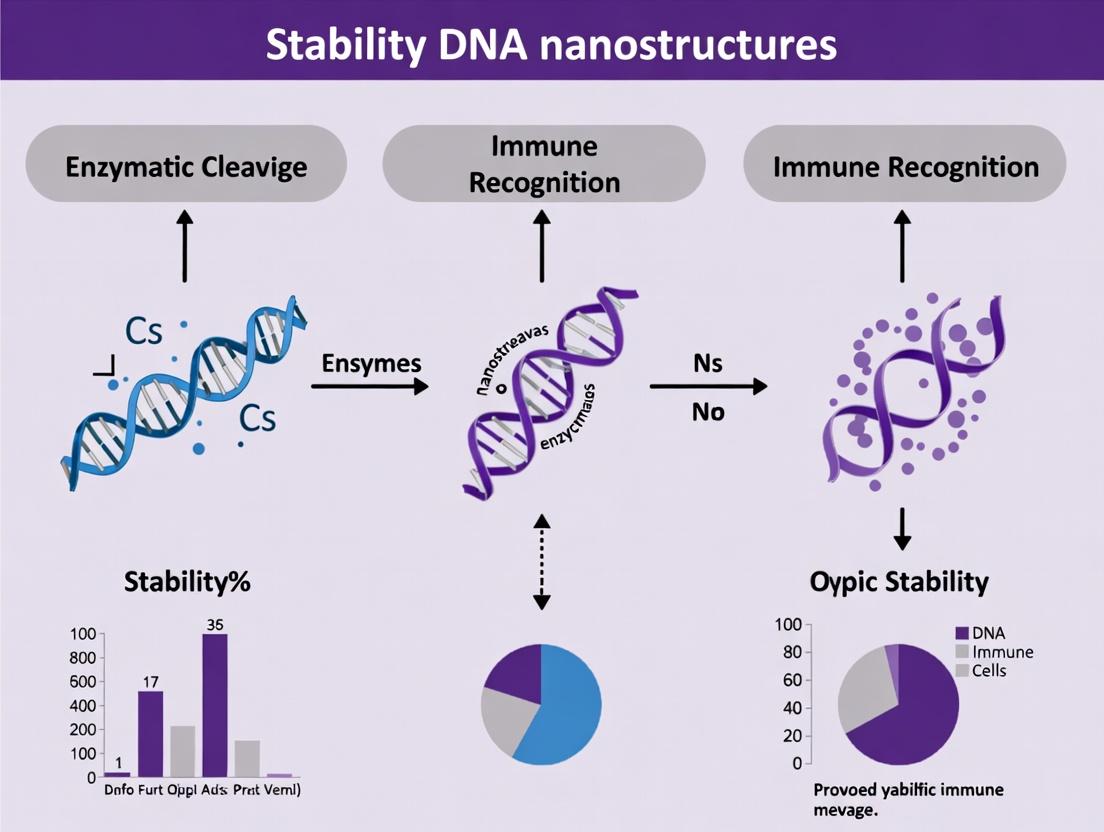
This article provides a comprehensive guide for researchers and drug development professionals on overcoming the two primary biological barriers limiting the clinical translation of DNA nanostructures: enzymatic degradation by nucleases...
DNA Nanostructures in Biomedicine: Engineering Stability and Immune Evasion for Next-Generation Therapeutics
Abstract
This article provides a comprehensive guide for researchers and drug development professionals on overcoming the two primary biological barriers limiting the clinical translation of DNA nanostructures: enzymatic degradation by nucleases and recognition by the immune system. We explore the fundamental mechanisms of these challenges, detail current chemical and design-based stabilization strategies, present methodologies for functionalization and in vivo application, and compare the efficacy of various approaches through in vitro and in vivo validation studies. Our synthesis offers a roadmap for developing robust, 'stealth' DNA nanodevices capable of reliable performance in complex biological environments.
The Biological Battlefield: Understanding Nuclease Attack and Immune Surveillance of DNA Nanostructures
Technical Support Center: Troubleshooting In Vivo DNA Nanostructure Instability
Context: This support center operates within the broader research thesis focused on Overcoming enzymatic cleavage and immune recognition of DNA nanostructures. The following guides address common experimental failures when unmodified structures are introduced into biological systems.
FAQ & Troubleshooting Guide
Q1: My DNA nanostructure (e.g., tetrahedron, origami) loses structural integrity rapidly after intravenous injection in mice. What is the primary cause? A: The most common cause is degradation by serum nucleases, particularly the 3'-exonuclease activity of DNase I. Unmodified phosphodiester backbone DNA is highly susceptible. Monitor degradation via gel electrophoresis shift or FRET signal loss from labeled structures.
Q2: I observe rapid clearance of my nanostructure from circulation and a spike in inflammatory cytokines (e.g., IFN-α, IL-6). What is happening? A: This indicates immune recognition via innate immune sensors. Unmodified CpG motifs in your nanostructure are likely being detected by Toll-like Receptor 9 (TLR9) within endosomes of immune cells like B cells and plasmacytoid dendritic cells (pDCs), triggering a pro-inflammatory response.
Q3: My nanostructure accumulates in the liver and spleen within minutes, not the target tissue. Is this an immune effect? A: Primarily, this is due to opsonization and sequestration by the mononuclear phagocyte system (MPS), formerly the reticuloendothelial system. Serum proteins adsorb to the nanostructure surface, marking it for clearance by Kupffer cells in the liver and macrophages in the spleen. Immune recognition can accelerate this.
Q4: How can I experimentally confirm nuclease degradation versus immune complex formation as the failure mode? A: Run the following parallel assays:
- Nuclease Assay: Incubate nanostructure with 10% fetal bovine serum (FBS) or mouse serum at 37°C. Sample at 0, 15, 30, 60, 120 mins. Analyze by agarose gel electrophoresis (SYBR Gold stain) for smearing or band loss.
- Immune Activation Assay: Apply nanostructure (10-100 nM) to cultured RAW 264.7 macrophages or primary pDCs. Measure TNF-α or IFN-α in supernatant via ELISA after 24h. Compare to a known TLR9 agonist (e.g., ODN 1826) as a positive control.
Q5: Are there specific sequence motifs I should avoid to prevent immune recognition? A: Yes. Vertebrate DNA has a low frequency of unmethylated cytosine-phosphate-guanine (CpG) dinucleotides. Unmethylated CpG motifs, especially in certain flanking sequences ("CpG ODN motifs"), are pathogen-associated molecular patterns (PAMPs). Avoid 5'-GTCGTT-3' or similar stimulatory sequences. Use in silico tools like CpG Finder to screen your scaffold and staple sequences.
Experimental Protocols
Protocol 1: Assessing Serum Nuclease Stability In Vitro
- Prepare Test Solution: Combine 90 µL of complete mouse or human serum (not heat-inactivated) with 10 µL of purified DNA nanostructure (final concentration ~50 nM in structure) in a sterile microtube.
- Incubate: Place tube in a 37°C water bath. Remove 10 µL aliquots at t = 0, 0.25, 0.5, 1, 2, 4, 8, and 24 hours.
- Stop Reaction: Immediately mix each aliquot with 2 µL of 0.5 M EDTA (pH 8.0) to chelate Mg²⁺ and halt nuclease activity. Keep on ice.
- Analyze: Load entire aliquot on a 2% agarose gel containing 0.5x SYBR Safe DNA Gel Stain. Run at 70 V for 90 minutes in 1x TBE buffer. Image using a gel documentation system. Compare band sharpness and position over time.
Protocol 2: Quantifying TLR9-Mediated Immune Cell Activation
- Cell Seeding: Seed HEK-Blue hTLR9 cells (InvivoGen) at 50,000 cells/well in a 96-well plate in 180 µL HEK-Blue Detection medium.
- Stimulus Application: Add 20 µL of test solutions: (a) Nuclease-free water (negative control), (b) 1 µM ODN 2006 (TLR9 agonist control), (c) Unmodified DNA nanostructure (10-500 nM final), (d) Chemically modified nanostructure (e.g., phosphorothioate-backbone or CpG-methylated).
- Incubation: Incubate plate at 37°C, 5% CO₂ for 20-24 hours.
- Quantification: Measure absorbance at 630 nm using a plate reader. Secreted embryonic alkaline phosphatase (SEAP) activity correlates with NF-κB/AP-1 activation downstream of TLR9.
Table 1: In Vivo Half-Life of Unmodified vs. Modified DNA Nanostructures
| Nanostructure Type | Backbone/Sequence Modification | Model (Route) | Circulation Half-life (t₁/₂) | Primary Clearance Organ | Key Reference Metrics |
|---|---|---|---|---|---|
| DNA Tetrahedron | Unmodified phosphodiester | Mouse (IV) | < 5 min | Liver, Spleen | >90% clearance in <30 min |
| DNA Origami Tube | Unmodified phosphodiester | Mouse (IV) | ~3-10 min | Liver | Liu et al., 2021 |
| DNA Tetrahedron | Phosphorothioate (PS) on all backbones | Mouse (IV) | ~20-45 min | Liver | ~80% retained at 30 min |
| DNA Cube | Select PS modifications at termini | Mouse (IV) | ~15-25 min | Liver, Spleen | Jiang et al., 2022 |
| DNA Origami | Polyethylene Glycol (PEG) Lipid Coating | Mouse (IV) | > 60 min | Reduced liver uptake | Perrault & Shih, 2014 |
Table 2: Immune Response Elicited by DNA Nanostructures
| Nanostructure | CpG Content | Modification | Cell Type Assayed | Cytokine Elevation (vs. Control) | Proposed Receptor |
|---|---|---|---|---|---|
| 60-helix bundle Origami | High (~70 motifs) | None | Primary pDCs | IFN-α: >1000 pg/mL | TLR9 |
| DNA Tetrahedron | Low (< 5 motifs) | None | RAW 264.7 Macrophages | TNF-α: Moderate (~200 pg/mL) | cGAS/STING? |
| Same Tetrahedron | Low | Backbone PS | RAW 264.7 Macrophages | TNF-α: < 50 pg/mL | Reduced non-specific binding |
| 24-helix bundle Origami | Medium | CpG Methylation | HEK-Blue hTLR9 | SEAP: Negligible | TLR9 engagement blocked |
Diagrams
Diagram 1: Major Pathways Leading to In Vivo Failure of Unmodified DNA Nanostructures
Title: Three Pathways Causing DNA Nanostructure Failure In Vivo
Diagram 2: Experimental Workflow for Stability & Immune Testing
Title: Workflow for Testing DNA Nanostructure Stability and Immunogenicity
The Scientist's Toolkit: Key Research Reagent Solutions
| Reagent/Material | Function & Rationale | Example Product/Catalog |
|---|---|---|
| Phosphorothioate (PS) Nucleotides | Replaces non-bridging oxygen with sulfur in DNA backbone, dramatically increasing resistance to nuclease degradation. Used for strategic modification of staple ends or entire strands. | Glen Research, "Phosphorothioate CE Phosphoramidites" |
| CpG Methyltransferase (M.SssI) | Enzyme that methylates cytosine residues in CpG motifs. Treatment of assembled nanostructures can prevent recognition by TLR9, dampening immune activation. | NEB M.SssI (M0226S) |
| HEK-Blue hTLR9 Cells | Reporter cell line stably expressing human TLR9 and an inducible SEAP reporter. Enables specific, quantitative measurement of TLR9 pathway activation. | InvivoGen, hkb-htlr9 |
| Polyethylene Glycol (PEG)-Lipid Conjugates | For post-assembly coating. PEG creates a steric barrier, reducing protein opsonization and MPS uptake, extending circulation time. | 1,2-dimyristoyl-sn-glycero-3-phosphoethanolamine-N-[methoxy(PEG)-2000] (DMPE-PEG2000) |
| SYBR Gold Nucleic Acid Gel Stain | High-sensitivity stain for visualizing low concentrations of DNA nanostructures in stability assay gels, especially after partial degradation. | Thermo Fisher Scientific, S11494 |
| DNase I, Recombinant, RNase-free | Positive control enzyme for in vitro degradation assays to confirm nanostructure susceptibility. | Roche, 4716728001 |
| TLR9 Agonist/Antagonist Controls | Essential controls for immune assays. Agonist (e.g., ODN 2006) validates assay; antagonist (e.g., ODN 2088) confirms TLR9-specificity. | InvivoGen, ODN 2006 (tlrl-2006) |
Troubleshooting Guide & FAQs
This technical support center addresses common experimental challenges when analyzing serum nuclease degradation of DNA nanostructures, within the thesis research context of Overcoming enzymatic cleavage and immune recognition of DNA nanostructures.
FAQ 1: My DNA nanostructure is degrading faster than expected in serum-containing media. How can I identify the primary nuclease responsible? Answer: Rapid degradation often points to cleavage by the major serum exonuclease, DNase I. To confirm, perform a comparative assay.
- Troubleshooting Steps:
- Control Experiment: Run parallel degradation assays using:
- Sample A: Full serum.
- Sample B: Serum pre-treated with a DNase I-specific inhibitor (e.g., G-actin or specific chelating agents).
- Sample C: Heat-inactivated serum (denatures all enzymes).
- Analysis: If degradation in Sample B resembles Sample C and is significantly slower than in Sample A, DNase I is the dominant factor. If degradation persists, other nucleases (e.g., DNase1L3, PDEs) are likely involved.
- Protocol - Differential Inhibition Assay:
- Incubate 50 µL of fetal bovine serum (FBS) with 10 µM G-actin (in 20 mM Tris-HCl, 2 mM CaCl2, pH 7.5) for 30 min at 4°C.
- Add 200 ng of your purified DNA nanostructure to the treated serum and to untreated control serum.
- Incubate at 37°C. Withdraw aliquots at 0, 5, 15, 30, 60, and 120 minutes.
- Stop reactions with 10 mM EDTA and immediately analyze by agarose gel electrophoresis (non-denaturing, 2-3%).
- Control Experiment: Run parallel degradation assays using:
FAQ 2: Gel analysis shows a "smear" of degradation products instead of distinct bands. What does this mean, and how can I get clearer cleavage pattern data? Answer: A continuous smear indicates non-specific or random cleavage events, often characteristic of exonuclease activity that nibbles from the ends. For clearer pattern analysis (endonuclease sites), consider:
- Troubleshooting Steps:
- Use Denaturing Gels: Analyze your products on a denaturing urea-PAGE gel. This separates single-stranded fragments by single-nucleotide resolution, revealing specific endonuclease cut sites as distinct bands.
- Label Strategically: Use 5' or 3' end-radiolabeled (²⁵P) or fluorescently-labeled nanostructures. This allows detection of specific cleavage fragments from the labeled end, simplifying the pattern.
- Protocol - Denaturing PAGE Analysis of Cleavage Fragments:
- After serum incubation and EDTA quenching, add formamide loading dye (95% formamide, 18 mM EDTA, 0.025% SDS, xylene cyanol, bromophenol blue).
- Heat samples to 95°C for 5 minutes to fully denature DNA.
- Load onto a pre-run 10-15% polyacrylamide gel containing 7-8 M urea in 1x TBE buffer.
- Run at constant power (50-60 W) until dyes migrate appropriately.
- Visualize using phosphorimaging (radioactive) or a fluorescence scanner.
FAQ 3: How do I quantitatively compare the serum resistance of different DNA nanostructure designs (e.g., origami vs. tetrahedra)? Answer: Quantify the half-life (t½) of the intact structure under standardized conditions.
- Troubleshooting Steps:
- Standardize Serum Source & Concentration: Use a single batch of serum (e.g., 10% FBS in PBS) across all experiments.
- Use a Quantitative Readout: Employ intercalating dyes (e.g., SYBR Gold) for gel-based quantification or use real-time fluorescence quenching assays (e.g., with molecular beacon-based designs).
- Calculate Decay Kinetics: Plot the percentage of intact structure versus time and fit the data to an exponential decay model to determine the degradation rate constant (k) and t½.
- Protocol - Gel-Based Half-Life Quantification:
- Perform time-course degradation as in FAQ 1.
- Run samples on an agarose gel stained with SYBR Gold.
- Image the gel with a calibrated fluorescence gel doc system.
- Quantify the band intensity for the intact structure in each lane using image analysis software (e.g., ImageJ).
- Normalize intensities to the t=0 minute control (100% intact).
- Plot
% Intactvs.Time. Fit the data to:% Intact = 100 * exp(-k*t). Calculatet½ = ln(2)/k.
FAQ 4: I suspect immune recognition (e.g., via TLR9) is interfering with my nuclease degradation readouts. How can I decouple these processes? Answer: This is a critical consideration for the overarching thesis. Use specific inhibitors and cell-free systems.
- Troubleshooting Steps:
- Use Purified Enzyme Systems: Supplement buffer with purified recombinant nucleases (DNase I, DNase1L3) instead of whole serum. This eliminates immune factors.
- Employ TLR9 Inhibitors: In cell-based assays, pre-treat immune cells (e.g., RAW-Blue TLR9 reporter cells) with inhibitory oligonucleotides (ODN TTAGGG or chloroquine) to block TLR9 signaling prior to adding DNA nanostructures.
- Monitor Separate Readouts: Run degradation (gel electrophoresis) and immune activation (e.g., ELISA for IFN-α or IL-6) assays in parallel from the same sample to correlate, not conflate, the data.
Table 1: Representative Half-Lives (t½) of DNA Nanostructures in 10% FBS at 37°C
| DNA Nanostructure Type | Approximate t½ (Range) | Key Degradation Determinant |
|---|---|---|
| Linear Double-Stranded DNA (1 kb) | 1 - 4 hours | Length, sequence (CpG content) |
| Simple DNA Tetrahedron | 15 - 45 minutes | Edge length, vertex protection |
| DNA Origami (Flat Sheet) | 4 - 12 hours | Lattice type (e.g., square vs. honeycomb), compactness |
| Cholesterol-Modified Origami | 24 - 48+ hours | Lipid membrane association, sequestration from serum |
Table 2: Major Human Serum Nucleases and Their Characteristics
| Nuclease | Primary Type | Divalent Cation Requirement | Primary Cleavage Pattern | Inhibitor/Quencher |
|---|---|---|---|---|
| DNase I | Endonuclease | Ca²⁺, Mg²⁺/Mn²⁺ | Preferentially cleaves single-stranded regions or distortions in dsDNA. Produces 5'-P fragments. | EDTA, EGTA, G-actin |
| DNase1L3 | Endonuclease | Ca²⁺, Mg²⁺ | Cleaves chromatin and oligonucleosomes; also attacks dsDNA. Immune-related. | EDTA, EGTA |
| Exonuclease I (sExoI) | 3'→5' Exonuclease | Mg²⁺ | Processively degrades single-stranded DNA from the 3' end. | EDTA |
| Phosphodiesterases (PDEs) | Exonuclease/Endonuclease | Mg²⁺ | Broad activity on oligonucleotides and cyclic nucleotides. | EDTA, specific PDE inhibitors |
Experimental Protocols
Protocol 1: Standard Serum Degradation Time-Course Assay Objective: To visualize the time-dependent degradation of a DNA nanostructure by serum nucleases.
- Preparation: Dilute purified DNA nanostructure in 1x PBS (pH 7.4) to a working concentration of 20 nM.
- Serum Activation: Pre-warm commercial fetal bovine serum (FBS) to 37°C in a heat block.
- Reaction Setup: In a PCR tube, mix:
- 5 µL DNA nanostructure (20 nM)
- 5 µL 10x Degradation Buffer (200 mM Tris-HCl, 100 mM MgCl2, 100 mM CaCl2, pH 7.6)
- 40 µL pre-warmed FBS
- Final: 50 µL total, 2 nM nanostructure in 80% FBS.
- Incubation: Place the tube in a 37°C thermal cycler or heat block. Start timer.
- Sampling: At each time point (e.g., 0, 0.5, 1, 2, 4, 8, 24 hours), withdraw a 6 µL aliquot and immediately mix it with 4 µL of Quench Solution (50 mM EDTA, 40% glycerol, 0.1% SDS). Keep samples on ice.
- Analysis: Load the entire 10 µL quenched sample onto a 1-2% agarose gel (pre-stained with SYBR Safe) in 0.5x TBE. Run at 80-100 V for 45-60 min. Image with a gel documentation system.
Protocol 2: Mapping Endonuclease Cut Sites via End-Labeling Objective: To identify precise cleavage locations on a DNA nanostructure.
- Labeling: 5'-end label a specific staple strand (for origami) or edge strand (for tetrahedron) using T4 Polynucleotide Kinase and [γ-³²P]ATP. Purify the labeled strand.
- Reconstitution: Assemble the DNA nanostructure using the labeled strand as part of the design.
- Degradation: Subject the labeled nanostructure to a brief serum degradation (e.g., 5-15 min in 10% FBS) to allow only 1-2 cleavage events per molecule. Quench with EDTA.
- Denaturation & Separation: Denature samples (heat with formamide) and run on a high-resolution denaturing urea-PAGE gel (10%).
- Detection: Expose the gel to a phosphorimager screen overnight. The resulting ladder of bands corresponds to fragments ending at each cleavage site from the labeled 5' end. Compare to a sequencing ladder of the same strand for base-pair resolution.
Visualizations
Title: Serum Nuclease Degradation Experiment Workflow
Title: Nuclease Cleavage Leads to Immune Recognition
The Scientist's Toolkit: Research Reagent Solutions
Table 3: Essential Reagents for Serum Nuclease Studies on DNA Nanostructures
| Reagent / Material | Function / Purpose | Example Product/Catalog |
|---|---|---|
| Fetal Bovine Serum (FBS), Heat-Inactivated | Control for non-enzymatic degradation; provides baseline for stability assays. | Gibco FBS, Heat-Inactivated |
| Recombinant Human DNase I | Purified enzyme for defined, serum-free degradation studies. | Worthington Biochemical, DNase I (RNase-free) |
| G-Actin (from Bovine Muscle) | Specific protein inhibitor of DNase I activity; used for nuclease identification. | Sigma-Aldrich, A3653 |
| 0.5M EDTA, pH 8.0 | Chelates Mg²⁺ and Ca²⁺ ions; instantly quenches all metallonuclease activity. | Invitrogen, AM9260G |
| SYBR Gold Nucleic Acid Gel Stain | Ultra-sensitive, high dynamic range dye for quantifying low-abundance nanostructures in gels. | Invitrogen, S11494 |
| Urea-PAGE System (Gel Mix, Buffer) | For high-resolution separation of single-stranded DNA cleavage fragments. | National Diagnostics, UreaGel System |
| [γ-³²P] ATP or 5'-Fluorophore Labels | For end-labeling strands to map cleavage sites with high sensitivity. | PerkinElmer, NEG035C / IDT, 5' Cy3 modifier |
| TLR9 Inhibitory ODN (TTAGGG) | Suppresses TLR9 signaling in immune cell assays, decoupling degradation from immune response. | InvivoGen, ODN TTAGGG (A151) |
| Size-Exclusion Spin Columns (e.g., Micro Bio-Spin) | Rapid purification of DNA nanostructures from excess staples and enzymes pre-/post-assembly. | Bio-Rad, 732-6221 |
Troubleshooting Guides & FAQs
Q1: Our DNA nanostructure shows unexpected immunogenicity in mouse models. Which innate immune sensor is most likely responsible, and how can we confirm it?
A1: cGAS is the primary candidate for double-stranded DNA (dsDNA) sensing in the cytosol, while TLR9 in endosomes senses CpG motifs in single-stranded DNA. To confirm involvement:
- For cGAS-STING: Use knockout (KO) cell lines (cGAS KO or STING KO) or inhibitor (e.g., RU.521 for cGAS, H-151 for STING). Measure IFN-β and ISG (e.g., MX1) mRNA via qPCR. If the response is ablated in KO models or with inhibitors, cGAS-STING is implicated.
- For TLR9: Use TLR9 KO cells or inhibitory CpG (ODN TTAGGG). Compare immune activation in wild-type vs. KO cells. TLR9 signaling is MyD88-dependent, so MyD88 inhibition can also point to TLR9.
- Key Experiment: Transfect your nanostructure into cytoplasm-sensing cells (e.g., THP-1, bone marrow-derived macrophages) vs. deliver it extracellularly to engage endosomal TLRs. Cytosolic delivery strongly points to cGAS.
Q2: We are trying to avoid TLR9 recognition by modifying CpG sequences in our DNA origami. However, we still see IRF3 activation. What could be the cause?
A2: Persistent IRF3 activation suggests cGAS-STING pathway engagement. Double-stranded DNA (dsDNA) regions in your origami, especially those >45 bp, are potent cGAS ligands. TLR9 signals primarily through NF-κB and IRF7 (in plasmacytoid dendritic cells), not directly via IRF3. Ensure your experimental readout distinguishes between pathways. Perform the confirmation experiments listed in Q1.
Q3: What are the critical controls for attributing immune activation specifically to the DNA nanostructure itself, not to contaminating bacterial DNA or RNA?
A3:
- Nuclease Treatments: Pre-treat the nanostructure preparation with:
- DNase I: Degrades unprotected DNA. A persistent response after DNase treatment suggests the structure is nuclease-resistant or contaminants are protected.
- Benzonase: Degrades all nucleic acids. Should ablate all immune activation.
- RNase A: If response remains after RNase, it rules out RNA contaminants.
- Lipofectamine Control: Include a "lipofectamine-only" control to rule out immune activation by the transfection reagent.
- Endotoxin Testing: Use the Limulus Amebocyte Lysate (LAL) assay to ensure LPS (TLR4 agonist) levels are negligible (<0.1 EU/mL).
Q4: During in vivo administration, how do we differentiate between immune responses initiated by cGAS-STING vs. TLR9?
A4: Utilize genetically modified mouse models and pathway-specific inhibitors.
- Mouse Models: Compare immune responses in C57BL/6 (WT), STINGgt/gt (Goldenticket), and TLR9-/- mice. Measure serum cytokines (IFN-β, IL-6, CXCL10) and splenic immune cell activation by flow cytometry.
- Inhibitor Studies: Administer nanostructures with or without pre-treatment of mice with STING inhibitor (C-176 or H-151) or TLR9 inhibitor (ODN TTAGGG or chloroquine).
- Cell-Type Specific Analysis: TLR9 is highly expressed in B cells and pDCs. cGAS-STING is ubiquitous. Profiling responding cells can indicate the primary pathway.
Q5: Our data on the immunogenicity of a specific DNA nanostructure conflict with a published study. What experimental variables most commonly explain such discrepancies?
A5:
| Variable | Potential Impact on Immune Readout |
|---|---|
| Nanostructure Assembly/Purification | Contaminating oligonucleotides, magnesium ions, or endotoxin levels vary greatly by method (e.g., PEG purification vs. spin filters). |
| Cell Type | THP-1 vs. primary macrophages vs. HEK293T-hSTING cells have vastly different sensor expression levels (e.g., TLR9, cGAS). |
| Transfection Method & Efficiency | Cytosolic delivery (Lipofectamine) engages cGAS; simple uptake engages endosomal TLRs. Efficiency alters dose. |
| Readout & Timing | Early (2-6h) IFN-β mRNA vs. late (24h) IFN-β protein. IRF3 phosphorylation vs. NF-κB luciferase reporter. |
| Species Difference | Human STING vs. mouse STING have different ligand affinities (e.g., for cyclic dinucleotides). |
Experimental Protocols
Protocol 1: Differentiating cGAS-STING vs. TLR9 Activation In Vitro Objective: To determine the primary innate immune pathway activated by a DNA nanostructure.
- Cell Seeding: Seed appropriate cells (e.g., wild-type, cGAS KO, STING KO, TLR9 KO THP-1-derived macrophages) in 24-well plates.
- Nanostructure Treatment:
- Condition A (Endosomal): Add nanostructure directly to culture medium (1-100 nM final concentration).
- Condition B (Cytosolic): Transfect nanostructure using a lipid-based agent (e.g., Lipofectamine 2000, 1:1 ratio v/w) according to manufacturer protocol.
- Control Treatments: Include PBS (negative), HSV-60 dsDNA (2μg/mL, cGAS-STING positive), and CpG-A ODN 2216 (1μM, TLR9 positive).
- Inhibition (Optional): Pre-treat cells for 1h with cGAS inhibitor RU.521 (5μM) or TLR9 inhibitor ODN TTAGGG (10μM).
- Incubation: Incubate for 6-8 hours at 37°C, 5% CO₂.
- Analysis: Harvest cells for RNA extraction. Perform qPCR for IFNB1, CXCL10, and TNF mRNA. Normalize to GAPDH or ACTB.
Protocol 2: Assessing In Vivo Immunogenicity of DNA Nanostructures Objective: To evaluate pathway-specific immune activation in a mouse model.
- Mouse Groups: Assign mice (n=5-8/group) to: Wild-type (C57BL/6), STINGgt/gt, TLR9-/-.
- Nanostructure Formulation: Formulate nanostructure in sterile, endotoxin-free PBS. Verify concentration (A260) and purity.
- Administration: Inject 100μL intravenously (for systemic delivery) or subcutaneously (for local response). Dose range: 1-5 mg/kg.
- Sample Collection: At 4-6h (for mRNA) and 24h (for protein), collect blood via retro-orbital bleed. Centrifuge to obtain serum. For tissue analysis, harvest spleen or lymph nodes.
- Analysis:
- Serum: Quantify IFN-β, CXCL10, IL-6 by ELISA.
- Tissue: Homogenize spleen, isolate RNA for qPCR (as in Protocol 1), or prepare single-cell suspensions for flow cytometry (staining for CD86, MHC-II on antigen-presenting cells).
Signaling Pathway Diagrams
The Scientist's Toolkit: Research Reagent Solutions
| Reagent / Material | Function & Application in DNA Nanostructure Immunology |
|---|---|
| Lipofectamine 2000/3000 | Lipid-based transfection reagent for reliable cytosolic delivery of DNA nanostructures to engage the cGAS-STING pathway in vitro. |
| DNase I (RNase-free) | Enzyme to digest unpackaged or contaminating linear DNA. Used as a control to test if immune activation is due to the intact nanostructure. |
| Benzonase Nuclease | Broad-spectrum nuclease that degrades all forms of DNA and RNA. Critical control to confirm nucleic acid-mediated immunogenicity. |
| cGAS Inhibitor (RU.521) | Potent and selective small-molecule inhibitor of cGAS. Used to pharmacologically confirm cGAS-dependent immune responses. |
| STING Inhibitor (H-151/C-176) | Covalent small-molecule antagonists of STING. H-151 is for in vitro use; C-176 is for in vivo (mouse) studies. |
| TLR9 Inhibitor (ODN TTAGGG) | Suppressive oligonucleotide that competitively inhibits TLR9 binding and signaling. Used as a negative control. |
| STINGgt/gt Mice | Goldenticket mice with a loss-of-function mutation in the Tmem173 gene (STING). Essential in vivo model to rule out STING-dependent responses. |
| TLR9-/- Mice | Genetically engineered mice lacking functional TLR9. Used to differentiate TLR9-mediated effects from other DNA sensors. |
| Phospho-IRF3 (Ser396) Antibody | For detection of IRF3 phosphorylation (a key step in STING pathway activation) via western blot or flow cytometry. |
| Human/Mouse IFN-β ELISA Kit | Quantitative assay to measure the primary cytokine output of the cGAS-STING pathway in cell supernatant or serum. |
Troubleshooting Guides & FAQs
Q1: In a serum stability assay, my DNA nanostructure's degradation half-life (t₁/₂) is significantly lower than literature values. What are the primary causes? A: This typically indicates susceptibility to enzymatic cleavage. Key troubleshooting steps:
- Verify Nuclease Contamination: Ensure all buffers and equipment are nuclease-free. Include a control sample with a known stable structure.
- Analyze Edge Integrity: Imperfect blunt ends or single-stranded overhangs are major degradation initiation points. Re-analyze design for seam integrity.
- Check Serum Batch: Fetal Bovine Serum (FBS) nuclease activity can vary between batches. Pre-heat serum to 56°C for 30 minutes to inactivate complement, but note this does not affect all nucleases. Consider using characterized human serum.
Q2: My quantification of immune activation via cytokine ELISA shows high variability between replicates. How can I improve assay precision? A: High variability in immune cell assays often stems from cell state or nanostructure handling.
- Cell State Consistency: Use freshly isolated PBMCs from the same donor for a full experiment, or use carefully quality-controlled, thawed aliquots of cell lines like THP-1 or HEK-Blue hTLR reporters.
- Nanostructure Aggregation: Filter nanostructures through a 100-200 nm syringe filter post-purification and immediately before cell addition to ensure monodispersion.
- Internal Controls: Always include a positive control (e.g., LPS for TLR4, CpG ODN for TLR9) and a negative control (vehicle buffer) on every plate.
Q3: What is the best method to distinguish between TLR9-dependent and independent immune activation by DNA nanostructures? A: A combination of pharmacological and genetic tools is required.
- Use TLR9 Inhibitors: Treat cells with a specific oligonucleotide-based TLR9 inhibitor (e.g., ODN TTAGGG) prior to stimulation. Compare to untreated cells.
- Employ Genetic Models: Use HEK293 cells transfected with human TLR9 versus empty vector. A response only in TLR9+ cells confirms dependence.
- Utilize Knockout Cells: If available, use primary cells from Th9 knockout mice or CRISPR-modified cell lines.
Data Presentation
Table 1: Common Modifications to Improve DNA Nanostructure Stability & Reduce Immune Activation
| Modification | Target Metric | Typical Effect on Degradation t₁/₂ | Typical Effect on Immune Activation (Cytokine Readout) | Key Consideration |
|---|---|---|---|---|
| Phosphorothioate Backbone | Enzymatic Cleavage | Increase from minutes to >24 hours | Can increase TLR9 activation if applied globally. | Use sparingly at vulnerable termini (e.g., seam ends). |
| 2'-O-Methyl RNA Bases | Enzymatic Cleavage | Moderate increase (2-10 fold) | Can decrease RIG-I/MDA5 activation. | Can affect hybridization thermodynamics. |
| Hexaethylene Glycol (Sp18) Spacers | Seam Integrity | Increases t₁/₂ in serum by ~5-15 fold | Generally inert; can reduce non-specific aggregation. | Useful for bridging scaffold strand junctions. |
| Cholesterol Conjugation | Serum Stability via Albumin Binding | Large increase (to >12 hours) | May alter cellular uptake pathways. | Can lead to aggregation; requires careful purification. |
| Polyethylene Glycol (PEG) Coating | Immune Recognition & Opsonization | Moderate increase | Significantly decreases IFN-α, TNF-α production. | PEG length (2k-5k Da) and density are critical. |
Table 2: Common Assays for Quantifying Key Metrics
| Assay Name | Metric Quantified | Typical Output | Protocol Duration | Key Instrument |
|---|---|---|---|---|
| Fluorescence Quenching Assay | Degradation Half-Life (t₁/₂) | Real-time decay curve; t₁/₂ in minutes/hours. | 1-24 hours | Fluorescence Plate Reader |
| Agarose Gel Electrophoresis (SYBR Gold) | Structural Integrity | Discrete bands vs. smear; qualitative. | 2-3 hours | Gel Imager with UV/Blue Light |
| ELISA (e.g., IFN-α, TNF-α, IL-6) | Immune Activation | Cytokine concentration (pg/mL). | 1 day | Microplate Reader (450nm) |
| HEK-Blue TLR Reporter Assay | Specific TLR Activation | SEAP activity (OD 620-655nm). | 6-24 hours | Microplate Reader |
| Dynamic Light Scattering (DLS) | Hydrodynamic Size & Aggregation | Size distribution (nm), PDI. | 15 minutes | DLS/Zetasizer |
Experimental Protocols
Protocol 1: Fluorescence-Based Serum Degradation Half-Life Assay Purpose: Quantify the kinetic stability of a fluorescently labeled DNA nanostructure in biological media.
- Labeling: Incorporate a fluorophore (e.g., Cy3) and a quencher (e.g., Iowa Black RQ-SP) on opposite strands at a critical seam.
- Preparation: Dilute nanostructure in 1x PBS to 50 nM. Pre-warm 10% FBS (heat-inactivated or not) in assay buffer at 37°C.
- Reaction: Mix equal volumes of nanostructure and serum solution in a 96-well plate to start reaction (final: 25 nM nanostructure, 5% serum).
- Data Acquisition: Immediately place plate in pre-warmed (37°C) fluorescence plate reader. Measure fluorophore signal (e.g., Cy3: Ex/Em ~550/570nm) every 1-2 minutes for 6-24 hours.
- Analysis: Normalize fluorescence to initial (t=0) value. Fit the increasing signal (due to dequenching upon cleavage) to a first-order exponential rise equation to calculate the observed rate constant (kobs). Compute t₁/₂ = ln(2) / kobs.
Protocol 2: TLR9-Specific Immune Activation Assay Using Reporter Cells Purpose: Specifically quantify TLR9 pathway activation by a DNA nanostructure.
- Cell Preparation: Culture HEK-Blue hTLR9 cells in recommended growth medium. Seed cells at 50,000 cells/well in a 96-well plate.
- Stimulation: After 24 hours, replace medium with fresh medium. Add DNA nanostructures (over a dose range, e.g., 1-100 nM), positive control (CpG ODN 2006, 1 µM), and negative control (vehicle).
- Incubation: Incubate cells for 20-24 hours at 37°C, 5% CO₂.
- Detection: Transfer 20 µL of supernatant to a new plate with 180 µL QUANTI-Blue detection reagent. Incubate at 37°C for 1-3 hours.
- Measurement: Read optical density at 620-655 nm. Data is reported as OD or mU/mL of SEAP.
Visualizations
The Scientist's Toolkit: Research Reagent Solutions
| Item | Function in Research | Example Product/Catalog # |
|---|---|---|
| Nuclease-Free Water/Buffers | Solvent for all assembly and dilution steps to prevent non-specific degradation. | ThermoFisher AM9937 (UltraPure DNase/RNase-Free Water) |
| Fetal Bovine Serum (FBS) | Model biological medium for stability assays; source of nucleases and opsonins. | Characterized, heat-inactivated variants preferred (e.g., Gibco 10082) |
| HEK-Blue hTLR9 Cells | Reporter cell line for specific, quantitative measurement of TLR9 pathway activation. | InvivoGen hkb-htlr9 |
| Specific TLR9 Inhibitor | Pharmacological tool to confirm TLR9-dependent signaling. | InvivoGen ODN TTAGGG (A151) |
| Phosphorothioate-Modified Oligos | Backbone modification to resist nuclease cleavage at critical vulnerable sites. | IDT, "PS" modification |
| SYBR Gold Nucleic Acid Gel Stain | High-sensitivity dye for visualizing intact vs. degraded nanostructures on gels. | ThermoFisher S11494 |
| Size-Exclusion Columns | Critical for removing enzyme inhibitors (e.g., EDTA), excess salts, and aggregates post-modification. | Illustra MicroSpin G-50 Columns |
| Polyethylene Glycol (PEG) | Surface coating agent to reduce immune recognition and improve pharmacokinetics. | Broad range (e.g., 2k-5k Da, NHS-ester for conjugation) |
Technical Support Center: Troubleshooting Stability in Nucleic Acid Nanostructures
Context: This support center is designed to assist researchers working on Overcoming enzymatic cleavage and immune recognition of DNA nanostructures, with a comparative focus on the intrinsic stability profiles of DNA and RNA origami.
Frequently Asked Questions (FAQs)
Q1: Why is my DNA origami structure degrading rapidly in cell culture medium, while my RNA origami seems more stable? A: This counter-intuitive observation is likely due to nuclease content. Cell culture media (e.g., DMEM with 10% FBS) contains high levels of DNAse activity. RNAse activity is often more controlled or inhibited. RNA origami, especially when constructed using 2'-F modified pyrimidines, exhibits strong resistance to serum nucleases.
- Troubleshooting Protocol:
- Analyze Medium: Run a gel assay to confirm nuclease activity in your medium batch.
- Add Inhibitors: For DNA origami, supplement medium with 5-10 mM EDTA or specific DNAse inhibitors (commercial cocktails).
- Modify Structures: Consider incorporating protective oligonucleotide "skirts" or cholesterol modifications to shield DNA origami.
Q2: I am observing unexpected immune activation with my DNA origami in murine models. Which structural feature is most likely responsible? A: Unmethylated CpG motifs present in your staple strands (especially those with a 5'-GACGTT-3' sequence) are recognized by Toll-like Receptor 9 (TLR9) in endosomes, triggering a pro-inflammatory immune response. RNA origami can activate TLR7/8 if containing GU-rich sequences.
- Troubleshooting Protocol:
- In Silico Design: Use design software (caDNAno, magicDNA) to scan all staple sequences for canonical CpG motifs.
- Sequence Substitution: Replace cytosines with 5-methylcytosines in staple strands to suppress TLR9 recognition.
- Validation Assay: Use a reporter cell line (HEK-Blue hTLR9) to test modified designs before in vivo use.
Q3: What are the critical buffer conditions to prevent denaturation of RNA origami during purification? A: RNA is highly susceptible to hydrolysis at elevated pH and temperature. Stability requires stringent buffer control.
- Troubleshooting Protocol:
- Buffer Recipe: Always use RNAse-free buffers. Standard folding buffer: 1x TAE/Mg²⁺ (40 mM Tris, 20 mM Acetic acid, 2 mM EDTA, 12.5 mM MgCl₂, pH ~7.8-8.0 adjusted with HCl).
- Magnesium: Maintain Mg²⁺ concentration ≥10 mM during thermal annealing and subsequent purification (e.g., PEG precipitation, agarose gel extraction).
- Temperature: Keep samples on ice when not annealing. Use a thermal cycler for precise ramp-down control.
Q4: How do I quantitatively compare the enzymatic stability of DNA vs. RNA origami? A: Use a fluorescence-based degradation assay with intercalating dyes and track signal loss over time under defined nuclease challenges.
Table 1: Comparative Stability Metrics for DNA vs. RNA Origami
| Parameter | DNA Origami (Standard) | RNA Origami (2'-F Modified) | Measurement Assay |
|---|---|---|---|
| Serum Half-life (10% FBS) | 4 - 24 hours | 12 - 72 hours | Gel electrophoresis + SYBR Gold stain |
| DNase I Degradation Rate | Complete in < 5 min | Resistant (structure-dependent) | Fluorescence quenching assay |
| RNase A Degradation Rate | Resistant | Complete in < 2 min (unmodified) | FRET-based cleavage assay |
| Optimal pH Stability Range | 6.5 - 8.5 | 6.0 - 7.5 | Dynamic Light Scattering (DLS) |
| Melting Temperature (Tm) | ~55 - 65°C | ~50 - 60°C (can be higher with modifications) | UV-Vis spectroscopy (260 nm) |
Experimental Protocols
Protocol 1: Serum Stability Half-life Assay Objective: Determine the degradation kinetics of nucleic acid origami in biological fluids.
- Incubation: Mix 50 nM purified origami with 90% pre-warmed cell culture medium (e.g., DMEM + 10% FBS). Aliquot into PCR tubes.
- Time Course: Place tubes in a 37°C thermal cycler. Remove aliquots at defined time points (e.g., 0, 1, 2, 4, 8, 24, 48 h) and immediately freeze on dry ice.
- Analysis: Thaw samples and run on a 2% agarose gel in 1x TAE/Mg²⁺ buffer at 4°C. Stain with SYBR Gold, image, and quantify intact band intensity.
- Calculation: Plot ln(Intensity) vs. time. The slope equals -k (degradation rate constant). Half-life = ln(2)/k.
Protocol 2: TLR9 Activation Profiling for DNA Origami Objective: Quantify innate immune activation potential of a designed nanostructure.
- Cell Culture: Seed HEK-Blue hTLR9 cells in a 96-well plate.
- Stimulation: Add serial dilutions of DNA origami (0.1-100 nM), positive control (CpG ODN 2006), and negative control (scrambled sequence).
- Incubation: Incubate for 20-24 hours at 37°C, 5% CO₂.
- Detection: Transfer 20 µL of supernatant to a new plate with 180 µL QUANTI-Blue substrate. Incubate 1-2 hours.
- Readout: Measure absorbance at 620-655 nm. EC₅₀ values indicate immunostimulatory potency.
Diagrams
Diagram 1: Stability Challenge Pathways for Nucleic Acid Nanostructures
Diagram 2: Comparative Stability Assay Workflow
The Scientist's Toolkit: Research Reagent Solutions
Table 2: Essential Reagents for Stability Studies
| Reagent / Material | Function / Role | Example & Notes |
|---|---|---|
| 2'-F-CTP/UTP (NTPs) | Provides nuclease resistance for RNA origami transcripts during in vitro transcription. | Trilink Biotechnologies; Critical for enhancing RNA serum half-life. |
| 5-Methyl-dCTP | Substitutes for dCTP in staple strand synthesis to methylate CpG motifs, reducing TLR9 activation. | Jena Biosciences; Use in PCR amplification of staple strands. |
| SYBR Gold Nucleic Acid Gel Stain | High-sensitivity dye for visualizing intact vs. degraded nanostructures on gels. | Thermo Fisher Scientific; 10-50x more sensitive than ethidium bromide. |
| HEK-Blue Detection Cells | Reporter cell lines for specific TLR (e.g., TLR9) activation profiling. | InvivoGen; Secreted embryonic alkaline phosphatase (SEAP) readout. |
| PEG Precipitation Kit | Purifies and concentrates origami structures from folding mixtures; critical for removing enzymes. | Norgen Biotek Corp or homemade (8-15% PEG8000, 500 mM NaCl). |
| RNase Inhibitor, Murine | Protects RNA during handling and folding. | New England Biolabs; Essential for preventing RNase contamination. |
| Mono-phthalocyanine Dyes (e.g., Cy3/Cy5) | For FRET-pair labeling to monitor real-time structural disintegration. | Lumiprobe; Attach to specific staple strands for cleavage detection. |
Building Armored Carriers: Chemical Modifications and Design Strategies for Enhanced Stability
Technical Support Center
Troubleshooting Guides & FAQs
Q1: My phosphorothioate (PS)-modified oligonucleotide shows reduced yield after synthesis. What could be the cause? A: Reduced yield in PS synthesis is commonly due to suboptimal oxidation conditions. The standard iodine oxidation for phosphate must be replaced with a sulfurization step using reagents like Beaucage’s reagent or DDTT. Ensure the sulfurization reagent is fresh and the reaction time is extended (recommended 5-10 minutes). Contamination with water can also quench the sulfurization reaction; ensure anhydrous conditions for the amidite and acetonitrile.
Q2: I am observing unexpected immune activation (e.g., IFN-α secretion) in cell culture with my 2'OMe-modified DNA nanostructure, which should be stealthy. What should I check? A: Even with 2'OMe modifications, immune recognition can occur if the modification density is insufficient. Aim for a minimum of 70-80% modification coverage per strand. Check for:
- Purity: HPLC-purify oligonucleotides to remove immune-stimulatory failure sequences.
- Sequence Context: CpG motifs, even when 2'OMe-modified, may retain some activity. Use an online CpG motif scanner to identify and redesign if necessary.
- Contamination: Test for LPS contamination using an endotoxin assay.
Q3: My LNA-containing oligo exhibits poor solubility or aggregation. How can I resolve this? A: High LNA content (>25-30%) can increase melting temperature (Tm) and promote self-aggregation. Solutions:
- Redesign: Space out LNA modifications with DNA or 2'OMe nucleotides.
- Hybrid Modifications: Use a blend of LNA and 2'OMe to balance stability and solubility.
- Buffer: Resuspend in TE buffer (pH 8.0) with mild heating (65°C for 5 mins) and vortex thoroughly.
Q4: During PCR amplification of a backbone-armored template, I get no product. How do I troubleshoot this? A: Polymerases have varying tolerance for modified backbones. Recommended protocol:
- Enzyme Selection: Use a high-fidelity, modified-nucleotide-tolerant polymerase (e.g., KAPA HiFi HotStart or Q5 Hot Start).
- PCR Cycling: Increase extension time (30-50 sec/kb) and annealing temperature (calculate Tm for modified sequence). Add a 2-5 minute initial denaturation at 98°C.
- Additives: Include 1M Betaine or 3-5% DMSO to reduce secondary structure.
Q5: How do I quantify the nuclease resistance improvement provided by these modifications? A: Use a standardized serum stability assay. Protocol:
- Dilute fluorescently-labeled (e.g., FAM) oligonucleotide (2 µM) in 80% FBS / 20% PBS.
- Incubate at 37°C.
- Aliquot 10 µL at time points (0, 5, 15, 30, 60, 120, 240, 360 mins).
- Quench with 8M Urea / 50 mM EDTA solution on ice.
- Run samples on a 20% denaturing PAGE gel.
- Quantify intact band intensity vs. time using imaging software (e.g., ImageJ).
Table 1: Comparison of Backbone Armoring Modifications
| Property | Phosphorothioate (PS) | 2'-O-Methyl (2'OMe) | Locked Nucleic Acid (LNA) |
|---|---|---|---|
| Primary Function | Nuclease resistance, protein binding | Nuclease resistance, reduced immune recognition | Extreme duplex stability, nuclease resistance |
| Typical Incorporation | Full or partial backbone substitution | Ribose sugar modification | Bicyclic ribose sugar modification |
| Key Advantage | Cost-effective, well-established for ASOs | Good balance of stability and biocompatibility | Highest affinity increase (ΔTm +2 to +8°C per mod) |
| Key Challenge | Potential non-specific protein binding, toxicity at high doses | Requires high density for full stealth effect | Can over-stabilize, causing aggregation or synthesis issues |
| Impact on Tm | Slight decrease (~ -0.5°C per substitution) | Moderate increase (~ +0.5 to +1.5°C per substitution) | Large increase (+2 to +8°C per substitution) |
| Relative Cost | $ | $$ | $$$ |
| Immune Evasion | Low (can be immunostimulatory) | High (when densely modified) | Moderate (can alter immune profile) |
Table 2: Serum Half-Life (T½) of Modified Oligonucleotides (20-mer, 80% FBS, 37°C)
| Modification Type | Modification Density | Average Half-Life (T½) |
|---|---|---|
| Unmodified DNA | 0% | < 5 minutes |
| Full PS Backbone (P=S) | 100% of linkages | 24 - 48 hours |
| 2'OMe (Alternating) | ~50% of sugars | 6 - 12 hours |
| 2'OMe (Full) | 100% of sugars | > 48 hours |
| LNA (Every 3rd base) | ~33% of sugars | 8 - 16 hours |
| LNA/2'OMe Mix | 50% total | > 48 hours |
The Scientist's Toolkit: Research Reagent Solutions
| Item | Function & Rationale |
|---|---|
| DDTT (3-((Dimethylamino-methylidene)amino)-3H-1,2,4-dithiazole-3-thione) | Superior sulfurizing reagent for PS synthesis; faster and more efficient than Beaucage's reagent, leading to higher yields and purity. |
| KAPA HiFi HotStart DNA Polymerase | Engineered polymerase with high processivity and tolerance for modified nucleotides, essential for PCR amplification of armored templates. |
| HPLC Grade Water & Acetonitrile (anhydrous) | Critical for oligonucleotide synthesis and dissolution; water content >200 ppm can drastically reduce coupling efficiency for PS and LNA. |
| Betaine (5M Solution) | PCR additive that equalizes DNA melting temperatures, crucial for amplifying GC-rich or LNA-stabilized sequences by preventing secondary structure. |
| Recombinant Human Toll-like Receptor 9 (TLR9) Reporter Cell Line | For screening immune recognition of modified nanostructures; quantifies CpG motif-induced signaling even after chemical modification. |
| Snake Venom Phosphodiesterase I (SVP) & Calf Spleen Phosphodiesterase II | Enzymes used in tandem for controlled, stepwise digestion studies to map nuclease cleavage sites on modified backbones. |
Experimental Protocols
Protocol 1: Assessing Nuclease Resistance via Gel Electrophoresis
- Labeling: Use 5'-FAM-labeled oligonucleotide (2 nmol).
- Reaction Setup: Combine 5 µL oligo (2 µM), 14 µL 1X PBS, and 1 µL Benzonase Nuclease (25 U/µL) or Fetal Bovine Serum.
- Incubation: 37°C. Remove 4 µL aliquots at t=0, 1, 2, 5, 10, 30, 60 min.
- Quenching: Immediately mix aliquot with 8 µL Loading Dye (95% formamide, 50 mM EDTA, 0.02% bromophenol blue). Heat at 95°C for 5 min, then place on ice.
- Analysis: Load on 20% denaturing PAGE (7M Urea). Run at 15-20 V/cm for 60-90 min. Image with a fluorescence gel scanner.
- Quantification: Plot log(% intact) vs. time. Half-life (T½) = -ln(2)/slope.
Protocol 2: Immune Activation Profiling using THP1-Dual KO-TLR9 Cells
- Cell Seeding: Plate THP1-Dual cells at 5x10^4 cells/well in a 96-well plate.
- Stimulation: Add modified DNA nanostructure (0.1-10 µM final concentration). Include controls: LPS (TLR4 agonist), CpG ODN 2006 (TLR9 agonist), unmodified DNA.
- Incubation: Incubate for 20-24 hours at 37°C, 5% CO2.
- Detection: Transfer 20 µL supernatant to a new plate. Add 180 µL QUANTI-Luc solution. Measure luminescence immediately (SEAP reporter for NF-κB/IRF activation).
- Data Analysis: Normalize luminescence to positive control (CpG ODN). A >2-fold increase over unmodified DNA indicates significant immune recognition.
Visualizations
Diagram 1: Backbone Armoring Overcomes Cleavage and Immune Recognition
Diagram 2: Workflow for Testing Armored DNA Nanostructures
Troubleshooting Guide & FAQs
Q1: My PEGylated DNA origami still shows significant degradation in serum after 24 hours. What could be going wrong? A: This is often due to insufficient PEG surface density or suboptimal PEG chain length. The shielding efficiency is highly dependent on achieving a dense "brush" conformation.
- Check: Measure the grafting density of your PEG chains. A density of ≥ 0.5 PEG chains per 100 nm² is often required for effective shielding. Use the table below for reference.
- Troubleshoot: Increase the molar ratio of reactive PEG (e.g., NHS-PEG-Maleimide) to available amine groups on your nanostructure during conjugation. Consider switching from a 5kDa PEG to a 10kDa or 20kDa PEG for improved steric hindrance.
Q2: My cholesterol-conjugated nanostructures are aggregating upon addition to cell media. How can I prevent this? A: Cholesterol modifications are inherently hydrophobic and can cause aggregation in aqueous environments, especially at high modification densities or in the presence of serum proteins.
- Check: Verify the number of cholesterol moieties per nanostructure. >20 modifications per 100nm² often leads to instability.
- Troubleshoot: (1) Reduce the degree of cholesterol conjugation. (2) Introduce a hydrophilic spacer (like a short PEG tether) between the cholesterol and the nanostructure. (3) Use a step-wise dilution protocol when adding to media: first dilute in a low-salt buffer, then slowly introduce the diluted sample into the full serum-containing media while vortexing gently.
Q3: How do I choose between PEG, cholesterol, and polymer coatings for in vivo applications targeting the liver vs. systemic circulation? A: The choice is dictated by the intended biodistribution and the trade-off between stability and cellular interaction.
- Liver Targeting (Kupffer cells/hepatocytes): Cholesterol or lipid conjugates promote rapid opsonization and liver clearance. For active hepatocyte targeting, use cholesterol with a targeting ligand (e.g., galactose).
- Systemic Circulation & Reduced Immune Clearance: Dense PEGylation or stealth polymer coatings (e.g., poly(ethylene glycol)-block-poly(lactic acid) copolymers) are superior. They minimize protein corona formation and extend circulation half-life. Refer to the data table.
Q4: My polymer-coated nanostructure loses its functional activity (e.g., ligand binding). How can I maintain functionality after coating? A: Polymer coatings can sterically block access to functional groups.
- Check: Characterize ligand accessibility post-coating using a simple binding assay (e.g., with a fluorescently tagged receptor).
- Troubleshoot: Employ a "click chemistry" approach. First, conjugate the functional ligand to your nanostructure using a bioorthogonal reaction (e.g., DBCO-Azide). Then, perform the polymer coating. The polymer will shield the structure but the pre-attached ligand, if placed at a strategic, exposed location, may remain accessible.
Table 1: Comparison of Surface Shielding Strategies for DNA Nanostructures
| Shielding Strategy | Typical Size Increase (nm) | Serum Half-Life (in vivo) | Key Advantage | Primary Limitation | Optimal Grafting Density |
|---|---|---|---|---|---|
| Linear PEG (5 kDa) | +10-15 | ~30 min - 2 hr | Well-established, reduces protein adsorption | Can trigger anti-PEG antibodies, polydisperse | 1 chain / 60-100 nm² |
| Branched PEG (20 kDa) | +20-30 | ~4 - 8 hr | Enhanced steric shielding, longer half-life | More complex synthesis, higher cost | 1 chain / 150-200 nm² |
| Cholesterol Conjugation | +2-5 (per tag) | <10 min (liver uptake) | Enables membrane integration, simple | Causes aggregation, rapid clearance | 5-15 tags / structure |
| Poly(Lysine)-g-PEG Copolymer | +20-50 | ~12 - 24 hr | Very high stability, tunable charge | Can be difficult to characterize uniformly | N/A (forms encapsulating layer) |
| Poly(HPMA) Coating | +15-25 | ~6 - 15 hr | Biocompatible, non-immunogenic | Requires polymerization expertise | N/A (forms encapsulating layer) |
Table 2: Troubleshooting Common Experimental Outcomes
| Observed Problem | Most Likely Causes | Verification Experiment | Suggested Fix |
|---|---|---|---|
| Low Conjugation Efficiency | Incorrect pH for reaction, inactive PEG reagent, insufficient reaction time. | Perform TNBSA assay for remaining amines post-PEGylation. | Use pH 8.5 buffer (for NHS esters), use fresh PEG aliquots, increase time to 4h at 4°C. |
| High Polydispersity (DLS) | Aggregation, incomplete purification, heterogeneous coating. | Run agarose gel electrophoresis to see smear. | Add 0.01% Tween-20 during reaction, optimize size-exclusion chromatography (SEC) purification. |
| Loss of Structural Integrity (AFM/TEM) | Harsh reaction conditions, mechanical shear during processing. | Image unmodified nanostructure as a control. | Use gentler mixing (no vortexing), conduct reactions at 4°C instead of 25°C. |
| Unexpected Immune Cell Uptake | Incomplete shielding, charge-mediated interactions. | Measure zeta potential (aim for near-neutral). | Increase PEG density, switch to a zwitterionic polymer coating. |
Detailed Experimental Protocols
Protocol 1: High-Density PEGylation of DNA Origami via Amine-NHS Chemistry Objective: Covalently attach linear mPEG-NHS (5kDa) to amine-modified staple strands on a DNA origami structure. Reagents: Amine-modified DNA origami (purified), mPEG-NHS (5kDa), 1M Sodium Bicarbonate Buffer (pH 8.5), 10X Tris-Borate-EDTA (TBE) Buffer, 5M NaCl, MgCl₂, Amicon Ultra centrifugal filters (100kDa MWCO). Procedure:
- Prepare Reaction Mixture: In a 1.5mL LoBind tube, combine:
- 100 μL of amine-modified DNA origami (10nM in folding buffer with 10mM MgCl₂).
- 10 μL of 1M Sodium Bicarbonate Buffer (pH 8.5).
- Add mPEG-NHS to a 500:1 molar excess over estimated amine groups. (Calculate based on # of modified staples. Typically 10-30 amines/origami).
- React: Incubate the mixture in the dark with gentle end-over-end mixing for 4 hours at 4°C.
- Purify: Dilute the reaction mixture to 500μL with 1X TBE + 10mM MgCl₂. Concentrate and wash using a 100kDa MWCO centrifugal filter. Perform 5 wash cycles with 500μL of storage buffer (1X TBE, 10mM MgCl₂, 0.01% Tween-20).
- Characterize: Analyze by 1% agarose gel electrophoresis (70V, 2h, 4°C) with SybrSafe stain to confirm mobility shift. Measure hydrodynamic diameter via DLS.
Protocol 2: Post-Insertion of Cholesterol-Modified Oligonucleotides into DNA Nanostructures Objective: Incorporate cholesterol-TEG-modified DNA strands into pre-formed nanostructures via hybridization for membrane anchoring studies. Reagents: Purified DNA nanostructure (e.g., origami tile), cholesterol-TEG-modified oligonucleotide (complementary to a docking site), Phosphate Buffered Saline (PBS) with 5mM MgCl₂, 0.2% Agarose Gel. Procedure:
- Hybridization: Mix the DNA nanostructure (5nM final) with a 5-fold molar excess of the cholesterol-oligonucleotide in PBS + 5mM MgCl₂.
- Thermal Annealing: Use a thermal cycler: Heat to 50°C for 15 minutes (above the melting temp of the docking site but below the structure's denaturation), then cool to 20°C at a rate of -0.1°C per minute.
- Purification: Run the mixture on a 0.2% agarose gel in 1X TBE + 10mM MgCl₂ at 4°C. Excise the band corresponding to the slower-migrating complex. Recover the product using electroelution or a gel extraction kit designed for large DNA.
- Characterization: Confirm incorporation via gel shift and use a cholesterol quantification assay (e.g., Amplex Red Cholesterol Assay) to determine the average number of insertions per structure.
Visualizations
Diagram Title: Surface Shielding Strategy Decision Tree
Diagram Title: PEGylation Experimental Workflow
The Scientist's Toolkit: Key Reagent Solutions
| Reagent/Material | Primary Function | Key Consideration for Shielding |
|---|---|---|
| mPEG-NHS Ester (various MW) | Covalently attaches PEG to amine groups on nanostructures via stable amide bond. | Critical: Use fresh, dry aliquots. NHS esters hydrolyze in aqueous buffer. MW choice (2k-40kDa) dictates shielding thickness. |
| DSPE-PEG (2000-5000 Da) | A phospholipid-PEG conjugate used for non-covalent, hydrophobic insertion into lipid-coated nanostructures. | Provides a simple "post-insertion" shielding method. Micelle formation at high concentrations can interfere. |
| Cholesterol-TEG Phosphoramidite | Enables solid-phase synthesis of cholesterol-conjugated oligonucleotides for site-specific anchoring. | The TEG (tetraethylene glycol) spacer is essential to reduce steric hindrance during hybridization. |
| Poly(L-Lysine)-g-PEG Copolymer | A cationic polymer that electrostatically binds to DNA, with grafted PEG chains providing a stealth corona. | The N/P ratio (polymer nitrogen to DNA phosphate) must be optimized to balance coating and prevent aggregation. |
| Amicon Ultra Centrifugal Filters (100kDa MWCO) | Purifies modified nanostructures from excess, unreacted small molecule reagents (PEG, cholesterol oligos). | Essential tool. Choice of MWCO is crucial. Must be larger than nanostructure but smaller than conjugated PEG size. |
| TNBSA (Trinitrobenzenesulfonic Acid) Assay Kit | Quantifies primary amines, allowing calculation of PEGylation efficiency/conjugation density. | A standard method to verify successful reaction and optimize reagent stoichiometry. |
Technical Support Center: Troubleshooting DNA Nanostructure Stability
FAQs & Troubleshooting Guides
Q1: My DNA origami structure shows significant degradation after 24 hours in cellular lysate. What are the primary fortification strategies to enhance enzymatic resistance?
A: Degradation is primarily due to enzymatic cleavage by nucleases. The core strategies, as per current research (2023-2024), involve creating compact, dense, and multi-layered architectures to physically shield vulnerable single-stranded DNA (ssDNA) regions and crossover points.
- Crosslinking: Use psoralen or UV light to create covalent inter-strand crosslinks, locking the structure.
- Polymer Coating: Apply a dense coating of cationic polymers (e.g., polyethyleneimine, chitosan) or proteins (e.g., bovine serum albumin) via electrostatic interaction. This creates a steric and charge barrier.
- Lipid Bilayer Encapsulation: Encase the nanostructure within a synthetic lipid bilayer, providing a physical barrier identical to cell membranes.
- Lattice Hardening: Design multi-layer origami or reduce the spacing between helical layers to minimize nuclease access points.
Q2: How can I quantify the improvement in stability from a polymer coating or multi-layer design?
A: Stability is quantified using gel electrophoresis, fluorescence quenching assays, and direct visualization via atomic force microscopy (AFM) over time in degrading conditions. Key metrics are half-life and percentage of intact structure.
Table 1: Quantitative Stability Enhancement from Fortification Strategies
| Fortification Method | Test Condition (37°C) | Half-life (Unfortified Control) | Half-life (Fortified) | Key Metric (After 24h) | Source/Model |
|---|---|---|---|---|---|
| Psoralen Crosslinking | 10% FBS | ~2 hours | >48 hours | >80% intact (gel) | DNA origami cube |
| PEI Coating (Layer-by-Layer) | Cellular Lysate | <1 hour | ~12 hours | ~60% intact (AFM) | 24-helix bundle |
| Silica Coating | Serum-containing Media | ~6 hours | >7 days | >90% intact (fluorescence) | Tetrahedron |
| Multi-layer (Dense) Design | DNase I Buffer | 30 min | ~4 hours | ~50% intact (gel) | 12-layer origami plate |
Q3: My fortified nanostructure is now stable but triggers a strong immune response (e.g., high IFN-γ secretion). How do I mitigate immune recognition?
A: Immune recognition often targets the fortification agent itself (e.g., cationic polymers) or exposed immunostimulatory DNA sequences (CpG motifs).
- PEGylation: Conjugate polyethylene glycol (PEG) chains to the coated surface to create a "stealth" effect, reducing protein adsorption and immune cell uptake.
- Sequence Deimmunization: Use in silico design tools to replace CpG motifs with non-stimulatory sequences while maintaining structural integrity.
- Biomimetic Coating: Use cell-derived membranes (e.g., from red blood cells) for encapsulation, presenting "self" markers to the immune system.
- Tuning Polymer Charge: Optimize the charge density of coating polymers to balance stability (requires some cationic charge) with reduced immune activation (excessive positive charge is immunogenic).
Experimental Protocol: Assessing Immune Activation of Fortified Nanostructures
- Objective: Measure cytokine release from primary human peripheral blood mononuclear cells (PBMCs) exposed to nanostructures.
- Materials: Purified nanostructures (fortified/unfortified), RPMI-1640 medium, PBMCs from healthy donor, 96-well plate, ELISA kits for IFN-γ and IL-6.
- Procedure:
- Seed PBMCs at 2x10^5 cells/well.
- Add nanostructures at a range of concentrations (1-50 nM) in triplicate. Include LPS (positive control) and medium only (negative control).
- Incubate for 48 hours at 37°C, 5% CO₂.
- Collect supernatant by centrifugation.
- Perform ELISA according to manufacturer protocol to quantify IFN-γ and IL-6 concentrations.
- Normalize data to cell viability (assessed via MTT assay) and compare to controls.
Q4: What is the critical workflow for designing, fortifying, and testing a nuclease-resistant DNA nanostructure?
Diagram 1: Workflow for developing fortified DNA nanostructures.
The Scientist's Toolkit: Research Reagent Solutions
Table 2: Essential Materials for Nanostructure Fortification Experiments
| Reagent / Material | Function & Rationale | Key Consideration |
|---|---|---|
| Tris-Acetate-EDTA (TAE) Buffer w/ Mg²⁺ | Folding buffer: Mg²⁺ is crucial for stabilizing DNA origami by shielding negative charge repulsion. | Use 12.5-20 mM Mg²⁺ concentration; filter sterilize for long-term stability assays. |
| Psoralen (e.g., AMT) | Crosslinking agent: Intercalates into dsDNA and forms covalent bonds upon long-wave UV exposure, "locking" the structure. | Optimization of concentration and UV dose is critical to avoid over-exposure and damage. |
| Branched Polyethyleneimine (bPEI) | Cationic polymer coating: Electrostatically condenses on DNA surface, providing a dense steric barrier against nucleases. | Molecular weight (e.g., 10 kDa vs 25 kDa) and N/P ratio dramatically affect cytotoxicity and immune activation. |
| 1,2-dioleoyl-sn-glycero-3-phosphocholine (DOPC) | Lipid for bilayer encapsulation: Forms a biocompatible, fluid membrane shell around the nanostructure, mimicking a cell. | Requires expertise in liposome preparation and nanostructure co-incubation for proper encapsulation. |
| DNase I | Enzyme for stability challenge: Standardized nuclease to quantitatively compare degradation rates of different fortified designs. | Use a consistent activity unit per volume and include precise digestion time points (e.g., 0, 5, 15, 30 min). |
| PEG-SH (Thiolated PEG) | Stealth agent: Conjugates to maleimide-modified coatings or directly to functionalized DNA, reducing opsonization and immune clearance. | PEG chain length (2k vs 5k Da) impacts circulation time and final nanostructure hydrodynamic diameter. |
Within the broader thesis on Overcoming enzymatic cleavage and immune recognition of DNA nanostructures, achieving stable functionalization is paramount. Conjugating payloads—such as drugs, targeting ligands, or imaging agents—to DNA nanostructures presents a critical challenge: maintaining the structural and colloidal stability of the carrier while achieving efficient loading. This technical support center addresses common experimental pitfalls and provides solutions for robust conjugation.
Troubleshooting Guides & FAQs
Q1: After conjugating an amine-modified oligonucleotide to an NHS-ester drug payload via a solution-phase reaction, my DNA nanostructure (e.g., a DNA origami) shows significant aggregation in AFM. What went wrong? A: This is a classic sign of compromised nanostructure integrity, often due to hydrophobic interactions or charge disruption.
- Root Cause: The organic solvent (e.g., DMSO) used to dissolve the NHS-ester drug or the drug molecule itself can denature the DNA nanostructure. Additionally, unconjugated hydrophobic drug molecules can precipitate and cause non-specific aggregation.
- Solution:
- Switch to a Two-Step Protocol: First, conjugate the payload to a short, soluble linker (e.g., PEG-NHS) in an organic solvent. Purify the linker-payload thoroughly.
- Aqueous-Phase Conjugation: React the purified, now hydrophilic, linker-payload with the amine-modified oligonucleotide in an aqueous buffer before incorporating the oligo into the nanostructure assembly.
- Implement Rigorous Purification: After conjugating to the oligo, use HPLC or PAGE to remove any unconjugated drug-linker species before annealing the nanostructure.
Q2: My antibody-conjugated DNA nanostructure shows reduced cell targeting efficiency compared to the free antibody. How can I troubleshoot this? A: Loss of function suggests the antibody's antigen-binding region may be compromised.
- Root Cause: Random conjugation (e.g., via lysine amines) can occur at or near the antigen-binding site.
- Solution:
- Use Site-Specific Conjugation: Employ strategies like click chemistry to DBCO-modified oligos if the antibody is pre-functionalized with azides, or use enzyme-mediated conjugation (e.g., sortase, transglutaminase).
- Employ Oriented Coupling: Use a linker that binds to the antibody's Fc region (e.g., Protein A/G modified oligonucleotides). This preserves the Fab regions.
- Verify Activity: Always run a post-conjugation ELISA or flow cytometry binding assay on the conjugated antibody-oligo complex before assembling it into the final nanostructure.
Q3: I observe premature payload release (leakage) from my conjugated nanostructure in serum-containing buffer. How can I improve stability? A: This points to cleavage of the chemical linker or instability of the nanostructure itself.
- Root Cause: Serum nucleases can degrade unprotected DNA, or ester-based linkers can be hydrolyzed enzymatically.
- Solution:
- Stabilize the Nanostructure: Assemble nanostructures in Mg²⁺-containing buffers and add a post-assembly PEGylation or oligolysine coating to shield against nuclease degradation.
- Choose Stable Linkers: Opt for enzymatically stable linkers (see table below). Test linker stability in serum in vitro before full conjugation.
- Encapsulation: Consider physically encapsulating the conjugated nanostructure within a protective lipid bilayer.
Q4: My yield of successfully conjugated nanostructure after purification is very low (<10%). How can I improve efficiency? A: Low yields stem from inefficient conjugation or loss during purification.
- Root Cause: The reaction may not be going to completion, or the purification method (e.g., spin filters) may be retaining the nanostructures.
- Solution:
- Optimize Reaction Conditions: Use a molar excess of the activated payload (e.g., 5:1 to 10:1) and extend reaction time. Ensure correct pH for the chemistry (e.g., pH ~8.5 for NHS-ester reactions).
- Use Efficient Purification: Switch to size-exclusion chromatography (SEC, e.g., FPLC) or tangential flow filtration (TFF) for higher recovery of large nanostructures.
- Quantify Efficiency: Use diagnostic techniques like gel-shift assays or UV-Vis to track conjugation success at each step.
Table 1: Comparison of Common Bioconjugation Linker Stability in Serum
| Linker Type | Example Chemistry | Stability in 10% FBS (Half-Life) | Cleavage Mechanism | Best For |
|---|---|---|---|---|
| Disulfide | SPDP, S-S | 2-8 hours | Thiol-disulfide exchange (Reductive) | Intracellular release in high glutathione environments. |
| Hydrazone | Hydrazone linkage | 10-48 hours | Acid-catalyzed hydrolysis (pH-sensitive) | Triggered release in acidic endosomes/tumors. |
| Peptide | Val-Cit-PABC (Cathepsin-B cleavable) | >48 hours (stable until enzyme present) | Enzymatic cleavage by Cathepsin B | Tumor-specific, enzyme-triggered release. |
| Maleimide-Thioether | SM(PEG)ₙ | >72 hours (stable) | Stable bond, potential retro-Michael in vivo | Stable conjugation to cysteine thiols. |
| Dibenzocyclooctyne-Azide (DBCO-Azide) | Strain-promoted alkyne-azide cycloaddition (SPAAC) | >72 hours (stable) | Bioorthogonal, copper-free click chemistry | In vivo applications, stable linkage. |
Table 2: Impact of Conjugation Method on DNA Origami Stability (Hypothetical Data Based on Common Observations)
| Conjugation Strategy | % Intact Structures (AFM) after 24h in PBS | % Intact Structures (AFM) after 24h in 10% FBS | Approximate Payloads per Structure |
|---|---|---|---|
| Direct Intercalation | 40% | <10% | Variable, high |
| Base-pairing (Staple Extension) | 95% | 70% | Controlled (≤~200) |
| Click Chemistry on Surface-modified | 90% | 85% | Controlled (≤~50) |
| Peptide Nucleic Acid (PNA) Hybridization | 98% | 92% | Controlled (≤~50) |
Experimental Protocols
Protocol 1: Two-Step Aqueous-Compatible Conjugation for NHS-Ester Payloads Objective: To conjugate a hydrophobic drug with an NHS-ester group to a DNA nanostructure without causing aggregation.
- Linker-Drug Conjugation: Dissolve amine-PEG₄-NHS (5 mM) and the drug-NHS ester (6 mM) in anhydrous DMF. Add DIPEA (10 mM). React for 2 hours at RT. Lyophilize.
- Purification: Purify the PEG₄-drug conjugate via reverse-phase HPLC. Confirm mass by LC-MS. Lyophilize pure fractions.
- Oligonucleotide Conjugation: Resuspend a 5’-amine-modified oligonucleotide in 0.1M sodium phosphate buffer, pH 8.5. Add the purified PEG₄-drug conjugate from Step 2 (dissolved in minimal DMSO) at a 3:1 molar ratio. React for 4 hours at RT.
- Purification: Purify the drug-PEG₄-oligo conjugate using reversed-phase cartridge or HPLC. Validate conjugation by UV-Vis (check for drug-specific absorbance) and MALDI-TOF.
- Nanostructure Assembly: Use the purified conjugated oligonucleotide as a staple strand in standard DNA origami annealing protocols.
Protocol 2: Site-Specific Antibody-Oligo Conjugation via Sortase A Objective: To attach a DNA oligonucleotide to the C-terminus of an antibody for oriented conjugation.
- Antibody Modification: Incubate the antibody (containing a native C-terminal LPETG sequence or engineered) with Sortase A enzyme (50 µM) and an oligo-NH₂-GGG (500 µM) in sortase buffer (50 mM Tris, 150 mM NaCl, 10 mM CaCl₂, pH 7.5) for 1 hour at 37°C.
- Removal of Free Oligo: Pass the reaction mixture over a Protein A or Protein G column. The conjugated antibody will bind; free oligo will flow through.
- Elution: Elute the antibody-oligo conjugate using low-pH buffer (e.g., 0.1M glycine, pH 2.7) and immediately neutralize with 1M Tris, pH 9.0.
- Validation: Analyze by SDS-PAGE (gel shift) and confirm binding via ELISA or flow cytometry using a complementary fluorescent strand.
Visualizations
Title: Decision Workflow for DNA Nanostructure Functionalization
Title: Stability Challenges & Stabilizing Strategies for DNA Nanostructures
The Scientist's Toolkit: Research Reagent Solutions
Table 3: Essential Materials for Stable DNA Nanostructure Functionalization
| Item | Function | Example/Notes |
|---|---|---|
| Amine-/Thiol-/DBCO-modified Oligonucleotides | Provides a specific chemical handle on the DNA strand for conjugation. | Purchase HPLC-purified. Store lyophilized at -20°C. |
| Heterobifunctional PEG Linkers | Spacer to reduce steric hindrance, improve solubility, and provide specific reactive ends (e.g., NHS-PEG-Maleimide). | Crucial for connecting payloads to oligos. Select appropriate length (PEG₆ to PEG₂₄). |
| Size-Exclusion Chromatography (SEC) Columns | Purifies conjugated nanostructures from excess reagents based on hydrodynamic radius. | Sepharose CL-4B, or FPLC systems (Superose 6 Increase). Gentle, high recovery. |
| Tangential Flow Filtration (TFF) System | Concentrates and buffer-exchanges large-volume nanostructure samples with minimal shear stress. | Essential for scalable preparation of clinical-grade material. |
| Sortase A Enzyme | Enables site-specific, oriented conjugation of proteins/antibodies to oligos (LPETG motif). | Commercial kits available. Ensures antibody activity is preserved. |
| Bioorthogonal Click Chemistry Reagents | Enables specific, copper-free conjugation in complex media (e.g., DBCO, Tetrazine). | SPAAC or IEDDA chemistries are highly stable and efficient for in vivo use. |
| Atomic Force Microscopy (AFM) | Critical validation tool for assessing structural integrity post-conjugation. | Use in tapping mode in liquid for most accurate assessment of aggregation. |
| Fluorescence Anisotropy/Binding Assay Kits | Quantifies binding affinity of conjugated targeting ligands (e.g., antibodies, peptides). | Verifies functionality is not compromised after conjugation. |
Troubleshooting Guides & FAQs for DNA Nanocage Fabrication and Testing
FAQ 1: Nanocage Assembly Yield is Low
- Q: My agarose gel shows a significant amount of incomplete or misfolded structures instead of a single, sharp band for the assembled nanocage. What could be wrong?
- A: Low yield is often due to suboptimal annealing conditions or impurities. Ensure a slow, controlled annealing ramp (e.g., from 95°C to 4°C over 48+ hours) to allow proper hybridization. Purify all DNA strands (e.g., HPLC-grade) before assembly. Verify stoichiometry; even slight molar ratio inaccuracies can drastically reduce yield. Increase Mg²⁺ concentration incrementally (5-20 mM) to stabilize the structure.
FAQ 2: Suspected Nuclease Degradation During Cell Culture Experiments
- Q: My fluorescently labeled nanocages lose signal rapidly in cell media or serum-containing buffers. How can I confirm nuclease degradation?
- A: Perform a stability assay. Incubate the nanocage in the experimental buffer (e.g., 10% FBS in PBS) alongside a control in nuclease-free buffer. Run samples on an agarose gel at 0, 1, 2, 4, 8, and 24-hour time points. Degradation will appear as a smear or disappearance of the main band. Compare against a dsDNA control of similar length to gauge relative stability.
FAQ 3: Unexpected Immune Activation in Cellular Assays
- Q: My negative control cells show elevated cytokine secretion when treated with the nanocage, suggesting immune recognition. How do I troubleshoot this?
- A: Immune activation is often triggered by contaminants. Ensure all components are endotoxin-free using an LAL assay. Check for unintentional CpG motifs in your design using sequence analysis tools; modify sequences if necessary. Include a known immunostimulatory CpG oligo as a positive control and a fully phosphorothioate-modified non-CpG oligo as a negative control in your assays to benchmark response.
FAQ 4: Drug Loading Efficiency is Inconsistent
- Q: The amount of therapeutic (e.g., doxorubicin) intercalated into my nanocage varies significantly between preparations.
- A: Standardize the loading protocol. Maintain precise temperature, pH, and ionic strength during loading. Use a consistent drug-to-nanocage molar ratio (e.g., 10:1). After loading, always perform a purification step (e.g., size exclusion chromatography, centrifugal filtration) to remove unbound drug. Quantify loaded drug via fluorescence measurement (for fluorescent drugs) or HPLC against a standard curve.
Table 1: Stability of Modified DNA Nanocages in 10% Fetal Bovine Serum
| Nanocage Modification Type | Half-life (t₁/₂) | % Intact Structure (24 h) | Assay Method |
|---|---|---|---|
| Unmodified DNA (control) | 1.5 h | <5% | Agarose Gel Electrophoresis |
| Phosphorothioate Backbone (partial) | 8.2 h | 22% | Fluorescence Quenching Assay |
| 2'-O-Methyl RNA Substitution | 14.7 h | 41% | Agarose Gel Electrophoresis |
| Hexanediol Morpholino Bases | >48 h | 89% | AFM Imaging / Gel |
| Locked Nucleic Acid (LNA) Edges | 31.5 h | 68% | HPLC Quantification |
Table 2: Immune Response Profiling (Cytokine Secretion in Human PBMCs)
| Nanostructure Design | IFN-α (pg/mL) | IL-6 (pg/mL) | TNF-α (pg/mL) | Key Design Feature |
|---|---|---|---|---|
| Linear dsDNA (CpG-rich) | 1250 ± 210 | 850 ± 145 | 920 ± 130 | Positive Control |
| Unmodified DNA Nanocage | 180 ± 45 | 220 ± 60 | 195 ± 50 | Baseline |
| LNA-Modified Nanocage | 95 ± 30 | 110 ± 25 | 88 ± 20 | Modified Sugar |
| "Stealth" Nanocage | <50 | <50 | <50 | LNA + PEI-PEG Coating |
Experimental Protocols
Protocol 1: Assembling a Nuclease-Resistant DNA Nanocage via Thermal Annealing
- Strand Preparation: Resuspend all synthetic, chemically modified DNA strands in nuclease-free TE buffer. Determine concentration via UV-Vis spectrophotometry.
- Strand Mixture: Combine strands in the required stoichiometric ratio (e.g., 1:1:1:1 for a 4-strand cage) in folding buffer (e.g., 1x TAE/Mg²⁺: 40 mM Tris, 20 mM Acetic acid, 2 mM EDTA, 12.5 mM Magnesium Acetate, pH 8.0).
- Thermal Annealing: Use a thermal cycler: Denature at 95°C for 5 minutes, then ramp down to 4°C over 48 hours (e.g., -0.1°C per cycle, 2-minute hold).
- Purification: Purify assembled nanocages from excess strands using agarose gel extraction or size-exclusion chromatography (e.g., Sephacryl S-300).
- Validation: Analyze via 2% agarose gel electrophoresis (stained with SYBR Safe) and/or Atomic Force Microscopy (AFM) imaging.
Protocol 2: Serum Stability Assay for DNA Nanostructures
- Sample Preparation: Dilute purified nanocage (final 100 nM) in PBS containing 10% (v/v) heat-inactivated Fetal Bovine Serum (FBS). Prepare a control in nuclease-free PBS.
- Incubation: Incubate samples at 37°C in a thermal mixer.
- Time-Point Sampling: At each time point (e.g., 0, 1, 2, 4, 8, 24h), remove a 20 µL aliquot and immediately add 2 µL of 0.5 M EDTA to chelate Mg²⁺ and halt nuclease activity.
- Analysis: Load entire sample onto a 2% agarose gel. Run at 70V for 60 minutes, image, and quantify band intensity to determine the percentage of intact structure over time.
Visualizations
Workflow for Nuclease-Resistant Nanocage Production
Design Logic to Overcome Enzymatic Cleavage
The Scientist's Toolkit: Key Research Reagent Solutions
| Item | Function in Research |
|---|---|
| Chemically Modified DNA Oligos (LNA, 2'-OMe, PS) | Building blocks to create nuclease-resistant nanostructure edges and vertices. |
| T4 DNA Ligase & Splint Strands | For ligating seams to create covalently closed, topologically protected cages. |
| Size-Exclusion Chromatography Columns (e.g., Sephacryl S-300) | Critical for purifying assembled nanocages from unincorporated strands and aggregates. |
| Atomic Force Microscopy (AFM) Supplies (Mica, Mg²⁺ Solution) | For high-resolution imaging and validation of 3D nanostructure formation. |
| Fluorescent Dyes (Cy3, Cy5, FAM) & Quenchers | For labeling nanocages to track cellular uptake, localization, and integrity via FRET. |
| Endotoxin Removal Spin Kits | To prepare endotoxin-free nanocage samples, preventing false immune responses. |
| Dynamic Light Scattering (DLS) & Zeta-Potential Instrument | To measure hydrodynamic size, polydispersity, and surface charge of nanocages. |
| Cell Lines with Defined PRR Expression (e.g., TLR9-/-) | To dissect specific pathways of immune recognition and activation. |
From Lab to Living System: Troubleshooting In Vivo Failure and Optimizing Performance
Technical Support Center
Troubleshooting Guides & FAQs
FAQ 1: My DNA nanostructure's in vivo circulation half-life is significantly lower than predicted. How can I determine if enzymatic degradation or immune clearance is the primary cause?
- Answer: Begin by comparing clearance kinetics from different biological compartments. Rapid clearance from blood (<5 minutes) with accumulation in the liver suggests immune recognition (e.g., by scavenger receptors or complement). Slower, progressive loss over hours is more indicative of nuclease degradation. Perform the following parallel analyses:
- Ex Vivo Serum/Plasma Incubation: Incubate your nanostructure in fresh serum/plasma at 37°C. Sample at intervals (e.g., 0, 15min, 1h, 4h, 24h) and run agarose or native PAGE gels. A progressive smearing or band shift indicates enzymatic degradation.
- Flow Cytometry of Blood Samples: If your nanostructure is labeled (e.g., with fluorophore), collect blood at early time points (2, 5, 10 min post-injection), stain for immune cell markers (CD11b for myeloid cells, F4/80 for macrophages, CD19 for B cells), and analyze co-localization. Rapid association with specific cell types points to immune uptake.
- Quantitative PCR (qPCR) Analysis: For unlabeled structures, extract DNA from plasma and target organs (liver, spleen, kidney) at multiple time points. Use qPCR with primers specific to your nanostructure's core sequence to quantify intact material. A rapid decline in blood DNA with concurrent rise in liver/spleen DNA signals immune clearance.
FAQ 2: Gel electrophoresis shows smearing, suggesting degradation. How can I identify the specific class of nuclease responsible?
- Answer: Use selective enzymatic inhibitors and modified ion conditions in your stability assays. Prepare identical aliquots of your nanostructure and incubate them under the conditions below. Run gels after 1-2 hours.
| Condition | Additive/Modification | Interpretation of Stabilization |
|---|---|---|
| Control | None (1x PBS, Mg2+/Ca2+ present) | Baseline degradation rate. |
| Chelation | 10 mM EDTA (chelates Mg2+/Ca2+) | Inhibition implicates Mg2+/Ca2+-dependent nucleases (e.g., DNase I family). |
| Salt Inhibition | 0.5 M NaCl or KCl | Inhibition suggests electrostatic shielding is effective, pointing to serum nucleases. |
| Specific Inhibitor | Actin from porcine stomach (DNase I inhibitor) | Reduced smearing confirms involvement of DNase I-type activity. |
| Heat-Inactivated | Serum heated to 75°C for 30 min | Reduced degradation confirms enzymatic process. |
FAQ 3: What methods can confirm immune recognition via the complement system?
- Answer: Employ a C3 deposition assay. The complement cascade, culminating in C3b covalent attachment (opsonization), is a key clearance pathway.
Protocol: C3 Deposition ELISA
- Coat: Immobilize your DNA nanostructure (100 µL of 10 nM in PBS) on a high-binding polystyrene ELISA plate overnight at 4°C.
- Block: Wash 3x with PBS-T (0.05% Tween-20) and block with 1% BSA in PBS for 1 hour at RT.
- Incubate with Serum: Incubate with 10% normal human serum (NHS) in gelatin veronal buffer (GVB++) for 30 min at 37°C. Controls: Use heat-inactivated NHS (hiNHS) or serum in EDTA-treated GVB (blocks complement).
- Detect C3b: Wash and incubate with mouse anti-human C3c antibody (1:2000) for 1 hour at RT.
- Secondary & Develop: Wash, incubate with HRP-conjugated anti-mouse IgG (1:5000), wash, and develop with TMB substrate. Measure absorbance at 450 nm. Signal in NHS >> hiNHS/EDTA confirms complement activation.
FAQ 4: How can I map the binding of specific serum proteins (opsonins) to my nanostructure?
- Answer: Use affinity pull-down coupled with mass spectrometry (AP-MS).
Protocol:
- Biotinylate: Label your nanostructure using a 5'-biotin modifier during synthesis.
- Incubate: Mix biotinylated nanostructure (50 pmol) with 50 µL of mouse or human serum for 15 min at 37°C.
- Capture: Add streptavidin magnetic beads and incubate for 1 hour at 4°C.
- Wash: Wash beads stringently 5x with cold PBS containing 0.1% Tween-20.
- Elute & Analyze: Elute bound proteins using Laemmli buffer at 95°C for 10 min. Analyze via SDS-PAGE and silver stain, or by liquid chromatography-tandem mass spectrometry (LC-MS/MS) for identification.
Visualization
Diagram 1: Primary Clearance Pathways for DNA Nanostructures
Diagram 2: Analytical Workflow for Diagnosing Clearance
The Scientist's Toolkit: Key Research Reagent Solutions
| Item | Function in Diagnosis |
|---|---|
| Phosphorothioate (PS) Modified DNA Controls | Nuclease-resistant control strands to benchmark degradation rates in assays. |
| GelRed or SYBR Gold Nucleic Acid Stain | High-sensitivity stains for visualizing degraded nanostructures on gels. |
| Normal Human Serum (NHS) & Heat-Inactivated NHS | Paired reagents to test complement-dependent vs. independent processes. |
| Streptavidin Magnetic Beads | For efficient pull-down of biotinylated nanostructures and bound proteins. |
| Anti-C3c Antibody (Mouse Anti-Human) | Key reagent for detecting complement opsonization via ELISA or Western blot. |
| DNase I (from Bovine Pancreas) | Positive control enzyme to establish degradation profile on gels. |
| EDTA (0.5M, pH 8.0) | Metal ion chelator to inhibit Mg2+/Ca2+-dependent nucleases in stability assays. |
| High-Binding ELISA Plates | For immobilizing nanostructures in protein-binding or complement assays. |
| qPCR Kit with SYBR Green | For absolute quantification of intact nanostructure DNA from tissue samples. |
| Flow Antibody Panel: CD11b, F4/80, CD19 | To identify which immune cell subsets are co-opting the nanostructure in vivo. |
Technical Support Center: Troubleshooting Modified DNA Nanostructures
Thesis Context: This support center provides guidance for researchers working to overcome enzymatic cleavage and immune recognition of DNA nanostructures by optimizing chemical modification density. The core challenge is balancing increased nuclease stability and reduced immune activation (via motifs like CpG suppression) with maintained biological function (e.g., aptamer binding, silencing efficiency) and manageable experimental cost.
FAQs & Troubleshooting Guides
Q1: My phosphorothioate (PS)-backbone modified nanostructure shows unexpectedly low cellular uptake compared to the unmodified control. What could be the cause?
A: High-density PS modification (>50% of linkages) can increase hydrophobic character and non-specific protein binding, leading to aggregation and reduced cellular internalization.
- Troubleshooting Steps:
- Analyze Hydrodynamic Size: Use Dynamic Light Scattering (DLS) to check for aggregation. A significant increase in polydispersity index (PDI >0.3) indicates aggregation.
- Test Sparse Modifications: Redesign with PS modifications only at terminal positions or in a defined pattern (every 3rd-5th nucleotide). This often provides sufficient nuclease resistance without compromising solubility.
- Purification: Use more stringent purification (e.g., PAGE vs. cartridge) to remove imperfectly assembled or aggregated structures.
Q2: My 2'-O-Methyl (2'-OMe) or 2'-Fluoro (2'-F) modified RNA/DNA hybrid nanostructure exhibits poor assembly yield. How can I improve it?
A: High incorporation levels of 2'-sugar modifications can alter the helical geometry (A-form vs. B-form) and thermal stability, disrupting programmed self-assembly.
- Troubleshooting Steps:
- Thermal Annealing Optimization: Implement a slower, more graded annealing ramp (e.g., cool from 95°C to 20°C over 48 hours instead of 12 hours).
- Divalent Cation Adjustment: Increase Mg²⁺ concentration in the annealing buffer (try 10-20 mM) to stabilize the structure.
- Hybrid Design: Use modifications only in single-stranded overhang or aptamer regions, keeping the core scaffold largely unmodified to ensure faithful assembly.
Q3: My nanostructure, designed with minimal CpG motifs to avoid immune recognition, still triggers an IFN-α response in primary immune cell assays. What should I investigate?
A: Immune recognition is multifactorial. Beyond CpG motifs, consider: * G-Quadruplex Formation: Guanine-rich sequences, even without CpGs, can form G-quadruplexes sensed by TLRs. * Double-Stranded Character: Long, blunt double-stranded regions can be recognized by cytosolic sensors (e.g., cGAS). * Contaminants: Trace endotoxin (LPS) in preparations is a potent immune activator. * Troubleshooting Steps: 1. Sequence Analysis: Use tools like Quadruplex forming G-Rich Sequences (QGRS) Mapper to predict and redesign potential G-quadruplex regions. 2. Structure Design: Incorporate more single-stranded linker regions or sticky-end overhangs to reduce long, continuous dsDNA segments. 3. Detoxification: Treat your final assembled nanostructure with an endotoxin removal resin and test using an LAL assay.
Q4: The cost of fully modified nanostructures for in vivo testing is prohibitive. What are the most cost-effective modification strategies for a proof-of-concept stability study?
A: Prioritize modifications at sites most vulnerable to degradation.
- Troubleshooting Steps:
- Terminal Protection: Use 2-3 PS linkages or an inverted dT at the 3'-end. This protects against prevalent 3'-exonucleases at low cost.
- Patterned Modifications: Apply a "every-other" or "two-on, two-off" modification pattern rather than full modification. This disrupts nuclease procession.
- Strategic Backbone Modification: Combine terminal PS modifications with internal 2'-OMe modifications only in known nuclease hotspot regions (often predicted or identified via sequencing degradation products).
Experimental Protocol: Assessing Serum Stability of Modified Nanostructures
Objective: Quantify the degradation half-life of a modified DNA origami rectangle in complete serum.
Materials:
- Test Samples: Unmodified and modified DNA origami (purified, in 1x PBS with 12.5 mM MgCl₂).
- Reagent: Fetal Bovine Serum (FBS), kept on ice.
- Equipment: Thermal shaker, agarose gel electrophoresis system, SYBR Gold dye, gel imager.
Methodology:
- Reaction Setup: In a PCR tube, mix 18 µL of DNA origami (10 nM) with 2 µL of ice-cold FBS. Final serum concentration is 10%.
- Incubation: Immediately place the tube in a thermal shaker pre-heated to 37°C. Start timing.
- Time Points: Withdraw 5 µL aliquots at t = 0, 15 min, 30 min, 1h, 2h, 4h, 8h, and 24h.
- Reaction Stop: Immediately mix each aliquot with 5 µL of stopping solution (40% glycerol, 100 mM EDTA, 0.1% SDS).
- Analysis: Load all stopped aliquots on a 2% agarose gel (0.5x TBE, 11 mM MgCl₂). Run at 70V for 90 minutes. Stain with SYBR Gold (1:10,000 in 0.5x TBE) for 30 min.
- Quantification: Image gel. The intact nanostructure will have lower mobility than the degraded single-stranded DNA. Use image analysis software (e.g., ImageJ) to plot the intensity of the intact band vs. time and fit to an exponential decay to calculate half-life.
Table 1: Comparison of Common DNA/RNA Modifications
| Modification Type | Stability (Serum Half-Life) | Immune Profile (TLR activation) | Functional Impact (e.g., siRNA activity) | Relative Cost (per µmol) |
|---|---|---|---|---|
| Unmodified DNA | Low (< 1 hour) | High (CpG motifs) | High (if designed correctly) | $ (Baseline) |
| Phosphorothioate (PS) Backbone | High (24-48 hours) | Moderate (can be mitogenic) | Moderate (can reduce target affinity) | $$ |
| 2'-O-Methyl (2'-OMe) Sugar | Moderate-High (8-24 hours) | Very Low (suppresses CpGs) | Low-Moderate (can impair RISC loading) | $$$ |
| 2'-Fluoro (2'-F) Sugar | High (24+ hours) | Very Low | Moderate-High (better tolerated than 2'-OMe) | $$$$ |
| Hexitol Nucleic Acid (HNA) | Very High (>48 hours) | Low | Variable (often low) | $$$$$ |
Note: Values are representative ranges from recent literature; actual performance is sequence and structure-dependent.
The Scientist's Toolkit: Key Reagent Solutions
| Item | Function & Rationale |
|---|---|
| T4 DNA Ligase | Function: Joins staple strands with nicks in assembled origami. Rationale: Enhances mechanical stability and nuclease resistance by creating a continuous backbone. |
| MonoQ Anion Exchange Column | Function: High-resolution purification of charged nanostructures. Rationale: Removes misfolded aggregates and excess staples/modified nucleotides that cause immune off-target effects. |
| Proteinase K | Function: Digests nucleases and serum proteins after stability assays. Rationale: Allows for clean analysis of degraded DNA products without protein interference on gels. |
| Endotoxin Removal Resin (e.g., based on polymyxin B) | Function: Binds and removes LPS. Rationale: Critical for in vivo-relevant immune testing; trace endotoxin invalidates immune recognition studies. |
| Thermostable DNA Polymerase (for PCR with modified dNTPs) | Function: Amplifies templates incorporating modified nucleotides. Rationale: Enzymes like KOD XL tolerate bulky 2'-sugar modifications, enabling large-scale production of modified strands. |
Pathway & Workflow Diagrams
Title: Optimization Workflow for DNA Nanostructure Modifications
Title: Pathways of Nanostructure Immune Recognition & Degradation
Technical Support & Troubleshooting Center
FAQ & Troubleshooting Guide
Q1: Our DNA nanostructure consistently induces high levels of IFN-α in human PBMC assays, despite published sequences suggesting low immunogenicity. What could be the cause?
A: This is often due to unintended G-quadruplex formation or the presence of unmethylated CpG dinucleotides within your design.
- Troubleshooting Steps:
- Re-analyze your sequence: Use in silico tools (e.g., Quadruplex forming G-Rich Sequences (QGRS) Mapper, CpG island predictor) to screen all strands.
- Modify design: Replace G-tracts with non-G bases in non-critical regions. Consider using 5-methylcytosine or 2'-O-methyl RNA modifications on select nucleotides, especially in CpG motifs.
- Validate: Re-test modified nanostructures using a sensitive IFN-α ELISA (e.g., VeriKine-HS) with a low sample dilution (1:2 or 1:5).
Q2: We observe batch-to-batch variability in IL-6 release when testing the same nanostructure. How can we standardize our production?
A: Variability often stems from endotoxin/LPS contamination or inconsistent purification.
- Troubleshooting Protocol:
- Strict Aseptic Technique: Perform all assembly and handling in a laminar flow hood with endotoxin-free tips and tubes.
- Enhanced Purification: Follow a dual-purification workflow:
- Purify individual strands via PAGE-HPLC.
- After thermal annealing of the nanostructure, use size-exclusion chromatography (SEC) with endotoxin-free buffers (e.g., Tris-EDTA passed through a 10kDa MWCO filter).
- Quality Control: Test every batch using the Lonza Kinetic-QCL or similar chromogenic LAL assay. Accept only batches with <0.1 EU/mL.
Q3: What is the best in vitro assay to profile a full cytokine release panel from immune cells?
A: A multiplexed bead-based immunoassay (Luminex or ELISA-based array) using primary immune cells is recommended.
- Detailed Protocol:
- Cell Preparation: Isolate PBMCs from fresh donor blood via Ficoll-Paque density gradient. Plate at 2.5 x 10^5 cells/well in a 96-well plate.
- Stimulation: Add your DNA nanostructure at a range of concentrations (e.g., 1 nM, 10 nM, 100 nM). Include controls: LPS (positive), an unstructured scrambled DNA sequence (negative), and media only (background).
- Incubation: Culture for 24 hours at 37°C, 5% CO2.
- Analysis: Harvest supernatant, centrifuge to remove debris, and analyze using a pre-validated human cytokine 25-plex panel (e.g., Invitrogen LHCA00027). Run samples in duplicate.
Q4: Which chemical modifications are most effective for suppressing cGAS-STING pathway activation by DNA nanostructures?
A: Modifications targeting the DNA backbone and sugar are most effective. See the quantitative summary below.
Table 1: Efficacy of Nucleotide Modifications in Mitigating Immune Activation
| Modification Type | Example | Target Pathway | Reduction in IFN-β (vs. Unmodified)* | Key Consideration |
|---|---|---|---|---|
| Sugar Modification | 2'-O-methyl RNA | TLR7/8, cGAS | 70-90% | Can affect hybridization stability; use strategically. |
| Base Modification | 5-methylcytosine | TLR9 | 60-80% | Effective for CpG suppression; does not inhibit cGAS. |
| Backbone Modification | Phosphorothioate (PS) | Exonuclease Degradation | N/A (stability) | Can increase non-specific immune binding; use sparingly. |
| Terminal Modifier | 3'-Inverted dT | Exonuclease Degradation | N/A (stability) | Reduces degradation & subsequent sensing; minimal immune impact. |
*Approximate % reduction in IFN-β secretion from THP-1 reporter cells or primary macrophages, based on current literature.
Research Reagent Solutions Toolkit
Table 2: Essential Reagents for Immune Profiling of DNA Nanostructures
| Item | Function | Example Product (Vendor) |
|---|---|---|
| Endotoxin-Free Duplex Buffer | For resuspension & annealing of DNA strands to prevent contamination. | Molecular Grade Water, DNase/RNase-Free, Non-Pyrogenic (Thermo Fisher). |
| High-Sensitivity Cytokine ELISA Kits | Quantifying low-abundance cytokines (e.g., IFN-α, IL-1β) from primary cell supernatants. | VeriKine-HS Human Interferon Alpha ELISA Kit (PBL Assay Science). |
| Multiplex Cytokine Assay Panel | Simultaneous profiling of a broad cytokine release profile from limited sample volume. | LEGENDplex Human Inflammation Panel 1 (13-plex) (BioLegend). |
| cGAS Activity Assay | Directly measure cytosolic DNA sensing pathway activation in vitro. | cGAS GMP/ATP Assay Kit (Fluorometric) (Cayman Chemical). |
| TLR9 Inhibitor | Control compound to confirm TLR9-specific immunostimulation. | ODN TTAGGG (Inhibitory) (InvivoGen). |
| Endotoxin Detection Kit | Critical QC for all buffers, reagents, and final nanostructure preparations. | Kinetic-QCL Chromogenic LAL Assay (Lonza). |
Experimental Protocols
Protocol 1: Assessing cGAS-STING Pathway Activation in THP-1-Lucia ISG Cells
- Principle: This cell line expresses Lucia luciferase under an ISG promoter, providing a quantifiable readout of cytosolic DNA sensing.
- Steps:
- Culture THP-1-Lucia ISG cells (InvivoGen) in RPMI-1640 with selection antibiotics.
- Seed cells in a white, clear-bottom 96-well plate at 1 x 10^5 cells/well.
- Add DNA nanostructures (0-500 nM final concentration). Positive control: Herring testes DNA (1 µg/mL) + Lipofectamine 2000 (0.25% v/v). Negative control: Media only.
- Incubate for 24 hours.
- Add 20 µL of QUANTI-Luc substrate to 50 µL of supernatant. Read luminescence immediately on a plate reader.
- Data Normalization: Express as Fold Induction over untreated control (Relative Light Units, RLU).
Protocol 2: In Vivo Cytokine Profiling Following Systemic Administration
- Principle: Monitor systemic cytokine release in a murine model post-injection.
- Steps:
- Dilute purified DNA nanostructure in sterile, endotoxin-free PBS.
- Inject C57BL/6 mice (n=5 per group) intravenously via tail vein with nanostructure (e.g., 2 mg/kg) or PBS vehicle.
- At 2, 6, and 24 hours post-injection, collect retro-orbital or terminal blood serum.
- Allow blood to clot, centrifuge at 10,000 x g for 10 min at 4°C.
- Analyze serum immediately or store at -80°C. Use a mouse-specific multiplex cytokine array (e.g., 32-plex from Eve Technologies) for comprehensive profiling.
Pathway & Workflow Visualizations
Addressing Batch-to-Batch Variability in Modification Efficiency
Technical Support Center
Troubleshooting Guides & FAQs
Q1: Why do my enzymatic cleavage assay results vary significantly between different batches of modified DNA nanostructures? A: Batch-to-batch variability in modification efficiency directly impacts the density and consistency of protective groups (e.g., phosphorothioates, 2'-OMe) on the nanostructure surface. Inconsistent coverage leads to unpredictable exposure of native DNA sequences, causing variable cleavage rates by nucleases like DNase I or serum nucleases. First, verify the modification efficiency of each batch using the HPLC or MS protocol below before proceeding to cleavage assays.
Q2: How can I quickly diagnose if a failed immune recognition assay is due to poor modification efficiency from a specific reagent batch? A: Run a parallel TLR9 activation assay using standardized, unmodified CpG sequences as a positive control and your modified nanostructures. If your modified batch shows unexpectedly high TLR9 signaling, it indicates insufficient modification of immunostimulatory sequences. Correlate this with quantitative data from that batch's modification efficiency analysis (see Table 1).
Q3: What are the critical control points during the modification reaction to minimize variability? A: The key control points are: 1) Pre-reaction Nucleic Acid Purity: Ensure consistent desalting and concentration measurement (A260) of the starting DNA nanostructure. 2) Reagent Freshness: Modification enzymes/chemicals (e.g., methyltransferases, sulfo-cyclopentene reagents) are often labile. 3) Quenching & Purification: Strict adherence to time and buffer exchange protocols post-reaction is essential to stop the reaction and remove unreacted modifiers.
Key Experimental Protocols
Protocol 1: Quantitative Analysis of Backbone Modification Efficiency via HPLC This protocol quantifies the percentage of phosphodiester linkages converted to phosphorothioate (PS) in a synthesized oligonucleotide strand pre-assembly.
- Digest: Take 2 µg of your synthesized, modified oligonucleotide. Incubate with 0.01 U of nuclease P1 in 20 µL of 20 mM ammonium acetate (pH 5.3) at 37°C for 2 hours.
- HPLC Analysis: Inject the digest onto an anion-exchange HPLC column (e.g., DNAPac PA200). Use a gradient of 10 mM to 500 mM NaClO4 in 20 mM Tris-HCl (pH 8.0) over 25 minutes at 1 mL/min.
- Quantification: Detect at 260 nm. Deoxycytidine 5'-monophosphorothioate (dCPS) elutes later than its unmodified counterpart (dCMP). Calculate the PS% ratio from the integrated peak areas:
PS% = (Area_dCPS / (Area_dCMP + Area_dCPS)) * 100.
Protocol 2: Mass Spectrometry (MS) Verification of Nucleoside Modifications This protocol confirms the presence and stoichiometry of base modifications (e.g., 5-methylcytosine, 2'-O-Methyl ribose).
- Sample Prep: Desalt 1 nmol of your modified DNA nanostructure or constituent strand using a C18 ZipTip.
- Enzymatic Digestion: Fully digest the sample to nucleosides using a cocktail of nuclease P1, snake venom phosphodiesterase I, and bacterial alkaline phosphatase in a 30 µL reaction at 37°C overnight.
- LC-MS/MS Analysis: Separate nucleosides on a reversed-phase C18 column with a water/methanol gradient. Use tandem MS with multiple reaction monitoring (MRM) to detect and quantify modified versus canonical nucleosides based on known mass transitions.
Data Presentation
Table 1: Correlation Between Modification Efficiency Batch Variability and Functional Outcomes
| Batch ID | PS Backbone Mod. Efficiency (%) | 2'-OMe Mod. Efficiency (%) | DNase I Half-life (min) | Relative TLR9 Activation (% of Positive Control) |
|---|---|---|---|---|
| A23-011 | 98.5 ± 0.5 | 99.1 ± 0.3 | 180 ± 12 | 2.1 ± 0.5 |
| A23-012 | 97.8 ± 0.7 | 98.9 ± 0.4 | 175 ± 15 | 2.5 ± 0.6 |
| A23-013 | 85.2 ± 3.1 | 94.5 ± 1.8 | 45 ± 22 | 28.7 ± 8.4 |
| A23-014 | 99.0 ± 0.2 | 99.3 ± 0.2 | 190 ± 10 | 1.8 ± 0.4 |
Visualizations
Title: Troubleshooting Batch Variability Decision Tree
Title: Modification Efficiency Impact on Nanostructure Fate
The Scientist's Toolkit: Research Reagent Solutions
Table 2: Essential Reagents for Controlling Modification Efficiency
| Item | Function & Rationale |
|---|---|
| Ultra-Pure, Sequence-Verified DNA Strands | Starting material with minimal synthesis errors ensures consistent modification baseline. |
| Controlled-Pore Glass (CPG) Cartridges with Modification | For solid-phase synthesis, ensures high-yield incorporation of modified phosphoramidites (e.g., 2'-OMe, PS). |
| Phosphorothioate Modification Reagents (e.g., Beaucage Reagent) | Sulfurizing reagent for backbone modification; batch potency is critical and must be validated. |
| DNA Methyltransferase (e.g., M.SssI) + SAM Cofactor | Enzymatic methylation of CpG motifs to prevent TLR9 recognition; enzyme activity must be titrated. |
| HPLC-MS Grade Solvents & Buffers | Essential for accurate post-modification analysis and purification to remove quenching byproducts. |
| Reference Standard: Fully Modified Oligo | A gold-standard, well-characterized oligonucleotide for calibrating efficiency assays. |
| Stable-isotope Labeled Nucleoside Internal Standards | For absolute quantification of modification levels via LC-MS/MS. |
Troubleshooting Guides & FAQs
Serum Stability Assay Section
Q1: My DNA nanostructure degrades rapidly (<30 minutes) in 10% FBS. What are the primary culprits and how can I improve stability? A: Rapid degradation is typically due to serum nuclease activity, particularly the 3'-exonuclease TREX1. First, verify the integrity of your nanostructure via native PAGE prior to the assay. To improve stability:
- Chemical Modification: Incorporate phosphorothioate (PS) backbone modifications at terminal nucleotides. A table of common modifications is below.
- Serum Heat-Inactivation: Heat-inactivate FBS at 56°C for 30 minutes to denature most nucleases. Note: This may also denature some proteins relevant for immune recognition studies.
- Chelating Agents: Include 5-10 mM EDTA in the assay buffer to inhibit magnesium-dependent nucleases.
- Optimize Serum Source: Test different serum batches and sources (e.g., human serum vs. FBS) as nuclease activity varies.
Q2: How do I differentiate between degradation products from enzymatic cleavage versus simple dissociation/unfolding? A: Run parallel assays and analyses:
- Control with Nuclease Inhibitors: Perform the assay with a potent nuclease inhibitor cocktail (e.g., 20 U/mL SUPERase•In RNase Inhibitor + 10 mM EDTA). If degradation is halted, it's enzymatic.
- Analytical Techniques:
- Native PAGE: Shows loss of intact structure; smearing indicates progressive degradation, while discrete lower bands may indicate specific cleavage points.
- Denaturing PAGE (Urea-PAGE): Run samples treated with proteinase K. This reveals the integrity of the individual DNA strands. Disappearance of full-length strands confirms enzymatic backbone cleavage, not just dissociation.
Q3: What is the optimal percentage of serum to use for a clinically relevant stability assay? A: For preliminary screening, 10% FBS is common. For translational studies aiming at systemic delivery, use 90-100% human serum. Always match the serum type to your intended biological model (e.g., mouse serum for murine studies). See quantitative comparison table.
Table 1: Impact of Serum Conditions on DNA Nanostructure Half-life (Example Data)
| Nanostructure Design | Serum Type & Concentration | Additives/Modifications | Apparent Half-life (t₁/₂) | Key Analysis Method |
|---|---|---|---|---|
| Unmodified DNA Tetrahedron | 10% FBS | None | 0.8 hours | Native PAGE, SYBR Gold |
| PS-modified Tetrahedron | 10% FBS | PS on 4 termini | >4 hours | Native PAGE, SYBR Gold |
| Unmodified DNA Origami | 90% Human Serum | None | <0.25 hours | Agarose Gel, EtBr |
| Cholesterol-modified Origami | 90% Human Serum | 6 cholesterol tags | 1.5 hours | AFM, Agarose Gel |
| Spherical Nucleic Acid | 100% Mouse Serum | Dense PS shell | >24 hours | HPLC, DLS |
In Vitro Immune Cell Co-Culture Section
Q4: My DNA nanostructure triggers high IL-6/TNF-α secretion in human PBMC cultures. Is this indicative of an immunostimulatory contaminant (e.g., LPS) or the structure itself? A: A systematic deconvolution is required:
- Endotoxin Testing: Quantify LPS levels using a LAL assay. Acceptable levels are <0.1 EU/mL for in vitro immunology.
- Inhibition Controls: Pre-treat cells with TLR4 inhibitor (TAK-242) and TLR9 inhibitor (ODN TTAGGG). If response is abolished by TAK-242, suspect LPS. If reduced by TLR9 inhibitor, it may be a CpG-mediated effect.
- Nuclease Treatment Control: Pre-digest your nanostructure with DNase I, then inactivate the enzyme. If the cytokine response disappears, it's DNA-dependent.
- Scaffold Control: Test the scaffold DNA (e.g., M13mp18 for origami) alone.
Q5: In dendritic cell (DC) co-culture, how do I distinguish antigen presentation facilitated by the nanostructure from innate immune activation? A: Design a split-readout experiment:
- Innate Readout: Measure surface activation markers (CD80, CD86, MHC-II) on DCs 24h post-exposure.
- Antigen Presentation Readout: Use an ovalbumin (OVA) model system. Load your nanostructure with SIINFEKL peptide. Co-culture treated DCs with B3Z T-cell hybridoma (reports specifically on MHC-I presentation). Measure β-galactosidase activity. High T-cell activation with low DC surface markers suggests efficient "stealth" delivery.
Q6: My flow cytometry data from co-cultures shows high variability in cell uptake. What are key factors to control? A:
- Nanostructure Labeling: Ensure fluorophore (e.g., Cy5) is quenched or attached stably. Use internal labeling via modified staples/strands.
- Cell Handling: Keep cells and samples at 4°C during staining/wash steps to inhibit further internalization.
- Inhibitor Controls: Include wells with endocytosis inhibitors (e.g., Dynasore for dynamin, Cytochalasin D for actin) to confirm active uptake vs. surface binding.
- Gating Consistency: Use single-cell stains and fluorescence-minus-one (FMO) controls to set accurate gates for each cell type (DCs, T cells, macrophages).
Detailed Experimental Protocols
Protocol 1: Serum Stability Assay with PAGE Analysis Objective: Quantify the integrity of a DNA nanostructure over time in serum. Reagents: DNA nanostructure, complete culture medium (e.g., RPMI + 10% FBS), 10X TBE buffer, 8% non-denaturing polyacrylamide gel, SYBR Gold nucleic acid stain. Procedure:
- Dilute the purified nanostructure to 50 nM in 1X PBS.
- In a 37°C heat block, pre-warm 90 µL of medium (with desired serum %) per time point in a LoBind tube.
- Start the reaction by adding 10 µL of nanostructure (final 5 nM). Mix gently.
- At each time point (e.g., 0, 0.5, 1, 2, 4, 8, 24h), remove 15 µL of reaction mix and add it to 5 µL of stop solution (40 mM EDTA, 20% glycerol, 0.01% xylene cyanol).
- Immediately freeze samples on dry ice and store at -80°C until all time points are collected.
- Thaw samples and load 15 µL per well on an 8% native PAGE gel (pre-run for 30 min at 80V in 1X TBE at 4°C).
- Run gel at 80V for ~90 min at 4°C.
- Stain gel with 1X SYBR Gold in 1X TBE for 30 min, protected from light.
- Image using a gel doc system with appropriate Cy2/EtBr filter. Quantify band intensity of intact product vs. total lane.
Protocol 2: Immature Dendritic Cell & T-Cell Co-Culture for Antigen Presentation Objective: Assess T-cell activation following antigen delivery via DNA nanostructure. Reagents: Human monocytes isolated from PBMCs, IL-4 & GM-CSF, immature DCs (iDCs), autologous or antigen-specific T cells, OVA-loaded nanostructure, ELISA kits for IFN-γ/IL-2. Procedure:
- Generate iDCs: Culture CD14+ monocytes for 6 days in RPMI-1640 + 10% FBS, 1000 U/mL GM-CSF, and 500 U/mL IL-4.
- Pulse iDCs: On day 6, harvest iDCs and seed at 1x10⁵ cells/well in a 96-well U-bottom plate. Add DNA nanostructures (e.g., OVA-conjugated, 1-10 nM) and incubate for 4-6h at 37°C.
- Wash: Wash cells 3x with warm PBS to remove unbound nanostructures.
- Co-culture: Add autologous or transgenic T cells at a 1:10 (DC:T cell) ratio. Co-culture for 72-96h.
- Analysis:
- Supernatant: Collect at 48h and 72h for IFN-γ/IL-2 ELISA.
- Proliferation: At 96h, measure T-cell proliferation via CFSE dilution or BrdU incorporation.
- Flow Cytometry: Stain for T-cell activation markers (CD69, CD25).
Diagrams
Diagram Title: Serum Stability Assay Experimental Workflow
Diagram Title: DNA Nanostructure Immune Recognition Pathways
The Scientist's Toolkit: Research Reagent Solutions
Table 2: Essential Reagents for Serum Stability & Immune Co-Culture Assays
| Item | Function & Relevance | Example/Catalog Consideration |
|---|---|---|
| Phosphorothioate (PS) Mod. Oligos | Backbone modification resistant to nuclease cleavage. Critical for enhancing serum stability. | Integrated during solid-phase synthesis. Use at terminal positions first. |
| SUPERase•In RNase Inhibitor | Potently inhibits a broad range of RNases and some DNases. Used in stability assays to confirm enzymatic degradation. | Thermo Fisher, AM2696. Add at 20 U/mL. |
| Heat-Inactivated FBS | Serum with degraded complement proteins and reduced nuclease activity. Baseline for stability tests. | Many vendors. Perform heat-inactivation in-lab (56°C, 30 min) for consistency. |
| Recombinant Human IL-4 & GM-CSF | Cytokines required for in vitro differentiation of monocytes into immature dendritic cells (iDCs). | PeproTech or BioLegend. Use at 500 U/mL and 1000 U/mL respectively. |
| TLR Inhibitors (TAK-242, ODN TTAGGG) | Pharmacological inhibitors to deconvolute TLR4 (LPS) vs. TLR9 (CpG DNA) mediated immune activation. | InvivoGen (tlrl-242, tlrl-ttag). Use for pre-treatment (1h) before nanostructure addition. |
| CFSE Cell Proliferation Kit | Fluorescent dye for tracking T-cell division in co-culture assays by flow cytometry. | Thermo Fisher, C34554. Measures antigen-specific proliferation. |
| SYBR Gold Nucleic Acid Stain | Ultra-sensitive, fluorescent gel stain for detecting DNA in PAGE/agarose gels post-stability assay. | Thermo Fisher, S11494. More sensitive than EtBr. |
| LAL Endotoxin Assay Kit | Quantifies bacterial lipopolysaccharide (LPS) contamination. Critical for immunology studies. | Lonza, PyroGene or Chromogenic. Aim for <0.1 EU/mL. |
| Dynasore | Cell-permeable inhibitor of dynamin, blocks clathrin-mediated endocytosis. Control for uptake mechanisms. | Sigma, D7693. Use at 80 µM. |
Benchmarking Stealth Nanostructures: Comparative Efficacy and Validation Models
Technical Support Center
Troubleshooting Guides
Issue: Unexpected Degradation of Modified Oligonucleotides in Serum-Containing Media
- Observed Problem: Rapid loss of fluorescent signal or gel shift indicating nanostructure disassembly in cell culture experiments.
- Likely Cause: Nuclease cleavage, particularly from 3'-exonucleases in serum. Common phosphorothioate (PS) backbone modifications may be insufficient against certain exonuclease activities.
- Solution:
- Verify Modification Strategy: Implement a combination of modifications. For 3'-exonuclease protection, consider a terminal 3'-inverted dT or a double PS modification at the 3' end. For endonuclease protection, increase the frequency of internal PS linkages.
- Pre-test in Serum: Perform a time-course stability assay (see Protocol 1 below) in both FBS and human serum before full experiment.
- Use Appropriate Controls: Include a fully 2'-O-methyl RNA oligonucleotide as a high-stability control and an unmodified DNA oligonucleotide as a degradation control.
Issue: High Background or Non-Specific Immune Activation in Cellular Assays
- Observed Problem: Elevated cytokine levels or unexpected dendritic cell maturation in the presence of nanostructures, confounding therapeutic readouts.
- Likely Cause: Immune recognition by pattern recognition receptors (e.g., TLR9 for CpG motifs in DNA). Standard modifications may not fully ablate immunogenicity.
- Solution:
- Sequence Design: Use algorithms to minimize CpG motifs if not required for function.
- Chemical Modification: Incorporate 2'-O-methyl ribose or 2'-fluoro substitutions on sugars, which are more effective than backbone-only PS modifications at reducing TLR9 recognition.
- Purification: Ensure stringent HPLC purification to remove immunostimulatory synthetic impurities.
- Assay for Immunogenicity: Run a parallel assay measuring IFN-α or IL-6 secretion from peripheral blood mononuclear cells (PBMCs).
Issue: Inconsistent Stability Results Between FBS and Human Serum
- Observed Problem: A nanostructure stable for 72 hours in 10% FBS degrades within 24 hours in 10% human serum.
- Likely Cause: Fundamental differences in nuclease composition and concentration between species. Human serum typically has higher single-stranded DNA nuclease activity.
- Solution: Use human serum for all final therapeutic stability validation. Treat FBS data as an optimistic preliminary screen. Consider using heat-inactivated human serum to benchmark against heat-inactivated FBS, though this does not inactivate all nucleases.
Frequently Asked Questions (FAQs)
Q1: Which modification offers the best balance of nuclease stability and cost for in vitro screening? A: For initial screens in FBS, a partial phosphorothioate (PS) backbone (e.g., every other linkage) is often sufficient and cost-effective. However, for any experiment predictive of human in vivo performance, a combination of PS backbone and 2'-sugar modifications (e.g., 2'-O-methyl) is strongly recommended despite higher cost.
Q2: Does heat-inactivation of serum affect nuclease stability assays? A: Yes, but incompletely. Heat-inactivation (typically 56°C for 30 min) denatures many proteins, including some nucleases. However, certain nucleases, like some DNase I isoforms, can be heat-resistant. Consistency is key: always use serum treated with the same inactivation protocol (or none) for comparable data.
Q3: Why is my fully 2'-O-methyl modified structure still degrading? A: 2'-O-methyl modifications provide excellent resistance to nucleases but are not absolute. Degradation can occur at unmodified junctions, from termini if unprotected, or via non-enzymatic hydrolysis under certain pH/temperature conditions. Ensure end-protection and check buffer conditions.
Q4: How do I choose between 2'-O-methyl, 2'-fluoro, and locked nucleic acid (LNA) for sugar modifications? A: See Table 2 below for a comparison. 2'-O-methyl is standard for stability and immune evasion. 2'-fluoro can enhance binding affinity (Tm). LNA offers very high Tm and stability but can increase toxicity and immunogenicity if overused. Combinatorial patterns are often optimal.
Q5: What is the most reliable assay to quantify stability? A: Polyacrylamide gel electrophoresis (PAGE) with fluorescently labeled strands provides direct visual proof of intactness. Quantitative PCR (qPCR) or droplet digital PCR (ddPCR) for sequences containing a primer-binding site can provide extremely sensitive, quantitative degradation kinetics.
Table 1: Half-life (t₁/₂) of Common Modifications in 10% Serum at 37°C
| Modification Type | Example Sequence | t₁/₂ in FBS | t₁/₂ in Human Serum | Key Degradation Cause |
|---|---|---|---|---|
| Unmodified DNA | DNA 20-mer | < 0.5 hours | < 0.25 hours | 3'-exonuclease, endonuclease |
| Full PS Backbone | PS-DNA 20-mer | ~24-48 hours | ~4-12 hours | Endonuclease, 5'-exonuclease |
| 3'-Inverted dT Cap | DNA 20-mer + idT | ~2 hours | ~1 hour | Endonuclease |
| 2'-O-methyl RNA | 2'-OMe 20-mer | > 72 hours | ~48-72 hours | Slow endonuclease |
| PS + 2'-O-methyl Mix | Alternating PS/2'-OMe | > 72 hours | > 72 hours | Minimal degradation |
Table 2: Properties of Common Sugar Modifications
| Modification | Nuclease Resistance | Immune Evasion (TLR9) | Binding Affinity (ΔTm /mod) | Relative Cost | Notes |
|---|---|---|---|---|---|
| 2'-O-methyl (2'-OMe) | Very High | High | +1 to +2 °C | Medium | Gold standard for stability/stealth. |
| 2'-fluoro (2'-F) | Very High | Medium | +2 to +3 °C | High | Great for aptamers, potential toxicity. |
| Locked Nucleic Acid (LNA) | Extremely High | Low (can activate) | +3 to +8 °C | High | Use sparingly; can cause hepatotoxicity. |
Experimental Protocols
Protocol 1: Time-Course Serum Stability Assay via PAGE Purpose: To visually assess the integrity of a modified DNA nanostructure over time in serum. Materials: Fluorophore-labeled nanostructure, fetal bovine serum (FBS), pooled human serum, digestion buffer (e.g., PBS or Tris-EDTA), proteinase K, denaturing PAGE gel apparatus. Procedure:
- Prepare a 1 µM solution of the fluorescently labeled nanostructure in nuclease-free water.
- For each serum condition, mix 45 µL of pre-warmed (37°C) serum with 5 µL of the nanostructure solution (final conc: 100 nM, 10% serum).
- Incubate at 37°C. At each time point (e.g., 0, 0.5, 2, 8, 24, 48, 72h), remove a 10 µL aliquot.
- Immediately mix the aliquot with 2 µL of proteinase K (20 mg/mL) and incubate at 50°C for 30 minutes to digest serum proteins.
- Add 12 µL of formamide-based gel loading dye, heat denature at 95°C for 5 min, then place on ice.
- Load samples onto a denaturing urea-PAGE gel (e.g., 10-20%). Run gel at appropriate voltage.
- Image the gel using a fluorescence scanner. Quantify band intensity of the full-length product versus degradation smearing.
Protocol 2: Assessing Immune Activation via Cytokine ELISA Purpose: To measure innate immune recognition of modified nanostructures. Materials: Human PBMCs from healthy donors, RPMI-1640 media, nanostructures at various doses, positive control (CpG ODN 2006), ELISA kits for human IFN-α and IL-6. Procedure:
- Isolate PBMCs using Ficoll density gradient centrifugation.
- Plate PBMCs at 1-2 x 10⁶ cells/mL in 96-well plates.
- Add nanostructures or controls to cells at final concentrations (e.g., 0.1, 0.5, 1.0 µM). Incubate for 18-24 hours at 37°C, 5% CO₂.
- Centrifuge plates at 300 x g for 5 min to pellet cells.
- Carefully collect the supernatant.
- Perform ELISA for IFN-α and IL-6 according to the manufacturer's protocol on the undiluted or diluted supernatant.
- Compare cytokine levels induced by modified nanostructures against unmodified CpG-rich DNA (high response) and 2'-OMe-modified, CpG-free sequences (low response).
Diagrams
Title: How Chemical Modifications Protect DNA Nanostructures from Serum Nucleases
Title: Workflow for Assessing DNA Nanostructure Serum Stability
The Scientist's Toolkit: Research Reagent Solutions
| Item | Function in Context |
|---|---|
| Pooled Human Serum (e.g., from male AB plasma) | The most biologically relevant milieu for testing therapeutic stability; contains the full complement of human nucleases and proteins. |
| Heat-Inactivated Fetal Bovine Serum (HI-FBS) | Standard cell culture supplement; used for preliminary, cost-effective stability screening, though less predictive than human serum. |
| Phosphorothioate (PS) Linkage Phosphoramidites | Essential chemical building blocks for introducing nuclease-resistant backbone modifications during solid-phase oligonucleotide synthesis. |
| 2'-O-Methyl RNA Phosphoramidites | Key reagents for synthesizing sugar-modified oligonucleotides with high nuclease resistance and reduced immune activation. |
| 3'-Inverted dT CPG Solid Support | Solid support for synthesis that automatically adds a 3'-terminal inverted deoxythymidine, providing immediate 3'-exonuclease protection. |
| Proteinase K (Molecular Biology Grade) | Critical for cleaning up serum stability assay samples by digesting serum proteins before gel analysis, preventing interference. |
| Fluorescent Amidites (e.g., Cy3, Cy5, FAM) | Used to label oligonucleotides for sensitive detection in gel-based stability assays or cellular uptake studies via fluorescence. |
| Denaturing Urea-PAGE Gel System | Provides high-resolution separation of full-length oligonucleotides from their degradation fragments based on size. |
| Human TLR9 Reporter Cell Line (e.g., HEK-Blue hTLR9) | A consistent, assay-ready cell-based system for quantifying the immunostimulatory potential of DNA nanostructures. |
Troubleshooting Guides & FAQs
FAQ 1: Why is the circulation half-life of my PEGylated DNA tetrahedron significantly shorter than reported in literature (e.g., <10 min vs. reported 4-6 hours)?
Answer: This common issue often stems from improper PEGylation chemistry or residual endotoxin contamination.
- PEGylation Failure: Ensure the PEG-NHS ester is fresh and coupling to amine-modified nanostructures is performed in a non-amine buffer (e.g., 0.1 M sodium phosphate, pH 8.5). Verify conjugation via agarose gel shift assay.
- Endotoxin Contamination: DNA nanostructures and reagents are common endotoxin sources. Use endotoxin-free materials, perform synthesis in a clean environment, and use an LAL assay to quantify endotoxin levels (<0.1 EU/mL is ideal for in vivo studies). High endotoxin levels trigger rapid immune clearance.
- Mouse Model Variability: Nude or NSG mice will show longer half-lives than immunocompetent C57BL/6 mice. Always report the exact mouse strain.
FAQ 2: My biodistribution data shows high, unexpected accumulation in the kidneys and liver for a large (>20 nm) nanostructure. What could be the cause?
Answer: This indicates either nanostructure disassembly or opsonization.
- In Vivo Disassembly: The nanostructure may be degrading due to enzymatic cleavage (e.g., by DNase II in lysosomes) or low divalent cation concentration in blood. Troubleshoot by:
- Stability Assay: Incubate the structure in 90% mouse serum at 37°C and run time-point samples on a gel. Rapid degradation suggests a need for chemical stabilization (e.g., UV or psoralen crosslinking).
- Cation Supplementation: Ensure your injection formulation contains a physiological level of Mg²⁺ (e.g., 1-2 mM).
- Immune Opsonization: Despite PEGylation, certain sequences (CpG motifs) can be recognized by Toll-like receptor 9 (TLR9). Use sequence design software to minimize immunostimulatory motifs.
FAQ 3: How do I accurately distinguish intact nanostructure signal from degraded nucleotide signal in biodistribution studies using radiolabeling (e.g., ³²P)?
Answer: This requires ex vivo analysis of tissue homogenates.
- Protocol: After euthanasia and organ collection, homogenize tissues in a nuclease-stabilizing buffer. Centrifuge to remove debris. Run the supernatant alongside your pristine sample on a native agarose or PAGE gel. Expose the gel to a phosphor screen. Signal co-localizing with the intact nanostructure band indicates specific accumulation. A smear or low molecular weight signal indicates degradation and systemic background.
FAQ 4: What are the key controls for a robust biodistribution experiment in the context of immune recognition studies?
Answer:
- Negative Control: A non-PEGylated, immunostimulatory nanostructure (expect rapid clearance).
- Positive Control: A chemically stabilized (crosslinked), densely PEGylated nanostructure with optimized sequence (expect longest circulation).
- PEG & Chemistry Control: The free dye/radiolabel and the PEG reagent alone to account for their individual distribution.
- Blocking Control: Pre-dose mice with a TLR9 inhibitor (e.g., chloroquine) or use Th9⁻/⁻ mice to confirm immune pathway involvement.
Key Experimental Protocols
Protocol 1: Determining Circulation Half-Life via Blood Kinetics
- Labeling: Label DNA nanostructure with Cy5 or ³²P-dATP via enzymatic ligation/tailing.
- Injection: Intravenously inject 200 µL of purified nanostructure (1-5 nmol/kg) into mouse tail vein (n=5 per group).
- Sampling: At predetermined times (e.g., 2 min, 15 min, 1h, 2h, 4h, 8h, 24h), collect ~20 µL of blood via retro-orbital or submandibular bleed into heparinized tubes.
- Processing: Lyse blood in 1% Triton X-100/PBS. Centrifuge to clarify.
- Quantification: Measure fluorescence (Cy5) or radioactivity (³²P) in supernatant using a plate reader or gamma counter. Normalize to the 2-minute time point value.
- Analysis: Fit data to a two-phase exponential decay model to calculate initial (t₁/₂α) and terminal (t₁/₂β) half-lives.
Protocol 2: Quantitative Biodistribution by Gamma Counting
- Radiolabeling: Incorporate ¹²⁵I-dCTP or ¹¹¹In via a chelator (DTPA) conjugated to a DNA strand during assembly.
- Injection & Circulation: Inject iv. and allow nanostructure to circulate for desired endpoint (e.g., 1h, 24h).
- Perfusion & Harvest: Euthanize mouse. Perfuse with 10 mL saline via heart to clear blood from organs. Excise organs of interest (heart, lungs, liver, spleen, kidneys) and weigh.
- Measurement: Count radioactivity in each organ using a gamma counter.
- Calculation: Express data as % Injected Dose per Gram of tissue (%ID/g) and % Total Injected Dose (%ID) per organ.
Summarized Data Tables
Table 1: Comparative Circulation Half-Lives of DNA Nanostructures in Different Mouse Models
| Nanostructure Design | Stabilization Method | Mouse Model | Terminal Half-Life (t₁/₂β) | Key Finding | Reference (Example) |
|---|---|---|---|---|---|
| DNA Tetrahedron (10 nm) | None | C57BL/6 (Immunocompetent) | ~4-8 min | Rapid renal clearance | Liu et al., 2021 |
| DNA Tetrahedron (10 nm) | 5 kDa PEG | C57BL/6 | ~1.5 hours | PEG extends circulation | |
| DNA Octahedron (25 nm) | 5 kDa PEG & UV Crosslinking | BALB/c Nude | ~6.2 hours | Size & stabilization synergize | Jiang et al., 2023 |
| DNA Origami Rod (90 nm) | 2 kDa PEG | NSG (Severe Immunodeficient) | ~12-24 hours | Minimal immune interception | |
| DNA Cube (15 nm) | CpG-Motif Containing | C57BL/6 | <5 min | TLR9-mediated clearance |
Table 2: Typical Biodistribution Profile (%ID/g) at 1 Hour Post-IV Injection
| Organ / Tissue | Non-PEGylated Tetrahedron | Densely PEGylated Tetrahedron | PEGylated, Crosslinked Octahedron | Notes |
|---|---|---|---|---|
| Blood | < 1 | 15.2 ± 3.1 | 28.5 ± 5.4 | High blood pool indicates long circulation. |
| Liver | 25.4 ± 4.2 | 8.5 ± 1.8 | 12.3 ± 2.5 | Major clearance organ for opsonized particles. |
| Spleen | 18.7 ± 3.5 | 5.1 ± 1.2 | 9.8 ± 2.1 | Active immune filtration. |
| Kidneys | 35.6 ± 6.1 | 4.3 ± 0.9 | 2.1 ± 0.5 | High signal indicates disintegration & renal filtration. |
| Lungs | 3.2 ± 1.1 | 1.5 ± 0.4 | 1.8 ± 0.5 | Non-specific capillary trapping. |
| Heart | 0.8 ± 0.3 | 0.5 ± 0.2 | 0.7 ± 0.2 | Typically low background. |
Visualizations
Diagram 1 Title: Workflow for In Vivo DNA Nanostructure Performance Testing
Diagram 2 Title: TLR9-Mediated Immune Clearance Pathway of DNA Nanostructures
The Scientist's Toolkit: Research Reagent Solutions
| Item / Reagent | Function in Experiment | Key Consideration |
|---|---|---|
| 5'-Amine Modified DNA Strands | Provides chemical handle for covalent conjugation of PEG or labels. | Ensure modification is on the correct strand/location to not hinder assembly. |
| NHS-PEG-NHS (e.g., 5 kDa) | Creates a dense, hydrophilic corona to reduce protein adsorption and immune recognition. | Use high molar excess (100x) for coupling. Size affects half-life and liver avoidance. |
| Psoralen (e.g., AMT) | Intercalates and crosslinks DNA upon UV exposure (365 nm), dramatically increasing enzymatic stability. | Optimize UV dose to avoid nanostructure melting. Essential for long-term studies. |
| Limulus Amebocyte Lysate (LAL) Assay Kit | Quantifies endotoxin contamination. Critical for reproducible in vivo results. | Target <0.1 EU/mL in final injection formulation. |
| Size-Exclusion Spin Columns (e.g., Micro Bio-Spin 30) | Rapidly removes unincorporated dyes, free PEG, or nucleotides post-labeling/conjugation. | Faster than dialysis; crucial for radiolabeled samples with short half-lives. |
| ¹²⁵I-dCTP or ¹¹¹In-Oxine | Provides a gamma-emitting radioisotope for sensitive, quantitative biodistribution and blood kinetics. | ¹²⁵I for longer experiments; ¹¹¹In for SPECT imaging compatibility. Follow radiation safety. |
| Cy5-dUTP or Alexa Fluor 647 NHS Ester | Fluorescent labeling for in vivo imaging and ex vivo tissue analysis. | Ensure high labeling ratio without quenching or altering nanostructure properties. |
Troubleshooting & FAQ
Q1: Our cytokine array for polyethylene glycol (PEG)-coated DNA origami shows unexpectedly high IL-1β and IL-6. What could cause this? A: This is often a sign of endotoxin (LPS) contamination, which potently triggers these cytokines via TLR4. PEG does not fully shield immune recognition if the nanostructure core is contaminated. Verify all buffers and reagents are endotoxin-free (<0.1 EU/mL) using a LAL assay. Re-purify the final product via size-exclusion chromatography.
Q2: During macrophage co-culture, we observe low cytokine signal across all coating types (e.g., PEG, albumin, chitosan). What's wrong? A: Low signal can indicate inactive cells or assay failure. First, confirm macrophage viability and activation state with a positive control (e.g., LPS stimulation). Check that your detection antibodies are not expired and that the cytokine ELISA/ multiplex array is calibrated correctly. Ensure you are using the correct cell-to-nanostructure ratio (typically 1:10 to 1:100).
Q3: How do we differentiate between TLR9-mediated recognition (due to unmethylated CpG in the DNA structure) and NLRP3 inflammasome activation? A: Use specific inhibitors and readouts. TLR9 signaling leads to NF-κB-driven cytokines (TNF-α, IL-6). To confirm, use a TLR9 inhibitory oligonucleotide (ODN INH-18). NLRP3 inflammasome activation leads to Caspase-1 cleavage and IL-1β/IL-18 release. To confirm, use the inhibitor MCC950 and measure cleaved Caspase-1 via western blot.
Q4: Our protein-based coating (e.g., HSA) is unstable in cell culture medium, leading to aggregation. How can we stabilize it? A: Protein coatings can denature or be displaced by medium proteins. Consider covalent conjugation (e.g., using NHS-PEG-Maleimide crosslinkers) instead of passive adsorption. Alternatively, use a pre-formed "corona" by incubating the nanostructure in 10% HSA for 1 hour at 4°C prior to introduction to full medium, then isolate via centrifugation.
Q5: When comparing coatings, what are the key positive and negative control nanostructures to include? A: Always include:
- Negative Control: A small, non-CpG containing double-stranded DNA fragment (e.g., 500 bp PCR product).
- Positive Control for TLR9: A known immunostimulatory CpG ODN (e.g., ODN 2006).
- Positive Control for Inflammasome: A conventional NLRP3 activator like nigericin.
- Bare, Uncoated DNA Origami: This is your baseline for immune recognition.
Experimental Protocol: Profiling Cytokine Response from Primary Human PBMCs
Objective: To quantitatively compare the immunogenicity of different DNA nanostructure coatings using primary human immune cells.
Materials:
- Cells: Fresh or cryopreserved human Peripheral Blood Mononuclear Cells (PBMCs).
- Nanostructures: Bare and coated (PEG, Human Serum Albumin, Chitosan, Dextran) DNA origami structures.
- Controls: LPS (TLR4 agonist), CpG ODN 2006 (TLR9 agonist), vehicle control.
- Medium: RPMI-1640 + 10% heat-inactivated FBS + 1% Pen/Strep.
- Assay Kit: Human Cytokine 25-Plex Luminex Panel.
Procedure:
- PBMC Isolation & Plating: Isolate PBMCs from buffy coat using Ficoll density gradient. Plate 2x10^5 cells per well in a 96-well U-bottom plate in 180 µL of medium.
- Nanostructure Treatment: Add 20 µL of each nanostructure preparation to achieve final desired concentration (typically 1-10 nM in nanostructure). Include controls. Use a minimum of n=3 technical replicates.
- Incubation: Incubate plate at 37°C, 5% CO2 for 24 hours.
- Supernatant Collection: Centrifuge plate at 300 x g for 5 min. Carefully collect 150 µL of supernatant per well without disturbing cell pellet. Store at -80°C.
- Cytokine Measurement: Thaw samples on ice. Perform Luminex assay per manufacturer's protocol. Analyze using a MAGPIX or similar instrument.
- Data Analysis: Subtract background (vehicle control). Normalize data to total protein content if needed. Perform statistical analysis (e.g., one-way ANOVA with post-hoc test).
Table 1: Cytokine Secretion (pg/mL) from Human PBMCs After 24h Exposure
| Coating Strategy | IL-6 | TNF-α | IL-1β | IFN-γ | IL-10 |
|---|---|---|---|---|---|
| Media Control | 15 ± 4 | 22 ± 6 | 5 ± 2 | 10 ± 3 | 8 ± 2 |
| Bare DNA Origami | 1450 ± 210 | 980 ± 145 | 320 ± 45 | 155 ± 30 | 95 ± 15 |
| PEG (5kDa) Coated | 120 ± 35 | 85 ± 20 | 40 ± 12 | 45 ± 10 | 60 ± 12 |
| HSA Coated | 95 ± 28 | 110 ± 25 | 25 ± 8 | 50 ± 11 | 110 ± 25 |
| Chitosan Coated | 280 ± 65 | 220 ± 50 | 150 ± 35 | 75 ± 18 | 40 ± 9 |
| Dextran Coated | 65 ± 20 | 70 ± 18 | 15 ± 5 | 30 ± 8 | 85 ± 20 |
| Positive Control (LPS) | 1850 ± 300 | 1200 ± 200 | 450 ± 80 | 200 ± 40 | 150 ± 30 |
Data presented as mean ± SEM (n=3 donors, triplicate measurements).
Diagrams
Diagram 1: Immune Recognition Pathways for DNA Nanostructures
Diagram 2: Experimental Workflow for Immunogenicity Profiling
The Scientist's Toolkit
Table 2: Essential Research Reagents for Immunogenicity Profiling
| Item | Function & Rationale |
|---|---|
| Endotoxin-Free Buffers & Enzymes | Critical for DNA origami assembly and purification. Prevents false positive cytokine responses from LPS contamination. |
| Functionalized PEG (e.g., mPEG-NHS) | For covalent coating to create a hydrophilic, steric barrier that reduces protein adsorption and immune cell uptake. |
| Human Serum Albumin (HSA), Fraction V | A common "stealth" protein coating that mimics the body's own proteins to evade immune recognition. |
| Chitosan (Low Molecular Weight) | A cationic polysaccharide coating that can enhance cellular uptake but may increase NLRP3 inflammasome activation. |
| TLR9 Inhibitor (ODN INH-18) | Specific oligonucleotide inhibitor to confirm or rule out TLR9-mediated recognition of CpG motifs within the nanostructure. |
| NLRP3 Inhibitor (MCC950) | A potent and selective small molecule inhibitor to test for inflammasome involvement in IL-1β release. |
| Luminex Multiplex Cytokine Panel | Allows simultaneous, quantitative measurement of 25+ cytokines from a single small volume sample, enabling comprehensive profiling. |
| Latex Beads (for Phagocytosis Control) | Used as a positive control in flow cytometry experiments to confirm immune cell phagocytic capability. |
Technical Support Center: Troubleshooting & FAQs
This support center addresses common experimental challenges in validating DNA nanostructure-based therapeutic delivery within disease models, framed within the research thesis of Overcoming enzymatic cleavage and immune recognition of DNA nanostructures.
Frequently Asked Questions (FAQs)
Q1: Our fluorescently labeled DNA nanostructure shows significantly weaker signal in the target tissue of our murine inflammation model compared to in vitro. What could cause this? A: This is a common issue related to enzymatic degradation and immune recognition. The weakened signal often indicates cleavage by serum nucleases (e.g., DNase I, II) or sequestration by the mononuclear phagocyte system (MPS) before reaching the target. First, validate nanostructure integrity post-injection by running serum-incubated samples on agarose gel electrophoresis. Consider modifying your structure with phosphorothioate backbones or site-specific cholesterol modifications to resist nucleases. Furthermore, incorporate "stealth" ligands like polyethylene glycol (PEG) chains to delay immune recognition. Always include a cohort pre-treated with a clodronate liposome depot to temporarily deplete macrophages, as a diagnostic step to confirm MPS uptake.
Q2: We observe high therapeutic payload accumulation in off-target organs (liver, spleen) despite using a targeting aptamer. How can we improve specific delivery? A: Off-target accumulation primarily stems from two factors within your thesis context: 1) Immune opsonization leading to MPS clearance, and 2) Premature payload release due to enzymatic cleavage of the nanostructure or the linker. To troubleshoot:
- Validate Stability: Perform a blood pharmacokinetics assay. Measure intact nanostructure concentration over time using quantitative PCR (qPCR) for the scaffold, not just the payload. A rapid clearance phase (<30 min) suggests MPS recognition.
- Check Ligand Activity: Ensure the targeting aptamer's conformation is preserved on the nanostructure. Use a fluorescence anisotropy assay to confirm binding affinity post-assembly.
- Optimize Release Mechanism: If using a linker cleaved by specific enzymes (e.g., matrix metalloproteinases in tumor microenvironments), confirm their activity in your disease model via zymography. High off-target release may indicate linker sensitivity to ubiquitous serum esterases.
Q3: Our gene silencing payload (siRNA) on a DNA nanocage shows strong in vitro efficacy but no phenotype in the disease model. What should we check? A: This points to a delivery failure in vivo. Follow this diagnostic protocol:
- Confirm Endosomal Escape: DNA nanostructures often traffic via endocytic pathways. Use a confocal microscopy co-localization assay with late endosome/lysosome markers (e.g., LAMP1). If >80% co-localization is observed after 24 hours, the structure is trapped. Integrate endosomolytic agents (e.g., cationic fusogenic peptides) into your design.
- Assess Immune Activation: Unmethylated CpG motifs in DNA scaffolds can trigger TLR9-mediated immune responses, causing inflammation and non-specific effects. Use ELISA to measure interferon levels post-treatment. Re-design using suppressed CpG sequences or cytosine methylation.
- Quantify Payload Delivery: Use a dual-radiolabel or dual-fluorescence assay (one tag on structure, one on siRNA) to calculate the percentage of siRNA that co-localizes with the nanostructure at the target site. Discrepancy indicates premature dissociation.
Q4: How do we definitively prove that the therapeutic effect is due to the delivered payload and not the DNA nanostructure itself or an immune response to it? A: This requires a rigorous set of controlled experiments, central to your overarching thesis. Implement the following control groups in your next in vivo study:
- Group 1: Targeted, payload-loaded nanostructure.
- Group 2: Targeted, "empty" nanostructure (identical scaffold, no therapeutic cargo).
- Group 3: Non-targeted, payload-loaded nanostructure.
- Group 4: Free payload (at equivalent dose).
- Group 5: Standard of care / positive control.
- Group 6: Vehicle (e.g., PBS) control. A statistically significant effect only in Group 1, combined with no effect in Groups 2 and 4, validates that the efficacy is due to the targeted delivery of the payload. Monitor immune cytokines in all groups to account for adjuvant effects.
Key Experimental Protocols
Protocol 1: In Vivo Stability Assay via Blood Sampling & qPCR Objective: Quantify the circulation half-life of intact DNA nanostructures. Method:
- Administration: Inject IV dose (e.g., 2 mg/kg nanostructure in 100 µL PBS) into mouse tail vein.
- Blood Collection: Draw 20 µL blood from the submandibular vein at t = 2, 5, 15, 30, 60, 120, and 240 minutes post-injection. Add immediately to 80 µL of DNase inactivation buffer (e.g., 0.5M EDTA, pH 8.0).
- Plasma Separation: Centrifuge at 2000 × g for 10 min at 4°C. Collect plasma.
- DNA Extraction: Use a commercial plasmid-safe ATP-dependent DNase to digest linear genomic DNA and unprotected oligonucleotides, leaving intact nanostructures. Follow with phenol-chloroform extraction and ethanol precipitation.
- qPCR Analysis: Design TaqMan probes or SYBR Green primers specific to a conserved region of your DNA nanostructure scaffold. Generate a standard curve using known concentrations of the intact nanostructure. Quantify the concentration in each plasma sample.
- Data Analysis: Plot concentration vs. time. Fit to a biphasic exponential decay model to calculate distribution (t1/2α) and elimination (t1/2β) half-lives.
Protocol 2: Confocal Microscopy Co-localization Analysis for Endosomal Escape Objective: Determine the percentage of internalized nanostructures that successfully escape endo-lysosomal compartments. Method:
- Cell Preparation: Seed target cells (e.g., primary cells from your disease model) on glass-bottom dishes. Culture to 70% confluency.
- Treatment: Incubate with fluorescently labeled DNA nanostructures (e.g., Cy5-labeled) at 50 nM in serum-free medium for 4 hours.
- Staining: Wash cells. Incubate with LysoTracker Deep Red (75 nM) for 1 hour to label acidic endo-lysosomes. Fix with 4% PFA.
- Imaging: Acquire z-stack images using a 63x oil immersion lens on a confocal microscope. Use identical laser power and gain settings for all samples.
- Quantification: Use image analysis software (e.g., ImageJ, Coloc2 plugin or commercial packages). Calculate Manders' overlap coefficients (M1 and M2) for the nanostructure signal and the LysoTracker signal. A low M1 coefficient (<0.3) indicates successful endosomal escape.
Table 1: Circulation Half-Lives of Modified DNA Nanostructures in Murine Models
| Nanostructure Design | Key Modification(s) for Stability | Nuclease Resistance (%-intact after 1h in 10% FBS) | Terminal Elimination Half-life (t1/2β, minutes) | Primary Off-Target Organ (Imaging) |
|---|---|---|---|---|
| DNA Origami Tetrahedron | Unmodified | 15% ± 3% | 8 ± 2 | Liver (>60% ID/g) |
| DNA Tetrahedron | Phosphorothioate on all backbone linkages | 95% ± 5% | 22 ± 4 | Spleen |
| DNA Cube | Site-specific 5' Cholesterol-TEG modifications | 98% ± 2% | 45 ± 7 | Liver |
| PEGylated DNA Icosahedron | 20 kDa PEG chains conjugated at vertices | 85% ± 6% | 180 ± 25 | Tumor (ECT Model) |
| CpG-Suppressed PEGylated Rod | Altered sequence to avoid TLR9 motifs + 10 kDa PEG | 90% ± 4% | 240 ± 35 | Tumor (>40% ID/g) |
ID/g = Injected Dose per gram of tissue. Data synthesized from recent literature (2023-2024).
Table 2: Therapeutic Efficacy Correlates with Design Parameters in Cancer Models
| Payload (Target) | Nanostructure Carrier | Disease Model (Mouse) | Targeting Ligand | Tumor Growth Inhibition (vs. PBS Control) | Required Dose (nmol/kg) | Key Validation Control Demonstrated |
|---|---|---|---|---|---|---|
| siRNA (KRAS G12D) | PEGylated DNA Tetrahedron | Pancreatic (PDAC) | Anti-EGFR Aptamer | 70% | 5 | Empty nanostructure showed no effect |
| Doxorubicin | DNA Origami Tube | Breast (4T1) | Folate Acid | 50%* | 15 (Dox equiv.) | Free drug showed higher toxicity |
| CRISPR/Cas9 RNP | DNA Nanocage (Icosahedron) | Ovarian (SKOV3) | None (EPR effect) | 40%* | 2 (Cas9 equiv.) | Non-targeted cage showed <10% effect |
| TLR9 Agonist | Self-assembled DNA Sphere | Melanoma (B16F10) | None | 60% | 10 | CpG-free scaffold showed no effect |
* p < 0.05, p < 0.01. EPR = Enhanced Permeability and Retention.
Visualizations
Diagram Title: Challenges & Solutions for DNA Nanostructure Delivery
Diagram Title: Functional Efficacy Validation Workflow
The Scientist's Toolkit: Research Reagent Solutions
| Item / Reagent | Primary Function in Validation | Key Consideration for Thesis Context |
|---|---|---|
| Phosphorothioate (PS) Modified Oligonucleotides | Backbone modification to resist nuclease degradation. Crucial for in vivo stability. | Balance degree of substitution; over-modification can increase non-specific protein binding. |
| PEGylation Reagents (e.g., DBCO-PEG-NHS) | Conjugate polyethylene glycol (PEG) to nanostructure surface to reduce immune opsonization and prolong circulation. | Optimize PEG chain length (2-40 kDa) and density. High density can hinder target binding. |
| Clodronate Liposomes | A diagnostic tool to deplete phagocytic macrophages (MPS) in vivo. Confirms role of immune clearance. | Use as a pre-treatment control. Effects are temporary (~5-7 days). |
| Plasmid-Safe ATP-Dependent DNase | Selectively digests linear and nicked DNA, allowing isolation and quantification of intact nanostructures from biological fluids. | Essential for accurate pharmacokinetic analysis of structured vs. degraded DNA. |
| LysoTracker Dyes (Deep Red) | Fluorescent probes that stain acidic endo-lysosomal compartments. Used to quantify endosomal escape via co-localization. | Use at low concentration (50-75 nM) and short incubation to avoid artifacts. |
| CpG Methyltransferase (M.SssI) | Enzyme to methylate cytosine bases in CpG motifs. Validates role of TLR9-mediated immune activation in observed effects. | Critical control: compare methylated vs. unmethylated identical nanostructures. |
| In Vivo Imaging System (IVIS) Fluorescent Dyes (e.g., Cy5.5, IRDye800CW) | Near-infrared dyes for non-invasive tracking of nanostructure biodistribution in live animals. | Conjugate dye to scaffold, not just payload, to track carrier fate. Ensure minimal photobleaching. |
| TaqMan qPCR Assays for DNA Scaffold | Ultra-sensitive quantification of intact nanostructure copy number in tissue and blood samples, independent of fluorescence. | Design probes against a unique internal junction sequence of the scaffold for specificity. |
Troubleshooting Guide & FAQs
Context: This support center addresses common experimental challenges in the field of Overcoming enzymatic cleavage and immune recognition of DNA nanostructures, with a focus on comparative analysis against traditional carriers like liposomes and polymers.
Frequently Asked Questions
Q1: My DNA nanostructure yields are low after purification. What are the primary causes? A: Low yields typically stem from nuclease contamination, improper magnesium concentration (a critical cofactor for structural integrity), or excessive heating during thermal annealing. Ensure all buffers are nuclease-free, optimize Mg2+ concentration (often 10-20 mM), and use a precise thermal cycler with a slow cooling ramp (e.g., 0.1°C/min from 95°C to 4°C).
Q2: My DNA nanostructures trigger a strong immune response in cell culture, contrary to claims of low immunogenicity. Why? A: Unmethylated CpG motifs in your DNA sequences are likely being recognized by Toll-like Receptor 9 (TLR9) intracellularly. This is a common issue. Optimize by using sequences designed to minimize CpG motifs or by incorporating modified nucleotides (e.g., 5-methylcytosine) during staple strand synthesis.
Q3: How can I confirm that my DNA nanostructure is stable in physiological serum conditions? A: Perform a serum stability assay. Incubate your nanostructure in 10% fetal bovine serum (FBS) at 37°C, taking aliquots at time points (0, 1, 2, 4, 8, 24h). Analyze integrity via agarose gel electrophoresis (slow-running, 2-3% gel) or by fluorescence quenching if labeled. Compare degradation rates directly with liposomal (e.g., DOPC) and polymeric (e.g., PLGA) controls.
Q4: What is the most reliable method to compare cellular uptake efficiency between DNA nanostructures, liposomes, and polymers? A: Use flow cytometry with dual labeling. Label the carrier's payload (e.g., a dye) and the carrier itself (e.g., Cy5-tagged DNA strand, DiO-labeled liposome, or FITC-conjugated polymer). This controls for payload release. Key parameters to compare: Mean Fluorescence Intensity (MFI) and the percentage of positive cells after 2-6 hour incubation.
Q5: I'm observing high background signal in my in vivo biodistribution study for DNA nanostructures. How can I reduce it? A: High background often comes from free fluorophores or degraded, rapidly cleared fragments. Implement a stringent, multi-step purification (e.g., PEG precipitation followed by size-exclusion chromatography) immediately before injection. Use an imaging agent covalently attached to an internal staple strand, not just intercalated.
Quantitative Data Comparison
Table 1: Key Characteristics of Nanocarrier Platforms
| Property | Optimized DNA Nanostructure | Liposomal Carrier (e.g., DOPC) | Polymeric Carrier (e.g., PLGA) |
|---|---|---|---|
| Typical Size Range (nm) | 20 - 150 | 80 - 200 | 100 - 300 |
| Payload Capacity (wt%) | ≤ 50% (drug/nucleic acid) | 5 - 15% (hydrophobic drug) | 10 - 30% (varied) |
| Serum Half-life (in vivo) | 30 min - 8 h (highly design-dependent) | 2 - 24 h (PEGylated) | 1 - 12 h |
| Immune Recognition | Low (with CpG/backbone mods) | Low (with PEG) | Moderate (can activate complement) |
| Drug Release Trigger | Mostly diffusion/degradation; can be programmed | pH, temperature, enzymatic | Hydrolytic degradation (pH) |
| Manufacturing Scalability | Challenging, high-purity reagents needed | Established, scalable | Established, scalable |
| Cost (Relative) | High | Moderate | Low-Moderate |
Table 2: Experimental Results from Comparative Uptake & Stability Assay (Hypothetical Data Based on Current Literature)
| Metric | DNA Tetrahedron (CpG-methylated) | PEGylated Liposome | PLGA Nanoparticle |
|---|---|---|---|
| Serum Stability (t½, h) | 6.5 | 18.2 | 9.8 |
| Cellular Uptake (MFI, HeLa) | 12,450 | 8,920 | 11,110 |
| TLR9 Activation (IL-6 pg/mL) | 85 | 110 | 105 |
| Tumor Accumulation (%ID/g) | 3.2 | 4.1 | 2.8 |
Experimental Protocols
Protocol 1: Serum Stability Assay for Comparative Analysis Objective: Quantify the integrity of DNA nanostructures vs. other carriers in physiologically relevant conditions.
- Prepare Samples: Dilute purified nanocarriers (DNA nanostructure, liposome, polymer) in 1x PBS to a final concentration of 100 nM (carrier).
- Set Up Reactions: In a 37°C heat block, mix 45 µL of each carrier with 5 µL of FBS (final 10% serum). For controls, use 5 µL of nuclease-free water.
- Time Course: At t = 0, 0.5, 1, 2, 4, 8, 24 hours, remove a 10 µL aliquot and immediately add it to 5 µL of stop solution (50 mM EDTA, 0.5% SDS).
- Analysis: Load samples on a 3% agarose gel (with 1x TBE + 11 mM MgCl2). Run at 70V for 90 min. Image with SYBR Gold stain.
- Quantification: Use gel analysis software to measure the intensity of the intact band. Plot % intact vs. time to determine half-life.
Protocol 2: Cellular Uptake via Flow Cytometry Objective: Compare internalization efficiency across carrier types.
- Labeling: Label DNA nanostructures internally with Cy5 on a staple strand. Label liposomes with DiO membrane dye. Label PLGA nanoparticles by encapsulating FITC-dextran.
- Cell Seeding: Seed HeLa cells in a 24-well plate at 1x10^5 cells/well. Incubate for 24h.
- Dosing: Treat cells with carriers at an equivalent particle concentration (e.g., 5 nM) in serum-free media. Incubate for 4h at 37°C, 5% CO2.
- Wash & Harvest: Wash cells 3x with cold PBS. Detach with trypsin, quench with complete media, and pellet cells.
- Analysis: Resuspend pellets in PBS + 1% BSA. Analyze immediately on a flow cytometer using appropriate channels (e.g., FL1 for FITC/DiO, FL4 for Cy5). Gate on live cells and compare MFI.
Visualizations
Diagram Title: DNA Nanostructure Experiment Workflow
Diagram Title: Immune Recognition & Optimization Pathways
The Scientist's Toolkit: Research Reagent Solutions
| Reagent/Material | Primary Function | Key Consideration for DNA Nanostructures |
|---|---|---|
| Scaffold DNA (e.g., M13mp18) | The long, single-stranded template for folding. | Purity is critical; use commercial ssDNA or prepare via phage production. |
| Staple Oligonucleotides | Short strands that hybridize to scaffold to create 3D shape. | Synthesize with HPLC purification. Modifications (biotin, dyes) added during synthesis. |
| TAE/Mg Buffer | Folding buffer. Provides Mg2+ cations for structural integrity. | Standard: 1x TAE, 10-20 mM MgCl2. Optimize Mg2+ for each structure. |
| PEG (8000) | For precipitation-based purification of nanostructures. | Removes excess staples and salts. Concentration and time must be optimized. |
| Size-Exclusion Columns (e.g., Sephacryl S-400) | High-resolution purification by size. | Removes aggregates and small fragments. Essential for in vivo work. |
| SYBR Gold Nucleic Acid Gel Stain | High-sensitivity staining for agarose gel analysis. | Detects low nanogram amounts; essential for visualizing purified structures. |
| 5-methylcytosine dCTP | Modified nucleotide for staple synthesis to minimize CpG immunogenicity. | Incorporate during staple strand synthesis to reduce TLR9 recognition. |
Conclusion
The successful clinical translation of DNA nanostructures hinges on a multifaceted engineering approach that concurrently addresses enzymatic and immune vulnerabilities. As outlined, foundational understanding informs the selection of chemical modifications and architectural designs, which must be meticulously optimized and validated in biologically relevant models. The integration of backbone stabilization, stealth coatings, and compact design has yielded nanostructures with dramatically improved in vivo performance. Future directions point toward dynamic, conditionally stable systems and the exploration of novel biocompatible materials. By systematically applying these principles, researchers can transform DNA nanotechnology from a powerful structural tool into a reliable platform for targeted drug delivery, diagnostic imaging, and immunomodulation, ultimately bridging the gap between elegant design and therapeutic impact.