Beyond Classical Crystallization: How Amorphous Precursor Phases Revolutionize Nanocrystal Synthesis and Drug Delivery
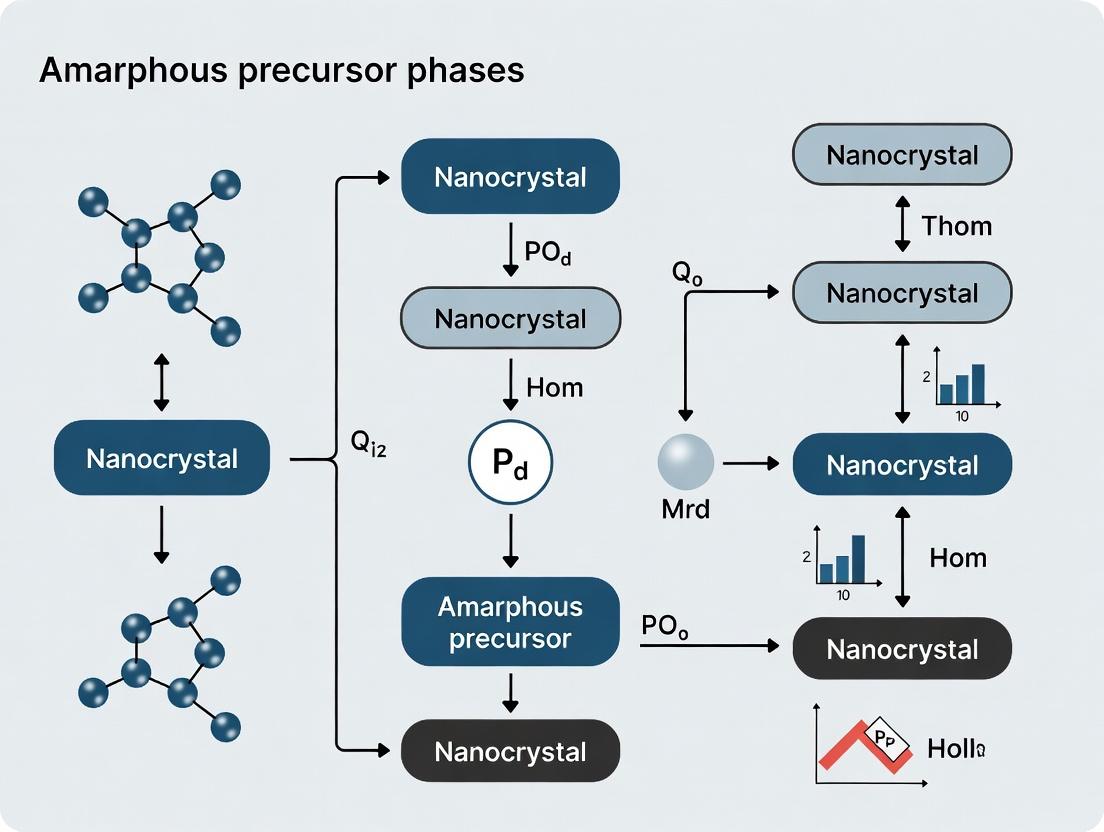
This article provides a comprehensive analysis of amorphous precursor phases in nanocrystal formation, a paradigm shift from classical nucleation theory.
Beyond Classical Crystallization: How Amorphous Precursor Phases Revolutionize Nanocrystal Synthesis and Drug Delivery
Abstract
This article provides a comprehensive analysis of amorphous precursor phases in nanocrystal formation, a paradigm shift from classical nucleation theory. We explore the foundational chemistry of non-classical pathways, detailing the metastable intermediates that precede crystalline order. Methodological approaches for observing, directing, and stabilizing these precursors are presented, with specific applications in pharmaceutical nanocrystal engineering for enhanced bioavailability. We address critical challenges in reproducibility and phase control, offering optimization strategies. Finally, we validate these pathways through comparative analysis with traditional methods, highlighting superior outcomes in particle size, morphology, and dissolution kinetics. This synthesis is essential for researchers and drug development professionals seeking to leverage advanced crystallization for next-generation therapeutics.
Unveiling the Hidden Pathway: The Chemistry and Physics of Amorphous Precursors in Non-Classical Crystallization
Classical Nucleation Theory (CNT) posits that crystalline nuclei form directly from a supersaturated solution via a stochastic assembly of monomers, with a defined critical size governed by a balance between bulk and surface free energy. However, contemporary research across biomineralization, materials science, and pharmaceutical development consistently reveals non-classical pathways. A predominant and well-supported alternative involves the initial formation of a metastable amorphous precursor phase, which subsequently transforms into the stable crystalline phase. This framework fundamentally challenges CNT's core assumptions of a single-step, homogeneous process, offering a more nuanced view of crystallization with profound implications for controlling nanocrystal size, morphology, polymorphism, and bioavailability in drug formulations.
Core Limitations of Classical Nucleation Theory
CNT provides a foundational but often incomplete model for real-world crystallization, particularly at the nanoscale. Key challenges include:
- Underestimation of Nucleation Rates: Experimental nucleation rates, especially for proteins and biominerals, can be orders of magnitude slower than CNT predictions.
- Neglect of Non-Classical Pathways: CNT cannot account for multi-step processes involving stable pre-nucleation clusters (PNCs) or dense liquid/amorphous phases.
- Oversimplified Free Energy Landscape: The model assumes a single, sharp free energy barrier, ignoring complex reaction coordinates and intermediate states.
- Inability to Predict Polymorphs: CNT typically describes the formation of the most stable polymorph, not the kinetic pathways leading to metastable forms crucial in pharmaceutical science.
The Amorphous Precursor Phase: Evidence and Mechanisms
Substantial experimental evidence supports the amorphous precursor pathway. The process can be generalized as: Supersaturated Solution → Pre-Nucleation Clusters (PNCs) → Dense Liquid Droplets or Amorphous Nanoparticles → Crystalline Phase via Internal Reorganization or Dissolution/Reprecipitation.
Quantitative Evidence Against Strict CNT
Recent studies provide direct quantitative comparisons between CNT predictions and observed behavior in amorphous precursor-mediated systems.
Table 1: Experimental Data Challenging CNT Predictions
| System (Reference) | CNT-Predicted Nucleation Rate (J) | Experimentally Observed Rate | Key Discrepancy & Proposed Mechanism |
|---|---|---|---|
| Calcium Carbonate (CaCO₃)(Science, 2009) | ~10⁵ cm⁻³s⁻¹ (for direct ion attachment) | Effectively 0 for direct calcite; Precursor forms instantly | No direct ion-to-crystal nucleation. Stable PNCs form, then aggregate into amorphous CaCO₃ (ACC). |
| Lysozyme Protein(PNAS, 2012) | Rapid nucleation at ~20 mg/mL | Significant lag phase; nucleation occurs only after dense liquid droplet formation | Two-step nucleation: Spinodal decomposition into protein-rich droplets precedes crystal nucleation within them. |
| Indomethacin (γ form)(Mol. Pharmaceutics, 2018) | Monotonic increase with supersaturation | Maximum rate at intermediate supersaturation; decrease at high supersaturation | At high supersaturation, rapid formation of amorphous nanoparticles competes with and inhibits direct crystalline nucleation. |
Detailed Experimental Protocol:In SituMonitoring of CaCO₃ Formation
This protocol is emblematic of experiments that directly visualize the amorphous precursor pathway.
Aim: To observe the sequence of phases during calcium carbonate precipitation. Materials:
- Reactants: Calcium chloride (CaCl₂) and sodium carbonate (Na₂CO₃) solutions, purified water.
- Stabilizer: Poly(acrylic acid) (PAA) or Mg²⁺ ions (to stabilize ACC).
- Equipment: Liquid Cell Transmission Electron Microscopy (LC-TEM) setup or Synchrotron-based in situ Small/Wide Angle X-ray Scattering (SAXS/WAXS) with a stopped-flow mixer.
- Analytical: TEM grids with silicon nitride windows, fast X-ray detector, pH/conductivity meter.
Procedure:
- Solution Preparation: Prepare 10 mM CaCl₂ and 10 mM Na₂CO₃ solutions in a CO₂-free, purified water atmosphere (e.g., N₂ glovebox).
- Mixing & Imaging (LC-TEM):
- Load the two solutions into separate syringes connected to a microfluidic LC-TEM holder.
- Rapidly mix within the holder and flow over the observation window.
- Initiate TEM imaging (at low electron dose to minimize beam effects) immediately upon mixing. Record video/data over 60-180 seconds.
- Mixing & Scattering (SAXS/WAXS):
- Use a stopped-flow apparatus to mix solutions directly in the path of a high-intensity X-ray beam.
- Simultaneously collect SAXS data (for nanoparticle size/shape evolution) and WAXS data (for phase identification) with millisecond time resolution.
- Data Analysis:
- (LC-TEM): Identify the initial appearance of diffuse, electron-lucent nanoparticles (ACC). Track their aggregation and the subsequent appearance of lattice fringes within particles, indicating crystallization.
- (SAXS/WAXS): Analyze SAXS for the growth of particle scattering intensity. Correlate with WAXS spectra: the absence of sharp Bragg peaks confirms the amorphous phase; the later emergence of peaks identifies the crystalline polymorph (vaterite, calcite).
Visualizing the Non-Classical Pathway
Title: Non-Classical Crystallization via Amorphous Precursor
The Scientist's Toolkit: Key Research Reagents & Materials
Table 2: Essential Reagents for Studying Amorphous Precursors
| Item | Function & Role in Challenging CNT |
|---|---|
| Liquid Cell TEM Holder | Enables direct, real-time visualization of nucleation events in liquid, capturing transient amorphous intermediates invisible to CNT. |
| Synchrotron X-ray Source | Provides high-flux beams for simultaneous SAXS/WAXS, quantifying size and structure evolution with millisecond resolution. |
| Cryo-TEM Setup | Rapid vitrification ("freezing") of reaction aliquots arrests dynamics, allowing high-res imaging of metastable precursors. |
| Polymer Stabilizers (e.g., PAA, PVP) | Selectively stabilize amorphous phases, proving their existence as isolable intermediates and enabling study of their properties. |
| Microfluidic Mixing Chips | Achieve ultra-fast, homogeneous mixing to synchronize reaction initiation for accurate kinetic studies of early stages. |
| Fluorescent Probes (e.g., polarity sensors) | Report on local environment changes (e.g., hydration) within clusters or droplets, indicative of non-classical assembly. |
Implications for Drug Development
Understanding and leveraging amorphous precursor pathways is transformative for pharmaceutical science.
- Polymorph Control: The initial amorphous phase can template specific crystalline polymorphs. Manipulating precursor stability (via polymers, additives, or process conditions) can direct crystallization to the desired bioavailable form.
- Particle Engineering: The amorphous pathway often leads to hierarchical or mesocrystalline structures with unique mechanical and dissolution properties.
- Predictive Formulation: Models incorporating multi-step nucleation improve prediction of crystallization outcomes in complex formulations, reducing trial-and-error in development.
- Biologics & Macromolecules: The two-step (liquid-liquid phase separation) model is critical for understanding and preventing unwanted protein aggregation or for crystallizing therapeutic proteins.
Title: Drug Development Applications of Precursor Pathways
The evidence for amorphous precursor phases in nanocrystal formation is robust and cross-disciplinary, presenting a significant challenge to the classical, one-step nucleation model. This paradigm shift necessitates new theoretical frameworks and experimental methodologies. For researchers and drug development professionals, embracing this complexity is not merely academic; it provides powerful levers for precise control over crystallization—a fundamental process in material synthesis and pharmaceutical formulation. The future lies in quantitatively mapping these alternative free energy landscapes to predict and design crystallization outcomes rationally.
Abstract: This technical guide, framed within the broader thesis of amorphous precursor pathways in nanomaterial and biomineral synthesis, provides a consolidated reference on the transient amorphous precursor phase (APP). We detail its defining properties, characterization methodologies, and experimental protocols, with a focus on its role as a kinetic intermediate in the non-classical crystallization of nanocrystals and active pharmaceutical ingredients (APIs).
The classical model of crystallization, involving ion-by-ion or monomer-by-monomer addition to a crystalline lattice, has been superseded in numerous systems by the observation of a transient, disordered intermediate—the amorphous precursor phase. This phase, typically a hydrated, metastable solid with short-range order, represents a critical kinetic trap in the free energy landscape. Its study is central to understanding and controlling nucleation, polymorphism, and morphology in fields ranging from biomineralization (e.g., calcium carbonate) to pharmaceutical nanosuspensions.
Defining Properties and Key Characteristics
The APP is defined by a suite of physicochemical and structural properties that distinguish it from both the solution and the stable crystalline phase.
Table 1: Defining Properties of the Amorphous Precursor Phase (APP)
| Property | Typical Characteristic | Analytical Technique(s) | Contrast with Crystalline Phase |
|---|---|---|---|
| Long-Range Order | Absent (short-range only) | PDF (Pair Distribution Function) analysis, TEM | Crystalline phases show sharp Bragg peaks. |
| Solubility | Higher than stable crystalline phase | Solution NMR, ICP-MS | Drives the Ostwald ripening process; higher driving force for transformation. |
| Density | Lower (typically 10-30% less) | Archimedes' principle, SAXS | Due to higher hydration and disordered packing. |
| Morphology | Spherical, globular, or fractal-like aggregates | Cryo-TEM, SEM | Often nanoscale particles (20-200 nm). |
| Thermodynamic Stability | Metastable, transient | In situ calorimetry | Gibbs free energy is higher than the crystalline polymorph. |
| Hydration State | Highly hydrated, often containing 1-3 moles H₂O per mole solute | TGA, FT-IR | Integral to stability; dehydration often triggers crystallization. |
Experimental Protocols for APP Identification and Monitoring
Reliable identification requires a combination of in situ and ex situ techniques to capture the transient state.
Protocol 3.1: In Situ Cryogenic Transmission Electron Microscopy (Cryo-TEM) for Direct Visualization
- Sample Preparation: Using a vitrification robot, apply 3-5 µL of the reacting suspension (e.g., 10 mM CaCl₂ + 10 mM Na₂CO₃) to a lacey carbon TEM grid.
- Vitrification: Blot excess liquid and plunge-freeze the grid into a liquid ethane slush (-183°C) within 200 ms of blotting to preserve hydrated, native-state structures.
- Transfer and Imaging: Transfer the grid under liquid nitrogen to a cryo-TEM holder. Image at 200 keV under low-dose conditions (<20 e⁻/Ų) to minimize beam damage.
- Analysis: Identify APP particles by their lack of lattice fringes and diffuse electron diffraction rings, contrasting with crystalline domains showing clear lattice spacing.
Protocol 3.2: Synchrotron-Based In Situ X-ray Scattering
- Setup: Utilize a flow cell or capillary for a mixed-solution reaction, positioned in a synchrotron X-ray beam (e.g., SAXS/WAXS beamline).
- Data Acquisition: Initiate reaction (e.g., by mixing) and collect sequential scattering patterns with high temporal resolution (100 ms to 1 s intervals).
- SAXS Region Analysis: Fit the low-q region to determine the radius of gyration (Rg) and shape of the initially formed nanoparticles.
- WAXS/PDF Analysis: Monitor the appearance of broad scattering features (APP) and their subsequent sharpening into Bragg peaks (crystalline phase). Use PDF to quantify the extent of short-range order.
Protocol 3.3: Constant Composition Titration for Kinetic Studies
- Calibration: Calibrate ion-selective electrodes (ISE, e.g., Ca²⁺) in the reaction medium.
- Reaction Initiation: Seed a metastable supersaturated solution into a thermostatted reactor with continuous stirring.
- Activity Maintenance: As precipitation lowers ion activity, a titrant controller (linked to ISE feedback) dispenses concentrated reactant solutions to maintain constant free ion concentration.
- Rate Calculation: The rate of titrant addition is directly proportional to the rate of APP formation or transformation, allowing precise kinetic measurement of these transient phases.
The Transformation Pathway
The journey from APP to crystalline material follows a non-classical pathway involving aggregation and internal restructuring.
(Diagram Title: APP Transformation Pathway to Crystal)
The Scientist's Toolkit: Essential Research Reagents & Materials
Table 2: Key Reagents and Materials for APP Research
| Item | Function/Description | Example in Research |
|---|---|---|
| Cryo-TEM Grids & Vitrification System | To instantaneously freeze hydrated samples for native-state imaging. | Visualizing calcium phosphate APP in simulated body fluid. |
| Synchrotron Beamtime Access | Provides high-flux X-rays for in situ SAXS/WAXS/PDF with millisecond resolution. | Tracking the lifetime of an iron oxide APP during co-precipitation. |
| Constant Composition Titrator | Maintains chemical potential for precise nucleation and growth kinetics. | Measuring the formation rate of amorphous calcium carbonate. |
| Ion-Selective Electrodes (ISE) | Monitor specific ion activity in real-time during precipitation. | Tracking free Ca²⁺ depletion during APP formation. |
| Polymer/Additive Libraries | Molecules that selectively stabilize or destabilize the APP. | Screening for inhibitors of pathogenic amyloid or mineral APP. |
| Microfluidics Mixing Chips | Achieve ultra-fast, homogeneous mixing to synchronize reaction initiation. | Studying the very early (<10 ms) stages of APP nucleation. |
| Quartz Crystal Microbalance with Dissipation (QCM-D) | Monitors mass and viscoelastic properties of APPs forming on surfaces. | Studying the interfacial formation of amorphous biofilms. |
Implications for Drug Development
In pharmaceutical science, the APP is a critical consideration in:
- Polymorph Control: The initial APP can dictate which polymorph of an API ultimately forms, impacting solubility and bioavailability.
- Nanocrystal Formulation: Bottom-up generation of drug nanocrystals often proceeds through an APP, whose stabilization can lead to ultra-small, stable particles.
- Lyophilization & Stabilization: Understanding the amorphous state of excipients and APIs is key to designing stable freeze-dried products.
(Diagram Title: APP Pathways in Drug Formulation)
The amorphous precursor phase is not a mere artifact but a fundamental intermediate in non-classical crystallization. Its systematic definition through the properties and protocols outlined here provides a foundation for exploiting this pathway. Deliberate manipulation of the APP offers researchers and drug developers a powerful strategy to engineer nanocrystal size, morphology, and polymorphism with unprecedented precision.
Contemporary research in biomineralization and materials science has established a paradigm shift: many crystalline materials do not form by direct ion-by-ion addition to a growing crystal lattice. Instead, they frequently proceed through transient, disordered amorphous precursor phases (APPs). This pathway, observed across diverse chemical systems, provides enhanced kinetic control over particle size, morphology, and polymorph selection—critical factors for functional material design. This whitepaper synthesizes current experimental data and methodologies for four common systems—calcium carbonate, calcium phosphate, metal oxides, and organic/pharmaceutical compounds—within the unifying thesis of amorphous precursor-mediated crystallization. The mechanisms, stabilization strategies, and characterization techniques for these APPs offer profound implications for fields ranging from bone tissue engineering to drug formulation and catalytic design.
System-Specific Analysis of Amorphous Precursor Phases
Calcium Carbonate (CaCO₃)
The CaCO₃ system is the archetype for APP research. The metastable amorphous calcium carbonate (ACC) can precipitate directly from supersaturated solutions and subsequently transform into crystalline polymorphs (vaterite, aragonite, calcite).
Key Quantitative Data:
Table 1: Characteristics and Transformation Data for Amorphous Calcium Carbonate (ACC)
| Property | Stabilized ACC (with additives) | Unstable ACC (pure) | Measurement Technique |
|---|---|---|---|
| Lifetime in Solution | Hours to days | < 1 minute | Time-resolved SAXS/WAXS |
| Density | 1.45 - 1.65 g/cm³ | ~1.54 g/cm³ | He Pycnometry |
| Short-Range Order | Similar to calcite | Variable, can be proto-calcite or proto-vaterite | PDF (Pair Distribution Function) Analysis |
| Onset of Crystallization | 25-40°C (induced) | < 25°C (spontaneous) | Differential Scanning Calorimetry (DSC) |
| Common Stabilizers | Mg²⁺, Poly(Asp), PAA, Citrate | — | — |
Experimental Protocol: In Situ Characterization of ACC Formation and Transformation
- Solution Preparation: Prepare a 10 mM Na₂CO₃ solution and a 10 mM CaCl₂ solution, both in a background electrolyte (e.g., 0.1 M NaCl). For stabilization studies, add MgCl₂ (Mg/Ca = 2-4) or 0.1-1.0 mg/mL poly(acrylic acid) (PAA, Mw ~2000) to the Ca²⁺ solution.
- Mixing & Reaction: Use a stopped-flow apparatus or rapid mixing syringe pump to combine equal volumes of the two solutions at a controlled temperature (e.g., 20°C). This ensures rapid, homogeneous supersaturation.
- Real-Time Monitoring: Direct the reacting slurry into a capillary or flow cell for simultaneous:
- Small-/Wide-Angle X-ray Scattering (SAXS/WAXS): To monitor particle size (from SAXS) and the emergence of crystalline Bragg peaks (from WAXS).
- Raman or FTIR Spectroscopy: To identify the loss of the broad ACC carbonate band (~1075 cm⁻¹) and the rise of polymorph-specific crystalline bands.
- Quenching & Ex Situ Analysis: At defined time points, quench aliquots in cold ethanol or by vacuum filtration. Analyze via TEM (with electron diffraction), AFM, or cryo-TEM to visualize particle morphology and internal structure.
Calcium Phosphate (CaP)
Amorphous calcium phosphate (ACP) is a fundamental precursor in biomineralization (bone, teeth) and synthetic materials. Its chemical formula is often denoted as CaₓHᵧ(PO₄)₂·nH₂O, with a Ca/P ratio typically between 1.2 and 1.5.
Key Quantitative Data:
Table 2: Characteristics and Transformation Data for Amorphous Calcium Phosphate (ACP)
| Property | Value / Description | Biological Relevance | Measurement Technique |
|---|---|---|---|
| Ca/P Molar Ratio | 1.2 - 1.5 | Distinct from hydroxyapatite (1.67) | ICP-OES after dissolution |
| Primary Particle Size | ~30-100 nm diameter | Mimics initial bone mineral particles | Dynamic Light Scattering (DLS), TEM |
| Lifetime (pH 7.4, 37°C) | Minutes to hours | Allows for cellular handling and templating | pH-stat, turbidity |
| Thermal Transition | Exothermic peak ~500-600°C (crystallizes to β-TCP/HA) | — | Thermogravimetric Analysis-DSC |
| Key Stabilizers | Citrate, ATP, Osteopontin, Casein Phosphopeptides | Abundant in serum and bone matrix | — |
Experimental Protocol: Synthesis and Stabilization of ACP Nanoparticles
- Rapid Precipitation: Rapidly add 100 mL of 0.1 M (NH₄)₂HPO₄ solution (pH adjusted to 9.0-10.0 with NH₄OH) into 100 mL of 0.15 M Ca(NO₃)₂ solution under vigorous stirring (500-1000 rpm) at room temperature.
- Stabilizer Addition: Introduce stabilizer (e.g., 5 mM sodium citrate or 1 mg/mL osteopontin) either to the phosphate solution prior to mixing or immediately (<10 s) after precipitation.
- Aging and Washing: Allow the suspension to age for 5-30 minutes. Centrifuge (15,000 g, 10 min) and wash the pellet with cold ammoniated water (pH ~9) to remove ions and halt transformation. Repeat twice.
- Characterization: Resuspend in a small volume of water or ethanol. Analyze via:
- FTIR: Look for broad phosphate bands (~560 and 600 cm⁻¹, ~1000-1100 cm⁻¹) and absence of sharp hydroxyapatite (HA) peaks.
- XRD: Confirm amorphous nature via a broad "halo" centered at ~30° 2θ (Cu Kα).
- TEM: Image morphology and use Selected Area Electron Diffraction (SAED) to confirm lack of crystallinity.
Metal Oxides (e.g., TiO₂, FeOOH, SiO₂)
Many metal oxides form via amorphous hydrous oxide gels. For example, titanium dioxide (TiO₂) crystallization from amorphous TiO₂·nH₂O determines the final anatase/rutile/brookite phase distribution and nanocrystal size.
Key Quantitative Data:
Table 3: Amorphous Precursors in Common Metal Oxide Systems
| System | Amorphous Phase | Crystalline Products | Typical Transformation Trigger |
|---|---|---|---|
| Titanium (Ti) | Amorphous TiO₂·nH₂O (TiO₂·xH₂O gel) | Anatase, Rutile, Brookite | Hydrothermal Treatment (>80°C), Calcination |
| Iron (Fe III) | Ferrihydrite (Fe₅HO₈·4H₂O) | Goethite (α-FeOOH), Hematite (α-Fe₂O₃) | pH, Temperature, Ionic Strength (Fe²⁺ catalysis) |
| Silicon (Si) | Silica Gel (SiO₂·nH₂O) | Cristobalite, Tridymite, Quartz | High Temperature (>1000°C) |
| Zirconium (Zr) | Amorphous Zr(OH)₄·nH₂O | Tetragonal/Cubic ZrO₂ | Calcination (>400°C) |
Experimental Protocol: Hydrothermal Transformation of Amorphous TiO₂ to Anatase
- Precursor Synthesis: Hydrolyze 10 mL of titanium(IV) isopropoxide (TTIP) in 100 mL of 0.1 M nitric acid (HNO₃) under vigorous stirring for 12 hours. A translucent, amorphous TiO₂·nH₂O sol will form.
- Hydrothermal Aging: Transfer the sol to a Teflon-lined autoclave, filling 70% of its volume. Heat at 80-130°C for 2-24 hours. Higher temperatures/times increase crystallinity and particle size.
- Product Isolation: Cool the autoclave to room temperature naturally. Centrifuge the resulting white suspension, wash sequentially with deionized water and ethanol, and dry at 60°C.
- Phase Analysis: Use XRD and Rietveld refinement to quantify anatase/brookite fractions. Use Raman spectroscopy (strong anatase band at ~144 cm⁻¹) for quick phase identification. Analyze particle morphology via SEM/TEM.
Organic/Pharmaceutical Compounds
For active pharmaceutical ingredients (APIs) and organic compounds, the amorphous state is a high-energy solid form with enhanced solubility but physical instability. Preventing crystallization is the primary challenge.
Key Quantitative Data:
Table 4: Properties of Amorphous vs. Crystalline Pharmaceutical Forms
| Property | Amorphous Solid Dispersion (ASD) | Crystalline API | Implication |
|---|---|---|---|
| Gibbs Free Energy | Higher (+5-50 kJ/mol) | Lower (stable reference) | Driving force for crystallization |
| Apparent Solubility | 2-1000x higher | Equilibrium solubility | Enhanced bioavailability |
| Glass Transition Temp (T_g) | Critical parameter (50-150°C) | Melting point (Tm) | Dictates storage stability |
| Physical Stability | Metastable, prone to recrystallization | Thermodynamically stable | Shelf-life determinant |
Experimental Protocol: Preparing and Assessing an Amorphous Solid Dispersion (ASD)
- Method: Hot-Melt Extrusion (HME)
- Materials: Crystalline API (e.g., Itraconazole) and polymeric matrix (e.g., PVP-VA, HPMC-AS) in a defined ratio (e.g., 30:70 w/w). Pre-blend using a mortar and pestle or tumbler mixer.
- Process: Feed the blend into a twin-screw extruder. Set temperature profile along barrels to 10-20°C above the API/polymer mixture's T_g but below the API's melting point. Use a screw speed of 50-200 rpm.
- Collection: Extrude the molten strand, cool on a conveyor belt, and mill into a powder.
- Characterization of Amorphousness:
- XRD: Confirm complete absence of crystalline Bragg peaks.
- DSC: Measure a single, composition-dependent Tg with no melting endotherm.
- Modulated DSC (mDSC): Separate reversible (heat capacity change at Tg) from non-reversible (enthalpy relaxation, crystallization) events.
- Stability Study: Store the ASD powder under accelerated conditions (e.g., 40°C/75% RH) in open and closed containers. Monitor for physical crystallization weekly using XRD or DSC.
The Scientist's Toolkit: Essential Research Reagents & Materials
Table 5: Key Reagents and Materials for Amorphous Precursor Research
| Item | Function / Role | Example Systems |
|---|---|---|
| Poly(Aspartic Acid) (pAsp) | Biomimetic polymer inhibitor; stabilizes ACC by binding to surface and disrupting ion ordering. | CaCO₃ |
| Sodium Citrate | Small molecule chelator; binds Ca²⁺, increases dissolution/reprecipitation barrier, stabilizes ACP. | CaCO₃, CaP |
| Polyvinylpyrrolidone (PVP) | Steric stabilizer; adsorbs to nanoparticle surfaces, preventing aggregation and Ostwald ripening. | Metal Oxides, Organics |
| Hydroxypropyl Methylcellulose Acetate Succinate (HPMC-AS) | pH-responsive polymer; maintains supersaturation of amorphous API in GI tract by inhibiting nucleation. | Pharmaceutical ASDs |
| Tetraethyl Orthosilicate (TEOS) | Hydrolyzable precursor for amorphous silica (SiO₂) sol-gel synthesis. | Metal Oxides (SiO₂) |
| 1-Hydroxyethylidene-1,1-Diphosphonic Acid (HEDP) | Powerful crystallization inhibitor for scale prevention; strongly adsorbs to growing crystal faces. | CaCO₃, CaP |
| Cryo-TEM Grids (Lacey Carbon) | Enable vitrification of liquid suspensions for direct imaging of hydrated, transient amorphous phases. | All aqueous systems |
Visualizing Pathways and Workflows
Title: Two Crystallization Pathways: Classical vs. Amorphous Precursor
Title: Experimental Workflow for APP Characterization
Title: Stability Battle in Amorphous Pharmaceutical Solids
The crystallization of nanocrystals, particularly in biomineralization and pharmaceutical development, is governed by a complex interplay between thermodynamic driving forces and kinetic controls. The broader thesis of contemporary research posits that amorphous precursor phases (ACPs) are not mere exceptions but a widespread intermediate state in non-classical crystallization pathways. Two competing frameworks explain the persistence or evolution of these ACPs: Ostwald's Rule of Stages (thermodynamic) and Kinetic Trapping. This whitepaper provides a technical analysis of these forces, detailing experimental approaches to distinguish between them within the context of nanocrystal formation research.
Conceptual Frameworks
Ostwald's Rule of Stages: A thermodynamic principle stating that a system undergoing a phase transformation will proceed via a sequence of metastable intermediates, each progressively more stable than the last, to minimize the global activation energy barrier. The transformation from an amorphous phase to a crystalline one is thus driven by the system's inherent tendency to lower its free energy.
Kinetic Trapping: A state where a metastable phase (e.g., an ACP) persists due to high energy barriers that prevent its transformation to a more stable crystalline phase. This is governed by kinetics—the rates of dissolution, nucleation, and growth—rather than thermodynamic inevitability. Factors like inhibitors, viscosity, or interfacial energies can create deep local free energy minima.
Quantitative Data Comparison
Table 1: Key Differentiating Parameters Between Thermodynamic & Kinetic Control
| Parameter | Ostwald's Rule (Thermodynamic Driver) | Kinetic Trapping |
|---|---|---|
| Primary Driver | System free energy minimization (ΔG). | Reaction rates and activation energies (Ea). |
| Pathway Predictability | Predictable sequence of intermediates. | Pathway is history-dependent and sensitive to conditions. |
| Phase Persistence | Transient; intermediates convert as stability allows. | Long-lived or permanent without external perturbation. |
| Dependence on Supersaturation | High supersaturation favors ACP as first step. | Can occur across a range of supersaturations if barriers are high. |
| Response to Temperature | Increased T accelerates progression through stages. | May have complex, non-Arrhenius behavior. |
| Role of Additives/Inhibitors | Modulate relative stability of intermediates. | Can create or deepen trapping barriers. |
| Characteristic Evidence | In situ observation of sequential phase transitions. | ACP remains stable indefinitely under conditions where crystal is thermodynamically favored. |
Table 2: Experimental Observables for Distinguishing Mechanisms
| Observable | Method | Indication of Ostwald's Rule | Indication of Kinetic Trapping |
|---|---|---|---|
| Phase Transformation Kinetics | Time-resolved XRD, PDF, SAXS | Sigmoidal curve; fits Avrami model for nucleation & growth. | No transformation observed over experimental timescale. |
| Activation Energy (Ea) | Arrhenius analysis of transformation rate. | Moderate Ea (e.g., 50-100 kJ/mol for dissolution/re-precipitation). | Very high Ea (>150 kJ/mol), indicating insurmountable barrier. |
| Morphological Evolution | TEM, SEM | Particles evolve from spherical (ACP) to faceted (crystal). | Spherical ACP particles remain unchanged. |
| Solubility | ICP-OES, Calcium Electrode | ACP solubility is higher than crystalline phase. | ACP solubility equals or is lower than crystal (false equilibrium). |
Detailed Experimental Protocols
Protocol 1: In Situ Monitoring of ACP to Crystal Transformation via Synchrotron SAXS/WAXS
Objective: To distinguish a progressive, thermodynamically-driven transformation from a sudden, kinetically-triggered one.
- Reagent Preparation: Prepare a metastable ACP suspension (e.g., Calcium Carbonate) by rapid mixing of 10 mM CaCl₂ and 10 mM Na₂CO₃ solutions in a 1:1 volume ratio at 4°C, followed by immediate membrane filtration (50 kDa) and re-dispersion in degassed, inhibitor-free mother liquor.
- Sample Environment: Load the ACP suspension into a temperature-controlled capillary flow cell (e.g., 25°C).
- Data Acquisition: Use a synchrotron X-ray source. Simultaneously collect SAXS (q-range: 0.01-1 nm⁻¹) and WAXS (q-range: 1-30 nm⁻¹) patterns at 1-10 second intervals.
- Analysis: Track the SAXS invariant for size/volume changes. In WAXS, quantify the decay of the amorphous halo (~1.1 Å⁻¹ for CaCO₃) and the rise of crystalline Bragg peaks (e.g., calcite (104)). Co-linear decay/growth suggests a direct, Ostwald-driven conversion. A lag phase or decoupled signals suggest kinetic intermediates.
Protocol 2: Determining the Activation Barrier for Transformation via Isothermal Calorimetry (ITC)
Objective: To measure the activation energy (Ea) of the ACP-to-crystal transformation.
- Sample Preparation: Generate a large, homogeneous batch of ACP as in Protocol 1. Aliquot into ampoules for ITC.
- Experimental Run: Load an ACP aliquot and reference (mother liquor) into a nano-ITC or isothermal titration calorimeter. Set the measurement cell to a specific temperature (T1, e.g., 20°C). Monitor the heat flow (μW) over time until baseline returns.
- Replication: Repeat the experiment at minimum four different temperatures (e.g., 20, 25, 30, 35°C).
- Data Processing: Integrate the exothermic peak to obtain the total enthalpy (ΔH). Determine the rate constant (k) at each temperature from the inverse of the time to peak maximum or by fitting the progress curve.
- Arrhenius Plot: Plot ln(k) vs. 1/T (in Kelvin). The slope of the linear fit is -Ea/R. An Ea > 150 kJ/mol strongly suggests kinetic trapping.
Visualizations
Title: Thermodynamic Pathway vs. Kinetic Trapping in Crystallization
Title: Integrated Workflow to Distinguish Driving Forces
The Scientist's Toolkit: Key Research Reagent Solutions
Table 3: Essential Materials for Amorphous Precursor Phase Studies
| Item | Function & Rationale |
|---|---|
| Ultrapure, Degassed Water | Prevents unintended gas bubble nucleation and contamination by CO₂ or metal ions that can act as accidental catalysts/inhibitors. |
| Calcium-Specific Ionophore (e.g., for ISE) | Enables precise, real-time measurement of free Ca²⁺ concentration, critical for determining solubility of ACP vs. crystalline phases. |
| Polycarbonate Membrane Filters (10-100 kDa) | For isolating and washing ACP from mother liquor without inducing transformation via dehydration or shear stress. |
| Phosphate- or Polyacrylate-based Inhibitors | Model additives to artificially induce kinetic trapping by binding to ACP surface and raising the transformation barrier. |
| Synchrotron-Compatible Flow Cell | Allows for continuous mixing and in situ observation of reaction kinetics with millisecond time resolution. |
| Siliconized Glassware/Vials | Minimizes heterogeneous nucleation on container walls, ensuring bulk solution-phase kinetics are measured. |
| Cryo-Transmission Electron Microscopy (Cryo-TEM) Grids | For vitrifying liquid samples to capture transient ACP and early nanocrystal morphology without artifacts. |
The Role of Additives, Polymers, and Biological Molecules in Precursor Stabilization
Within the broader thesis on amorphous precursor phases in nanocrystal formation, the strategic stabilization of these transient, disordered intermediates is paramount. This whitepaper provides an in-depth technical examination of how additives, synthetic polymers, and biological molecules act as effective stabilizing agents. By modulating interfacial energy, kinetics, and local chemical environments, these agents control the lifetime and evolution of precursors, directing synthesis toward nanocrystals with precise size, morphology, and functionality—critical for applications in catalysis, optoelectronics, and targeted drug delivery.
The non-classical crystallization pathway involving amorphous precursor phases is a ubiquitous mechanism in biological and synthetic systems. These metastable, often hydrated phases (e.g., amorphous calcium carbonate, ACC) offer a pathway to overcome high energy barriers associated with direct ion-by-ion growth. Their inherent instability, however, presents a central challenge: uncontrolled rapid dissolution or transformation into crystalline polymorphs. Stabilization of these precursors is thus a critical lever for controlling the subsequent nanocrystal attributes.
Mechanisms of Stabilization
Stabilizing agents operate through distinct but often synergistic physicochemical mechanisms.
Electrostatic and Steric Stabilization
Additives with charged functional groups (e.g., citrate, polyacrylic acid) adsorb onto the precursor surface, creating an electrostatic repulsion barrier. Polymers and biomolecules provide a physical steric barrier, preventing aggregation and coalescence.
Complexation and Ion Sequestration
Molecules like ethylenediaminetetraacetic acid (EDTA) or peptides with high-affinity binding sites chelate free ions in solution. This reduces the supersaturation level, slowing the kinetics of both precursor precipitation and its transformation, effectively "pausing" the system in the amorphous state.
Surface Hydration and Interface Modification
Hydrophilic polymers and biomacromolecules (e.g., polysaccharides, proteins) can enhance the stability of the hydration shell around precursor nanoparticles. This increased hydration layer energy barrier inhibits dehydration, a key step in crystallization.
Confinement and Spatial Regulation
Block copolymers or lipid vesicles can create nanoscale compartments that physically isolate precursor phases, limiting their growth and providing a defined chemical microenvironment that favors stability.
Table 1: Efficacy of Common Stabilizing Agents on Amorphous Calcium Phosphate (ACP) Lifetime
| Stabilizing Agent | Class | Typical Concentration | Mean ACP Lifetime (min) | Primary Mechanism | Key Outcome |
|---|---|---|---|---|---|
| Citrate | Small Molecule Additive | 5 mM | 45 | Electrostatic, Complexation | Delayed transformation to HAp |
| Poly(acrylic acid) (PAA) | Synthetic Polymer | 1 mg/mL | > 240 | Steric, Surface Adsorption | Stable ACP nanoparticles (~50 nm) |
| Mg²⁺ ions | Inorganic Additive | 20% molar (vs. Ca²⁺) | 120 | Interface Poisoning, Hydration | Inhibits nucleation of crystalline phases |
| Osteopontin-derived peptide | Biological Molecule | 0.1 mg/mL | > 360 | Specific Binding, Steric | Highly stable, monodisperse ACP |
| Polyethylene glycol (PEG) | Synthetic Polymer | 10 mg/mL | 60 | Steric, Crowding | Prevents aggregation |
Table 2: Impact on Final Nanocrystal Characteristics
| Agent Type | Example | Typical Precursor | Resultant Nanocrystal Size (nm) | Morphology Control | Application Context |
|---|---|---|---|---|---|
| Linear Polymer | PVP | Ag⁰/Amorphous Oxide | 20 ± 5 | Spherical | Conductive inks, Catalysis |
| Dendrimer | PAMAM | Au⁰ | 5 ± 1 | Ultra-uniform | Sensing, Drug delivery carrier |
| Protein | Ferritin / Apoferritin | FeOOH / Fe₃O₄ | ~6 (within cavity) | Templated | MRI contrast agents |
| Double-Hydrophilic Block Copolymer | PEG-b-PMAA | CaCO₃ (ACC) | 50-100, adjustable | Layered, Complex | Biomimetic composites, Delivery |
Experimental Protocols
Protocol: Stabilizing Amorphous Calcium Carbonate (ACC) with Poly(Acrylic Acid)
Objective: To synthesize and characterize PAA-stabilized ACC nanoparticles with extended lifetime. Materials: Calcium chloride dihydrate (CaCl₂·2H₂O), Sodium carbonate (Na₂CO₃), Poly(acrylic acid, sodium salt) (Mw ~5,100), Deionized water (degassed), Isopropanol. Procedure:
- Prepare a 10 mM CaCl₂ solution in 50 mL of degassed DI water.
- Dissolve PAA to a final concentration of 1 g/L in the CaCl₂ solution. Stir for 1 hour.
- Rapidly add an equal volume of a 10 mM Na₂CO₃ solution under vigorous stirring (≈ 1000 rpm).
- Immediately after mixing, quench a 5 mL aliquot into 20 mL of isopropanol to arrest reaction. Centrifuge at 10,000 rpm for 5 min, wash twice with isopropanol, and dry under vacuum for solid characterization.
- Monitor the remaining reaction mixture in situ using time-resolved dynamic light scattering (DLS) every 5 minutes to assess particle size stability, and using Raman spectroscopy (checking for the absence of the calcite 1086 cm⁻¹ peak) to confirm the amorphous state.
Protocol: Assessing Peptide-Mediated ACP Stabilization via pH-Stat
Objective: To quantitatively measure the transformation kinetics of ACP to hydroxyapatite (HAp) in the presence of a stabilizing peptide. Materials: Calcium chloride, Potassium phosphate dibasic (K₂HPO₄), Stabilizing peptide (e.g., DSS repeating sequence), 0.1M KOH solution, pH-stat apparatus, N₂ gas. Procedure:
- Purge 100 mL of DI water with N₂ for 30 min to exclude CO₂.
- Dissolve CaCl₂ (final 4 mM) and peptide (final 0.05 mg/mL) in the water. Maintain at 37°C under N₂ atmosphere and constant stirring.
- Initiate reaction by adding K₂HPO₄ (final 2.4 mM, Ca/P = 1.67). The pH will drop sharply.
- Immediately start the pH-stat, titrating with 0.1M KOH to maintain a constant pH (e.g., 7.4). The rate of KOH consumption is directly proportional to H⁺ release from HAp formation.
- Record the titration curve. A prolonged induction period with low KOH consumption indicates effective ACP stabilization by the peptide. Compare the lag time to a peptide-free control.
Visualization of Pathways and Workflows
Diagram Title: Agent Intervention in Precursor Transformation Pathway
Diagram Title: Experimental Workflow for Polymer-ACC Synthesis
The Scientist's Toolkit: Key Research Reagent Solutions
Table 3: Essential Materials for Precursor Stabilization Studies
| Reagent/Material | Function & Rationale |
|---|---|
| Poly(acrylic acid) (PAA), variable Mw | Benchmark anionic polymer for steric/electrostatic stabilization; Mw influences adsorption kinetics and layer thickness. |
| Citric acid / Trisodium citrate | Small molecule chelator and electrostatic stabilizer; used to establish baseline inhibition of crystal growth. |
| MgCl₂ hexahydrate | Ubiquitous inorganic additive; Mg²⁺ ions incorporate into precursor phases, increasing disorder and hydration, delaying transformation dramatically. |
| Poly(vinylpyrrolidone) (PVP) | Neutral polymer stabilizer; acts primarily via steric hindrance and surface adsorption, widely used for metal oxide precursors. |
| PAMAM Dendrimers (G4-G6) | Provide well-defined nanoscale compartments and surface functional groups for templating and encapsulating precursor phases. |
| Lysozyme or Osteopontin | Model biological macromolecules for studying biomimetic stabilization; provide specific binding interactions. |
| PEG-b-PMAA Block Copolymer | Double-hydrophilic block copolymer; PEG provides solubility, PMAA binds ions/precursors, enabling complex morphogenesis. |
| D₂O-based buffers | For in-situ monitoring via Raman or NMR, where H₂O signals interfere; allows study of hydration dynamics. |
| Silane-based coupling agents | To functionalize substrates or seeds for studying heterogeneous precursor stabilization and nucleation. |
The deliberate stabilization of amorphous precursors using additives, polymers, and biological molecules has evolved from an observational phenomenon to a precise synthetic tool. The choice and design of the stabilizing agent directly dictate the precursor's lifetime, size, and interfacial properties, thereby programming the outcome of nanocrystal formation. Future research directions include the computational design of sequence-specific biomimetic polymers, the exploitation of multi-stimuli-responsive stabilizers for triggered crystallization, and the integration of these principles into continuous manufacturing processes for next-generation nanomaterials and biopharmaceuticals.
Within the prevailing thesis on amorphous precursor phases in nanocrystal formation, in-situ observation techniques provide the critical evidence linking transient disordered states to final crystalline order. This whitepaper details how liquid-phase transmission electron microscopy (LP-TEM) and in-situ X-ray scattering (SAXS/WAXS) synergistically elucidate nucleation pathways, kinetic intermediates, and phase transformation dynamics. The guide provides technical protocols, data interpretation frameworks, and essential toolkits for researchers investigating amorphous precursors in materials science and pharmaceutical development.
The classical nucleation theory (CNT) posits direct formation of crystalline nuclei from a supersaturated solution. A transformative thesis in crystallization research challenges CNT, proposing that many crystals, especially biominerals, perovskites, and active pharmaceutical ingredients (APIs), form via metastable amorphous precursor phases. These amorphous intermediates, often liquid or gel-like, act as a storage of mass that subsequently undergoes internal ordering and dehydration. In-situ observation is paramount to validate this thesis, as it captures these transient, non-equilibrium states that are otherwise inaccessible to ex-situ characterization.
Core Techniques: Principles and Synergies
Liquid-Phase Transmission Electron Microscopy (LP-TEM)
LP-TEM enables direct, real-space imaging of dynamic processes in a liquid environment with nanometer spatial resolution. A key innovation is the use of liquid cells with electron-transparent windows (e.g., SiNx) to encapsulate the solution.
2In-SituX-ray Scattering
- Small-Angle X-ray Scattering (SAXS): Probes nanoscale density fluctuations (1-100 nm), ideal for detecting amorphous clusters, pre-nucleation species, and particle size distributions.
- Wide-Angle X-ray Scattering (WAXS): Analyzes atomic-scale order (0.1-1 nm), providing fingerprints of short-range order in amorphous phases and crystal structure evolution.
The synergy is clear: LP-TEM offers direct visualization of morphology and particle dynamics, while SAXS/WAXS provides ensemble-averaged, quantitative structural data on length scales from atomic to mesoscopic.
Experimental Protocols for Key Studies
Protocol 3.1: LP-TEM Observation of Calcium Carbonate Formation
Objective: Visualize the multistep pathway from ions to crystals via an amorphous calcium carbonate (ACC) phase.
- Liquid Cell Assembly: Load a solution of 10 mM CaCl₂ into one reservoir of a commercial MEMS-based liquid cell (e.g., Protochips Poseidon). Load 10 mM Na₂CO₃ into the opposing reservoir.
- Environmental Control: Set cell temperature to 25°C. Use syringe pumps to establish a stable, laminar flow interface between the two solutions within the observation window.
- TEM Imaging: Operate TEM (e.g., FEI Tecnai) at 200 kV in low-dose mode (dose rate < 10 e⁻/Ųs) to minimize radiolysis. Acquire video at 1-2 frames per second.
- Data Acquisition: Record bright-field imaging and selected area electron diffraction (SAED) patterns at regular intervals (e.g., every 30s) to monitor phase changes.
- Analysis: Track the appearance, growth, and crystallization of initial liquid-like droplets (ACC) into final calcite/vaterite crystals.
Protocol 3.2:In-SituSAXS/WAXS of Perovskite Nanocrystal Synthesis
Objective: Quantify the kinetics of precursor aggregation and crystallization during ligand-assisted synthesis.
- Setup: Utilize a synchrotron beamline (e.g., ESRF ID02) equipped with a flow reactor and dual SAXS/WAXS detectors.
- Reactor Configuration: Use a stopped-flow or continuous-flow microfluidic mixer. Precursor solutions: PbBr₂ in DMF and methylammonium bromide in DMF with oleic acid/oleylamine ligands.
- Triggering & Measurement: Rapidly mix precursors at time t=0 directly in the X-ray beam path. Initiate simultaneous SAXS and WAXS acquisition with 100 ms time resolution.
- Data Collection: SAXS data yields radius of gyration (Rg) and pair-distance distribution functions. WAXS data monitors the emergence of Bragg peaks characteristic of the perovskite phase.
- Kinetic Modeling: Fit time-dependent SAXS intensity at low-q to a kinetic model of aggregation. Correlate with the rise of crystalline WAXS signals.
Critical Evidence and Quantitative Data
The following tables summarize key quantitative findings from recent studies supporting the amorphous precursor thesis.
Table 1: LP-TEM Evidence for Amorphous Precursors in Nanocrystal Systems
| System | Observed Amorphous Intermediate | Lifetime (LP-TEM) | Final Crystal Phase | Key Reference (Year) |
|---|---|---|---|---|
| Calcium Phosphate | Amorphous spherical particles | 30 - 120 s | Hydroxyapatite | Science (2019) |
| Calcium Carbonate | Liquid-like ACC droplets | 10 - 60 s | Calcite / Vaterite | Nature (2020) |
| Zeolite (LTA) | Dense amorphous gel clusters | 10 - 30 s | LTA crystals | Science (2021) |
| Gold Nanocrystals | Amorphous Au aggregates | < 5 s | Faceted Au NPs | Nature Mat. (2022) |
Table 2: Quantitative SAXS/WAXS Parameters from In-Situ Studies
| System (Formation Step) | SAXS Parameter (Trend) | WAXS Parameter (Trend) | Inferred Mechanism |
|---|---|---|---|
| Pre-Nucleation (CaCO₃) | Rg ~ 0.8-1.2 nm (constant) | No Bragg peaks; Broad halo | Stable pre-nucleation clusters |
| ACC Formation (CaCO₃) | I(0) increases sharply; Rg ~ 50 nm | Broad halo intensifies | Cluster aggregation into ACC |
| Crystallization (Perovskite) | Power-law slope changes (-4 to -2) | Bragg peak (100) emerges at t = 3.2s | Densification & internal ordering |
| Ligand-Mediated (CdSe) | Guinier region flattens | Peak narrowing (size increase) | Oriented attachment of amorphous NPs |
Visualizing Pathways and Workflows
Diagram 1: The Amorphous Precursor Crystallization Pathway (78 characters)
Diagram 2: Correlative LP-TEM and X-ray Workflow (76 characters)
The Scientist's Toolkit: Essential Research Reagents & Materials
Table 3: Key Reagent Solutions and Materials for In-Situ Studies
| Item Name / Category | Example Product / Specification | Primary Function in Experiment |
|---|---|---|
| Liquid Cell (LP-TEM) | Protochips Poseidon E-chip, SiNx windows (50nm thick) | Encapsulates liquid sample between electron-transparent membranes for TEM observation. |
| Microfluidic Mixer (X-ray) | HPLC Tee Mixer (PEEK, 250 μm bore) / Stopped-flow apparatus | Enables rapid, reproducible mixing of precursors directly in the X-ray beam path. |
| Radiation-Resistant Solvent | Highly purified Water (HPLC grade), Degassed DMF | Minimizes radiolysis bubble formation under electron or X-ray beam, ensuring stable observation. |
| Synchrotron-Compatible Cell | Quartz Capillary (1.5 mm diameter), Kapton tape sealed cell | Holds sample for in-situ X-ray scattering with low background scattering and beam absorption. |
| Calibration Standards | Silver Behenate (for q), LaB6 (for intensity), Au NP size std. | Calibrates the scattering vector (q) and intensity scale for accurate SAXS/WAXS quantification. |
| Precursor Salts (Model Systems) | CaCl₂, (NH₄)₂HPO₄, PbBr₂, CsOAc, Na₂CO₃ (≥99.99% purity) | Provides high-purity ionic components for studying classic amorphous precursor systems. |
| Surface Ligands/Capping Agents | Oleic Acid, Oleylamine, Citrate, Polyvinylpyrrolidone (PVP) | Modifies surface energy of intermediates, stabilizing amorphous phases and directing final morphology. |
| Buffer Solutions | HEPES, Tris, Carbonate buffers (pH-specific) | Maintains precise pH to control supersaturation and ion speciation during nucleation. |
From Observation to Engineering: Methodologies for Harnessing Amorphous Precursors in Nanocrystal Synthesis
The study of amorphous precursor phases is pivotal in elucidating non-classical crystallization pathways, particularly for functional nanocrystals in catalytic, biomedical, and optoelectronic applications. These transient, disordered intermediates govern nucleation kinetics, polymorph selection, and final nanocrystal morphology. A comprehensive, multi-modal characterization strategy is essential to capture their dynamic, non-equilibrium nature. This whitepaper details four advanced techniques—Cryogenic Transmission Electron Microscopy (Cryo-TEM), Small-/Wide-Angle X-ray Scattering (SAXS/WAXS), Pair Distribution Function (PDF) analysis, and Atomic Force Microscopy (AFM)—that synergistically provide a holistic view of amorphous precursor evolution, from local atomic ordering to mesoscale assembly and interfacial forces.
Core Techniques: Principles and Protocols
Cryogenic Transmission Electron Microscopy (Cryo-TEM)
- Principle: Rapid vitrification of a suspension traps amorphous precursors and nascent nanocrystals in a native, hydrated state. High-resolution imaging and diffraction reveal morphology, size distribution, and crystallinity.
- Detailed Protocol for Precursor Analysis:
- Sample Preparation: Apply 3-5 µL of the reaction aliquot onto a glow-discharged, holey carbon TEM grid.
- Vitrification: Blot excess liquid automatically for 2-4 seconds and plunge-freeze the grid into a liquid ethane/propane mixture cooled by liquid nitrogen.
- Transfer & Imaging: Transfer the grid under cryogenic conditions (< -170°C) into the microscope. Acquire images at low electron dose (e.g., 5-20 e⁻/Ų) at 200-300 keV to minimize beam-induced artifacts. Use low-dose SAED (Selected Area Electron Diffraction) on regions of interest to distinguish amorphous halos from crystalline rings.
Small-Angle & Wide-Angle X-ray Scattering (SAXS/WAXS)
- Principle: SAXS probes nanoscale density fluctuations (1-100 nm), quantifying the size, shape, and volume fraction of precursors and particles. WAXS detects Bragg peaks from crystalline phases and broad features from amorphous or liquid-like ordering (0.1-1 nm). Simultaneous measurement is key.
- Detailed Protocol for Time-Resolved Studies:
- Setup: Use a synchrotron or lab-based X-ray source with a flow-through capillary cell or stopped-flow setup.
- Calibration: Calibrate q-range using silver behenate (SAXS) and cerium dioxide (WAXS) standards.
- Data Acquisition: For a precipitation reaction, trigger mixing and collect sequential frames (e.g., 100 ms integration per frame). Monitor the invariant (SAXS) for total volume fraction evolution and the appearance of sharp Bragg peaks (WAXS).
- Analysis: Fit SAXS data using form factors (spheres, ellipsoids) and structure factors for interactions. Deconvolute WAXS patterns via linear combination or whole-pattern fitting.
X-ray Pair Distribution Function (PDF) Analysis
- Principle: Fourier transformation of total scattering (both Bragg and diffuse) yields the PDF, G(r), which describes the probability of finding two atoms at a distance r. It is uniquely sensitive to short- and medium-range order (< 2 nm) within amorphous materials.
- Detailed Protocol for Total Scattering:
- Data Collection: Use a high-energy X-ray beam (> 60 keV, e.g., at a synchrotron) or Mo/Kα source with a 2D detector to collect scattering to high q-max (often > 20 Å⁻¹). Measure sample in a capillary or Kapton tube, plus background/empty container.
- Data Reduction: Correct data for background, absorption, Compton scattering, and fluorescence. Normalize by incident flux and sample composition to obtain the total scattering structure function, S(q).
- Fourier Transform: Compute the PDF, G(r), via sine Fourier transform of q[S(q)-1] over the measured q-range. Use software like PDFgetX3 or xPDFsuite.
- Modeling: Refine atomic models (e.g., using PDFgui, Diffpy-CMI) to extract parameters like bond lengths, coordination numbers, and domain size.
Atomic Force Microscopy (AFM)
- Principle: A sharp tip scans a surface to map topography and measure nanomechanical properties. In liquid, it can probe the formation and adhesion of precursor phases on substrates in real time.
- Detailed Protocol for In-Situ Precursor Adhesion Studies:
- Substrate & Tip Preparation: Use freshly cleaved mica or a relevant mineral substrate. Use a silicon nitride cantilever with a known spring constant (calibrated via thermal tune).
- Fluid Cell Setup: Inject the metastable precursor solution into the fluid cell. Allow thermal equilibration.
- Imaging: Use tapping mode in liquid to minimize lateral forces and image evolving surface-adsorbed species.
- Force Spectroscopy: Perform force-volume mapping or single-point force-distance curves. Approach and retract the tip at a constant rate (e.g., 0.5-1 µm/s) to measure adhesion forces (jump-off contact in retraction curve) and mechanical stiffness.
Table 1: Technique Comparison for Amorphous Precursor Characterization
| Technique | Length Scale Probe | Key Measurable Parameters for Precursors | Typical Experiment Duration | In-Situ Capability |
|---|---|---|---|---|
| Cryo-TEM | 1 nm – 1 µm | Morphology, size distribution, crystallinity via SAED, aggregation state. | Minutes per grid (snapshot) | No (quench-and-look) |
| SAXS | ~1 – 100 nm | Radius of gyration (Rg), particle size/shape, volume fraction, fractal dimension. | Milliseconds to seconds | Yes (flow cells) |
| WAXS | 0.1 – 1 nm | Short-range order, crystallinity %, crystalline phase ID, lattice parameters. | Milliseconds to seconds | Yes (flow cells) |
| 0.1 – 5 nm | Bond lengths, coordination numbers, domain size, strain, medium-range order. | Seconds to minutes | Yes (capillary cells) | |
| AFM | 0.1 nm – 10 µm | Topography, surface coverage, adhesion force, elastic modulus, hydration forces. | Minutes to hours | Yes (liquid cell) |
Table 2: Representative Data from Model System: Calcium Carbonate Precursor Studies
| Technique | Observed Phenomenon | Quantitative Output | Interpretation |
|---|---|---|---|
| Cryo-TEM | Spherical droplets (Prenucleation Clusters) | Diameter: 30-50 nm, No lattice fringes | Presence of dense liquid precursors |
| SAXS | Growth of scatterers post-mixing | Rg increases from 2 to 15 nm in 60s | Coalescence/cluster growth of precursors |
| WAXS | Broad feature at ~3.0 Å⁻¹ | No sharp Bragg peaks for first 120s | Lack of long-range crystalline order |
| Short-range Ca-O/C-C correlations | Ca-O peak at ~2.4 Å, persistence to r=20 Å | Amorphous calcium carbonate (ACC) with medium-range order | |
| AFM | Precursor adsorption on calcite | Adhesion force: 0.5-2 nN, Layer height: ~3 nm | Hydrated precursor film stabilizing substrate |
Visualizing the Multi-Modal Workflow
Multi-modal analysis of amorphous precursors
Precursor pathway and key characterization probes
Research Reagent Solutions & Essential Materials
Table 3: Key Research Reagents and Materials for Precursor Characterization
| Item | Function / Relevance |
|---|---|
| Glassy Carbon TEM Grids | Supports for Cryo-TEM with improved ice thickness uniformity and low background. |
| Liquid Ethane/Propane | Cryogen for rapid vitrification to form amorphous ice, preserving native solution-state structures. |
| Synchrotron-Grade Capillaries | Thin-walled (e.g., quartz, borosilicate) capillaries for X-ray scattering/PDF, minimizing background scattering. |
| Calibrated SAXS Standards | Colloidal silica or silver behenate for precise q-range calibration of SAXS cameras. |
| NIST Standard Reference Material 660c (LaB₆) | For instrumental broadening correction in WAXS/PDF measurements. |
| Soft Cantilevers for AFM | Silicon nitride cantilevers with low spring constants (0.06-0.6 N/m) for sensitive force measurement in liquid. |
| Freshly Cleaved Mica | Atomically flat, negatively charged substrate for AFM studies of precursor adsorption and film formation. |
| Inert Atmosphere Glovebox | For sample preparation sensitive to atmospheric CO₂ or O₂ (e.g., certain metal chalcogenide precursors). |
| Stopped-Flow Mixing Device | For rapid (< 10 ms) mixing of reactants to initiate reactions for time-resolved SAXS/WAXS studies. |
| D₂O or Deuterated Solvents | For contrast variation in SANS (Small-Angle Neutron Scattering) complementary studies of organic/inorganic interfaces. |
Within the broader thesis on amorphous precursor phases in nanocrystal formation, the controlled synthesis strategy is a critical determinant of phase evolution, particle size, morphology, and final crystallinity. Amorphous intermediates often precede the crystallization of nanostructured materials, acting as a metastable state that can be manipulated via synthesis parameters to direct outcomes. This technical guide provides an in-depth analysis of three foundational wet-chemical routes—Precipitation, Hydrothermal, and Solvothermal—focusing on their capacity to generate and control amorphous precursors for nanocrystals relevant to advanced materials and drug development.
Core Synthesis Strategies: Mechanisms and Control
Precipitation
- Principle: Rapid nucleation from a supersaturated solution at ambient or moderately elevated temperatures. This method frequently kinetically traps metastable amorphous phases due to high supersaturation.
- Key Control Parameters: Reactant concentration, pH, mixing rate, temperature, and solvent polarity.
- Role in Amorphous Precursor Research: The fastest route to induce supersaturation, often resulting in amorphous nanoparticles (NPs) that can be aged or heated to undergo solvent-mediated crystallization.
Hydrothermal Synthesis
- Principle: Reactions in aqueous solutions within a sealed vessel (autoclave) at elevated temperature (typically 100-250°C) and autogenous pressure. The process exploits the altered properties of water (dielectric constant, ionic product) to facilitate dissolution and recrystallization.
- Key Control Parameters: Temperature, pressure, time, fill factor, and precursor solubility.
- Role in Amorphous Precursor Research: Provides an environment where amorphous precursors can form and then undergo Ostwald ripening or transformation to crystalline phases under controlled thermodynamic conditions.
Solvothermal Synthesis
- Principle: A generalized form of hydrothermal synthesis using non-aqueous solvents. It expands the range of accessible precursors and phases, especially for non-oxide materials, by controlling solvent properties like boiling point, viscosity, and coordination ability.
- Key Control Parameters: Solvent type (polar aprotic, coordinating, etc.), temperature, time, and precursor chemistry.
- Role in Amorphous Precursor Research: The choice of solvent can stabilize specific amorphous intermediates through surface complexation, directing the phase and morphology of the final nanocrystal.
Quantitative Comparison of Synthesis Parameters
Table 1: Comparative Analysis of Synthesis Routes for Nanocrystal Formation via Amorphous Precursors
| Parameter | Precipitation | Hydrothermal | Solvothermal |
|---|---|---|---|
| Typical Temp. Range | 0-80°C | 100-250°C | 100-300°C+ |
| Pressure | Ambient | Autogenous, High (0.3-4 MPa) | Autogenous, Variable |
| Reaction Time | Seconds to Hours | Hours to Days | Hours to Days |
| Particle Size Range | 2-100 nm | 10-1000 nm | 5-500 nm |
| Morphology Control | Moderate (often spherical/agglomerated) | High (rods, wires, faceted crystals) | Very High (complex shapes, polyhedra) |
| Crystallinity | Often requires post-annealing | Usually highly crystalline | Highly crystalline |
| Amorphous Phase Role | Common initial product | Transient or isolable intermediate | Tunable intermediate via solvent choice |
| Primary Energy Input | Chemical supersaturation | Thermal & Pressure | Thermal & Chemical (solvent) |
| Scalability | High (continuous flow possible) | Moderate (batch) | Moderate/Low (batch, specialized solvents) |
Detailed Experimental Protocols
Protocol: Precipitation of Amorphous Calcium Carbonate (ACC) Nanoparticles
Objective: To synthesize ACC as a model amorphous precursor for subsequent transformation to calcite/aragonite.
- Solution A: Dissolve 1.11 g CaCl₂·2H₂O in 100 mL deionized (DI) water.
- Solution B: Dissolve 1.06 g Na₂CO₃ in 100 mL DI water.
- Precipitation: Rapidly mix Solution A and Solution B under vigorous magnetic stirring (1200 rpm) at 25°C. Instantaneous clouding indicates ACC formation.
- Quenching: After 10 seconds, separate the precipitate via vacuum filtration (0.1 μm membrane) and rinse with cold ethanol.
- Drying: Dry the collected powder under vacuum for 2 hours. Characterize immediately (PXRD, TEM, FTIR) to confirm amorphous nature.
Protocol: Hydrothermal Synthesis of TiO₂ Nanocrystals from Amorphous Titania
Objective: To convert amorphous TiO₂ into crystalline anatase nanorods.
- Precursor Preparation: Disperse 0.5 g of commercially obtained amorphous TiO₂ powder in 35 mL of 10 M NaOH aqueous solution. Sonicate for 30 min.
- Reaction Setup: Transfer the suspension to a 50 mL Teflon-lined stainless steel autoclave. Seal tightly.
- Hydrothermal Treatment: Place the autoclave in a preheated oven at 180°C for 24 hours.
- Cooling & Washing: Allow the autoclave to cool naturally to room temperature. Collect the product by centrifugation (10,000 rpm, 10 min). Wash sequentially with 0.1 M HCl and DI water until neutral pH.
- Drying: Dry the white precipitate at 60°C overnight. PXRD will confirm anatase phase.
Protocol: Solvothermal Synthesis of ZIF-8 MOF Nanocrystals
Objective: To synthesize crystalline Zeolitic Imidazolate Framework-8 (ZIF-8) nanoparticles, potentially via amorphous intermediates.
- Solution A: Dissolve 0.297 g Zn(NO₃)₂·6H₂O in 20 mL of methanol.
- Solution B: Dissolve 0.324 g of 2-methylimidazole in 20 mL of methanol.
- Mixing: Rapidly pour Solution B into Solution A under stirring. A transient milky suspension (potential amorphous intermediate) may form.
- Reaction Setup: Transfer the mixture to a 100 mL Teflon-lined autoclave. Seal and heat at 120°C for 4 hours.
- Work-up: Cool naturally, centrifuge the product (8,000 rpm, 5 min). Wash three times with fresh methanol.
- Activation: Dry the white powder under vacuum at 80°C overnight.
Visualization of Pathways and Workflows
Diagram 1: General Workflow for Nanocrystal Synthesis via Amorphous Precursors
Diagram 2: Decision Tree for Selecting a Synthesis Route
The Scientist's Toolkit: Essential Research Reagent Solutions
Table 2: Key Reagents and Materials for Controlled Synthesis Experiments
| Item Name | Function & Role in Synthesis | Example in Protocols |
|---|---|---|
| Metal Salt Precursors | Source of cationic metal species. Choice of anion (chloride, nitrate, acetate) affects solubility and reaction kinetics. | CaCl₂·2H₂O, Zn(NO₃)₂·6H₂O |
| Precipitating Agents | Provide anions (carbonate, hydroxide, sulfide) or ligands to induce supersaturation and nucleation. | Na₂CO₃, NaOH, 2-methylimidazole |
| Structure-Directing Agents (SDAs) | Organic molecules or polymers that adsorb to specific crystal faces, directing growth and morphology. | Cetyltrimethylammonium bromide (CTAB), PVP |
| Polar Aprotic Solvents | High boiling point, low coordination solvents for solvothermal synthesis of non-oxide materials. | Dimethylformamide (DMF), Diethyleneglycol (DEG) |
| Mineralizing Agents | Enhance solubility and reprecipitation of precursors under hydrothermal conditions (e.g., OH⁻, F⁻). | NaOH, NH₄F |
| Teflon-Lined Autoclave | Sealed reaction vessel capable of withstanding high temperature and pressure safely. | Used in all hydrothermal/solvothermal steps. |
| Centrifuge | Critical for isolating nanoparticles from reaction media via differential sedimentation. | Product washing and collection. |
| 0.1 μm Membrane Filter | For rapid separation of unstable amorphous precipitates to quench reactions. | Isolation of ACC in precipitation protocol. |
Within the prevailing thesis on amorphous precursor phases (APPs) in nanocrystal formation, precise control of solution conditions is not merely supportive but deterministic. The transient, non-equilibrium nature of APPs makes them exquisitely sensitive to the chemical and physical environment. This whitepaper provides an in-depth technical guide on how pH, ionic strength, supersaturation, and temperature govern the stability, lifetime, and transformation pathways of APPs, ultimately dictating the size, morphology, and polymorphism of the final crystalline product.
pH: Governing Protonation, Speciation, and Stability
pH directly controls the protonation state of ionic precursors (e.g., Ca²⁺, PO₄³⁻, SiO₄⁴⁻, metal hydroxides), affecting their solubility and intermolecular interactions. In APP formation, pH often dictates the net charge of nascent clusters, influencing stability against aggregation via electrostatic repulsion.
Key Mechanism: For systems like calcium phosphate, a pH drop favors the formation of Posner's clusters (Ca₉(PO₄)₆) and their assembly into stable, hydrated ACP. Higher pH increases the OH⁻ concentration, promoting deprotonation of precursors and accelerating crystallization to hydroxyapatite.
Experimental Protocol: Determining Critical pH for APP Stability
- Prepare a 0.1M precursor solution (e.g., CaCl₂) and a 0.06M reacting ion solution (e.g., Na₂HPO₄), both pre-adjusted to identical ionic strength (I=0.15 M with NaCl).
- Mix equal volumes under vigorous stirring at constant temperature (25°C).
- Monitor using a combination of potentiometric pH measurement and solution turbidity at 400 nm.
- Repeat the experiment across a pH range from 5.0 to 10.0 (adjusted using HCl/KOH).
- Characterize the isolated solid at each time-point via FT-IR (for amorphous vs. crystalline phosphate signatures) and SEM.
Table 1: Impact of pH on Calcium Phosphate APP Formation & Transformation
| Initial pH | APP Lifespan (min) | Dominant APP Phase | Final Crystalline Phase | Average Final Crystal Size (nm) |
|---|---|---|---|---|
| 6.0 | 120±15 | Dense, spherical | Brushite (DCPD) | 250±50 |
| 7.4 | 45±10 | Porous, fractal | Hydroxyapatite (HA) | 50±15 |
| 9.0 | <5 | Unstable, fleeting | HA / OCP mixture | 500±100 |
Ionic Strength: Screening Electrostatic Interactions
Ionic strength (I) modulates the Debye length, screening electrostatic interactions between charged particles. High I can suppress the stabilization of APP clusters, leading to rapid aggregation or direct crystallization.
Key Mechanism: According to DLVO theory, increasing I compresses the electrical double layer. This can reduce the energy barrier to aggregation of primary APP particles, favoring densification or phase transformation.
Experimental Protocol: Assessing Ionic Strength Effects
- Prepare a stock solution of a model APP (e.g., freshly precipitated amorphous calcium carbonate, ACC).
- Disperse identical aliquots into a series of solutions with varying ionic strength (0.01 M to 0.5 M) adjusted using an inert salt like NaClO₄.
- Maintain constant pH and temperature across all samples.
- Monitor transformation kinetics using in-situ Raman spectroscopy (tracking the emergence of the calcite ν₁ peak at 1088 cm⁻¹).
- Quench reactions at set intervals and analyze particle size via dynamic light scattering (DLS).
Table 2: Ionic Strength Influence on ACC Stability at pH 9.0
| Ionic Strength (M) | ACC Half-life (t₁/₂, s) | Transformation Product | Aggregate Size (Z-avg, nm) after 60s |
|---|---|---|---|
| 0.01 | 420±30 | Vaterite | 110±20 |
| 0.10 | 150±20 | Calcite | 350±50 |
| 0.50 | 35±5 | Calcite | >1000 (precipitate) |
Supersaturation: The Driving Force for Nucleation
Supersaturation (S) is the thermodynamic engine for phase separation. High S favors rapid nucleation of the amorphous phase, which is typically associated with a lower interfacial energy barrier than its crystalline counterpart.
Key Mechanism: The rate of homogeneous nucleation (J) is exponentially dependent on S. In the "pre-nucleation cluster" pathway, high S promotes the densification of dynamic clusters into a solid APP.
Experimental Protocol: Controlled Supersaturation Generation
- Utilize a double-jet or continuous flow reactor for precise control.
- Prepare two stable reactant streams (e.g., Ca²⁺ and CO₃²⁻).
- Mix streams at a defined volume ratio and flow rate in a reaction chamber equipped with a pH and conductivity probe.
- Vary supersaturation by changing the input concentrations while maintaining all other conditions.
- Sample the effluent at precise time points for analysis via cryo-TEM and wide-angle X-ray scattering (WAXS).
Table 3: Supersaturation Dependence in Calcium Carbonate Systems
| Relative S (σ) | Primary Nucleation Phase | Induction Time (ms) | APP Particle Density (#/µm³) |
|---|---|---|---|
| Low (σ=2) | Calcite (direct) | 5000±1000 | N/A |
| Medium (σ=5) | ACC | 100±25 | 10±2 |
| High (σ=10) | ACC | <10 | 50±10 |
Temperature: Kinetics and Thermodynamics
Temperature affects both the kinetic rates of reaction/diffusion and the thermodynamic solubility of phases. Lower temperatures often stabilize APPs by slowing down dehydration and reorganization kinetics.
Key Mechanism: The transformation of APP to crystal is often an activated process described by an Arrhenius equation. Lower T increases the viscosity of the solution, hindering ion diffusion and rearrangement.
Experimental Protocol: Temperature-Dependent Transformation Kinetics
- Generate a consistent batch of APP (e.g., amorphous magnesium carbonate) using a rapid mixing protocol at 0°C.
- Divide the slurry into aliquots and transfer to temperature-controlled baths (e.g., 5°C, 25°C, 37°C, 60°C).
- Monitor the transformation in real-time using isothermal calorimetry (ITC) to measure the exothermic heat flow of crystallization.
- Fit the transformation progress to a kinetic model (e.g., Avrami) to extract rate constants.
- Analyze final products via PXRD and BET surface area analysis.
Table 4: Temperature Effect on Amorphous Magnesium Carbonate
| Temperature (°C) | APP Stability Window | Transformation Enthalpy (kJ/mol) | Activation Energy (Ea, kJ/mol) | Final Surface Area (m²/g) |
|---|---|---|---|---|
| 5 | > 24 hours | -28.5 ± 1.5 | 65.2 ± 5.0 | 350±25 |
| 25 | 90 ± 15 minutes | -30.1 ± 1.2 | 65.5 ± 4.8 | 280±20 |
| 37 | 25 ± 5 minutes | -31.0 ± 1.0 | 64.8 ± 5.2 | 150±30 |
The Scientist's Toolkit: Key Research Reagent Solutions
| Reagent / Material | Primary Function in APP Research |
|---|---|
| Hepes Buffer (1M, pH 7.4) | Maintains physiological pH during biomimetic mineralization studies with high buffer capacity and minimal metal complexation. |
| Polyacrylic Acid (PAA, 5kDa) | A common crystallization additive that stabilizes ACP/ACC by binding to cluster surfaces, inhibiting growth and transformation. |
| Tetramethylorthosilicate (TMOS) | Hydrolyzes to form silicic acid, the precursor for silica APPs, allowing controlled study of silica condensation. |
| Cryo-TEM Grids (Lacey Carbon) | Enable vitrification of liquid APP suspensions for direct imaging of hydrated, native-state structures without drying artifacts. |
| Synchrotron SAXS/WAXS Capillary Cells | Allow simultaneous, time-resolved structural probing at nano- and atomic-scale during APP formation and transformation. |
| Potentiometric pH Stat (e.g., Tiamo) | Precisely controls pH by automated titrant addition during reactions, critical for maintaining constant driving force. |
Pathways and Workflows
Title: Solution-Driven Pathways from Precursors to Nanocrystals
Title: Interplay of Solution Parameters on APP Fate
This technical guide explores the experimental paradigms of templated and confined assembly within the overarching thesis that amorphous precursor phases are fundamental, directed intermediates in nanocrystal formation. This thesis posits that long-range crystalline order does not arise spontaneously from ionic solutions but is channeled through transient, disordered, or short-range-ordered phases. These amorphous precursors are not passive aggregates but dynamic, programmable matrices whose stabilization, localization, and transformation can be exquisitely controlled using engineered templates and spatial confinement. Directing assembly via these methods allows researchers to steer phase selection, control polymorphism, dictate crystal size and morphology, and ultimately design nanomaterials with tailored functions for catalysis, sensing, and targeted drug delivery.
Core Principles and Mechanisms
Templates provide a structured interface (chemical, topological, or electrostatic) that reduces the activation energy for nucleation of the amorphous precursor and dictates its geometry. Common templates include porous solids, functionalized surfaces, and self-assembled micelles.
Confined Environments (e.g., nanoemulsions, vesicles, porous matrices) limit the volume available for phase separation and growth. This restriction stabilizes metastable amorphous phases by suppressing the nucleation of more stable bulk crystalline phases, in accordance with Ostwald's rule of stages. Confinement also dramatically alters reactant concentration gradients and interfacial free energy contributions.
Experimental Protocols
Protocol 1: Polymer-Induced Liquid Precursor (PILP) Process for Calcium Carbonate Morphogenesis
This protocol exemplifies using a polymeric template (polyaspartic acid) to direct assembly via an amorphous calcium carbonate (ACC) precursor.
- Solution Preparation: Prepare 10 mL of a 10 mM calcium chloride (CaCl₂) solution and 10 mL of a 10 mM sodium carbonate (Na₂CO₃) solution in ultrapure water. Filter both through a 0.22 µm membrane.
- Template Addition: To the CaCl₂ solution, add polyaspartic acid (pAsp, Mw ~10 kDa) to a final concentration of 10 µg/mL. Stir gently for 10 minutes.
- Reaction Initiation: Combine the two solutions rapidly in a sealed vial under static conditions at 25°C.
- Incubation & Monitoring: Allow the reaction to proceed for 2-24 hours. Monitor the formation of ACC films or particles using in-situ Raman spectroscopy (peak at ~1085 cm⁻¹, broad) or by sampling and immediate analysis via cryo-transmission electron microscopy (cryo-TEM).
- Characterization: Isolate products by gentle centrifugation (500 x g, 2 min), wash with ethanol, and analyze via XRD (to confirm amorphous nature) and SEM (to observe final morphology after transformation).
Protocol 2: Confined Crystallization within Lipid Mesophases for API Polymorph Screening
This protocol uses the confined water channels of a lipid cubic phase (monoolein/water) to stabilize amorphous precursors of active pharmaceutical ingredients (APIs).
- Cubic Phase Preparation: Mix monoolein and ultrapure water in a 60:40 (w/w) ratio. Vortex and cycle between centrifugation (10,000 x g, 5 min) and resting until a clear, viscous gel forms. Confirm phase identity by small-angle X-ray scattering (SAXS).
- API Loading: Dissolve the target API (e.g., glycine, indomethacin) in a concentrated aqueous buffer at a concentration near its bulk solubility limit.
- Injection and Confinement: Inject 5 µL of the API solution into 100 mg of the pre-formed cubic phase gel using a micro-syringe. Homogenize carefully with a spatula, ensuring no bulk water pools form.
- Incubation: Seal the sample in an X-ray capillary or well plate. Incubate at controlled temperature (e.g., 20°C and 37°C) for 1-7 days.
- In-Situ Analysis: Use SAXS/WAXS simultaneously to monitor the phase behavior of the lipid matrix and the emergence of crystalline peaks from the API. Compare the polymorphs obtained against control crystallizations in bulk solution.
Data Presentation: Comparative Analysis of Templated vs. Confined Systems
Table 1: Impact of Assembly Direction on Precursor Stabilization and Crystal Outcomes
| Parameter | Polymeric Template (PILP) | Soft Confinement (Lipid Cubic Phase) | Hard Confinement (Mesoporous Silica) |
|---|---|---|---|
| Precursor Lifetime | Hours to days | Minutes to hours | Days to indefinite |
| Primary Control Lever | Polymer charge density & conformation | Water channel diameter (~5 nm) & interfacial chemistry | Pore diameter (2-50 nm) & surface functionalization |
| Typical Size Outcome | Thin films, large micronscale particles with complex shape | Nanocrystals (5-50 nm) | Nanocrystals constrained to pore size (2-50 nm) |
| Key Characterization | Cryo-TEM, SEM, Raman | SAXS/WAXS, Cryo-TEM | XRD, NMR, N₂ porosimetry |
| Effect on Polymorphism | Can access metastable vaterite, shape-directed calcite | High propensity for metastable polymorphs | Can suppress crystallization entirely (glass) |
Mandatory Visualizations
Title: The Role of Templates and Confinement in the Amorphous Precursor Pathway
Title: PILP Process Experimental Workflow
The Scientist's Toolkit: Essential Research Reagent Solutions
Table 2: Key Reagents for Directing Assembly Experiments
| Reagent/Material | Function & Role in Directing Assembly | Example Use Case |
|---|---|---|
| Poly(Aspartic Acid) | Anionic polypeptide template; sequesters cations, induces liquid-liquid phase separation, stabilizes ACC, imparts morphological control. | PILP process for biomineralization. |
| Monoolein | Lipid forming a bicontinuous cubic phase; provides a ~5 nm periodic network of confined water channels for nucleation. | Polymorph screening of APIs. |
| Mesoporous Silica (SBA-15) | Hard template with tunable pore diameter (5-30 nm); provides rigid confinement that alters nucleation thermodynamics. | Synthesis of size-controlled metal nanocrystals. |
| Pluronic F-127 | Amphiphilic block copolymer; forms micelles for soft confinement, can also act as a surface modifier/stabilizer. | Synthesis of mesoporous metal oxides. |
| 1,2-Dioleoyl-sn-glycero-3-phosphocholine (DOPC) | Phospholipid for forming unilamellar vesicles; creates a spherical, membrane-defined confined environment. | Biomimetic crystallization studies. |
| Polyethyleneimine (PEI) | Cationic polymer; used as a co-template or surface modifier to alter electrostatic interactions with anionic precursors. | Layer-by-layer assembly of thin films. |
The rational design of bioavailability-enhanced drug nanocrystals represents a pivotal application of nanomedicine, addressing the critical challenge of poor aqueous solubility for Biopharmaceutics Classification System (BCS) Class II and IV drugs. This whitepaper frames nanocrystal engineering within the emergent thesis of amorphous precursor-mediated crystallization pathways. Recent research posits that nanocrystal formation, particularly via bottom-up approaches (e.g., antisolvent precipitation, microfluidics), often proceeds through transient, metastable amorphous nanoparticles that subsequently undergo solvent-mediated or interfacial crystallization. Mastering this amorphous-to-crystalline transition is central to controlling the critical quality attributes (CQAs) of the final nanocrystal—size, polymorphic form, and physical stability—which directly dictate in vivo bioavailability.
Core Mechanisms: Bioenhancement and Amorphous Precursor Theory
Bioenhancement Mechanism: Drug nanocrystals (typically 100-1000 nm) enhance bioavailability primarily via increased surface area (Noyes-Whitney dissolution kinetics) and saturation solubility (Ostwald-Freundlich equation). A high-energy amorphous phase, often present as a precursor, can further elevate apparent solubility, driving a higher concentration gradient for absorption.
Amorphous Precursor Thesis: The pathway from molecular dissolution to stable nanocrystals is non-classical. An intermediate liquid-like or amorphous solid phase can nucleate first, acting as a precursor that lowers the thermodynamic barrier for crystallization. The stabilization of this amorphous intermediate—through polymers and surfactants—allows for its controlled transformation, enabling the "size engineering" of the final crystalline particle.
Table 1: Comparative Analysis of Nanocrystal Production Techniques
| Production Method | Typical Particle Size (nm) | PDI | Key Advantage | Throughput/Scale Challenge |
|---|---|---|---|---|
| Wet Media Milling (Top-Down) | 150 - 400 | 0.15 - 0.25 | Robust, scalable | Potential erosion, batch-to-batch variability |
| High-Pressure Homogenization | 200 - 600 | 0.2 - 0.3 | Sterile production possible | High energy input, thermal degradation risk |
| Antisolvent Precipitation (Bottom-Up) | 50 - 300 | 0.1 - 0.3 | Smallest sizes achievable | Requires strict kinetic control, solvent removal |
| Microfluidic Reactor (Bottom-Up) | 50 - 200 | < 0.2 | Superior size control, continuous | Early-stage scale-up, potential clogging |
Table 2: Impact of Stabilizer Systems on Nanocrystal CQAs and Performance
| Stabilizer Class (Example) | Primary Function | Effect on Amorphous Precursor | Reported Cmax Increase (vs. API) | Physical Stability (at 25°C) |
|---|---|---|---|---|
| Non-ionic Polymer (HPMC) | Steric stabilization, inhibits growth | Prolongs amorphous phase lifetime | 2.5 - 4.0 fold | > 24 months |
| Ionic Surfactant (SLS) | Electrostatic stabilization | Can promote rapid crystallization | 2.0 - 3.5 fold | 12-18 months |
| Polymeric Stabilizer (PVP VA64) | Steric & anti-plasticization | Stabilizes amorphous intermediate | 3.0 - 5.0 fold | > 18 months |
| Combination (Poloxamer 407 + SDS) | Synergistic steric/electrostatic | Modulates transformation kinetics | 4.0 - 6.0 fold | > 24 months |
Detailed Experimental Protocols
Protocol 1: Microfluidic Antisolvent Precipitation with Amorphous Phase Monitoring Objective: To produce drug nanocrystals via a controlled amorphous precursor phase. Materials: Drug (e.g., Itraconazole), organic solvent (THF), antisolvent (deionized water), stabilizer solution (e.g., 1% w/v PVP K30 in antisolvent), syringe pumps, PTFE microfluidic tubing (ID: 500 µm), static mixer element, dynamic light scattering (DLS) instrument, polarized light microscope (PLM), Raman spectrometer. Procedure:
- Prepare drug solution at 10 mg/mL in THF.
- Load drug solution and stabilizer-containing antisolvent into separate syringe pumps.
- Connect feeds to a PTFR tube reactor with an integrated static mixer. Maintain antisolvent: solvent volumetric flow ratio at 10:1. Total flow rate: 10 mL/min.
- Collect effluent in a stirred vessel. Immediately sample for DLS analysis to measure initial particle size (expected 50-100 nm, amorphous).
- Monitor the slurry in situ using flow-cell Raman spectroscopy (tracking the emergence of crystalline fingerprint peaks) or offline via PLM for birefringence.
- Allow the suspension to stir for 2-4 hours for complete amorphous-to-crystalline transformation.
- Remove residual solvent via rotary evaporation or tangential flow filtration.
- Lyophilize with cryoprotectant (e.g., 5% trehalose) for dry powder collection.
Protocol 2: Accelerated Stability Testing of Nanocrystal Slurries Objective: To assess physical stability and Ostwald ripening propensity. Materials: Nanocrystal suspension, controlled temperature chamber, DLS, laser diffraction. Procedure:
- Divide the final nanosuspension into 2 mL vials.
- Store samples at 5°C (ref), 25°C/60% RH, and 40°C/75% RH (ICH conditions).
- At predetermined intervals (1, 3, 7, 14, 30 days), sample and analyze for:
- Particle size distribution (DLS/Laser Diffraction).
- Zeta potential (electrophoretic light scattering).
- Polymorph form (PXRD, DSC).
- Plot mean particle size (Z-Ave) over time. A slope > 1 nm/day indicates instability.
Visualization: Pathways and Workflows
Diagram Title: Amorphous Precursor Pathway to Nanocrystals
Diagram Title: Bottom-Up Nanocrystal Synthesis Workflow
The Scientist's Toolkit: Key Research Reagent Solutions
Table 3: Essential Materials for Nanocrystal Engineering Research
| Item / Reagent | Primary Function | Technical Note |
|---|---|---|
| Polyvinylpyrrolidone (PVP) K30 | Steric stabilizer. Inhibits growth & agglomeration by adsorbing to particle surface. | Molecular weight (~50 kDa) offers optimal chain length for steric hindrance. |
| Hydroxypropyl Methylcellulose (HPMC E5) | Viscosity modifier & stabilizer. Retards diffusion and growth, stabilizes amorphous phase. | Low-viscosity grade (E5) ideal for nanoprecipitation without impeding mixing. |
| Sodium Lauryl Sulfate (SLS) | Ionic surfactant. Provides electrostatic stabilization via negative surface charge. | Often used in combination with non-ionic polymers for synergistic stabilization. |
| Poloxamer 407 (Pluronic F127) | Block copolymer surfactant. Excellent steric stabilizer for biological compatibility. | PEO-PPO-PEO structure aids in wetting and prevents opsonization in vivo. |
| D-α-Tocopheryl Polyethylene Glycol Succinate (TPGS) | Absorption enhancer & stabilizer. Inhibits P-gp efflux and aids nanocrystal stabilization. | Dual function makes it valuable for in vivo performance enhancement. |
| Trehalose Dihydrate | Cryoprotectant. Preserves nanocrystal structure during lyophilization by forming an amorphous glass. | Prevents irreversible aggregation and cake formation upon freeze-drying. |
| Methylene Chloride / Acetone (1:1) | Organic solvent for nanoprecipitation. Good solubilizing power with relatively low toxicity. | Common solvent system for hydrophobic drugs; easily removed under vacuum. |
| Zirconia Milling Beads (0.3-0.5 mm) | Milling media for top-down processing. High density and hardness for efficient size reduction. | Yttrium-stabilized zirconia minimizes erosion contamination. |
| Polyterafluoroethylene (PTFE) Microfluidic Tubing | Reactor for continuous bottom-up synthesis. Chemically inert, gas-permeable for degassing. | Inner diameter (250-1000 µm) controls mixing kinetics and residence time. |
| In-line Raman Probe | Real-time polymorphic form monitoring. Tracks amorphous-to-crystalline transformation. | Critical for validating the amorphous precursor thesis experimentally. |
The investigation of amorphous precursor phases in nanocrystal formation presents a paradigm shift in the design of poorly water-soluble Active Pharmaceutical Ingredients (APIs). This case study is situated within the broader thesis that transient, non-crystalline nanoprecursors are critical intermediates in the solution-mediated crystallization of nanostructured drugs. By deliberately stabilizing these metastable amorphous drug nanoprecursors, we can bypass the slow dissolution kinetics of their crystalline counterparts, achieving rapid dissolution and enhanced bioavailability. This whitepaper details the formulation strategies, analytical methodologies, and stabilization protocols essential for translating this concept into viable drug products.
Core Principles and Stabilization Strategies
Amorphous drug nanoprecursors are high-energy, nanoscale clusters lacking long-range molecular order. Their stabilization requires inhibiting crystallization kinetics. Key strategies include:
- Polymeric Steric Stabilization: Adsorption of amphiphilic or non-ionic polymers (e.g., HPMC, PVP, Soluplus) onto the nanoparticle surface creates a hydrodynamic barrier, preventing aggregation and growth.
- Ionic and Surfactant Stabilization: Use of ionic surfactants (e.g., SLS, CTAB) provides electrostatic repulsion via surface charge (zeta potential).
- Matrix Formation / "Nano-Cocrystal" Approach: Dispersing the drug at a molecular level within a solid polymeric matrix (solid dispersion) or with a co-former to inhibit molecular mobility.
- Lyoprotection for Solid-State Stability: Addition of disaccharides (e.g., trehalose, sucrose) during freeze- or spray-drying to vitrify the system and prevent crystallization upon storage.
Table 1: Impact of Stabilizer Type on Nanoprecursor Characteristics
| Stabilizer (Class) | Example | Typical Conc. (% w/w) | Avg. Particle Size (nm) | PDI | Zeta Potential (mV) | Physical Stability (at 25°C) |
|---|---|---|---|---|---|---|
| Non-ionic Polymer | HPMC AS | 2-10% | 120-250 | 0.15-0.25 | -5 to +5 mV | 3-6 months |
| Vinylpyrrolidone Polymer | PVP K30 | 5-15% | 80-200 | 0.1-0.22 | -3 to +3 mV | 1-3 months |
| Ionic Surfactant | Sodium Lauryl Sulfate (SLS) | 0.1-1% | 50-150 | 0.08-0.2 | -30 to -50 mV | 1-2 months (suspension) |
| Block Copolymer | Poloxamer 407 | 0.5-5% | 150-300 | 0.15-0.3 | -2 to +2 mV | 2-4 months |
| Combined (Polymer + Surfactant) | HPMC + SLS | 5% + 0.5% | 70-120 | 0.1-0.18 | -25 to -35 mV | >6 months |
Table 2: Dissolution Performance vs. Crystalline Form
| API (BCS Class II) | Formulation Type | % Drug Released at 15 min (pH 1.2) | % Drug Released at 60 min (pH 6.8) | Supersaturation Maintenance Time (min) |
|---|---|---|---|---|
| Itraconazole | Crystalline Micronized | 5-10% | 20-30% | N/A |
| Itraconazole | Stabilized Amorphous Nanoprecursors | 85-95% | >90% | 120-180 |
| Fenofibrate | Crystalline Micronized | <5% | 25-35% | N/A |
| Fenofibrate | Stabilized Amorphous Nanoprecursors | 80-90% | >85% | >90 |
| Ritonavir | Crystalline | 10-15% | 40-50% | N/A |
| Ritonavir | Stabilized Amorphous Nanoprecursors | >95% | >95% | >240 |
Detailed Experimental Protocols
Protocol: Antisolvent Precipitation with Inline Stabilization
Objective: To produce stabilized amorphous drug nanoprecursors via rapid mixing. Materials: API (e.g., Itraconazole), stabilizer polymer (e.g., HPMC), organic solvent (e.g., acetone), antisolvent (deionized water), syringe pumps, inline mixer (e.g., confined impinging jet mixer), probe sonicator. Procedure:
- Prepare drug solution: Dissolve API in organic solvent at near-saturation (e.g., 10 mg/mL).
- Prepare stabilizer solution: Dissolve stabilizer in antisolvent (e.g., 1% w/v HPMC in water).
- Set syringe pumps: Equilibrate both solutions to 20°C. Using two syringe pumps, feed drug solution and stabilizer solution at a defined flow rate ratio (typically 1:5 to 1:10 vol/vol) into an inline mixer.
- Instantaneous nanoprecipitation: Nucleation and formation of amorphous nanoprecursors occurs upon mixing within milliseconds.
- Post-processing: Transfer the milky suspension immediately to a bath for gentle magnetic stirring to evaporate residual organic solvent. Optionally, apply brief probe sonication (5 min, 30% amplitude, pulse mode) for deagglomeration.
- Characterization: Analyze particle size (DLS), morphology (TEM), and solid state (PXRD, mDSC) immediately.
Protocol: Spray Drying for Solid Powder Production
Objective: To produce a dry, redispersible powder of stabilized amorphous nanoprecursors. Materials: Co-spray drying feed solution (from Protocol 4.1 or similar), lyoprotectant (e.g., trehalose), spray dryer (e.g., Büchi B-290), inert collection vessel. Procedure:
- Prepare feed solution: Use the suspension from Protocol 4.1 or prepare a homogeneous solution of drug and stabilizer/lyoprotectant in a volatile solvent system (e.g., acetone:water 80:20).
- Optimize parameters: Set inlet temperature (80-120°C), aspirator flow rate (100%), pump rate (3-5 mL/min), and nozzle gas flow.
- Spray dry: Process the feed solution. The rapid solvent evaporation quenches the drug in its amorphous state within the stabilizer matrix.
- Collect and store: Collect powder in a sealed container with desiccant and store at controlled temperature and humidity (e.g., 25°C/60% RH).
- Redispersion test: Reconstitute powder in aqueous medium under gentle agitation. Characterize particle size post-redispersion to assess aggregation.
Protocol: Stability and Crystallization Kinetics Monitoring
Objective: To monitor the physical stability of amorphous nanoprecursors under accelerated conditions. Materials: Nanoprecursor suspension or powder, stability chamber, isothermal calorimeter (ITC), or spectroscopy setup. Procedure:
- Storage Stability: Place samples in sealed vials under controlled conditions (e.g., 4°C, 25°C/60% RH, 40°C/75% RH). Sample at predetermined intervals (0, 1, 2, 4, 8, 12 weeks).
- Solid-State Analysis: At each interval, analyze powder samples by PXRD to detect crystalline Bragg peaks and mDSC to measure glass transition temperature (Tg) and exothermic crystallization events.
- Solution-State Analysis: For suspensions, analyze by DLS for particle growth/aggregation and by microscopy for crystal formation.
- Dissolution Stress Test: Perform dissolution (USP Apparatus II) on aged samples. A decrease in initial dissolution rate indicates instability.
Visualization: Workflows and Mechanisms
Title: Amorphous Nanoprecursor Formation and Stabilization Pathway
Title: Core R&D Workflow for Nanoprecursor Formulation
The Scientist's Toolkit: Research Reagent Solutions
Table 3: Essential Materials for Nanoprecursor Research
| Item | Function/Principle | Key Examples & Notes |
|---|---|---|
| Polymeric Stabilizers | Provide steric hindrance, inhibit growth/aggregation, and stabilize the amorphous state. | HPMC (Hypromellose): Versatile, often used in acetate succinate (AS) grade for pH-dependent release. PVP (Polyvinylpyrrolidone): Excellent amorphous solid dispersion former. Soluplus: Amphiphilic, enhances wetting and dissolution. |
| Surfactants | Reduce interfacial tension during formation, provide electrostatic stabilization, aid wetting. | Sodium Lauryl Sulfate (SLS): Anionic, provides high zeta potential. Poloxamers (Pluronics): Non-ionic triblock copolymers (PEO-PPO-PEO). D-α-Tocopheryl PEG succinate (TPGS): Enhances permeability and stability. |
| Lyoprotectants/Matrix Formers | Prevent fusion and crystallization during drying and storage by forming a rigid glassy matrix. | Trehalose: Superior glass-forming agent, high Tg. Mannitol: Can induce crystallization; use with caution. PVP-VA (Copovidone): Excellent dispersant and matrix former. |
| Organic Solvents (Water-miscible) | Dissolve hydrophobic API for antisolvent precipitation. Must be GRAS and easily removable. | Acetone: Low boiling point, common. Ethanol: GRAS status. Tetrahydrofuran (THF): Good solvent power, requires careful control of residuals. |
| Inline Mixing Devices | Enable rapid, homogeneous mixing for reproducible nanoprecipitation (millisecond timescale). | Confined Impinging Jet (CIJ) Mixer: Standard for rapid precipitation studies. Multi-Inlet Vortex Mixer (MIVM): Allows more than two streams. Microfluidic Chips: Provide precise control over mixing parameters. |
| Characterization - Solid State | Confirm amorphous nature, monitor stability, and measure thermal properties. | Powder X-ray Diffraction (PXRD): Gold standard for detecting crystallinity. Modulated DSC (mDSC): Separates reversible (Tg) from non-reversible (crystallization) events. Dynamic Vapor Sorption (DVS): Measures moisture uptake, critical for amorphous stability. |
| Characterization - Particle | Measure size, distribution, charge, and morphology of nanoparticles. | Dynamic Light Scattering (DLS): For hydrodynamic size and PDI in suspension. Laser Diffraction: For broader size ranges. Transmission Electron Microscopy (TEM): Direct imaging of morphology and size. Zeta Potential Analyzer: Measures surface charge, predicts colloidal stability. |
Within the broader thesis on amorphous precursor phases in nanocrystal formation, this whitepaper explores their pivotal role beyond pharmaceutical contexts. The transient, disordered nature of amorphous intermediates offers unique kinetic and thermodynamic pathways for generating nanocrystals with tailored properties. This guide details the application of these principles in catalysis, energy storage, and composite materials, providing technical depth for research scientists.
Amorphous Precursors in Heterogeneous Catalysis
The controlled conversion of amorphous precursors to crystalline nanocatalysts allows for precise modulation of active site density, surface energy, and defect structures, directly influencing activity and selectivity.
Key Mechanism: The amorphous phase acts as a metastable reservoir, facilitating the incorporation of dopant atoms and the formation of non-equilibrium solid solutions prior to crystallization. This is crucial for creating multi-metallic catalysts.
Quantitative Data Summary:
Table 1: Performance Metrics of Catalysts Synthesized via Amorphous Precursors
| Catalyst System (Amorphous Precursor) | Crystalline Phase Obtained | Key Metric (e.g., Turnover Frequency) | Comparison to Direct Crystalline Synthesis |
|---|---|---|---|
| Ni-Fe-(oxy)hydroxide | NiFe₂O₄ / γ-Fe₂O₃ | OER TOF: 0.12 s⁻¹ @ η=300mV | 3.5x higher TOF |
| Amorphous Zirconia-silicate | ZrO₂/SiO₂ mesoporous | Acid site density: 0.45 mmol NH₃/g | 40% higher site density |
| Co-B-P alloy film | CoP / Co₂P | HER Current Density: 100 mA/cm² @ η=120mV | Overpotential reduced by 60mV |
Experimental Protocol: Synthesis of High-Surface-Area Mixed Oxide Catalysts via Amorphous Citrate Gel
- Precursor Solution Preparation: Dissolve stoichiometric amounts of metal nitrates (e.g., Ni(NO₃)₂·6H₂O, Fe(NO₃)₃·9H₂O) in deionized water. The total metal ion concentration should be 0.5 M.
- Complexation: Add citric acid as a chelating agent at a 1.5:1 molar ratio (citric acid:total metals) under vigorous stirring.
- Gelation: Adjust pH to ~7 with ammonium hydroxide. Heat the solution at 80°C with continuous stirring until a viscous gel forms.
- Amorphous Precursor Formation: Dry the gel at 120°C for 12 hours to form a xerogel. Mill into a fine powder. Confirm amorphous nature via XRD (broad halo pattern).
- Controlled Crystallization: Calcine the amorphous powder in a muffle furnace using a programmed ramp rate (e.g., 5°C/min) to a target temperature (e.g., 400-600°C) for 2 hours in air.
Energy Storage: Electrodes and Solid Electrolytes
Amorphous precursors enable the synthesis of nanostructured battery and supercapacitor materials that mitigate stress from volume changes and provide percolation pathways for ions.
Key Mechanism: The isotropic nature of amorphous phases allows for uniform incorporation of conductive additives or lithium ions. Their subsequent crystallization can be directed to form advantageous nano-architectures (e.g., porous networks, core-shell structures) that enhance cyclability.
Quantitative Data Summary:
Table 2: Electrochemical Performance of Materials from Amorphous Precursors
| Material Class (Amorphous Route) | Application | Specific Capacity / Capacitance | Capacity Retention after Cycling |
|---|---|---|---|
| FePO₄·xH₂O → LiFePO₄ | Li-ion Cathode | 165 mAh/g (0.1C) | 98% (500 cycles, 1C) |
| SiOₓ → Si@C Nanocomposite | Li-ion Anode | 1250 mAh/g (0.2A/g) | 89% (200 cycles) |
| Amorphous Li-La-Zr-O → LLZO | Solid-State Electrolyte | Ionic Conductivity: 0.42 mS/cm (25°C) | N/A |
Experimental Protocol: Synthesis of Si@C Anode via Amorphous SiOₓ
- Amorphous Silica Template: Precipitate amorphous SiO₂ nanoparticles via Stöber process (TEOS in ethanol/water with ammonia catalyst).
- Magnesiothermic Reduction: Mix amorphous SiO₂ powder with Mg metal powder at a 1:2 molar ratio (SiO₂:Mg). Place in a sealed stainless-steel reactor under Ar atmosphere.
- Reaction: Heat to 650°C at 5°C/min and hold for 6 hours.
- Product Workup: Leach the resulting MgO and Mg₂Si byproduct by stirring in 1M HCl for 4 hours. Wash with water and ethanol to obtain a porous Si framework.
- Carbon Coating: Infiltrate the porous Si with a carbon precursor (e.g., sucrose solution). Dry and carbonize at 700°C under Ar/H₂ (95/5) flow for 2 hours to form a conformal carbon coating (Si@C).
Composite Materials: Reinforcements and Functional Fillers
Amorphous precursors are used to synthesize nanocrystalline ceramic or metallic reinforcements in-situ within a matrix, improving dispersion and interfacial bonding.
Key Mechanism: The low viscosity and high reactivity of amorphous nanoparticle precursors allow for homogeneous mixing with polymer or metal matrix precursors. Upon thermal processing, they crystallize, forming a strong chemical interface with the matrix, enhancing load transfer.
Quantitative Data Summary:
Table 3: Mechanical/Functional Property Enhancement in Composites
| Composite System | Amorphous Precursor Filler | Property Enhanced | % Improvement vs. Neat Matrix |
|---|---|---|---|
| Epoxy Resin | Al₂O₃ - SiO₂ (colloidal) | Fracture Toughness (K1C) | +85% |
| Polyimide Film | Graphene Oxide (amorphous C regions) | Tensile Strength | +70% |
| Al Alloy (6061) | Amorphous Al₂O₃-Y₂O₃ nanopowder | Yield Strength | +25% |
Experimental Protocol: In-situ Generation of Al₂O₃ Nanofillers in Epoxy
- Dispersion: Disperse aluminum tri-sec-butoxide (ASB) as the alumina precursor into the liquid epoxy resin (e.g., DGEBA) at 1-5 wt% using high-shear mixing (30 min at 3000 rpm).
- Hydrolysis & Amorphous Phase Formation: Add a stoichiometric amount of water (for ASB hydrolysis) dissolved in a small amount of ethanol. Mix thoroughly. The ASB hydrolyzes to form an amorphous aluminum hydroxide phase uniformly within the epoxy.
- Curing & Crystallization: Add the epoxy hardener (e.g., triethylenetetramine) and mix. Cure the composite at 120°C for 2 hours. During this exothermic cure, the amorphous aluminum hydroxide converts to crystalline γ-Al₂O₃ nanoparticles in-situ.
The Scientist's Toolkit
Table 4: Key Research Reagent Solutions for Amorphous Precursor Synthesis
| Item | Function | Example in Protocols |
|---|---|---|
| Polymeric Chelators (Citric Acid, PVP, PEG) | Complex metal ions, inhibit premature crystallization, control gelation. | Citrate gel process for mixed oxide catalysts. |
| Alkoxide Precursors (TEOS, ASB) | Hydrolyze to form uniform amorphous metal oxides (SiO₂, Al₂O₃) in organic matrices. | SiO₂ template for Si anodes; in-situ Al₂O₃ in epoxy. |
| Non-aqueous Solvents (Oleylamine, 1-Octadecene) | Provide high-temperature, controlled environment for nucleation of amorphous nanoparticles. | Synthesis of amorphous chalcogenide quantum dots. |
| Reducing Agents for Metallic Glasses (NaBH₄, Superhydride) | Rapid co-reduction of mixed metal salts to form amorphous alloy powders. | Synthesis of amorphous Co-B-P for HER catalysis. |
Visualizations
Title: Amorphous Precursor Pathway to Functional Nanomaterials
Title: Experimental Workflow for Amorphous Precursor Research
Navigating Instability: Solving Common Challenges in Amorphous Precursor Phase Control
Within the broader thesis on amorphous precursor phases in nanocrystal formation, a central technical paradox emerges. The transient amorphous phase, crucial for directing nanocrystal morphology and size, presents a dual challenge: its premature crystallization disrupts controlled assembly, while its undesirable persistence prevents the formation of the target crystalline product. This guide dissects the thermodynamic and kinetic levers governing this balance and provides a practical framework for its experimental mastery.
Thermodynamic & Kinetic Foundations
The competition between amorphous persistence and crystallization is governed by the interplay of nucleation barriers and growth kinetics. The following table summarizes the key parameters influencing this balance:
Table 1: Key Parameters Governing Amorphous Phase Fate
| Parameter | Influence on Premature Crystallization | Influence on Amorphous Persistence | Typical Measurement/Control Method |
|---|---|---|---|
| Supersaturation (S) | High S lowers nucleation barrier, promoting premature crystallization. | Moderate S can stabilize amorphous phase kinetically. | Concentration monitoring, solvent/antisolvent control. |
| Interfacial Energy (γ) | High γ between amorphous and crystalline phases raises nucleation barrier, suppressing premature crystallization. | High γ of amorphous/solvent can hinder amorphous phase dissolution/transition. | Templating agents, surfactants, polymer coatings. |
| Glass Transition Temp (Tg) | Low Tg increases molecular mobility, accelerating crystallization. | High Tg "freezes" the amorphous matrix, leading to persistence. | Differential Scanning Calorimetry (DSC), plasticizer/additive use. |
| Molecular Mobility (D) | High diffusion coefficient (D) accelerates both nucleation and growth. | Low D arrests phase transition, leading to persistent amorphous material. | Viscosity modifiers, temperature control. |
| Polymer/Additive Conc. | Certain additives can act as nucleating agents, triggering premature crystallization. | Polymers (e.g., HPMC, PVP) inhibit nucleation & growth, stabilizing the amorphous phase. | Formulation screening, adsorption isotherms. |
Experimental Protocols for Controlled Phase Transition
Protocol 1:In SituMonitoring of Amorphous Precursor Evolution
Objective: To track the lifetime and transformation kinetics of an amorphous intermediate in real-time.
- Reaction Setup: Utilize a mixed-solvent precipitation (e.g., antisolvent) method in a well-stirred, temperature-controlled vessel fitted with multiple probes.
- Simultaneous Monitoring:
- Raman/FTIR Spectroscopy: For molecular-level identification of amorphous and crystalline phases. Track the disappearance of amorphous broad bands and emergence of sharp crystalline peaks.
- Static Light Scattering (SLS): To detect the initial formation of amorphous aggregates (size increase).
- Particle Vision Microscope (PVM) or FBRM: For real-time imaging or chord length distribution tracking of particle morphology change.
- Data Correlation: Plot signal intensities (e.g., amorphous Raman band area) versus time. The point of inflection marks the onset of crystallization from the amorphous precursor.
Protocol 2: Seeding to Overcome Amorphous Persistence
Objective: To induce controlled crystallization from a persistently metastable amorphous phase without triggering bulk solid-state transformation.
- Amorphous Phase Generation: Produce the amorphous phase via spray drying or quench cooling. Characterize by XRD (halo pattern) and DSC (no melting peak, presence of Tg).
- Seed Crystal Preparation: Prepare a separate batch of small, well-characterized crystals of the target API. Micronize if necessary to increase surface area.
- Seeded Crystallization: Suspend the amorphous solid in a saturated or slightly undersaturated solvent system to prevent dissolution. Introduce a precise, low concentration (e.g., 0.1-1.0% w/w) of seed crystals under controlled stirring.
- Monitoring: Use off-line XRD or in situ probes (as in Protocol 1) to monitor the growth on seeds, ensuring the amorphous phase is consumed via solution-mediated transformation rather than solid-state conversion.
Research Reagent Solutions Toolkit
Table 2: Essential Materials for Amorphous Phase Research
| Item | Function & Rationale |
|---|---|
| Hydroxypropyl Methylcellulose (HPMC) | A non-ionic polymer that adsorbs to particle surfaces, inhibiting both nucleation and crystal growth, thereby stabilizing the amorphous phase. |
| Polyvinylpyrrolidone (PVP) | Acts as a crystallization inhibitor through hydrogen bonding with API molecules, increasing the kinetic barrier to rearrangement. |
| Mesoporous Silica (e.g., SBA-15) | Provides nanoscale confinement (pores) to physically stabilize the amorphous phase by disrupting long-range order and suppressing crystal nucleation. |
| Plasticizers (e.g., Glycerol, Triacetin) | Lowers the Tg of an amorphous solid dispersion, increasing molecular mobility to prevent undesired persistence and facilitate deliberate crystallization if needed. |
| Nucleating Agents (e.g., tailored silica, crystalline nanocellulose) | Provides heterogenous surfaces to lower the nucleation barrier, used to intentionally trigger crystallization from a metastable amorphous phase in a controlled manner. |
| Synchrotron X-ray Source | Enables high-intensity, time-resolved XRD or SAXS for in situ characterization of ultrafast phase transitions with millisecond resolution. |
Visualization of Pathways and Workflows
Pathways from Solution to Final Solid Form
Seeding Protocol to Overcome Amorphous Persistence
The investigation of amorphous precursor phases has fundamentally reshaped our understanding of nanocrystal formation pathways. These transient, disordered intermediates offer a pathway to kinetic control over crystalline products, influencing particle size, morphology, polymorphism, and purity. A central strategy for exploiting this pathway is the judicious use of molecular additives—categorized as inhibitors, stabilizers, and crystallization modifiers. This guide details the rational selection and application of these additives, positioning their optimization as a critical lever in directing amorphous precursor evolution toward desired nanocrystalline outcomes, with profound implications for advanced material synthesis and pharmaceutical development.
Additive Classifications and Mechanistic Roles
Additives exert control by interacting with solutes, crystal faces, or the amorphous matrix itself. Their primary roles are defined below:
- Inhibitors: Delay nucleation and/or growth by binding to critical growth sites or increasing the activation energy barrier for phase transition. They are essential for stabilizing amorphous precursors against premature crystallization.
- Stabilizers: Physically or chemically adsorb to nanoparticle surfaces, reducing surface energy and preventing aggregation or Oswald ripening. They are crucial for colloidal stability post-nucleation.
- Crystallization Modifiers: Selectively adsorb to specific crystal facets, altering relative growth rates to control particle shape (morphology) or promoting the formation of one polymorph over another (polymorphic control).
Table 1: Efficacy of Common Polymeric Inhibitors on Amorphous Calcium Carbonate (ACC) Stability (in vitro).
| Polymer Additive | Concentration (ppm) | Mean ACC Lifetime (min) | Primary Proposed Mechanism |
|---|---|---|---|
| Poly(acrylic acid) (PAA) | 10 | 120±15 | Chelation of Ca²⁺ ions, surface adsorption |
| Poly(aspartic acid) | 10 | 85±10 | Inhibition of nucleation clusters |
| Poly(vinyl phosphonic acid) (PVPA) | 10 | 180±20 | Strong surface poisoning of nascent nuclei |
| No additive (Control) | 0 | 5±2 | Spontaneous crystallization |
Table 2: Impact of Surfactant Stabilizers on Final Nanocrystal Properties (Model API: Celecoxib).
| Stabilizer | Class | Mean Particle Size (nm) | PDI | Zeta Potential (mV) | Key Function |
|---|---|---|---|---|---|
| HPMC | Cellulose polymer | 210±25 | 0.18 | -12±2 | Steric hindrance, growth inhibition |
| PVP K30 | Vinyl polymer | 185±30 | 0.22 | -5±1 | Steric stabilization, amorphous stabilizer |
| Poloxamer 407 | Block copolymer | 155±20 | 0.15 | -3±1 | Steric stabilization, wetting agent |
| SDS | Ionic surfactant | 120±15 | 0.25 | -38±3 | Electrostatic stabilization |
| Scientist's Toolkit: Key Research Reagent Solutions | |||||
| Item | Function/Explanation | ||||
| Polymeric Inhibitors (e.g., PAA, PVPA) | Sequester ions or adsorb to amorphous surfaces to delay crystallization. | ||||
| Non-ionic Steric Stabilizers (e.g., Poloxamers, PVP) | Provide colloidal stability via long-chain adsorption, preventing aggregation. | ||||
| Ionic Surfactants (e.g., SDS, CTAB) | Impart electrostatic stabilization via surface charge (high zeta potential). | ||||
| Biomimetic Additives (e.g., Polyphosphates, Citrate) | Mimic natural mineralization regulators to control phase transitions. | ||||
| Lattice-Directed Additives (e.g., Tailored Peptides) | Designed for specific facet binding to control morphology/polymorph. | ||||
| In-situ Analytical Probes (e.g., Fluorescent Dyes for Ca²⁺) | Monitor ion activity and precursor consumption in real-time. |
Experimental Protocols for Key Investigations
Protocol 1: Evaluating Additive Inhibition Potency via Induction Time Measurement. Objective: Quantify the effectiveness of an additive in delaying nucleation from an amorphous precursor. Method:
- Prepare a supersaturated solution of the target solute (e.g., CaCl₂ and Na₂CO₃ for ACC) in a temperature-controlled reactor.
- Introduce the selected additive at a known concentration.
- Rapidly mix precursors to form the amorphous phase while monitoring solution turbidity (λ=600 nm) or using a focused beam reflectance measurement (FBRM) probe.
- Record the induction time (t_ind) as the period from mixing to the first detectable signal increase from crystalline nuclei.
- Compare tind across additive types/concentrations. A longer tind indicates higher inhibitory potency.
Protocol 2: Determining Critical Stabilizer Concentration (CSC) for Nanocrystal Suspensions. Objective: Identify the minimum stabilizer concentration required for long-term colloidal stability. Method:
- Generate nanocrystals via bottom-up (precipitation) or top-down (wet milling) methods in the presence of varying concentrations of the candidate stabilizer.
- Subject the resulting nanosuspensions to accelerated stability testing (e.g., 4-40°C cycles, or storage at 25°C/60% RH).
- Monitor particle size (via dynamic light scattering) and zeta potential over 7-14 days.
- The CSC is identified as the concentration below which significant particle growth (aggregation) or caking occurs. It is typically plotted against resulting particle size to find the optimal formulation window.
Visualizing Additive Action and Workflows
Diagram 1: Additive Roles in Precursor-to-Crystal Pathway (75 chars)
Diagram 2: Additive Screening and Optimization Workflow (61 chars)
Fine-Tuning Process Parameters for Reproducible Precursor Formation
This technical guide operates within the broader thesis that amorphous precursor phases are non-classical, transient intermediates that exert deterministic control over the nucleation, growth, and final properties of functional nanocrystals. The reproducibility of these precursors is paramount, as slight variations in their formation directly cascade into inconsistencies in crystal size, morphology, phase purity, and, consequently, functional performance in applications ranging from catalysis to drug delivery. This document details the systematic fine-tuning of critical process parameters to achieve reproducible precursor formation.
Core Process Parameters & Quantitative Data
The formation of an amorphous precursor is governed by a delicate interplay of kinetic and thermodynamic factors. The following table summarizes the key parameters, their typical operational ranges, and their primary influence on precursor characteristics.
Table 1: Critical Process Parameters for Amorphous Precursor Formation
| Parameter | Typical Range / Type | Primary Influence on Precursor | Mechanism / Rationale |
|---|---|---|---|
| Supersaturation (S) | S = 5 - 50 (system dependent) | Nucleation rate, Precursor stability | Drives the initial aggregation of ions/molecules. Higher S favors rapid, less-ordered amorphous phase formation. |
| pH | 2.0 - 11.0 (varies with system) | Speciation of reactants, Surface charge of clusters | Controls protonation state of ligands and precursors, affecting aggregation kinetics and interfacial energy. |
| Temperature (T) | 25°C - 90°C | Reaction kinetics, Thermodynamic stability | Higher T increases ion mobility and reaction rates but can destabilize the amorphous phase relative to the crystalline product. |
| Ionic Strength (I) | 0.01 - 0.5 M | Screening of electrostatic interactions | Modifies Debye length, influencing the aggregation behavior of primary clusters via double-layer compression. |
| Reactant Addition Rate | 0.1 - 10 mL/min (for solutions) | Local supersaturation gradient | Slow addition promotes controlled growth; fast addition creates "burst" nucleation and heterogeneous precursors. |
| Mixing Efficiency | Stirring speed: 300 - 1200 rpm | Homogeneity of reactant distribution | Ensures uniform spatial concentration, preventing localized "hot spots" of high supersaturation. |
| Chelating / Capping Agent Concentration | 0.1 - 5.0 molar ratio to metal | Stabilization of intermediate clusters | Binds to precursor surfaces, inhibiting premature crystallization and extending precursor lifetime. |
Experimental Protocol for Systematic Parameter Optimization
This protocol outlines a Design of Experiments (DoE) approach for fine-tuning parameters in a model system: the synthesis of calcium carbonate (CaCO₃) via an amorphous calcium carbonate (ACC) precursor, a canonical model in non-classical crystallization research.
Protocol: DoE for Reproducible Amorphous Calcium Carbonate (ACC) Formation
Objective: To determine the optimal combination of pH, temperature, and mixing rate for forming stable, reproducible ACC precursors.
Materials:
- Precursor Solutions: 0.1 M Calcium chloride (CaCl₂), 0.1 M Sodium carbonate (Na₂CO₃).
- Buffer Solution: 10 mM HEPES buffer (pH 8.5) or Tris buffer (adjustable pH).
- Equipment: Programmable syringe pumps (x2), jacketed reaction vessel with overhead stirrer, pH meter with temperature probe, thermostatic circulator, dynamic light scattering (DLS) instrument, vacuum filtration setup (0.22 μm pore size).
Methodology:
- DoE Matrix Setup: Construct a 2³ full factorial design with center points. Independent variables: pH (8.0, 9.0, 10.0), Temperature (20°C, 25°C, 30°C), Stirring Rate (400 rpm, 700 rpm, 1000 rpm).
- Reaction Setup: Add 100 mL of HEPES buffer to the jacketed vessel. Set the thermostatic circulator to the target temperature and allow the buffer to equilibrate. Set the overhead stirrer to the target speed.
- Precursor Formation: Simultaneously pump the CaCl₂ and Na₂CO₃ solutions into the stirred buffer at identical, controlled rates (e.g., 2 mL/min) using syringe pumps. Maintain constant pH by automated titrant addition (e.g., 0.1 M NaOH/HCl) if required.
- Immediate Quenching & Analysis: Immediately upon complete addition, sample the suspension.
- Stability Assay: Filter a portion rapidly. Rinse the collected solid with cold ethanol and dry under vacuum for 5 min. Analyze by FTIR or Raman for the characteristic broad features of ACC versus sharp calcite/vaterite peaks. Record the time-to-crystallization observed in the mother liquor.
- Precursor Characterization: Analyze the unfiltered suspension via DLS to determine the hydrodynamic diameter and polydispersity index (PDI) of the ACC particles.
- Data Analysis: Use statistical software to analyze the effects of pH, T, and stirring rate, and their interactions, on response variables: ACC Stability Time and Particle Size PDI. Identify the parameter set that maximizes stability and minimizes PDI (greatest reproducibility).
Visualization of the Parameter Optimization Workflow
Diagram 1: DoE Workflow for Parameter Fine-Tuning
The Scientist's Toolkit: Key Research Reagent Solutions
Table 2: Essential Materials for Amorphous Precursor Research
| Item | Function / Role in Precursor Formation | Example(s) |
|---|---|---|
| High-Purity Precursor Salts | Source of constituent ions with minimal impurities that can act as unintended crystallization seeds. | Metal chlorides, nitrates, or alkoxides (e.g., ZrOCl₂, TEOS). |
| Chelating Agents | Bind metal ions in solution, modulating free ion activity and supersaturation, often stabilizing transient precursors. | Citrate, EDTA, ethylenediamine. |
| Polymeric Stabilizers / Inhibitors | Adsorb onto the surface of amorphous clusters, physically blocking addition of ions and delaying crystallization. | Poly(acrylic acid) (PAA), polyvinylpyrrolidone (PVP). |
| Biomimetic Additives | Often contain functional groups that mimic natural mineralizing systems, promoting specific precursor pathways. | Peptides, polysaccharides (e.g., chitosan), phospholipids. |
| Buffering Agents | Maintain precise pH control throughout the reaction, crucial for consistent ion speciation. | HEPES, TRIS, carbonate/bicarbonate buffers. |
| Non-Aqueous Solvents | Provide alternative medium with different dielectric constant, polarity, and water activity to probe precursor formation mechanisms. | Ethanol, ethylene glycol, dimethylformamide (DMF). |
| In-situ Probes | Enable real-time monitoring of precursor formation and evolution without quenching. | pH/ion-selective electrodes, flow cells for UV-Vis/DLS/Raman. |
Signaling Pathways in Precursor Evolution
The transformation from free ions to a crystalline solid via an amorphous precursor involves a network of competing pathways. The following diagram maps these decision points.
Diagram 2: Decision Pathways in Precursor Evolution & Crystallization
Mitigating Batch-to-Batch Variability in Scale-Up Scenarios
The study of amorphous precursor phases has revolutionized our understanding of nanocrystal formation, positing that many crystalline nanomaterials, including pharmaceutical actives, nucleate via transient, disordered intermediate states. This non-classical pathway offers a powerful lever for controlling particle size, polymorphism, and morphology. However, the very sensitivity of these metastable phases to subtle changes in their chemical and physical environment is the root cause of severe batch-to-batch variability during process scale-up. Translating a robust laboratory synthesis to pilot or manufacturing scale introduces heterogeneities in mixing, heating, and reagent addition that can drastically alter the kinetics of amorphous phase formation, stability, and crystallization, leading to irreproducible nanocrystal attributes.
This guide details a systematic, data-driven approach to mitigate these variabilities by controlling the critical process parameters (CPPs) that govern the amorphous precursor pathway.
Critical Process Parameters (CPPs) & Their Impact
The transition from molecular/disordered species to a crystalline nanomaterial via an amorphous precursor involves several sensitive stages: supersaturation generation, amorphous phase nucleation, growth, and final crystallization. Key CPPs influencing each stage are summarized below.
Table 1: Critical Process Parameters and Their Impact on Amorphous Precursor Pathways
| CPP Category | Specific Parameter | Impact on Amorphous Phase & Nanocrystals | Target Monitoring Method |
|---|---|---|---|
| Solution Dynamics | Local Supersaturation (S) | Governs nucleation rate of amorphous phase. High S leads to rapid, uncontrolled burst nucleation. | In-line UV/Vis, Conductivity |
| Mixing Efficiency (Re, θ_mix) | Controls homogeneity of S. Poor mixing creates zones of high S, causing polydisperse nuclei. | CFD Simulation, PAT (FBRM) | |
| Thermodynamics | Temperature (T) Profile | Affects solubility, S, and stability of amorphous phase. Critical for Ostwald ripening. | In-line IR Thermometry |
| Solvent/Anti-solvent Ratio | Directly determines S and can stabilize/destabilize the amorphous intermediate. | Automated Gravimetric Feed | |
| Interfacial Chemistry | Additive/Polymorph Selector Concentration | Binds to specific faces of amorphous phase, directing final crystal form & morphology. | HPLC Sampling |
| Ionic Strength / pH | Alters precursor aggregation kinetics and surface charge (zeta potential) of nuclei. | In-line pH & Conductivity |
Experimental Protocols for Characterization & Control
Protocol 3.1: In-Line Monitoring of Amorphous Phase Formation
- Objective: To track the real-time formation and consumption of the amorphous precursor during scale-up.
- Methodology:
- Integrate a combination of Process Analytical Technology (PAT) tools into the reactor.
- Use Focused Beam Reflectance Measurement (FBRM) to track the chord length distribution, detecting the initial particle formation event (amorphous phase nucleation).
- Simultaneously, employ In-line Raman Spectroscopy with a immersion probe. Pre-calibrate the Raman model to distinguish between the amorphous phase signature (broad bands) and the final crystalline form (sharp peaks).
- Correlate the FBRM count rate spike with the appearance of the Raman amorphous signature. The subsequent decay of the amorphous signal and rise of the crystalline signal provides direct kinetics.
- Outcome: Enables endpoint determination based on phase transformation, not just time.
Protocol 3.2: Seeded Crystallization from a Stabilized Amorphous Slurry
- Objective: To bypass stochastic primary nucleation by using seeds derived from a well-characterized amorphous precursor batch.
- Methodology:
- At laboratory scale, produce a batch of amorphous nanoparticles under ideal, controlled conditions. Characterize fully (DLS, SEM, XRD-confirmed amorphous).
- Stabilize this slurry with a tailored polymeric stabilizer (e.g., HPMC, PVP) to prevent aggregation and crystallization.
- At scale-up, generate a supersaturated solution in the main reactor. Precisely control T and mixing to achieve a metastable zone where spontaneous nucleation is unlikely.
- Introduce a defined mass of the stabilized amorphous seed slurry as a "phase template" using a precise transfer pump. The existing high-surface-area amorphous seeds grow or act as a template for crystallization, ensuring consistent primary nucleation events across batches.
The Scientist's Toolkit: Key Research Reagent Solutions
Table 2: Essential Materials for Controlling Amorphous Precursor Pathways
| Item | Function in Mitigating Variability |
|---|---|
| Polyvinylpyrrolidone (PVP K30) | A kinetic stabilizer that adsorbs to the surface of amorphous precursors, preventing uncontrolled aggregation and Ostwald ripening during scale-up. |
| Hydroxypropyl Methylcellulose (HPMC) | A polymeric growth modifier that can selectively bind to developing crystal faces, often used to direct crystallization from the amorphous phase to a specific polymorph. |
| Sodium Lauryl Sulfate (SLS) | An ionic surfactant used to control the interfacial energy of nascent amorphous nuclei, leading to more uniform particle size distributions by reducing agglomeration. |
| Silicon Dioxide (Aerosil 200) | An anti-caking agent and flow aid; critical in downstream processing (lyophilization, spray drying) of amorphous nanocrystal powders to ensure consistent bulk powder properties. |
| Dimethyl Sulfoxide (DMSO) / N-Methyl-2-pyrrolidone (NMP) | High-boiling point, water-miscible solvents. Useful for creating controlled, gradual supersaturation via anti-solvent addition, crucial for managing amorphous phase nucleation kinetics. |
Visualizing Control Strategies
Diagram 1: Scale-up control workflow (85 characters)
Diagram 2: Amorphous phase pathway & risks (77 characters)
Data-Driven Decision Making: A Case Study
Table 3: Batch Data Comparison - Uncontrolled vs. PAT-Controlled Scale-Up
| Metric | Lab Scale (50 mL) | Pilot Scale (50 L) - Uncontrolled | Pilot Scale (50 L) - PAT-Controlled |
|---|---|---|---|
| Amorphous Phase Onset Time | 120 ± 10 s | 180 - 350 s (Variable) | 130 ± 20 s |
| Crystallization Completion | 900 ± 30 s | 1100 - 1800 s | 950 ± 50 s |
| Final Particle Size (D50) | 245 ± 15 nm | 550 ± 210 nm | 260 ± 25 nm |
| Zeta Potential | -32 ± 2 mV | -25 ± 8 mV | -30 ± 3 mV |
| Polymorph Purity | >99% Form I | 70-95% Form I | >98% Form I |
Conclusion: Mitigating batch-to-batch variability in nanocrystal synthesis hinges on recognizing and controlling the amorphous precursor phase as a distinct, critical intermediate. By combining targeted PAT, designed stabilization strategies, and seed-based approaches, researchers can transform this sensitive pathway from a source of inconsistency into a lever for robust, scalable, and reproducible nanomaterial manufacturing.
Preventing Ostwald Ripening and Aggregation of Precursor Droplets/Nanoparticles
This technical guide addresses a critical, persistent challenge within the broader thesis on amorphous precursor phases in nanocrystal formation. The transient, non-equilibrium nature of these precursors—be they liquid-like droplets, amorphous nanoparticles, or poorly ordered clusters—makes them exceptionally prone to degradation via two interrelated pathways: (1) Ostwald ripening, where larger particles grow at the expense of smaller ones due to solubility differences, and (2) aggregation, where particles irreversibly coalesce or fuse. Preventing these processes is paramount to isolating, studying, and utilizing the precursor state to understand and control the subsequent crystallization pathway, a central goal of the overarching research.
Core Mechanisms and Stabilization Strategies
Physical and Chemical Drivers
Ostwald ripening is governed by the Gibbs-Thomson equation, where the solubility S(r) of a particle increases with decreasing radius r: S(r) = S∞ exp(2γVm / rRT), where S∞ is solubility of a flat surface, γ is surface energy, Vm is molar volume. Aggregation is driven by the DLVO theory balance of van der Waals attraction and electrostatic repulsion, with non-DLVO forces (steric, hydration) playing a key role in stabilization.
Quantified Stabilization Strategies
The following table summarizes primary strategies, their mechanisms, and key quantitative parameters.
Table 1: Strategies to Prevent Ostwald Ripening and Aggregation
| Strategy | Primary Mechanism | Key Parameters/Agents | Typical Efficacy (Size Stability Duration) | Key Trade-offs/Considerations | ||
|---|---|---|---|---|---|---|
| Electrostatic Stabilization | Creates repulsive energy barrier via surface charge. | Zeta Potential (> | ±30 | mV), Ionic strength, pH. | Hours to days in low ionic media. | Sensitive to pH, salt concentration; ineffective in high ionic strength. |
| Steric Stabilization | Physical barrier from adsorbed polymers/ surfactants. | Grafting density (> 0.1 chains/nm²), Molecular weight (1-100 kDa), Solvent quality. | Weeks to months. | Requires optimal anchor-solvent combination; can complicate surface chemistry. | ||
| Electrosteric Stabilization | Combines electrostatic & steric repulsion. | Charged polymers (e.g., PSS, chitosan), Zwitterionic ligands. | Months. | Robust across wider pH/ionic strength ranges. More complex synthesis. | ||
| Surface Energy Reduction | Limits thermodynamic drive for ripening by lowering γ. | Strongly coordinating ligands (e.g., thiols, phosphines, peptides), Surface passivation. | High for ripening prevention. | Ligand exchange kinetics critical; may inhibit desired crystallization. | ||
| Size Uniformity & Small Size | Reduces solubility differential (ΔS) between particles. | Rapid nucleation bursts, Seeding. | Effective if monodispersity is high (PDI <0.1). | Requires exquisite synthetic control. | ||
| Confinement | Physically blocks coalescence & diffusion. | Mesoporous silica, Microemulsions, Vesicles. | Highly effective for aggregation. | Can limit precursor growth and complicate recovery. | ||
| Chemical Cross-linking | Creates covalent network on droplet/particle surface. | Glutaraldehyde (for biopolymers), TEOS (silica shells), Divalent ions (alginate). | Long-term stability. | Can alter precursor properties; may be irreversible. |
Detailed Experimental Protocols
Protocol: Synthesis of Sterically Stabilized Amorphous Calcium Carbonate (ACC) Precursor Nanoparticles
This protocol is adapted from recent literature on stabilized precursor phases.
Objective: To produce amorphous precursor nanoparticles resistant to ripening and aggregation for >1 month. Materials: See "Research Reagent Solutions" below. Procedure:
- Solution A (Calcium Source): Dissolve 1.0 g of poly(acrylic acid) sodium salt (PAA, 5 kDa) in 95 mL of ultrapure water. Add 0.555 g CaCl₂·2H₂O (5 mM final) and stir until fully dissolved. Adjust pH to 9.0 using 0.1 M NaOH.
- Solution B (Carbonate Source): Dissolve 0.53 g Na₂CO₃ (5 mM final) in 95 mL of ultrapure water. Adjust pH to 9.0.
- Reaction: Under vigorous stirring (800 rpm) at 25°C, rapidly pour Solution B into Solution A. Immediate turbidity indicates ACC formation.
- Stabilization: Continue stirring for 5 minutes. Add 100 µL of 1 M MgCl₂ solution (1 mM final) under stirring and stir for an additional 15 minutes.
- Purification: Transfer the suspension to centrifugal filter units (10 kDa MWCO). Centrifuge at 4000 RCF for 15 minutes. Retain the retentate. Wash twice with 10 mL of alkaline water (pH 9.0). Re-disperse the final product in 10 mL of pH 9.0 water via mild sonication (30 s, 20% amplitude).
- Characterization: Measure hydrodynamic diameter and PDI hourly via DLS for the first 24h, then daily. Monitor crystallization via XRD or FTIR.
Protocol: Assessing Ripening Kinetics via Time-Resolved DLS
Objective: Quantify the rate of particle growth due to Ostwald ripening. Procedure:
- Prepare a stable, monodisperse precursor suspension (PDI < 0.15).
- Place sample in a temperature-controlled DLS cuvette holder (e.g., 25°C).
- Acquire correlation functions every 30 seconds for 2-4 hours.
- Use cumulants analysis or NNLS fitting to extract the Z-average diameter (dz) or intensity-weighted distribution at each time point.
- Data Analysis: Fit the cube of the average radius (r³) versus time (t) to the Lifshitz-Slyozov-Wagner (LSW) model: r(t)³ - r(0)³ = Kt, where K is the ripening rate constant. A linear fit confirms diffusion-controlled Ostwald ripening; the slope K quantifies its rate.
Visualization of Concepts and Workflows
Stabilizing Precursors Against Degradation Pathways
Experimental Workflow for Stability Optimization
The Scientist's Toolkit: Research Reagent Solutions
Table 2: Essential Reagents for Precursor Stabilization Experiments
| Item | Function / Role | Example & Typical Concentration | Key Consideration |
|---|---|---|---|
| Polymeric Stabilizers (Steric) | Adsorb to surface, create physical barrier against aggregation & diffusion for ripening. | Poly(vinylpyrrolidone) (PVP, 10-40 kDa, 0.1-1% w/v), Poly(acrylic acid) (PAA, 2-50 kDa). | Molecular weight affects layer thickness and adhesion. |
| Surfactants (Electrosteric) | Provide combined electrostatic and short steric stabilization. | Sodium dodecyl sulfate (SDS, 1-10 mM), Cetyltrimethylammonium bromide (CTAB, 0.1-5 mM). | Can form micelles; critical micelle concentration (CMC) is key. |
| Charged Ligands (Electrostatic) | Impart high surface charge (Zeta Potential). | Citrate salts (1-10 mM), Tannic acid, (Poly)phosphates. | pH-sensitive; chelating ability can modify precursor chemistry. |
| Biocompatible Stabilizers | For drug delivery or biological systems. | Poloxamers (Pluronics), Polyethylene glycol (PEG), Chitosan, Alginate. | Requires biocompatibility and often specific functional groups. |
| Cross-linkers | Form covalent shells or networks to "lock" precursor structure. | (3-Aminopropyl)triethoxysilane (APTES), Glutaraldehyde (0.01-0.25%), Genipin. | Must be tuned to avoid altering the core amorphous structure. |
| Dopant Ions | Reduce surface energy/internal mobility of precursor. | Mg²⁺, Zn²⁺, PO₄³⁻ (often at 1-10 mol% relative to primary ion). | Can either inhibit or catalyze crystallization at higher doses. |
| Size-Selective Filters | Isolate uniform population to minimize ripening drive. | Centrifugal filters (MWCO 10-100 kDa), Dialysis membranes. | Material must not adsorb precursors or induce nucleation. |
| Zeta Potential Analyzer | Measure surface charge to predict electrostatic stability. | Instrument measuring electrophoretic mobility. | Sample must be dilute, conductivity adjusted. |
Within the prevailing thesis of amorphous precursor phases as critical intermediates in controlled nanocrystallization, achieving on-demand conversion to the crystalline state represents a pivotal research frontier. This technical guide explores advanced, stimulus-responsive strategies to trigger and direct this transformation, enabling precise control over nucleation kinetics, polymorph selection, and particle morphology for applications in materials science and pharmaceutical development.
The non-classical crystallization pathway via metastable amorphous intermediates offers a powerful route for synthesizing complex crystalline materials with tailored properties. The fundamental challenge lies in decoupling the formation of the amorphous phase from its conversion, thereby creating a "loaded" system that can be triggered to crystallize with spatial and temporal precision. This guide details the physical and chemical levers available for such targeted conversion.
Quantitative Comparison of Triggering Modalities
Table 1: Efficacy Metrics for Primary Triggering Strategies
| Trigger Modality | Typical Energy/Concentration Threshold | Lag Time (Post-Trigger) | Typical Crystal Size (nm) | Polymorph Selectivity | Key Application Area |
|---|---|---|---|---|---|
| Thermal Annealing | Tg + 10-50°C | Seconds to hours | 5-100 | Low to Moderate | Metallic/ Ceramic NPs |
| Solvent Vapor | 60-95% RH / Solvent Activity | Minutes | 10-200 | High | Organic/Pharmaceuticals |
| Mechanical Stress | 0.1-2 GPa | < 1 second | 2-50 | Moderate | Energetic Materials |
| Photoinduction (UV-Vis) | 5-100 mJ/cm² | Nanoseconds to seconds | 3-30 | Very High | Semiconductor QDs |
| Biomolecular (Enzyme/Ion) | µM-nM concentration | Minutes to hours | 5-100 | Extreme High | Biomineralization |
Table 2: Impact of Trigger Parameters on Final Crystalline Product
| Parameter Varied | Effect on Nucleation Rate | Effect on Crystal Growth Rate | Result on Final Size Distribution | Common Characterization Technique |
|---|---|---|---|---|
| Trigger Ramp Rate | Increases exponentially with supersaturation spike | Moderately increases | Narrower, if nucleation is synchronous | Differential Scanning Calorimetry (DSC) |
| External Seed Presence | Dramatically increases (heterogeneous) | Unchanged or decreases | Bimodal (seeded vs. spontaneous) | Transmission Electron Microscopy (TEM) |
| Polymer/Additive Concentration | Decreases (inhibits) | Decreases significantly | Broader, larger average size | Small-Angle X-Ray Scattering (SAXS) |
| pH Shift Magnitude | Sharp increase at threshold | Variable | Can be very narrow | In-situ Wide-Angle X-Ray Scattering (WAXS) |
Detailed Experimental Protocols
Protocol: Photoinduced Crystallization of Perovskite Quantum Dots
Objective: To convert amorphous lead halide precursor films to crystalline perovskite QDs using controlled light exposure. Materials: See "The Scientist's Toolkit" below. Procedure:
- Precursor Film Deposition: Spin-coat a stoichiometric solution of PbI₂ and methylammonium iodide in DMF/DMSO (4:1 v/v) onto a cleaned substrate at 4000 rpm for 30s. Immediately anneal at 70°C for 1 min to form a continuous, dry amorphous film.
- Triggering Setup: Place film in a N₂-purged chamber with optical window. Use a 455 nm LED source with calibrated irradiance (use neutral density filters to achieve 10-50 mW/cm²).
- On-Demand Conversion: Expose selected film regions through a photomask for 1-60 seconds. Monitor in real-time via a coupled spectrometer for emergence of the ~760 nm photoluminescence peak.
- Quenching: Stop conversion by removing light source and flushing chamber with dry air.
- Analysis: Characterize converted regions by photoluminescence quantum yield (PLQY) measurements and TEM to correlate light dose with crystal size and density.
Protocol: Enzyme-Triggered Crystallization of Calcium Carbonate
Objective: To utilize urease activity to locally shift pH and trigger amorphous calcium carbonate (ACC) crystallization. Materials: ACC nanoparticles (synthesized via rapid mixing), Urease (from Canavalia ensiformis), Urea solution (1.0 M), Calcium chloride solution (10 mM), TRIS buffer (pH 7.0). Procedure:
- ACC Stabilization: Disperse ACC nanoparticles in TRIS buffer containing 1 mM Mg²⁺ to inhibit spontaneous conversion.
- Introduction of Trigger: Add urease to the dispersion to a final activity of 0.5 U/mL.
- Initiation: Introduce urea substrate to a final concentration of 50 mM. The enzymatic hydrolysis (CO(NH₂)₂ + H₂O → 2 NH₃ + CO₂) causes a localized pH increase.
- Monitoring: Use in-situ pH microelectrode and simultaneous video microscopy. Crystallization (ACC → Calcite/Vaterite) initiates at pH ~ 9.2.
- Kinetics Analysis: Plot crystal area fraction vs. time to derive enzyme-activity-dependent crystallization rates.
Visualization of Pathways and Workflows
Diagram 1: Thermal Trigger Pathway
Diagram 2: General Experimental Workflow
The Scientist's Toolkit: Key Research Reagent Solutions
Table 3: Essential Materials for Triggered Conversion Experiments
| Reagent/Material | Function & Rationale | Example Supplier/Product |
|---|---|---|
| Polyvinylpyrrolidone (PVP, MW 10-55k) | Steric stabilizer for amorphous nanoparticles; inhibits premature surface nucleation. | Sigma-Aldrich, 856568 |
| Trimethylsilyl iodide (TMSI) | Chemical desiccator in vapor triggers; sequesters water, driving solvent-mediated conversion. | TCI Chemicals, T1292 |
| Polydimethylsiloxane (PDMS) Stamps | For spatially confined solvent vapor delivery, enabling patterned crystallization. | Dow, Sylgard 184 Kit |
| Pluronic F-127 Triblock Copolymer | Mesostructure director; templates amorphous phase and influences crystal growth direction post-trigger. | BASF, pluronic F127 |
| Photoacid Generators (e.g., Diphenyliodonium nitrate) | Releases acid upon UV exposure, catalyzing solubility shifts for ionic amorphous precursors. | Tokyo Chemical Industry, D1428 |
| Urease Enzyme (Lyophilized) | Biocatalytic trigger for pH-sensitive systems (e.g., biominerals, certain organics). | Sigma-Aldrich, U1500 |
| D₂O (Deuterium Oxide) | Solvent for in-situ NMR monitoring of conversion kinetics; minimizes interference. | Cambridge Isotope Labs, DLM-4 |
| Hydroxypropyl Methylcellulose (HPMC) | Viscosity modulator and inhibitor for pharmaceutical amorphous solid dispersions. | DuPont, Methocel E15 |
| Gold Nanoparticle Seeds (5nm) | Heterogeneous nucleation sites for photothermal or catalytic triggering. | nanoComposix, 05-40-503 |
| In-situ Cell for SAXS/WAXS | Allows real-time structural analysis during trigger application (heat, light, vapor). | Anton Paar, SAXSess mc² |
Proof of Superiority: Validating Performance of Precursor-Derived Nanocrystals Against Conventional Methods
Within the foundational thesis on amorphous precursor phases in nanocrystal formation, the characterization of the resulting crystalline products is paramount. Two critical metrics—Particle Size Distribution (PSD) and Morphological Uniformity—serve as primary indicators of synthesis control and precursor pathway fidelity. This whitepaper provides a technical comparison of these metrics, detailing their measurement, interdependence, and significance in evaluating the success of amorphous-to-crystalline transformations relevant to advanced material and pharmaceutical nanocrystal development.
Quantitative Data Comparison
Table 1: Comparative Analysis of Characterization Techniques for PSD and Morphology
| Technique | Primary Metric | Typical Data Output | Resolution Range | Key Advantage | Key Limitation |
|---|---|---|---|---|---|
| Dynamic Light Scattering (DLS) | Hydrodynamic Size (PSD) | Intensity-weighted distribution (PdI) | 1 nm - 10 µm | Rapid, in-solution analysis | Sensitive to aggregates; assumes sphericity |
| Laser Diffraction (LD) | Volume-based PSD | % volume in size classes | 10 nm - 3 mm | Broad measuring range; robust | Lower resolution for sub-micron particles |
| Scanning Electron Microscopy (SEM) | Morphology & Size | 2D micrograph; manual/auto size count | > 5 nm | Direct visualization of shape & aggregation | Sample preparation; vacuum required; 2D projection |
| Transmission Electron Microscopy (TEM) | Morphology, Crystallinity & Size | High-resolution image; lattice fringes | < 1 nm | Atomic-scale details; shape & structure | Expensive; time-consuming; thin samples only |
| X-ray Diffraction (XRD) Scherrer Analysis | Crystallite Size (not particle) | Crystallite size from peak broadening | 1 - 100 nm | Measures intrinsic crystallite size within particles | Cannot assess agglomeration or polycrystallinity |
Table 2: Impact of Amorphous Precursor Properties on Final Nanocrystal Metrics
| Precursor Synthesis Variable | Primary Effect on PSD (Polydispersity Index - PdI) | Primary Effect on Morphological Uniformity | Proposed Mechanism |
|---|---|---|---|
| Precursor Aging Time | PdI decreases with optimal aging (e.g., 0.12 to 0.08) | Uniformity improves, then may degrade | Controlled condensation & densification of amorphous phase |
| Supersaturation Rate | High rates increase PdI (>0.25) | Leads to heterogeneous, anisotropic growth | Burst nucleation followed by uncontrolled growth |
| Stabilizer/Inhibitor Concentration | Optimal conc. minimizes PdI (~0.05-0.1) | Enables shape-selective growth | Selective adsorption to crystal facets, regulating growth kinetics |
| Solvent Polarity | Moderate polarity yields lowest PdI | Directs isotropic vs. anisotropic habit | Modulates precursor solubility and interfacial energy |
Experimental Protocols
Protocol: Monitoring PSD During Crystallization from an Amorphous Gel Precursor
- Precursor Synthesis: Prepare an amorphous metal hydroxide gel (e.g., Fe(OH)₃) by rapid precipitation from aqueous metal salt solution (0.1 M) with NaOH (1 M) under vigorous stirring. Age the gel for a controlled period (t = 0-72 h) at 60°C.
- Crystallization Induction: Transfer aliquots of aged gel into a hydrothermal reactor. Heat to target crystallization temperature (e.g., 150°C) for defined intervals (t = 1, 6, 24 h).
- DLS Sample Preparation: Quench reactions, centrifuge particles, and redisperse in deionized water with 5 mM sodium citrate as a dispersant. Sonicate for 3 minutes at 100W.
- PSD Measurement: Analyze using a DLS instrument at 25°C with a 173° detection angle. Perform minimum 10 measurements per sample. Report Z-average size and Polydispersity Index (PdI) from cumulant analysis, and intensity-based size distribution.
Protocol: Assessing Morphological Uniformity via SEM/TEM Image Analysis
- Sample Grid/Stub Preparation: For TEM, deposit 10 µL of diluted nanocrystal suspension (in ethanol) onto a carbon-coated copper grid, wick away excess, and air-dry. For SEM, dry powder onto conductive carbon tape and sputter-coat with 5 nm Ir.
- Imaging: Acquire micrographs at multiple magnifications (e.g., 20kX, 50kX, 100kX) across at least 5 different grid/stub areas to ensure statistical relevance.
- Image Analysis: Use software (e.g., ImageJ, Fiji) to:
- Manually or automatically threshold images to isolate particles.
- Measure Feret's diameter (for size) and Circularity/Aspect Ratio (for shape).
- Calculate coefficient of variation (CV = Standard Deviation / Mean) for Feret's diameter as a metric for size uniformity. A CV < 10% indicates high uniformity.
- Plot aspect ratio distribution; a narrow peak near 1.0 indicates high morphological (shape) uniformity.
Visualizations
Diagram Title: Interplay of Precursor Phase, Synthesis, and Final Metrics
Diagram Title: Complementary Analysis Workflow for PSD and Morphology
The Scientist's Toolkit: Essential Research Reagents & Materials
Table 3: Key Reagents and Materials for Precursor-Based Nanocrystal Synthesis and Analysis
| Item | Function/Description | Typical Example/Catalog # |
|---|---|---|
| Metal Salt Precursors | Source of cationic species for amorphous gel formation. | Iron(III) chloride hexahydrate (FeCl₃·6H₂O), Zirconyl chloride octahydrate (ZrOCl₂·8H₂O) |
| Precipitating Agent | Induces rapid gelation to form the amorphous precursor phase. | Ammonium hydroxide (NH₄OH), Sodium hydroxide (NaOH) pellets |
| Capping/Stabilizing Agents | Modulate surface energy during nucleation/growth from precursor, controlling size & shape. | Polyvinylpyrrolidone (PVP, various MW), Sodium citrate, Oleic acid |
| Hydrothermal/Solvothermal Reactor | Provides controlled temperature/pressure environment for crystallization from amorphous gel. | Parr autoclave, Teflon-lined stainless steel vessel |
| Dispersant for DLS | Ensotes stable, non-aggregated suspension for accurate hydrodynamic size measurement. | Sodium pyrophosphate, Triton X-100 |
| TEM Grids | Substrate for high-resolution imaging of individual nanocrystal morphology. | Carbon-coated copper grids (400 mesh) |
| Sputter Coater | Applies thin conductive layer for non-conductive samples in SEM imaging. | Iridium or gold-palladium target |
| Image Analysis Software | Quantifies particle size and shape parameters from micrographs. | ImageJ/Fiji (open-source), Malvern Morphologi 4, iNano Particle Analyzer |
This whitepaper examines the critical role of dissolution kinetics and supersaturation maintenance in enhancing the bioavailability of Biopharmaceutics Classification System (BCS) Class II and IV drugs. This discussion is framed within a broader thesis investigating the emergence and stabilization of amorphous precursor phases during nanocrystal formation—a key mechanism for generating high-energy solid forms that achieve rapid dissolution and sustained supersaturation. The intentional generation and stabilization of these transient amorphous intermediates present a paradigm-shifting strategy for overcoming the solubility-limited absorption of poorly water-soluble active pharmaceutical ingredients (APIs).
Fundamental Principles
For BCS II (low solubility, high permeability) and BCS IV (low solubility, low permeability) drugs, the rate-limiting step for oral absorption is often dissolution in the gastrointestinal fluid. The Noyes-Whitney equation describes this relationship:
[ \frac{dC}{dt} = \frac{A \cdot D}{h} \cdot (C_s - C) ]
Where dC/dt is the dissolution rate, A is the surface area, D is the diffusion coefficient, h is the diffusion layer thickness, C_s is the solubility, and C is the bulk concentration.
Supersaturation, a metastable state where the dissolved API concentration exceeds its thermodynamic solubility ((S = C / C_s > 1)), is the driving force for absorption. The key challenge is maintaining this supersaturation long enough for absorption to occur, preventing rapid precipitation to a stable, less soluble crystalline form.
Quantitative Data on Dissolution and Supersaturation
The following tables summarize key quantitative findings from recent studies on formulations designed to enhance dissolution and maintain supersaturation for BCS II/IV drugs.
Table 1: Comparative Supersaturation Ratios (S_max) and Duration for Different Formulation Strategies
| Formulation Strategy | Example API (BCS Class) | Maximum Supersaturation Ratio (S_max) | Time above S=1 (hours) | Key Stabilizing Mechanism |
|---|---|---|---|---|
| Amorphous Solid Dispersion (Polymer-based) | Itraconazole (II) | 5.2 | > 4 | Polymer inhibition of nucleation & growth |
| Mesoporous Silica Carrier | Fenofibrate (II) | 3.8 | ~ 2 | Spatial confinement in pores |
| Co-amorphous System | Celecoxib (II) | 4.5 | > 3 | Molecular-level mixing with co-former |
| Nanocrystal Suspension | Griseofulvin (II) | 1.5 (rapid dissolution) | N/A | Massive surface area increase |
| Lipid-Based Formulation | Cinnarizine (II) | 2.9 | ~ 2 | Solubilization in lipid colloids |
| Amorphous Precursor Phase (Thesis Context) | Model Compound (II) | 6.0 - 8.0 | > 6 | Kinetic trapping of high-energy amorphous intermediate |
Table 2: Impact on Pharmacokinetic Parameters in Preclinical Models
| API (Formulation vs. Control) | C_max Increase (%) | AUC_(0-∞) Increase (%) | T_max Reduction (%) | Model |
|---|---|---|---|---|
| Azilsartan (ASD vs. Crystal) | 320 | 450 | 50 | Rat |
| Olaparib (Nanocrystal vs. API) | 250 | 300 | 40 | Dog |
| Ritonavir (LBF vs. Tablet) | 800 | 950 | 60 | Minipig |
| Carbamazepine (Co-amorphous vs. Di-hydrate) | 400 | 500 | 55 | Rat |
| Thesis Model Drug (Stabilized Precursor vs. Stable Polymorph) | 500 | 700 | 60 | Rat |
Experimental Protocols for Key Studies
Protocol 4.1: Generating and Monitoring Amorphous Precursor Phases
Aim: To fabricate and characterize a transient amorphous precursor phase during nanocrystallization and measure its dissolution/supersaturation profile. Materials: Model BCS II API (e.g., ritonavir), hydrotropic agent (e.g., sodium salicylate), anti-solvent (water), polymeric stabilizer (HPMC-AS). Method:
- Prepare a concentrated, clear solution of the API in a hydrotropic agent.
- Use a syringe pump to add this solution at a controlled rate (e.g., 1 mL/min) into a stirred aqueous solution containing the polymeric stabilizer (anti-solvent precipitation).
- Monitor the process in real-time using in-situ Raman spectroscopy and dynamic light scattering (DLS). The Raman shift from crystalline to amorphous fingerprint regions indicates precursor formation.
- Immediately isolate the resulting suspension via ultracentrifugation.
- Dissolution/Supersaturation Test: Use a µDISS Profiler or fiber-optic UV system. Introduce the isolated solid into simulated gastric fluid (pH 1.2, 37°C) without enzymes. Monitor concentration every 10 seconds for the first hour, then every minute for 24 hours.
- Fit the concentration-time data to mathematical models (e.g., Johnson-Mehl-Avrami-Kolmogorov for precipitation kinetics) to quantify supersaturation maintenance.
Protocol 4.2: Evaluating Precipitation Inhibition Capacity of Polymers
Aim: To rank polymers for their ability to maintain supersaturation from an amorphous phase. Materials: Amorphous API (prepared by quench cooling), candidate polymers (e.g., PVP, PVP-VA, HPMC, HPMC-AS, Soluplus), organic solvent (DMSO), phosphate buffer (pH 6.8). Method:
- Dissolve the amorphous API and each polymer separately in DMSO to make stock solutions.
- Mix API and polymer stock solutions to achieve a defined drug-to-polymer ratio (e.g., 1:2 w/w).
- Use a liquid handler to rapidly inject this solution (e.g., 10 µL) into 1 mL of pre-warmed phosphate buffer under agitation (solvent-shift method).
- The final solution will be highly supersaturated. Monitor the concentration of dissolved API via UV plate reader for 24 hours.
- Calculate the Area Under the supersaturation Curve (AUCsup) and the precipitation induction time (tind) for each polymer formulation. Polymers with higher AUCsup and longer tind are superior stabilizers.
Visualizations
Diagram Title: Pathway from Drug Form to Absorption
Diagram Title: Amorphous Precursor Experiment Workflow
The Scientist's Toolkit: Research Reagent Solutions
| Item | Function & Rationale |
|---|---|
| Hydroxypropyl Methylcellulose Acetate Succinate (HPMC-AS) | A pH-responsive polymer. Remains insoluble in acidic gastric fluid, inhibiting precipitation, and dissolves at intestinal pH, releasing the drug. The primary stabilizer in many amorphous solid dispersions. |
| Polyvinylpyrrolidone-Vinyl Acetate (PVP-VA) | A widely used precipitation inhibitor. Acts by increasing solution viscosity and adsorbing to the surface of nascent nuclei/crystals, blocking further growth. |
| Soluplus | A polyvinyl caprolactam-polyvinyl acetate-polyethylene glycol graft copolymer. Functions as both a solubilizer and stabilizer, forming micelles that can encapsulate drug molecules. |
| Mesoporous Silica (e.g., SBA-15, Syloid) | A carrier with high surface area and tunable pore size. Confines API in amorphous state within nanopores, physically preventing recrystallization and enhancing dissolution. |
| µDISS Profiler | An automated dissolution testing apparatus with fiber-optic UV probes. Enables real-time, non-invasive concentration measurement in small volumes, ideal for supersaturation studies. |
| In-situ Raman Spectrometer | Provides real-time molecular-level analysis of solid-state form (amorphous vs. crystalline) during processing or dissolution, critical for detecting precursor phases. |
| Dynamic Light Scattering (DLS) / Nanoparticle Tracking Analysis (NTA) | Measures particle size distribution in suspension (from nm to µm). Essential for characterizing nanocrystal formation and stability against aggregation/ Ostwald ripening. |
| Differential Scanning Calorimetry (DSC) with Humidity Generator | Measures glass transition temperature (T_g) and crystallinity. A humidity accessory is crucial for studying moisture-induced crystallization of amorphous phases. |
The investigation of amorphous precursor phases in nanocrystal formation represents a paradigm shift in understanding non-classical crystallization pathways. This paradigm necessitates rigorous, parallel assessment of both physical and chemical stability to deconvolute the factors governing the longevity of these transient, yet critical, intermediates. Physical longevity refers to the retention of structural integrity (e.g., size, shape, aggregation state, amorphous nature), while chemical longevity denotes the resistance to compositional change (e.g., hydrolysis, oxidation, covalent degradation). Within the thesis context of amorphous calcium carbonate (ACC) or amorphous drug nanoparticles in pharmaceutical formulations, this comparative assessment is foundational for controlling crystallization kinetics and achieving desired final material properties.
Methodologies for Stability Assessment
Detailed protocols for key experiments are provided below. These methodologies are designed to run in parallel for a holistic stability profile.
Protocol 2.1: Simultaneous Physical and Chemical Stability Monitoring (Accelerated Conditions)
- Objective: To quantitatively assess degradation rates under controlled stress.
- Materials: Purified amorphous precursor suspension/solid, controlled humidity chambers, temperature-controlled shaker bath, appropriate buffer solutions, filtration units (0.1 µm).
- Procedure:
- Dispense identical aliquots of the amorphous phase into vials containing relevant stress media (e.g., pH 2.0, 7.4, 10.0 buffers; oxidizing agents like H₂O₂).
- Incubate vials at accelerated temperatures (e.g., 25°C, 40°C, 60°C) under constant agitation.
- At pre-defined time points (t=0, 1h, 4h, 24h, 1 week), sacrificially remove vials.
- For Physical Analysis: Immediately filter a portion to isolate solids. Analyze via:
- Powder X-ray Diffraction (PXRD): To quantify crystallinity index.
- Dynamic Light Scattering (DLS): To determine hydrodynamic diameter and polydispersity index (PDI).
- Transmission Electron Microscopy (TEM): For morphological assessment.
- For Chemical Analysis: Centrifuge/filter the remaining sample.
- Analyze supernatant via High-Performance Liquid Chromatography (HPLC) or Inductively Coupled Plasma Optical Emission Spectroscopy (ICP-OES) to quantify dissolved species or degradation products.
- Analyze solid pellet via Fourier-Transform Infrared Spectroscopy (FTIR) or X-ray Photoelectron Spectroscopy (XPS) for surface composition changes.
Quantitative Data Presentation
The following tables summarize typical comparative metrics from a model study on amorphous drug nanoparticles.
Table 1: Physical Longevity Metrics of Amorphous Drug Nanoparticles under Hydrolytic Stress (40°C, pH 7.4)
| Time Point | Mean Diameter (nm) by DLS | PDI by DLS | Crystallinity Index (%) by PXRD | Morphology by TEM |
|---|---|---|---|---|
| t = 0 hours | 105 ± 12 | 0.18 | < 1 | Smooth, spherical |
| t = 24 hours | 118 ± 18 | 0.22 | 5 | Slight surface roughening |
| t = 1 week | 215 ± 45 (Aggregates) | 0.35 | 45 | Mixed amorphous/crystalline |
Table 2: Chemical Longevity Metrics under Oxidative Stress (25°C, 0.1% H₂O₂)
| Time Point | % Parent Compound Remaining (HPLC) | Primary Degradation Product (%) | Surface Oxygen/Carbon Ratio (XPS) |
|---|---|---|---|
| t = 0 hours | 100.0 ± 0.5 | Not Detected | 0.25 ± 0.02 |
| t = 24 hours | 98.5 ± 0.7 | < 0.5 | 0.28 ± 0.03 |
| t = 1 week | 92.1 ± 1.2 | 3.2 ± 0.4 | 0.41 ± 0.05 |
Mechanistic Pathways and Decision Logic
The interplay between physical and chemical destabilization follows defined pathways.
(Diagram Title: Physical vs. Chemical Destabilization Pathways)
(Diagram Title: Decision Logic for Stability Mechanism)
The Scientist's Toolkit: Key Research Reagent Solutions
Table 3: Essential Materials for Amorphous Precursor Stability Studies
| Item | Function & Rationale |
|---|---|
| Polyvinylpyrrolidone (PVP K30) | A polymeric stabilizer. Inhibits physical aggregation and retards crystallization by adsorbing to precursor surface, reducing surface energy. |
| Polyethylene Glycol-b-Poly(lactic acid) (PEG-PLA) | Block copolymer. Provides steric stabilization against aggregation and can form a barrier against chemical permeants. |
| Tris-HCl & Phosphate Buffered Salines | Maintain precise pH during stress testing. Critical for isolating pH-dependent chemical degradation from other factors. |
| Tert-Butyl Hydroperoxide (TBHP) | A controllable, lipophilic oxidant. Used to induce and study chemical (oxidative) degradation pathways in accelerated models. |
| L-Arginine | Amino acid additive. Can chelate metal ions in inorganic precursors (e.g., ACC) or act as a crystallation inhibitor for organic molecules. |
| Synchrotron-Radiation SAXS/WAXS Cell | Flow cell for in situ analysis. Enables simultaneous, real-time collection of small- and wide-angle X-ray scattering data to monitor physical and structural changes. |
| Quartz Crystal Microbalance with Dissipation (QCM-D) | Measures mass and viscoelastic changes on a sensor surface. Used to study in situ adsorption of stabilizers and precursor film stability. |
Thesis Context: This whitepaper details the in vitro performance assessment methodologies critical for evaluating novel amorphous precursor phases en route to therapeutic nanocrystals. The transition from amorphous to crystalline states directly impacts key biopharmaceutical properties, necessitating rigorous permeability and uptake studies to predict in vivo behavior and therapeutic potential.
The rational design of nanocrystals via amorphous precursor phases presents a paradigm shift in enhancing the bioavailability of poorly water-soluble Active Pharmaceutical Ingredients (APIs). The metastable, high-energy nature of amorphous intermediates can significantly alter a compound's dissolution profile and subsequent interaction with biological membranes. This guide provides an in-depth technical framework for evaluating these interactions through standardized in vitro permeability and cellular uptake studies, which are essential for linking material science to biological performance in drug development pipelines.
Table 1: Comparative Permeability Coefficients (Papp) for Various Nanocrystal Precursor Formulations
| API & Precursor Type | Caco-2 Papp (×10⁻⁶ cm/s) | PAMPA Papp (×10⁻⁶ cm/s) | Efflux Ratio (P-gp) | Reference Model |
|---|---|---|---|---|
| Amorphous Felodipine Nanoparticles | 2.58 ± 0.31 | 1.95 ± 0.22 | 1.2 | (Artursson et al., 2001) |
| Crystalline Felodipine Nanocrystals | 1.12 ± 0.15 | 0.89 ± 0.18 | 1.5 | |
| Amorphous Itraconazole Spray-Dried Dispersion | 0.95 ± 0.21 | N/D | 0.8 (Inhibited) | (Volpe, 2010) |
| Itraconazole Crystalline Form | 0.11 ± 0.03 | N/D | 1.8 | |
| Co-Amorphous Carbamazepine-Arginine | 4.32 ± 0.45 | 3.88 ± 0.41 | 1.1 | (Avdeef, 2012) |
Table 2: Cellular Uptake Parameters of Fluorescently-Labeled Nanocrystal Precursors in HT29-MTX Cells
| Formulation | Mean Fluorescence Intensity (MFI) at 2h | Uptake Rate Constant (Ku, min⁻¹) | Energy-Dependent Uptake (%) | Lysosomal Co-localization (%) |
|---|---|---|---|---|
| Amorphous SiO₂-Encapsulated API | 12540 ± 2105 | 0.058 ± 0.007 | 87% | 72% |
| Crystalline Nanocrystal API | 4210 ± 987 | 0.021 ± 0.004 | 45% | 35% |
| Polymeric Micelle (Control) | 8920 ± 1340 | 0.042 ± 0.005 | 92% | 65% |
Experimental Protocols
Parallel Artificial Membrane Permeability Assay (PAMPA)
Objective: To determine passive transcellular permeability. Protocol:
- Membrane Preparation: Coat a hydrophobic PVDF filter on a 96-well acceptor plate with 4 µL of a 2% (w/v) phosphatidylcholine solution in dodecane. Allow solvent to evaporate for 30 min.
- Donor Solution: Prepare a 100 µM solution of the amorphous precursor nanocrystal formulation in PBS (pH 6.5 or 7.4) with ≤1% DMSO.
- Assay Setup: Fill acceptor wells with 300 µL of PBS (pH 7.4). Place the coated filter plate on top. Add 200 µL of donor solution to each corresponding donor well.
- Incubation: Seal the plate and incubate at 25°C for 4-6 hours without agitation.
- Analysis: Quantify compound concentration in donor and acceptor compartments post-incubation using HPLC-UV/MS. Calculate the apparent permeability: Papp = (VA / (Area × Time)) × (CA / CD, initial), where VA is acceptor volume, Area is membrane area, and C is concentration.
Caco-2 Monolayer Transport Study
Objective: To evaluate permeability, including active transport and efflux mechanisms. Protocol:
- Cell Culture: Seed Caco-2 cells at 1.0 × 10⁵ cells/cm² on 12-well Transwell inserts (0.4 µm pore). Culture for 21-25 days, changing media every 2-3 days, until transepithelial electrical resistance (TEER) > 500 Ω·cm².
- Transport Experiment: Pre-wash monolayers with HBSS (pH 7.4, 37°C). Add the amorphous precursor formulation (e.g., 50 µM in HBSS pH 6.5) to the apical (A) or basolateral (B) compartment for directional studies (A→B and B→A). The opposite compartment receives fresh HBSS.
- Sampling: At 30, 60, 90, and 120 min, sample 200 µL from the receiver compartment and replace with fresh buffer.
- Analysis: Quantify API by LC-MS/MS. Calculate Papp and efflux ratio: Papp (A→B) / Papp (B→A). Include positive controls (e.g., propranolol for high permeability, atenolol for low permeability, digoxin for P-gp efflux).
Flow Cytometry-Based Cellular Uptake
Objective: To quantify internalization kinetics and mechanisms. Protocol:
- Cell Seeding: Seed HT29-MTX or relevant cell line in 24-well plates at 2.5 × 10⁵ cells/well and incubate for 48h.
- Dosing: Label amorphous precursor particles with a lipophilic fluorescent dye (e.g., DiI or DiO). Apply fluorescently-labeled formulation to cells at 37°C. For inhibition studies, pre-treat cells with endocytosis inhibitors (e.g., 10 µM chlorpromazine for clathrin-mediated, 5 µM filipin III for caveolae-mediated) at 37°C for 1h.
- Harvesting: At designated time points (15, 30, 60, 120 min), wash cells 3x with ice-cold PBS. Detach cells with trypsin, quench with complete media, centrifuge (300 × g, 5 min), and resuspend in PBS with 1% BSA.
- Analysis: Analyze cell fluorescence immediately via flow cytometry (≥10,000 events). Correct for membrane-bound fluorescence by including a parallel sample incubated at 4°C. Express data as Mean Fluorescence Intensity (MFI) normalized to protein content or cell count.
Visualizations
Title: Permeability and Uptake Pathways for Amorphous Nanocrystals
Title: Integrated In Vitro Performance Assessment Workflow
The Scientist's Toolkit: Research Reagent Solutions
Table 3: Essential Materials for Permeability and Uptake Studies
| Reagent / Material | Function & Rationale |
|---|---|
| Caco-2 Cell Line (HTB-37) | Gold-standard human colorectal adenocarcinoma cell line for predicting intestinal drug absorption due to spontaneous enterocytic differentiation. |
| HT29-MTX Mucus-Secreting Cell Line | Provides a mucus layer barrier when co-cultured with Caco-2, creating a more physiologically relevant model for uptake studies. |
| PAMPA Plate System (e.g., Corning Gentest) | Standardized 96-well system for high-throughput, cell-free assessment of passive transcellular permeability. |
| Transwell Permeable Supports (Polycarbonate, 0.4 µm) | Inserts for culturing polarized cell monolayers, allowing compartmentalized access to apical and basolateral sides for transport assays. |
| HBSS with 10 mM HEPES (pH 7.4 & 6.5) | Physiological buffer for transport assays; dual pH mimics intestinal (6.5) and bloodstream (7.4) environments. |
| Fluorescent Probes (DiI, DiO, Coumarin-6) | Lipophilic dyes for stable, non-covalent labeling of amorphous lipid/polymer matrices to track particulate uptake without modifying API. |
| Endocytosis Inhibitor Cocktail (Chlorpromazine, Filipin III, Amiloride) | Pharmacological tools to dissect dominant internalization pathways (clathrin-mediated, caveolae-mediated, macropinocytosis). |
| P-glycoprotein Substrate/Inhibitor (Digoxin / Verapamil) | Critical controls for evaluating the impact of efflux transporters on the permeability of amorphous nanocrystal formulations. |
| LC-MS/MS with Electrospray Ionization | Essential analytical tool for sensitive, specific quantification of API concentrations in complex biological matrices from uptake/transport studies. |
This technical guide, framed within a thesis on the role of amorphous precursor phases in nanocrystal formation, details the critical in vivo validation step for novel drug formulations. The transition from amorphous intermediates to stable nanocrystals directly impacts key pharmacokinetic (PK) parameters and bioavailability. This document provides current methodologies, data standards, and experimental protocols essential for researchers and drug development professionals to accurately assess these metrics.
The investigation of amorphous precursor phases as transient intermediates in the bottom-up synthesis of drug nanocrystals presents a unique challenge for in vivo validation. The dissolution advantage of the amorphous state and the metabolic stability of the crystalline form must be balanced. The pharmacokinetic profile of the final formulation is profoundly influenced by the kinetics of precursor conversion, crystal size, and surface stability, making rigorous in vivo validation non-negotiable.
Core Pharmacokinetic Parameters & Bioavailability Metrics
The following table summarizes the primary quantitative metrics used to evaluate in vivo performance. The values for a hypothetical "Nanocrystal Formulation A" derived from an amorphous calcium carbonate precursor model are compared against a conventional micronized crystalline suspension.
Table 1: Key Pharmacokinetic Parameters and Bioavailability Metrics
| Parameter | Symbol | Unit | Definition | Nanocrystal Formulation A (Mean ± SD) | Conventional Suspension (Mean ± SD) |
|---|---|---|---|---|---|
| Maximum Plasma Concentration | C~max~ | µg/mL | Highest observed drug concentration in plasma | 124.5 ± 10.2 | 85.3 ± 12.1 |
| Time to C~max~ | T~max~ | h | Time to reach C~max~ | 1.5 ± 0.5 | 3.0 ± 1.0 |
| Area Under the Curve (0-t) | AUC~0-t~ | µg·h/mL | Total drug exposure over time until last measurable point | 845.7 ± 75.3 | 522.4 ± 65.8 |
| Area Under the Curve (0-∞) | AUC~0-∞~ | µg·h/mL | Total drug exposure extrapolated to infinity | 880.2 ± 80.1 | 550.0 ± 70.5 |
| Half-life | t~1/2~ | h | Time for plasma concentration to reduce by 50% | 8.2 ± 1.1 | 8.0 ± 1.3 |
| Clearance | CL | L/h/kg | Volume of plasma cleared of drug per unit time | 0.11 ± 0.02 | 0.18 ± 0.03 |
| Volume of Distribution | V~d~ | L/kg | Apparent volume to distribute the drug | 1.3 ± 0.3 | 2.0 ± 0.4 |
| Absolute Bioavailability | F | % | Fraction of dose reaching systemic circulation (vs. IV) | 78.5% ± 6.5 | 48.2% ± 7.1 |
| Relative Bioavailability | F~rel~ | % | AUC ratio of test vs. reference formulation | 162% | (Reference) |
Experimental Protocols for In Vivo PK Studies
Protocol 3.1: Rodent Pharmacokinetic Study (Serial Sampling)
Objective: To determine the basic PK profile and absolute bioavailability of a nanocrystal formulation synthesized via an amorphous precursor route.
Materials: See "The Scientist's Toolkit" (Section 6). Animal Model: Male Sprague-Dawley rats (n=6-8 per group), cannulated (jugular vein). Formulations: 1) Test: Stabilized drug nanocrystals (target 100 nm, from amorphous phase). 2) Reference: Solution for intravenous injection (for absolute F). 3) Control: Micronized drug suspension. Dose: 10 mg/kg (oral gavage for test/control; slow IV bolus for reference).
Procedure:
- Pre-dose: Fast animals for 12h with free access to water.
- Dosing & Sampling: Administer formulation. Collect blood samples (200-300 µL) via cannula at pre-dose, 0.25, 0.5, 1, 2, 4, 8, 12, and 24h post-dose.
- Sample Processing: Immediately centrifuge blood at 4°C, 5000g for 10 min. Transfer plasma to a clean tube and store at -80°C until LC-MS/MS analysis.
- Bioanalysis: Develop and validate a selective LC-MS/MS method for drug quantification in plasma. Use a stable isotope-labeled internal standard.
- Pharmacokinetic Analysis: Use non-compartmental analysis (NCA) with validated software (e.g., Phoenix WinNonlin) to calculate parameters in Table 1.
Protocol 3.2: In Vivo Dissolution and Absorption Correlation
Objective: To link the in vivo performance to the dissolution behavior of nanocrystals vs. precursors.
Materials: As in 3.1, plus access to in situ intestinal perfusion models. Procedure:
- Parallel Groups: Include groups dosed with the pure amorphous precursor phase (if stable enough) and the matured nanocrystals.
- Intestinal Luminal Sampling: In anesthetized models, sample luminal content at different intestinal segments at fixed times to quantify remaining solid phase (via XRD/IR) and dissolved drug.
- Plasma PK: Conduct concurrent PK study as in 3.1.
- Deconvolution: Use mathematical deconvolution to relate the plasma concentration-time profile to the in vivo dissolution and absorption rates, comparing amorphous, nanocrystal, and crystalline phases.
Data Analysis and Interpretation Workflow
The following diagram illustrates the logical sequence from study execution to interpretation, specifically highlighting the feedback loop to amorphous precursor synthesis.
The Scientist's Toolkit: Research Reagent Solutions
Table 2: Essential Materials for In Vivo PK Validation of Nanocrystal Formulations
| Item / Reagent | Function / Application | Key Considerations |
|---|---|---|
| Stable Isotope-Labeled Internal Standard (e.g., ^13^C- or ^2^H-labeled drug) | Critical for accurate LC-MS/MS quantification; corrects for extraction and ionization variability. | Must be chromatographically separable from the analyte. Chemical purity >95%. |
| Pharmacokinetic Analysis Software (Phoenix WinNonlin, PK-Solver) | Performs non-compartmental & compartmental modeling to calculate PK parameters from concentration-time data. | Regulatory acceptance (WinNonlin). Open-source alternatives (PK-Solver) for initial analysis. |
| Cannulation Supplies (e.g., Polyethylene/vinyl tubing, heparin locks) | Enables serial blood sampling in rodents without stress or volume depletion, ensuring high-quality PK data. | Material must be biocompatible and heparinized to prevent clotting. |
| Stabilizers & Cryoprotectants (e.g., Poloxamer 407, Trehalose) | Maintain nanocrystal stability and prevent Ostwald ripening or conversion in biological fluids post-dosing. | Must be pharmaceutically acceptable and not interfere with bioanalysis. |
| Validated LC-MS/MS Method | Gold standard for sensitive, specific, and high-throughput quantification of drug in complex biological matrices. | Requires full validation per FDA/EMA guidelines: selectivity, sensitivity, matrix effects, recovery. |
| Amorphous Precursor Characterization Kits (e.g., Dye-based probes for local pH, calcium sensors) | To monitor the fate and conversion kinetics of amorphous precursors in vivo or in simulated fluids. | Probes must be specific and not alter the conversion pathway. |
Cost-Benefit and Process Efficiency Analysis
The study of amorphous precursor phases in nanocrystal formation represents a paradigm shift in materials science and pharmaceutical development. This technical guide provides a rigorous cost-benefit and process efficiency analysis for research methodologies central to this field. The strategic optimization of these protocols is critical for advancing a broader thesis on non-classical crystallization pathways, which promise enhanced control over nanocrystal size, morphology, and bioavailability—key factors in drug formulation.
Table 1: Cost-Benefit Analysis of Primary Characterization Techniques
| Technique | Capital Cost (USD) | Operational Cost per Sample (USD) | Time per Analysis | Key Data Output for Amorphous Precursors | Benefit Score (1-10) |
|---|---|---|---|---|---|
| In-situ Liquid-Phase TEM | 750,000 - 1,200,000 | 500 - 1,000 | 2-4 hours | Direct imaging of nucleation & phase transition | 9 |
| Synchrotron SAXS/WAXS | N/A (Beamline Access) | 200 - 500 | 30-60 min | Ensemble structural evolution kinetics | 8 |
| Cryo-TEM | 500,000 - 800,000 | 300 - 600 | 4-8 hours | Snapshot of metastable intermediates | 7 |
| AFM in Fluid Cell | 150,000 - 300,000 | 100 - 200 | 1-2 hours | Topography & mechanical properties in situ | 6 |
| NMR Spectroscopy | 400,000 - 800,000 | 50 - 150 | 30-90 min | Molecular environment & dynamics | 7 |
Table 2: Process Efficiency of Synthesis Methods
| Synthesis Method | Yield (%) | Batch Time | Reproducibility (RSD) | Energy Consumption | Scalability Potential |
|---|---|---|---|---|---|
| Continuous Flow Reactor | 85 - 95 | Minutes | <5% | High | Excellent |
| Microfluidic Droplet | 70 - 90 | Minutes-Hours | <8% | Low | Moderate |
| Solvothermal (Batch) | 60 - 85 | Hours-Days | 10-15% | Very High | Good |
| Electrodeposition | 50 - 80 | Hours | 5-10% | Moderate | Limited |
Experimental Protocols
Protocol 3.1: In-situ Monitoring of Amorphous Calcium Phosphate (ACP) Transformation
Objective: To track the kinetics of ACP precursor formation and its conversion to hydroxyapatite nanocrystals.
- Solution Preparation: Prepare 500 mL of a 1.5 mM CaCl₂ solution and 500 mL of a 0.9 mM Na₂HPO₄ solution, both buffered to pH 7.4 with 50 mM Tris-HCl. Maintain at 37°C.
- Reaction Initiation: Rapidly mix equal volumes (e.g., 50 mL each) under vigorous stirring (1200 rpm) in a jacketed reactor.
- In-situ Monitoring:
- pH/ISE: Continuously log pH and free Ca²⁺ ion concentration.
- SAXS: Inject aliquots (or use flow cell) into a synchrotron SAXS beamline at t = 10s, 30s, 1, 2, 5, 10, 30, 60, 120 min. Fit data to model spherical aggregates and track radius of gyration (Rg).
- TEM Sampling: Quench 5 µL aliquots on a carbon grid at identical time points, plunge-freeze in liquid ethane (Cryo-TEM) or blot and dry (TEM).
- Data Analysis: Correlate Rg evolution (SAXS) with particle morphology (TEM) and ion consumption (ISE) to construct a phase transformation timeline.
Protocol 3.2: High-Throughput Screening of Polymer Stabilizers
Objective: To efficiently identify polymers that kinetically trap amorphous precursor phases.
- Library Preparation: Prepare a 96-well plate with 100 µL of precursor solution (e.g., 10 mM CaCO₃) in each well.
- Polymer Addition: Using a liquid handler, add 10 µL of different polymer solutions (e.g., PVP, PEG, PMAA, pluronics) at varying concentrations (0.01-1% w/v) to individual wells. Include control wells.
- Induction & Readout: Automatically inject 10 µL of precipitant (e.g., Na₂SO₄). Monitor each well via:
- Turbidity at 600 nm (kinetics of aggregation).
- Fluorescence with a calcium-sensitive dye (Fura-2) to assess ion activity.
- End-Point Analysis: After 24h, analyze content of selected wells via Raman microscopy to identify amorphous (broad bands) vs. crystalline (sharp bands) material.
Visualization of Pathways and Workflows
Title: Amorphous Precursor Phase Transformation Pathway
Title: High-Efficiency Continuous Process Workflow
The Scientist's Toolkit: Research Reagent Solutions
Table 3: Essential Materials for Amorphous Precursor Research
| Item / Reagent | Primary Function | Key Consideration for Efficiency |
|---|---|---|
| Liquid-Phase TEM Chips (e.g., SiN membrane windows) | Enables real-time nanoscale imaging in solution. | High cost per chip; requires optimized protocol to prevent clogging/breakage. |
| Calcium-Sensitive Fluorescent Dyes (e.g., Fura-2, Fluo-4) | Probes free Ca²⁺ concentration kinetics in solution. | Must be calibrated and checked for interference with polymer additives. |
| Polymer Library (PVP, PEG, Pluronics, PMAA) | Modifies interfacial energy to stabilize amorphous phases. | High-throughput screening required to identify structure-activity relationships. |
| Synchrotron-Beam Compatible Flow Cells (Quartz capillary, Kapton) | Allows time-resolved SAXS/WAXS during reaction. | Must balance X-ray transparency with chemical compatibility and pressure rating. |
| Cryo-Plunging System (Vitrobot) | Rapidly freezes samples for Cryo-TEM to capture transient states. | Optimization of blot time, humidity, and plunge speed is critical for artifact-free samples. |
| Programmable Syringe Pumps (for continuous flow) | Provides precise control over mixing and residence time. | Pulsation-free flow is essential for reproducible nucleation kinetics. |
The study of amorphous precursor phases in nanocrystal formation represents a paradigm shift in materials science and drug development, offering pathways to metastable polymorphs with tailored properties. While advanced in situ and computational techniques have revolutionized this field, significant limitations and boundary conditions exist where classical, ex situ methods remain not only viable but essential. This guide delineates these scenarios, providing a framework for researchers to select the optimal methodological approach.
Comparative Analysis: Advanced vs. Classical Techniques
Table 1: Quantitative Comparison of Technique Performance in Precursor Phase Analysis
| Technique Category | Specific Method | Temporal Resolution | Spatial Resolution | Sample Environment | Approx. Cost (USD/run) | Key Limitation in Precursor Studies |
|---|---|---|---|---|---|---|
| Advanced In Situ | Liquid-Phase TEM | 1-10 ms | 0.2-1 nm | Limited liquid cells, beam effects | $1,500-$3,000 | Electron beam induces crystallization/ dissolution artifacts. |
| Advanced In Situ | Synchrotron SAXS/WAXS | 1-100 ms | 1-100 nm (indirect) | Versatile (flow, temp) | $2,000-$5,000 | Poor sensitivity to poorly ordered phases; complex data modeling. |
| Advanced In Situ | AFM-in-Fluid | 1-10 s | 0.5-1 nm (vertical) | Ambient to controlled | $800-$1,500 | Scan area limited; slow for rapid nucleation events. |
| Classical Ex Situ | Quench & Characterize | N/A (endpoint) | <0.1 nm (cryo-TEM) | Preserved native state | $300-$800 | Provides only "snapshots"; misses kinetics. |
| Classical Ex Situ | Bulk Analytical (PXRD, DSC) | N/A (bulk avg.) | Bulk average | Various | $100-$400 | Averages over entire population; misses local heterogeneity. |
Table 2: Decision Matrix for Method Selection Based on Experimental Boundary Conditions
| Research Question | Recommended Classical Method | Rationale for Preference Over Advanced In Situ |
|---|---|---|
| Definitive atomic structure of a stabilized amorphous intermediate | Cryo-TEM with 3D reconstruction, ex situ PDF (Pair Distribution Function) analysis | Minimizes beam damage; allows for longer, higher-signal data collection without radiation-induced transformation. |
| Screening for precursor formation across 100+ chemical conditions | High-throughput quenching + plate reader analytics (turbidity, fluorescence) | Cost, throughput, and parallelization are unattainable with most in situ tools. |
| Quantifying trace impurities or chemical stability of isolated precursor | HPLC, LC-MS, classical stability chambers | Requires sample destruction for extraction; superior sensitivity and specificity of established assays. |
| Validating in situ data against a perturbation-free ground truth | Cryo-FIB/SEM with EDX on vitrified samples | Provides a "frozen moment" validation state without any probe (beam, tip, X-ray) influence. |
Detailed Experimental Protocols for Key Classical Methods
Protocol 3.1: Cryo-Quenching and Ex Situ Analysis of Amorphous Precursors
Objective: To capture and characterize transient amorphous intermediates in nanocrystal formation.
- Reaction Initiation: Prepare supersaturated solution under controlled temperature and pH (e.g., for calcium carbonate, mix 100mM CaCl₂ and 100mM Na₂CO₃ in a monitored reactor).
- Timed Quenching: At predetermined time intervals (e.g., 10s, 30s, 60s post-mix), extract 5 µL aliquots.
- Rapid Cryo-Fixation: Immediately plunge-freeze aliquot in liquid ethane (or propane) cooled by liquid nitrogen. This vitrifies the solution, halting all dynamics.
- Cryo-Transfer: Under liquid N₂, transfer vitrified sample to cryo-TEM holder or cryo-FIB/SEM apparatus.
- Imaging/Analysis: Perform cryo-TEM imaging (<120 K, low-dose mode). Alternatively, for bulk phase analysis, thaw multiple identical quenched samples for analysis via PDF from high-energy X-ray scattering or FTIR.
Protocol 3.2: Classical Bulk Crystallization Kinetics as a Proxy for Precursor Activity
Objective: To infer the presence and lifetime of amorphous precursors from bulk crystallization curves.
- Setup: Use a temperature-controlled UV-Vis spectrophotometer or turbidimeter with magnetic stirring.
- Calibration: Establish a calibration curve between solution turbidity (OD at 500-600 nm) and solid mass for the final crystalline phase.
- Kinetic Run: Initiate crystallization in a 3 mL cuvette. Monitor OD over time until plateau.
- Data Modeling: Fit the induction time (τ) before turbidity increase. A prolonged τ under conditions favoring amorphous phases (e.g., high Mg²⁺/Ca²⁺ ratio) suggests a stabilized precursor. Compare τ across conditions as a quantitative proxy for precursor stability.
Visualization of Method Selection and Workflows
Diagram 1: Decision tree for selecting precursor analysis methods. (Max width: 760px)
Diagram 2: Workflow for classical cryo-quench protocol. (Max width: 760px)
The Scientist's Toolkit: Key Research Reagent Solutions
Table 3: Essential Materials for Classical Precursor Phase Studies
| Item | Function & Relevance to Amorphous Precursors | Example Product/Catalog |
|---|---|---|
| Cryo-Plunging System (Vitrobot) | Standardizes rapid vitrification for reproducible capture of liquid/semi-solid precursors. | Thermo Fisher Scientific Vitrobot Mark IV |
| Cryogenic Transmission Electron Microscope (Cryo-TEM) | Enables high-resolution imaging of vitrified precursors without beam-induced crystallization. | JEOL JEM-F200 with cryo-holder |
| Pair Distribution Function (PDF) Analysis Software | Extracts structural information from diffuse scattering of X-ray total scattering data of amorphous materials. | PDFgetX3, xPDFsuite |
| High-Throughput Crystallization Plate Reader | Screens hundreds of conditions (additives, pH, concentration) for precursor formation via turbidity/fluorescence kinetics. | BMG Labtech PHERAstar with UV-Vis |
| Specialized Anti-Solvent Crystallization Reactors | Provides precise mixing for studying solvent-mediated precursor pathways (e.g., for pharmaceuticals). | Mettler Toledo Crystalline |
| Polymer/Additive Libraries | Modifiers used to selectively stabilize amorphous precursor phases for extended study. | Sigma-Aldrich Polymer Screening Kit, PEGs, PSS |
| Cryogenic Focused Ion Beam (Cryo-FIB) | Enables site-specific milling and cross-sectioning of vitrified samples for tomography or subsurface analysis. | Thermo Scientific Helios Hydra UX |
Conclusion
The study of amorphous precursor phases represents a fundamental advancement in materials science, providing a powerful framework for rational nanocrystal design. This synthesis demonstrates that moving beyond classical nucleation theory allows for unprecedented control over particle size, morphology, and ultimately, functional performance—particularly critical for pharmaceutical applications. By understanding the foundational principles (Intent 1), employing advanced methodological tools (Intent 2), overcoming stability and reproducibility hurdles (Intent 3), and rigorously validating the outcomes (Intent 4), researchers can reliably exploit these non-classical pathways. Future directions point toward the intelligent design of multi-functional additives, the integration of machine learning for pathway prediction, and the translation of these principles for next-generation nanomedicines, including targeted drug delivery systems and theranostic agents. Mastery of amorphous precursors is therefore not merely a synthetic curiosity but a cornerstone for innovation in biomedical and clinical research.